Defining Roles in Agile Software Development
Unpack the key roles in agile software development. This guide clarifies team structures, responsibilities, and how to build a high-performing agile team.
Agile roles aren't just job titles; they're sets of responsibilities built for flexibility and tight collaboration. The core team is made up of a Product Owner, a Scrum Master, and the Development Team, and each one plays a distinct but deeply interconnected part in getting the product out the door.
The Core Players in an Agile Production
Think of an Agile project like a film production. It's a creative, fast-moving environment where everyone has to work together to make something great. Just like on a movie set, every person has a specific job that contributes to the final cut. The core Agile team is that essential crew.
These three foundational roles are designed to operate in a tight feedback loop, which is a world away from the rigid, siloed departments of traditional development. It's their synergy that turns a great idea into functional software, one sprint at a time.
The Product Owner: The Visionary Director
The Product Owner is the director of the film. They hold the creative vision and are ultimately on the hook for the product's success in the market. This person is the voice of the customer and stakeholders, making absolutely sure the team is building the right thing.
Their main job is to own and prioritize the product backlog—basically, the team's to-do list. The PO decides what gets built and in what order, always focused on delivering the most business value as quickly as possible. You'll find that POs have a huge impact; by 2025, they are expected to make up 36% of all Agile practitioners within companies.
A great Product Owner doesn't just manage a backlog; they own the product's vision and value proposition. They bridge the gap between business strategy and technical execution, making them indispensable for true agility.
The Product Owner role is crucial for defining the vision, and there are many solutions tailored for Product Owners that help them manage their complex workflow.
The Scrum Master: The Supportive Producer
If the Product Owner is the director, the Scrum Master is the producer. Their job isn't to call the creative shots but to make sure the entire production runs without a hitch. They are a coach, a facilitator, and the guardian of the Agile process for the team.
The Scrum Master is constantly removing impediments—anything and everything that gets in the team's way. They also lead key Agile ceremonies like daily stand-ups, sprint planning, and retrospectives. Their entire focus is on nurturing a high-performing, self-organizing team that gets better and better over time.
The Development Team: The Talented Cast and Crew
The Development Team is the talented cast and crew responsible for bringing the director's vision to life. This is a cross-functional group of professionals who have all the skills needed to take a backlog item and turn it into a finished, shippable piece of software.
And this team isn't just a bunch of coders. It’s a mix of different specialists:
Software Engineers who write the actual code.
QA Engineers who make sure the product is high-quality. You can dive deeper into what quality assurance in software development involves in our detailed guide.
UX/UI Designers who shape the user's experience.
Analysts and other experts as the project demands.
Together, they build, test, and deliver the working product increment in each sprint. The team is empowered to decide how they will get the work done, which creates a powerful sense of ownership and accountability.
To give you a quick cheat sheet, here's how these core roles break down:
Core Agile Roles and Key Responsibilities
Role | Primary Focus | Key Responsibilities |
|---|---|---|
Product Owner | Maximizing business value | Manages and prioritizes the product backlog; represents stakeholder and customer needs; defines the product vision. |
Scrum Master | Protecting the process and the team | Facilitates Agile ceremonies; removes impediments; coaches the team on Agile principles; fosters self-organization. |
Development Team | Delivering a high-quality product increment | Designs, builds, and tests the product; commits to work in sprints; owns the "how" of implementation. |
Each role is essential, and when they click, the results speak for themselves. The key is having the right people in those seats.
Finding the right talent for these specialized roles is what makes or breaks a project. TekRecruiter connects innovative companies with the top 1% of engineers who thrive in Agile environments. Whether you need a visionary Product Owner, a supportive Scrum Master, or a complete cross-functional development team, we can help you deploy elite talent anywhere to bring your vision to life.
Expanding Your Team For Modern Development
The core trio of Product Owner, Scrum Master, and Developers is a great start, but it's often not enough to keep up with today's software demands. As projects get more complex and user expectations skyrocket, high-performing teams need more specialized firepower. The goal isn't just to add headcount; it's to embed specialists who make the entire team faster, smarter, and more self-sufficient.

This is about building a truly cross-functional unit that owns the entire software lifecycle. When you can move from idea to deployment with zero outside help, that's when you really start to accelerate. These specialists bring the focused skills that get you there.
QA Engineers: The Guardians of Quality
Forget the old way of doing things, where testing was a bottleneck at the very end. In a modern Agile team, the QA Engineer is in the mix from day one, acting as a constant advocate for quality. They're not gatekeepers; they're collaborators.
Their job goes way beyond just finding bugs. A good QA Engineer works with the Product Owner to nail down acceptance criteria, making sure every requirement is actually testable. They partner with developers to build out automated testing frameworks, creating a safety net that catches issues without slowing anyone down.
A modern QA Engineer’s mantra is 'prevent defects, don't just find them.' By shifting quality checks earlier in the development cycle—a practice known as 'shift-left testing'—they empower the team to build a better product from the start.
This proactive approach turns quality into a shared responsibility, not an afterthought. The QA Engineer coaches the whole team to think with a quality-first mindset, which means less rework and faster delivery.
UX and UI Designers: The Architects of User Experience
A product that works is one thing. A product that users love is another. That's the world of UX/UI Designers. In an agile setup, they aren't just handing off static mockups from an ivory tower; they are right there in the trenches, sprint after sprint.
User Experience (UX) Designers are obsessed with the feel of the product. They're doing user research, building out personas, and mapping customer journeys to make sure the software is intuitive and solves a real-world problem. Meanwhile, User Interface (UI) Designers focus on the visuals—the layouts, buttons, and typography that make an application look and feel polished.
They work side-by-side with developers and the PO, delivering designs just as they're needed and iterating based on real user feedback. This constant loop ensures the final product isn't just a technical achievement, but something people actually want to use. Sourcing designers who can work this way is a specific skill. For anyone building out their team, this comprehensive guide on how to recruit developers and designers is a solid resource.
DevOps and Platform Engineers: The Enablers of Speed
How do elite teams push new features to production multiple times a day? The secret weapon is usually their DevOps and Platform Engineers. These are the people who build and maintain the digital factory that makes rapid, automated releases a reality.
Their main gig is the CI/CD pipeline (Continuous Integration and Continuous Delivery). This is the automated assembly line that builds, tests, and deploys code, letting teams ship updates safely and with confidence. By automating all the manual, error-prone steps, they free up developers to do what they do best: build great software.
If you need to get this expertise on board quickly, understanding how staff augmentation can benefit your team provides a flexible path for hiring. DevOps engineers tear down the wall between "building" and "running" software, creating one seamless process. Their work is the engine that powers truly high-performing Agile teams.
Building a team with this mix of core and specialized talent is how you win. At TekRecruiter, we specialize in finding the top 1% of engineers who already have this integrated, Agile-native mindset. We connect innovative companies with elite QA, UX, and DevOps talent anywhere in the world, giving you the complete team you need to build faster and dominate your market.
While the core team is busy turning ideas into working software, another layer of strategic roles is working behind the scenes. These folks aren't always in the daily stand-up, but they’re the ones creating the stable foundation and clear direction the team needs to actually succeed.
Think of it like this: if your Agile team is a high-performance race car, the core team is the driver and the pit crew making real-time adjustments on the track. The strategic roles? They're the chief engineer who designed the car, the team principal securing funding and clearing organizational hurdles, and the sponsors who define what "winning" the race even means.
The Software Architect: The Technical Visionary
The Software Architect is the one who draws up the technical blueprint. While the development team is heads-down deciding how to build a specific feature this sprint, the architect is looking at the big picture. Their job is to make sure the product will be scalable, secure, and maintainable long after the initial launch, preventing the team from painting themselves into a technical corner.
They set up the "technical guardrails"—the standards, patterns, and technologies the team will use. This isn't about micromanagement; it's about providing a clear path that gives developers autonomy without letting chaos take over. The architect's guidance ensures that today’s sprint contributes to a coherent, robust system tomorrow. For leaders stepping into similar high-level technical roles, understanding the responsibilities of a startup CTO can provide valuable insights into balancing strategy and execution.
The Engineering Manager: The People Leader
If the Scrum Master is focused on the team's process, the Engineering Manager is focused on the people. Their main job is to champion the professional growth and well-being of the engineers. This means one-on-one coaching, mapping out career paths, and handling performance management.
Engineering Managers are also the ones who remove the big organizational roadblocks—the stuff that's way outside the team's control. Need a bigger budget? New tools? Help navigating company politics? The Engineering Manager steps in to clear the path. They act as a protective shield, letting the team focus on delivery while making sure they have everything they need to do their best work.
The Engineering Manager's true measure of success isn't the team's velocity, but its health and growth. A well-supported team is an effective team, and the manager's role is to cultivate an environment of psychological safety, continuous learning, and high engagement.
The agile leadership landscape is constantly shifting. The role of the Scrum Master has undergone a significant transformation, with only about 28% of organizations now maintaining a dedicated role, favoring embedded agile leadership within teams. In fact, 50% of Agile coaches now earn between $120,000 and $300,000 annually, highlighting the premium placed on experienced, versatile agile leaders who can blend technical, process, and people skills. You can explore more about these industry shifts in a recent analysis of Agile trends.
Stakeholders: The Voice of Business Value
Finally, you have the Stakeholders. This is anyone with a vested interest in the product's success. It’s a broad group that can include:
Executives worried about ROI and market strategy.
End-users who will be clicking around in the product every day.
Marketing and sales teams who have to figure out how to sell and support it.
Support staff who will be answering customer calls.
Their involvement is absolutely critical. Stakeholders provide the real-world feedback and business context that the Product Owner needs to shape and prioritize the backlog. Regular check-ins, especially during sprint reviews, make sure the team stays aligned with actual business needs instead of just building features in a vacuum. Their active participation is the ultimate reality check, confirming that the team is delivering true, measurable value.
Finding leaders who can fill these strategic roles—architects who provide vision, managers who build great teams, and stakeholders who offer clear guidance—is a major challenge. TekRecruiter specializes in just that, connecting companies with the top 1% of engineers and technology leaders who possess the strategic mindset to guide agile success. We help you deploy the elite talent needed to build not just a product, but a sustainable and innovative engineering culture.
How Agile Roles Actually Work Together
Knowing the individual roles in Agile is one thing, but the real magic happens when you see how they connect. Agile isn't a relay race, where one person finishes their part and blindly hands it off to the next. It’s much more like a jazz band—each musician knows their instrument, but they’re also constantly listening, improvising, and playing off each other to create something amazing.
That daily, fluid collaboration is where ideas become reality.
Let’s walk through a real-world example to see this in practice. We'll follow a single feature, a user story, from its first spark of an idea all the way to its release, watching how each role contributes and interacts along the way.
From a Business Need to a User Story
It almost always starts with a stakeholder. Let's say a sales executive notices a pattern: customers keep asking for a way to export their monthly reports as a PDF. They bring this insight directly to the Product Owner (PO).
The PO’s first job is to be a translator. They take this high-level business need (“we need PDF exports”) and dig into the why. What problem does this actually solve for the user? After a quick chat with the stakeholder and maybe some light user research, the PO reframes it as a user story: "As a user, I want to download my monthly report as a PDF so I can easily share it with my manager."
Just like that, a vague request becomes a clear, actionable item in the product backlog.
Designing a Seamless User Experience
Before a single line of code gets written, the PO pulls in the UX Designer. The designer’s entire focus is on making this new feature feel intuitive. They don't just disappear into a cave and come back with a perfect design; they might sketch out a quick wireframe or build a simple, clickable prototype.
Then comes the critical part: they share it. The UX Designer presents these early concepts to the PO and a few developers from the team. This feedback loop is gold. A developer might spot a design choice that looks simple but would be a nightmare to build, suggesting a minor tweak that delivers the same value with half the effort. This back-and-forth prevents headaches and ensures the final design is both user-friendly and buildable.
Building and Ensuring Quality
Once the story is refined, prioritized, and pulled into a sprint, the Development Team takes the spotlight. They huddle up and break the user story down into smaller technical tasks. But while the developers are busy writing code, the QA Engineer is already at work, writing test cases based on the story’s acceptance criteria.
Quality isn’t something that’s checked at the end; it’s baked in from the start. The QA Engineer works alongside the developers, sometimes even pairing up to test code as it's written. This continuous testing catches bugs early when they're cheap and easy to fix. We dive deeper into this in our guide on the 10 agile development best practices to ship faster in 2025.
The flowchart below shows how strategic roles like Architects and Managers provide the bigger-picture direction for all of these day-to-day activities.
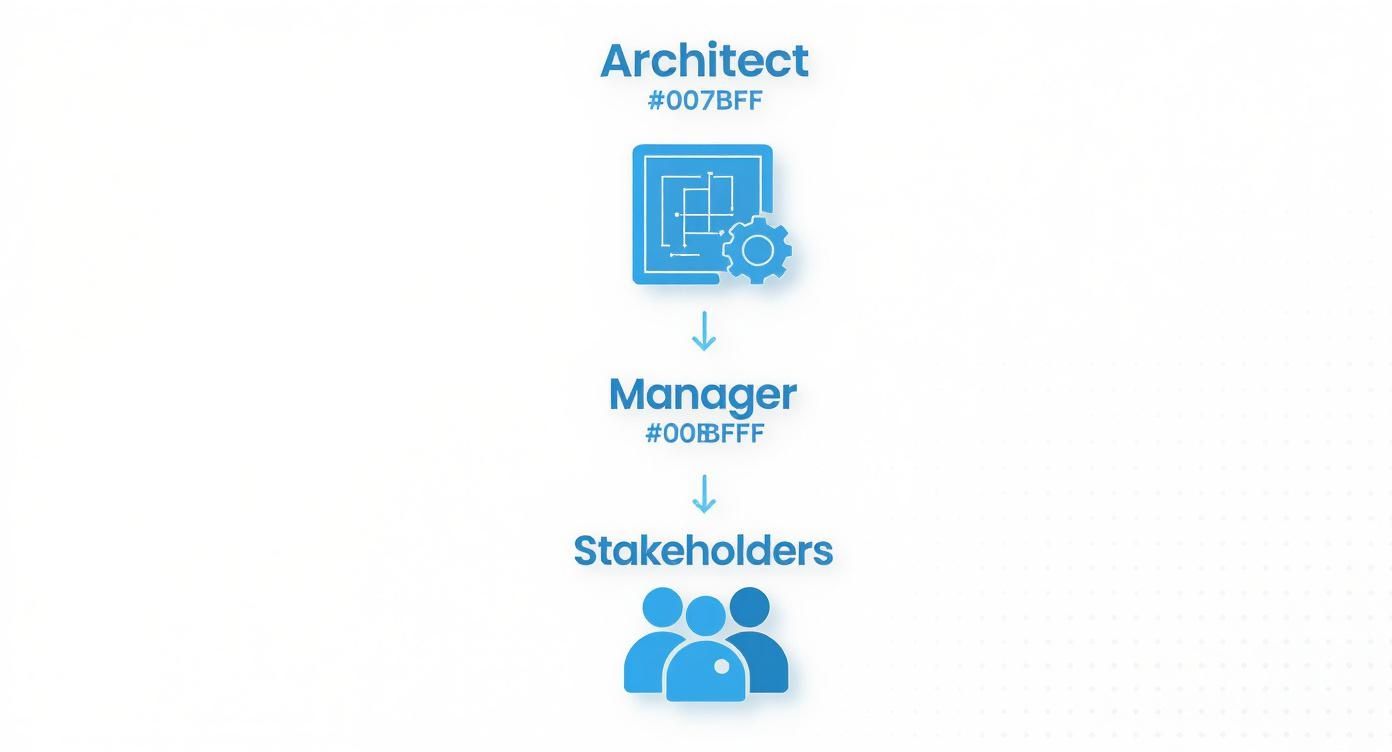
This illustrates that while the delivery team is focused on execution, their work is always guided by a broader business and technical vision.
Releasing with Confidence
Once the feature is coded and passes every automated and manual test, it's ready for the world. This is where the DevOps Engineer shines. They own the CI/CD pipeline—the automated highway that moves code from a developer’s laptop safely into the hands of users.
Because of their work, deploying the new PDF export feature isn't a stressful, all-hands-on-deck emergency. It's a button click. The new code goes live, and the DevOps engineer keeps an eye on the system to make sure everything is running smoothly. The stakeholder's idea is now a real feature, delivering value.
This entire lifecycle isn't a linear assembly line. It's a web of constant collaboration, feedback, and shared ownership. From idea to launch, the key is communication.
The RACI matrix is a great tool for mapping out who does what in this process. RACI stands for Responsible, Accountable, Consulted, and Informed. It clarifies expectations and prevents things from falling through the cracks.
Sample Agile RACI Matrix for a User Story Lifecycle
This chart breaks down the typical responsibilities for each role as a single feature moves from idea to deployment.
Activity/Task | Product Owner | Scrum Master | Developer | QA Engineer | UX Designer | Stakeholder |
|---|---|---|---|---|---|---|
Define Business Need | Accountable | Informed | Consulted | Consulted | Consulted | Responsible |
Write User Story & AC | Responsible | Consulted | Consulted | Consulted | Consulted | Informed |
Prioritize Backlog Item | Accountable | Informed | Informed | Informed | Informed | Consulted |
Create UI/UX Designs | Consulted | Informed | Consulted | Consulted | Responsible | Informed |
Develop the Feature | Consulted | Informed | Responsible | Consulted | Consulted | Informed |
Write & Run Test Cases | Consulted | Informed | Consulted | Responsible | Consulted | Informed |
Fix Bugs | Informed | Informed | Responsible | Consulted | Informed | Informed |
Accept the Story | Accountable | Informed | Informed | Consulted | Informed | Informed |
Deploy to Production | Informed | Informed | Responsible | Consulted | Informed | Informed |
Gather User Feedback | Responsible | Informed | Consulted | Consulted | Consulted | Consulted |
As you can see, most activities involve multiple "Consulted" or "Informed" parties. This reflects the highly collaborative nature of a true Agile team. It’s never just one person’s job.
Common Role-Based Pitfalls to Avoid
Defining roles is the easy part. The real challenge is making them stick. Even with a perfect org chart, teams can easily slip into bad habits—or "anti-patterns"—where the lines between roles get blurry and people start acting outside their intended function. These slip-ups are silent killers of productivity and morale, undoing the very agility you’re trying to build.
Spotting these issues early is everything. When role boundaries break down, you get friction, confusion, and a process that grinds to a halt. Fixing it isn't about blaming people; it's about getting back to the core Agile principles of clear ownership and genuine collaboration.
The Product Owner as a Project Manager
One of the most common traps is the Product Owner (PO) who thinks they're a traditional project manager. Instead of obsessing over the what and the why—the product vision—they get lost in the weeds of assigning tasks, chasing daily status updates, and micromanaging timelines. This completely breaks the Agile model.
When a PO turns into a taskmaster, the development team loses all sense of autonomy. They stop being creative problem-solvers and become order-takers, waiting for instructions. Meanwhile, the PO’s real job of talking to stakeholders and ensuring every feature delivers maximum value gets ignored. You risk building the wrong thing, just very efficiently.
A Product Owner’s job is to be the voice of the customer and the guardian of business value. When they start managing tasks, the team loses its strategic compass and becomes a feature factory, not a value-creation engine.
The Scrum Master as a Task Assigner
Here’s another classic mistake: the Scrum Master acts like a team lead, handing out assignments and telling developers how to do their work. A Scrum Master is a coach, a facilitator, a servant-leader—not a manager. Their entire purpose is to protect the process, clear roadblocks, and help the team learn to manage itself.
When a Scrum Master assigns tasks, they rob the team of its ownership. The power to decide how to tackle the work is fundamental to Agile. Take that away, and you get disengagement and resentment. The focus shifts from collaborative problem-solving to finger-pointing, which is the exact opposite of what you want. A great Scrum Master asks questions, guides conversations, and empowers the team to find its own solutions.
The Siloed Development Team
Developers are the heart of the engine, but they can easily fall into the trap of working in their own little bubble. This "silo" mentality is deadly. It’s what happens when an engineer hammers out their code and just "throws it over the wall" to QA without any real conversation or collaboration. This creates bottlenecks, tension, and a messy handoff that slows everything down.
Agile only works with constant communication. Developers are the core of software delivery—adoption among dev teams is expected to hit 86% by 2025 for a reason. Agile delivers results. In fact, 64% of companies say it drastically improves their ability to handle changing priorities. But you don't get those benefits if your developers aren't acting like part of a whole team, responsible for delivering a finished, high-quality feature, not just a chunk of code. You can see more on how companies are winning with Agile by reviewing these insightful statistics.
Getting these anti-patterns corrected is all about reinforcing the intent behind each role. It takes consistent coaching, honest retrospectives, and a real commitment from leadership to embrace Agile principles, not just go through the motions.
Navigating these team dynamics and finding talent that truly gets it can feel impossible. TekRecruiter specializes in sourcing the top 1% of engineers who aren't just brilliant coders but are also experts in true Agile collaboration. We help innovative companies deploy elite talent anywhere, so your team can sidestep these common pitfalls and perform at its absolute peak.
Build Your Elite Agile Team with TekRecruiter
Knowing the agile roles is one thing. Assembling a team of killers who live and breathe them is how you win. Let's be honest, hiring for an agile team has almost nothing to do with checking off technical skills on a resume. You're hunting for a specific mindset—problem-solvers who don't just tolerate but actually thrive on collaboration, constant communication, and a flood of feedback.
This is the single biggest hurdle for most leaders. Finding that perfect blend of hard and soft skills feels impossible. You can have a brilliant engineer, a true 10x coder, who can single-handedly sink a sprint if they can't collaborate. The entire agile system is built on shared ownership and tight iteration cycles, and that machine grinds to a halt without trust and psychological safety.
Look for a Collaborative Mindset, Not Just a Contributor
When you're screening candidates, dig into their experience of actually working with other humans. Ask them about a time they disagreed with a teammate. Ask how they handle getting tough feedback, or how they contribute when the goal isn't just about their individual piece of the puzzle.
The best agile players are natural collaborators. They see themselves as part of a whole, not just lone wolves racking up commits.
You're looking for signs of:
Active Listening: Are they actually processing what others say, or just waiting for their turn to talk? It's a huge difference.
Low Ego: Can they admit they were wrong? More importantly, can they pivot their entire approach based on new information from the team?
Proactive Communication: Do they instinctively share updates and context, or do you have to drag it out of them?
These aren't nice-to-haves. They're non-negotiable. A team of A-players with massive egos and poor collaboration will get smoked by a B-team that clicks together perfectly, every single time.
Prioritize Problem-Solving Over Specific Tool Knowledge
Tools change. Frameworks become obsolete. A candidate’s ability to learn, adapt, and think on their feet is infinitely more valuable than their current mastery of a specific platform. Agility is, by definition, about responding to change. Your team needs people who are wired to tackle problems they've never seen before.
The most valuable asset in an agile professional isn’t what they already know, but how they think. Their ability to decompose a complex problem, experiment with solutions, and learn from what breaks is what will actually drive your project forward.
Forget the technical pop quiz. In the interview, throw them a real-world problem your team has actually struggled with. Don't listen for the "right" answer, because there probably isn't one. Instead, watch their process. How do they break it down? What questions do they ask? How do they handle constraints you throw at them mid-conversation? That tells you more about their problem-solving horsepower than anything else.
Whether you’re augmenting your team with a couple of specialists or building a whole new squad from scratch, the stakes couldn't be higher. Getting the right people into the right roles is the only thing that separates sluggish, frustrating progress from accelerated delivery.
Assembling a world-class agile team is its own specialized skill. TekRecruiter lives and breathes this stuff, connecting companies with the top 1% of engineers who are pre-vetted not just for technical brilliance, but for the collaborative mindset that makes agile work. We help you deploy elite talent anywhere, making sure you have the right people in the right seats to make your vision a reality.
Contact us to build your dream team today.
A Few Lingering Questions on Agile Roles
Can One Person Fill Multiple Agile Roles?
You see this a lot, especially in smaller teams trying to be efficient, but mixing core roles is a classic anti-pattern. Think about having the same person act as both Product Owner and Scrum Master. It creates an immediate conflict of interest.
One role is laser-focused on the product vision (the what), pushing for more features and value. The other is dedicated to protecting the team's process and health (the how), ensuring a sustainable pace. They are designed to be a check and balance for one another. Combining them usually means one side suffers—and it's almost always the process.
So, Do Agile Teams Even Need a Project Manager?
In a pure Scrum setup, the traditional project manager role is intentionally left out. It’s not that the work disappears; it’s that the responsibilities get distributed across the team.
The Product Owner handles the backlog and priorities. The Scrum Master clears obstacles and coaches the team on the process. And the Developers manage their own work within the sprint. This is a deliberate shift away from top-down command-and-control and toward team empowerment and shared ownership.
How Should We Introduce New Roles to a Team?
Slowly and deliberately. The worst thing you can do is drop a new role into a team without context. Start by clearly defining the why—what problem this role solves and how it will help the team achieve its goals.
Run a trial period. This gives everyone, including the new person, a chance to adapt, give feedback, and tweak the interactions. The goal is to integrate them smoothly so they become a value-add from day one, not a disruption to an already humming workflow.
Assembling a team with crystal-clear roles in agile software development is how you move from just "doing Agile" to actually being agile. It's the bedrock of efficiency and real innovation. But let's be honest: finding the kind of talent that thrives in these roles is the real challenge.
That's where we come in. TekRecruiter is a premier technology staffing, recruiting, and AI Engineer firm that empowers innovative companies to build their dream teams. We specialize in sourcing and deploying the top 1% of engineers anywhere, ensuring you get the elite talent needed to accelerate your agile projects and dominate your market. Stop searching and start building.