Hiring Manager Roles and Responsibilities Explained
A complete guide to hiring manager roles and responsibilities. Learn the key skills, KPIs, and strategies for success in modern tech recruiting.
The hiring manager’s job boils down to one thing: strategically defining what the team needs and then owning the quality of every single person who walks through the door. They aren’t just a participant in the hiring process; they are the architect responsible for building the high-performing teams that actually drive the business forward.
The Architect Behind High-Performing Teams
Think of a great hiring manager as the master architect of a building. An architect doesn't just show up to a job site and start throwing bricks around. They create a detailed blueprint that serves a specific purpose, guarantees structural integrity, and fits into a much grander vision.
In the same way, a modern hiring manager doesn’t just fill an empty seat. They strategically design their team to crush current project demands while also anticipating future business goals.
This level of strategic ownership is a huge shift from the old way of doing things. Traditionally, the role was purely tactical—a manager would simply give a thumbs-up to a candidate HR sent their way. Today, that approach is a recipe for disaster. The speed of tech and the brutal competition for top talent demand a hands-on, strategic leader at the helm.
Shifting from Tactical to Strategic
The modern hiring manager's responsibilities have expanded because team building itself has fundamentally changed. Companies aren't just hiring to replace someone who left; they're building capacity for what's next. A recent survey found that 53% of HR hiring managers pointed to company growth as the main reason for staffing up, followed by new projects and the chance to snag available skilled talent. This is a proactive, forward-thinking approach to bringing people on board. You can dive deeper into the latest hiring trends with research from Robert Half.
The most effective hiring managers get it: hiring isn't an admin task you can just delegate. It's a core leadership function, every bit as critical as product development or financial planning.
Adopting this mindset transforms the hiring process from a reactive chore into a massive competitive advantage.
Traditional vs Modern Hiring Manager Responsibilities
The table below breaks down exactly how this evolution from tactical gatekeeper to strategic owner plays out in their day-to-day responsibilities. It’s a move from passively approving to actively building.
Area of Responsibility | Traditional Focus (Tactical) | Modern Focus (Strategic) |
|---|---|---|
Role Definition | Approves a generic job description provided by HR. | Collaborates to write a compelling job description that attracts top-tier talent. |
Sourcing | Waits for recruiters to present a shortlist of candidates. | Actively networks and builds a talent pipeline before a role is even open. |
Interviewing | Asks standard questions and assesses technical skills. | Conducts structured interviews to evaluate skills, culture fit, and future potential. |
Decision Making | Relies on "gut feeling" or a single strong interview. | Uses data and a consistent evaluation framework for unbiased decisions. |
Onboarding | Leaves the onboarding process entirely to the HR department. | Owns the new hire's first 90 days to ensure rapid integration and success. |
Mastering these modern responsibilities is non-negotiable, especially when you’re building specialized teams that need to execute from day one.
When you're ready to find the top 1% of engineers to architect your company's future, TekRecruiter provides the specialized staffing and recruiting expertise to make it happen.
Mastering the Modern Hiring Lifecycle
The best hiring managers I know don't see recruitment as a checklist of separate tasks. They see it as a complete cycle they own from start to finish. Each stage, from spotting a team gap to welcoming a new hire, is a chance to make the team stronger. Skimp on any part of that cycle, and you end up with wasted time, bad hires, and people walking out the door a few months later.
Success starts long before you ever see a resume. A hiring manager’s real first job is to turn a vague "we need someone" into a crystal-clear, compelling role. This isn't about grabbing a generic template; it's about defining the actual skills, performance goals, and impact the position will have.
This upfront strategic work is completely non-negotiable. If you don’t clearly define what you need and what success looks like, the whole process is doomed from the start. You'll attract candidates who look great on paper but are totally wrong for what the team actually needs to accomplish.
This is all about evolving from a tactical participant into a strategic owner of the hiring process. When you make that shift, high-performing teams are the natural result.
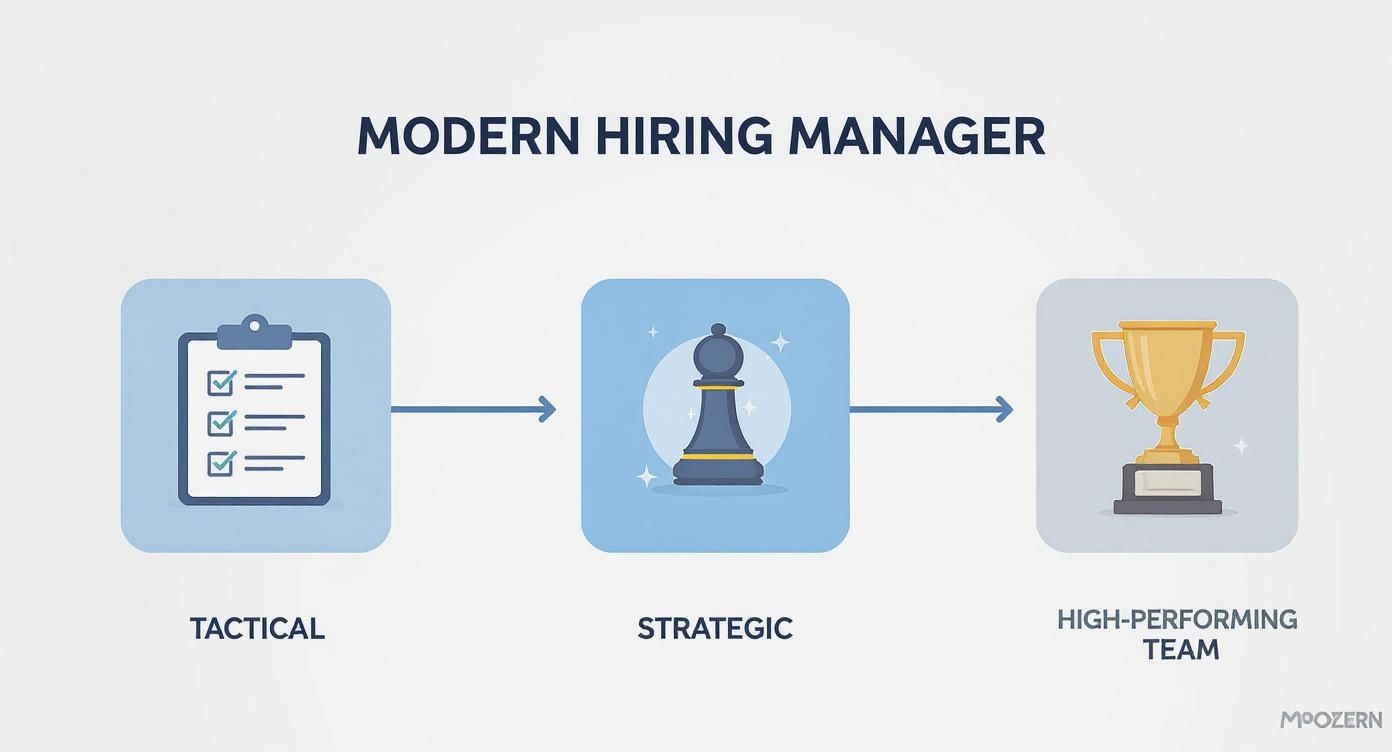
The key takeaway here is simple: lasting team success is a direct result of a hiring manager’s commitment to strategic, forward-thinking recruitment.
From Sourcing to Screening
Once the role is locked in, the game shifts to building a solid talent pipeline. Great hiring managers don't just sit back and wait for a recruiter to drop a shortlist on their desk. They get in the game, tapping their own professional networks and giving recruiters the kind of context they could never get from a job description alone.
As applications roll in, the hiring manager's involvement is what keeps things moving. You have to give timely, specific feedback on resumes and initial screens. This helps the talent team zero in on the right profiles and keeps the whole process from stalling out.
A slow or disengaged hiring manager is one of the biggest reasons top candidates drop out. Quick, decisive feedback shows you respect their time and keeps the momentum going.
This hands-on approach ensures only the most relevant candidates make it through, saving everyone a ton of time and energy down the line.
Conducting Interviews and Making the Offer
The interview stage is where a hiring manager really earns their keep. The goal isn't just to grill someone on their technical skills. It's about having structured, insightful conversations to see how they solve problems, how they’ll vibe with the team, and what their potential looks like. This is the heart of the hiring manager's responsibilities.
During this phase, your key duties include:
Preparing Structured Questions: Craft questions tied directly to the job requirements and company values. This ensures you’re evaluating every candidate against the same fair and consistent yardstick.
Leading the Interview Panel: Make sure every interviewer is on the same page about what to look for and how to get the information needed for a smart decision.
Assessing Culture Fit and Add: Look beyond raw skills. Will this person complement and elevate the existing team dynamic?
After the interviews, the hiring manager runs the debrief, pushing the team to make a decision based on evidence, not just "gut feelings." When you've picked your person, you're the one who crafts a compelling offer and often makes the personal call that seals the deal.
For niche roles, having a dialed-in process is make-or-break. You can check out a detailed framework in The Ultimate Guide to Recruiting and Hiring Software Engineers.
Owning Onboarding and Integration
A hiring manager’s job isn't over when the offer is signed. In fact, one of the most overlooked responsibilities is owning the onboarding process. A great onboarding experience is what turns a promising new hire into a productive, long-term cornerstone of your team.
This is about more than just a hand-off to HR. The hiring manager has to:
Set Clear Expectations: Define what success looks like in the first 30, 60, and 90 days. Give them clear goals and a path to some early wins.
Facilitate Integration: Personally introduce the new hire to key team members and stakeholders. Help them build those initial relationships and get a feel for the team's real culture.
Provide Continuous Support: Schedule regular check-ins. Offer mentorship and constructive feedback to make sure they feel supported and are on a clear path to success.
By mastering every stage of this lifecycle, a hiring manager turns recruiting from an administrative chore into their most powerful tool for building and leading an incredible team.
Building a Powerful Recruiting Partnership

Even the best hiring manager can’t build an elite team in a vacuum. Modern hiring is a team sport, demanding a real alliance between the manager, the internal talent acquisition team, and, quite often, specialized external partners. Success depends on moving this relationship beyond a simple handoff into a true strategic partnership.
This alliance is built on shared goals, mutual respect, and constant, open communication. The recruiter brings market intelligence and sourcing expertise to the table; the hiring manager provides the deep technical and cultural context. When those two perspectives click, the whole hiring process gets faster, smarter, and far more likely to land the right person.
Fueling the Partnership with Clear Communication
The single most important thing a hiring manager does in this alliance is deliver an exceptional brief. A standard job description just won’t cut it. A great partnership kicks off with a detailed meeting where the manager explains all the unspoken nuances of the role.
What are the team’s current roadblocks? What specific impact must this new hire make in their first six months? What are the soft skills that really determine who thrives in this specific team dynamic? Think of it as giving your recruiter a high-resolution picture of your ideal candidate, not just a blurry sketch.
That clarity has to continue. When you’re reviewing candidates, vague feedback like “not a fit” is useless. Get specific and constructive: “Their Python skills are solid, but they didn’t have experience with large-scale data pipelines, which is a core need for this project.” Feedback like this is a calibration tool—it helps the recruiter zero in on the target and bring you stronger candidates every time.
A strong recruiting partnership is a feedback loop, not a one-way street. The more specific and timely the feedback from the hiring manager, the more targeted and effective the recruiter's search becomes.
Leveraging Specialized Staffing Firms for an Edge
For highly specialized or tough-to-fill tech roles, even the best internal talent teams can hit a wall. This is where partnering with an external staffing firm becomes a strategic advantage, not a last resort. These firms have dedicated networks and deep expertise in niche domains—like AI engineering or cybersecurity—that an internal team might not have.
When you’re looking at external partners, you have to find a firm that gets the specific demands of your industry. To learn more about what to look for, check out our guide on how to find the best IT staffing services.
These partnerships give you a few key advantages:
Accelerated Speed: Specialized recruiters can tap into passive candidate pools and get qualified people in front of you much faster.
Access to Global Talent: Firms with international reach can connect you with top-tier nearshore talent, opening up your options way beyond local markets.
Market Intelligence: They offer real-time data on salary benchmarks, competing offers, and talent availability, giving you a serious competitive edge.
By treating recruiters—both internal and external—as genuine partners, a hiring manager multiplies their own effectiveness. This collaborative approach is fundamental to one of the most important hiring manager roles and responsibilities: building a talent pipeline that can actually sustain long-term growth and innovation.
Ultimately, building a world-class engineering team requires more than just a great process; it demands the right partners. TekRecruiter specializes in deploying the top 1% of engineers from a global talent pool, connecting innovative companies with the exact skills needed to win. Let us be the expert partner that helps you build your future.
The Skills That Define an Elite Hiring Manager
Technical chops on a team are table stakes. But it’s the refined soft skills that separate a passable hiring manager from a truly elite one. The best managers know their job is way more than just ticking boxes on a resume. They’re strategic thinkers, incredible communicators, and unbiased decision-makers who build an experience that pulls in—and keeps—top talent.
These skills aren’t just "nice-to-haves." They're core competencies that directly shape team performance and company culture. When a manager gets these right, the hiring process stops being a chore and becomes a powerful strategic advantage. This is where the real work begins.
Strategic Workforce Planning
Elite hiring managers are always playing chess, not checkers. They don't just fill the role that's open today; they're already forecasting the skills their team will need six, twelve, even eighteen months from now. This means they have a bone-deep understanding of the product roadmap, the company's big-picture goals, and where the industry is headed.
This foresight lets them build a proactive talent pipeline. So, instead of scrambling when a key person leaves or a new project spins up, they’ve already got a shortlist of people they’ve been building relationships with. That’s what strategic workforce planning is all about—making sure the team is always ready for what's next.
Razor-Sharp Interviewing and Assessment
A great hiring manager runs an interview like a skilled conductor leads an orchestra. Every single question has a purpose. It's designed to dig deeper than what a candidate knows and uncover how they think, solve real problems, and work with others. They ditch the generic, tired questions and create scenarios that reveal a candidate’s true abilities under pressure.
This means building structured interviews that evaluate everyone against the same core competencies, fairly and consistently. It also means training the entire interview loop to hunt for specific evidence, not just run on gut feelings. For technical roles, this might involve practical, hands-on assessments. For more on that, check out these methods for assessing programming skills with online coding tests.
Championing Unbiased and Inclusive Hiring
Without a doubt, one of the most critical hiring manager roles and responsibilities is to be a champion for diversity, equity, and inclusion (DEI). This isn’t about hitting quotas. It’s about building a stronger, more creative, and more resilient team by bringing different perspectives and life experiences to the table.
An elite manager is actively working to root out unconscious bias from the process. They do this by:
Standardizing Criteria: Making sure every single candidate is measured against the same objective, skill-based standards.
Diversifying Panels: Putting together interview panels with people from different backgrounds, roles, and viewpoints.
Focusing on Skills: Prioritizing what a candidate can actually do over where they went to school or what company names are on their resume.
The role of the hiring manager has shifted dramatically. They are now central figures in shaping the employee experience, driving organizational culture, and championing retention. This is reflected in recent data, where 85% of talent acquisition leaders now prioritize diversity hiring as a key business objective.
This focus is part of a bigger trend. Today, 57% of recruiters’ strategies have shifted from pure acquisition to include retention and engagement. That puts the responsibility squarely on hiring managers to build an inclusive culture from the very first conversation. You can discover more insights about these recruiting statistics and how they're changing modern hiring.
Building world-class engineering teams requires a partner who gets these nuances. TekRecruiter connects innovative companies with the top 1% of engineers globally, helping you build a diverse, high-performing team that drives results.
How to Measure Hiring Success with KPIs
Great hiring isn't about gut feelings or just getting lucky. It’s a data-informed science. To really understand their impact, a hiring manager has to move beyond simply counting new hires and start measuring success with specific key performance indicators (KPIs).
Think of these metrics as the scoreboard for your entire recruiting process. They tell you what’s working, what’s broken, and where you need to focus your efforts. Tracking KPIs turns hiring from a reactive, administrative task into a strategic part of the business, giving you a clear, objective way to talk about effectiveness with leadership and justify the resources you need.
Core Hiring Funnel Metrics
First, let's look at the foundational KPIs. These are all about the efficiency and speed of the hiring process itself. They help you pinpoint bottlenecks and show you where you can build a better, more candidate-friendly experience. Consider them the essential health check for your recruitment engine.
Time-to-Fill: This is the big one—the total number of days from when a job req is approved to when a candidate signs on the dotted line. A long Time-to-Fill means lost productivity and could be a red flag that your sourcing or interview process is dragging its feet.
Cost-per-Hire: This metric adds up every dollar you invested to get that new hire, including recruiter fees, ad spend, and tech subscriptions. To be successful, hiring managers must implement strategies to reduce recruitment cost per hire and make every penny count.
Offer Acceptance Rate: Calculated as the percentage of offers you extend that get accepted, this KPI is a direct reflection of your candidate experience, how competitive your compensation is, and your ability to sell the role and the company's vision.
Measuring the Ultimate Goal: Quality of Hire
While speed and cost matter, the most critical KPI in the entire hiring game is Quality of Hire. This metric answers the ultimate question: did we hire the right person? It measures a new employee's actual contribution to the company's long-term success.
Quality of Hire is the true north of recruiting. It links hiring decisions directly to business outcomes, proving that great recruiting isn't a cost center—it's a value creator.
Tracking this is a bit more complex, but it usually involves a mix of factors you assess over the new hire's first year:
New Hire Performance: How are they doing? You can measure this through performance reviews at the 90-day or one-year mark. Is the new employee meeting or crushing the expectations set for the role?
Retention Rate: Are they sticking around? Tracking how many new hires are still with the company after one or two years is key. High turnover among new folks often points to a mismatch somewhere in the hiring process.
The pressure is on. The average time-to-fill for high-demand tech roles has climbed to 44 days, and the average cost-per-hire is $4,700. These numbers show just how much time and money are on the line. With 45% of employers struggling to find qualified candidates, you have to find that sweet spot between speed and quality.
To build an elite engineering team that consistently delivers on quality, you need a partner who gets the stakes. TekRecruiter is a technology staffing and recruiting firm that specializes in helping innovative companies deploy the top 1% of engineers, anywhere. Let us help you turn your hiring process into a strategic advantage.
Using Technology And AI To Hire Smarter

The recruitment game is being completely reshaped by technology, and the sharpest hiring managers are using it to build a serious competitive advantage. The goal isn't to replace your intuition or judgment. It’s to supercharge it.
Think of these tools as the world’s best assistant. Instead of burning hours manually scheduling interviews across three different time zones, you let automation handle it in seconds. This frees you up to focus on what actually matters: digging into a candidate’s experience, asking the right questions, and making a connection.
Supercharging The Hiring Process
Modern tools, particularly those running on AI, can inject serious horsepower into almost every part of the hiring cycle. By putting this tech to work, hiring managers can build stronger teams, faster.
Here are a few areas where the right tools make a massive difference:
Smarter Sourcing: AI platforms can scan huge talent pools to pinpoint best-fit candidates who aren't even looking for a job. This expands your reach way beyond the usual job boards.
Reducing Unconscious Bias: Some tools can be set up to hide names and other identifying details on resumes, forcing a focus on skills and experience alone. This helps level the playing field.
Effective Skill Assessment: Forget guessing from a resume. Automated coding challenges or simulated projects give you hard data on what a candidate can actually do.
Technology is an enabler, not a replacement. The best hiring managers use it to kill administrative friction and get better data so they can double down on the human side of building a great team.
Maintaining A Human-Centric Approach
While the advantages are huge, you can't let technology strip the humanity out of your process. No candidate wants to feel like just another number spat out by an algorithm. Smart integration means using tools to make communication better and more consistent, not to eliminate it entirely.
A solid grasp of AI in recruiting—what it’s good at and where it falls short—is non-negotiable for any manager looking to get this right. For a deeper dive, our guide on the power of recruiting AI breaks it all down.
By thoughtfully weaving technology into your workflow, you create a process that's more efficient, fair, and engaging for everyone involved. This strategic approach is a core part of modern hiring manager roles and responsibilities and is key to building elite teams at scale.
When you're ready to combine smart technology with expert human insight to find those top-tier engineers, TekRecruiter is your partner. We specialize in placing the top 1% of tech talent, giving your company the firepower it needs to build what's next.
Build Your Elite Engineering Team Today
Mastering the modern hiring manager role isn't just about filling seats; it's about architecting the teams that innovate, execute, and win. From defining a role with strategic precision to owning the entire hiring lifecycle, every step is a chance to build a competitive advantage. But in the high-stakes world of technology and AI, even the best managers need a specialist partner to secure elite talent.
Ready to stop searching and start building? TekRecruiter is a technology staffing and recruiting and AI Engineer firm that allows innovative companies to deploy the top 1% of engineers anywhere. Learn how we can build your team today.
 Ron SmithPresident & Lead RecruiterTekRecruiter