_edited.png)
Revolutionize Recruitment in Engineering for Top Teams
Recruiting engineers isn’t just filling seats on your team—it’s about reading the market’s pulse. When you know exactly where skills are scarce and how pay packages have shifted, you step ahead of the pack.
Exploring Engineering Talent Dynamics

Right now, demand for niche engineering chops far outpaces what talent pools can deliver. Teams powering large-scale projects in oil, infrastructure and green energy are rethinking rigid job specs just to cast a wider net.
Skills gaps are widening faster than hiring funnels can refill.
Salary expectations jumped 15% year-over-year in rising tech hotspots.
Leading companies are dropping strict degree rules to attract more candidates.
Skill Gaps And Project Pressures
In one Texas renewable energy rollout, we saw 200 pipeline engineer slots remain unfilled despite premium offers. It forced our team to double down on local labor forecasts and real-time market data.
Global figures back this up: the UK faces a shortage of 37,000–59,000 engineers annually, while U.S. demand is set to climb 13% by 2031. Read the full research about engineering labor markets (https://energipeople.com/engineering-talent-market-update-2025-2/).
Key Takeaway Forecasting talent shortages keeps your projects from stalling.
Benchmarking Compensation And Targets
Offering packages that mirror industry standards cuts out a lot of back-and-forth. We lean on quarterly market surveys and regular candidate feedback to calibrate our budgets.
Analyze local salary surveys for each critical role
Set budgets anchored in competitor data
Monitor offer-acceptance rates and tweak as needed
In Warsaw, for example, full-stack engineer pay climbed 25% year-over-year as startups battled for the same folks.
Read also: Explore high-paying tech jobs in demand roles for 2024 to see which positions command top salaries.
Forecasting Regional Demand
The best talent strategies blend public labor stats with your own dashboards. By modeling six-month talent shortages, you keep your pipeline flowing.
Track monthly time-to-fill metrics
Watch withdrawal rates post-offer
Update job descriptions to highlight flexible skills
Hubs like Bangalore and São Paulo are seeing rapid growth in AI and cloud positions, so having an agile hiring plan gives you a real edge.
Insight Mapping salary ranges region by region uncovers where competitors are overbidding.
Once you understand each market’s hiring rhythm, your roadmap becomes far more realistic. And with those insights, your engineering recruitment stays one step ahead.
Ready to tap into global engineering expertise? Get in touch with TekRecruiter and deploy seasoned professionals exactly where you need them—fast.
Define Your Recruitment Strategy and Hiring Models
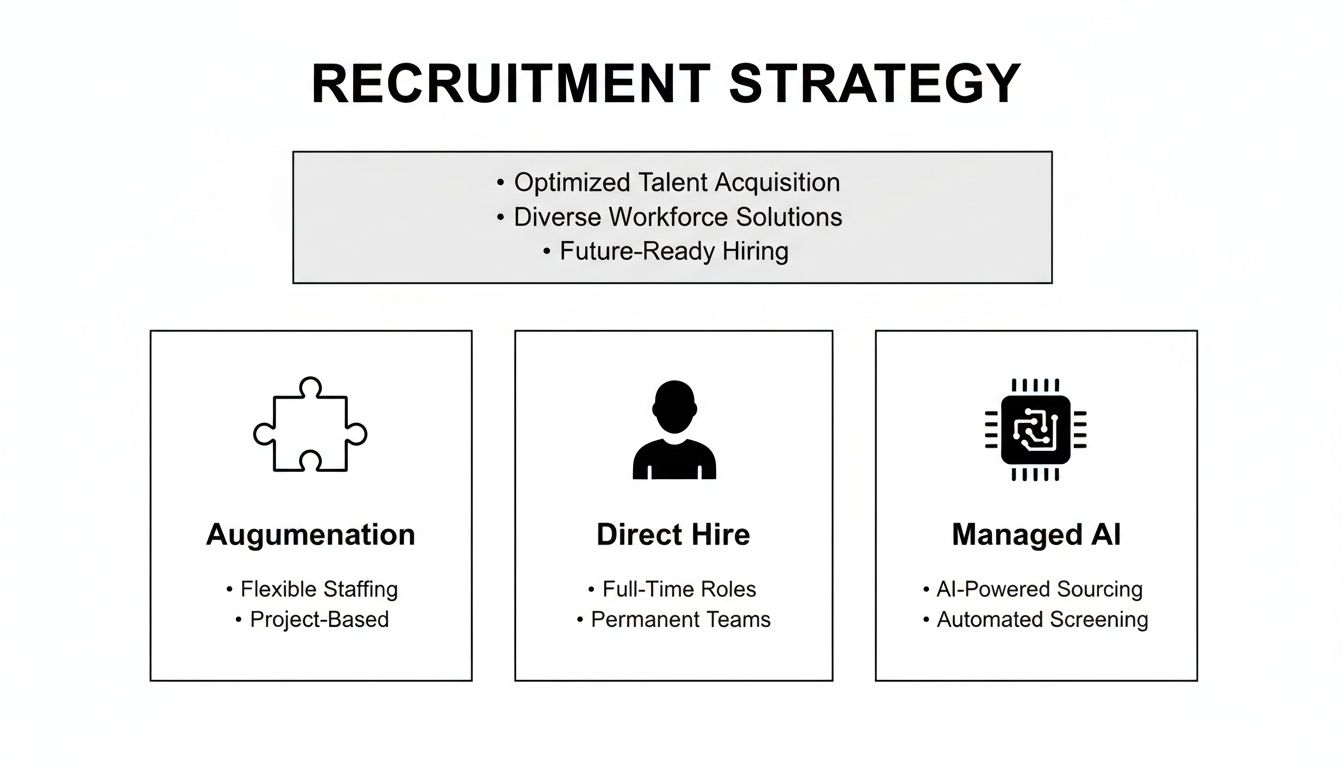
Selecting the right hiring model can make or break your project timeline. A clear roadmap helps teams choose between staff augmentation, direct hire, or managed AI teams, matching your approach to scope, budget, and deadlines.
Talent mobility matters when 25% of today’s engineering workforce will retire within ten years and demand in AI, semiconductor, and cybersecurity remains intense. Discover more insights about engineering hiring trends in 2025 on hirecruiting.com
Hiring Models Explained
Every project comes with its own set of goals and constraints. Here’s how three popular models stack up:
Staff Augmentation plugs pre-vetted engineers into your existing team, perfect when deadlines loom and you need specialized skills fast.
Direct Hire builds a dedicated core team, fostering deep institutional knowledge and loyalty.
Managed AI Teams hand off complete AI development to a specialized provider, accelerating milestones without adding headcount.
Model | Speed To Fill | Team Cohesion |
|---|---|---|
Staff Augmentation | Fast | Medium |
Direct Hire | Medium | High |
Managed AI Teams | Fast | Variable |
An AI-focused startup we teamed up with rolled out an image recognition feature in just six weeks. By tapping into specialists who slid straight into their workflows, they hit every sprint without missing a beat.
“Matching project pace with flexible engagement is crucial for startups and enterprises alike.”– Senior AI Leader
Geographic Staffing Options
Onshore talent simplifies communication but comes with premium rates.
Nearshore teams offer 20–30% savings, cultural alignment, and similar time zones.
Offshore groups drive cost efficiency but demand robust compliance and quality safeguards.
Mapping workflows, time-zone overlaps, and legal requirements upfront keeps everyone on the same page. Integrating AI-driven sourcing tools supercharges screening—skill tags sync with job specs in seconds, automated scoring cuts bias, and top matches rise to the top.
Key Takeaway Choosing a hiring model and geography in tandem creates a balanced talent strategy.
Compliance And Workflow
Regulations shift by region and sector. Building compliance checks into your recruitment flow avoids legal hurdles and protects data privacy.
For instance, GDPR governs hires in Europe, while CCPA applies to California-based employees.
Infrastructure Firm Example
A major telecom provider tapped managed AI teams to deploy predictive maintenance tools in under three months. This tactic slashed internal hiring cycles by 40%, freeing up budget for R&D and innovation.
Check out our guide on staff augmentation vs outsourcing which model fits you to select the best engagement type.
Use TekRecruiter’s expertise to deploy the top 1% of engineering talent worldwide—so you can hit every milestone without overhauling your internal processes.
Build Sourcing Pipelines With Nearshore And Global Options
Putting together a varied talent pipeline is crucial for any engineering team. By blending nearshore hubs with broader global networks, you avoid putting all your eggs in one basket. It also keeps fresh candidates flowing in, even when one region slows down.
Working with talent in Latin America, Southern Europe or India means getting comfortable with different cultures, visa processes and time‐zone quirks. Pair that know-how with an AI sourcing platform, and you’ve effectively added a proactive teammate who never clocks out.
A real proof point: a São Paulo‐based fintech brought on two nearshore partners and saw qualified leads climb by 40% in just two months.
Engaging Passive Candidates
Reaching out to engineers who aren’t actively job-hunting demands a human touch. Generic emails won’t cut it—you need to show you understand their work and what motivates them.
Reference a recent open-source contribution or GitHub repo to catch their eye.
Mention real challenges, like scaling cloud infrastructure or fine-tuning machine-learning models.
Suggest a short screening call or a virtual coffee to keep scheduling easy.
“Personalization boosted our response rate from 5% to 18% in two months.”
Small touches like these build rapport long before the formal interview process starts.
Tracking Pipeline Health
Catching bottlenecks early lets you course-correct before roles stay open too long. A simple dashboard can highlight drop-off points—from that initial email open to offer acceptance.
Here’s a side-by-side look at how onshore, nearshore and offshore pipelines stack up:
Comparison of Onshore Nearshore and Offshore Sourcing
Pipeline Type | Key Advantages | Key Challenges | Ideal Use Cases |
|---|---|---|---|
Onshore | Easiest communication | Highest hourly rates | Fast turnarounds on local projects |
Nearshore | 20–30% cost savings, shared zones | Smaller talent pool per region | Continuous agile roadmaps |
Offshore | Maximum cost efficiency | Time-zone gaps, compliance complexities | Large-scale backend development |
Evaluating each option against your budget and timeline helps pinpoint the right mix for your team.
Optimizing Communication Across Zones
When your people span three continents, overlap windows become your best friend. A few smart tweaks ensure no one ever feels left out.
Block out core hours that touch at least two regions.
Use asynchronous channels like shared wikis and chat threads for updates.
Rotate stand-up times monthly so every hub has its moment in the spotlight.
Document your overlaps, then refine meeting cadences to keep communication smooth.
This AI-driven dashboard shows real-time metrics across regions. Notice how nearshore response rates often top 85%, while offshore time-to-interview can drop by 20%.
Recruiters today lean on skills-based hiring and AI-augmented sourcing to slash time-to-fill—but that also means navigating tougher salary negotiations and offer-acceptance hurdles in a candidate-driven market. Learn more about top engineering recruiting trends for 2025.
Check out our guide on unlocking tech hiring success with nearshore staffing for deeper insights.
TekRecruiter specializes in connecting cutting-edge companies with the top 1% of engineering talent worldwide. Rely on our global sourcing expertise to build resilient pipelines and speed up your hiring cycles.
Craft Effective Technical Assessments and Interviews
When your assessment mirrors the work your team actually does, you get a clear view into a candidate’s real abilities. Puzzle-style questions can be fun, but they rarely translate to day-one productivity.
Align exercises with active product modules to test true on-the-job readiness.
Apply realistic time limits to see how candidates handle pressure and prioritize.
Include a live code review session to evaluate maintainability and commenting style.
Design Coding Exercises
Pick challenges that match your stack and conventions. If you run a Scala-based data pipeline, have engineers troubleshoot a small job in that environment.
Cloning a short repo, diagnosing a bug, and adding a feature not only tests syntax knowledge but also yields a talking point during the interview.
Case Study: AI Engineering Quiz
I once worked with a client who needed strong Python talent. We built a Jupyter notebook scenario simulating a data pipeline failure.
Simulated missing data loads to force fallback logic.
45 min timebox kept things focused and brisk.
As a result, top-performer response times dropped by 30%, and we zoomed in on the strongest candidates quickly.
Build System Design Tasks
Architectural problems reveal an engineer’s big-picture thinking. Ask candidates to draft a cloud deployment diagram for your microservices or sketch out an API contract.
Limit each design slot to 30 min to spark a deep trade-off discussion.
Challenge them on scaling: caching vs. sharding, single-region vs. multi-region.
For embedded roles, spin up a virtual lab and ask for a C routine handling interrupts and I/O.
Task Type | Time Estimate | Skills Evaluated |
|---|---|---|
Microservice Build | 60 min | Coding, API Design |
Database Schema | 45 min | Data Modeling, SQL |
Cloud Architecture | 30 min | Scalability, Networking |
A good design task surfaces how a candidate reasons about trade-offs in real systems.
Use Standardized Rubrics
A clear rubric is your strongest guardrail against bias. Lay out specific criteria so every interviewer knows exactly what to look for:
Correctness & edge-case handling
Readability & style adherence
Test Coverage & level of automation
Communication throughout the walkthrough
Pull together a balanced panel—mix senior engineers, peers, and a hiring manager. And don’t let candidates hang: deliver feedback within 48 hours to keep momentum on your side.
Learn more about assessing programming skills with an online coding test in our 2023 guide: Assess Programming Skills with Online Coding Test in 2023.
Partner with TekRecruiter today to craft rigorous technical interviews that surface true expertise and keep your talent pipeline flowing.TekRecruiter is a technology staffing and recruiting and AI Engineer firm that allows innovative companies to deploy the top 1% of engineers anywhere.
Improve Onboarding Retention And Employer Branding

A strong onboarding starts with thoughtful rituals, not paperwork. From the moment an engineer accepts the offer, you’re shaping their sense of belonging and purpose.
Kick things off before Day 1 with a preboarding package: login details, a team mission summary, and a quick intro video. Pair each newcomer with a mentor for weekly check-ins, code walkthroughs, and shadow sessions. Then, lock in 30-60-90 day feedback loops to celebrate wins, tackle challenges, and map out next steps.
Preboarding Emails: Send team goals, access links, and a short welcome clip.
Mentorship Pairing: Match new hires with senior engineers for hands-on support.
Feedback Milestones: Schedule reviews at 1, 2, and 3 months to keep growth on track.
“An inclusive onboarding journey boosts retention by 82%.”
Preboarding And Mentorship Pairings
First-week jitters are real. One fintech client slashed time-to-productivity by 30% after building a shared onboarding wiki and buddy system. Clear guidebooks and a go-to mentor make that first sprint far less daunting.
Stage | Focus |
|---|---|
Onboarding Week | Team Introductions |
Month One | Project Ownership |
Month Three | Career Path Planning |
Spotlight Career Growth And Recognition
Showcasing engineers’ work pays dividends. A cloud startup we advised ran weekly “spotlight” posts, lifting referrals by 25%. Public shout-outs in all-hands meetings or Slack channels fuel motivation and pride.
Early Turnover Signals: Flag pulse survey scores under 3.5 for a quick check-in.
Career Path Planning: Draft 1-year and 3-year roadmaps in Q1.
Peer Recognition: Host shout-out sessions to celebrate everyday wins.
Tracking retention metrics early can preempt churn:
Internal Mobility Paths: Use skills matrices to plot role switches within six months.
Frequent Pulse Surveys: Gather feedback biweekly to spot misfits before they grow.
Peer-To-Peer Incentives: Launch micro-bonuses for creative problem solving and teamwork.
Your employer brand lives in every story you tell. Share your tech stack, customer case studies, and employee testimonials on the careers page. Consistent, honest storytelling turns employees into brand ambassadors.
Measure And Iterate With KPI Insights
Data shines a light on what’s working. Track time-to-productivity by counting days until a first solo code commit. Blend that with quality-of-hire scores at 90 days and offer acceptance rates to refine your approach. A SaaS leader we support lifted 12-month retention by 18% after acting on these insights.
Time-To-Productivity: Days until the first independent commit.
Quality-Of-Hire Score: Aggregate peer reviews at 90 days.
Offer Acceptance Rate: Accepted offers versus total extended.
“Strong employer branding cuts cost-per-hire by 50%, according to employers.”
Milestone rewards—training stipends or conference passes—reinforce a growth mindset. Quick peer check-ins in the first 30 days can flag any concerns before they escalate.
“Building belonging takes deliberate rituals, not chance.”
Building a cohesive engineering team is more than filling seats—it’s about crafting an experience that resonates. TekRecruiter helps you design every touchpoint, connecting you with the top 1% of engineers worldwide. Start shaping your employer brand and retention strategy at TekRecruiter.
Measure Recruitment Success With KPIs And Continuous Improvement
Recruiting engineers without clear metrics feels like flying blind. When you track Time-to-Fill, Quality-of-Hire, Offer Acceptance Rate, and Retention, data turns into your secret weapon.
Gather those figures early and patterns become obvious. You’ll spot where candidates stall, which stages drag on, and what tweaks drive real impact.
• Time-to-Fill: Days between posting and a signed offer• Quality-of-Hire: Performance ratings at the 90-day mark• Offer Acceptance Rate: Ratio of accepted offers to those extended• Retention Rate: Percentage of hires who stay past your benchmark
By feeding these numbers into live dashboards, you get a pulse on your process. One manufacturing software team I mentor cut their cycle by 30% simply by removing redundant interview rounds.
Interactive charts let you slice data by role, region or recruiter. That way, you immediately know if a channel is underperforming or if an assessment needs a refresh.
Visualize KPIs With Dashboards
Connect your ATS to a BI tool or a polished spreadsheet template
Match each KPI to the right visualization—bar charts for volume, heatmaps for regional performance
Automate daily or weekly updates so you’re always looking at fresh insights
Key TakeawayData-driven dashboards align recruiters fast and keep cycle times in check.
Test Sourcing And Assessment Tactics
Real A/B tests expose your top performers. Tweak job titles, adjust messaging or compare two sourcing channels side by side. In my experience, these experiments boost responses by over 20%.
Pick two channels or description variants
Run them simultaneously with equal budgets
Compare application volume and offer acceptance
Channel | Application Rate | Offer Acceptance |
|---|---|---|
12% | 75% | |
GitHub Career | 18% | 82% |
Job Boards | 10% | 68% |
A fintech startup I advise shifted budget to GitHub Career and saw a 15% jump in quality-of-hire within weeks.
InsightRegular A/B testing sharpens your focus on what really drives successful engineering hires.
When a metric dips below your threshold, act immediately. Maybe that means cutting an interview loop, refining assessment rubrics or trialing a new sourcing channel. Small, continuous tweaks stack up over time—showing stakeholders real recruiting ROI and powering your hiring engine forward.
TekRecruiter specializes in tech staffing and AI engineering. Book a KPI health check to benchmark your current metrics and uncover quick wins.
Contact TekRecruiter at link to kick off your data-driven hiring journey immediately.
Frequently Asked Questions
Q1 What hiring model suits fast-growing startups? Staff augmentation brings on experts fast—you fill gaps immediately. Alternatively, direct hires become your project’s backbone, driving long-term vision and accountability.
Q2 How can teams build global pipelines cost-effectively? A mix of nearshore hubs in Latin America paired with AI-driven sourcing and vetted local partners keeps costs down while maintaining a steady talent stream.
Q3 Fair And Predictive AssessmentsNearly all my teams have cut bias and improved match rates by using structured scoring rubrics, live simulation tasks, and panels spanning engineering, product, and design.
Q4 Retention In Remote TeamsRetention climbs when you treat culture as a living thing—weekly rituals, transparent career paths, and pulse surveys that actually drive change.
These answers tackle common hiring hurdles head-on. You’ll still want to adapt each tactic to your tech stack, time zones, and compliance requirements to keep your recruitment process both agile and effective.
When To Use These Answers
Any high-velocity project can lean on this playbook. If you’re wrestling with niche compliance needs or specialized roles, run a quick pilot to validate the best approach before scaling.
Here’s a simple pilot framework:
Time-to-Fill: Measure how fast roles close versus your usual pace.
Candidate Satisfaction: Survey applicants on process clarity and responsiveness.
Hiring Manager Feedback: Capture qualitative insights on fit and speed.
Key Insight Piloting these FAQs can shorten decision cycles by up to 30%.
Once you see real metrics, refine your sourcing channels and hiring models. That transforms guesswork into a data-driven playbook.
Now you’ve got practical, battle-tested answers—go ahead and deploy top engineering talent. Revisit this FAQ as your team and market evolve to keep your recruitment strategy razor-sharp.
Accelerate your hiring with TekRecruiter. Access the top 1% of engineers anywhere by visiting TekRecruiter.
TekRecruiter is a technology staffing and recruiting and AI Engineer firm that allows innovative companies to deploy the top 1% of engineers anywhere.
Comments