10 Cloud Migration Best Practices for Engineering Leaders in 2025
Discover the top 10 actionable cloud migration best practices for CTOs. Learn how to plan, secure, and optimize your move to the cloud with expert tips.
Cloud migration is no longer an 'if' but a 'how.' For CTOs, VPs of Engineering, and tech leaders, a successful migration is a strategic imperative that dictates future scalability, innovation velocity, and cost-efficiency. However, the path is fraught with potential pitfalls, from runaway costs and security vulnerabilities to operational disruptions that can cripple a business. Simply 'lifting and shifting' legacy systems often fails to unlock the true promise of the cloud, resulting in a more expensive, complex version of your on-premise data center.
The key to success lies in a disciplined, strategic approach. This guide cuts through the noise to provide a prioritized, actionable roundup of the 10 most critical cloud migration best practices. Each practice is designed to help you de-risk your migration, maximize your return on investment, and build a resilient, future-proof cloud foundation.
We will move beyond high-level theory to provide concrete, implementation-focused advice on everything from initial assessment to ongoing optimization. This includes establishing a robust Cloud Center of Excellence (CoE), integrating FinOps from day one, and mastering complex data migration with minimal downtime. For leaders planning comprehensive infrastructure changes, including cloud adoption, a detailed data center migration checklist can provide invaluable insights into the physical and logistical aspects that complement this digital strategy.
From choosing the right migration strategy for each application to building and upskilling your engineering teams, these best practices provide the blueprint for a seamless and impactful transition. Following this playbook will enable you to avoid common mistakes, accelerate your cloud journey, and position your organization to fully harness the power of cloud-native technologies.
1. Conduct a Comprehensive Cloud Readiness Assessment
A successful cloud migration doesn't start with moving servers; it begins with a meticulous, holistic evaluation of your organization's readiness. This foundational step, often overlooked in the rush to innovate, is a systematic audit of your current IT infrastructure, applications, data, and workforce capabilities. It's about creating a detailed map of your existing landscape before you chart a course to a new destination. This assessment is one of the most critical cloud migration best practices because it uncovers hidden risks, aligns technology with business goals, and prevents costly missteps down the line.
What It Involves
A cloud readiness assessment moves beyond a simple inventory. It's a deep-dive analysis that quantifies technical debt, scrutinizes security posture against cloud-native threats, and maps existing processes to future-state cloud operations. For leaders managing complex global teams or heavy AI engineering workloads, this assessment ensures that the chosen cloud strategy supports distributed collaboration and can handle intensive computational demands.
Key areas of evaluation include:
Technical Viability: Analyzing application architecture, dependencies, and performance baselines to determine the best migration path (e.g., rehost, replatform, refactor).
Operational Readiness: Assessing your team's current skills. Do your engineers have experience with Infrastructure as Code (IaC), containers, and serverless architectures?
Business Alignment: Creating a clear business case that outlines expected ROI, TCO, and strategic benefits, securing buy-in from finance and other key stakeholders.
Security and Compliance: Identifying all regulatory and compliance requirements (like GDPR, HIPAA, or SOC 2) and planning how they will be met in the cloud environment.
Actionable Implementation Strategy
To execute this effectively, use a structured approach. Leverage established frameworks like the AWS Migration Readiness Assessment (MRA) or the Microsoft Cloud Adoption Framework for Azure. These tools provide a consistent methodology to identify gaps and generate data-driven recommendations.
Pro Tip: Engage a cross-functional team from the start. Your assessment should include insights from engineering, security, finance, and operations. This collaborative approach ensures the resulting migration plan is realistic and has broad organizational support.
Augmenting your internal team with specialized talent can accelerate this phase. If your team lacks deep cloud expertise, partnering with a firm like TekRecruiter can provide access to pre-vetted cloud architects and strategists who have led numerous successful readiness assessments, ensuring you don't miss a critical detail.
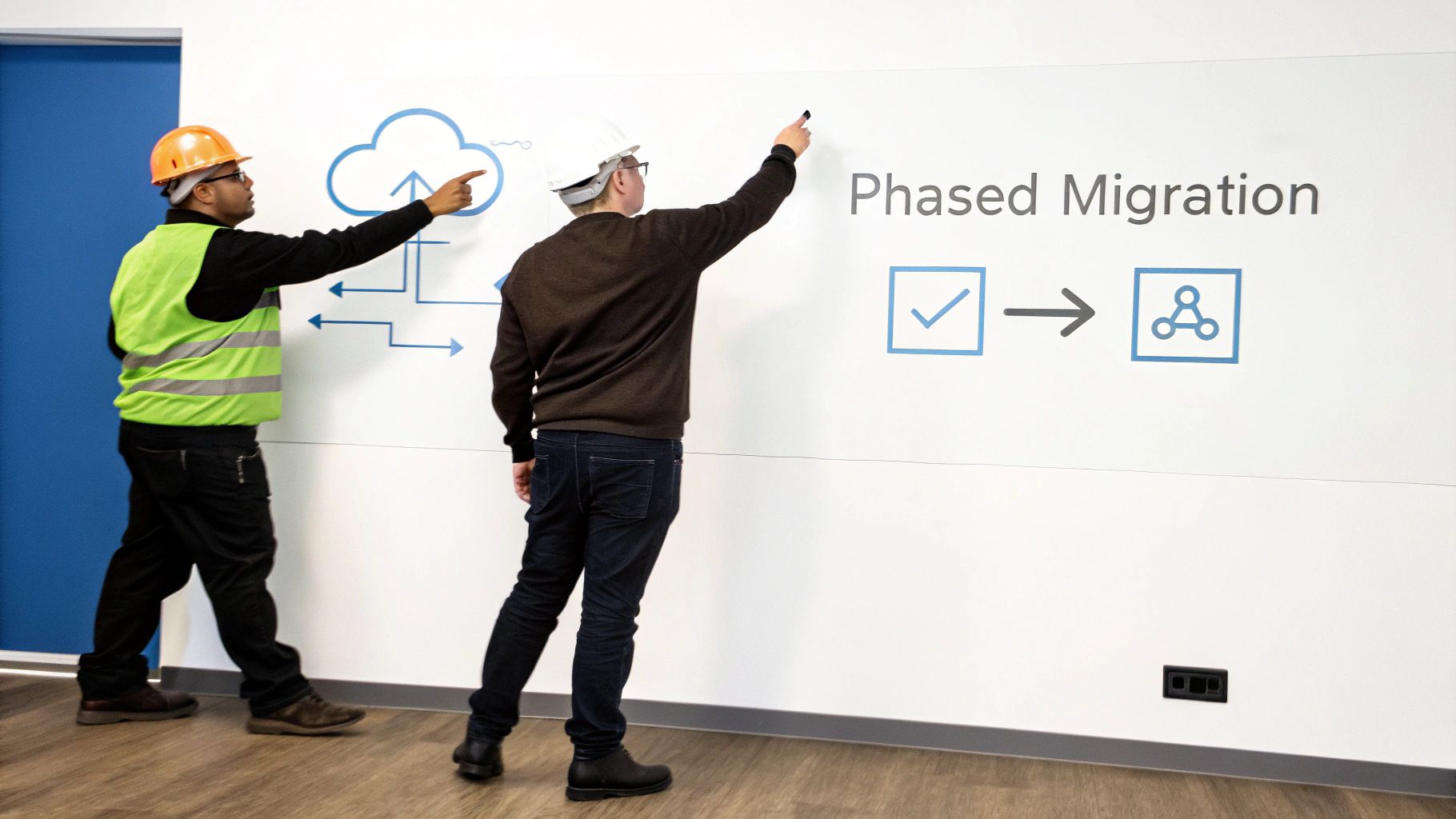
2. Adopt a Phased Migration Strategy (The 6Rs Framework)
Once you understand your landscape, the next step is to decide how you’ll move your applications, not if. A "big bang" migration, where everything moves at once, is a recipe for high risk, extended downtime, and organizational chaos. Instead, a phased approach using the established 6Rs framework is one of the most effective cloud migration best practices. This methodology provides a strategic lens to classify every application in your portfolio and assign it to a specific migration path, transforming an overwhelming task into a series of manageable, parallel workstreams.
What It Involves
Popularized by Amazon Web Services, the 6Rs framework helps leaders categorize applications based on business value, complexity, and technical requirements. This allows you to prioritize efforts, achieve quick wins, and build momentum. For instance, GE successfully used this model to migrate over 400 applications, achieving a 30% cost reduction by systematically moving workloads.
The six strategies are:
Rehost (Lift-and-Shift): Moving applications without modification. Ideal for building early confidence and migrating stable, non-critical systems.
Replatform (Lift-Tinker-Shift): Making minor optimizations to leverage cloud capabilities without changing the core architecture.
Refactor/Re-architect: Fundamentally altering an application to become cloud-native, often using microservices. Best for critical applications where performance and scalability are paramount.
Repurchase: Switching to a different product, typically a SaaS solution.
Retire: Decommissioning applications that are no longer needed, providing an immediate cost saving.
Retain: Keeping certain applications on-premises, usually due to latency, compliance, or cost constraints.
Actionable Implementation Strategy
Begin by creating a clear, objective scoring matrix to assign each application to one of the 6R categories. This matrix should weigh factors like business criticality, technical debt, operational cost, and team skills. Start by identifying applications to Retire and Retain to quickly reduce the scope of the migration project. Then, use Rehost for low-risk applications to help your team learn and adapt to the new cloud environment with minimal disruption.
Pro Tip: Reserve your most intensive Refactor efforts for the applications that provide the greatest competitive advantage. This is where you’ll unlock the full power of the cloud, but it requires significant engineering investment. Document lessons from each phase to create a feedback loop that refines your process for subsequent migrations.
Intensive refactoring projects often strain internal resources. To execute these critical initiatives without derailing your product roadmap, consider augmenting your team. TekRecruiter provides access to the top 1% of pre-vetted cloud and software engineers who specialize in re-architecting complex systems, ensuring your most valuable applications are successfully modernized.
3. Establish Clear Cloud Governance and CoE (Center of Excellence)
Migrating to the cloud without a central governing body is like building a city without a planning commission; it leads to sprawl, inconsistency, and inefficiency. Establishing a Cloud Center of Excellence (CoE) creates a dedicated, cross-functional team responsible for developing and enforcing the standards, policies, and best practices that guide your cloud journey. This institutional approach is one of the most vital cloud migration best practices as it ensures that as teams embrace cloud adoption, they do so in a secure, compliant, and cost-effective manner, preventing the chaos of uncontrolled cloud usage.
What It Involves
A CoE is more than just a gatekeeper; it's an enabler. It provides the guardrails that empower engineering teams to innovate safely and autonomously. For leaders managing distributed teams or complex AI/ML workloads, the CoE standardizes environments, tooling, and security protocols, ensuring consistency whether your engineers are in Silicon Valley or a nearshore hub. It translates high-level business objectives into tangible, repeatable technical patterns and policies.
Key areas of focus include:
Policy and Standards: Defining clear rules for everything from resource tagging and identity management to data encryption and network security configurations.
Cost Management: Implementing FinOps practices, setting budgets, and creating automated alerts to control cloud spend before it spirals out of control.
Architecture and Tooling: Publishing and maintaining a library of approved reference architectures and a standardized toolchain (e.g., for IaC, CI/CD, and monitoring).
Knowledge Sharing: Acting as a central hub for training, documentation, and expertise, accelerating skill development across the entire organization.
Actionable Implementation Strategy
Begin by forming a small, dedicated CoE with 5-7 members representing key functions: cloud architecture, security, finance, and operations. This initial team, as seen in models from firms like JPMorgan Chase, focuses on creating foundational policies and reference architectures for high-priority use cases like web applications or data pipelines. As cloud adoption matures, the CoE can scale its influence and responsibilities.
Pro Tip: Establish a "Cloud Review Board" that meets regularly to approve major architectural decisions or requests for exceptions to established policies. This creates a clear, transparent process for governance and prevents teams from becoming blocked while still maintaining necessary oversight.
A CoE can be a significant investment in specialized talent. For organizations needing to build this function quickly, TekRecruiter offers access to elite, pre-vetted cloud architects and FinOps specialists who can form the core of your CoE or augment your existing team, bringing proven governance frameworks to accelerate your cloud transformation.
4. Implement Strong Security and Compliance Controls Throughout Migration
Treating security as a bolt-on feature after a migration is a recipe for disaster. True security is integrated into every phase of the cloud journey, from initial planning to final cutover and beyond. This "shift-left" security approach ensures that compliance and protection are foundational elements, not afterthoughts. This is one of the most vital cloud migration best practices because it proactively mitigates risks, prevents data breaches, and ensures you meet complex regulatory demands from day one in the new environment.

What It Involves
This practice goes far beyond traditional perimeter security. It involves a comprehensive strategy that embeds security controls into your architecture, data flows, and operational processes. For leaders managing sensitive financial data or healthcare records, this means mapping specific regulatory requirements like PCI-DSS, SOC 2, or HIPAA to cloud-native services and configurations. It's about building a secure landing zone before the first workload is even moved, ensuring a compliant foundation for all future deployments.
Key areas of evaluation include:
Identity and Access Management (IAM): Implementing least-privilege access controls using granular IAM roles and policies to ensure users and services only have the permissions they absolutely need.
Data Encryption: Enforcing encryption for all data, both in-transit (using TLS) and at-rest (using services like AWS KMS or Azure Key Vault), preferably with customer-managed keys for maximum control.
Network Security: Designing robust network segmentation with Virtual Private Clouds (VPCs), subnets, and security groups to isolate workloads and control traffic flow between tiers.
Continuous Compliance Monitoring: Utilizing cloud-native tools like AWS GuardDuty, Azure Sentinel, or GCP Security Command Center to automate threat detection and maintain continuous compliance oversight.
Actionable Implementation Strategy
Begin with a threat modeling exercise for each application slated for migration. This identifies potential vulnerabilities specific to a cloud context. Use frameworks like the AWS Well-Architected Framework's Security Pillar or the NIST Cybersecurity Framework to guide your architecture and control implementation. For example, a financial services firm migrating to Azure can use Azure Policy to enforce SOC 2 compliance controls across all subscriptions automatically.
Pro Tip: Automate everything you can. Use Infrastructure as Code (IaC) tools like Terraform or CloudFormation to codify your security controls. This makes your security posture repeatable, auditable, and less prone to human error.
Embedding security expertise into your migration team is non-negotiable. If your current team is stretched thin or lacks specialized cloud security skills, a partner like TekRecruiter can connect you with elite, pre-vetted cloud security engineers who can lead threat modeling, implement automated compliance, and build a resilient security architecture from the ground up.
5. Develop a Robust Data Migration and Management Strategy
For most organizations, data is the most valuable asset, and moving it is the most perilous part of a cloud journey. A robust data migration strategy isn't just about transferring files; it's a comprehensive plan to move data securely, maintain its integrity, and minimize downtime. This plan addresses data volume, complexity, dependencies, and validation. Properly executing this phase is one of the most vital cloud migration best practices, as data-related failures can halt operations, corrupt critical information, and derail the entire project.
What It Involves
A sophisticated data migration plan goes far beyond simple copy-paste operations. It involves a detailed classification of data types, a clear understanding of inter-application dependencies, and a precise execution sequence to prevent data loss or corruption. For leaders overseeing AI and machine learning initiatives, the quality and accessibility of training data are paramount; a flawed migration can poison models and compromise analytical outcomes.
Key areas of evaluation include:
Data Assessment: Cataloging all data sources, volumes, formats, and regulatory requirements (like GDPR or HIPAA) to determine the complexity and risk of the move.
Tool Selection: Choosing the right tools for the job, such as AWS Database Migration Service (DMS) for live database replication or Azure Data Factory for complex ETL/ELT pipelines.
Migration Method: Deciding between online transfers for continuous synchronization and offline methods (like AWS Snowball) for massive, multi-petabyte datasets where network bandwidth is a constraint.
Validation and Governance: Establishing automated checks to verify data integrity post-migration and defining clear cloud data governance policies for ownership, access, and retention.
Actionable Implementation Strategy
To de-risk the process, adopt an incremental approach rather than a "big bang" migration. Begin migrating data in parallel with application migration to shorten the overall project timeline. For example, Novartis utilized AWS DMS to move critical legacy databases, enabling their AI-driven drug discovery programs without significant service interruption. Use continuous replication tools to keep source and target data in sync, dramatically reducing the final cutover window.
Pro Tip: Implement data quality dashboards and automated validation scripts from day one. These tools provide real-time visibility into the health of your data throughout the migration process, allowing you to catch and fix issues before they impact business operations.
Executing a complex data migration requires specialized skills in ETL development, data engineering, and quality assurance. If your team has gaps in these areas, augmenting your staff is a strategic move. A firm like TekRecruiter can connect you with elite, pre-vetted data engineers and architects who specialize in large-scale cloud data migrations, ensuring your most critical asset is handled with expert care.
6. Plan and Execute Application Modernization Alongside Migration
A cloud migration offers a unique inflection point: you can either move your existing problems to a new environment or seize the opportunity to solve them. Simply "lifting-and-shifting" legacy applications often fails to unlock the cloud's true potential for agility, scalability, and cost efficiency. Instead, strategically modernizing applications during the migration process is one of the most impactful cloud migration best practices, transforming it from a simple infrastructure project into a long-term competitive advantage. This approach involves thoughtfully re-architecting applications to become cloud-native.
What It Involves
Application modernization is the process of refactoring, re-platforming, or rebuilding legacy software to align with modern cloud architectures. For engineering leaders, this means moving beyond monolithic codebases toward more modular, resilient systems. It’s about leveraging cloud services to reduce operational overhead and accelerate development cycles, as seen in Spotify's famous transition to a microservices architecture, which enabled hundreds of weekly deployments.
Key modernization patterns include:
Architectural Transformation: Decomposing monolithic applications into independent microservices, guided by principles like Domain-Driven Design (DDD) to ensure logical separation.
Containerization: Packaging applications and their dependencies into containers using Docker and managing them with an orchestrator like Kubernetes, as Target did to handle Black Friday scale.
Adopting Serverless: Rebuilding event-driven or intermittent workloads using serverless functions (e.g., AWS Lambda) to minimize idle infrastructure costs and operational burden.
Leveraging Managed Services: Replacing self-managed components like databases or message queues with fully managed cloud-native services (e.g., Amazon RDS, Google Cloud Pub/Sub).
Actionable Implementation Strategy
Begin by categorizing your application portfolio and identifying high-value, low-risk candidates for modernization. Start with a non-critical application to build team expertise and establish reusable patterns. Create a clear architectural governance model and reference architectures for microservices to ensure consistency and prevent sprawl. Early adoption of a container orchestration platform is critical to managing the increased deployment complexity that comes with a distributed system.
Pro Tip: Modernization requires a shift in both technology and team structure. Implement comprehensive observability from day one with distributed tracing, metrics, and centralized logging to maintain visibility into your new distributed architecture.
This transformation requires specialized skills in areas like cloud-native development, container orchestration, and distributed systems. If your current team is stretched thin or lacks this specific expertise, augmenting your squads is a powerful accelerator. TekRecruiter connects you with the top 1% of pre-vetted nearshore and AI engineers who specialize in application modernization, providing the critical talent needed to execute your strategy successfully without derailing your existing product roadmap.
7. Establish Cost Optimization and FinOps Practices from Day One
A common pitfall in cloud migration is treating cost management as an afterthought, only to be tackled when the first surprisingly high bill arrives. The most effective migrations embed financial accountability directly into the process from the very beginning. This proactive approach, known as FinOps (Financial Operations), is one of the most vital cloud migration best practices because it transforms cloud cost from a reactive IT problem into a strategic, value-driven business metric. It ensures that every architectural decision and resource deployment is made with a clear understanding of its financial impact.
What It Involves
FinOps is a cultural and operational shift that brings financial accountability to the variable spending model of the cloud, uniting engineering, finance, and business teams around a shared goal: maximizing business value. It's not just about saving money; it's about making money by enabling teams to make informed trade-offs between cost, quality, and speed. For a VP of Engineering overseeing a sprawling microservices architecture, this means empowering teams with real-time cost data to guide their design choices, rather than imposing top-down budget cuts after the fact.
Key areas of focus include:
Cost Visibility and Allocation: Implementing a rigorous tagging strategy to accurately allocate cloud costs to specific teams, projects, or products.
Real-Time Optimization: Continuously right-sizing resources based on actual usage, leveraging auto-scaling, and utilizing cost-effective pricing models like Reserved Instances or Spot Instances.
Governance and Automation: Setting up automated alerts for budget anomalies and enforcing cost-saving policies through Infrastructure as Code (IaC).
Cultural Shift: Fostering a culture where engineers are empowered and expected to take ownership of the cost of their services, just as they own performance and reliability.
Actionable Implementation Strategy
Begin by forming a small, cross-functional FinOps team with members from engineering, finance, and operations. This team's initial mandate should be to establish a universal resource tagging policy and configure cloud provider cost management tools like AWS Cost Explorer or Azure Cost Management. This creates the foundational visibility needed for all subsequent optimization efforts.
Pro Tip: Don't wait for perfect data to start. Begin with simple "showback" reports distributed to engineering leads. The mere act of making costs visible to the teams incurring them often drives immediate behavioral changes and uncovers low-hanging fruit for optimization.
If your organization lacks dedicated FinOps expertise, building this capability can be challenging amidst a migration. Partnering with a firm like TekRecruiter can connect you with specialized FinOps engineers and cloud economists who can help you build these practices and tooling from day one, ensuring your cloud investment delivers maximum ROI from the start.
8. Build and Upskill Cloud-Native Engineering Teams Through Strategic Staffing
A sophisticated cloud strategy is only as effective as the engineering team that implements and maintains it. Simply having a plan is not enough; your organization must possess the specialized, cloud-native skills required to execute it. This involves a proactive approach to building team capabilities, acknowledging the acute scarcity of qualified cloud professionals. Investing in your team is one of the most impactful cloud migration best practices, as it directly addresses the human element crucial for long-term success and innovation in the cloud.
What It Involves
Strategic staffing for a cloud migration is a multi-faceted approach that combines hiring, internal development, and external partnerships. It’s about building a sustainable talent pipeline that can support not just the initial migration but also the ongoing optimization and evolution of your cloud environment. For leaders, this means creating a clear plan to acquire expertise in areas like cloud architecture, DevOps, site reliability engineering (SRE), and cloud security.
Key areas of focus include:
Targeted Hiring: Identifying and recruiting key roles like cloud architects and DevOps engineers 3-6 months before the migration begins to lead the strategy.
Internal Upskilling: Investing in official certification programs from AWS, Azure, and GCP to elevate the skills of your existing engineering talent, fostering loyalty and domain knowledge.
Skill Gap Analysis: Continuously assessing your team's capabilities against the project roadmap to identify where specialized expertise is needed.
Knowledge Transfer: Creating a culture where new skills are shared, often by pairing internal engineers with external consultants to ensure expertise is retained in-house.
Actionable Implementation Strategy
Begin by defining the core competencies your team needs for each phase of the migration. Prioritize hiring for leadership and architectural roles first, as they will shape the technical direction. For existing staff, create structured learning paths tied to certifications and project milestones. This not only builds skills but also provides clear career progression for cloud-focused roles.
Pro Tip: Balance your team with both specialists (e.g., a cloud security architect) and generalists (T-shaped engineers with broad DevOps skills). This blend ensures you have deep expertise for complex challenges and versatile talent for day-to-day operations.
For highly specialized or urgent needs, staff augmentation is a powerful accelerator. Instead of entering a lengthy and competitive hiring process for a niche skill set, you can quickly embed pre-vetted experts into your team. A firm like TekRecruiter can provide access to the top 1% of cloud and AI engineers, allowing you to fill critical gaps with elite talent and ensure your migration timeline stays on track.
9. Implement Continuous Monitoring, Logging, and Observability
Moving to the cloud fundamentally changes how you view system health. Traditional monitoring is no longer sufficient; you need a proactive, unified view into the performance of distributed systems. This requires establishing comprehensive monitoring, logging, and observability from day one of your migration. It’s about building a nervous system for your cloud environment that allows you to ask unknown questions about your systems, not just check predefined health metrics. Adopting this strategy is one of the most essential cloud migration best practices for maintaining resilience and performance in complex, dynamic cloud architectures.
What It Involves
Observability goes beyond simple server health checks. It combines metrics, logs, and traces to provide a holistic understanding of application behavior, especially in microservices environments where a single user request can traverse dozens of services. For engineering leaders managing high-velocity teams, like those at Netflix who deploy hundreds of times a day, robust observability is what enables rapid, confident innovation. It's the key to diagnosing issues in seconds, not hours.
Key components include:
Centralized Logging: Aggregating logs from all applications and infrastructure into a single, searchable platform using structured formats (like JSON) for easy parsing.
Application Performance Monitoring (APM): Gaining deep insights into code-level performance, transaction times, and error rates to identify bottlenecks.
Distributed Tracing: Tracking requests as they flow across multiple services to pinpoint latency issues and failure points in complex workflows.
Intelligent Alerting: Creating alerts based on business impact (e.g., a drop in conversion rate) and service-level objectives (SLOs), not just arbitrary technical thresholds.
Actionable Implementation Strategy
Begin by instrumenting your most critical applications before migrating them. Use cloud-native tools like AWS CloudWatch, Google Cloud Monitoring, or third-party platforms like Datadog to get started quickly. Establish a baseline of performance in your current environment to compare against post-migration metrics, ensuring a clear measure of success.
Pro Tip: Define your observability strategy around key business outcomes. Instead of just tracking CPU utilization, monitor metrics that directly impact user experience, such as API latency and error rates for critical user journeys. Tie alerts to runbooks that provide clear, actionable remediation steps for your on-call team.
Building and managing a sophisticated observability practice requires specialized skills. If your team needs to scale its Site Reliability Engineering (SRE) or DevOps capabilities, TekRecruiter can connect you with elite, pre-vetted engineers who specialize in building and operating high-performance monitoring systems for cloud-native applications.
10. Plan and Execute Database Migration with Minimal Downtime
The database is the heart of most modern applications, making its migration one of the riskiest and most complex phases of any cloud initiative. A flawed database cutover can lead to data loss, extended downtime, and significant business disruption. Therefore, a core tenet of cloud migration best practices is meticulously planning and executing the database migration to ensure continuity, data integrity, and a seamless transition for end-users. This involves moving beyond simple "lift-and-shift" backups and restores, embracing advanced techniques for live data synchronization.
What It Involves
A zero or near-zero downtime database migration focuses on keeping the source and target databases in sync while the primary application is still live. This allows for a swift, controlled cutover with minimal impact. This approach is critical for leaders managing systems with high availability requirements or global user bases where there is no "off-peak" window for maintenance. It requires a sophisticated strategy to replicate data continuously and validate its integrity before the final switch.
Key areas of evaluation include:
Replication Strategy: Selecting the right tool and technique, such as log-based change data capture (CDC), which reads database transaction logs to replicate changes in real-time.
Data Validation: Implementing a rigorous process to compare data between the source and target databases to guarantee consistency and prevent data corruption.
Cutover and Rollback Planning: Defining the exact sequence of events for the cutover, including application configuration updates and DNS changes, along with a clear, tested rollback plan.
Performance Testing: Benchmarking the new cloud database under realistic load conditions to ensure it meets or exceeds the performance of the on-premises system.
Actionable Implementation Strategy
Leverage specialized cloud-native tools designed for this exact purpose, such as AWS Database Migration Service (DMS) or Azure Database Migration Service. These services automate much of the complexity involved in setting up replication and managing the migration process for heterogeneous or homogeneous database migrations. For example, LinkedIn famously used a log-based CDC approach to enable continuous replication and achieve smooth migrations.
Pro Tip: Implement a dual-write pattern during the transition phase. In this approach, the application temporarily writes to both the old and new databases. While complex, it provides an additional layer of safety and simplifies rollback if an issue is discovered immediately after the cutover.
Executing a flawless database migration requires deep, specialized expertise. If your team is stretched thin or lacks experience with complex CDC tools, augmenting your staff is a strategic move. TekRecruiter can connect you with elite database architects and migration specialists who have successfully orchestrated numerous high-stakes, zero-downtime migrations, ensuring this critical phase is handled with precision.
10-Point Cloud Migration Best Practices Comparison
Item | 🔄 Implementation Complexity | ⚡ Resource Requirements | ⭐ Expected Outcomes | 💡 Ideal Use Cases | 📊 Key Advantages |
|---|---|---|---|---|---|
Conduct a Comprehensive Cloud Readiness Assessment | Moderate→High — cross-functional inventory, dependency mapping | Moderate — assessment tools, cloud architects, stakeholder time | ⭐⭐⭐ — clear migration roadmap, prioritized apps, ROI & risk visibility | Pre-migration planning for large/complex enterprises and distributed teams | Reduces surprises, improves budgeting, prioritizes phased migration |
Adopt a Phased Migration Strategy (6Rs) | Moderate — multiple workstreams, dependency coordination | Variable — staged engineering effort, hybrid ops maintenance | ⭐⭐⭐ — incremental value, lower failure risk, flexible adjustments | Large application portfolios, high-risk or business-critical apps | Minimizes disruption, enables quick wins, adaptable approach |
Establish Clear Cloud Governance and CoE | High — policy creation, organizational change | Moderate→High — dedicated CoE staff, governance tooling, budget | ⭐⭐⭐ — consistent standards, compliance, controlled sprawl | Regulated industries, multi-team or multi-region cloud operations | Standardization, faster decisions, stronger compliance controls |
Implement Strong Security & Compliance Controls | High — regulatory mapping, technical controls integration | High — security specialists, monitoring, encryption & tooling | ⭐⭐⭐⭐ — reduced breach risk, audit readiness, data protection | Healthcare, finance, government, cross-border data handling | Prevents violations, builds customer trust, lowers liability |
Develop a Robust Data Migration & Management Strategy | High — data mapping, validation, replication orchestration | High — ETL/data engineers, bandwidth, migration tools | ⭐⭐⭐ — data integrity, minimal downtime, analytics readiness | AI/ML initiatives, large datasets, analytics migrations | Preserves data quality, ensures compliance, reduces cutover risk |
Plan & Execute Application Modernization Alongside Migration | Very High — rearchitecture, decomposition, new patterns | Very High — specialized devs, refactoring time, orchestration | ⭐⭐⭐⭐ — cloud-native performance, scalability, faster releases | Legacy monoliths needing scalability, teams pursuing cloud-native ops | Improves scalability/resilience, reduces long-term TCO, attracts talent |
Establish Cost Optimization & FinOps Practices from Day One | Moderate — policy/process changes, tagging, governance | Moderate — FinOps team, cost tools, reporting processes | ⭐⭐⭐ — predictable spend, measurable savings, cost-aware decisions | High cloud spenders, multi-team environments, variable workloads | 20–40% potential savings, better forecasting, accountability |
Build & Upskill Cloud-Native Engineering Teams (Staffing) | Moderate→High — hiring pipelines, training programs | High — recruitment, certification budgets, retention incentives | ⭐⭐⭐ — sustained capability, faster delivery, knowledge transfer | Organizations lacking cloud expertise or scaling major projects | Sustainable internal skills, flexible augmentation, reduced consulting reliance |
Implement Continuous Monitoring, Logging & Observability | Moderate→High — instrumentation, tracing, alerting tuning | Moderate — monitoring platforms, SRE/DevOps resources, storage | ⭐⭐⭐ — reduced MTTR, improved performance visibility, capacity planning | Microservices, high-velocity deployment environments, SLAs | Faster troubleshooting, data-driven decisions, improved reliability |
Plan & Execute Database Migration with Minimal Downtime | Very High — CDC, replication, cutover orchestration & testing | High — DB specialists, staging environments, temporary dual-run costs | ⭐⭐⭐ — near-zero downtime, data consistency, safe cutover | Transactional systems, e‑commerce, finance where downtime is costly | Minimizes revenue impact, reliable rollback paths, validated integrity |
Accelerate Your Migration with Elite Engineering Talent
Embarking on a cloud migration is more than a technological shift; it's a fundamental transformation of how your organization builds, deploys, and manages its most critical assets. The journey from on-premise infrastructure to a cloud-native ecosystem is complex, but by following a structured approach, you can navigate the challenges and unlock immense strategic value. The cloud migration best practices we've detailed provide a comprehensive roadmap, guiding you from initial assessment to ongoing optimization.
From Strategy to Execution: The Human Element
Mastering this transition hinges on your ability to execute meticulously at every stage. A successful migration is not merely the sum of its technical parts; it is a symphony of strategic planning, robust security implementation, and operational excellence. The most critical, and often most challenging, component of this equation is having the right talent. The best strategies for data migration, application modernization, and FinOps are only as effective as the engineers who implement them.
Let's distill the core principles from this guide into three pivotal takeaways:
Preparation is Paramount: The success of your entire cloud initiative is determined long before the first server is provisioned. A comprehensive readiness assessment, a clear governance framework established by a Center of Excellence (CoE), and a phased migration strategy based on the 6Rs are non-negotiable foundations. Rushing this phase inevitably leads to budget overruns, security vulnerabilities, and operational instability.
Security and Cost are Not Afterthoughts: Integrating security and compliance controls from the very beginning is essential to protect your data and maintain customer trust. Similarly, establishing FinOps practices on day one ensures that the financial benefits of the cloud are realized, preventing costs from spiraling out of control. These are continuous disciplines, not one-time setup tasks.
Migration is a Catalyst for Modernization: The true power of the cloud is unlocked not by simply lifting and shifting old architectures, but by modernizing them. This means refactoring applications for microservices, planning database migrations with minimal downtime, and building a culture of continuous improvement through robust monitoring and observability. This is where your investment yields the highest returns in agility, scalability, and innovation.
Bridge Your Cloud Vision and Reality with Elite Talent
Ultimately, a cloud migration is a talent and execution challenge. The specialized expertise required represents some of the most sought-after skills in the technology market. This significant talent gap is often the single biggest obstacle that prevents companies from migrating with the speed and confidence their business demands.
 Ron SmithPresident & Lead RecruiterTekRecruiter