A Guide to Custom Software Development Outsourcing
Unlock growth with our guide to custom software development outsourcing. Learn how to hire elite developers, manage remote teams, and accelerate your projects.
Feeling stuck behind a talent bottleneck while your competitors are shipping new features? You’re not the only one. This is exactly where custom software development outsourcing stops being a simple line item for cost savings and becomes a powerful strategic weapon. It’s about getting access to elite global talent and seriously cutting down your time-to-market.
Why Leaders Outsource Custom Software Development

Picture a CTO, let's call her Sarah. She’s staring down an ambitious product deadline that could make or break her company's year. Her in-house team is sharp, but they're completely maxed out. Meanwhile, the local market for the specialized engineers she needs is painfully slow and eye-wateringly expensive. Every single day she spends trying to hire is another day her competition pulls ahead.
This isn’t a hypothetical—it’s the reality for countless tech leaders today. The pressure to innovate is relentless, but building a world-class engineering team from scratch is a massive hurdle. This is the exact moment when outsourcing custom software development becomes a non-negotiable strategy. Before we get into the nuts and bolts, it’s worth understanding what a true bespoke software development service really brings to the table.
Unlocking a Real Competitive Edge
Let's be clear: this isn't just about saving a few bucks anymore. It’s about gaining a decisive advantage in the market. By partnering with external experts, companies can instantly tap into a global talent pool, bringing on specialized skills that are either impossible to find or prohibitively expensive at home.
This move lets leaders:
Crush Timelines: Instead of a hiring process that drags on for months, you can have a vetted, high-performing team ready to go in just a few weeks. That’s a massive reduction in your development lifecycle.
Refocus Your Core Team: By offloading heavy development work, you free up your internal talent to do what they do best—driving the core business strategy and innovating on your flagship products.
Build a More Resilient Org: Outsourcing gives you the power to scale your engineering muscle up or down as project demands change. It creates an agile, resilient organization that isn't locked into a fixed headcount.
The market data backs this up completely. The global custom software development market hit a value of £28.53 billion in 2023 and is projected to keep growing at a breakneck pace. To see how this model specifically supercharges teams while controlling costs, check out the benefits of nearshore outsourcing.
This guide is your roadmap to getting it right. We'll walk through everything from choosing the right engagement model to vetting partners and managing remote teams effectively. You'll get the real-world insights you need to make it a success.
Weighing the Benefits and Navigating the Risks
Deciding to outsource custom software development isn't just a line item on a budget—it's a major strategic move. Like any big decision, it comes with powerful advantages and potential pitfalls that you absolutely have to consider. The only way to succeed is to go in with a clear-eyed view of both sides of the coin.
While the financial upside gets all the attention, the real value is in strategic acceleration and getting access to talent you simply can't find at home.
The Strategic Upside of Outsourcing
Think of outsourcing as a powerful lever for growth. One of the most compelling reasons to do it is to slash your product's time-to-market. Instead of spending months grinding through a slow, expensive local hiring process, you can have a team of vetted, elite engineers ready to go in a matter of weeks.
That kind of speed gives you an immediate competitive edge. You can innovate faster and react to what the market wants with far more agility.
On top of that, outsourcing swings the doors wide open to a massive global talent pool, giving you access to nearly 29 million developers worldwide. This means you can find that niche expert in AI, a specific cloud architecture, or a programming language that’s either impossible to find or wildly expensive in your local market.
A critical economic driver for custom software development outsourcing is the consistent 40-60% cost savings compared to building an in-house team. This financial relief transforms how engineering leaders can approach modernization and cloud projects.
This isn't just about saving a few bucks. The lower overhead often translates into a boosted ROI of 150-230%, which comes from faster development velocity and fewer costly mistakes down the line. For the 63% of U.S. companies struggling with in-house IT recruitment, outsourcing is a practical lifeline. It's no surprise that 72% of firms use this model to solve talent shortages.
Navigating the Common Risks and Concerns
Of course, this isn't a risk-free decision. Handing over a critical project to an outside team naturally brings up some valid concerns, and you have to tackle them head-on. Many leaders worry about communication breaking down, protecting their intellectual property (IP), and losing direct control over the project.
These risks are real, but they are completely manageable with the right partner and the right processes. For instance, communication gaps—often a product of massive time zone differences—can be solved by choosing a nearshore model. When you have partners in similar time zones and U.S.-based project management, you create a seamless, collaborative environment that truly feels like an extension of your own team.
Concerns about IP security are another major hurdle. The key here is locking down your assets with robust, ironclad contracts.
To properly secure your project, make sure your partnership includes:
A comprehensive Non-Disclosure Agreement (NDA) that’s signed before a single sensitive detail is shared.
Clear IP ownership clauses in your master service agreement, stating that all code and work products belong exclusively to you.
Verification of security protocols, including their data protection policies and secure coding practices.
When you're bringing on external partners for custom software development, effective third-party risk management isn't just a good idea; it's essential for protecting yourself from potential vulnerabilities. A partner you can trust will be proactive and transparent about how they plan to secure your intellectual property.
By understanding both the opportunities and the potential hurdles, you can make a decision rooted in strategic advantage, not anxiety. The key is finding a partner who doesn’t just provide talent, but also offers the structure and security to make outsourcing a massive success.
Choosing Your Outsourcing Engagement Model
Picking the right approach to custom software development outsourcing is a lot like choosing the right tool for a job. The wrong one just leads to frustration and wasted effort, but the right one makes everything click. Think of it like building a house; you wouldn’t use the same contractor for absolutely every single task.
This is a critical decision. To help you map out the first steps, here’s a simple decision tree on whether outsourcing is even the right path for your organization in the first place.
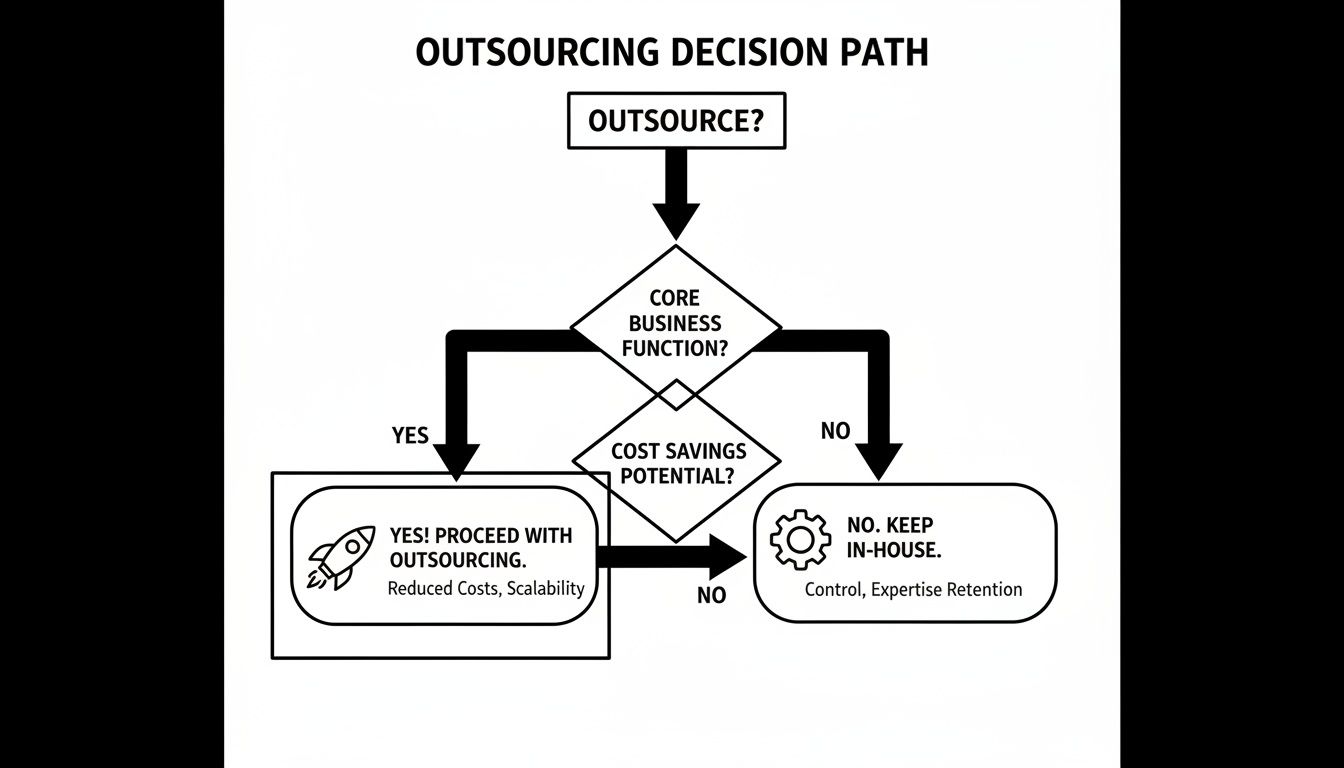
As the flowchart shows, the journey starts by figuring out if a function is core to your business and if outsourcing can genuinely drive significant cost savings. Once you've decided to move forward, the next step is selecting an engagement model that actually fits your needs for control, expertise, and day-to-day management.
Staff Augmentation: Hiring Specialists
Think of Staff Augmentation as hiring specialized subcontractors for your house build. You need a master plumber or an expert electrician for a very specific phase of construction. You find that exact talent, they join your existing team, and they work directly under your project manager.
This model is perfect when you already have strong internal leadership but are missing a few critical skills. It gives you maximum control and lets you slot new talent right into your established workflows without any fuss.
Best For: Filling specific, temporary skill gaps within your current team.
Your Control Level: High. The augmented staff report directly to you.
Common Use Case: Your solid DevOps team needs to bring in a certified cloud security expert for a three-month compliance project.
Managed Teams: A Cohesive Unit
A Managed Team is like hiring a general contractor to handle the entire electrical or plumbing system for your new house. You provide the blueprints and the final goal, and the contractor brings their own trusted, pre-vetted crew to get it done. They manage their own people day-to-day while reporting progress back to you.
This model strikes a great balance between control and delegation. It’s ideal when you need to offload an entire piece of a project—like building a mobile app or a new API—without getting bogged down in the daily management of yet another team.
Project-Based Outsourcing: The Turnkey Solution
Finally, Project-Based Outsourcing is like commissioning a fully built, move-in-ready home. You define what the final product looks like, agree on the scope and price, and the development partner handles everything else, from architecture to deployment. You’re still responsible for approvals and feedback at key milestones, but the end-to-end execution is entirely on them.
This is the most hands-off approach you can take. It’s best suited for projects with crystal-clear, well-documented requirements that are not likely to change. For a deeper dive into how these models stack up, our guide on Staff Augmentation vs. Outsourcing provides a detailed breakdown.
Choosing the right engagement model isn’t about which one is "best." It’s about which one fits your project's needs, your team's current structure, and the level of control you want to maintain. The goal is a partnership that feels like a natural extension of your own organization.
Deciding between these models demands a clear-eyed look at your internal capabilities and project goals. Once you have a model in mind, the next critical decision is geography—choosing between nearshore and offshore partners. This choice has a massive impact on communication, collaboration, and your project's odds of success. For companies that need agile, real-time teamwork, the alignment of time zones and cultural work styles is often the deciding factor.
Your Checklist for Selecting the Right Partner
Choosing a partner for custom software development outsourcing is one of the biggest calls a technology leader can make. You’re not just hiring coders; you’re entrusting a core piece of your business to an external team. A great partner feels like a true extension of your organization, while a poor one creates endless friction.
This checklist will help you cut through the noise and vet potential vendors with real confidence.
The right partnership can be a massive accelerant. There's a reason custom software development outsourcing is the most procured service globally, making up 64% of all outsourced IT services. This isn't just a trend—it's a direct response to a severe talent crunch. 57% of recruitment managers admit that hiring skilled developers is their biggest challenge. For the 72% of companies that outsource just to solve talent shortages, finding a high-quality partner is non-negotiable. You can discover more insights on why nearshore partnerships are a growing solution for U.S. companies.
Scrutinize Their Technical Expertise
Every outsourcing firm will tell you they have top-tier talent. You need to verify that claim beyond their sales deck. A truly expert partner can demonstrate deep, practical knowledge, not just buzzword compliance.
Here’s how to dig deeper:
Review Technical Case Studies: Look past the glossy marketing. Do their case studies detail the specific technical challenges they solved? They should be able to explain architectural decisions, framework choices, and how they overcame complex integration problems. Vague success stories are a red flag.
Request Technical Interviews: Insist on speaking directly with the senior engineers or architects who might actually work on your project. Ask them pointed questions about their experience with your technology stack and, more importantly, your industry.
Assess Their Problem-Solving Approach: Give them a hypothetical (but realistic) technical problem your team is facing. A strong partner won’t just jump to a solution; they will ask clarifying questions to fully understand the context before proposing a strategic approach. This is where you separate the order-takers from the problem-solvers.
Evaluate Their Talent Vetting and Retention
A vendor is only as good as its people. The best firms have a rigorous, multi-stage vetting process to ensure they are hiring elite engineers, not just filling seats. This is a crucial differentiator.
Ask them directly about their process:
Sourcing Strategy: Where do they find their talent? What is their reputation in the local development community? Do top engineers want to work there?
Vetting Process: How many stages are in their interview process? Does it include live coding challenges, system design interviews, and solid soft skill assessments? You’re looking for rigor, not a rubber stamp.
Retention Rates: What is their annual developer turnover rate? High turnover is a massive red flag that can derail project continuity and knowledge transfer. A healthy rate suggests they’ve built a strong engineering culture that people want to be a part of.
The real value of a partner isn't just in providing talent, but in ensuring that talent is consistently high-quality and stable. A firm that invests heavily in vetting and retaining its engineers is investing in your long-term success.
Verify Communication and Cultural Alignment
Technical skills are only half the equation. Seamless communication and cultural alignment are what make a partnership click. Misaligned expectations or poor communication can sink even the most technically sound projects.
Look for a partner who prioritizes transparent and proactive communication. How do their project management methodologies—like Agile or Scrum—align with your team’s way of working? If you're trying to build a truly cohesive unit, our guide on hiring a dedicated development team offers practical steps for successful integration.
Ultimately, you want a partner who feels like part of your team, not just another contractor on the payroll.
How to Manage Your Outsourced Development Team

Here’s where the real work begins. The success of any custom software development outsourcing partnership doesn’t come from the contract you sign—it comes from how you integrate and manage the team after kickoff. Just handing over a project scope and hoping for the best is a recipe for failure.
Think of it this way: you’re coaching a sports team where some of your star players practice in a different city. You can't just send them a playbook and expect a win. You need a rock-solid strategy to make sure everyone is running the same plays, communicating clearly, and feels like they’re all working toward the championship.
The trick is to manage outcomes, not just clock hours. This means putting practical systems in place for communication, collaboration, and culture. These are the day-to-day tactics that turn a vendor into a true partner and make your remote developers feel as vital as the people sitting in your office.
Establishing a Strong Communication Cadence
Consistent, predictable communication is the glue that holds a remote team together. Without it, small misunderstandings snowball into major blockers, and progress grinds to a halt. The goal isn’t to micromanage every task but to create a reliable rhythm that keeps information flowing and problems surfaced quickly.
Your communication cadence should blend real-time conversation with asynchronous updates:
Daily Stand-ups: This is non-negotiable. A quick, 15-minute sync keeps the entire team aligned on what was done yesterday, what's on deck for today, and what's getting in the way.
Asynchronous Updates: Tools like Slack or Microsoft Teams are your digital HQ. They're perfect for quick questions, sharing status updates, and keeping the conversation going without derailing deep work.
Weekly Demos and Retrospectives: This is your formal feedback loop. Demos are for showing off progress and getting stakeholder input, while retrospectives are for honestly discussing what’s working, what isn’t, and how to improve next week.
Leveraging the Right Collaborative Tools
For a distributed team, technology isn't just a facilitator; it's the central nervous system. The right tools create a shared digital workspace that makes geography irrelevant. Picking the right stack—and getting everyone to actually use it—is critical for visibility and productivity.
A project management tool like Jira or Asana, for instance, becomes your single source of truth for the entire development lifecycle. It puts the backlog, current tasks, and progress reports in one place where everyone, in-house or remote, can see exactly what's going on.
By standardizing your toolset, you tear down information silos. You create a transparent environment where everyone—regardless of location—is working from the same playbook. That unified view is the foundation of trust and accountability.
Cultivating a Unified Team Culture
This is the one thing everyone forgets. You can have the best developers and the slickest project management tools, but if your outsourced team doesn't feel like they're part of your team, you'll never get their best work. You have to be intentional about creating a "one team" culture.
It starts with small, powerful actions. Invite your remote members to virtual company all-hands meetings. Give them a public shout-out when they crush a feature. Make sure they have direct lines of communication with your in-house staff, not just a single point of contact. For more ideas, check out our modern playbook for managing distributed teams.
When you make your external developers feel like integral members of the organization, you’re not just buying their time—you’re earning their loyalty and a shared sense of ownership. That cultural glue is what elevates a good outsourcing partnership to a great one.
Build Your Elite Engineering Team Today
Let's be honest: navigating the endless cycle of talent shortages, ballooning operational costs, and stalled development timelines is an uphill battle. Your roadmap is packed with game-changing features, but your team is stretched thin, and progress has slowed to a crawl. This is exactly where smart custom software development outsourcing stops being a cost-cutting tactic and becomes a real lever for growth.
TekRecruiter offers a direct line to solving these problems for good. We connect you with the top 1% of vetted engineers from elite nearshore hubs in Latin America and Europe. This isn't about finding cheap labor; it's about accessing world-class talent without the communication breakdowns and late-night calls that come with massive timezone gaps. Your teams can actually work together, in real time.
A Hybrid Model That Just Works
Our entire approach is built to give you the best of both worlds. We blend the raw flexibility of staff augmentation with the accountability and quality you'd expect from a fully managed service. What does that mean for you? You get dedicated engineers who plug directly into your existing team and workflows, backed by expert, U.S.-based project management that keeps everything aligned and moving forward.
Whether you need to pour fuel on a specific project or build out a new, long-term capability, our model bends to fit your goals. We’ve structured it to eliminate the classic risks of old-school outsourcing, creating a partnership that feels less like a vendor and more like a genuine extension of your own company.
The real goal here is to get past the "hired gun" mentality. This is about building a cohesive, high-performing engineering unit that is genuinely invested in your success, so you can innovate faster and more effectively than ever before.
Specialized Talent, Ready When You Are
Your technical challenges are specific, and your team should be, too. We don't do generalists. We build elite teams with certified expertise across the most critical tech domains, so you can stop wasting months hunting for niche skills and start building immediately.
Our specialized talent pools are ready to deploy:
Certified AI Engineering: Get immediate access to experts in machine learning, AI data preparation, and complex AI systems engineering.
Cloud Solutions: Bring on certified pros for AWS, Azure, and GCP to build, manage, and scale your infrastructure the right way.
Salesforce Development: Onboard specialized developers who know how to customize and get the most out of your entire Salesforce ecosystem.
Stop letting talent bottlenecks dictate your pace. TekRecruiter is a technology staffing, recruiting, and AI Engineer firm built to help you deploy elite engineering talent right where you need it. Contact TekRecruiter today to build your dedicated team and finally accelerate your roadmap.
Frequently Asked Questions
When you start digging into custom software development outsourcing, a lot of practical questions pop up. Let's tackle the big ones that tech leaders ask most, so you can get the clarity you need to move forward.
How Is the Cost of Custom Software Outsourcing Calculated?
It almost always comes down to one of three models, and the right one depends entirely on your project.
The most common is the Time & Materials (T&M) model. You’re essentially paying an hourly or monthly rate for each developer on your project. This is perfect for agile development where you know the requirements are going to shift and evolve. It gives you maximum flexibility.
Then there’s the Fixed Price model. This is exactly what it sounds like: a single, total cost for a project with a rock-solid, unchanging scope. If you know exactly what you need built and don't expect any surprises, this can be a great way to manage your budget.
Finally, you have the Dedicated Team model. This involves a fixed monthly fee for a full-time team that acts as an extension of your own. They integrate directly into your workflows and culture. Your choice really hinges on how predictable your project is and how much wiggle room you need.
What Are the Key Security Measures for Outsourcing?
Protecting your intellectual property is non-negotiable. Before you share a single line of code or a single business secret, you need a comprehensive Non-Disclosure Agreement (NDA) signed and in place. That’s step one, always.
But an NDA is just the beginning. Your contract has to explicitly state that all code, documentation, and anything else created belongs 100% to your company. It’s also on you to verify that the vendor has their own house in order—think robust data protection policies, secure network protocols, and a team that actually follows secure coding practices. A partner worth their salt will be upfront about their security certifications and posture from the very first conversation.
The core of a secure partnership isn't just legal agreements; it's a shared commitment to protecting your most valuable assets. Your vendor should act as a guardian of your IP, not just a contractor.
What Is the Best Way to Start My First Outsourcing Project?
Don't try to boil the ocean. Start with a well-defined, non-critical pilot project. This is your chance to test-drive the partnership, see how well you communicate, and gauge the quality of their work with minimal risk.
First, document the pilot project's requirements, scope, and what a successful outcome looks like. Then, use a solid vendor selection checklist to narrow down a few partners that feel like a good technical and cultural fit. Nail the pilot, and you’ll build the trust and operational rhythm you need to tackle much bigger, more critical business goals together.
Feeling confident but need the right partner to execute? Stop letting talent gaps slow you down. TekRecruiter is a technology staffing, recruiting, and AI Engineer firm that allows innovative companies to deploy the top 1% of engineers anywhere. We build the elite, dedicated team you need to accelerate your roadmap. Find out how we can help you at https://www.tekrecruiter.com.