A Modern Guide to Recruitment Cyber Security
Struggling with recruitment cyber security? This guide offers actionable strategies to source, assess, and hire elite cybersecurity talent for your team.
Recruiting in cybersecurity is a beast of its own. We're facing a massive talent shortage where the demand for skilled professionals is rocketing past the available supply. If you’re relying on old-school recruiting methods, you’re likely falling behind. To protect your digital assets, you have to think globally and strategically, because your next great hire probably isn’t down the street.
Navigating The Cyber Security Talent Shortage
Let’s be blunt: the gap between the cybersecurity talent you need and the talent you can actually find is more than an inconvenience. It’s a critical business risk.
This isn’t just about filling seats. It’s an operational vulnerability that leaves your company exposed. As threats get smarter—think AI-driven attacks and rapid cloud adoption—the need for highly specialized skills has exploded. We’re seeing roles pop up that are nearly impossible to fill through conventional hiring channels.
This grind leads to burnout and unsustainable hiring cycles, with tech leaders stuck in a perpetual search for qualified candidates. The consequences are real and they hurt: projects get delayed, and worse, you’re running an understaffed security team. Every one of those empty chairs is a potential weak point in your defenses.
The Scale of the Skills Gap
The numbers don’t lie, and they paint a stark picture. Recent studies show a staggering global deficit of qualified professionals, a problem with direct financial and operational costs for businesses of every size.
The flowchart below breaks down the core problem—the ever-widening chasm between skyrocketing demand and a painfully limited supply of talent.
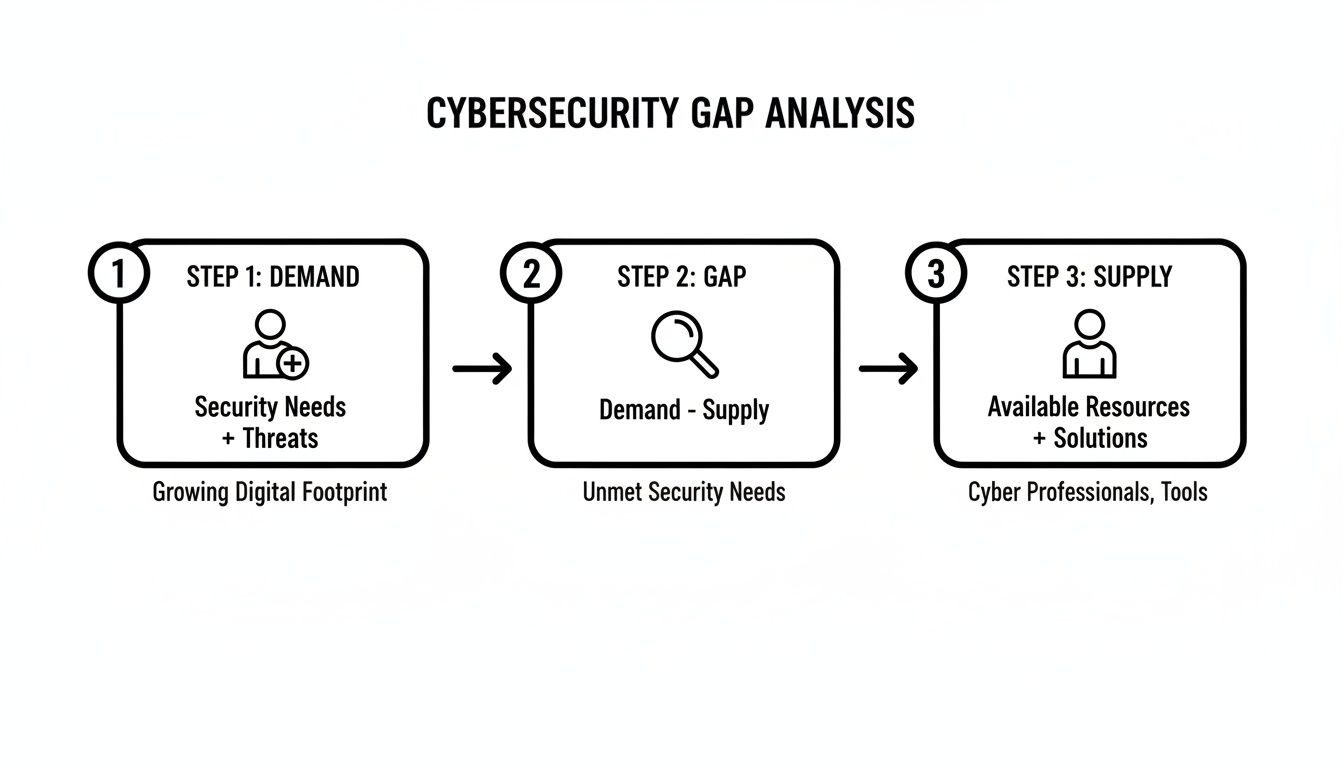
This really drives home how the escalating demand for talent simply isn't being met by the current workforce. It creates a significant gap that organizations have to get creative to solve.
The Real-World Impact of an Understaffed Team
Globally, the cybersecurity workforce stands at 5.5 million professionals. The problem? The demand is for an estimated 10.2 million roles. That leaves a jaw-dropping gap of 4.8 million unfilled positions.
This shortfall is fueled by a perfect storm of rapidly evolving threats, economic pressures, and a fundamental mismatch between the skills companies need and what’s available. For many tech leaders, the only viable solution is to look to international talent hubs in places like Latin America and Europe.
The stakes couldn't be higher. Understaffed firms face average breach costs that are $1.76 million higher than their fully-staffed competitors. It’s an expensive problem to have.
This isn't just a numbers game. For every empty seat on your security team, your organization's risk profile grows. The talent shortage directly correlates with increased vulnerability and slower incident response times, turning a recruitment challenge into a tangible business threat.
Forward-thinking companies are flipping this challenge on its head and turning it into a competitive advantage. Instead of fighting over the same small pool of local talent, they're building smarter, global-first recruitment strategies to land top-tier professionals. This doesn’t just fill critical roles; it brings in diverse perspectives that genuinely strengthen their security posture.
For a deeper dive, exploring specific cybersecurity recruitment strategies and use cases can provide some incredibly practical solutions. Of course, budgeting for global talent is also key; you can learn more by checking out our guide on https://www.tekrecruiter.com/post/attracting-top-tech-talent-navigating-the-budget-dilemma.
At TekRecruiter, bridging this exact gap is what we do. Our model gives you access to the top 1% of vetted global engineers, letting you build a world-class security team without being limited by geography. We connect you with elite talent from nearshore hubs, so the fit and the time-zone overlap are right from day one.
Defining Your Ideal Cybersecurity Candidate
Jumping into cybersecurity recruiting without a clear target is like navigating a minefield blindfolded. A vague job description is a magnet for unqualified applicants, and it actively repels the elite professionals you actually want to attract. To win in this market, you have to move beyond generic templates and define exactly who you need with surgical precision.
This all starts with a shift in perspective. You're not just filling a vacancy; you're solving a specific business problem. Whether that problem is protecting sensitive customer data, securing a new cloud infrastructure, or actively hunting for threats, the role has a direct impact on the company's bottom line. Articulating this "why" is your secret weapon.

Collaborating to Build the Candidate Persona
The best job descriptions are born from collaboration, not created in an HR silo. Your first move should be to sit down with your technical hiring managers and security team leads. They’re on the front lines, and they have the real-world context on the day-to-day challenges and the specific skill gaps that need to be filled.
This conversation should be all about building a realistic candidate persona. Instead of listing every possible skill under the sun, get laser-focused on the non-negotiables.
What are the top three technical skills absolutely required on day one? Is it deep experience with AWS security services, proficiency in a SIEM like Splunk, or hands-on penetration testing?
What skills are just "nice-to-have"? This could be familiarity with a secondary cloud provider or experience with a scripting language that can be learned on the job.
What’s the single biggest security challenge this person will tackle in their first six months? Framing the role in terms of impact, not just a list of tasks, is far more compelling to top-tier talent.
This approach stops you from chasing a "unicorn" candidate who doesn't exist. It grounds your search in reality and makes sure your recruitment efforts are perfectly aligned with what the technical team actually needs.
The most effective cybersecurity job descriptions read less like a wishlist and more like a mission briefing. They clearly define the threat, outline the objective, and specify the exact skills needed to succeed. This clarity attracts professionals who are driven by challenge and impact.
Balancing Technical Prowess with Soft Skills
Technical ability is the price of admission, but in cybersecurity, soft skills are what separate a good analyst from a great leader. Security pros have to communicate complex threats to non-technical stakeholders, collaborate under pressure during an incident, and think critically to solve problems that don't have a playbook.
With a 32% projected growth in the field by 2032, the need for these interpersonal skills is only going to intensify.
When you’re building that ideal candidate profile, be explicit about the soft skills that matter most:
Problem-Solving: Can they analyze a complex security alert, cut through the noise, and pinpoint the root cause?
Communication: How effectively can they explain a critical vulnerability to the executive team without causing a panic?
Collaboration: Are they able to work seamlessly with DevOps, legal, and IT during a high-stakes incident response?
Weaving these into your job description sends a clear signal that you value well-rounded professionals, not just keyboard warriors. For instance, instead of just saying "strong communication skills," try something like, "Proven ability to translate complex technical findings into clear, actionable reports for business leadership."
Essential Skills for Key Cybersecurity Roles
To give you a head start, here’s a quick breakdown of the must-have skills for some of today's most in-demand cybersecurity roles.
Role | Core Technical Skills | Essential Soft Skills | Common Certifications |
|---|---|---|---|
Security Analyst | SIEM (e.g., Splunk, QRadar), Intrusion Detection Systems (IDS/IPS), Threat Intelligence Platforms, Log Analysis | Analytical Thinking, Attention to Detail, Written Communication | CompTIA Security+, GIAC Certified Intrusion Analyst (GCIA) |
Cloud Security Engineer | AWS/Azure/GCP Security Services, Infrastructure as Code (Terraform), Container Security (Docker, Kubernetes) | Adaptability, Collaboration, Proactive Problem-Solving | Certified Cloud Security Professional (CCSP), AWS/Azure Security Specialty |
Penetration Tester | Metasploit, Burp Suite, Nmap, Python/PowerShell Scripting, Web Application Security | Ethical Mindset, Creativity, Clear Reporting | Offensive Security Certified Professional (OSCP), Certified Ethical Hacker (CEH) |
This table provides a solid framework, but remember to tailor it to the unique challenges and technologies within your own environment.
Crafting this precise, compelling candidate profile is the absolute cornerstone of a successful cybersecurity recruiting strategy. It’s what ensures you attract professionals who have the right blend of skills and can make an immediate impact.
If you're struggling to define these roles or find candidates who tick all the right boxes, TekRecruiter can help. We specialize in connecting innovative companies with the top 1% of vetted global engineers, helping you build an elite security team without compromise.
Sourcing Talent in a Global Marketplace
If you want to win the war for cybersecurity talent, you have to go where the experts live—and it's almost never on mainstream job boards. Let's be honest, the "post and pray" method is a losing strategy. The most skilled professionals are almost always passive candidates, head-down in their work, not scrolling through job listings.
Proactive, targeted sourcing isn't just a good idea; it's the only way to find them.
This means you need to immerse yourself in the digital ecosystems where these experts collaborate and share what they know. Forget just using LinkedIn. We’re talking about niche subreddits like r/netsec or r/cybersecurity, which are constantly buzzing with high-level technical discussions. It means joining specialized Discord and Slack servers dedicated to threat intelligence or penetration testing, where real-world problems get solved on the fly.
And frankly, a candidate's GitHub profile tells you more than any resume ever could. Contributions to open-source security projects show you their real technical skills, their passion for the craft, and whether they can play well with others. These are the modern-day footprints of elite talent.
The Strategic Advantage of Global and Nearshore Talent
If you’re only looking in your own backyard, you're setting yourself up for long, painful hiring cycles and missing out on incredible people. The talent shortage is a global problem, and it demands a global solution. Expanding your search to include international and nearshore talent pools, especially in tech hubs across Latin America and Europe, gives you a massive competitive edge.
This isn’t just about getting more applicants. It’s about accessing a diverse range of specialized skills you simply won't find locally. A security engineer in Brazil might have deep, specific expertise in financial services threat vectors. A developer in Poland could be a leading contributor to a critical open-source security tool you already use.
By looking globally, you’re not just filling a role. You're injecting entirely new perspectives and creative problem-solving approaches into your team.
Adopting a global mindset for recruitment isn't just about finding more candidates—it's about finding the right candidates. It transforms the talent shortage from an insurmountable obstacle into a strategic opportunity to build a more resilient, diverse, and skilled security organization.
The numbers don't lie. Cybersecurity Ventures projects a mind-boggling 3.5 million unfilled jobs worldwide. This gap is getting worse in major hubs, with an estimated 1.5 million vacancies in India and 500,000 in the U.S. alone. As AI creates new threats and demands new security skills, this problem is only going to intensify.
Building a Brand That Attracts Passive Candidates
The best security pros aren't looking for a job; they have to be courted. This means you need to build an employer brand that actually resonates with the cybersecurity community. Passive candidates are drawn to companies that prove they have a genuine commitment to a strong security culture and aren't afraid of innovation.
Here are a few ways to start building that magnetic brand:
Sponsor Local Meetups and CTFs: Put your money where your mouth is. Supporting local security groups or capture-the-flag competitions shows you’re invested in the community, not just trying to poach talent from it.
Encourage Conference Participation: Give your security team a budget and the time off to speak at or attend major conferences like Black Hat or DEF CON. When your own engineers are seen as experts, other top talent will want to work with them.
Maintain an Engineering Blog: Let your team write about the cool, tough technical challenges they're solving. It gives outsiders a real window into your company culture and the caliber of your technical environment.
This all requires a different way of thinking about recruiting. If you want to dig deeper into this approach, check out our guide on how to source tech talent who aren't job hunting. Yes, navigating different time zones and cultural nuances is part of the deal, but it's about setting up clear communication protocols and fostering an inclusive remote culture.
The effort pays off. By sourcing globally and building a brand that the best people respect, you shift from a reactive hiring model to a proactive, strategic one.
If navigating this global marketplace feels like a lot, that's where a partner like TekRecruiter comes in. We specialize in connecting innovative companies with the top 1% of vetted engineers from nearshore hubs in Latin America. Our model lets you deploy elite talent anywhere, seamlessly bridging international borders to build your world-class cybersecurity team.
Designing a Modern Technical Assessment

When you're hiring for cybersecurity, a typical Q&A interview just doesn't cut it. It can tell you what a candidate knows in theory, but it says almost nothing about how they'll actually perform when a real incident is unfolding.
The real goal is to see a candidate’s practical skills, their problem-solving instincts, and how they think under pressure. A great technical assessment isn’t about stumping someone with obscure trivia; it's a simulation. It needs to be fair, engaging, and, above all, a real predictor of on-the-job success. This approach not only respects the candidate's time but also gives you a much clearer signal of their true abilities.
Moving Beyond Theory to Hands-On Evaluation
The best assessments are interactive and hands-on. Don't ask how someone would respond to an alert—put them in a situation where they have to respond to one. This is the single biggest shift you can make in your technical interview process.
Here are a few ways to get a true measure of a candidate’s skills:
Hands-On Lab Exercises: Set up a sandboxed virtual environment with a specific vulnerability. Maybe the task is to spot a misconfiguration in an AWS S3 bucket, analyze malicious traffic in a packet capture, or harden a Linux server based on a set of security requirements.
Capture-the-Flag (CTF) Challenges: A well-designed, time-boxed CTF can be a fantastic way to see offensive security or digital forensics skills in action. You'll quickly learn about their creativity, persistence, and technical ingenuity in a gamified, low-pressure format.
Scenario-Based Problem Solving: Give them a realistic incident scenario and ask them to walk you through their response plan. For example: "You've just received a credible alert that a key production database has been compromised. What are your first five steps, and who do you notify?" This tests both their incident response knowledge and their communication skills.
Many of these principles apply across technical fields. For a look at how this works in a related area, check out our guide on assessing programming skills with online coding tests.
Tailoring Questions to Specific Roles
Your questions have to be targeted. A Cloud Security Engineer and a Security Analyst need very different skills, and your assessment must reflect that. Generic questions will get you generic hires.
Here’s what I mean:
For a Security Analyst:
Technical: "Here's a log file showing some anomalous outbound traffic. Walk me through how you'd investigate this. What tools are you using, and what indicators are you looking for?"
Behavioral: "Describe a time you had to escalate a security incident to senior leadership. How did you communicate the risk without causing unnecessary panic?"
For a Cloud Security Engineer:
Technical: "You just found out a developer accidentally exposed IAM credentials in a public GitHub repository. What's your immediate remediation plan for the AWS environment?"
Behavioral: "Tell me about a time you had to convince a DevOps team to adopt a new security practice. What was the challenge, and how did you get their buy-in?"
The best technical assessments feel less like an interrogation and more like a collaborative problem-solving session. You want to see how a candidate thinks, not just what they know. Observing their process reveals way more about their potential than a perfect, memorized answer ever could.
Avoiding Common Assessment Pitfalls
It’s surprisingly easy to get technical assessments wrong. A poorly designed test will alienate top talent and lead you straight to a bad hiring decision.
Make sure you steer clear of these mistakes:
Unrealistic Time Constraints: Giving a candidate four hours for a task that would take a full day in the real world is a recipe for failure. You're just testing their ability to rush, not to be thorough.
Irrelevant Technologies: Don't test a candidate on a tool or system they will never actually use on the job. The assessment has to be directly relevant to their day-to-day work.
Lack of Feedback: Candidates are investing significant time in your process. Always provide constructive, respectful feedback, no matter the outcome. A positive candidate experience is non-negotiable for protecting your employer brand.
Striking the right balance between challenging and fair is tough, but getting it right is a huge advantage in your recruitment cyber security efforts. It’s how you find the pros who can not only talk the talk but can actually walk the walk when it counts.
If you’re struggling to design effective technical assessments or find candidates who can pass them, TekRecruiter can help. We connect companies with the top 1% of vetted global engineers, ensuring you hire professionals with proven, real-world skills.
Crafting Offers That Win Top Talent

You've done the hard work. You navigated the sourcing, the screening, the technical deep-dives, and now your top candidate is waiting for an offer. This feels like the finish line, but in cybersecurity recruiting, it’s really just the final, most critical battle.
Getting this part wrong is costly. A weak offer doesn't just get a "no, thanks"—it can damage your reputation in the tight-knit security community. The best candidates always have multiple offers. Yours has to be the one that shows you actually get what drives them.
Benchmarking for Competitive Compensation
In a market this tight, competitive pay is just table stakes. If you're pulling numbers from generic salary websites, you're already behind. You're going to underbid and lose your best shot.
To build a compelling offer, you need to dig deeper. Start with real-world, role-specific data from tools like Levels.fyi and Payscale. Analyze compensation by seniority, location (including remote), and most importantly, the specific skill set. A cloud security expert isn't the same as a pentester, and your offer needs to reflect that premium.
Look Beyond the Base: A flat salary isn't enough. Your total package should tell a story. Think signing bonuses, real performance-based incentives, and equity—especially if you're a startup trying to land a heavy hitter.
Factor in Certifications: Don't overlook advanced credentials. A candidate with a CISSP or OSCP has put in serious time and money. Your offer should acknowledge that investment.
This isn't about throwing money around; it's about showing you've done your homework and value their specific expertise.
More Than Money: Perks That Actually Matter
Salary gets you in the door, but the right benefits are what seals the deal. Forget the ping-pong tables and free snacks. Top security pros are obsessed with staying ahead of the curve, and they’re looking for an employer who will fuel that obsession.
ISACA’s State of Cybersecurity Report paints a grim picture for IT Directors: 39% say it takes 3-6 months just to fill senior roles, and half of them can't keep the talent they have. This is why your offer has to be about more than just the initial hire; it has to be about retention from day one.
A cybersecurity professional's greatest asset is their knowledge. An offer that invests in their continuous education is an offer that invests in the company's long-term security. It proves you see them as a strategic asset, not just a line item on a spreadsheet.
To build a package that truly stands out, focus on what they actually want:
A Real Professional Development Budget: This is non-negotiable. Offer a dedicated annual budget for conferences like Black Hat or DEF CON, specialized training, and certification exams.
Real Flexibility: The freedom to work remotely or set their own hours isn't a perk anymore; it's an expectation. It shows you trust them to get the job done without micromanaging their time.
Dedicated Research Time: This is a game-changer. Allocate 10-15% of their time to hunt for new threats, contribute to open-source projects, or just tinker. It keeps them sharp and drives innovation for you.
Strategic Onboarding for Lasting Retention
The moment a candidate accepts your offer, the clock starts ticking on retention. A chaotic, disorganized first few weeks is the fastest way to create buyer's remorse and have them answering calls from other recruiters.
Your onboarding can't just be about HR paperwork and IT setup. It needs to be a strategic immersion into your company's security culture, key players, and current challenges.
Give them a mentor on the team. Create a 30-60-90 day plan with clear, achievable goals. This helps them score early wins, shows them a clear path forward, and fights the burnout that plagues so many security teams.
Putting together a winning offer and a supportive environment is a massive undertaking, especially when you have multiple critical roles to fill. If you're ready to attract and hold onto the best global talent, TekRecruiter can connect you with the top 1% of vetted engineers, so you can build an elite cybersecurity team ready for anything.
Build Your Elite Security Team with TekRecruiter
Let's be honest, solving the recruitment cyber security puzzle isn't a solo mission. All the challenges we've talked about—from hunting down niche talent to designing assessments that actually work—are tough. But you don’t have to go it alone. This is where bringing in a specialized partner can give you a serious edge.
TekRecruiter was built to solve these exact problems. Our model gives you direct access to the top 1% of vetted global engineers from talent hotspots in Latin America. We don't just work around traditional hiring limits; we eliminate them, offering quality-focused staff augmentation and direct hiring services that give you the agility you need. We bridge the distance, and nearshore time-zone overlap keeps collaboration tight.
Partnering with a specialized firm isn't just about filling roles faster. It's about fundamentally upgrading your talent strategy. You get plugged into a pre-vetted, global talent pool that would otherwise take you months, if not years, to find and build yourself.
Of course, you need to make sure your investment pays off. It's critical to find ways to reduce recruitment cost per hire without sacrificing the quality of your team. Our entire approach is built to deliver on both fronts, giving you a sustainable path to building a security team that’s truly world-class.
See for yourself how we connect companies with cheaper and more talented software engineers and start securing your organization’s future today.
Common Questions We Hear All The Time
What Are The Biggest Challenges In Recruiting For Cyber Security Roles?
Let's be blunt: the biggest hurdles are the massive skills gap, the relentless competition for anyone actually qualified, and the fact that security tech changes seemingly overnight.
Companies are scrambling to find people with niche, high-demand skills in areas like cloud security for AWS and Azure, AI security, or advanced incident response. Good luck finding them on your local job board.
This shortage means you're looking at painfully long hiring cycles, sky-high salary demands, and a very real risk of making a bad hire that costs you dearly. To win, you have to think differently—expand your search beyond your zip code, get serious about your technical assessments, and build a reputation people in the security community actually respect.
Why Should We Consider Nearshore Talent For Our Cybersecurity Team?
Thinking beyond your immediate area isn't just a nice-to-have; it's a necessity. It dramatically opens up your talent pool.
Nearshore regions, especially in Latin America, are a goldmine. You get access to highly skilled engineers who are largely aligned with U.S. time zones, but with much more competitive salary expectations.
This isn't just about saving money. It's a strategic move to fill critical roles faster and build a more diverse, resilient security team. A good nearshore staffing partner handles the vetting, payroll and compliance, so the process stays simple on your end.
Expanding your search globally isn't just a tactic to find more candidates—it's a fundamental strategy for finding better candidates. It transforms the talent shortage from a roadblock into an opportunity to build a truly world-class security function.
How Can We Effectively Assess A Cybersecurity Candidate's Skills?
You have to get past just reading resumes and asking theoretical questions. The best assessments throw candidates into situations that mimic real-world security challenges. That's the only way to see what they can actually do.
Forget hypotheticals. Implement hands-on technical exercises that show you their practical abilities.
A capture-the-flag (CTF) event is perfect for testing offensive security instincts.
Spin up a practical lab environment where they have to find and patch a live vulnerability.
Run a scenario-based interview where they walk you through their step-by-step response to a simulated data breach.
This approach reveals how they solve problems and think under pressure, which is a far better predictor of success than memorized answers. Getting this practical is central to effective recruitment for cyber security.
Navigating the world of global talent and technical vetting isn't easy—it requires real expertise. TekRecruiter is a technology staffing and recruiting firm that allows innovative companies to deploy the top 1% of engineers anywhere. We help you build the elite security team you've been trying to find.
 Ron SmithPresident & Lead RecruiterTekRecruiter