A Practical Guide to Nearshore Agile Software Development
Unlock speed and quality with this guide to nearshore agile software development. Learn to build elite distributed teams that accelerate delivery.

Nearshore agile software development isn't just a buzzword; it’s the sweet spot between having your team in the next room and outsourcing to the other side of the world. It’s a strategic play that blends the real-time collaboration of an in-house team with the massive cost and talent upsides of tapping into a nearby country.
This model is all about scaling your engineering muscle, and doing it fast. By leaning on teams with similar time zones and cultural contexts, you keep the fast, iterative pace that makes agile work—all while solving the brutal challenge of finding top-tier tech talent without killing your momentum.
Why Nearshore Agile Is Gaining Momentum

Smart engineering leaders are turning to nearshore agile for one simple reason: it solves the impossible problem of growing the team without gumming up the works. It offers a potent mix of benefits that sidestep the pitfalls of keeping everything in-house or going fully offshore.
The real magic is in the real-time collaboration. When your teams are in similar time zones, daily stand-ups, sprint planning, and those critical "can you look at this for a sec?" moments all happen in the same workday. It completely eliminates the soul-crushing communication lag that kills offshore projects, where a simple question can sit unanswered for a full 24 hours.
The Strategic Value of Alignment
But it goes deeper than just logistics. The cultural affinity you find in nearshore hubs like Latin America builds a much tighter, more cohesive team. This isn't a "nice-to-have"; it's foundational. Better alignment means fewer misunderstandings and builds the psychological safety a high-performing agile team needs to really fire on all cylinders.
When your nearshore developers feel like true partners—not just ticket-takers—they’re far more likely to jump in with ideas, challenge bad assumptions, and take real ownership of the product.
This shift is happening for a reason. Agile isn't some niche methodology anymore; a whopping 71% of organizations are using it. That means nearshore teams are often built from the ground up on agile principles like rapid iteration and continuous feedback. They get it.
By pairing time-zone alignment with a deep well of agile-native talent, the nearshore model gives you a straight line to crushing your time-to-market goals and building a real competitive advantage.
Unlocking Growth and Innovation
Look, nearshore agile isn’t just a cost-cutting measure; it’s a growth engine. It plugs you into a global pool of elite, hard-to-find engineers who can help you build and scale your products faster than you ever could with local talent alone. To see how this really plays out, check out our guide on the top nearshore outsourcing benefits for tech leaders.
Ready to build a high-velocity engineering team that actually moves your roadmap forward? At TekRecruiter, we specialize in placing the top 1% of engineers from premier nearshore locations, plugging them right into your existing agile workflows. Let us help you stop searching and start building.
Finding The Right Nearshore Partner
Picking a nearshore partner is the make-or-break decision in this entire game. Get it right, and you're not just adding headcount; you're building a genuine extension of your engineering culture that pushes your roadmap forward. Get it wrong, and you're in for a world of pain—endless misaligned expectations, shoddy delivery, and constant firefighting.
This choice goes so much deeper than just comparing hourly rates. It's about finding a partner who lives and breathes Agile, not just one who lists it on their website.
Your vetting process needs to be intense and practical. Kick things off with the absolute non-negotiables. You need a partner with serious technical chops in your specific tech stack. Don't fall for a vendor that claims to be a jack-of-all-trades. Just as important are their security credentials. Look for things like SOC 2 or GDPR compliance—these aren't just fancy badges. They're proof you're dealing with a mature, professional organization that won't play fast and loose with your data and IP.
Defining Your Engagement Model
Once you've got a shortlist of vendors who are technically solid and secure, the next question is how you'll actually work together. The engagement model you land on sets the tone for the entire relationship, from team structure all the way to who's accountable for what. Each model has its place, and the right one for you depends entirely on your business goals and what your in-house team looks like.
Here are the main ways this can play out:
Staff Augmentation: This is your go-to for plugging specific skill gaps or just adding more muscle to an existing, well-oiled team. Think of an enterprise that needs two more senior backend engineers with Kafka experience to nail a critical platform deadline. Staff augmentation lets them drop that talent right into their current Agile ceremonies and workflows. You can learn more about how nearshore staff augmentation empowers startups with the flexibility they crave.
Dedicated Team: Perfect for a fast-growing startup spinning up a new product. This model gives you a complete, self-managing squad—developers, QA, a project lead, the works—that takes total ownership of a project. It’s less about filling seats and more about outsourcing an entire outcome.
Project-Based: This is the best fit for well-defined, one-and-done projects with a clear scope and a fixed budget. If you need to build a specific mobile app or a marketing microsite with no long-term maintenance in the cards, this model gives you total predictability on cost and timeline.
Choosing the right engagement model is fundamental. It dictates control, cost, and collaboration. To help you decide, here’s a quick breakdown of how these models stack up against the factors that matter most.
Comparing Nearshore Engagement Models
Factor | Staff Augmentation | Dedicated Team | Project-Based |
|---|---|---|---|
Control | High. You manage the talent directly within your teams. | Medium. You guide the product vision; the vendor manages the team. | Low. You define the scope; the vendor handles all execution. |
Flexibility | High. Easy to scale resources up or down as needed. | Medium. Long-term commitment, but team can pivot with product. | Low. Scope is fixed upfront; changes are costly. |
Cost Structure | Time and materials (monthly rate per person). | Fixed monthly cost for the entire team. | Fixed price for the entire project scope. |
Best For | Filling skill gaps, adding capacity to existing teams. | Long-term product development, building new verticals. | One-off projects with a clear, defined scope. |
Ultimately, the model you choose should feel like a natural fit for your company’s DNA and the specific problem you're trying to solve. Don't force a project-based approach on a long-term product vision, and don't hire a dedicated team when all you need is a couple of extra hands for a few months.
Evaluating Regional Hubs And Cost Structures
Geography matters. A lot. For North American companies, the two big nearshore hubs are Latin America and Eastern Europe, and each brings something different to the table.
Latin America offers fantastic time-zone alignment, which is a massive win for real-time collaboration. You also get strong cultural affinity and a booming talent pool in countries like Brazil, Mexico, and Colombia. Eastern Europe, while further away on the clock, is legendary for its deep technical talent and mature engineering culture in hubs like Poland and Romania.
The right partner isn’t just a service provider; they are a strategic asset. The goal is to find a firm that thinks like you, prioritizes quality, and integrates so seamlessly that the lines between their team and yours begin to blur.
From a cost perspective, nearshoring hits a strategic sweet spot. It delivers significant savings while maintaining the high-bandwidth collaboration that offshore models often kill. As a general rule, you can expect developer rates in Latin America and Central/Eastern Europe to fall somewhere between $4,000 to $7,000 per developer per month.
Sure, some offshore options might look cheaper on paper, but nearshoring almost always delivers a lower total cost of ownership thanks to faster turnarounds and higher-quality work. For a deeper dive, you can discover more insights about development rates on Cloudemployee.io.
Finding the right partner is a ton of work, but the payoff is huge. At TekRecruiter, we cut through the noise by giving you direct access to the top 1% of vetted engineers from the best nearshore locations. We don't just find people; we help you build a high-performing, integrated team that feels like a true extension of your own, letting you deploy world-class talent from anywhere.
Running Agile Ceremonies Across Time Zones
Just throwing your standard Agile ceremonies onto a video call is a recipe for disaster with a nearshore team. You'll end up with disengaged developers and progress that moves at a crawl. The real trick is to fundamentally redesign these rituals for a distributed world, turning the friction of time zones into a strategic edge.
Success isn’t about perfectly replicating an in-office meeting online. It's about creating a new rhythm of communication that keeps everyone tightly aligned and moving fast, no matter where they are.
Rethinking The Daily Stand-Up
The daily stand-up is usually the first casualty when time zones get in the way. Forcing your entire team onto a call at some awkward hour is a fantastic way to kill morale. A much smarter approach is a hybrid model that mixes asynchronous updates with a short, sharp synchronous meeting.
Have your team members post their daily updates in a dedicated Slack or Teams channel before any live meeting happens. Keep the format simple and consistent:
Yesterday's Progress: What got done.
Today's Plan: The main tasks for today.
Blockers: Any roadblocks, with the right people tagged for help.
This async-first habit completely changes the game. The live stand-up is no longer a monotonous status report. It becomes a 15-minute tactical huddle focused only on solving problems and getting people unblocked. It's a massive sign of respect for everyone's time and keeps the project's momentum sky-high. When you're coordinating across regions, mastering effective timezone event planning is non-negotiable for making this work.
Mastering Remote Sprint Planning And Retrospectives
Sprint planning and retrospectives are all about collaboration, and they can easily fall flat remotely if you don't manage them right. Your secret weapon here? A digital whiteboard. Tools like Miro or Mural are absolutely essential for making these sessions feel inclusive and productive.
For sprint planning, set up a digital board with columns for your product backlog, sprint backlog, and user stories. As the team talks through priorities and estimates story points, everyone can literally see the sprint come together in real time. It's a visual, interactive process that makes sure every voice is heard and the whole team feels ownership over the plan.
A well-run remote retrospective on a digital whiteboard can actually be more powerful than an in-person one. It creates a psychologically safe space where even the quietest team members can contribute their honest thoughts on digital sticky notes, giving you unfiltered, high-quality feedback.
Retrospectives, in particular, get a huge boost from this. Create columns for "What went well," "What could be improved," and "Action items." Team members can add their thoughts anonymously at first, which encourages total candor. Then, the group discusses the patterns that show up and collectively agrees on concrete actions to improve the next sprint. For more ideas on refining your team's workflow, you might be interested in our guide covering 10 Agile development best practices to ship faster.
The decision tree below can help you figure out the best nearshore model for your project, which will directly influence how you structure these ceremonies.
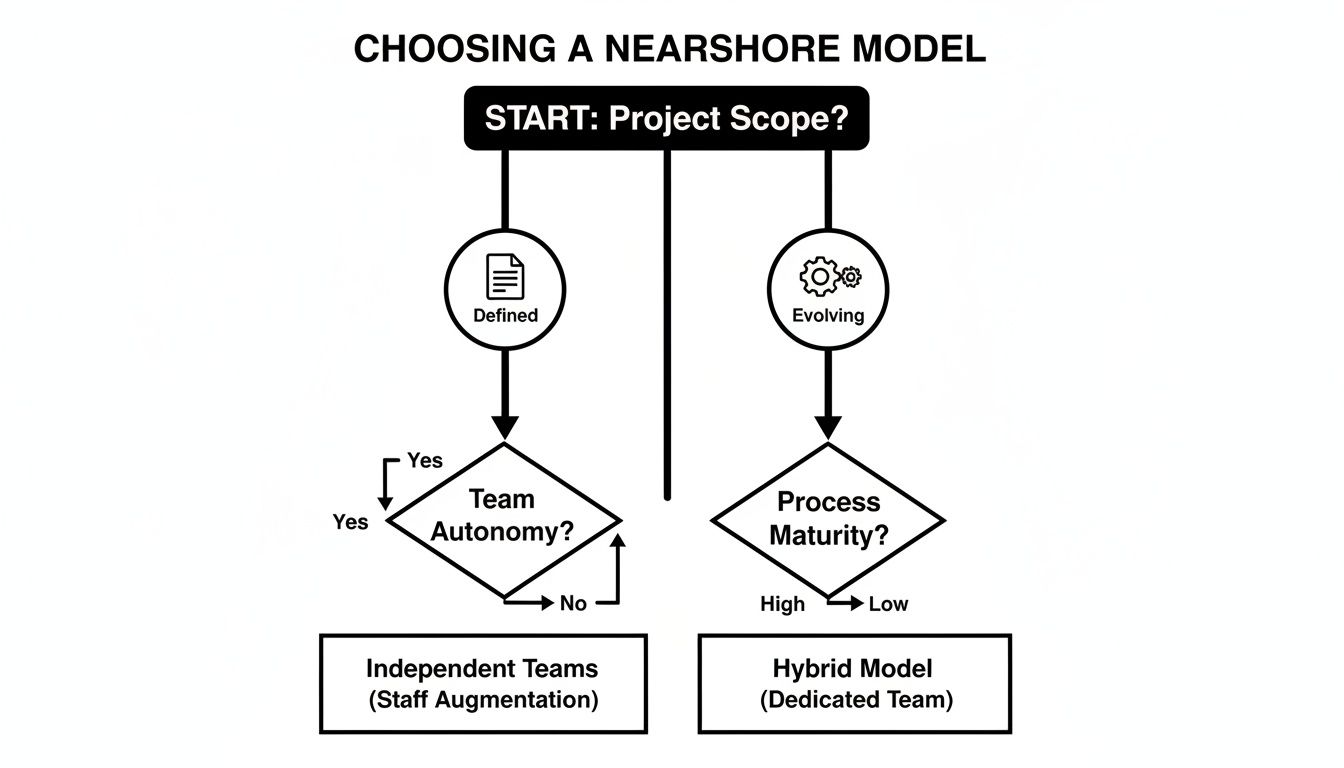
As the flowchart shows, the nature of your project—whether the scope is locked in or still evolving—should shape your entire engagement strategy, from simple staff augmentation to a fully dedicated team.
Ultimately, adapting your Agile ceremonies is about being intentional. It's a mindset shift from just running meetings to actively designing collaborative experiences.
This thoughtful approach ensures that your nearshore agile software development initiative doesn't just work—it thrives. You'll build a connected, high-performing team that delivers incredible results.
Of course, executing these adapted ceremonies requires elite talent that gets the subtleties of remote collaboration. TekRecruiter specializes in deploying the top 1% of engineers who aren't just technical wizards but are also masters of thriving in distributed Agile setups. Let us help you build the cohesive, high-velocity team you need to crush your roadmap.
Building a Cohesive Cross-Border Culture
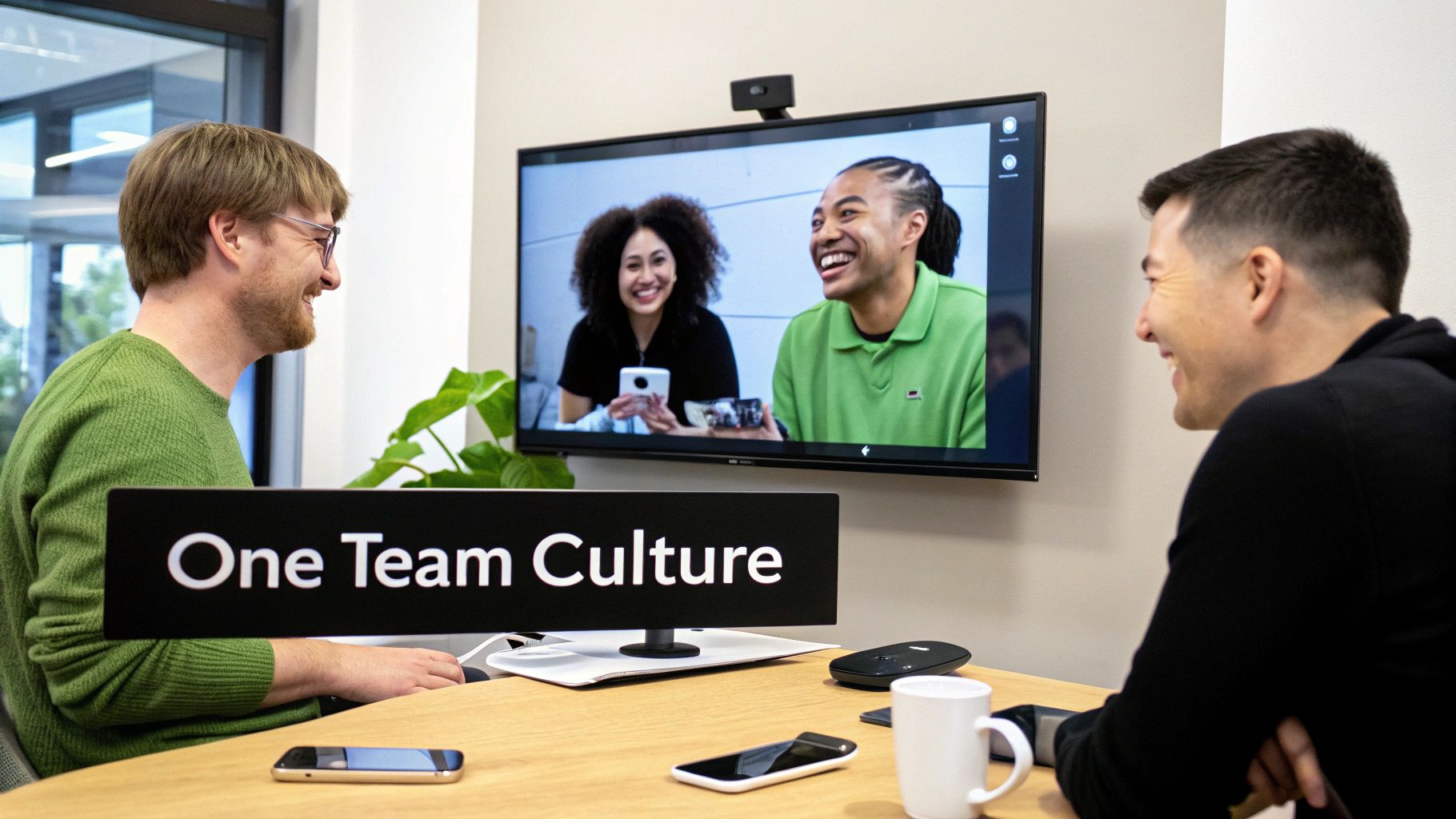
Let's be blunt: technology and process are just table stakes. Culture is the glue that actually holds a distributed team together. In a successful nearshore agile software development model, you stop thinking in terms of an "in-house team" and a "nearshore team." There is only one, unified engineering organization.
Getting to that 'one team' identity takes real, intentional effort. It doesn't just happen because you use the same project management tool.
It all starts with laying down crystal-clear ground rules for communication. Without them, you get ambiguity, which quickly breeds inefficiency and frustration. To get this right, you need to implement proven strategies for effective remote team management.
Setting the Communication Cadence
Defining how your teams talk to each other is fundamental. Everyone needs to know the right channel for the right issue, which cuts out the guesswork and gets problems solved faster. This is about creating a simple but powerful communication playbook.
Here’s a practical framework I’ve seen work wonders in high-performing teams:
Urgent Blockers: This is a drop-everything scenario. A direct video call or huddle is mandatory for any issue actively derailing a sprint.
Complex Technical Questions: Schedule a meeting. Send a prepared agenda. Get the right engineers in the room. This respects everyone's focus time.
General Updates & Asynchronous Questions: Use a dedicated Slack or Teams channel. This keeps the chatter organized and creates a searchable history.
Informal Chatter: You absolutely need non-work channels. Think #music, #pets, #random. This is where the personal bonds form, and those bonds are what fuel professional trust.
This kind of structure empowers engineers to solve problems on their own terms, without fostering a culture of constant interruptions. It’s about creating clarity and reducing the cognitive load on everyone.
The goal isn't just to communicate; it's to build shared understanding and trust. A well-defined communication strategy is the bedrock of a healthy remote culture, turning a group of individuals into a truly cohesive unit.
Navigating Cultural Nuances
Cultural affinity is one of the biggest selling points of nearshoring, but subtle differences always exist. The mark of a mature organization is how proactively it addresses them. Communication styles, for instance, can vary wildly—some cultures are incredibly direct, while others rely on a more nuanced, high-context approach.
A simple yet incredibly effective tactic is to hold a "working norms" session during the onboarding process. Get both your onshore and nearshore folks in a room to openly discuss preferences around giving feedback, meeting etiquette, and even humor. This one conversation builds massive amounts of empathy and prevents the small misunderstandings that can slowly erode trust. At the end of the day, strong interpersonal abilities are non-negotiable; poor soft skills can be a major reason for high employee turnover.
The Essential Tech Stack for Connection
While culture is all about people, the right technology is the central nervous system that connects them. Your tech stack needs to be chosen with intent, fostering both formal productivity and informal connection across your nearshore teams.
Workflow and Project Management:
Jira: The industry standard for a reason. It's your single source of truth for user stories, sprint management, and all work in progress.
GitHub/GitLab: Absolutely essential for version control, code reviews, and maintaining a transparent, collaborative codebase.
Communication and Collaboration:
Slack/Microsoft Teams: This is your digital office. It's where real-time conversations, async updates, and quick team huddles happen.
Zoom/Google Meet: High-quality video is not a luxury, it's a necessity. You need it for all agile ceremonies and important discussions to capture those crucial non-verbal cues.
Intentionally building this cohesive culture is what separates the struggling distributed teams from the high-performing ones. It’s how you ensure every single engineer, no matter their location, feels valued, connected, and empowered to do their best work.
Building this kind of elite, integrated team is our specialty. TekRecruiter doesn't just find engineers; we connect you with the top 1% of talent and help deploy them seamlessly into your existing culture. If you're ready to build a world-class nearshore team, we can help you find the right people to make it a reality.
Measuring Performance and Getting Ahead of Pitfalls
So, how do you really know if your nearshore Agile strategy is working? If you're just looking at the budget, you're missing the entire point. True success is about delivery, quality, and the health of your team. To get the full picture, you need to move past simple cost tracking and build a dashboard of key performance indicators (KPIs) that tells the real story of your partnership.
These metrics aren't just for a report that sits on a manager's desk. They create a shared language for both your onshore and nearshore teams to talk about performance, pinpoint friction, and—just as importantly—celebrate wins. It’s about replacing guesswork with objective reality.
A Dashboard of KPIs That Actually Matter
To measure what matters, you need a balanced view covering speed, quality, and morale. This gives you a complete picture of performance and helps you catch small issues before they blow up.
Here are the critical KPIs I always recommend tracking:
Delivery Velocity: The classic Agile metric. It tracks the amount of work (usually in story points) your team knocks out per sprint. A stable or climbing velocity means you have a healthy, predictable team. A sudden drop? That's your first alarm bell that something's off.
Cycle Time: This is the big one for efficiency. It measures the total time from the moment a developer starts a feature to the second it’s live. Shorter cycle times mean you're delivering value to your users faster. Simple as that.
Defect Escape Rate: This KPI tracks the number of bugs that slip through the cracks and make it into production. A low escape rate is a direct signal of high-quality work and solid testing processes from your nearshore team.
Team Morale / Developer Satisfaction: Don't ever overlook this. A simple, regular survey or a Developer Net Promoter Score (dNPS) tells you if your engineers feel engaged, valued, and plugged in. High morale is a leading indicator of high performance and low turnover—every single time.
These metrics are the bedrock of effective governance. They turn conversations from subjective feelings ("I feel like we're slowing down") into objective data ("Our cycle time has increased by 15%"), which is where real, productive change happens.
Common Pitfalls and How to Sidestep Them
Even with the best metrics, partnerships hit bumps in the road. In my experience, most problems come from misaligned expectations and communication gaps, not a lack of technical skill. Here are the most common traps I’ve seen derail projects and the proven ways to avoid them.
Pitfall 1: Misaligned Business Goals
This happens when the nearshore team is laser-focused on shipping features but has no clue why they're building them. It's a fast track to building the wrong thing, very efficiently.
Mitigation Strategy: Get your nearshore product owner or tech lead into your core business strategy meetings. Make sure they can clearly explain how the current sprint’s work ties directly to a major business objective. This builds a powerful sense of ownership, not just execution.
Pitfall 2: Vague Service Level Agreements (SLAs)
Without clear, written expectations, accountability vanishes. Things like slow response times for critical bugs or people not showing up for key meetings become constant sources of friction.
Mitigation Strategy: Your contract needs specific SLAs. No ambiguity. For example: "Critical Production Bugs: Acknowledged within 1 hour, with a senior engineer assigned and actively working on a fix within 2 hours." This leaves no room for interpretation.
Pitfall 3: Communication Breakdowns
This is the silent killer. Assumptions take the place of clear communication, especially when someone is blocked. An onshore dev might assume their nearshore counterpart is on it, while the nearshore engineer is stuck waiting for more information.
Mitigation Strategy: Define a dead-simple escalation path. If a blocker isn't resolved in four hours, it's mandatory to escalate it from Slack to a direct video call with the relevant team leads. This forces a conversation and a resolution instead of letting problems fester for days.
The global enterprise agile transformation market is projected to grow at a staggering 19.50% CAGR through 2026—a clear sign of massive investment in models like nearshore agile. This growth is driving an evolution in KPIs, moving beyond simple output to include metrics like time-to-sync for resolving cross-border blockers. You can read the full research about these agile statistics to get ahead of the trends.
Navigating these challenges successfully all comes down to a proactive governance framework. You're not just managing a vendor; you're building a partnership founded on transparency, shared goals, and mutual accountability.
Finding a partner who gets these dynamics is everything. At TekRecruiter, we specialize in deploying the top 1% of engineers who aren't just technical wizards—they're experts in the nuances of making distributed teams perform at a high level. We help you build a nearshore Agile practice that’s measured, managed, and built for the long haul.
Build Your Elite Engineering Team with TekRecruiter
Let's be honest. A successful nearshore agile software development strategy comes down to one thing: people. You can have the slickest processes, the most advanced tools, and the clearest KPIs on the planet, but without elite engineering talent, your roadmap is going nowhere.
This guide has laid out the entire playbook. We've covered selecting the right partner, picking an engagement model, measuring performance, and sidestepping the common pitfalls.
The next step? Turning that strategy into reality. And this is where most initiatives hit a wall. The hunt for exceptional engineers becomes a massive bottleneck, burning time and resources that you should be spending on your product. Finding developers who are not just technically brilliant but also a perfect cultural fit and ready for a distributed agile workflow is a serious challenge.
Bridge the Gap Between Strategy and Execution
Just finding a few individual contributors won't cut it. The real win is building a high-velocity, fully integrated team that feels like a seamless extension of your own engineering org.
This means sourcing talent from the best nearshore locations, vetting them for both hard and soft skills, and making sure they can get up to speed fast and start delivering value from sprint one. You need a partner who gets that you’re building a team, not just filling a role. A real partner focuses on creating cohesive units that actually accelerate your roadmap.
The ultimate success of your nearshore initiative depends on the caliber of the engineers you bring on board. The top 1% don't just write code; they solve problems, collaborate proactively, and take ownership of business outcomes.
Deploy the Top 1% of Engineering Talent
At TekRecruiter, we don't just find people. We specialize in sourcing and deploying the top 1% of engineers from the world's premier nearshore hubs. We go way beyond traditional recruiting by focusing on what actually matters: building high-performing, integrated teams ready to tackle your toughest problems.
Our model is built for modern engineering leaders who need to move fast:
Elite Vetting: We’re relentless when it comes to screening for technical excellence, agile maturity, and communication skills. No compromises.
U.S.-Based Project Management: You get local oversight to ensure everything stays perfectly aligned with your business goals. No lost-in-translation moments.
Deep AI Expertise: We started as an AI engineering firm, so we can find specialized talent that’s almost impossible to source elsewhere.
We don't just find talent; we build the high-velocity, integrated teams that innovative companies need to win.
If you're ready to stop searching and start building, connect with TekRecruiter. Let's talk about how we can deploy the world's best engineers to accelerate your vision.
Your Questions, Answered
When I talk with engineering leaders about going nearshore, the same critical questions always come up. They're not just kicking the tires; they're pointed questions about security, integration, and what this model really delivers versus traditional offshoring.
Let's cut through the noise and get you some straight answers. These are the practical realities you need to understand before you commit.
How Do You Protect My Intellectual Property?
Let’s be clear: protecting your IP is non-negotiable. Any nearshore partner worth their salt enforces rigid security from the moment you sign the contract. This isn’t just about an NDA. It’s about building a secure-by-design operation.
That means mandatory VPNs, strict access controls based on the principle of least privilege, and full compliance with international standards like GDPR and SOC 2. Your partner should be able to walk you through their entire security stack.
Ultimately, every line of code, every architectural diagram, and all IP created by your nearshore team is 100% yours. Continuous security audits aren't a "nice to have"; they're a requirement to ensure your most valuable assets stay protected.
What Does the Onboarding Process Actually Look Like?
A clunky onboarding process kills momentum before you even start. The goal is to get your new engineers contributing and productive within the very first sprint.
A good partner handles the initial heavy lifting with a thorough technical and cultural orientation. But then, the ball is in your court. You need to lead a deep dive into your project's specific goals, the current state of the architecture, and the codebase.
The best partners also manage all the logistics—setting up secure development environments, provisioning accounts, and making sure the new engineer is in every single Agile ceremony from day one. They should feel like a core part of the team immediately, not some temporary add-on.
The real distinction between nearshore and offshore isn't just about the clock; it's about the quality of collaboration. Nearshore's cultural and operational affinity drastically reduces communication friction, enabling the proactive, high-bandwidth partnership that complex agile development demands.
How Is Nearshore Really Different From Offshore?
Everyone talks about the time zone alignment, and yes, that’s a huge tactical win. But the fundamental advantage of nearshore is the deep cultural and operational affinity.
Teams in nearshore hubs like Latin America often share strong cultural similarities and business etiquette with North American teams. This isn't a minor detail—it fosters a more intuitive, proactive style of collaboration that you just don't get with massive time and cultural gaps.
This alignment is precisely what makes Agile work. Offshore can be fine for siloed, heavily documented, waterfall-style tasks. But nearshore is built for the complex, iterative, and high-communication problem-solving that actually drives innovation and gets products shipped faster.
Executing a world-class nearshore agile strategy requires elite talent. As a premier technology staffing, recruiting, and AI Engineer firm, TekRecruiter allows innovative companies to deploy the top 1% of engineers anywhere. If you're ready to stop searching and start building the high-velocity, integrated team you need to succeed, connect with us today.