Benefits of Nearshore Outsourcing: Boost Teams and Cut Costs
Discover the benefits of nearshore outsourcing: faster collaboration, lower costs, and access to top regional talent.
The main benefits of nearshore outsourcing are lower costs than hiring onshore, faster access to skilled engineers, and real-time collaboration with a team that shares your working hours. The big wins aren't just about saving money anymore. We're talking about finally getting access to elite global talent and having project collaboration that actually works, thanks to overlapping work hours and cultural alignment. This model is a direct answer to the classic friction of offshore, giving a real strategic advantage to companies that need speed, quality, and agility.
The Strategic Shift to Nearshore Outsourcing

Are you tired of the constant talent shortages? The frustrating project delays and communication black holes that plague traditional offshore models? You're not the only one. Tech leaders are desperately searching for a better way to build and scale their engineering teams, and many are finding the answer right next door.
Nearshore outsourcing has grown up. It's no longer just a cost-cutting tactic; it's a powerful strategic move. CTOs and VPs of Engineering are ditching distant offshore partners for a model that delivers agility and quality without compromise. This is about gaining a genuine competitive edge, not just shaving a few points off a budget. For a full picture, it's worth understanding the pros and cons of offshore outsourcing as a benchmark.
A New Model for High-Performing Teams
The magic is in the proximity. When you partner with teams in neighboring countries, you're tapping into talent that operates in your time zone and gets your cultural nuances. It sounds simple, but this geographic shift completely changes the game.
Instead of waiting 12 hours for a reply on a critical bug report, your teams can jump on a call and solve it in real-time. That immediate feedback loop is the lifeblood of modern agile development.
Nearshore outsourcing transforms the dynamic from a transactional client-vendor relationship to a truly integrated partnership. It’s about building one cohesive team, regardless of physical location, united by shared goals and working hours.
This guide will break down the real-world benefits driving this strategic shift. We’ll show you how nearshore delivers not just efficiency, but a sustainable way to build high-performing, resilient engineering teams ready to tackle your most ambitious projects. The advantages hit several key areas:
Cost Efficiency: Get serious savings without the hidden costs of rework and management headaches that come with time zone disconnects.
Elite Talent Access: Tap into vibrant, highly skilled tech hubs to fill critical roles in a fraction of the time.
Seamless Collaboration: Kill the communication lag and build a "one team" culture with people who work when you do.
Once you see these pillars in action, it becomes clear why this is the go-to model for companies that want to innovate, not just manage contracts. As we cover in our article on the rise of nearshore staffing in 2024, this isn't a fad—it's reshaping how businesses think about global talent.
Saving Smarter, Not Cheaper

When people talk about nearshore outsourcing, the conversation usually starts and ends with "it's cheaper." While that's true, it’s a surface-level take that misses the real story. The financial win isn't just about paying a lower salary; it’s about getting a much higher return on investment (ROI) by dodging all the hidden costs that silently kill budgets in other outsourcing models.
Think of it like price versus value. An offshore team might quote you a dirt-cheap hourly rate, but that "price" never includes the expensive friction that comes later. You’ve got project delays from a 12-hour communication lag, rework caused by cultural wires getting crossed, and the heavy management tax needed to keep a distant team on track. Nearshore flips that script. It’s all about value.
Looking Beyond the Hourly Rate to Find True ROI
The real financial victory with nearshore is budget predictability. Because your teams are working in similar time zones and share a cultural shorthand, collaboration is just easier. It’s more direct. That simple fact dramatically cuts down on the need for constant hand-holding and minimizes the expensive back-and-forth that plagues misaligned teams.
Projects just move faster and hit deadlines more reliably. What you get is a predictable, manageable budget where your money goes into productive work, not putting out preventable fires.
Nearshore cost savings aren’t about paying less per hour. They’re about paying for more productive hours. It’s a strategic pivot from chasing the lowest rate to getting the highest possible value for every dollar you spend.
This operational efficiency delivers savings that blow initial estimates out of the water. In fact, most businesses see 30-50% in cost savings with nearshore partners compared to hiring onshore, with some hitting 40-70%. This isn't about finding the rock-bottom price; it's about smarter economics that sidestep the hidden fees of miscommunication, turnover, and launch delays. For perspective, nearshore software development rates often sit 46% below U.S. levels, freeing up your budget for actual innovation.
Turning Those Savings into Strategic Growth
For any IT Director or Program Manager, these smarter savings unlock some powerful opportunities. Instead of burning cash on unforeseen expenses and management overhead, you can reinvest that capital into initiatives that actually drive the business forward.
This new budgetary freedom allows you to:
Accelerate Cloud Modernization: Get your critical infrastructure to the cloud faster without cutting corners on security or expertise.
Expand AI Initiatives: Fund the machine learning models, data projects, or automation that give you a real competitive edge.
Drive Product Innovation: Build out new features, explore new markets, or fund the next generation of your core product.
Ultimately, the cost benefit of nearshore is about making every dollar count toward growth. It’s a calculated financial strategy that strengthens your bottom line while improving project outcomes and speed. For a deeper dive, check out our guide on maximizing cost savings with nearshore software development.
At TekRecruiter, our entire model is built around creating these high-value, cost-efficient teams. We connect you with the top 1% of engineers from Latin America, helping you realize significant savings without ever having to compromise on the quality and collaboration your most important projects demand.
Accessing Elite Global Engineering Talent Pools

While the cost savings are a huge draw, let’s be honest: the single most powerful benefit of nearshore outsourcing is its direct answer to the brutal tech talent shortage at home. Finding just one qualified AI or DevOps engineer can feel like a six-month mission. Nearshore partnerships, on the other hand, plug you directly into entire ecosystems of highly skilled, ready-to-work professionals.
This isn’t about just filling an empty seat. It’s a fundamental shift in how you build and scale your engineering teams.
Think of it like building a world-class orchestra. You could spend months searching for individual musicians in your city, hoping to find the right talent. Or, you could get an all-access pass to the world's most prestigious conservatories, where top-tier performers are already trained, experienced, and ready to play. That's what nearshoring does for your tech team.
Tapping into Vibrant Tech Ecosystems
Latin America has spent the last decade building incredibly deep talent pools. These aren't just random collections of developers. They are thriving, interconnected tech hubs with strong universities and a culture of constant learning.
They produce engineers who are not just technically sharp but also have the soft skills—like proactive communication and creative problem-solving—that are absolutely critical for modern agile development.
The sheer scale of this talent is a game-changer. There are over 1 million IT professionals in Latin America. This creates a massive, English-proficient talent pool that matches or even surpasses the quality found offshore. For Software Development Leaders, this is huge—42% now prioritize talent access over cost, and nearshoring is filling crucial DevOps and cloud roles 75% faster than traditional hiring.
To see how specialized outsourcing can supercharge your talent acquisition, check out this guide on Recruitment Process Outsourcing (RPO).
Gaining More Than Just Technical Skills
One of the most overlooked upsides of nearshoring is the caliber of the talent. The goal isn't just to find someone who can write code. It's about finding the top 1% of engineers who think strategically, collaborate seamlessly, and actually drive innovation.
Nearshore outsourcing is a talent multiplier. It allows you to bypass the fierce competition and high costs of domestic hiring to build a more resilient, globally diverse team with specialized skills that are often scarce locally.
This approach gives you a direct line to engineers with specific, in-demand expertise that might be impossible to find otherwise. You can rapidly assemble teams with deep experience in:
Artificial Intelligence and Machine Learning: Find data scientists and AI engineers with real-world experience building and deploying complex models.
Cloud-Native Development: Onboard certified AWS, Azure, and GCP specialists who live and breathe modern cloud architecture.
Advanced DevOps and CI/CD: Integrate engineers who can build and manage sophisticated, automated delivery pipelines from day one.
This strategic injection of talent means you fill critical roles in weeks, not months. You end up with a stronger, more capable, and future-proof organization. To learn more, check out our guide on tapping into Latin America's tech talent pool.
At TekRecruiter, we specialize in connecting you with this exact tier of talent. Our model is built to deploy the top 1% of engineers from elite nearshore hubs, giving you the specialized skills you need to push your most important technology initiatives forward, faster.
Boosting Project Velocity with Real-Time Collaboration
What happens when your extended engineering team works the same hours you do? Simple. Everything gets faster.
One of the biggest wins with nearshore outsourcing is ditching the communication lag that absolutely cripples traditional offshore models. It’s the difference between squashing a bug in minutes versus waiting a full day just to get a reply.
This all comes down to timezone alignment. Instead of booking midnight calls to sync with a team halfway across the globe, your developers can just hop on a quick video call at 10 AM. This immediate, real-time feedback is the lifeblood of any modern agile, CI/CD pipeline.
A Tale of Two Development Cycles
Picture this: a critical bug pops up in your production environment. With a classic offshore team, your U.S.-based project manager flags it at the end of their day. The offshore team, just clocking in, picks it up but has questions. Those questions sit in a queue for hours until the U.S. team is back online.
This painful cycle repeats, turning a simple fix into a multi-day saga.
Now, imagine that same scenario with a nearshore team in Latin America. The bug is found, and within minutes, your domestic and nearshore engineers are in a virtual room, sharing screens and hammering out a solution together. The problem is diagnosed and patched before lunch.
This isn’t just a nice-to-have; it’s a fundamental shift in project velocity. Shared work hours create a genuine "one team" vibe where cultural sync and instant feedback obliterate bottlenecks and speed up every decision.
The real power of nearshore collaboration lies in its ability to compress timelines. By removing communication friction, you enable a seamless flow of information that keeps projects moving forward, turning potential delays into opportunities for rapid progress.
This kind of collaborative environment is non-negotiable for any project where speed is a competitive weapon. For a deeper look into fostering this dynamic, check out our guide on how to leverage technology to boost your remote work teams.
From Lag Time to Real Time
The impact of this seamless collaboration isn't just a feeling—it's measurable. In fact, nearshore outsourcing delivers an impressive 80% project success rate, a stark contrast to the 60% seen in offshore models.
This massive difference comes down to fewer communication breakdowns. Nearshore setups see 65% fewer issues and hit 40% faster completion times. For any CTO or VP of Engineering, that means pushing DevOps, cloud, or AI projects forward without the usual drag of asynchronous work. You can find more details in these nearshore outsourcing statistics.
This surge in velocity translates directly into a faster time-to-market, giving your business a serious edge.
Outsourcing Model Performance Comparison
To really see the difference, let's put the two models head-to-head on a few key metrics that every engineering leader cares about. The contrast in day-to-day operations is striking.
Metric | Nearshore Model | Offshore Model | Strategic Impact |
|---|---|---|---|
Problem Response Time | Immediate (minutes) | Delayed (8-12 hours) | Faster bug fixes and issue resolution |
Meeting Scheduling | Simple, within business hours | Complex, often outside core hours | Increased team cohesion and morale |
Agile Ceremonies | Real-time and interactive | Asynchronous or difficult to align | More effective sprints and retrospectives |
Decision Making | Quick and collaborative | Slow and sequential | Accelerated project milestones |
The data is clear: when your teams can actually talk, they can build—faster and better. The nearshore model isn't just about being in a nearby country; it’s about achieving operational excellence driven by real-time human connection.
Ready to see how a truly collaborative, high-velocity nearshore team can transform your projects? At TekRecruiter, we specialize in recruiting the top 1% of engineers from Latin America, in time zones that make real-time collaboration easy. Let us help you build the agile, responsive team you need to win.
Building Your Elite Engineering Team with TekRecruiter
Knowing the benefits of nearshore outsourcing is one thing. Actually turning that knowledge into a high-performing engineering team that ships code and drives revenue? That’s a whole different ballgame.
It's easy to get sold on the theory—lower costs, access to senior talent, and real-time collaboration. But this is where the strategy has to meet the pavement. The single most important decision you'll make is choosing the right partner. It's the difference between hiring a few remote developers and building a truly integrated, elite engineering force.
Turning Nearshore Theory into Tangible Results
At TekRecruiter, we’ve built our entire model to deliver on the promise of nearshore, systematically. We're a technology staffing and recruiting firm with a single mission: to help innovative companies deploy the top 1% of engineers, wherever they happen to be.
We don’t just find talent; we help you assemble cohesive, high-impact teams. Our approach taps into the world-class engineering talent in Latin America, giving you direct access to the specialized skills you’re struggling to find, from AI and machine learning to cloud architecture and DevOps.
The real power of a nearshore partnership isn't just about geography. It’s about operational and cultural alignment, making sure your extended team operates as a seamless part of your own, driving toward the same goals with the same urgency.
To cut the communication friction that plagues so many other models, TekRecruiter screens nearshore engineers for communication and time-zone overlap. That gives you the cost and talent advantages of nearshore with the clear communication of a domestic team.
The chart below isn't just marketing fluff; it visualizes the real-world outcomes of a well-managed nearshore model.
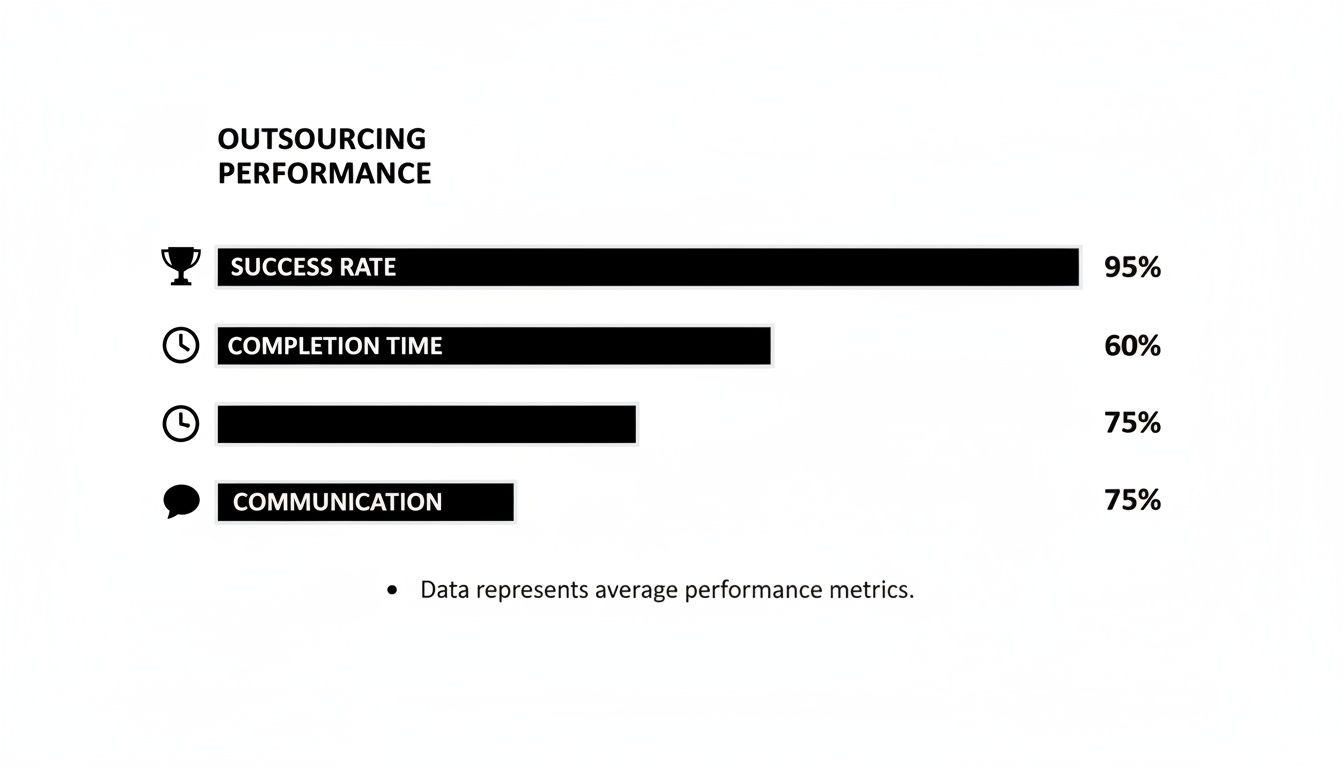
The data tells a clear story: when you get the model right, strategic nearshore partnerships consistently deliver higher success rates, faster project completion, and far smoother communication.
Specialized Expertise for Your Most Critical Projects
In today’s world, generalists won't cut it. You need specialists who have proven, certified expertise in the platforms that actually run your business. That’s who we recruit.
That means we bring verified experts to the table:
Salesforce: We recruit certified pros who build, customize, and integrate solutions on the world's biggest CRM platform.
Amazon Web Services (AWS): We recruit AWS-certified engineers who design and manage scalable, secure, and cost-effective cloud infrastructure.
Microsoft Azure: We recruit specialists who build and manage applications across Microsoft’s powerful cloud ecosystem.
Google Cloud Platform (GCP): We recruit engineers who use GCP's advanced services for everything from data analytics and machine learning to application modernization.
This deep, certified expertise isn't just a badge. It means we find specialized AI and cloud engineers with precision. Whether you need to plug a specific skill gap on your team or hire a full crew, we have the network to find the right people.
Flexible Engagement Models Built for Your Needs
We get it—every company is different. Your needs can change on a dime, which is why we've built our engagement models to be just as agile as you are.
Staff Augmentation: Seamlessly embed our elite engineers directly into your current teams. Fill skill gaps, hit aggressive deadlines, and add deep expertise exactly where you need it, right now.
MSP & Outsourcing Search: When a project belongs with an outside team, we find and vet the best nearshore software development company for it. You contract with that company directly, and the search costs you nothing.
This flexibility ensures you get all the benefits of nearshore outsourcing without getting locked into some rigid, one-size-fits-all contract. You get the A-list talent you need, on terms that actually work for you.
At TekRecruiter, we recruit the engineers who turn your vision into reality. We combine elite global talent with deep technical recruiting expertise to help you hire people who are hard to find elsewhere. If you’re ready to stop searching for talent and start building your next world-class engineering team, contact us today.
Answering the Tough Questions on Nearshore Outsourcing
Let's be direct. Moving part of your engineering team to another country, even a nearby one, brings up some serious questions. It’s not just about finding talent; it’s about trust, security, and making sure this move actually pays off. You have to get this right.
This isn’t just a theoretical exercise. We're going to tackle the big concerns head-on—from protecting your most valuable code to making sure your new engineers feel like part of the team, not just a name on a Slack channel. Think of this as the practical guide you need to make a smart, confident decision.
How Is My Intellectual Property Protected?
This is the big one. Your source code, your proprietary data, your trade secrets—they're the lifeblood of your company. Handing over access is a massive deal, and it's where nearshoring has a powerful, built-in advantage over traditional offshore models.
The key difference comes down to legal and regulatory alignment. Many countries in Latin America have built their legal systems to mirror those in the U.S. and Western Europe. This isn't a minor detail; it means contracts are enforceable, and legal action, if ever needed, isn't a journey into the unknown.
The real security of nearshoring comes from legal harmony. When a partner country respects international IP conventions and has strong data privacy laws, you’re not just hoping for the best—you're building on a foundation of trust.
A partner who takes this seriously won't just talk about security; they'll live it. It's a multi-layered approach that should be non-negotiable:
Ironclad Legal Agreements: We're talking comprehensive NDAs, Master Service Agreements (MSAs), and clear IP assignment clauses that leave no doubt: your company owns 100% of the work product. Period.
Fortified Infrastructure: This means secure networks, mandatory VPNs, strict access controls, and endpoint security on every machine. Unauthorized access should be virtually impossible.
Rigorous Vetting and Training: Every engineer should undergo thorough background checks and receive ongoing training in security best practices and data privacy protocols.
When you combine strong legal frameworks with proactive security measures, you create an environment where your IP is genuinely safe.
How Do I Actually Integrate Nearshore Engineers into My Team?
Getting integration right is the difference between a disconnected group of contractors and a high-performing, unified team. It’s not about just adding someone to a GitHub repo; it’s about building a single, cohesive culture. The great news? Nearshore's time zone overlap and cultural familiarity make this infinitely easier.
First things first: treat them like your employees from day one. They aren't "the nearshore team"; they are your team. This means they're in every daily stand-up, every sprint planning session, and even the virtual happy hours. Consistent video calls are crucial—it puts a face to a name and builds real human connection.
A killer onboarding process is just as vital. It needs to cover your tech stack, of course, but also your unwritten rules: how you communicate on Slack, how you manage tickets in Jira, and what your philosophy is on code reviews. The secret weapon? Assign an onshore "buddy" or mentor. Because they work the same hours, this relationship becomes a natural, productive lifeline for the new engineer, not a logistical nightmare scheduled across a 12-hour time difference.
What's the Real Way to Measure ROI?
If you’re only looking at the hourly rate, you’re missing the point entirely. Measuring the true return on a nearshore partnership goes way beyond a simple cost comparison. The real ROI is found in the operational gains—the speed, the quality, the stability—that directly impact your bottom line.
To get the full picture, you need to track a mix of metrics.
Key Metrics for Measuring Nearshore ROI:
Category | Specific Metrics to Track | Why It Matters |
|---|---|---|
Financial Efficiency | - Fully loaded cost per engineer (salary, benefits, overhead) - Reduction in recruitment agency fees - Overall project budget adherence | This gives you a clear picture of direct cost savings and predictable spending. |
Project Velocity | - Cycle time (from commit to production) - Sprint velocity and completion rate - Time-to-market for new features | This measures the raw speed and efficiency you gain from real-time, same-day collaboration. |
Team Performance | - Employee retention rates (nearshore team) - Code quality metrics (bug count, code churn) - Team morale and engagement survey results | This highlights the impact on team stability, product quality, and the overall health of your culture. |
When you track these metrics together, you'll see the full story. You’ll find that the benefits of nearshore outsourcing aren't just about reducing costs. They’re about shipping better products faster with a more stable, engaged, and motivated engineering team.
Ready to stop searching for talent and start building a world-class engineering team? TekRecruiter is a technology staffing and recruiting firm that allows innovative companies to deploy the top 1% of engineers anywhere. We recruit elite talent from Latin America to help you build a team that delivers.
See how TekRecruiter recruits nearshore engineers in Latin America.
 Ron SmithPresident & Lead RecruiterTekRecruiter