How to Reduce Employee Turnover: A Practical Guide for Tech Leaders
Discover how to reduce employee turnover with practical strategies for tech teams, manager training, and clear career paths.
Let's be blunt about the problem that keeps every tech leader awake at night: the revolving door of your best engineers. This isn't just a hit to morale; it’s a direct shot at your product roadmap, your innovation pipeline, and your bottom line.
When a senior engineer walks out, they don't just leave a vacancy. They take a massive chunk of institutional knowledge with them—the kind of nuanced, undocumented wisdom that’s impossible to replace.
The fallout spreads fast. Productivity tanks as the remaining team members scramble to pick up the slack, which is a fast track to burnout and, you guessed it, more resignations. It’s a vicious cycle. According to Gallup, the lost productivity from employee turnover costs the global economy trillions of dollars. For you, it means delayed projects and a slow erosion of your competitive edge while you're stuck in a constant loop of hiring and onboarding.
The Real Damage Is What You Don't See
Sure, the financial hit is staggering, but the costs you can't easily measure are often far more destructive. High turnover is a massive red flag for deeper cultural problems. It could point to a lack of psychological safety, where engineers are afraid to take risks or speak up.
When an essential team member departs, it's not just the intimate knowledge of our workflow we lose. We also face a decrease in productivity and employee morale until a fitting replacement is found.
This kind of churn poisons the well for recruiting, too. The tech community is small and word gets around. Once you're known as a "revolving door" company, attracting the A-players you need to grow becomes exponentially harder.
And while everyone defaults to blaming compensation, the real culprits are usually harder to nail down. More often than not, it comes down to a fundamental breakdown in communication and a lack of skilled management. We've seen it time and time again; in fact, we wrote a whole guide explaining why soft skills are the reason behind high employee turnover.
This guide is your playbook to fix it. We’re going to help you shift from constantly putting out 'quitting' fires to building a proactive culture of retention. It’s time to stop guessing and start implementing data-backed strategies that create an environment where your best engineers actually want to build their careers.
Remember, finding great talent is only half the battle. Keeping them is what separates good companies from truly innovative ones. If your main challenge is deploying and retaining that top 1% of engineering talent, TekRecruiter provides specialized technology staffing and AI engineering services designed to build the stable, elite teams that drive real success.
Diagnosing Why Your Engineers Are Walking Away
Let’s be honest. When an engineer quits, the go-to assumption is that they left for "more money" or a "better title." It’s an easy answer, but it’s almost always a trap. Relying on guesswork keeps you from seeing the real, often fixable, issues that are pushing your best talent out the door.
Before you can build a solid retention strategy, you have to play detective. That means digging into the data to understand the specific, nuanced reasons your engineers are actually leaving.
The process starts with getting honest feedback, which is harder than it sounds. Standard exit interviews are often filled with polite, surface-level answers because no one wants to burn a bridge on their way out. To get to the truth, you need to combine a few different methods to piece together the full picture.
It’s about moving from simply identifying the problem to taking deliberate action that fosters the kind of environment people want to be a part of.
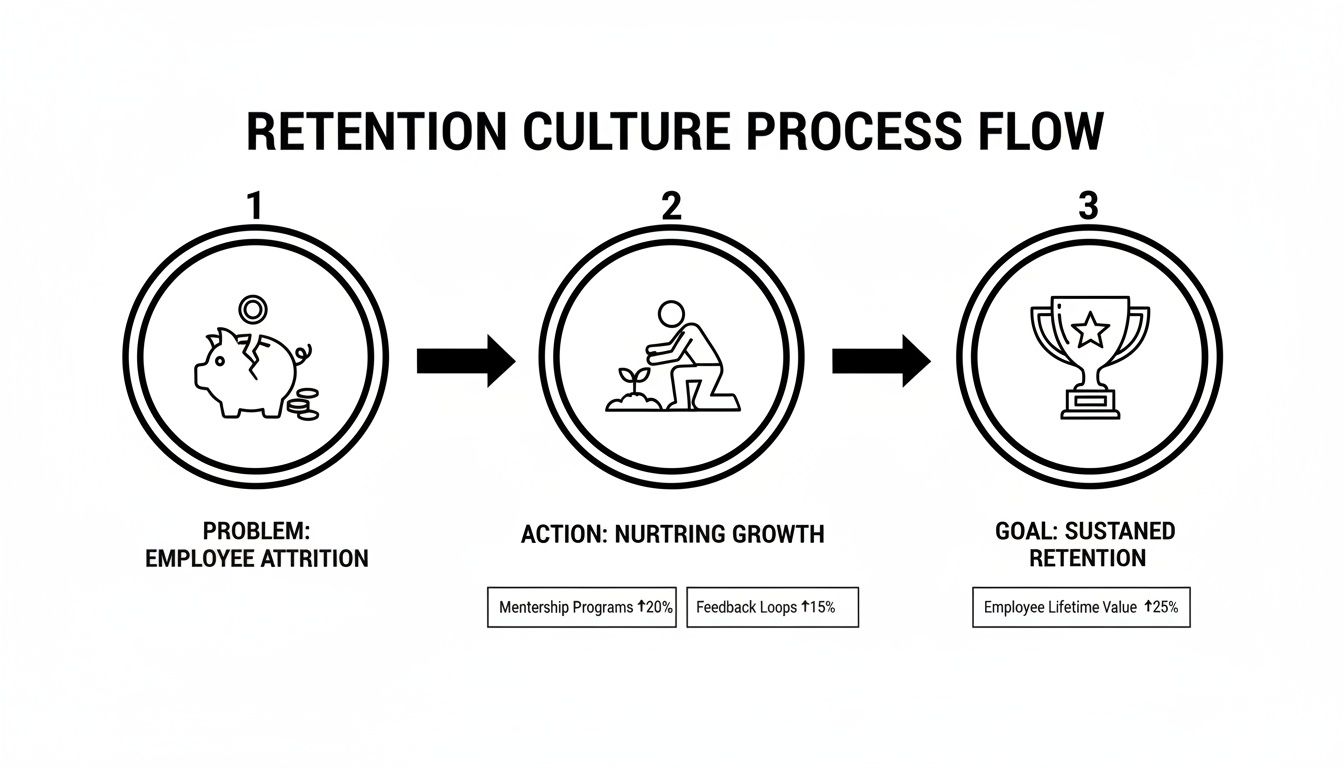
This framework isn't just a flowchart; it’s a mindset shift. You have to actively nurture your culture to achieve the goal of making your team a place where great talent thrives.
Gathering Candid Feedback
Believe it or not, the most valuable feedback comes from the people who still work for you, not just the ones who are leaving.
Anonymous pulse surveys are a great way to get a real-time feel for team morale and catch frustrations before they boil over into resignations. These are short, frequent check-ins, not massive annual surveys nobody wants to fill out.
Combine those surveys with proactive "stay interviews." Unlike an exit interview, a stay interview is all about understanding what keeps your best people here and what might tempt them to look elsewhere. It's a conversation, not an interrogation.
Try asking direct, open-ended questions like:
"What do you actually look forward to when you start your workday?"
"If you could change one thing about your job to make it better, what would it be?"
"Honestly, what kind of opportunity would make you consider leaving?"
These conversations do two things: they give you incredibly valuable, actionable insights, and they show your team you're genuinely invested in them. That alone builds trust. Of course, you still need to get what you can from departing staff. For tips on that, check out our ultimate guide to exit interviews.
Analyzing the Data for Critical Patterns
Once you have feedback from surveys and interviews, it’s time to pair it with your HR data. Don't just stare at the overall turnover number. You need to slice and dice the data to find the hidden stories.
The goal is to get from a vague "we have a turnover problem" to a specific diagnosis like, "We have a regrettable turnover problem with mid-level engineers on the Platform team who leave between months 12 and 18, citing a lack of career growth."
Look for the patterns. Is turnover concentrated in one specific team or under a particular manager? Do you see a spike in resignations after bonuses are paid out or right after a massive project launch? Finding these trends is where the real work begins.
Focusing on Key Turnover Metrics
To get a true read on the health of your engineering org, you have to track more than just the raw turnover rate. I've found a few key metrics are far more insightful for diagnosing the real issues.
This table breaks down the most important metrics to start tracking immediately.
Key Turnover Metrics for Your Engineering Organization
Metric | What It Measures | How to Calculate It | Why It Matters for Tech Teams |
|---|---|---|---|
Overall Turnover Rate | The percentage of employees who leave over a specific period. | (Total Departures / Average Headcount) x 100 | Provides a baseline health check, but lacks context on its own. It's your starting point. |
Regrettable Turnover | The departure rate of high-performing, high-potential employees you wanted to keep. | (Number of High-Performers Who Left / Total Departures) x 100 | Losing a top 10x engineer hurts way more than losing an underperformer. This metric quantifies the real impact of turnover. |
First-Year Attrition | The percentage of new hires who leave within their first 12 months. | (Departures Within 1 Year / Total Hires in That Period) x 100 | A high number here is a huge red flag for your hiring process, onboarding, or team culture. It means you're burning cash and time. |
Manager-Specific Turnover | The turnover rate for employees reporting to a specific manager. | (Departures from Manager's Team / Average Team Headcount) x 100 | People leave managers, not companies. This helps you spot leadership issues that need immediate coaching or intervention. |
By tracking these specific numbers, you stop guessing and start making targeted, data-driven decisions. Your retention strategy transforms from a shot in the dark to a surgical action plan.
If diagnosing these issues and finding the right talent to build a stable team feels overwhelming, TekRecruiter can help. We specialize in deploying the top 1% of engineers who are vetted not just for skill, but for long-term project alignment, ensuring you build a team that stays and delivers.
Transforming Managers Into Retention Magnets
Once you start digging into the real reasons for turnover, the data almost always points to one uncomfortable truth: people don't leave companies, they leave managers.
It’s the classic misstep. You take your most brilliant engineer and promote them into a leadership role. It seems logical, right? But the skills that make someone a phenomenal coder—deep focus, solitary problem-solving, raw technical mastery—are often the opposite of what makes a great people leader.
This is precisely where most retention strategies completely fall apart. An untrained manager, no matter how well-intentioned, can accidentally kill team morale, create communication chaos, and ultimately drive your best people out the door. Investing in your managers isn't just a "nice-to-have"; it's the single most powerful lever you have for keeping your team intact.
From Coder to Coach: The Essential Skill Shift
An engineering manager's job isn't to write code anymore. It's to unlock the full potential of the people who do. That demands a completely different toolkit, one built around soft skills that have a very, very hard impact on your bottom line.
Here are the most critical skills your new and existing managers need to master, starting now:
Giving Actionable, Timely Feedback: Engineers don’t want vague praise or a surprise performance review once a year. They crave specific, constructive input that helps them get better. Managers need to learn how to deliver feedback that’s both direct and kind.
Fostering Psychological Safety: This is the absolute bedrock of a high-performing team. It's the shared belief that you can speak up, ask a dumb question, or admit a mistake without getting shut down or humiliated. Managers build this by showing vulnerability themselves and encouraging healthy, respectful debate.
Mastering the 1-on-1: A good 1-on-1 is never a status update. It's a protected conversation that’s all about the employee—their career goals, their roadblocks, and their well-being. A great manager uses this time to listen way more than they talk.
In the tech staffing world, we see it every day. We're constantly trying to find that top 1% of engineering talent, and the one thing that makes or breaks a team is the manager. Improving manager quality can slash turnover by up to 50%. Think about that. Gallup's global workplace research found that half of the employees who quit do so because of their direct boss. Bad management is the silent killer, especially in competitive fields like AI and cloud engineering.
An Action Plan for Upskilling Your Managers
Turning your managers into leaders people want to work for requires a real commitment, not just a one-off workshop. It’s an investment that pays you back in loyalty, innovation, and stability.
A manager’s job is to create an environment where their team can do their best work. They are a multiplier, either amplifying their team's talent and motivation or diminishing it. There is no in-between.
Here's a practical, three-pronged approach you can implement:
Launch a Manager Coaching Program: Pair new managers with seasoned internal leaders or bring in an external coach. This gives them a safe space to talk through real-world challenges, like dealing with a disengaged engineer or navigating a tough project deadline.
Implement 360-Degree Feedback: This is where managers get anonymous, confidential feedback from their direct reports, their peers, and their own boss. It's an eye-opening way to get a complete picture of their leadership style and uncover blind spots they never knew they had.
Provide a Leadership Playbook: Don't leave them guessing what "good" looks like. Create a simple, accessible guide that spells out your company’s expectations for leaders. Include templates for effective 1-on-1s, frameworks for career path conversations, and practical tips for recognizing great work.
A huge part of this is just defining what a manager is even responsible for. Check out our detailed breakdown of hiring manager roles and responsibilities to make sure your leadership expectations are crystal clear from day one.
Real-World Scenario: The Multiplier Effect
Picture two teams. Team A is led by a "Diminisher"—a brilliant ex-engineer who micromanages every detail, constantly overrides decisions, and gives vague, unhelpful feedback. Team B is led by a "Multiplier"—a manager who asks sharp questions, gives her team real ownership, and celebrates both the wins and the lessons learned from failures.
What happens? Team A is drowning in stress, engagement is in the gutter, and talented engineers are constantly heading for the exit in search of more autonomy. Team B, on the other hand, becomes an innovation hub that attracts talent from other parts of the company and consistently ships incredible work. The only variable was the quality of leadership. That’s how directly upskilling your managers impacts turnover.
Building this kind of leadership muscle is foundational. If you’re struggling to find and keep the A-players you need to drive your projects forward, TekRecruiter can help. We specialize in deploying the top 1% of engineers and AI specialists who thrive under great leadership, helping you build the dedicated teams that get results.
Building Career Paths That Make Engineers Stay
Your best engineers are wired for growth and challenge. The moment their learning curve flattens and the work feels routine, their focus starts to drift. If they can't see a clear, compelling future inside your company, you can bet they'll start looking for one somewhere else.
This is probably one of the most common—and entirely preventable—reasons for losing top-tier talent.
And no, simply dangling a promotion isn't the answer. The old-school model of forcing your best technical minds into management just to give them a raise is a recipe for disaster. You take a brilliant engineer away from what they do best and create an unhappy, ineffective manager. It's a two-for-one failure that tanks team morale and accelerates attrition.
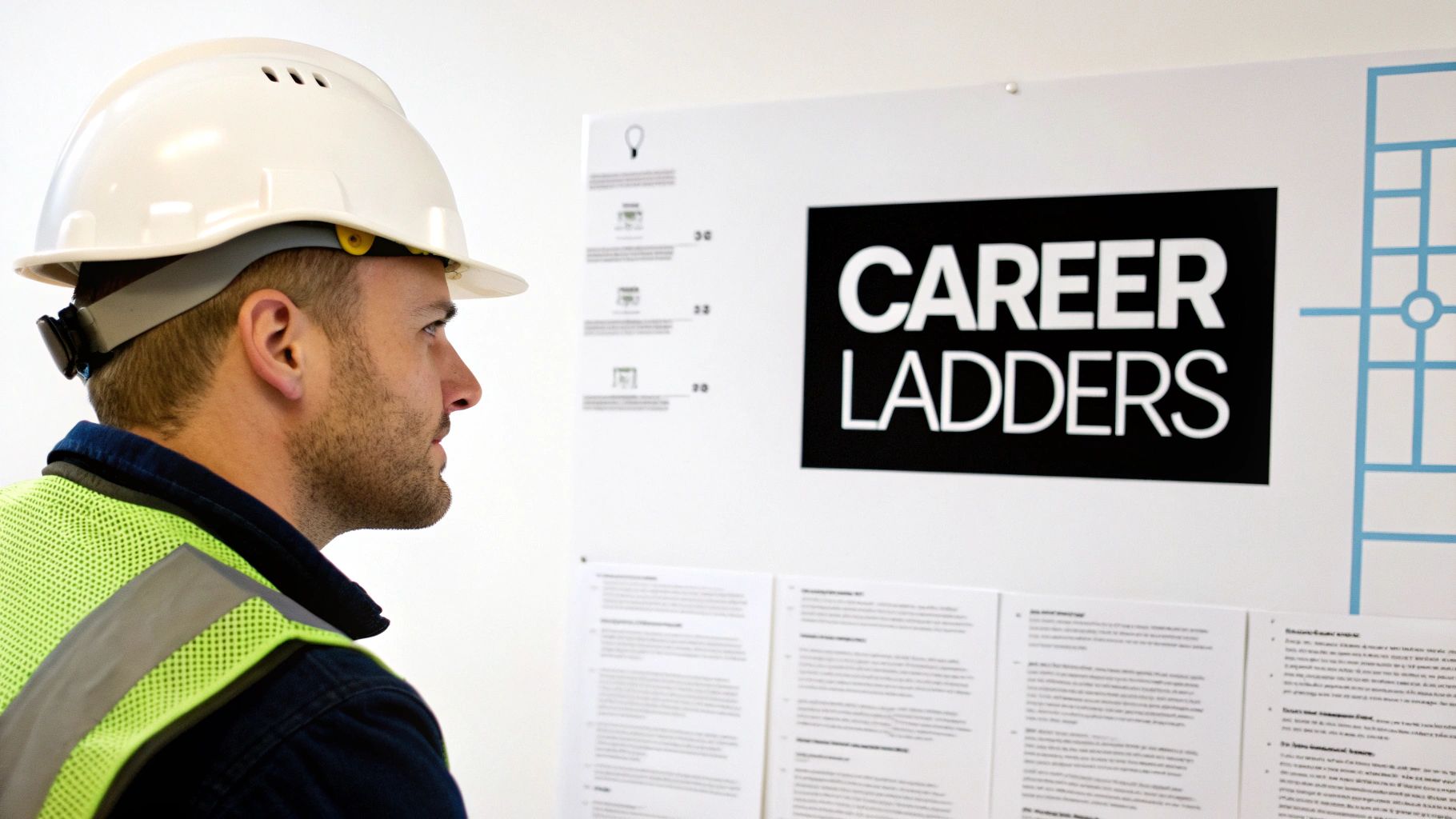
A modern retention strategy needs something better: a robust system of career paths that understands growth doesn't always lead to a corner office. It's about creating parallel, equally prestigious tracks for both individual contributors (ICs) and managers.
Developing Dual Career Ladders
The core idea is simple. Create two distinct, equally viable paths for advancement. This ensures your most talented coders can keep growing in seniority, influence, and compensation without being shoehorned into people management.
The Management Track: This path is for engineers who show a real knack and desire for leadership. It’s all about developing skills like coaching, strategic planning, and building high-performing teams. Titles might progress from Engineering Lead to Engineering Manager, then Director of Engineering.
The Individual Contributor (IC) Track: This path is built for the technical experts who live and breathe their craft. It rewards deep mastery, innovation, and technical leadership. Here, titles could move from Senior Engineer to Staff Engineer, then Principal Engineer—with pay and influence that mirrors their management counterparts.
The goal is to make "Principal Engineer" as respected and impactful as "Engineering Director." When you truly value both paths, you give engineers the freedom to choose the journey that aligns with their actual skills and passions. That’s a powerful retention magnet.
Mapping Skill-Based Growth Paths
Beyond just splitting IC and Manager tracks, you need to get more granular. Highly specialized roles require their own defined growth trajectories. An AI Specialist or a DevOps Engineer has a unique skill set, and their career path should reflect that. Generic ladders just won't cut it.
For a DevOps Engineer, a career map might look something like this:
Mid-Level: Focuses on mastering CI/CD pipelines and infrastructure-as-code tools.
Senior: Starts leading major infrastructure projects and mentoring junior engineers.
Staff/Principal: Drives architectural decisions for scalability and reliability across the entire organization.
One of the most effective ways to make engineers want to stay is by clearly outlining their future with practical examples of career development plan models. These frameworks make growth tangible. They transform a vague promise of "advancement" into a clear, actionable roadmap and show you’re genuinely invested in their long-term success.
Making Career Development a Continuous Conversation
An annual review is too little, too late. Career development needs to be woven into the fabric of your regular one-on-ones. Managers should be trained to constantly connect an engineer's personal growth ambitions with real, impactful company goals.
This strategy pays off, big time. Mercer's data from over 2,600 companies shows that a strong internal promotion culture can slash voluntary turnover by 23-30%. The logic is simple: higher positions offer better pay, more autonomy, and the challenging growth paths top performers crave. It creates a powerful incentive to stick around.
When you show people a clear path from where they are to a future they’re excited about, you stop competing on salary alone. You start competing on opportunity—and that's a much stronger foundation for building a stable, elite engineering team.
If creating these structures and finding engineers motivated by long-term growth is your priority, TekRecruiter can help. We specialize in deploying the top 1% of engineers who are looking for more than just a job—they're looking for a career. We connect innovative companies with the talent needed to build lasting success.
Crafting an Unbeatable Employee Experience
While great managers and clear career ladders are the bedrock of retention, a killer Employee Value Proposition (EVP) is the secret weapon that makes you unbeatable.
In a market this hot, your EVP is the entire package—it's everything you offer in exchange for your team's skill and commitment. It’s so much more than a paycheck.
To really get a grip on turnover, you have to think about the entire employee experience. This means building an environment where the top 1% of talent doesn't just show up to work—they show up to win. You're creating a place so compelling that your best people wouldn't even think about leaving.
The best EVPs are built on what truly matters to top engineers today: a real culture of innovation, access to modern tech, genuine work-life flexibility, and a mission that actually means something.
Beyond the Paycheck: What Engineers Really Value
Let's be clear: compensation is table stakes. If you're not competitive, you're not in the game. But once salaries are fair, the real drivers of loyalty kick in. These are the things that create a magnetic culture.
Here’s what a winning EVP for tech talent looks like:
A Culture of Innovation: Engineers are builders. They live to solve complex problems, test new ideas, and see their work make a real impact—without getting tangled up in bureaucracy.
Access to Modern Tools: Nothing kills an engineer's motivation faster than being forced to use outdated tech. Giving them a modern stack shows you're invested in their work and their growth.
Genuine Work-Life Flexibility: This has nothing to do with a foosball table. It’s about trusting your team with real autonomy over where and when they get their work done. It’s about respecting their life outside the office.
Nailing these areas pays off, big time. Tech firms that get the employee experience right see dramatically better retention. In fact, with 89% of HR leaders calling retention their top priority, companies that emphasize their EVP hold onto their talent 58% better. You can explore more insights on 2025 employee turnover statistics to see how a strong EVP keeps tech turnover impressively low.
Leveraging New Workforce Models for Flexibility
One of the most powerful moves you can make to boost your EVP is embracing remote and nearshore team models. This strategy hits the demand for flexibility head-on while opening up a massive new talent pool.
Building dedicated nearshore teams gives you the flexibility top engineers crave while maintaining tight collaboration and cultural alignment. It’s a win-win that supercharges your EVP and builds a more resilient, distributed workforce.
Take a nearshore team in Latin America, for example. They work in similar time zones, making collaboration with your U.S. teams completely seamless. This gives you direct access to elite, highly skilled engineers who are hungry for challenging projects, no matter where they're located.
This isn't just about saving money; it's a strategic talent play. It signals that you're a forward-thinking company that trusts its people and cares about results, not just butts-in-seats. This modern approach is a cornerstone of an unbeatable employee experience that doesn't just attract the top 1% of talent—it convinces them to stay and build their careers with you.
If your goal is to build a world-class engineering team that stays, TekRecruiter can be your strategic partner. We specialize in deploying the top 1% of engineers anywhere, building dedicated nearshore teams that give you the elite talent and stability you need.
It’s All About Building a Stable, Elite Engineering Team
Let's be clear: learning how to reduce employee turnover isn't a one-and-done project. It’s a constant, hands-on effort. You have to be committed to digging in, finding the real problems, and giving your managers the leadership skills they actually need to lead. It’s about building career paths that make your best engineers want to stick around. When you get these pieces right, they lock together to create a powerful ecosystem that fuels both loyalty and high performance.
For a deeper dive into the nuts and bolts, check out these proven strategies to reduce employee turnover. They cover the full spectrum, from hiring and compensation all the way to culture. Integrating these ideas is how you build an environment where top talent doesn't just work—they thrive for the long haul.
Your goal isn't just to fill seats. It's to build a stable, deeply knowledgeable team that can crush complex challenges without the constant disruption of churn. That stability is the engine for sustained innovation and predictable project delivery.
At the end of the day, building a team that lasts means you have to truly understand what makes your top performers tick. Our guide on how to build high-performing teams in tech offers more on how to lay the right cultural groundwork. The payoff is huge: a workforce that isn't just skilled, but is deeply invested in seeing your company win.
Partner with the Experts to Secure Your Team
If your goal is to build a stable, elite team and finally put an end to the churn, TekRecruiter can be your strategic partner. We specialize in one thing: connecting innovative companies with the top 1% of engineers—the kind of talent motivated by tough challenges and long-term projects.
Our expertise in building dedicated nearshore teams means you get the elite engineering firepower you need with the stability you crave. Let's work together to deploy your next custom AI solution or build the powerhouse engineering team that will drive your vision forward.
Common Questions About Engineering Turnover
Even with a solid playbook, you're going to have questions as you start digging in. Here are some of the most common ones I hear from tech leaders trying to get a handle on their turnover.
What Is a Healthy Turnover Rate for a Tech Company?
Everyone wants a magic number, but the industry benchmark of 10-15% for voluntary turnover in tech doesn't tell the whole story. Honestly, context is everything.
A much more telling metric is "regrettable turnover"—the rate your high-performers are walking out the door.
If your top engineers are leaving, it doesn't matter if your overall rate is low. That's a five-alarm fire. Stop focusing on the generic benchmark and start obsessing over who is leaving, not just how many.
How Long Does It Take to See Results From a New Strategy?
You’ll see the early signs pretty quickly. Things like employee engagement scores can tick up within a single quarter, especially after you roll out manager training or finally publish those career ladders. That's your leading indicator—it shows people are noticing the effort.
But a real drop in your turnover rate? That’s a lagging indicator. It usually takes a good six to twelve months for the data to be statistically meaningful. The trick is to keep executing consistently while you watch both the leading metrics (engagement, feedback) and the lagging ones (the actual turnover percentage).
Retention is a long game. There are no quick fixes for deep-seated cultural issues. Real stability comes from genuine, consistent effort over several quarters.
Is Compensation Still the Most Important Retention Factor?
Let's be clear: competitive pay is table stakes. If you're not in the right market range, you're not even in the game. You'll bleed talent constantly if your team feels they're being underpaid.
But once you've achieved fair compensation, money is rarely the main reason a great engineer stays or leaves. For the talent you really want to keep, the drivers are almost always:
Work that is genuinely challenging and has a real impact.
A clear, believable path for career growth.
A direct manager who is a coach and an advocate, not a roadblock.
A team culture that’s collaborative and healthy, not toxic.
A bigger paycheck is a short-term patch. It won’t keep a brilliant engineer who's bored, blocked, or working for a terrible manager. They will always chase growth and a great environment over a few extra dollars.
Fixing high turnover starts with getting the right people on your team in the first place. As a premier technology staffing, recruiting, and AI Engineer firm, TekRecruiter allows innovative companies to deploy the top 1% of engineers anywhere. Let us help you build the elite, stable team you need to stop the churn and drive your vision forward.
Find out more at https://www.tekrecruiter.com.
 Ron SmithPresident & Lead RecruiterTekRecruiter