Cost of Employee Turnover Calculator: cost of employee turnover calculator insights
Discover the cost of employee turnover calculator to quantify attrition costs and uncover savings opportunities for your tech team.

That gut-punch feeling when a key engineer resigns mid-project? It’s not just an operational headache—it’s a financial black hole.
For CTOs and VPs of Engineering, employee turnover isn’t just some HR metric. It’s a critical business risk that hits your bottom line and blows up your project timelines. A cost of employee turnover calculator brings this into sharp focus, showing that replacing an employee costs far more than you think—often hitting 30% to over 200% of their annual salary.
For highly specialized tech roles, this hidden expense can quietly siphon hundreds of thousands from your budget for a single departure. Getting a handle on this is the first step toward building a more resilient, and profitable, engineering organization.
The Real Financial Drain Hiding in Your Engineering Team

Most leaders account for the obvious recruitment fees, but those costs are just the tip of the iceberg. The real damage is happening beneath the surface.
Think about the lost productivity, the institutional knowledge that just walked out the door, and the massive amount of time your remaining senior staff now has to spend interviewing candidates instead of actually building your product. It all adds up.
The True Cost of a Vacant Role
Let's get specific. Imagine you're the CTO at a fast-scaling tech firm, and your top DevOps engineer just got poached by a competitor. That’s a financial disaster in the making.
While the average cost to replace an employee sits around 20% of their salary, that number explodes to a staggering 210% for senior and highly specialized positions.
Let's look at what this means in real dollars for a few key roles, using salary data from our 2023 Software Developer Salary Guide.
Turnover Cost at a Glance for Key Tech Roles
This table gives you a quick snapshot of the potential financial hit when a key player leaves.
Tech Role | Annual Salary | Estimated Low-End Turnover Cost (30%) | Estimated High-End Turnover Cost (210%) |
|---|---|---|---|
Mid-Level Software Engineer | $120,000 | $36,000 | $252,000 |
Senior DevOps Engineer | $175,000 | $52,500 | $367,500 |
Principal AI/ML Engineer | $220,000 | $66,000 | $462,000 |
Lead Data Architect | $190,000 | $57,000 | $399,000 |
For a senior AI architect, the total replacement cost could easily fund an entire nearshore team for months. That’s the kind of number that should keep you up at night. You can find more employee turnover statistics and see how they can impact your budget on folksrh.com.
The most dangerous costs are the ones you don’t measure. Turnover isn’t just about filling a seat; it’s about the ripple effect of lost momentum, strained teams, and delayed innovation that follows.
Why Every Tech Leader Needs This Calculation
Using a cost of employee turnover calculator turns this abstract risk into a concrete number you can actually do something about. It’s a diagnostic tool that quantifies the financial impact of every departure.
Armed with these numbers, you can:
Build a rock-solid business case for retention initiatives.
Justify investments in training, better benefits, and competitive comp packages.
Show the clear ROI of building a stable, engaged engineering culture.
Budget strategically to account for potential hiring needs without derailing your roadmap.
Understanding these numbers is the first step. The next is having a partner who can help you fill critical gaps without missing a beat. TekRecruiter specializes in deploying the top 1% of engineers anywhere, giving you the stability and elite talent needed to de-risk your projects and keep things on track.
Uncovering the Hidden Costs of Losing an Engineer
The real price tag for losing an engineer isn't on a single invoice. It’s a messy mix of obvious expenses and subtle, hidden drains that quietly chip away at your budget and kill project momentum. To get a real number from any cost of employee turnover calculator, you have to get your hands dirty and itemize two very different categories: direct costs and indirect costs.

Direct costs are the easy ones—the tangible, out-of-pocket expenses you see on a P&L statement. They’re the first things that come to mind, but they're just the tip of the iceberg.
The indirect costs? Those are the silent killers. They’re the productivity black holes, the knowledge gaps, and the morale dips that never show up on a balance sheet but have a huge, lasting impact on your team’s performance and your ability to innovate.
The Clear-Cut Direct Costs
Let's start with the straightforward stuff. The moment an engineer quits, a predictable chain of spending kicks off. Think of it as the upfront investment you have to make just to get back to where you were before that resignation letter landed on your desk.
These are the costs managers usually think of first, and they're pretty simple to track.
Recruitment and Agency Fees: If you're working with a staffing firm, this is a big one. It's often a hefty percentage of the new hire's first-year salary.
Job Board Advertising: Posting on LinkedIn, Indeed, and niche tech boards adds up fast, especially when you're hunting for senior or specialized talent.
Signing Bonuses: In today's market for AI and cloud engineers, a signing bonus is often what it takes to land a top candidate. This can easily be anywhere from $5,000 to $25,000 or more.
Background Checks and Screening: Don't forget the fees for third-party services that verify credentials, run background checks, and handle technical assessments.
Travel and Relocation: If you're hiring from outside your local area, you'll need to budget for interview travel or even a full relocation package.
While these numbers are nothing to sneeze at, focusing only on them gives you a dangerously incomplete picture. The real financial damage starts to become clear when you dig into the hidden, indirect expenses.
The Damaging Indirect Costs
This is where the true pain of turnover lives. Indirect costs are tougher to pin down with a hard number, but they are infinitely more damaging to your team's health and your project roadmaps. They represent lost time, stalled progress, and a fractured team.
In the high-stakes world of engineering leadership, where every developer counts toward hitting DevOps and AI modernization goals, voluntary turnover is more than just disruptive—it’s devastatingly expensive. The average US voluntary turnover rate is 13.0%, but the replacement costs can be anywhere from 30% to a staggering 400% of an employee's salary, depending on their seniority.
For a $180,000 cloud engineer, that's a hit of $54,000 to $720,000 for just one departure. That figure covers not only the direct costs but also the dreaded productivity dip. If you want to see the full scope of the problem, check out these workforce turnover trends from Mercer.
The hours your best engineers spend reviewing resumes and sitting in interviews are hours they aren't shipping code. That's a direct trade-off between administrative burden and product innovation.
Here are the key indirect costs you absolutely must factor in:
Lost Productivity of the Vacant Role: From the day an engineer walks out the door until their replacement is fully up to speed, that role is a dead weight. This productivity gap can drag on for months, pushing back feature releases and wrecking deadlines.
Time Spent by Hiring Managers and Interviewers: This is a massive productivity sink. Your senior engineers and managers will burn dozens, if not hundreds, of hours screening resumes, conducting technical interviews, and sitting in debriefs.
Onboarding and Training Costs: This goes way beyond a quick HR orientation. It includes the countless hours your senior team members spend mentoring the new hire, explaining the codebase, and getting them integrated into team workflows.
New Hire Ramp-Up Time: Even a rockstar engineer doesn't hit 100% productivity on day one. It typically takes 3 to 6 months for a new hire to truly understand your systems and culture enough to be as effective as the person they replaced.
Decreased Team Morale and Cohesion: When a key player leaves, it creates uncertainty and can drag down the morale of the entire team. The remaining engineers get overworked picking up the slack, leading to burnout and, you guessed it, more turnover. It's a costly domino effect often rooted in overlooked team dynamics. For a deeper dive, see our guide on how soft skills are a hidden reason behind high employee turnover.
By meticulously tracking both direct and indirect costs, you can build a real, comprehensive cost of employee turnover calculator. It’s a powerful tool that will show you the true financial impact of every departure and give you the ammo you need to make a solid business case for better retention strategies and smarter staffing solutions.
At TekRecruiter, we help innovative companies sidestep these risks by connecting them with the top 1% of engineers. Our quality-first staff augmentation and direct hiring services let you fill critical gaps quickly, minimizing the productivity drain and keeping your projects moving forward.
How To Calculate Your Own Employee Turnover Cost
Theory is great, but putting real numbers to the problem is where you gain power over your budget. Building your own employee turnover cost calculator isn't some dark art reserved for the finance department. It just takes a structured approach and a bit of detective work to gather real data from your own teams.
This process transforms turnover from an abstract HR headache into a hard financial metric—one you can take straight to leadership to justify strategic decisions.
First, you'll need to round up the essential data points. Think of it like assembling ingredients for a recipe. You’re looking for hard numbers like salaries, benefits costs, and recruitment fees, but also softer (yet crucial) data like how long it really takes to fill a vacant engineering role in your company.
Then, you'll use some straightforward formulas to assign a dollar value to those tricky indirect costs we talked about—things like lost productivity and the hours your best engineers spend interviewing candidates instead of shipping code.
Gathering Your Essential Data
Before you can crunch any numbers, you need the numbers themselves. The accuracy of your final calculation hinges entirely on the quality of your data. Don't just grab generic industry averages; dig into your own company's records for the real story.
Here’s a checklist to get you started:
Departing Employee’s Salary & Benefits: This is your foundation. Start with the annual salary, then add the cost of benefits (health insurance, 401k contributions, etc.). This typically tacks on another 25-40% to the base salary.
Recruitment Expenses: Get specific here. List every direct cost, from job board advertising fees to recruiter commissions and any signing bonuses you offered.
Interviewing Time: This one adds up fast. Calculate the total hours everyone involved in the interview process spent—the hiring manager, the senior engineers on the panel, everyone. Multiply those hours by their hourly rates to get a true cost.
Onboarding and Training Time: Tally up the hours your HR team, managers, and mentors pour into getting the new hire up to speed. Just like with interviewing, convert this time into a dollar amount.
Average Time-to-Fill: How many days does a role like this typically sit empty? This number is absolutely critical for calculating lost productivity.
New Hire Ramp-Up Time: Be honest. How many weeks does it really take for a new engineer to hit full stride? It's rarely less than three months.
Don't guesstimate. The more precise your inputs are, the more undeniable your final number will be. When you have to present this to your leadership team, having specific, defensible data from your own business makes your case airtight.
Calculating the Total Cost: A Walkthrough
Once you have your data, you can start plugging it in to see the total cost of turnover. Let's walk through a complete example for a hypothetical Senior Cloud Engineer earning a $180,000 salary. This breakdown shows just how quickly direct and indirect costs stack up.
The process is a lot like creating a detailed budget for a major project. For more on that kind of financial planning in a tech context, check out our guide on software development cost estimation.
The table below provides a sample calculation, turning raw data into a powerful financial metric that shows the true impact of losing just one key engineer.
Sample Calculation for a Senior Cloud Engineer ($180,000 Salary)
Here's a detailed breakdown of the costs associated with replacing a single high-value engineer. It’s a real eye-opener that shows how all the different factors contribute to the final tally.
Cost Category | Calculation/Notes | Estimated Cost |
|---|---|---|
Separation Costs | Exit interview time (2 hrs HR, 1 hr Manager) + admin processing. | $450 |
Vacancy Costs | Lost productivity during a 60-day vacancy period (Daily Salary x 0.5 productivity factor x 60 days). | $20,769 |
Recruitment Costs | Agency fee (20% of salary) + Job board ads + Background check. | $36,850 |
Interviewing Costs | 40 hours of team time (Engineers, Manager) at an average of $100/hr. | $4,000 |
Onboarding Costs | HR orientation (4 hrs) + Manager setup (8 hrs) + equipment/software. | $2,500 |
Training Costs | Mentor time (80 hrs over 3 months) + New hire's salary during training. | $16,000 |
Lost Productivity (New Hire) | 12 weeks to reach 100% productivity (averaging 50% productivity during this time). | $20,769 |
Total Estimated Turnover Cost | Sum of all categories above. | $101,338 |
As you can see, the final cost of $101,338 is roughly 56% of the engineer's annual salary. That’s a massive financial hit that goes way beyond a simple recruiter fee.
This calculation isn't just an academic exercise. It’s a vital tool. Use it to build a data-driven case for investing in retention, improving your company culture, or partnering with a staffing firm that can shrink your time-to-fill and deliver high-quality, pre-vetted candidates.
When vacancies throw your roadmap into chaos, you need a partner who can fill critical gaps immediately. TekRecruiter specializes in deploying the top 1% of engineers anywhere, helping innovative companies maintain momentum and build resilient teams that drive growth.
Turning Your Turnover Data Into Actionable Insights
Calculating your turnover cost is a huge first step. But the number itself? That's just the starting point. Its real power comes from what you do with it next.
Think of that figure less as a line item and more as a diagnostic tool. It reveals the financial health of your engineering culture and gives you a clear, data-backed mandate for action.
Without context, a six-figure turnover cost is alarming but abstract. The key is to benchmark it. How does your cost stack up against others in the tech industry? This context is what transforms your data from a simple metric into a powerful story about your company's performance.
From Raw Numbers to Strategic Narrative
You have to frame your turnover cost in a way that resonates with leadership. Don't just present a big, scary number—show them what it actually means for the business. High turnover isn't just an HR problem. It’s a direct threat to product timelines, innovation, and profitability.
Imagine your scale-up’s AI engineering team loses a key GCP-certified architect right in the middle of a critical project. That single departure creates a ripple effect of delays and lost knowledge.
Organizations bleed an estimated $2.9 trillion every year from voluntary turnover alone. It’s no surprise that 89% of HR leaders call retention a top priority, yet a staggering 76% struggle to fill crucial software and DevOps roles. The average US voluntary turnover benchmark is 13.2%, but tech’s relatively stable 1.8-2.0% monthly rate can easily mask significant pain points.
A cost of employee turnover calculator cuts through the noise. It shows you exactly how one departure can create six-figure hits and gives you the ammo to justify proactive retention strategies. For more on this, check out these employee retention statistics on secondtalent.com.
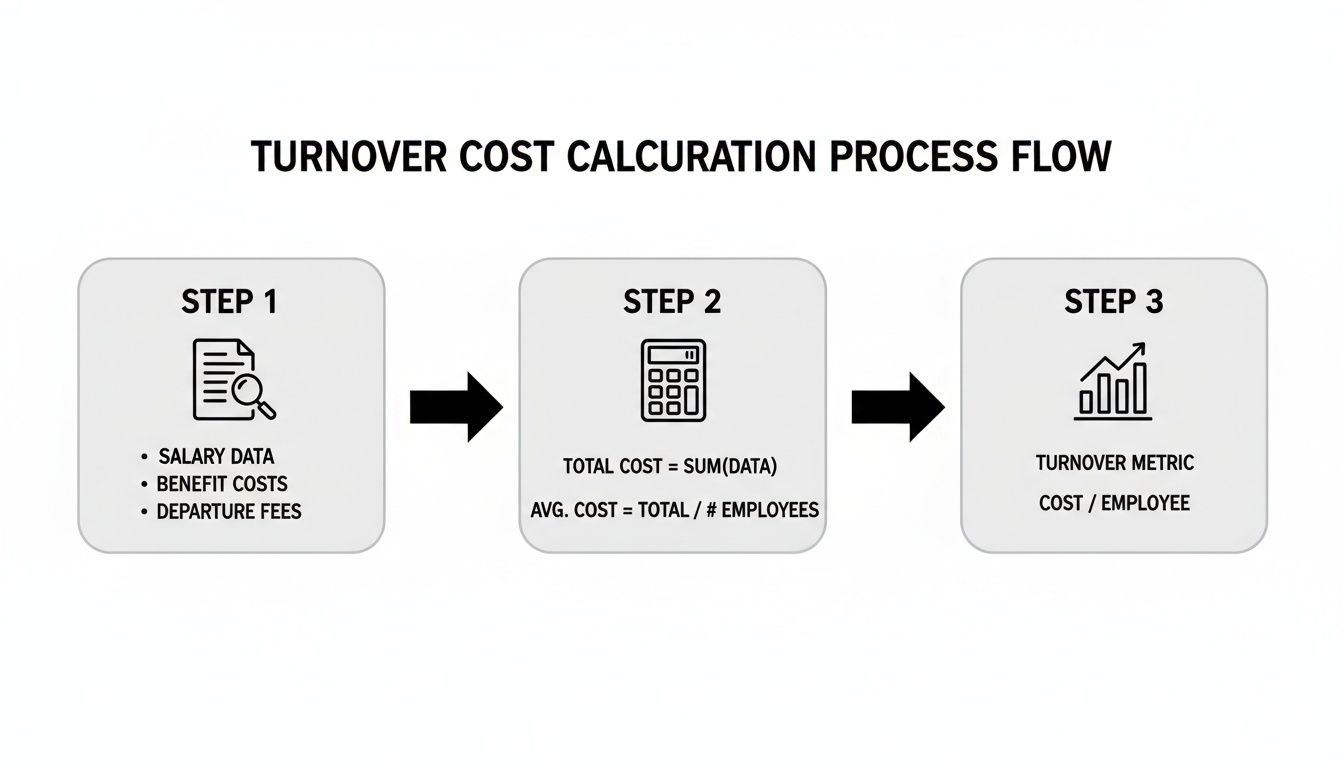
As you can see, the process isn't overly complicated. It’s a logical flow: gather the data, apply the formulas, and arrive at a clear, actionable number that tells a story.
Building a Business Case for Retention
Once you have a benchmarked turnover cost, you can build a compelling business case for investing in your people. This isn't about asking for more budget based on a gut feeling; it's about proving the ROI of specific initiatives.
Your argument should be structured around clear financial trade-offs. For example:
Professional Development: "Our annual turnover is costing us $500,000. We can cut that by 20% by investing $100,000 in advanced training and clear career paths. That’s a net saving of $100,000, plus we retain critical institutional knowledge."
Leadership Training: "A big chunk of our turnover is tied to manager effectiveness. A $30,000 leadership development program for our engineering leads could prevent the loss of just one senior engineer, saving us over $150,000."
Flexible Staffing Models: "Instead of letting massive vacancy costs pile up, we can use strategic staff augmentation to fill roles quickly. This keeps projects moving and reduces the strain on the existing team."
Your turnover cost is the ultimate justification for investing in your people. It reframes retention from a 'nice-to-have' cultural goal to a core financial strategy that directly impacts the bottom line.
Proactive Workforce Planning
Finally, put your turnover data to work for proactive workforce planning. Dive in and look for patterns. Are you losing mid-level engineers after two years? Are specific teams a flight risk? Understanding the why behind the numbers is where the real magic happens.
Exit interviews are a goldmine of this kind of information. For a complete guide, check out our post on how to conduct effective exit interviews.
By turning your cost of employee turnover calculator into an ongoing diagnostic tool, you can get ahead of problems, make data-driven decisions, and build a more resilient engineering organization.
When you're ready to turn these insights into a world-class team, TekRecruiter is here to help. We connect innovative companies with the top 1% of engineers globally, providing the elite talent and flexible staffing solutions you need to build a stable, high-performing workforce that drives results.
Practical Strategies to Reduce Turnover in Tech Teams

Alright, you’ve run the numbers through the cost of employee turnover calculator and you have the hard data. Now what? That big, scary number isn’t a sign of failure. It's a flashing neon sign telling you exactly where to invest—in the systems, culture, and career paths that make your engineering team a place where top talent actually wants to stick around.
Vague advice won't get you anywhere. You need concrete, actionable tactics designed for the unique pressures and motivations that drive technical teams.
After calculating the financial bleed, the next move is implementing changes that matter. For a broad overview, you can explore some great strategies on how to reduce employee turnover that build a solid foundation. Here, though, we're zeroing in on high-impact moves specifically for engineering orgs.
Redesign Your Onboarding to Slash Early Attrition
The first 90 days are everything. Let's be honest, a chaotic or isolating onboarding experience is one of the biggest reasons for early exits. You end up eating those turnover costs before a new engineer has even had a chance to meaningfully contribute. This isn't just about handing over a laptop; it's about integration, clarity, and connection from day one.
A revamped onboarding process needs to deliver on a few key things:
A Structured Mentorship Program: Every new engineer gets a dedicated mentor—and it can't be their manager. This person is their go-to for all the "stupid questions" about the codebase, deployment quirks, and internal tools. It creates a safe, informal channel for real learning.
The First "Win" Within Week One: Give the new hire a small, low-risk, but achievable task they can ship to production in their first five days. That immediate feeling of accomplishment is a huge confidence booster and proves they can make an impact right away.
Clear Documentation and "Playbooks": Stop making new hires hunt for information. A well-maintained wiki or playbook covering everything from setting up their dev environment to team communication norms is non-negotiable.
Onboarding isn't an administrative checklist; it's the first and most critical retention strategy. A great onboarding experience proves to new hires that they made the right choice and that the company is invested in their success from day one.
Build Career Ladders That Actually Motivate
Senior engineers don't typically leave for a small pay bump. They leave because they've hit a ceiling. They're looking for a bigger challenge, more autonomy, or a clear path to keep growing. If your only advancement track is a slow march toward management, you will absolutely lose your best individual contributors.
A solid engineering career ladder needs two distinct and equally valued paths:
The Management Track: This is for the engineers who thrive on leading people, steering projects, and developing the talent on their teams.
The Individual Contributor (IC) Track: This path is crucial. It’s for the technical wizards who want to deepen their expertise and influence through architecture, innovation, and solving the gnarliest problems. A Principal or Staff Engineer should have the same level of influence and compensation as a Director of Engineering.
This dual-track system signals to your top technical talent that they don't have to give up their passion for code to advance their career. It gives them a real reason to build their future with you.
De-Risk Projects with Strategic Staff Augmentation
Even with the best retention plans, people will leave. The market is volatile, competitors are aggressive, and life happens. The key isn't to prevent every departure—it's to build a resilient workforce so that one person leaving doesn't torpedo a critical project.
This is where strategic staff augmentation, especially with nearshore talent, becomes a powerful tool. It helps you bridge hiring gaps and insulate your projects from the whims of the local market. By partnering with a firm that gives you access to a global pool of elite engineers, you can:
Fill Roles Faster: You can slash the "vacancy cost" in your turnover calculation by bringing on pre-vetted talent in a matter of weeks, not months.
Access Specialized Skills: Need an expert in a niche technology for a specific project? Augmentation lets you bring in that firepower without committing to a full-time, long-term hire.
Increase Team Stability: Bringing in highly skilled contractors helps reduce the strain on your full-time staff, preventing the burnout that often leads to a domino effect of turnover.
This approach isn't about replacing your team; it's about reinforcing it. It gives you the flexibility to scale up for key initiatives and maintain momentum, even when unexpected departures happen.
Struggling to fill critical roles and keep your roadmap on track? TekRecruiter helps innovative companies deploy the top 1% of engineers anywhere in the world. Our quality-first staff augmentation and AI engineering services provide the stability and elite talent you need to de-risk your projects and build a resilient, high-performing team.
Stop Bleeding Money on Turnover. Start Building a Resilient Engineering Team.
High turnover isn't just a number on a spreadsheet; it's a critical business risk you can, and should, actively manage. Once you’ve run the numbers with the cost of employee turnover calculator, the true financial drain becomes impossible to ignore. The path forward isn't just about filling roles faster. It's about building a more resilient, stable, and genuinely high-performing engineering organization.
This is exactly where TekRecruiter steps in as your strategic partner.
We specialize in one thing: helping innovative companies build world-class engineering teams. We do this by giving you direct access to the top 1% of vetted global talent. Our entire model is designed to counteract the very pain points that send turnover costs through the roof. We slash your time-to-fill, shrink those painful productivity gaps, and make sure you get the exact skills you need without the exhausting, time-sucking search that pulls your senior staff away from their real jobs.
Your Strategic Advantage in a Volatile Market
Trying to navigate the tech talent market alone right now is tough. The competition is insane, and the best engineers are rarely—if ever—on the open market for long. Partnering with us gives you a distinct, immediate advantage.
Our approach is built for flexibility and real impact:
Fill Critical Roles: We connect you with elite engineers for permanent positions, ensuring a perfect long-term fit for both your team and your culture.
Augment Your Current Team: Seamlessly inject specialized skills into your existing team for a crucial project. You get the capabilities you need without the long-term overhead.
Launch Dedicated Nearshore Centers: We can help you establish a dedicated delivery center in talent-rich regions like Latin America or Europe, all managed with U.S.-based project oversight.
High turnover is a symptom of hiring friction and talent gaps. The cure is a strategic staffing partner who truly understands your technical needs and delivers elite, vetted engineers who can contribute from day one.
Stop letting preventable turnover derail your product roadmap and drain your budget. The numbers from your calculation give you the "why." TekRecruiter provides the "how."
Let's build a workforce that doesn't just withstand market pressures but actually thrives on them.
Ready to stop calculating the cost of turnover and start building a more resilient engineering team? TekRecruiter is a technology staffing and recruiting and AI Engineer firm that allows innovative companies to deploy the top 1% of engineers anywhere. Let's discuss your talent strategy today.