_edited.png)
Software Development Cost Estimation Your Ultimate Guide
Software development cost estimation isn’t just about crunching numbers; it's the process of predicting the real-world resources you'll need to actually build and launch a product. It forces you to account for everything—project complexity, team size, the tech stack—and gives you a strategic roadmap to keep the project on track and the budget in the black.
Why Accurate Cost Estimation Is Non-Negotiable

Imagine your most critical project running out of money halfway to launch. For too many tech leaders, this isn't a bad dream—it’s a preventable crisis they’ve lived through. A solid cost estimate is far more than a spreadsheet exercise; it’s the strategic cornerstone for any successful initiative.
Think of it like building a custom house. Your initial estimate is the architectural blueprint. If that blueprint is flawed—miscalculating materials, underestimating labor, or ignoring the tricky terrain you're building on—the entire structure is at risk from day one. In the same way, a sloppy software estimate almost guarantees failure down the line.
The Ripple Effect of Flawed Estimates
When an estimate is wrong, the consequences tear through an organization, hitting a lot more than just the bottom line. These downstream effects can sink the entire project and even derail broader business goals.
The financial stakes are staggering. Studies consistently show that nearly 70% of software projects blow past their initial budgets. And with the average cost for a custom application now hitting $171,450, largely driven by sky-high developer salaries, there is zero room for error. You can dig deeper into these industry benchmarks and cost drivers to see what’s behind the numbers.
An inaccurate estimate isn't just a budget problem; it's a credibility problem. It erodes trust with stakeholders, crushes team morale, and forces leaders into a reactive, crisis-management mode instead of proactive, strategic leadership.
Beyond the immediate financial bleed, a bad estimate creates a cascade of operational chaos:
Eroding Morale: Nothing burns out an engineering team faster than forcing them to meet unrealistic deadlines based on faulty numbers.
Compromised Quality: To stay within a failing budget, teams are often pressured to cut corners on testing and QA, racking up technical debt that will have to be paid later.
Strained Stakeholder Trust: When you consistently miss budget targets, the reputation of the entire tech leadership and department takes a major hit.
Setting the Foundation for Success
Ultimately, a reliable cost estimate is the foundation for predictable delivery. It gets everyone—from the C-suite to the individual developer—aligned on what’s actually achievable within a given budget and timeline. It turns a high-risk gamble into a well-managed investment.
This guide will give you a clear path forward, arming you with the methodologies and real-world insights needed to master this critical discipline.
Navigating the complexities of project budgeting requires the right processes and the right people. TekRecruiter connects you with the top 1% of global engineering talent, so you can build elite teams that deliver on time and on budget. Whether you need specialized staff augmentation or a fully managed AI engineering solution, we help you turn your accurate estimates into reality.
Exploring Core Estimation Methodologies
Once you know why you need a solid estimate, the next question is how. There's no single magic formula here. The right tool for the job really depends on where you are in the project, how messy things are, and how much detail you actually have.
Think of these methodologies as different camera lenses. Some give you a quick, wide-angle shot when you're just starting out. Others are like a macro lens, giving you a microscopic view when every detail counts. Mastering them means you can handle any estimation challenge, from a fuzzy, early-stage AI concept to a locked-in DevOps roadmap.
Analogous Estimation: The Quick Comparison
This is the fastest way to get a number on the board, period. Analogous estimation is all about looking at a similar project you've done before and using its final cost and timeline as your starting point. It’s like pricing a house by seeing what the one next door just sold for.
This top-down approach is your go-to in the very early stages when details are thin. If your last e-commerce platform took six months and cost $200,000, that’s your baseline for the new one.
But speed comes at a price. The whole thing hinges on how "similar" that past project really is. A different tech stack, a less experienced team, or a few "minor" changes in complexity can throw your numbers way off. It's a great gut check, but it's rarely the final answer.
Parametric Estimation: The Data-Driven Recipe
Here, we get a bit more scientific. Instead of comparing entire projects, parametric estimation uses specific, measurable data points—like ingredients in a recipe—to calculate the total effort. You know that a certain amount of flour and sugar gets you a predictable number of cookies; this is the same idea.
In software, those "ingredients" could be:
Function Points: A standardized way to measure the business functionality a system provides.
User Stories: The number of features you've planned in an Agile backlog.
Lines of Code (LOC): An old-school metric, but still useful for certain types of projects.
The power of this method is its objectivity. By applying a cost-per-unit metric (e.g., $1,500 per user story), you build a scalable, repeatable process. This is where models like the Constructive Cost Model (COCOMO) have been industry staples for decades.
The table below from COCOMO II shows how it breaks down projects by "scale drivers" to sharpen the estimate.
This model doesn't just guess; it adjusts the baseline using factors like team cohesion and development flexibility. This data-first approach is why parametric models have been a cornerstone of software cost prediction for so long. In fact, deep-dive analysis shows these models can hit an impressive Mean Magnitude of Relative Error (MMRE) as low as 20-30% on projects where the data is solid. You can read the full research on software cost estimation techniques to see just how dominant they've been.
Three-Point Estimation: Embracing Uncertainty
Let's be honest: no project plan survives contact with reality. Three-Point Estimation tackles this head-on by forcing you to think in terms of a range, not a single, fragile number. For every task, you come up with three estimates:
Optimistic (O): The best-case scenario. Everything goes right, no interruptions.
Pessimistic (P): The worst-case scenario. Murphy's Law is in full effect.
Most Likely (M): Your realistic, gut-feel estimate.
You then plug these into a weighted average formula, often from the PERT (Program Evaluation and Review Technique) method, to get a much more probable outcome. It gives you a realistic range to work with, which is infinitely more useful than a single number you know is probably wrong.
By forcing teams to consider both best- and worst-case outcomes, Three-Point Estimation helps identify risks early and builds contingency planning directly into your budget.
Bottom-Up Estimation: The Granular Deep Dive
When you absolutely, positively need the most accurate number possible, this is your method. Bottom-Up Estimation is exactly what it sounds like: you break the entire project down into the smallest possible chunks—individual features, functions, or technical tasks—and estimate each one. Then, you add them all up.
It's the most time-consuming approach, no question. But it's also the most precise. This is the right move when you have a well-defined scope and a detailed Work Breakdown Structure (WBS). In the Agile world, this looks a lot like estimating individual user stories with Story Points and then rolling them up for the release.
Choosing the right methodology—or, more often, a combination of a few—is crucial. But even the best estimate is just a number. It takes the right team to make it a reality. TekRecruiter gives you access to the top 1% of global engineers, so you can build an elite team that turns precise estimates into delivered projects. Whether you need to augment your staff or stand up a managed AI engineering team, we connect you with the talent to get it done, on time and on budget.
What's Really Driving Your Project's Cost?
Any cost estimate is only as good as the information you feed it. Even the most bulletproof estimation model will fall apart if you miss the quiet variables that have a habit of blowing up your budget. These are the hidden cost drivers, and they’re often the difference between a smooth launch and a project that spirals out of control.
To get beyond a ballpark guess and build a real forecast, you have to dig into the factors that drain time, money, and expertise. I like to break them down into four key areas. Think of it as a checklist to make sure nothing slips through the cracks.
Project Scope and Complexity
This is the most obvious one, but it’s also where people get tripped up. The real cost isn’t just about the number of features you’re building; it’s about how tangled and intricate those features are. A simple marketing website and a complex enterprise platform are two entirely different beasts.
Here’s where complexity often hides in plain sight:
Third-Party Integrations: Every time you connect to an external service—whether it’s a payment gateway like Stripe, a CRM like Salesforce, or an analytics tool—you're adding another layer of work. Each API has its own quirks, its own documentation (or lack thereof), and its own potential for headaches.
Algorithmic Complexity: Are you building a straightforward app that just moves data around? Or does it rely on sophisticated algorithms for machine learning, data processing, or real-time analytics? The second path demands specialized, expensive skills and a whole lot more development time.
Legacy System Migration: This is the big one. Trying to pull data from or integrate with an old, poorly documented system is a minefield. It’s almost guaranteed to uncover nasty surprises that will inflate your timeline and your budget.
Team Composition and Location
Your team will be your single biggest line item, so how you build it matters—a lot. It’s not just about the number of people; it’s about their experience level and, crucially, where they’re located. A team of five junior developers will move at a very different pace (and cost) than a blended team of two senior engineers and three mid-level developers.
Senior developers cost more upfront, but they solve tough problems faster, mentor the rest of the team, and build architectures that don't crumble later. They often end up saving you money in the long run.
Geography is a massive lever you can pull. Onshore developers in places like North America come with a premium price tag. In contrast, building a nearshore team in Latin America or Europe can slash your labor costs by 30-50% without giving up technical skill, quality, or time zone alignment. Getting a handle on these salary differences is non-negotiable, which is why our 2023 salary guide for hiring software developers is such a critical tool for anyone putting a budget together.
Technology Stack Choices
The languages, frameworks, and platforms you select aren't just technical decisions; they're financial ones. Every choice you make has cost implications that go way beyond the initial build.
For instance, picking a brand-new, bleeding-edge programming language might sound innovative, but good luck finding engineers who know it. A smaller talent pool means hiring is slower and more expensive.
A few other tech-related costs to keep on your radar:
Licensing Fees: Proprietary software, databases, or certain cloud services can come with hefty recurring fees that add up fast.
Framework Maturity: A mature framework like React or Node.js has a huge community, tons of libraries, and answers for almost every problem. A newer, less-established framework means your team will be doing more custom work and troubleshooting from scratch.
Non-Functional Requirements
Finally, we have the silent budget killers: the non-functional requirements (NFRs). These are the things that aren't specific features but define the quality of the system—think security, performance, and scalability.
Ignoring NFRs until the end is one of the most common and costly mistakes you can make. For example:
Security Compliance: If your app needs to be HIPAA or GDPR compliant, you can't just "add security" later. You need to budget for specialized audits, penetration testing, and extra development work from day one to protect user data.
Scalability Targets: There's a world of difference between building a system for 1,000 users and one for 1,000,000. Hitting high scalability targets requires a more sophisticated architecture, extensive load testing, and more robust infrastructure—all of which have a significant price tag.
By thinking through these four areas, you can move from a vague guess to a cost estimate grounded in reality. But a great estimate is worthless without the right talent to execute on it. At TekRecruiter, we connect companies with the top 1% of engineers worldwide, so you can deploy elite teams and build incredible products without the staggering costs of traditional hiring.
Putting It All Together: A Start-to-Finish Project Estimate
Okay, enough with the theory. Let's walk through how this actually works on a real project.
We'll map out a realistic cost estimate for a common business request: building a new AI-powered customer service chatbot. To do this right, we'll use a hybrid approach that mirrors how most successful projects get planned.
We'll start with a broad, top-down estimate to get a ballpark figure for the whole thing. Then, we'll zoom in and get super granular with a bottom-up estimate for the very first development sprint. This is how you move from a big-picture idea to a concrete, actionable plan.
But before we dive in, it’s crucial to remember that coding hours are just one piece of the puzzle. Costs can hide in plain sight—scope creep, team overhead, technical debt, and unmet user needs all drive up the final price tag.
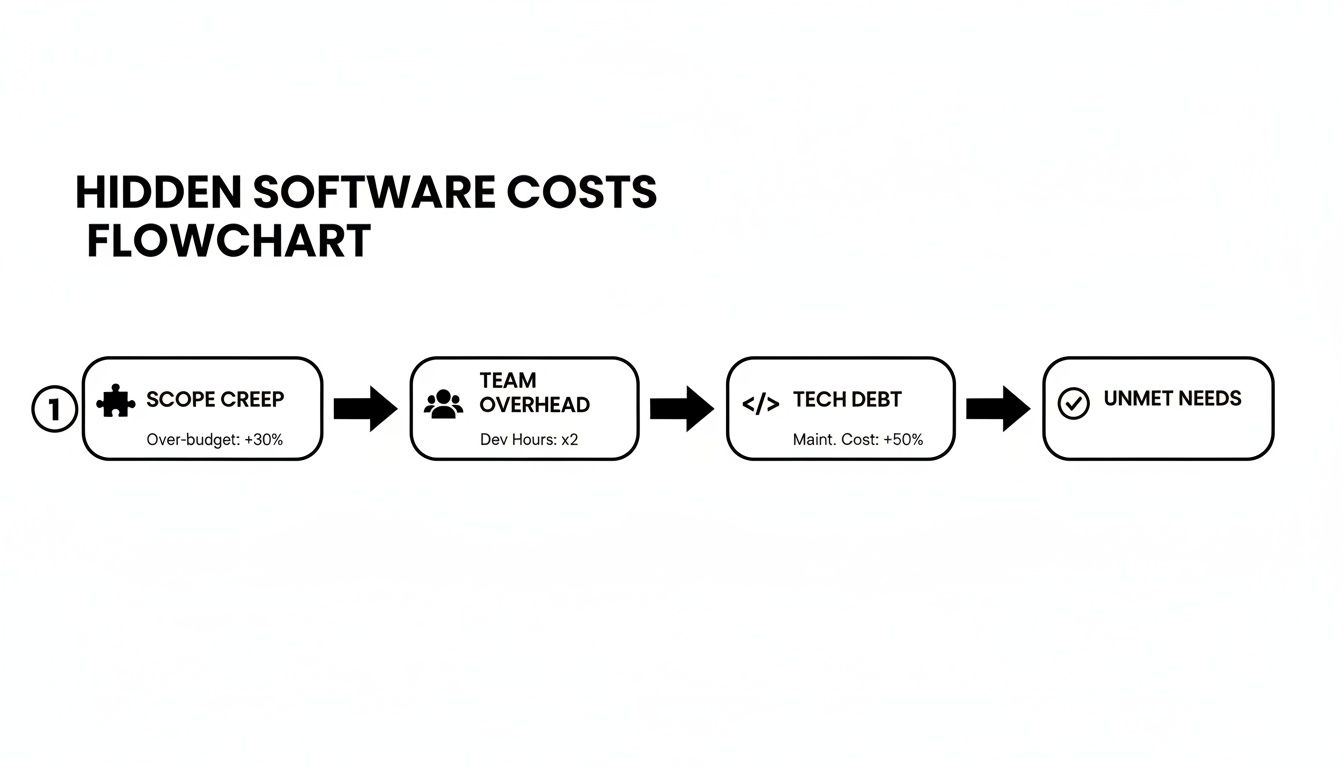
Think of this as a reminder: a solid estimate accounts for the entire ecosystem of a project, not just the code.
Step 1: Define the Scope and Key Features
First things first, what exactly is this chatbot supposed to do? After a discovery session with key stakeholders, we've nailed down the core features for our Minimum Viable Product (MVP).
Natural Language Understanding (NLU): The bot has to actually understand what users are asking in plain English.
Knowledge Base Integration: It needs to connect to our existing help docs to pull answers.
User Authentication: Users need a way to log in to talk about account-specific problems.
Live Agent Handoff: If the bot gets stumped, it must seamlessly pass the conversation to a human.
With these features mapped out, we can make a quick top-down guess. Let's say we built a similar, but less complex, chatbot last year that cost $90,000. Factoring in the added complexity of the AI components, a reasonable analogous estimate for this new MVP would be somewhere in the $110,000 - $130,000 range.
Step 2: Break Down Sprint 1 into User Stories
Now we get specific. It's time to shift to a bottom-up approach for the first sprint, where the team will tackle the NLU and knowledge base features. We break these big features into small, digestible user stories.
User Story 1: As a user, I want the chatbot to understand my question so I can get a relevant answer.
User Story 2: As a developer, I need to connect the chatbot to the knowledge base API so it can retrieve articles.
User Story 3: As a user, I want the chatbot to present the most relevant article snippet as an answer.
Breaking the work down like this is the secret to accurate estimation. It also creates a clear roadmap for testing, since each story is a self-contained, testable piece of the product. This process is the heart of what quality assurance in software development is all about.
Step 3: Apply Three-Point Estimation
Next, the dev team puts their heads together to estimate the effort for each user story using the Three-Point Estimation technique. This isn't just pulling a number out of thin air; it's a structured way to consider the best-case, worst-case, and most-likely scenarios.
Let's look at their breakdown for User Story 1 (NLU integration):
Optimistic (O): 30 hours (If everything goes perfectly)
Most Likely (M): 45 hours (The realistic guess)
Pessimistic (P): 75 hours (If we hit unexpected snags)
Using the PERT formula——we get a weighted estimate of 47.5 hours. We do this for all three stories, and the total estimated effort for Sprint 1 comes out to 110 hours. That number is far more defensible than a single off-the-cuff guess.
Step 4: Translate Effort Into Cost
The last step is the simple part: turning hours into dollars. But this is also where you have the most direct control over your budget. Team composition is a massive financial lever.
To illustrate, here's a look at how staffing choices dramatically impact your budget.
Onshore vs Nearshore Rate Comparison
This table shows the significant cost savings you can achieve by tapping into nearshore talent for key engineering roles. It's a critical factor for anyone trying to build an accurate budget.
Role | Average Onshore Hourly Rate (USD) | Average Nearshore Hourly Rate (USD) | Potential Savings |
|---|---|---|---|
Senior Software Engineer | $150 | $75 | 50% |
AI/ML Engineer | $180 | $90 | 50% |
QA Engineer | $110 | $55 | 50% |
Project Manager | $125 | $65 | 48% |
For our chatbot project, let's assume a blended team rate. An onshore team might average $150/hour, making the cost for our 110-hour sprint $16,500. By contrast, a nearshore team with a blended rate of $75/hour brings that same sprint cost down to just $8,250.
That’s a 50% reduction in cost. Instantly, you’ve cut the sprint cost in half, freeing up a huge amount of budget for future sprints, new features, or just to have as a buffer for the unexpected.
This four-step process isn't just an example; it's a repeatable template you can use for your own software development cost estimation.
Building a world-class engineering team shouldn't break your budget. TekRecruiter provides access to the top 1% of vetted nearshore engineers and AI specialists. We empower you to build high-performing teams that deliver exceptional results at a fraction of the cost. Contact us to deploy the elite talent you need to bring your projects to life.
Avoiding Common Software Estimation Pitfalls
Even the sharpest, most detailed cost estimate can get torpedoed by a few common, hidden traps. Knowing what these are ahead of time is the difference between a project that launches on budget and one that becomes a cautionary tale. Think of this as your field guide to spotting trouble before it turns into a five-alarm fire.
The most notorious budget-killer is scope creep. It’s that slow, quiet expansion of project requirements, usually disguised as a series of small, “harmless” requests. You know the one: "Can we just add one more button?" Each tiny change seems insignificant on its own, but together they inflate your timeline and costs until the original estimate is a distant memory. It’s no surprise that over 52% of projects suffer from it.
The only real defense is a formal change request process. This isn't about being difficult or saying "no" to every new idea; it's about forcing a transparent conversation about trade-offs.
A formal change request process makes everyone acknowledge that every new feature comes with a cost in time and money. It turns "Can we just add..." into a real business decision.
Countering Unchecked Optimism
Another classic mistake is unchecked optimism. It’s just human nature to imagine the best-case scenario—assuming every line of code works on the first try and no unexpected roadblocks will ever appear. This "optimism bias" creates estimates that look aggressive and impressive but are fundamentally unrealistic. You're setting the team up to fail from day one.
The most effective way to counter this is by building in a contingency buffer. This isn't just padding the numbers; it’s a calculated, professional way to manage risk.
For straightforward, low-complexity projects, a 10-15% buffer is usually enough.
For highly complex projects with a lot of unknowns, you might need 20-30% or more to cover unexpected technical hurdles.
This buffer gives your team the breathing room to handle the inevitable surprises that pop up during development, keeping the project on track without constant budget fire drills.
Addressing Hidden Costs and Communication Overhead
Finally, a lot of estimates fall apart because they completely ignore critical, less-obvious costs. The two biggest culprits here are non-functional requirements and the drag of communication overhead.
Non-functional requirements (NFRs)—things like security, scalability, and performance—aren't flashy features you can point to, but a product is useless without them. If you don't budget for the time it takes to make an application secure (pen-testing, code reviews) or scalable (load testing, infrastructure work), you're looking at massive, unplanned expenses late in the game.
At the same time, communication overhead grows exponentially as you add more people. All that time spent in meetings, coordinating tasks, and clearing up confusion is real work that has to be factored in. A small team sitting in the same room operates very differently than a large, distributed one. For a deeper dive on managing this with external teams, check out our guide on [everything you need to know before outsourcing software projects](https://www.tekrecruiter.com/post/everything you need to know before outsourcing software projects).
Using a solid product management platform like Productboard for improved scope definition can also go a long way in pinning down ambiguous requirements, which are often the source of these hidden costs.
Navigating these pitfalls takes more than just good planning—it takes experience. TekRecruiter connects you with the top 1% of elite engineers who know how to anticipate these challenges from the start. Whether you need to augment your current team or want a managed AI engineering solution, we provide the seasoned expertise to turn your accurate estimates into successfully delivered projects.
Control Costs with Strategic Talent Solutions

A great estimate is your starting line, but smart execution is what wins the race. The most buttoned-up cost estimation only helps if you can actually control spending when the work starts. This is where your talent strategy becomes your biggest advantage, turning a static budget forecast into a dynamic, controllable asset.
Think of flexible talent models like staff augmentation and nearshore delivery as powerful cost-control levers. Instead of getting locked into the high, fixed costs of a purely onshore team, you can scale your engineering power up or down with absolute precision, reacting in real-time to your project’s needs.
The Power of Flexible and Nearshore Teams
When you open up to a global talent pool, you gain a serious competitive edge. By building teams with engineers from talent-rich regions like Latin America and Europe, you can slash blended hourly rates by 40-60% without giving up an inch on quality or expertise.
But this isn't just a simple cost-cutting trick; it's about building a more resilient and efficient development operation. A flexible talent strategy gives you the freedom to:
Access Specialized Skills: Need an AI or cybersecurity expert for a specific project phase? Bring them in on-demand without the long-term overhead of a full-time hire.
Scale On-Demand: Seamlessly add developers to crush a deadline or handle a surge in workload, then scale back down just as easily once the peak has passed.
Maintain 24/7 Productivity: With teams in different time zones, you can create a development cycle that runs around the clock, dramatically shrinking your time-to-market.
We dive deep into how to make this work in our guide on maximizing cost savings with nearshore software development. It lays out the playbook for implementing this strategy effectively.
By decoupling your project's progress from the limitations of a single geographic talent pool, you gain the agility to meet deadlines and stay on budget, even when unexpected challenges arise.
Beyond talent, other strategic moves can protect your budget. Using a SaaS boilerplate, for instance, provides a pre-built code foundation that can shave weeks or months off your development timeline and cut total project costs.
Turn Your Estimates into Reality with Elite Talent
Ultimately, the goal is to turn that well-crafted estimate into a successfully shipped product. That requires a partner who knows how to connect strategy with execution. At TekRecruiter, we give you direct access to the top 1% of vetted engineers from the world’s best nearshore locations.
Whether you need to augment your team with a few elite developers or require a fully managed AI engineering solution to deliver a complex project on a predictable budget, we provide the talent to make it happen. By deploying the world’s best engineers right where you need them, we help innovative companies nail their budgets and build exceptional software.
Common Questions, Answered
When you're trying to nail down a budget for a new software project, a few key questions always seem to pop up. Let's get them out of the way so you can move forward with confidence.
What's a Reasonable Cost for Custom Software?
Honestly, there's no magic number. A project can run anywhere from $50,000 to over $250,000, and that's not even the high end. A simple app with just a handful of core features might squeak by on the lower end. But if you’re building a complex system that works across multiple platforms and has AI baked in, you'll blow past that higher number without breaking a sweat.
The real cost drivers are always project complexity, where your team is located (a huge factor), and the tech stack you choose to build on.
Don't fall into the trap of looking for an "average" project cost. The only estimate that matters is one built from a detailed breakdown of your specific features and technical needs.
How Can I Get a More Accurate Estimate?
Precision comes from clarity. The less guesswork the engineering team has to do, the sharper your estimate will be.
It really boils down to three things:
Define Your Core Features: Seriously, make a list. What are the absolute must-haves for your first version (MVP)?
Sketch It Out: Wireframes or simple mockups are invaluable. They give developers a visual map of the user flow and help them see the complexity you might not know how to describe.
Detail the "Under-the-Hood" Stuff: Don't forget non-functional requirements. How fast does it need to be? What are your security standards? How many users should it handle on day one versus year one? Get this stuff down on paper.
What's the Single Biggest Mistake in Software Estimation?
Easy. Forgetting what happens after the launch.
The most common—and most painful—mistake is building a budget that only covers the initial development. People completely ignore the ongoing costs of maintenance, bug fixes, security patches, feature updates, and server hosting. It's like buying a car but not budgeting for gas, insurance, or oil changes.
A good rule of thumb is to set aside an additional 15-20% of the initial development cost every year just for maintenance. That’s what it takes to keep your product healthy, secure, and running smoothly.
Ready to turn your accurate estimates into a successfully delivered project? TekRecruiter is a technology staffing, recruiting, and AI Engineer firm that allows innovative companies to deploy the top 1% of engineers anywhere. We provide the elite talent to ensure you have the skill and expertise to build exceptional software on time and on budget. Find your perfect team at https://www.tekrecruiter.com.
Comments