Dedicated software developers: Hire top remote talent fast
Discover how to hire dedicated software developers and build a top remote engineering team.
So, what exactly are dedicated software developers? Think of them as a full-time, long-term extension of your own team. They just happen to work remotely through a partner agency. This isn't about hiring a freelancer for a few weeks to knock out a specific task. It’s a model built on deep integration and an exclusive commitment to your projects and your company's future.
The Core Concept of a Dedicated Development Team
Imagine you’re building a high-performance race car. You wouldn't just grab a random mechanic for a day's work, right? You'd build a permanent crew—a team that lives and breathes your car's unique engineering. Dedicated software developers work on that exact same principle. They’re not temporary help; they are a solid, cohesive unit that becomes fully integrated into your mission.
This model goes way beyond just handing off tasks. A dedicated team gets to know your company culture, digs into your long-term product roadmap, and has a real say in your technical architecture. They become genuine experts in your specific field, which means they can offer insights and proactive solutions that a short-term contractor simply wouldn't have the context to provide.
More Than Just Outsourced Coding
The real magic of dedicated developers is the sense of ownership and stability they bring. You get a consistent pool of talent, which puts an end to the frustrating cycle of hiring, onboarding, and losing crucial knowledge every time a freelancer’s contract ends. That stability is everything for complex, long-term projects where deep institutional knowledge gives you a serious competitive edge.
Here’s what makes this model different:
Full Integration: They’re in your daily stand-ups, sprint planning meetings, and strategy sessions, just like your local folks.
Long-Term Commitment: This is a relationship built for the long haul. Your developers grow right alongside your product.
Exclusive Focus: Their time and brainpower are 100% committed to you. No context-switching or divided loyalties.
Deep Alignment: They adopt your technical standards, coding practices, and, most importantly, your business goals.
A dedicated team isn't just a resource you rent; it's an asset you build. It's a direct investment in a stable, scalable, and deeply knowledgeable engineering force that becomes a seamless part of your organization.
Meeting the Demand in a Competitive Market
This approach has become a total game-changer for companies that need to move fast without sacrificing technical ownership. It’s no secret that the hiring market is tough. The global software development workforce is expected to add nearly 327,900 new jobs between 2023 and 2033, but the skills gap is real and painful. In Europe, a staggering 90% of employers say they struggle to find engineers with the right skills, especially in hot areas like AI/ML and cloud architecture.
The dedicated model is a direct answer to this problem, giving you access to a pre-vetted, global talent pool. It’s a strategic move that bypasses the slow and expensive process of local hiring. While it shares some similarities with other models, it offers far deeper integration than what you'll typically find when exploring what staff augmentation is.
By partnering with a firm that supplies dedicated software developers, you can tap into world-class talent without being limited by geography. This lets you build a top-tier team that's not only cost-effective but also perfectly matched to your technical needs.
Ready to build an elite engineering team that functions as a true extension of your own? TekRecruiter specializes in deploying the top 1% of dedicated software developers from premier global talent hubs, allowing you to scale your capabilities quickly and efficiently.
Choosing The Right Engagement Model
Figuring out how to build your team is one of those bedrock decisions that will define your product's future, your budget, and your timeline. This isn't just about filling seats; it's a strategic call that sets the pace for your time-to-market, locks in your cost structure, and determines how fast you can actually scale. For any engineering leader, this goes way beyond a simple headcount game. It’s about understanding the real trade-offs between control, flexibility, and deep integration.
To get this right, you have to weigh your long-term product vision against the practical realities of each talent model. Every path—whether you’re hiring in-house, pulling in contractors, or partnering for dedicated software developers—comes with its own unique set of pros and cons. The best fit is all about what you’re trying to build.
In-House Teams: The Gold Standard Of Control
Hiring your own full-time engineers gives you the absolute most control and cultural buy-in. These are your people. They're fully invested in the company's mission and are foundational to building a strong, unified engineering culture. This model is the only real option when your core intellectual property is so sensitive or central to the business that it just can't be touched by outside hands.
But that level of control comes with a hefty price tag. We all know the hiring process is painfully slow and expensive, especially in competitive tech hubs. You aren't just paying a salary. You're on the hook for benefits, office space, new equipment, and recruiter fees that can easily eat up 20-30% of the first year's salary. On top of that, scaling an in-house team up—or down—is a rigid, slow, and often gut-wrenching process.
Contractors And Freelancers: The Flexibility Play
For short-term projects or plugging a very specific skill gap, contractors offer maximum flexibility. Need a niche expert to knock out a single feature or squash a critical bug? You can get a freelancer spun up quickly to handle the task and then they're gone once the job is done. It's a fantastic model for handling temporary spikes in workload without taking on long-term financial weight.
The trade-off, however, is a lack of deep integration and strategic thinking. Contractors are transactional. They’re paid to execute a specific task, not to bleed for your product's long-term vision. This can create knowledge silos and lead to a final product that feels cobbled together, as different freelancers might not stick to the same architectural standards or even fully grasp the business context behind the code.
This decision tree helps visualize where the need for long-term expertise points you toward a dedicated model.
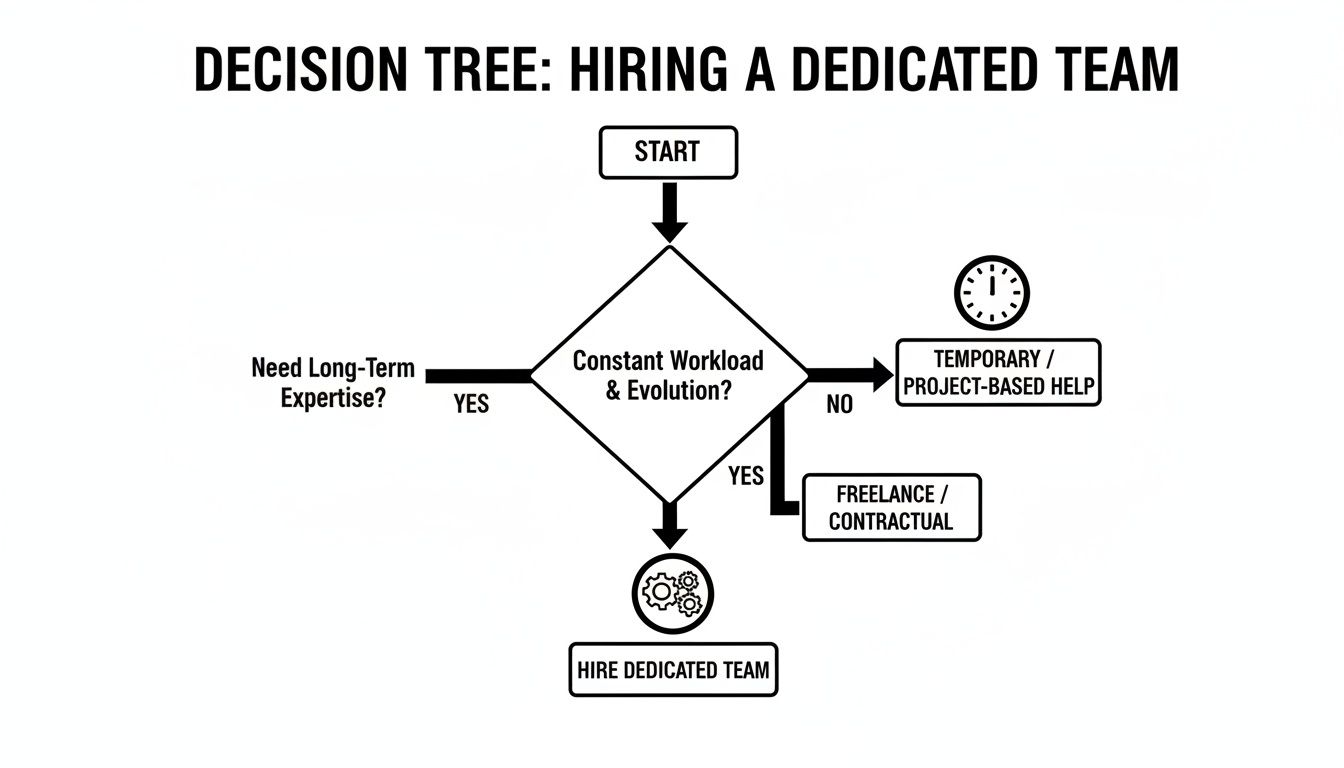
As the graphic shows, when a project demands continuous development and deep, evolving product knowledge, the logic steers you away from temporary fixes and toward a more embedded solution.
Dedicated Software Developers: A Strategic Balance
The dedicated team model strikes a powerful balance, giving you the long-term commitment of an in-house team combined with the flexibility of an external partner. A dedicated team works only on your projects, becoming true extensions of your organization. They get embedded in your workflows, your culture, and your strategic goals. You get the stability and product ownership of an in-house team without the painfully slow and expensive local hiring process.
With dedicated software developers, you gain a stable, scalable engineering unit that functions as an extension of your own organization. You get the long-term focus without the long-term overhead of direct employment.
This approach truly brings together the best of both worlds. It delivers the deep technical ownership required for complex, evolving products while giving you the agility to scale the team up or down as your needs shift. It’s a model that goes far beyond just adding temporary capacity—a key difference when you dig into the nuances of staff augmentation vs outsourcing. For businesses that need to innovate fast without compromising on quality or strategic direction, it’s an ideal fit.
Engagement Model Comparison for Engineering Leaders
Choosing the right talent model means weighing the pros and cons of each against your specific business goals. This table breaks down the key differences to help you make a more informed, strategic decision.
Model | Best For | Control Level | Scalability | Cost Structure | Integration |
|---|---|---|---|---|---|
In-House Team | Core IP development, long-term vision, building company culture | Maximum | Low | High (salaries, benefits, overhead) | Deep |
Contractors | Short-term projects, specific skill gaps, temporary workload spikes | Low | High | Variable (hourly/project-based) | Superficial |
Dedicated Team | Long-term projects, scaling fast, balancing cost and control | High | High | Moderate (monthly fee, no overhead) | Deep |
Ultimately, the right choice always comes down to your context. Are you building a core product that will need years of dedicated focus, or do you just need a quick boost for a one-off project? By getting crystal clear on your goals, you can pick the engagement model that truly sets your team up to win.
If you're aiming for long-term innovation and need a scalable, integrated team, TekRecruiter is your strategic partner. We connect innovative companies with the top 1% of dedicated software developers, enabling you to build an elite engineering force anywhere in the world.
Unlocking the Nearshore Advantage
When companies start hunting for dedicated software developers, the conversation almost always kicks off with cost. And while the budget is a big piece of the puzzle, the real strategic power of a nearshore partnership goes way beyond the balance sheet. Smart companies are tapping into talent hubs in Latin America and Europe not just to save a few bucks, but to gain a massive competitive edge through real-time, seamless collaboration.

The single most powerful advantage is timezone alignment. Forget the frustrating 24-hour communication lag you get with traditional offshore models. Nearshore teams work on a schedule that mirrors your U.S.-based team’s day. This simple overlap is a total game-changer for speed and productivity.
The Power of Real-Time Collaboration
Think about this: your in-house engineer hits a nasty blocker at 2 PM. With a nearshore team, they just jump on a quick video call and hammer out a solution together in minutes. No more firing off an email into the void and hoping for an answer by morning. That ability to solve problems on the fly is priceless.
This alignment means your nearshore dedicated developers can:
Actively participate in daily stand-ups and sprint planning, not just listen in.
Join impromptu troubleshooting sessions to get things unblocked immediately.
Weigh in on strategy meetings, offering critical technical perspectives as ideas unfold.
It creates a dynamic where your entire engineering organization moves as one. You eliminate the friction and bottlenecks that plague teams scattered across completely different time zones. The relationship shifts from a transactional hand-off of tasks to a truly integrated partnership.
Nearshore isn't just about being geographically closer; it's about being operationally aligned. It erases the "us vs. them" mentality, forging a single, cohesive engineering unit that solves problems faster and innovates better.
Bridging the Cultural and Communication Gap
Beyond the clock, talent pools in places like Latin America and Eastern Europe share a strong cultural affinity with North American companies. High English proficiency and a solid grasp of U.S. business norms make for a much smoother integration. This cultural alignment cuts down on misunderstandings and helps build a genuine sense of one unified team.
When your dedicated software developers share a similar communication style, they're more comfortable challenging ideas, giving honest feedback, and building real rapport. That’s the secret sauce for creating an environment of psychological safety where true innovation happens. The team feels less like a group of hired guns and more like colleagues driving toward the same goal. If you want to dive deeper into this model, check out our guide to nearshore software development services.
This blend of time, culture, and communication is what truly unlocks the nearshore advantage. It empowers companies to build high-performing, deeply integrated teams that operate with the speed of an in-house crew but with the scale and talent access of a global model.
A Blueprint for Hiring and Onboarding Elite Developers
Let's be honest: finding and integrating top-tier talent is both an art and a science. Building a high-performing team of dedicated software developers takes a deliberate, structured approach that goes way beyond just checking boxes on a resume. It all starts with a crystal-clear understanding of not just what you need them to do, but how you expect them to contribute to your company's long-term vision.

This process demands a strategic mindset, especially as the job market gets more specialized. In fact, a recent analysis shows that half of all developers now work in small, agile teams of just two to seven people. This puts a huge premium on finding people who are not only technically brilliant but also highly collaborative and efficient.
Defining the Role with Precision
Before you even think about writing a job description, you need a north star: a detailed role and skills matrix. This isn't just a laundry list of programming languages. It's a comprehensive document that maps out the specific responsibilities, technical skills, and—just as important—the soft skills required for someone to succeed on your team.
A solid matrix should cover:
Core Responsibilities: What are the key outcomes this developer will own? Think in terms of "building a scalable checkout API" instead of just "writing Java code." Be specific about the impact.
Technical Proficiency: Get granular. Detail the must-have technologies (e.g., Python, AWS Lambda) and the desired experience level (e.g., senior-level proficiency with microservices architecture).
Soft Skills: Define the non-negotiable personality traits. Do you need a proactive communicator, a meticulous problem-solver, or someone who thrives in a highly collaborative environment?
This matrix becomes the foundation for your entire hiring process. It ensures every step, from the initial screen to the final interview, is aligned with finding the right person, not just a warm body. For a deeper dive, check out our playbook on https://www.tekrecruiter.com/post/how-to-hire-software-engineers-a-playbook-for-tech-leaders.
Vetting for Real-World Excellence
Once you have a pool of candidates, your goal is to see how they solve real problems, not abstract puzzles. Generic algorithm challenges rarely predict on-the-job performance. You'll get much better signal by designing technical assessments that mirror the actual work your team does day in and day out.
The best technical interviews don't feel like a test; they feel like a collaborative work session. Give candidates a problem your team has actually faced and observe their thought process, communication, and problem-solving approach.
Effective vetting is a mix of technical and behavioral evaluation:
Practical Coding Challenge: Give them a small, self-contained project that reflects your daily challenges. This could be refactoring a piece of legacy code or building out a small feature.
System Design Interview: For senior roles, this is a must. Ask them to architect a system from the ground up. This reveals their ability to think at a high level about scalability, security, and trade-offs.
Behavioral Assessment: Use structured questions to dig into their past experiences with teamwork, conflict resolution, and adapting to change. This is where you really confirm if they'll be a good culture fit.
A Structured Onboarding Roadmap
Hiring elite dedicated software developers is only half the battle. Integrating them effectively is what truly unlocks their potential. A structured 30-60-90 day plan provides a clear roadmap that can turn a new hire into a fully productive contributor much faster. When bringing on remote talent, a practical playbook for smooth remote employee onboarding is absolutely essential for getting it right.
Here's how that plan breaks down:
First 30 Days (Setup & Learning): This is all about immersion. Focus on getting their environment set up, making introductions to key team members, and facilitating deep dives into the codebase and product architecture.
Next 30 Days (Contribution): Start assigning the developer their first small, well-defined tasks. This builds their confidence and allows them to start adding value while they're still learning the ropes.
Final 30 Days (Ownership): By now, the developer should begin taking ownership of larger features or components. They're transitioning into a fully integrated, proactive member of the team.
This blueprint ensures you not only attract and identify the right talent but also set them up for long-term success from day one.
Finding and onboarding the top 1% of engineers requires expertise and a robust network. TekRecruiter simplifies this entire process, allowing you to deploy elite dedicated software developers from premier global talent pools. Partner with us to build your world-class team without the hiring headaches.
Managing Your Dedicated Team for Peak Performance
So, you’ve hired an elite team of dedicated software developers. That’s a huge win, but it’s just the starting line. The real, long-term success of this model comes down to how you manage and integrate them.
Great management is what turns a group of talented individuals into a cohesive, high-performing unit that absolutely crushes your product goals.

This is about more than just handing out tickets in Jira. You need to build a rock-solid framework of communication, transparency, and shared purpose. The mission is to completely erase any "us vs. them" vibe and build a genuine "one team" culture where everyone feels valued, connected, and empowered to do their best work.
Establishing Crystal-Clear Communication
For any remote team, effective communication is the literal lifeblood. You don't have those casual office run-ins, so you have to be incredibly intentional about creating communication rhythms that are consistent and predictable. This is how everyone stays on the same page, blockers get nuked fast, and a real sense of camaraderie starts to form.
Your communication stack should be non-negotiable:
Real-Time Chat (Slack/Teams): This is for the quick questions, daily updates, and informal team chatter that builds culture. Set up dedicated project channels to keep things from becoming a chaotic mess.
Regular Video Syncs (Zoom/Google Meet): Daily stand-ups are a must. No excuses. Back those up with weekly sprint planning sessions, retrospectives, and crucial one-on-one check-ins.
Transparent Project Workflows (Jira/Asana): A meticulously maintained project management tool is your single source of truth. It tells everyone what needs to be done, why it's a priority, and where things stand.
This kind of structure kills ambiguity. It gives developers the confidence to work autonomously because they know they’re perfectly aligned with the team's objectives.
The ultimate goal is to make your dedicated team feel like a true extension of your company. This is achieved not just through tools and processes, but by fostering a culture of shared ownership, mutual respect, and collective success.
Fostering a Culture of Shared Ownership
Tools and meetings are just one side of the coin. If you want to unlock peak performance, you have to actively pull your dedicated developers into your company culture. They can't just be lines of code; they need to feel like they’re part of the company's story.
It’s about making them feel seen and included in things that go beyond their immediate tasks. You’d be surprised how much of an impact the small gestures can have on morale and drive.
For instance, you should:
Include them in company-wide events, like virtual all-hands meetings or happy hours.
Celebrate wins together, making sure they get public shout-outs for their work.
Give them access to company resources, like internal newsletters or learning platforms.
The long-term success of any dedicated team hinges on understanding and using effective strategies to reduce employee turnover and boost retention. When you build an environment on mutual respect, you get developers who solve problems proactively because they’re deeply committed to your success.
By investing in both the plumbing (structure) and the soul (culture) of management, you create a powerhouse partnership. Your dedicated team stops being just a resource and becomes a strategic asset, fully invested in building amazing products and hitting your business goals.
Ready to build an elite team and manage them for peak performance? TekRecruiter specializes in deploying the top 1% of engineers and provides the expertise to help you integrate them seamlessly into your organization, ensuring long-term success.
Build Your Elite Engineering Team with TekRecruiter
Let’s be honest. Hunting for high-performing engineers in the global talent market is a grind. It’s complex, it’s slow, and the traditional hiring process can drag on for months—pulling your focus away from what actually matters: building an incredible product.
This is where a real partner makes all the difference.
TekRecruiter was built to help companies like yours cut through the noise. We connect you with the top 1% of dedicated software developers from elite nearshore hubs in Latin America and Europe. This isn't about just filling a seat; it's about building a world-class team with speed and precision.
Your Strategic Talent Partner
Imagine skipping the endless recruiting cycles and, instead, deploying a fully integrated team that’s ready to contribute from day one. We do the heavy lifting—sourcing, vetting, and matching engineers to your exact technical and cultural needs.
Our screening process is relentless. You only meet the engineers who are not just technically brilliant but also have the communication and problem-solving skills to actually drive your projects forward.
Our entire model is built around making this seamless for you:
Nearshore Excellence: You get all the collaborative upside of timezone alignment with proven talent from top Latin American and European tech hubs.
U.S.-Based Project Management: Our local oversight guarantees clear communication, total accountability, and tight alignment with your business goals.
Certified Expertise: As certified partners with AWS, Azure, and GCP, we ensure your team has the validated skills to own modern cloud and infrastructure challenges.
Partnering with TekRecruiter isn’t just about filling roles; it's about building a sustainable competitive advantage. We provide the talent and framework so you can focus on innovation and execution.
Don't let talent scarcity or a sluggish hiring process hold back your vision. Building your team of dedicated software developers should be an accelerator, not a bottleneck. Let us handle the complexities of global talent acquisition so you can get back to building the future.
Ready to deploy an elite engineering team? Connect with TekRecruiter today and see how our top-tier developers can help you scale fast, cut overhead, and accelerate your roadmap.
Got Questions? We've Got Answers.
When you're thinking about bringing on dedicated software developers, a few practical questions always come up. It's smart to ask them. Getting these details sorted out is the difference between a good strategic move and a great one. Let's tackle the most common ones engineering leaders ask.
What Does the Cost Structure Actually Look Like?
Forget about unpredictable hourly bills that wreck your budget forecast. The model here is simple: a flat monthly retainer for each developer on your team.
This single fee is all-inclusive. It covers the engineer's salary, benefits, and all the administrative overhead. You get a clean, predictable monthly invoice, which makes financial planning a whole lot easier.
Of course, the exact price tag will shift based on a few things:
Experience Level: A senior engineer with a decade of experience will naturally cost more than a mid-level one.
Tech Stack: Got a niche requirement for something like advanced AI or blockchain? That specialized skillset can affect the rate.
Location: Rates will differ between, say, a developer in Colombia versus one in Poland.
But even with these variables, this model is almost always more cost-effective than hiring someone full-time in a major US tech hub. Once you add up the recruiter fees, benefits, and office costs you're saving, the value becomes crystal clear.
How Do We Handle Our Intellectual Property?
This is non-negotiable, and any partner worth their salt knows it. Your Intellectual Property (IP) is your most valuable asset, and it must be protected from day one.
The legal agreements—specifically the Master Service Agreement (MSA) and Statement of Work (SOW)—should spell this out in no uncertain terms. All code, designs, and anything else created by the dedicated software developers for your project belongs 100% to you.
Make sure the contract language is airtight. It should grant your company sole and exclusive ownership of all IP the team produces. The best partners will even have the developers sign direct agreements reinforcing this, giving you an extra layer of legal protection.
Don't just skim this section of the contract. Read it, understand it, and confirm it's unambiguous before you sign anything. This is how you ensure your proprietary tech stays yours.
How Fast Can We Scale the Team Up or Down?
Flexibility is the name of the game here, and it's one of the biggest draws of the dedicated team model. You’re not locked into rigid, long-term headcount decisions.
Need to add a couple more engineers to hit a tight deadline? Most of the time, you can get new talent onboarded and contributing within a few weeks. It just depends on finding the right skills. This kind of agility means you can pour fuel on the fire when you need to accelerate your roadmap.
On the flip side, if you need to scale back, you’re not dealing with the painful process of layoffs. Typically, you just provide a standard notice period—usually 30 to 60 days. It’s a straightforward, professional way to adjust your team size based on real-world project needs and budget cycles.
Ready to bypass the complexities of global hiring and build a high-performing team? As a premier technology staffing, recruiting, and AI Engineer firm, TekRecruiter helps innovative companies deploy the top 1% of engineers anywhere in the world. We provide the elite talent so you can focus on building the future. Learn how TekRecruiter can build your dedicated team.