_edited.png)
How to Hire Software Engineers A Playbook for Tech Leaders
Before you even think about posting a job description or scheduling a single interview, the real work of hiring needs to happen. I know the pressure is on. You need someone in that seat, yesterday. The temptation to just jump straight into sourcing is huge, but trust me, that reactionary approach almost always leads to a chaotic, inefficient search that lands you a hire who doesn't actually fit.
Building Your Foundation for a Successful Hire
The real starting point isn't a checklist of programming languages. It's strategic planning. It’s about building a comprehensive “ideal candidate persona”—a detailed profile of the person who won’t just fill a role but will actually push your team and your vision forward.

Translating Business Goals into Role Requirements
Every engineering role exists to solve a business problem. That’s it. So, your first move is to connect the company's high-level objectives to the specific responsibilities of this new hire. If your goal is launching a new mobile app in six months, you need an engineer with a proven track record of shipping products on a tight deadline—not just someone who knows React Native.
Get in a room with your engineering leads and product managers. This conversation is where you separate the absolute essentials from the nice-to-haves.
Must-Haves: These are the non-negotiables. The skills and experiences a candidate needs to have from day one to even have a chance at success. For instance, if you're building a real-time data processing pipeline, experience with Kafka is probably a must-have, not a preference.
Nice-to-Haves: These are the skills that would be a great bonus but aren't core to the job. Maybe it’s experience with a specific cloud provider or a secondary programming language.
Making this distinction is a powerful filter. It helps you write a focused job description and stops you from accidentally disqualifying a fantastic candidate who’s missing a peripheral skill but nails the core requirements. This process is a key part of the hiring manager's roles and responsibilities and ensures everyone is on the same page.
Defining the Intangibles: Culture and Soft Skills
Look, technical skill is only half the battle. A brilliant coder who craters team morale or can't communicate their ideas is a net negative. In today's collaborative world, soft skills are just as critical as knowing how to code.
Before you start your search, you need to understand the essential qualities of a great tech hire. Think about attributes like:
Problem-Solving Approach: Are you looking for someone who thrives in ambiguity, or someone who needs well-defined specs to execute flawlessly?
Communication Style: How critical is async communication versus real-time collaboration for this specific role?
Mentorship Potential: Is this a senior role where you expect them to level up the junior developers?
A common mistake is hiring for "culture fit," which often just leads to a team where everyone thinks and looks the same. Aim for "culture add" instead. Find people who bring new perspectives and experiences that enrich your team, not just mirror it.
Getting this foundation right isn't optional. It sharpens your focus, streamlines your entire interview process, and dramatically increases the odds of finding an engineer who is not just technically capable but is genuinely aligned with where your company is headed.
When you invest this time upfront, you’re not just filling a role; you’re making a strategic investment in your team’s future. To accelerate this process and connect with engineers who have already been vetted for both technical excellence and crucial soft skills, you need a specialized partner. TekRecruiter connects innovative companies with the top 1% of global engineering talent, ensuring you build a team that’s ready to tackle any challenge.
Sourcing and Attracting Top Engineering Talent
Now that you have a crystal-clear picture of who you're looking for, it's time to find them. Let's be blunt: just posting a job description and waiting for the right person to apply is a losing strategy. It’s like fishing in a tiny pond and hoping a whale swims by. Elite talent isn't just sitting around on job boards.

The global software engineer talent pool is expected to reach 28.7 million by 2025, a noticeable jump from 26.9 million in 2023. Even with recent tech layoffs adding some great people to the market, that massive number means you have to be smart and proactive to cut through the noise.
You have to go where the best engineers actually spend their time.
Looking Beyond the Usual Suspects
The most skilled engineers are what we call "passive candidates." They aren't actively job hunting because they're already valued and challenged where they are. To get their attention, you need to think like a detective.
Where do great developers show off their skills and passion in public?
GitHub Profiles: This is their real-world portfolio. Look for clean, documented code, well-maintained personal projects, and thoughtful contributions to open-source software. It tells you more than any resume ever could.
Stack Overflow: High-reputation users who consistently provide clear, helpful answers to complex problems are demonstrating serious technical chops and excellent communication skills. That’s a powerful combination.
Technical Blogs and Newsletters: Engineers who take the time to write about their work, share lessons learned, or detail side projects are showing a deep passion for their craft and a desire to contribute to the community.
The key is shifting from a reactive "post and pray" mindset to a proactive one. Instead of waiting for talent to find you, you go find them. For a deeper dive, check out our guide on sourcing tech talent who aren't job hunting.
Crafting Outreach That Actually Gets a Response
Once you’ve found someone who looks promising, your first message is everything. A generic, copy-pasted template is a one-way ticket to their trash folder. Personalization is the only thing that works.
Your message has to prove you’ve done your homework and that you genuinely respect their work.
Here’s an example that gets replies:"Hi [Candidate Name],I came across your contributions to the [Open-Source Project] on GitHub, and I was really impressed with your approach to [mention a specific feature or pull request]. Your work on [specific detail] shows a deep understanding of [relevant technology].At [Your Company], we're tackling a similar challenge in [describe your problem space]. Given your expertise, I thought you might be interested in a brief chat about what we're building. No pressure at all, but I’d love to get your thoughts.Best,[Your Name]"
See the difference? It's specific, genuine, and focuses on their accomplishments before ever mentioning a "job opening." It starts a conversation, not a sales pitch.
Sourcing isn't just about finding people; it's about finding the right people in the right places. The channels you use will depend entirely on the role you're hiring for.
Comparison of Sourcing Channels
The table below breaks down some of the most common channels, giving you a quick reference for where to focus your energy based on your specific needs.
Sourcing Channel | Best For | Pros | Cons |
|---|---|---|---|
LinkedIn Recruiter | High-volume outreach, finding specific corporate experience. | Massive user base, powerful search filters. | Very high noise level, expensive, low response rates to generic messages. |
GitHub / GitLab | Finding hands-on developers, open-source contributors. | Direct view of code quality, passion projects, and real work. | Slower, more manual process; requires technical knowledge to evaluate profiles. |
Technical Communities (e.g., Stack Overflow, Hacker News) | Sourcing specialists, thought leaders, and passionate problem-solvers. | Candidates are demonstrating expertise in real-time. | Can be seen as intrusive if not approached respectfully. |
Niche Job Boards (e.g., Wellfound, Hired) | Finding candidates actively or passively looking in the startup/tech ecosystem. | Candidates are pre-vetted to some degree and have intent. | Can be costly; talent pool is limited compared to larger platforms. |
Employee Referrals | Finding high-quality, culturally aligned candidates quickly. | Highest conversion rate, pre-vetted for culture fit, lower cost-per-hire. | Can lead to a less diverse team if not managed carefully. |
Specialized Recruiting Partners (e.g., TekRecruiter) | Hard-to-fill roles, urgent hires, accessing pre-vetted global talent. | Access to an exclusive network, saves massive amounts of time. | Involves a service fee. |
Each channel has its place. The trick is to build a multi-channel strategy that aligns with your hiring goals instead of relying on just one or two.
Expanding Your Talent Pool with Modern Hiring Models
If you're only looking for talent within a 20-mile radius of your office, you're severely limiting your potential. Smart companies are using modern hiring models to build world-class teams without being held back by geography.
Consider these powerful options:
Nearshore Talent: Hiring engineers from nearby countries (like Latin America for US-based companies) unlocks a highly skilled, cost-effective talent pool in similar time zones. This makes real-time collaboration seamless without the headaches of a 12-hour time difference.
Staff Augmentation: This flexible model lets you add specialized engineers to your team for specific projects without the long-term commitment and overhead of permanent hires. It’s the perfect way to scale your capacity up or down to meet immediate project demands.
These aren't just strategies for massive corporations anymore. They're a competitive advantage for any company that wants to hire the best software engineers, period.
Designing a Modern Technical Assessment
The days of asking a brilliant engineer to solve a complex algorithm on a whiteboard are just about over. And for good reason. That whole song and dance often has very little to do with the actual job.
A modern technical assessment should feel less like a pop quiz and more like a preview of the collaborative work they’ll be doing with your team.
This shift is crucial if you want to attract top talent. Great engineers want to solve real problems, not abstract puzzles from a textbook. The goal isn't to trick them; it's to create an environment where they can show you their genuine skills in a context that respects their time and experience. An effective assessment predicts on-the-job performance, not just how well they crammed for an exam.
Moving Beyond Abstract Puzzles
Let’s be honest, traditional coding challenges often select for candidates who are great at memorizing algorithms, not necessarily those who are masters at building robust, scalable software. Today's best engineers are using AI-powered coding assistants and a whole suite of other tools to work smarter and faster. Your assessment process needs to get with the times.
Instead of abstract drills, think about formats that actually mirror your team's day-to-day workflow. This approach gives you a much clearer signal on a candidate’s practical abilities.
Tailored Take-Home Projects: Give them a small, well-defined project that reflects a real business problem your team has tackled. This is your chance to see how a candidate structures code, handles ambiguity, and prioritizes features when they're on their own.
Collaborative Pair Programming: Jump on a call and work through a small feature together in real-time. This isn’t about watching them code under a microscope; it’s about observing how they communicate, think through a problem, and take feedback.
Practical System Design Sessions: Whiteboard a real-world problem you're facing. Talk through how they would architect a solution. This reveals their high-level thinking, their grasp of trade-offs, and whether they can plan for scale.
These methods assess the skills that actually matter: critical thinking, code quality, and collaboration. They also give the candidate a positive, realistic glimpse into what it’s like to work on your team—a huge selling point.
Creating a Fair and Consistent Evaluation
Once you've designed the assessment, the next critical step is creating a standardized evaluation rubric. This is your single most powerful tool for kicking unconscious bias to the curb and ensuring every candidate is measured against the same objective criteria. Gut feelings are notoriously unreliable; a rubric forces a data-driven decision.
Your rubric should clearly define what "good" looks like across several key dimensions.
A strong rubric doesn't just list technical skills. It includes criteria for problem-solving approach, code clarity, communication during the assessment, and testing practices. This ensures you’re evaluating the complete engineer, not just their coding syntax.
For example, a rubric for a take-home project might break down like this:
Code Quality: Is the code clean, well-documented, and something another engineer could actually maintain?
Correctness: Does the solution actually work and meet all the functional requirements?
Problem-Solving: Did they make sensible architectural choices and trade-offs? Can they explain why?
Testing: Did they bother to include meaningful tests to validate their solution?
Using a rubric transforms the review process from a bunch of subjective opinions into a structured, evidence-based discussion. The interview team can score each category, leading to a much more confident and defensible hiring decision. For more on this, check out our detailed guide on assessing programming skills with online coding tests.
Ultimately, a modern technical assessment is a two-way street. It lets you accurately gauge a candidate's real-world abilities while giving them a compelling reason to want to join your team. By designing a respectful and relevant process, you signal that you value practical skills and collaborative problem-solving—the very qualities that define the best engineering cultures.
Struggling to design assessments that attract top-tier talent? TekRecruiter helps innovative companies deploy the top 1% of engineers from around the world. We handle the rigorous vetting process, so you can focus on meeting candidates who have already demonstrated the practical skills needed to drive your projects forward.
Mastering The Interview And Offer Stage
You’ve designed a slick technical assessment, and now comes the part where most hiring processes fall apart: the human-to-human interviews. This is where "gut feel" creeps in, and relying on it is a fast track to expensive hiring mistakes and hidden biases that quietly sabotage your team's quality.
A truly structured interview process is your best defense. It creates a repeatable, reliable system for making confident, data-driven decisions. This isn’t about being robotic; it's about being intentional. Every stage should have a clear purpose, and every interviewer must know exactly what they are evaluating.
Building A Purposeful Interview Loop
A great interview loop is designed to assess a candidate from multiple angles. It’s a team sport, involving a diverse group from your engineering org—not just the hiring manager.
Each person in the loop needs a specific focus:
Peer Programmers: These are the people who can best assess raw technical depth, coding practices, and how a candidate actually collaborates on a real problem. They answer the question, "Can they do the work, and would I want to build with them every day?"
Hiring Manager: Their focus is bigger picture. They’re looking at role alignment, career goals, team fit, and an overall sense of ownership. They need to figure out if the candidate’s ambitions line up with where the team is headed.
Key Stakeholders: This might be a product manager or a senior leader from a team they’ll work with closely. They evaluate cross-functional communication and whether the candidate gets the "why" behind the code.
By giving everyone a distinct role, you stop three different people from asking the same generic questions. It respects the candidate’s time and gives you a far richer, multi-dimensional view of who they are.
Asking Questions That Reveal True Behavior
The quality of your interviews comes down to the quality of your questions. Ditch the hypotheticals ("What would you do if...?"). Instead, lean into behavioral and situational questions that force candidates to talk about what they've actually done.
Behavioral Questions are all about digging into past experiences:
"Tell me about a time you had a major disagreement with a colleague about a technical approach. How did you handle it, and what was the outcome?"
A question like this forces a real-world example. It reveals conflict resolution and communication skills way more effectively than a made-up scenario ever could.
Situational Questions drop them into a realistic work problem:
"Imagine you've just been assigned a feature, but the product requirements are vague and incomplete. Walk me through the first five steps you would take."
This shows you their problem-solving process, how proactive they are, and their ability to deal with ambiguity—all critical traits for any strong engineer.
The flow from a project to a pair programming session to a system design interview is designed to give you different signals at each stage, building a complete picture of their skills.
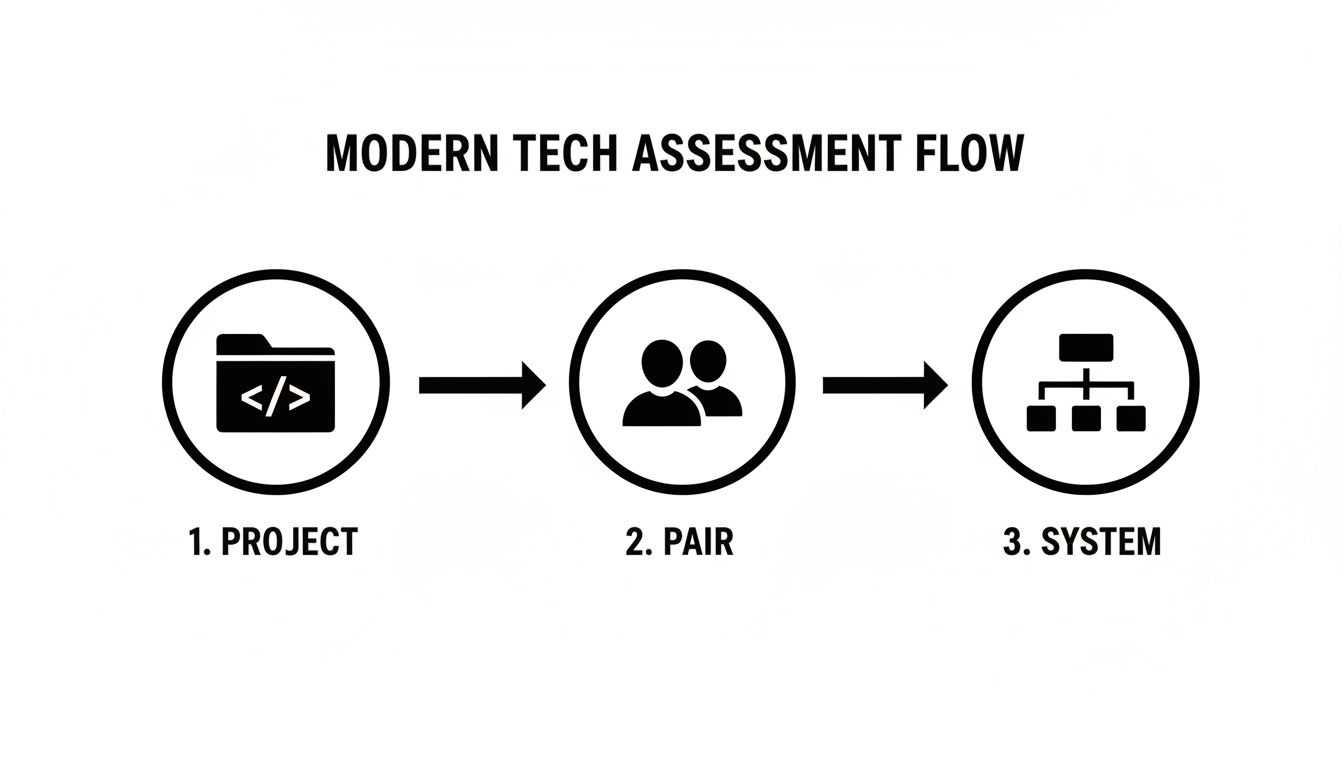
This structured flow ensures you get a comprehensive assessment before you even think about making a decision.
From Feedback To Offer
The final interview is done. Now what? Don’t let feedback trickle in over several days. Get a debrief meeting on the calendar with the entire interview panel, ideally the same day, while impressions are still sharp.
Use a structured system where each interviewer shares their notes based on the specific competencies they were assigned. This data-driven approach kills the "I just got a good vibe" commentary and forces the conversation to center on actual evidence.
Once the team hits a consensus, it's time to build an offer they can’t refuse. This is more than just a number; it’s a statement about your company’s value. The 2025 hiring market has shifted hard toward senior talent—senior roles now make up more than half of all open software engineering positions. Tech giants are driving this, with Meta's engineering team growing 19% and Google's 16% since early 2022, mostly by grabbing experienced talent. You can find out more about how the market is shifting toward senior talent and what it means for your strategy.
When you extend the offer, be ready to sell the total package, not just the salary.
Compensation: Lay out the base salary, bonus structure, and equity in simple, clear terms.
Benefits: Talk up the unique perks. Is it the professional development budget? The killer health insurance? The truly flexible work policy?
Impact: Remind them of the exciting challenges they’ll get to solve and the direct impact they will have on the company's mission.
Moving fast and with conviction at this stage is critical. It shows the candidate they are your top choice and can dramatically boost your offer acceptance rate.
Navigating the minefield of interviewing and negotiating for top engineers takes real expertise. At TekRecruiter, we’re a technology staffing firm that helps innovative companies land the top 1% of engineering talent, anywhere in the world. We handle the entire process—from sourcing and vetting to managing the offer—so you can secure the people you need to build what's next.
Onboarding and Retaining Your New Engineer
Getting a "yes" on your offer is a huge win, but it’s the starting line, not the finish. The real work—building a long-term, high-performing engineer—is just beginning. A killer onboarding experience is your single most powerful tool for driving engagement and making sure the talent you worked so hard to find actually sticks around.

That gap between offer acceptance and day one? It’s a make-or-break window. Use this time to build excitement and smooth out any potential bumps. Simple things like sending company swag, giving them early access to key documentation, or setting up a welcome lunch with the team can make a massive difference.
The First Week: Execute Flawlessly
Day one sets the tone for an engineer's entire time with you. A chaotic start bogged down by access issues and setup problems screams disorganization and can kill their motivation instantly. The goal is a completely seamless technical and cultural handoff from the moment they log in.
Your pre-start checklist needs to be airtight:
Hardware and Accounts: All their gear should be shipped and every necessary account (email, Slack, GitHub, Jira) must be created and tested before they start. No excuses.
Pristine Dev Environment: Give them clear, up-to-date docs or, even better, a scripted setup process. Getting their local environment running should take hours, not days.
Assigned Onboarding Buddy: Pair them with a peer engineer who can answer the practical, day-to-day questions, make introductions, and help them navigate the team's social currents.
This isn’t about micromanaging. It's about removing roadblocks so your new hire can focus on learning and connecting, not battling administrative headaches.
Structuring Success with a 30-60-90 Day Plan
A structured plan is the antidote to new-hire anxiety. That feeling of "What should I even be doing?" is paralyzing. A clear roadmap with achievable milestones turns an overwhelming new role into a series of manageable wins, empowering them to contribute and integrate fast.
Here’s what a practical plan actually looks like:
First 30 Days: Learning and Integration
Complete setup and push a small, low-risk bug fix to production in the first week.
Schedule 1-on-1s with every team member and key partners across other departments.
Get a high-level understanding of the core architecture and where the product is headed.
Days 31-60: Contribution and Ownership
Take full ownership of a small, well-defined feature, from ideation to deployment.
Start participating actively in code reviews, offering thoughtful feedback.
Pinpoint an area for improvement in the existing codebase or a team process.
Days 61-90: Autonomy and Impact
Confidently tackle larger, more complex tasks with minimal hand-holding.
Show a deep understanding of their domain within the product.
Become the go-to person for at least one specific component or system.
This plan isn't just a checklist; it's a communication tool. Regular check-ins against these milestones with their manager ensure they feel supported and give you early opportunities to squash any challenges before they become real problems.
Tracking What Matters for Long-Term Retention
You can't fix what you don't measure. Tracking the right retention metrics is the only way to understand the health of your engineering org and dial in your hiring and onboarding. Beyond just getting them in the door, creating an environment that boosts developer productivity is what makes top talent stay. You can find plenty of practical tips for improving developer productivity that will keep your new engineers fired up and effective.
Key metrics you absolutely have to monitor:
Ramp-Up Time: How long does it take for a new engineer to become a fully productive contributor? A shorter ramp-up time is a direct signal of a strong onboarding process.
First-Year Attrition: This is the ultimate red flag. It points to a mismatch in hiring or a failure in onboarding. High turnover in the first 12 months is a costly mistake that demands immediate attention.
By obsessing over a world-class onboarding experience and tracking the right data, you build an engineering team that people are not only excited to join but are proud to be a part of for years to come.
Making sure your new hires thrive requires a dedicated strategy that starts long before their first day. If you need to build a team with engineers who are vetted for long-term success, TekRecruiter can help. We connect you with the top 1% of global talent, ensuring you not only hire the best but are set up to retain them.
Partner with TekRecruiter for Top Engineering Talent
You now have a solid playbook for hiring elite software engineers. From defining the role and sourcing talent to crafting the perfect offer, you understand the mechanics of building a world-class team.
But let’s be honest. In this competitive market, a playbook is only as good as its execution. Knowing the steps is one thing; having the time, network, and specialized expertise to execute them flawlessly is something else entirely. This is where you find your edge.
TekRecruiter is the technology staffing and recruiting and AI Engineer firm that allows innovative companies to deploy the top 1% of engineers anywhere. We move far beyond the resume. Our deep expertise in AI engineering and other complex technical roles means we understand your challenges intimately.
Our rigorous vetting process is designed to assess what truly matters: practical problem-solving ability, code quality, and the collaborative mindset needed to drive your mission forward. We make sure you only meet candidates with proven skills who are ready to make an impact from day one.
Whether you need to build a core team from scratch, rapidly scale with staff augmentation, or find a niche expert for a critical project, TekRecruiter gives you the strategic advantage you need to build the future. Stop gambling on the hiring process and start building with confidence.
Partner with TekRecruiter to deploy the world's top engineers and accelerate your innovation. Get in touch with us today to learn how we can help you build your dream team.
Comments