Finding the Right Machine Learning Consulting Firms
A practical guide for tech leaders on how to find, vet, and hire the right machine learning consulting firms for your next AI project. Avoid common pitfalls.
Machine learning consulting firms aren't just vendors; they're specialists you bring in to design, build, and deploy custom AI solutions that actually move the needle on business goals. Think of them as a way to bridge the gap between complex data science theory and practical, real-world application. For many, it's a much faster path to innovation than trying to build a world-class ML team from the ground up.
Knowing When You Need an ML Consulting Partner

The decision to hire an external ML firm is rarely a simple "build vs. buy" calculation. It’s a strategic choice, usually sparked by specific business pressures where speed, unique skills, and market positioning are everything. The signals aren't always blaring, but they almost always point to a gap between where you are and where you need to be.
This growing need for specialized help is why the market is exploding. The AI consulting space is expected to be worth around USD 11.07 billion in 2025 and is on track to hit nearly USD 90.99 billion by 2035. That’s a compound annual growth rate of 26.2%, fueled by businesses scrambling to bring in experts to get ahead.
Identifying the Triggers for a Partnership
Certain scenarios are dead giveaways that it's time to look for outside help. Spotting these moments can be the difference between a successful AI launch and a project that fizzles out before it even starts.
One of the most common triggers is a non-negotiable time-to-market deadline. Imagine you're a retail company racing to launch a new recommendation engine before the holiday shopping frenzy. Your internal team is sharp, but they're already buried in other projects. Missing that holiday window means leaving millions in revenue on the table. In a situation like this, a consulting firm gives you the immediate horsepower to hit that critical deadline.
Another clear sign is the need for highly specialized, niche expertise. Let's say you're a fintech startup that needs a sophisticated fraud detection model to close your next funding round. Your small team is great at core product development, but they don't have deep experience with adversarial attacks or anomaly detection at scale. A consulting firm with a proven track record in financial services can deliver a robust, compliant model that keeps both your investors and regulators happy.
Assessing Your Internal Capabilities
You have to be brutally honest about your internal team's bandwidth and skills. Your engineers might be brilliant, but are they stretched too thin? Throwing a complex ML project on top of their existing duties is a recipe for burnout and mediocre results.
An honest look at your team's project pipeline is the first step. If your top engineers are already at 100% capacity, bringing in a machine learning consulting firm isn't a sign of weakness—it's a smart allocation of resources.
On top of that, a successful ML project needs more than just a few data scientists. It requires a whole cast of characters you might not have on hand:
MLOps Engineers to build and maintain the deployment pipeline.
Data Engineers to create clean, reliable data streams.
Domain Experts who understand the specific business problem inside and out.
Project Managers who have experience navigating the unique chaos of an AI project.
If you’re missing even one of these key roles, a consulting firm can plug that hole instantly. This whole evaluation process ties into the bigger picture of technical implementation, which we cover more in our CTO's guide on how to implement AI in business.
To help clarify the decision, here's a quick breakdown of when each approach usually makes the most sense.
Internal Team vs ML Consulting Firm Key Decision Factors
A quick comparison to help you decide between building an in-house team and hiring an external machine learning consulting firm based on common business needs.
Factor | Best for In-House Team | Best for ML Consulting Firm |
|---|---|---|
Speed | Long-term, foundational projects where speed isn't the top priority. | Urgent projects with tight deadlines and a high cost of delay. |
Expertise | Developing core, proprietary IP that is central to your long-term strategy. | Needing niche, specialized skills (e.g., NLP for legal, computer vision for medical imaging) for a specific project. |
Cost | You have the budget and time for a lengthy hiring and onboarding process. | Project-based, predictable costs are preferred over long-term headcount. |
Risk | Comfortable with the risks of R&D and potential project pivots. | Need to de-risk a project by leaning on proven methodologies and experience. |
Focus | Keeping your internal team focused on their core responsibilities. | Augmenting your team without distracting them from their primary roadmap. |
Ultimately, the right choice depends on your specific goals and constraints.
Bringing in the right firm allows you to accelerate your AI initiatives without the long, costly headache of hiring a full-time, specialized team. This agility lets you focus on your core business while the experts handle the technical heavy lifting, setting your project up for success from day one.
How to Vet and Compare ML Consulting Firms
So, you’ve decided to bring in the heavy hitters. Good. Now the real work begins. Choosing the right partner from a sea of machine learning consulting firms means you have to look past the slick websites and polished sales pitches.
You need a battle plan to separate the genuine experts from the marketing machines. This is about finding a true partner, not just another vendor.
The AI consulting market is absolutely exploding, which makes this vetting process all the more critical. Projections show the market expanding by a staggering USD 38.16 billion between 2024 and 2029, growing at a compound annual rate of nearly 28.8%. A huge chunk of that growth—roughly 36%—is right here in North America. If you want to dive deeper into the numbers, you can explore the full market dynamics on Technavio.
Look Beyond the Case Studies
Every firm will show you a highlight reel of their biggest wins. Your job is to get behind the curtain and see the reality of how those results were achieved. Don't just take their word for it; you need to ask the tough questions.
A great place to start? Ask about a project that didn't go according to plan. How did they handle it when the data was a mess, the client pivoted, or unexpected roadblocks appeared? Their answer will tell you more about their problem-solving chops and transparency than any shiny success story ever could.
Once they've shared their war stories, circle back to those "successful" projects and dig in:
What was the baseline? If they boast a 20% efficiency gain, you need to know what the starting point was.
How was success measured? Did they define the metrics, or did the client? This reveals a lot about their focus on business outcomes versus just technical milestones.
Who was actually on the team? Insist on speaking with the engineers who did the hands-on work, not just the sales lead who closed the deal.
This approach cuts through the marketing fluff and gets you to the ground truth of their capabilities.
Evaluate Technical Depth and MLOps Maturity
Any decent firm can build a model. That's table stakes. The real question is whether they can deploy, monitor, and maintain that model in a live production environment. This is where their MLOps (Machine Learning Operations) maturity comes into play. A firm with a strong MLOps culture knows the project isn't over when the model is built—it's just beginning.
A great machine learning model that never makes it into production is just an expensive research project. When vetting firms, prioritize their MLOps capabilities just as highly as their data science talent. This ensures your investment delivers real, ongoing business value.
Ask them directly about their MLOps practices. How do they handle model versioning, automated retraining, and performance monitoring? Are they experienced with tools like Kubeflow, MLflow, or are they fluent in cloud-native solutions like AWS SageMaker or Google's Vertex AI? Their comfort level with these topics is a dead giveaway of their technical depth.
Assess Cultural Fit and Collaboration Style
Don't ever underestimate the importance of cultural alignment. This firm will operate as an extension of your own team, and a clash in working styles can kill a project, no matter how technically brilliant the plan is. Find out if they're agile and iterative or if they prefer a more rigid, waterfall approach.
How do they communicate? Will you get a dedicated project manager and have direct lines to the technical team? A true partner prioritizes clear, constant communication and feels like a part of your organization, not some siloed third party you have to chase for updates.
Finally, you need to lock down the non-negotiables—the legal and security stuff. Here’s a checklist of questions every potential firm needs to answer, clearly and in writing:
Data Security: How will our sensitive data be handled, stored, and protected throughout the project?
Compliance: Do you have experience with regulations like GDPR, CCPA, or HIPAA?
IP Ownership: Who owns the final model, the source code, and any derivative works? Get this in writing.
Team Composition: Will the senior engineers who pitched the project be the same ones doing the work, or will they be swapped out for junior talent?
Getting straight answers here is essential. It protects your business and sets the foundation for a smooth partnership.
Navigating the world of machine learning consulting firms is tough, but focusing on these core areas—real results, technical maturity, and cultural fit—will point you to the right partner.
If this process feels like too much to run alongside your roadmap, TekRecruiter can run it for you. We find and vet the best AI engineering company or ML consulting firm for the project and bring you a shortlist, at no cost to you (see how MSP & Outsourcing Search works). If you’d rather build your own in-house team, we also recruit the top 1% of AI engineers directly, without the overhead of a consulting firm.
Running an RFP and Technical Vetting Process That Works
A generic Request for Proposal (RFP) gets you a generic sales pitch. It's that simple. If you want to find the right machine learning consulting firm, you have to force them to move beyond glossy brochures and into the messy, technical reality of your project. This means designing a vetting process that makes them prove their expertise, not just talk about it.
Your goal isn't just to get proposals; it's to get the right information to make a confident decision. This starts by building an RFP that leaves zero room for vague, boilerplate answers. A solid document clearly defines the business problem, is painfully honest about the data you have (and don't have), and spells out what success looks like in cold, hard numbers. A winning template for proposal request writing can be a good starting point, but you'll need to customize it heavily to solicit clear, comparable bids.
Designing an RFP That Gets Real Answers
Think of your RFP as a filter. It should be designed to immediately weed out the firms that don't have the specific chops your project demands. Stop asking broad questions like, "What's your experience with AI?" and get granular.
Your RFP needs to cover:
Project Context: Get straight to the point. Are you trying to cut customer churn, slash inventory costs, or get better at spotting fraud? Give them the business problem, not just a technical wishlist.
Data Availability: Be brutally honest about your data. Describe the datasets, formats, volume, and any known quality issues. Telling them upfront that your data is a bit of a mess saves everyone a ton of time and pain later.
Success Metrics: Define the win. Is it hitting a 95% accuracy rate? Getting prediction latency under 100ms? Reducing manual data entry by 40%? Be specific.
Technical Environment: Lay out your current tech stack. Are you an AWS shop running on Snowflake? This context helps firms propose solutions that will actually work in your ecosystem, not just in their lab.
When you provide this level of detail, you force respondents to stop copying and pasting and actually engage with your unique challenge.
The best RFP responses almost always come from the firms that ask you the most intelligent questions. A potential partner who pokes holes in your assumptions and flags data challenges before a contract is even on the table is showing real expertise, not just salesmanship.
Conducting a Meaningful Technical Interview
The RFP gets you a shortlist. The technical interview is where you find your winner. This is not the time to quiz them on obscure algorithms from a textbook. It's your chance to see how their team thinks, collaborates, and attacks problems.
And here’s the most important part: you absolutely must interview the actual engineers and data scientists who would be working on your project. Don't let them send in the polished senior partners from the sales deck.
Once you have the right people in the room (or on the call), move past their canned case studies. Hit them with a practical, open-ended problem that looks a lot like the one you're trying to solve.
For instance:
“We have customer transaction histories, demographic data, and a messy pile of support ticket logs. Walk us through how you’d approach building a predictive churn model. What are your first steps? Talk us through data exploration, feature engineering, and how you’d select and validate a model.”
This single question tells you more than a dozen slides. You get to see their thought process live. Do they immediately gravitate toward a complex deep learning model, or do they wisely start with a simpler, more interpretable baseline? Do they ask smart, clarifying questions about the business impact and the real-world cost of getting it wrong?
Probing Deeper on MLOps and Model Maintenance
A model that only works on a data scientist's laptop is a useless science project. You need to know—not hope—that the firm can build, deploy, and maintain a model that survives in a live production environment. Their MLOps expertise is completely non-negotiable. For a solid primer on this, check out some of the top MLOps best practices for engineering leaders.
Here are a few questions to separate the talkers from the builders:
How do you monitor for data and concept drift after a model goes live? What's your process?
What’s your preferred way to version datasets, code, and models?
Tell me about a time you had to roll back a model deployment in a hurry. What went wrong, and what did you learn?
What’s your take on model explainability tools like SHAP or LIME? When have you actually used them on a project?
Their answers will tell you everything you need to know. You'll quickly find out if they're a true end-to-end partner or just a data science shop that throws the hard engineering work over the wall. This kind of tough vetting is what ensures you find a firm with the deep technical and practical experience to actually deliver business value.
If you decide that building this capability in-house is the smarter long-term play, TekRecruiter can help there too. We connect companies with the top 1% of AI and machine learning engineers and embed elite talent directly into your own teams.
Crafting Contracts and SLAs That Protect Your Project
Alright, the sales pitches are done and you’ve shaken some hands. Now comes the part that will actually make or break your project with a machine learning consulting firm: the contract. A flimsy agreement is just an invitation for scope creep, blown budgets, and ugly fights over who owns what at the end of the day.
Getting the legal framework right is non-negotiable, especially with the money pouring into this space. The global machine learning market was pegged at USD 72.6 billion in 2024 and is on track to explode to nearly USD 420 billion by 2030. With that much at stake, you can’t afford to be casual about the paperwork.
This whole process, from sending out your RFP to signing on the dotted line, is a funnel designed to find the right partner.
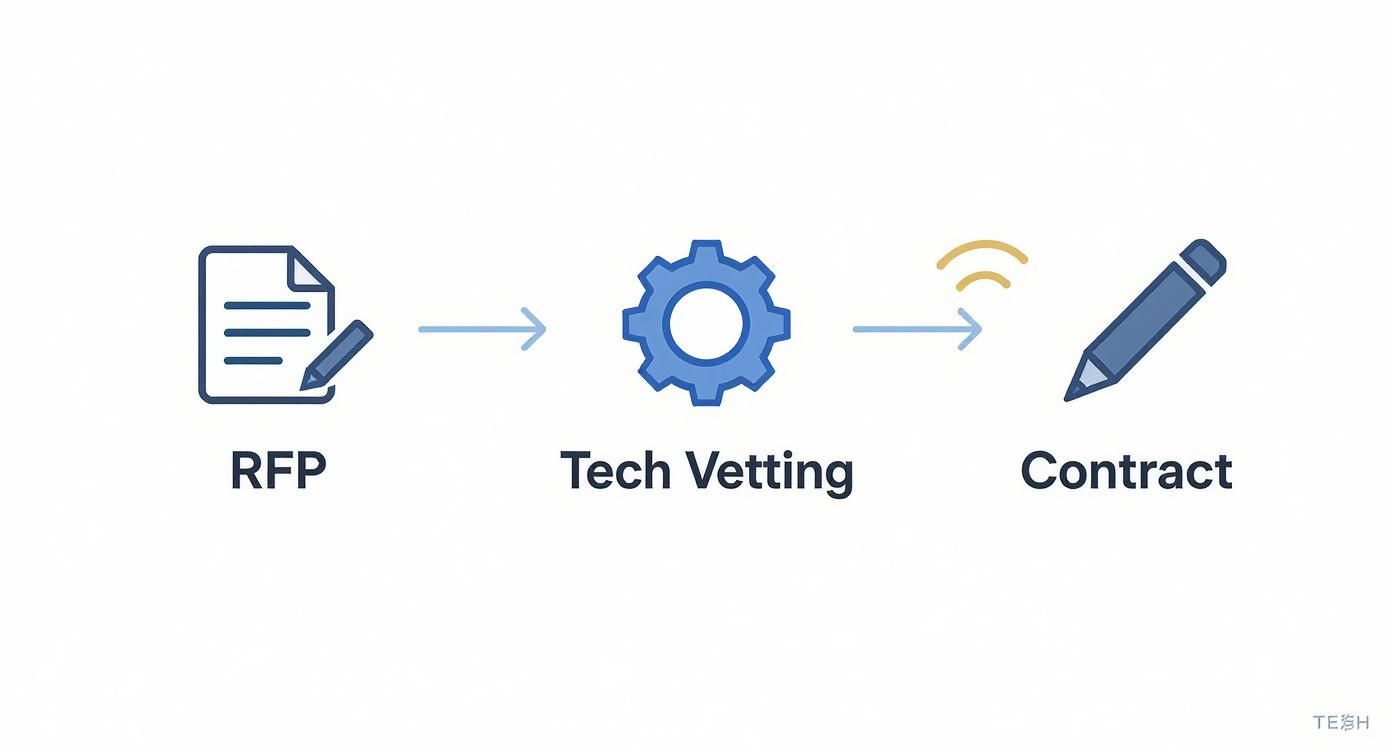
As you can see, the contract isn’t just a final step; it’s the legal anchor for all the technical and business vetting you’ve already done.
Defining Non-Negotiable Contract Clauses
Your contract needs to go way beyond the standard legal boilerplate. This is ML, and ambiguity is your worst enemy.
First, lock down a rock-solid Scope of Work (SOW). It has to detail the exact business problem you're solving, the datasets they'll use, and the specific deliverables—like a trained model, API endpoints, and full documentation. Just as critical is listing what's out of scope. This is your number one defense against runaway projects.
Next up is Intellectual Property (IP) Ownership. This is a big one. Who owns the final model? The code? The feature engineering pipelines you paid them to build? The contract must spell out, in no uncertain terms, that your company owns all custom work developed for you. Period.
Finally, you need ironclad Data Confidentiality terms. The agreement has to specify exactly how your data will be handled, stored, secured, and either destroyed or returned when the project wraps. If you need a good primer on the nuts and bolts, this is a helpful resource on how to write a contract.
A contract with an ML consulting firm is more than a formality—it’s a strategic tool that aligns everyone’s incentives. If a firm balks at clear IP ownership or wants a fuzzy SOW, that’s a massive red flag.
Moving Beyond Uptime with Meaningful SLAs
Forget traditional Service Level Agreements (SLAs). An SLA focused on simple metrics like server uptime is almost completely useless for an ML project. You need to measure what actually drives business value: the model's real-world performance.
A proper ML-centric SLA should have specific, measurable targets for:
Model Accuracy: What’s the minimum performance you'll accept (e.g., F1 score, precision, recall) on live, production data?
Prediction Latency: How fast does the model need to be? Set clear targets, like 99% of all requests must be served in under 200 milliseconds.
Model Retraining Frequency: How often will the model get a refresh to fight data drift? The SLA needs to define the triggers and the schedule.
Data Drift Monitoring: The contract should lay out which metrics will be used to watch for data drift and what happens when a major shift is detected.
These kinds of SLAs turn a simple work-for-hire agreement into a true performance-based partnership. It makes the consulting firm accountable not just for building a model, but for delivering one that actually works and keeps working over the long haul.
Exploring Smarter Alternatives to Traditional Consulting
Going all-in with a high-cost, traditional machine learning consulting firm isn't always the answer. Sometimes your needs are more specific, your budget is tighter, or your real goal is to build long-term strength in-house rather than just outsourcing a single project. The good news is, the talent market has moved on. There are now smarter, more flexible ways to get the expertise you need without the eye-watering price tag and rigid contracts of old-school consulting.
Understanding these alternatives gives you a full menu of options. You're no longer stuck with a one-size-fits-all approach and can pick the most scalable and cost-effective solution for what you're actually trying to achieve.
Nearshore Staff Augmentation: Adding Precision Skills
Think of staff augmentation as a surgical strike. Instead of hiring an entire firm to own a project from A to Z, you bring in one or two highly specialized engineers to fill a specific gap on your team. It's the perfect model when your crew is 90% of the way there but just missing that one key skill—like deep reinforcement learning or advanced NLP.
This person becomes a fully integrated member of your squad, working under your project management and within your existing culture. It's an incredibly effective way to hit the accelerator on a project without disrupting your team's flow or giving up control over the project's direction. For a deeper dive, check out this breakdown of what staff augmentation is and how it benefits teams.
The biggest advantage here is control. You keep full ownership of the project roadmap, architecture, and IP, while injecting elite talent exactly where you need it most.
Direct Hiring: Building Your Own AI Powerhouse
For companies where machine learning is a core, long-term competitive advantage, building your own in-house team is the ultimate play. It's the most investment-heavy path, for sure, but it pays the biggest dividends down the road.
When you have your own team, the expertise stays within your walls. Proprietary models are yours and yours alone. Your AI capabilities grow and compound over time. This is the strategy for when you're moving past one-off projects and are ready to weave AI into the very fabric of your product. It demands a serious commitment to recruiting and retention, but it’s the only way to build a truly sustainable AI center of excellence.
Managed AI Services: Outsourcing the Entire Lifecycle
Managed AI services offer a solid middle ground between a full consulting engagement and building everything from scratch. With this model, a third-party provider takes on the whole ML lifecycle for you—from data prep and model training to deployment, monitoring, and maintenance.
This is a fantastic option for companies that need a sophisticated AI solution but don't want the headache of managing the underlying infrastructure or hiring a dedicated MLOps team. You define the business problem, and the provider handles the technical heavy lifting. You lose some of the granular control you’d have with other models, but you gain a predictable, outcome-based service, often with a more manageable subscription-style price tag.
So, how do you decide which path is right for you? It helps to see how these models stack up against each other.
Comparing Talent Solutions for Your AI Project
Here’s a quick overview of the different models for bringing in machine learning talent, breaking down the best use cases and key things to consider for each.
Model | Best For | Control Level | Cost Structure |
|---|---|---|---|
Traditional Consulting | Large, complex, one-off projects with a defined end date and a need for strategic guidance. | Low | Project-based, high upfront cost. |
Nearshore Staff Augmentation | Filling specific skill gaps and accelerating existing projects without losing control. | High | Time and materials, flexible hourly/monthly rates. |
Direct Hire | Building a long-term, core competency and owning all intellectual property in-house. | Full | Fixed salary and benefits, long-term investment. |
Managed AI Services | Outsourcing the entire ML lifecycle for a specific function with predictable outcomes. | Medium | Subscription or usage-based, predictable recurring cost. |
Choosing the right model isn't just a financial decision; it's a strategic one. It impacts your team's growth, your project's speed, and your company's long-term capabilities.
Instead of defaulting to a legacy consulting firm, the modern approach is to mix and match. Maybe you start with staff augmentation to get a critical project off the ground, which then helps you build the business case for a full-time hire later on. This flexibility ensures you're always using the smartest, most efficient path to bring in world-class engineering talent.
Build Your AI Team with Elite Engineering Talent
Navigating the world of AI is complex, but finding the right talent shouldn’t be. Whether you decide a traditional engagement with machine learning consulting firms is your path forward or a more agile model like staff augmentation makes more sense, the goal is always the same. You need elite talent to solve your biggest challenges.
The right engineers do more than just build models; they turn raw data into a real competitive advantage. TekRecruiter is a technology and engineering staffing and recruiting agency that finds the top 1% of AI and machine learning engineers and, when the work calls for a firm, the best AI engineering company for it.
When an in-house team is the better path, hiring directly gives you more control and builds capabilities that last. If you want more insights on attracting this kind of top-tier talent, check out our ultimate guide to recruiting and hiring software engineers.
Got Questions? We've Got Answers.
Even after you've done all the vetting, a few nagging questions always seem to pop up before you sign on the dotted line with an ML consulting firm. That's normal. Getting straight answers on these points is the difference between a smooth partnership and a painful one.
Let's cut through the noise and tackle the big questions we hear from tech leaders all the time.
How Much Is This Actually Going to Cost?
This is the big one, and the answer is... it depends. Costs can swing wildly, but they usually boil down to two models: a fixed project fee or hourly rates.
For a specific, well-defined project—like building out a predictive maintenance model—you could be looking at a fixed bid anywhere from $75,000 to over $500,000. The final number really hinges on the complexity. If you're diving into more open-ended R&D, expect to pay top-tier consultants somewhere in the $250 to $500+ per hour range.
Don't ever accept a number without a detailed breakdown. The price tag is a direct result of:
The Team: How many data scientists, MLOps engineers, and project managers are on deck?
The Clock: Are we talking a three-month sprint or a year-long marathon?
The Data: Is your data clean and ready to go, or is it a tangled mess that needs a ton of prep work? That prep work costs money.
What’s a Realistic Timeline for Seeing Results?
Timelines can be deceiving. A typical project has a familiar lifecycle, but the devil is in the details. A proof-of-concept (PoC) might only take 6-8 weeks, which sounds great. But turning that PoC into a hardened, production-ready system? That can easily eat up another 4-6 months.
A real-world timeline has to account for data discovery, feature engineering, model training, deployment, and—this is the one people forget—thorough user acceptance testing.
Be extremely skeptical of any firm promising a production-grade solution in less than three months. Real ML projects hit unexpected data hurdles and require iterative model tuning. Rushing that process is a recipe for an unreliable, low-quality system.
Who Owns the IP?
This is a deal-breaker. It needs to be crystal clear in your contract.
The industry standard is simple: you, the client, own all the custom work. That means the final trained model, every line of source code, and any data pipelines built for you. Full stop.
Now, some firms might want to retain ownership of their proprietary, pre-existing tools or frameworks. That’s usually fine. But the bespoke solution you paid them to build? That belongs to you, free and clear. Don't move forward until that clause is in writing.
How Do We Actually Measure the ROI on This?
You can't. Not unless you define what success looks like before the project kicks off. Measuring the return on investment for an ML project isn't about model accuracy scores; it's about business impact.
You need to be tracking concrete metrics tied to business outcomes, like:
Cost Savings: Did the new model reduce operational expenses by a measurable percentage?
Revenue Growth: Did that fancy new recommendation engine actually increase the average order value?
Efficiency Boost: How many work-hours did we reclaim through automation?
When you tie the project's performance directly to these kinds of KPIs, you can build a rock-solid case for the investment and prove its value to the rest of the business.
 Ron SmithPresident & Lead RecruiterTekRecruiter