How to Hire Remote Developers and Build Your Dream Team
Discover how to hire remote developer talent with our expert guide. Learn proven strategies for sourcing, vetting, and managing elite global engineers.

The whole conversation around hiring developers has changed. It's no longer about finding a temporary fix or jumping on a trend. For companies that want to seriously out-innovate their competition, hiring globally is a core business strategy.
Smart tech leaders are intentionally looking beyond their city limits—not just to fill an open role, but to find the absolute best person for the job, period. It doesn't matter where they live.
The Strategic Shift to Global Remote Talent
This global-first approach gives you a massive advantage, especially when your local market is completely saturated. Trying to find a top-tier AI engineer or a seasoned cloud architect in your immediate area can feel like an impossible task. The moment you decide to hire a remote developer, your talent pool explodes from one city to the entire world.
Why Global Talent Unlocks Growth
Let's be honest: local talent shortages are a huge bottleneck. I've seen critical projects stall for months while a company searches for a single engineer with the right niche skills.
When you embrace a global talent strategy, you can:
Actually hit your project deadlines. Instead of waiting forever for the "perfect" local candidate, you get access to a massive pool of qualified pros who are ready to jump in.
Build a more diverse team. Bringing in engineers from different backgrounds and cultures introduces new ways of thinking. This leads to more creative problem-solving and way more robust products.
Get a real competitive edge. While your competitors are stuck fighting over the same handful of local engineers, you're busy building a world-class team with specialized skills sourced from nearshore hubs in Latin America.
This isn't just about filling seats. It's about building a more dynamic, resilient, and capable organization. The data backs this up completely.
We're in a strange new phase of the remote hiring market. While only 18% of new tech jobs are fully remote, those roles are attracting 2.5 times more applicants than on-site positions. This tells a story: companies are getting strategic, saving their remote opportunities to land elite, specialized talent they simply can't find in their own backyard.
Responding to a Looming Skills Crisis
The demand for tech talent is absolutely surging. US tech jobs are projected to hit 7.1 million by 2034. At the same time, a massive skills shortage is breathing down our necks, with over 90% of organizations worldwide expecting to feel the pain by 2026. This gap is especially bad for roles in AI and machine learning.
To survive—let alone thrive—companies must hire remote developers from global talent pools. By sourcing from high-growth nearshore regions and focusing on keeping the talent you find, you build a stable, powerful engineering force. It’s worth noting that remote hires show a 62% two-year retention rate versus just 41% for on-site staff. If you're interested, you can read more about the remote developer hiring trends and see the data for yourself.
Of course, navigating this global market takes real expertise and a process that works. TekRecruiter is a technology and engineering staffing and recruiting agency that helps innovative companies hire the top 1% of engineers, no matter where they are.
Finding and Attracting Elite Global Developers
If you want to hire a remote developer who can actually move the needle on your roadmap, you have to think beyond the usual job boards. Let's be honest: elite engineers—especially the ones who aren't actively looking—are not scrolling through massive job aggregators.
They’re busy. They're active in niche communities, contributing to open-source projects, and deep in technical discussions where their skills do all the talking.
Think of sourcing less like casting a wide net and more like a targeted search. The "post and pray" approach is dead. You have to go where the real talent congregates. This means exploring specific channels where proven expertise is the only thing that matters.
Niche Developer Communities: Specialized Slack or Discord servers for specific technologies (think a Python framework or a cloud platform) are absolute goldmines.
Open-Source Contributions: An engineer’s GitHub profile is a better resume than any document they could ever write. Look for consistent, high-quality contributions to projects relevant to your stack.
Specialized Talent Networks: Platforms that pre-vet engineers are a massive time-saver. They give you a curated pool of candidates who have already cleared tough technical assessments.
Of course, just finding these passive candidates is only half the battle. Our guide on sourcing tech talent who aren’t job hunting dives much deeper into the strategies you need to actually engage these high-value individuals.
The Nearshore Advantage
Once you decide to hire remotely, geography suddenly becomes a strategic choice. And while the global talent pool is huge, nearshore regions like Latin America offer a powerful mix of benefits for U.S. companies.
The data backs this up. A recent explosion in global remote hiring shows that 78% of companies are now sourcing developers internationally, with 59% managing teams across three or more time zones. This borderless approach is driven by real results, especially in nearshore hubs. Latin America and Eastern Europe have seen remote hiring growth of 156% and 143%, respectively. Why? It's a combination of significant cost savings and excellent U.S. time-zone alignment.
But nearshoring offers a lot more than just a convenient time zone. It brings cultural affinity and a deep pool of engineers skilled in high-demand areas like DevOps, UI/UX, and cloud computing. This approach makes real-time collaboration possible without the logistical nightmare of managing a 12-hour time difference.
The infographic below really drives home the key benefits a global remote talent strategy can bring to your organization.
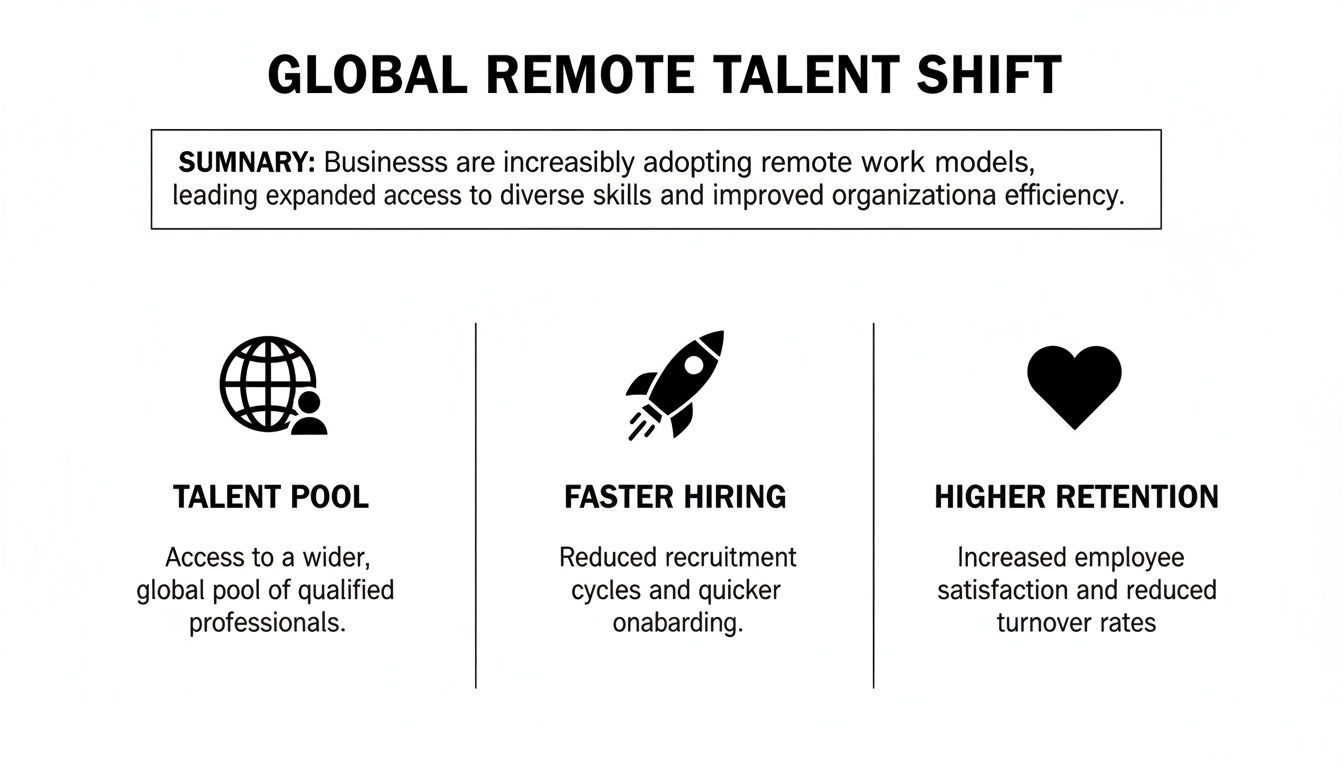
As you can see, accessing a worldwide talent pool isn't just a talking point—it leads directly to faster hiring cycles and stronger employee retention.
Choosing Your Hiring Model
Okay, so you know where to look. Now you have to decide how you're going to engage this talent. Every hiring model comes with its own set of trade-offs in speed, cost, and the sheer amount of administrative work involved.
The right hiring model depends entirely on your immediate needs, long-term goals, and internal resources. A startup needing to scale yesterday has completely different requirements than an enterprise adding a single specialist to an established team.
To help you decide, here’s a quick comparison of the different ways you can source remote talent.
Comparison of Remote Hiring Sourcing Channels
Sourcing Channel | Best For | Average Time-to-Hire | Cost Implication | Talent Quality |
|---|---|---|---|---|
Direct Hiring | Long-term roles, building core team culture | 8-12 weeks | High (recruiting, legal, benefits overhead) | Varies; success depends on internal expertise |
Staff Augmentation | Filling short-term gaps, project-based needs | 1-3 weeks | Moderate (hourly/daily rates, no overhead) | Generally high for specific skills, less cultural fit |
Specialized Firm | Speed, accessing pre-vetted elite talent, reducing admin burden | 1-2 weeks | Varies (often higher upfront, but lower total cost) | Highest (curated, top 1%-5% of talent) |
Freelance Platforms | Small, well-defined tasks or gig work | 1-7 days | Low (highly variable hourly rates) | Inconsistent; requires heavy vetting |
Each channel has its place. Your job is to align the model with your immediate business goals—whether that's speed, cost-efficiency, or finding that one perfect, long-term fit.
Let's break down the top three approaches:
Direct Hiring: You source, vet, hire, and manage the developer as a full-time employee or contractor. This gives you the most control but also means you’re on the hook for all compliance, payroll, and HR management.
Staff Augmentation: You bring a developer onto your team temporarily from a third-party company to fill a specific skill gap or help with a project. It’s fast, flexible, and perfect for short-term needs without a long-term commitment.
Partnering with a Specialized Firm: You work with a technology staffing partner that handles everything—sourcing, vetting, compliance, and payroll. This is the most efficient route, offloading the admin work and giving you direct access to a pre-vetted network of top-tier talent.
For a deeper look into the entire process, check out this proven playbook on how to hire remote developers.
At TekRecruiter, our entire business is built around making this choice simple. We find the top 1% of engineers, including senior nearshore engineers in Latin America at about $39–$57 an hour all in. We take care of international sourcing and vetting so you can focus on what you do best: building incredible products with world-class talent.
Running a Remote Interview Process That Works
Let's be blunt: hiring a great remote engineer is a completely different ballgame than hiring for an on-site role. Technical chops are just the table stakes. When you bring on a remote developer, you're really betting on their ability to work with a high degree of autonomy, communicate with exceptional clarity, and solve problems without someone peeking over their shoulder.
Your interview process, then, has to be built from the ground up to find those traits. A standard series of algorithm challenges and a casual chat just won't cut it. You need a process that actually simulates the reality of remote work.
Design Practical Technical Challenges
The single best way to see how someone will perform on the job is to... well, see them perform on the job. Forget the generic coding puzzles that don't mirror the real work your team does. Instead, give them a practical challenge that looks a lot like a day-in-the-life task for your engineers.
A well-designed take-home assignment is perfect for this. Just keep it concise—something that can be knocked out in 3-4 hours maximum—to respect the candidate's time. This isn't about getting free labor; it's about seeing their thought process, code quality, and documentation skills in action.
For example, you could ask a backend candidate to:
Build a simple REST API endpoint with a specific framework you use.
Containerize the application using Docker.
Write a clear README file explaining how to get it running.
This one small task tells you a ton. Can they work with modern libraries? Do they follow basic software engineering best practices? Can they explain their work clearly? These are all make-or-break skills for a remote developer.
Master the Behavioral Interview for Remote Traits
Behavioral interviews are where you separate the good from the great in a remote context. The trick is to ask specific, open-ended questions that force them to talk about past experiences, not just give you rehearsed, hypothetical answers.
Don't ask, "Are you a good communicator?" That's a waste of everyone's time.
Instead, dig for a real-world example:
"Tell me about a time a project was blocked because of an unclear requirement. What specific steps did you take to get the clarity you needed, especially if the project owner was in a different time zone?"
A question like this is a multi-tool. It probes for several critical remote skills at once:
Proactivity: Did they sit around and wait, or did they own the problem?
Problem-Solving: How did they navigate the ambiguity?
Asynchronous Communication: How did they manage getting answers across time zones?
You're listening for answers that show a clear bias for action and a logical communication style. For a deeper dive into crafting these kinds of questions, check out our guide on asking the right questions in a tech interview.
Evaluate Asynchronous Communication Skills
In a remote team, written communication isn't just a skill—it's the skill. A developer who writes clearly is exponentially more valuable than one who doesn't. Your interview process needs to actively test for this from the very beginning.
Pay close attention to every written interaction you have with them. Seriously.
Their first email: Is their intro message clear and professional?
Email threads: Are their replies timely, well-structured, and easy to follow?
The take-home project: Is their README so clear that another engineer could get the project running with zero friction?
These aren't just minor details. They're powerful signals of how this person will communicate in Slack, in pull requests, and in your project management tool. An engineer who nails asynchronous communication prevents misunderstandings, cuts down on pointless meetings, and keeps projects moving.
This meticulous approach ensures you hire someone who isn't just a skilled coder, but a self-sufficient, communicative, and proactive force multiplier for your team.
At TekRecruiter, this philosophy is baked into our vetting process. We go far beyond just a technical screen to identify the top 1% of engineers who have the autonomy and communication skills to thrive remotely. We connect you with talent that’s ready to make an impact from day one.
Untangling International Contracts and Compliance
So, you've decided to hire a remote developer from another country. This is a huge win for tapping into global talent, but it also means you're stepping into the world of international law. Don't let that scare you. With the right strategy, you can handle the legal side of things without getting tangled up in red tape.
The first, and most critical, decision you'll make is whether to classify your new hire as a contractor or an employee. This isn't just semantics—it has massive downstream effects on taxes, benefits, liability, and the sheer amount of paperwork you'll face. Get it wrong, and you could be looking at serious penalties.
Choosing Your Engagement Model
There's no single "right" way to hire globally. The best approach depends on your company's size, how much risk you're willing to take on, and your long-term vision. You generally have three paths you can go down.
Direct Contracts: This is the simplest path. You find a developer, sign them as an independent contractor, and pay them directly. It’s fast and flexible, but it also means you’re on the hook for all compliance, tax forms, and contract enforcement. The entire burden rests on your shoulders.
Employer of Record (EOR): An EOR service becomes the legal employer for your developer in their home country. They handle everything—local payroll, taxes, benefits, and compliance—while the developer works as a dedicated member of your team. This model slashes your legal risk but comes with recurring service fees.
Staffing Partner: Working with a specialized firm like TekRecruiter gives you a dedicated recruiting partner. We handle sourcing and vetting from start to finish, and you get a single point of contact.
Each option has its own set of trade-offs. If you're wrestling with this decision, our guide on direct hire vs. contract employees breaks it down even further to help you find the right fit.
To make this even clearer, here's a quick breakdown of how these models stack up.
International Hiring Models At a Glance
Choosing how to engage international talent is a strategic decision. This table summarizes the key differences between the most common models to help you decide which path aligns with your company's goals, resources, and risk appetite.
Hiring Model | Compliance Responsibility | Cost Structure | Ideal For |
|---|---|---|---|
Direct Contractor | Your company is fully responsible for classification, contracts, and tax forms. | Pay-per-project or hourly/monthly retainer. Minimal overhead. | Short-term projects, specialized tasks, and companies comfortable managing legal risks. |
Employer of Record (EOR) | The EOR provider handles all local labor laws, payroll, taxes, and benefits. | Developer's salary + a percentage-based monthly management fee. | Companies wanting full-time, integrated team members without establishing a legal entity abroad. |
Staffing Partner | The staffing partner (like TekRecruiter) handles sourcing and vetting. | All-inclusive rate that covers the developer's pay and the partner's service fee. | Businesses that need to hire top-tier talent quickly, reduce risk, and offload the search. |
Ultimately, the right model depends on how much control you want versus how much risk you're willing to offload.
Crafting Ironclad International Contracts
No matter which model you choose, the contract is your single most important legal shield. A flimsy, poorly written agreement is an open invitation to IP risks and messy payment disputes.
A strong international contract is non-negotiable. It must include:
Intellectual Property (IP) Assignment: This clause must explicitly state that all work product and IP created during the engagement belong 100% to your company. It needs to be enforceable in both your country and the developer's.
Confidentiality (NDA): A rock-solid non-disclosure agreement is essential for protecting your trade secrets, client information, and proprietary code.
Payment Terms: Be crystal clear. Define the currency, payment schedule (net-15, net-30, etc.), and invoicing method. Ambiguity here is the number one cause of friction.
Termination Clause: Spell out the exact conditions for ending the contract, including notice periods and final payment procedures.
I see this mistake all the time: companies use a generic, US-centric contractor template for an international developer. These agreements are often worthless abroad, failing to account for local labor laws and putting your IP in serious jeopardy.
As your team grows, navigating remote worker compliance across different jurisdictions becomes a major challenge. A tailored, airtight contract is your first and best line of defense.
Managing these legal nuances for every new hire can easily become a full-time job, pulling you away from what you do best. TekRecruiter takes the hiring side of that headache off your plate. We source and vet the engineers so you can deploy the top 1% of global engineers with complete confidence.
Onboarding and Managing a High-Performing Remote Team
Signing the contract is just the beginning. The real work starts now: turning a talented new hire into a deeply integrated, high-impact member of your team. When you hire a remote developer, you can't rely on the casual, in-office osmosis of culture and process. This requires a deliberate and structured approach.
A well-executed onboarding plan is your single best tool for setting a new remote engineer up for success. It removes ambiguity, builds early momentum, and shows your organization is serious about supporting its distributed workforce.

A 30-60-90 Day Onboarding Blueprint
A structured 90-day plan gives your new hire a clear roadmap, helping them understand what’s expected and measure their own progress. The goal is simple: move them from learning the basics to contributing meaningfully as quickly as possible.
First 30 Days: Integration and a Small Win
The first month is all about immersion and removing friction. Your primary goal is to get them plugged into the team and the tech stack, capped off with a small, tangible victory.
Day 1-7 (Setup & Connections): Grant all system access—from code repos to project management tools—before their first day. Schedule brief, informal 1:1s with key team members and assign an onboarding buddy to field practical questions. Their very first task should be simple: get the local dev environment running and push a non-critical change.
Weeks 2-4 (First Contribution): Hand them a well-defined, low-risk starter project. This could be fixing a minor bug, adding a small feature, or improving documentation. This first win is a massive confidence booster and the best way for them to learn your team's real-world workflow.
Days 31-60: Ownership and Collaboration
By month two, the developer should start taking more ownership. They need to feel comfortable jumping into team ceremonies and contributing to technical discussions without hesitation.
Increased Responsibility: Assign them a more substantial feature or a key component of a larger project. They should be the primary owner, responsible for seeing it through from development to deployment.
Pair Programming: Schedule regular pair programming sessions. In a remote setting, this is one of the most effective ways to transfer deep knowledge about your codebase and coding standards.
Days 61-90: Proactive Impact
In the final phase, your new hire transitions into a fully functioning team member. They should be moving from reactive task-completion to proactive problem-solving, identifying areas for improvement in the code or process and suggesting solutions.
A common mistake is to overwhelm a new remote hire with a massive project on day one. A structured onboarding process that builds from a small, early win to full ownership is far more effective. It establishes momentum and integrates them into the team’s rhythm without causing burnout.
Fostering a Strong Remote Culture
A thriving remote culture doesn't just happen; it’s built intentionally. This comes down to disciplined communication and a serious commitment to security.
Asynchronous Communication is Key
Effective async communication is the lifeblood of any successful distributed team. It means documenting decisions, providing clear context in written updates, and respecting that your team works across different time zones. To learn more, check out our insights on how to leverage technology to boost your remote work teams.
Essential Security Practices
With a distributed team, your security perimeter expands to every employee’s home office. Protecting your company’s data is completely non-negotiable.
Endpoint Security: All devices used for work, whether company-provided or personal, must have managed endpoint protection software installed. No exceptions.
Secure Access: Implement a Zero Trust security model. This means enforcing multi-factor authentication (MFA) for all critical systems and applying the principle of least privilege for data access.
Data Policies: Have clear, enforceable policies for handling sensitive data. This includes strict rules against using public Wi-Fi for work and clear guidelines for secure data storage.
Turning a great hire into a long-term asset requires a thoughtful approach to both their integration and ongoing management. It's an investment that pays dividends in higher productivity, stronger retention, and a more resilient engineering team.
If you’re ready to hire remote developers without the operational headache of managing global onboarding and security, TekRecruiter can help. We connect you with the top 1% of global engineers and handle the sourcing and vetting, letting you focus on building great products with an elite team from day one.
Let Us Recruit Your Elite Engineering Team
Let’s be honest: navigating the global hiring market is a full-time job. It’s a maze of sourcing, vetting, and mind-numbing administrative work. Every hour you spend wrestling with international compliance and payroll is an hour you’re not spending on your actual product.
That’s where TekRecruiter comes in. We cut through the noise and act as your strategic partner, connecting you with the top 1% of engineers from the world’s best talent pools, including nearshore talent in Latin America. We help you hire remote developers without the operational drag.
Your End-to-End Hiring Partner
Whether you need to quickly augment your team for a specific project, find a critical direct hire, or hire specialized AI engineers for your next big feature, we recruit for all three.
Our model is unique. We blend world-class global talent with recruiters who know the work. What does that mean for you? Crystal-clear communication and an obsession with quality control. We handle the sourcing and the grueling vetting process so you can focus on what you do best: building.
At its core, TekRecruiter’s value is speed and precision. We get rid of the friction in global hiring so you can deploy proven, top-tier engineering talent and start accelerating your projects from day one.
If you’re ready to stop searching and start building, let’s talk. Connect with TekRecruiter, and we'll show you how our flexible staffing can bring you the elite engineers you need to win.
Questions We Hear All the Time
Even with a solid game plan, you're going to have questions. Everyone does. Here are some of the most common ones we field from leaders about to hire their first (or next) remote developer, with some straight-up answers from our experience.
What Are the Biggest Hidden Costs?
It's never just about the salary. Ever. The biggest costs that catch people off guard are the platform fees for global payroll or an Employer of Record (EOR). They’re worth it, but they aren't free.
You've also got to factor in currency conversion charges, which can bite you if you're not paying attention. And don't forget the practical stuff—like the cost of shipping a secure, company-issued laptop internationally.
Then there's the software. You'll need to budget for top-tier collaboration tools and, more importantly, enhanced cybersecurity to keep your distributed team and your IP safe. The most overlooked cost, though, is time. Juggling time zones and untangling international compliance rules can quietly eat up a ton of management overhead if you don't have an efficient system in place.
How Do You Actually Assess Soft Skills Like Autonomy?
You have to get past the standard technical drill. To find out if someone is truly autonomous, you need to hear real stories.
Throw them a behavioral question like, "Tell me about a time you were completely blocked on a project. What did you do to get unstuck on your own?" Their answer tells you everything about their problem-solving instincts.
Look at their communication style from the very first interaction. How clear were their written answers in the application? How well do they articulate complex ideas on a video call? Give them a vague, hypothetical task and ask them how they'd start. A proactive candidate will start asking smart questions immediately; a passive one will wait for you to fill in all the blanks.
You can learn more about a candidate's communication skills from their documentation in a take-home assignment than from an hour-long interview. Clean, well-reasoned written communication isn’t a nice-to-have for remote hires; it’s a dealbreaker.
What’s the Best Way to Handle Intellectual Property?
Your single most powerful tool for protecting your Intellectual Property (IP) with a global contractor is a rock-solid contract. No exceptions. This agreement needs an ironclad IP assignment clause that explicitly states all work created for you belongs 100% to your company.
But here's the critical part: that contract has to be legally enforceable in both your country and theirs. This is where winging it gets dangerous.
Using an Employer of Record (EOR) gives you a serious layer of legal armor. Its contracts are built from the ground up to navigate these exact international IP minefields and lock down your assets.
Trying to manage the sourcing, vetting, and compliance needed to hire a remote developer can burn through your time and money fast. At TekRecruiter, we take the search off your plate. As a technology and engineering staffing and recruiting agency, we help innovative companies hire the top 1% of engineers anywhere in the world. We handle the sourcing and vetting so you can focus on building.
Ready to bring elite talent on board and get your projects moving? See how TekRecruiter can recruit your world-class engineering team.
 Ron SmithPresident & Lead RecruiterTekRecruiter