Land Remote Software Engineer Jobs
Discover how to land high-paying remote software engineer jobs. This guide covers profile optimization, strategic sourcing, and expert interview tips.

Landing a remote software engineer job has gone from a pandemic-era gold rush to a stable, but seriously competitive, market. Your success now hinges on a sharp, strategic understanding of which companies are truly remote-first versus those just offering it as a perk.
This playbook is your guide to navigating that new reality.
Understanding the Remote Tech Job Market
The landscape for remote software engineers has settled. The frantic hiring of the last few years is over, replaced by more deliberate, calculated decisions from companies.
What does that mean for you? Your job search has to be just as strategic, starting with a crystal-clear picture of the current market. Getting this right is the first step toward targeting opportunities where you can actually thrive.
The biggest shift is the rise of the hybrid model, which now carves out a huge slice of the tech job market. A lot of organizations are trying to walk the line, balancing the flexibility everyone wants with the old-school thinking that in-person collaboration is king.
The Hybrid Squeeze and What It Means for You
For engineers dead-set on a fully remote role, this "hybrid squeeze" is the new obstacle. Companies that aren't actually built for distributed work often treat their remote folks as second-class citizens. This can lead to brutal communication gaps, missed opportunities, and career stagnation.
Your job is to learn how to tell the difference between companies that tolerate remote work and those that empower it.
To help you get a handle on the market, the following table breaks down the current distribution of software engineering jobs by work model. It’s a good snapshot of where employer preferences are landing right now.
Current Software Job Distribution by Work Model
Work Model | Percentage of New Postings | Common Employer Rationale |
|---|---|---|
Fully Remote | 27% | Access to a global talent pool, lower overhead costs, and a commitment to employee autonomy. |
Hybrid | 55% | An attempt to blend flexibility with perceived benefits of in-office culture and collaboration. |
Fully On-Site | 18% | Belief in spontaneous innovation, easier onboarding for junior staff, and traditional management styles. |
As you can see, the numbers tell a story. While a significant portion of jobs are still remote, it’s no longer the default. Knowing this helps you manage your own expectations and focus your search where it will count.
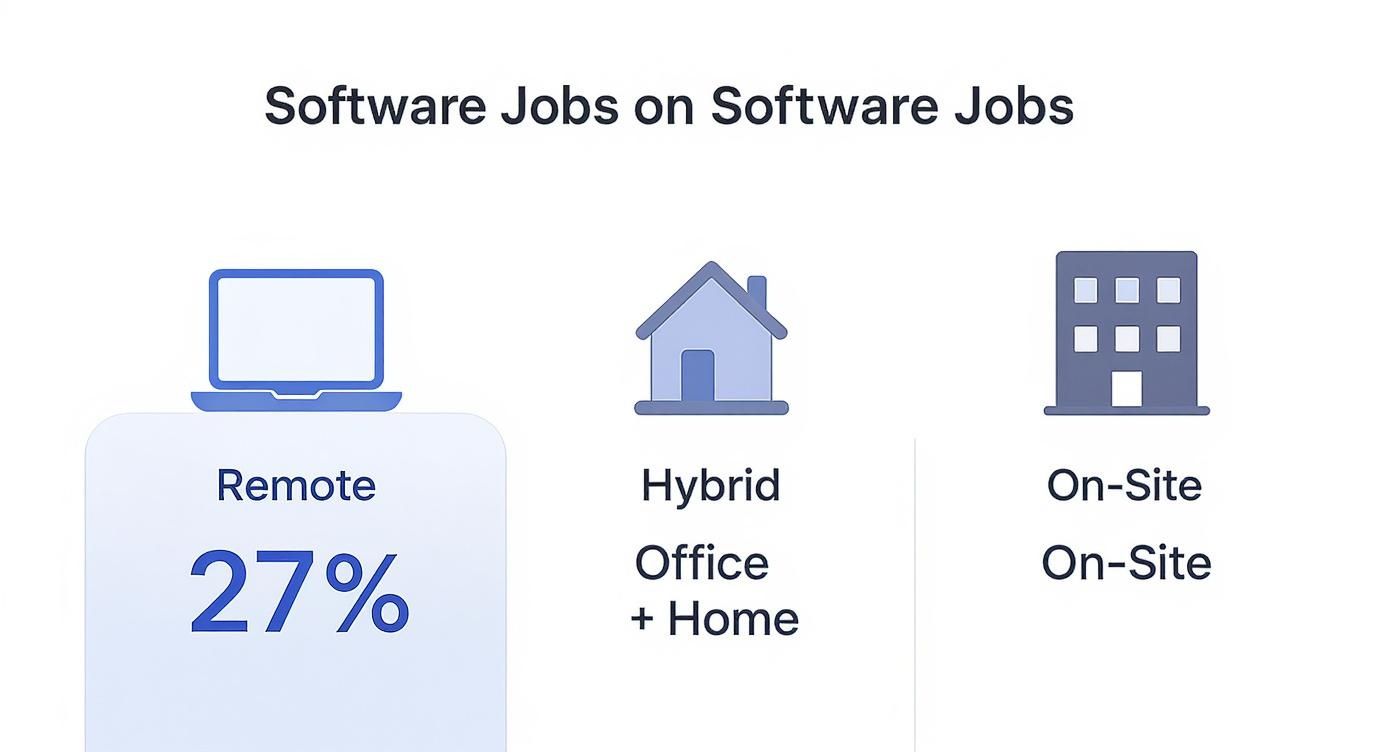
This data makes it pretty clear: remote work is a huge segment, but it’s not the only game in town anymore.
The challenge today isn't just finding a remote job; it's finding the right remote job. Your success depends on identifying companies where remote work is a core part of their operational DNA, not just a line in a job description.
By early 2025, the market has found its new normal. Roughly 27% of all software engineer job postings are fully remote, marking a plateau after the post-pandemic hiring frenzy. While major U.S. tech hubs like California and Texas still lead in sheer volume, the decline in pure remote listings highlights the industry's pivot toward hybrid models.
This shift also has a big impact on what you can expect to earn. For a deeper dive into that, check out our comprehensive guide to understanding tech industry paychecks.
Navigating this complicated and crowded space requires a partner who has real industry connections. At TekRecruiter, we specialize in placing the top 1% of engineers with innovative companies offering premier remote and hybrid roles, some of which never appear on public job boards. Let our experts help you find your next great opportunity.
Building Your Remote-First Professional Brand
When you're going after a remote software engineering role, your online presence isn't just a digital CV—it’s your entire professional identity. Recruiters and hiring managers can't meet you in person, so they rely entirely on your digital footprint to figure out if you have the discipline, communication skills, and self-starting attitude to succeed on your own.
This means your LinkedIn, GitHub, and resume need to tell a single, powerful story.
It’s about showing, not just telling. Instead of just listing what you know, you have to prove your impact and demonstrate that you can ship high-quality work without someone looking over your shoulder. This is how you turn a boring profile into a compelling case for your remote-readiness.
Frame Your Impact, Not Just Your Tasks
Hiring managers for remote jobs are looking for one thing above all else: proof of autonomy. They need to see that you can take a project from an idea to a finished product with minimal hand-holding. A generic bullet point like "Developed a new API endpoint" just won't cut it.
You have to frame your experience around ownership and results.
Before: "Wrote unit tests for the user authentication service."
After: "Owned the test-driven development process for the user authentication service, achieving 95% code coverage and reducing pre-production bugs by 30%, all while collaborating with a distributed team via asynchronous code reviews."
See the difference? That small tweak shifts the narrative from "I did a task" to "I drove a result."
Make Your GitHub a Remote-Ready Portfolio
Your GitHub profile can be more revealing than your resume. It's a direct window into your coding habits, your documentation skills, and how you motivate yourself. A neglected, dusty profile is a huge red flag for remote employers. A thoughtfully curated one signals true professionalism.
A clean, well-documented personal project on GitHub is often more impressive than a dozen random contributions to a massive open-source library. It shows you can build, document, and ship something from start to finish on your own initiative.
To really drive the point home, you can learn to write effective LinkedIn posts for software developers and use them to funnel traffic directly to your best GitHub projects.
Optimize Your LinkedIn for Recruiters
Recruiters live and breathe LinkedIn, and they use specific keywords to hunt for candidates for top-tier remote software engineer jobs. You need to seed your profile with the exact terms they’re plugging into their search bars. This goes way beyond just listing your tech stack.
Sprinkle these kinds of phrases throughout your headline, summary, and experience sections:
Distributed teams
Asynchronous communication
Time-zone management
Remote collaboration tools (Jira, Confluence, Slack)
The current job market only makes this more critical. New graduate software engineers account for a mere 7% of hires this year, a steep drop as companies double down on experienced pros with proven track records. As you polish your online presence, it helps to understand the mechanics of social recruiting and how platforms like LinkedIn are used to discover talent. At the same time, the demand for flexibility isn't going away— 87% of developers favor hybrid or fully remote work, according to recent job market reports.
Building a strong brand is your ticket to the best remote opportunities. TekRecruiter specializes in connecting engineers who have curated their professional presence with innovative companies that value top-tier talent. Let us help you put your brand in front of the right people.
Finding and Targeting the Best Remote Roles
Let’s be honest: blasting your resume across massive job boards is a great way to get ignored. The best remote software engineer jobs aren't usually sitting on the front page of Indeed or LinkedIn. They’re tucked away on niche platforms and within tight-knit tech communities where the really exciting opportunities get shared first.
A successful search needs a proactive, strategic approach. Forget reactively applying to everything you see. The goal is to identify and target companies where you genuinely want to work. This means moving beyond the usual suspects to uncover where the high-quality remote roles are actually hiding.

Go Where the High-Quality Jobs Live
The highest signal-to-noise ratio is always on curated and specialized job boards. These platforms do the heavy lifting for you, vetting companies and filtering out the low-quality or "remote-in-name-only" gigs.
Start your search on these types of sites:
Remote-Specific Boards: Platforms like We Work Remotely or Remotive are dedicated exclusively to remote positions. No more sifting through hybrid and on-site roles.
Curated Marketplaces: Sites like Hired or Otta often feature high-growth startups and established tech companies that are serious about hiring top remote talent.
Community Hubs: Don't sleep on the power of communities. The monthly "Who is hiring?" thread on Hacker News is an absolute goldmine, and so are dedicated Slack and Discord channels for specific technologies like Go or Rust.
By diversifying your sources, you dramatically increase your chances of finding a role that lines up perfectly with your skills and career goals.
The Power of Personalized Outreach
The most effective way to get noticed? Bypass the application portal completely. A thoughtful, personalized message to a hiring manager or recruiter on LinkedIn can immediately set you apart from the hundreds of other applicants in the queue.
The key is to make it about them, not just you.
Your goal isn't to ask for a job; it's to start a genuine conversation. Show you’ve done your research, connect your skills to a specific challenge they're solving, and express authentic interest in their work.
Here’s a simple, non-spammy template that actually works:
"Hi [Recruiter Name], I've been following [Company Name]'s work in the cloud-native space and was particularly impressed by the engineering blog post on your recent migration to Kubernetes. As a software engineer with deep experience in building scalable CI/CD pipelines, I'm passionate about the problems your team is solving. I would love to connect and learn more about the engineering culture at [Company Name]."
This approach is respectful, specific, and shows you've put in the effort. Creative outreach on any platform can be powerful; for instance, our guide shows how to find https://www.tekrecruiter.com/post/the-best-way-to-find-remote-junior-entry-level-jobs-on-tiktok, proving that unconventional methods can pay off. For a more in-depth look at navigating this competitive market, check out this excellent resource: Land Your Next Remote Software Engineer Job: A Practical Guide.
Finding these hidden gems often requires an inside track. At TekRecruiter, we have direct lines to innovative companies looking for the top 1% of engineers. Let us connect you with remote software engineer jobs at companies hiring now, including roles that never reach public job boards.
Acing Your Virtual Technical and Culture Interviews
Let's get one thing straight: remote interviews are a totally different beast. They're not just testing your ability to write clean code. They are a live audition of your communication style, your clarity under pressure, and your ability to connect with people through a screen.
Hiring managers for remote software engineer jobs aren't just looking for technical brilliance. They’re looking for definitive proof that you can be a proactive, effective, and reliable collaborator from hundreds or even thousands of miles away. Your success really hinges on projecting confidence and competence from the second you join that call.
This means you have to treat the virtual setup with the same gravity you would an in-person meeting. All the small details—from your lighting to your audio quality—create an immediate and lasting impression of your professionalism.
Nail Your Pre-Flight Tech Checklist
Technical glitches are not just embarrassing; they're completely avoidable. A choppy connection or bad audio is a huge distraction from your expertise and, frankly, can signal a lack of preparation.
Before every single video call, run through this quick pre-flight check.
Test Your Gear: About 15 minutes before the interview, test your microphone, camera, and internet connection. Make absolutely sure your chosen video platform has the necessary browser permissions.
Frame Your Shot: Position your camera at eye level. Use a stack of books if you have to—seriously. Make sure you're facing a light source, like a window, to avoid being a backlit silhouette.
Curate Your Background: A clean, uncluttered background is always the best bet. If your space isn't ideal, a simple, professional virtual background is a solid backup plan. Just avoid anything distracting.
This little ritual takes five minutes but ensures that when the interview starts, your focus is entirely on the conversation, not on fumbling with your setup.
Excelling in Live Coding and System Design
In a virtual technical interview, narrating your thought process is completely non-negotiable. Silence is deadly. Your interviewer can't read your mind, so you have to verbalize your problem-solving journey every step of the way.
Think of it as providing live commentary on your own brain. Explain your initial thoughts, weigh the trade-offs of different approaches out loud, and articulate why you're choosing a particular data structure or algorithm. This turns a solo coding challenge into a collaborative problem-solving session.
When it comes to system design, use the virtual whiteboard or diagramming tool to your full advantage. Don't just draw boxes; clearly label components, map out data flows, and explain your architectural decisions as you go. This shows not just what you know, but how you think and communicate complex ideas—a critical skill for any remote engineer.
Answering Remote-Centric Behavioral Questions
Behavioral questions for remote roles are designed to dig deeper into your autonomy, communication habits, and self-management skills. Expect to be asked how you handle asynchronous communication, manage your own deadlines without a manager looking over your shoulder, and stay aligned with a distributed team.
It's also a two-way street. Mastering the art of asking intelligent questions yourself can set you apart in a big way. For some ideas, check out our guide on asking the right questions in a tech interview.
The market for remote talent has definitely shifted. While 22.8% of U.S. employees now work remotely part-time—an 87% increase from pre-pandemic figures—fully remote roles now make up only 18% of new postings. This points to a much more competitive landscape where being able to prove you're remote-ready is absolutely crucial. You can find more details on these remote developer hiring trends to get a better sense of the market.
Acing the interview is the final hurdle before the offer lands. If you're looking for elite remote software engineer jobs, TekRecruiter connects the top 1% of talent with innovative companies that value excellence. Let us help you find an organization where you can truly thrive.
Negotiating a Winning Remote Job Offer
Getting the offer is a huge milestone, but don’t pop the champagne just yet. This isn't the finish line. It's your opportunity to make sure the final package truly reflects your market value and sets you up for success in a distributed environment.
For remote roles, negotiation is a whole different ballgame. It's about so much more than just the base salary. You're literally crafting the foundation of your work life, and the conversation needs to reflect that depth. It all starts with one critical piece of information: how the company thinks about pay.
Understand Their Compensation Philosophy
Before you even dream about numbers, you need to find out the company’s pay model. This single detail will shape your entire negotiation strategy.
Location-Based Pay: Still common in larger, more traditional companies. Your salary gets adjusted based on the cost of living in your city.
Unified Pay Bands: The modern standard for most remote-first organizations. Your role and level determine your salary, plain and simple—no matter where your desk is.
You can figure this out early on. Just ask the recruiter, "Could you share a bit about the company's compensation philosophy? Do you adjust salaries based on location?" Their answer tells you whether they value the role or your zip code.
Think Beyond Base Salary
A winning offer is about the total package, not just the number on your paycheck. Certain perks have a massive impact on your bottom line and productivity when you're working from home. These aren't just "nice-to-haves"; they're essential pieces of a strong remote package.
Don't be shy about negotiating these points with the same conviction you’d use for your salary.
Your negotiation should focus on the total value of the package. A slightly lower base salary might be perfectly acceptable if it comes with a generous home office stipend, truly flexible hours, and meaningful equity.
Think about what really matters for your day-to-day remote life:
Home Office Stipend: A one-time payment to get a proper desk, an ergonomic chair, and good monitors.
Recurring Tech/Internet Allowance: A monthly stipend to cover high-speed internet and other ongoing costs.
Professional Development Budget: Funding for courses, certifications, or conferences to keep your skills sharp.
Flexible Hours: Getting explicit confirmation that you have real autonomy over your schedule outside of core collaboration times.
Articulate Your Value with Confidence
When it's time to counter, anchor your request in data, not feelings. Do your homework. Use sites like Levels.fyi and Glassdoor to find national averages for your role, seniority, and tech stack. This data is your leverage.
Here’s a simple script you can adapt:
"Thank you so much for this offer! I'm very excited about the opportunity. Based on my research for a Senior Engineer with my experience in distributed systems, I was expecting a base salary closer to the $X to $Y range. Given my expertise, I'm confident I can deliver significant value from day one. Would you be open to discussing this?"
This approach is professional, data-driven, and ties your request directly to the value you bring to the table.
Navigating these conversations for elite remote software engineer jobs can feel high-stakes. The experts at TekRecruiter work with you to secure offers that reflect your true worth, connecting you with innovative companies that deploy the top 1% of engineers, anywhere. Let us help you land a package that empowers your career.
Partner With TekRecruiter to Find Your Next Role

Trying to navigate the competitive market for remote software engineer jobs all on your own can feel like shouting into the void. A specialist recruitment partner doesn’t just find you a job; they give you an inside track to elite, often unadvertised opportunities. This is where a firm with real industry connections becomes a serious ally in your career.
TekRecruiter is a technology and engineering staffing and recruiting firm built to connect innovative companies with the top 1% of engineering talent, no matter where they are in the world. We work with a network of companies hiring remote and hybrid engineers, and some of those roles never appear on public job boards.
Our expert recruiters genuinely understand the nuances of the tech landscape. They work with you one-on-one to find that perfect match—not just a role that fits your skills, but a company that aligns with your goals.
We believe the best opportunities come from pairing exceptional talent with forward-thinking organizations. We handle the introductions and logistics so you can focus on what you do best: building the future.
Let us connect you with companies that are actively looking for the best remote engineers right now. Partner with TekRecruiter and let's find your next great role together.
Got Questions? We’ve Got Answers.
When you’re hunting for a remote software engineering job, a lot of questions pop up. It’s a different world from the typical office grind. Let's tackle some of the most common ones I hear from engineers.
How Can I Stand Out if I've Never Worked Remotely?
This is a big one, but don’t sweat it. It’s not about having “Remote Engineer” on your resume. It’s about proving you have the traits to succeed without someone looking over your shoulder.
You need to frame your existing experience in a way that screams "self-starter."
Own your projects: Talk about a time when you took a feature from idea to launch with minimal supervision. Did you set your own deadlines? Did you solve problems without waiting for permission? That’s gold.
Show your async chops: You’re already using tools like Jira, Slack, and Git. Frame your experience with them as asynchronous collaboration. You know how to move work forward through tickets, pull requests, and clear documentation, not just meetings.
Let your GitHub do the talking: A personal project that's well-documented is concrete proof. A solid README, clean commit history, and clear comments show you can communicate in writing and manage your own work. That’s exactly what hiring managers are looking for.
Are Remote Salaries Always a Pay Cut?
Not at all, but the compensation game is different. The old model of basing pay on your city’s cost of living is fading, but it’s not gone. Some companies still do it.
The good news? A growing number of remote-first companies have location-agnostic pay bands. They pay for the role, not your address, which helps them attract the best people no matter where they are.
Your leverage comes from the value you deliver, not your zip code. Do your homework on the company’s pay philosophy, and anchor your salary expectations to your skills and market data for that specific role.
What Skills Do Remote Companies Really Care About?
Look, a strong technical foundation is table stakes. You have to know your stuff. But for remote roles, the tie-breakers are almost always the "soft" skills that prove you can thrive in that environment.
Yes, expertise in cloud platforms like AWS, Azure, or GCP is huge. The same goes for DevOps and solid CI/CD practices. But the one skill that’s absolutely non-negotiable?
Exceptional written communication.
If you can prove you’re a proactive, self-managing problem-solver who can communicate clearly in writing, you’re already ahead of 90% of the competition for top-tier remote software engineer jobs.
Navigating the remote job market can feel like a full-time job in itself. As a technology and engineering staffing and recruiting firm, TekRecruiter allows innovative companies to deploy the top 1% of engineers anywhere. We are plugged into a network of companies looking for elite talent for their best remote roles. If you're ready to find a position that aligns with your skills and career goals, let us help. Let's find your next opportunity.