_edited.png)
8 Managed Services Examples for Growing Tech Teams
Outsourcing engineering work doesn't automatically create accountability, speed, or better products. A vendor can add people to a project while leaving ownership unclear, architecture undocumented, incidents unresolved, and delivery metrics disconnected from business results. Managed services are operating models, not just vendors. The provider takes ongoing responsibility for a defined technology function, with an agreed team structure, technical scope, service expectations, and measurable outcomes.
That distinction matters because managed services can address very different constraints. A growing team may need end-to-end product delivery, while another needs platform reliability, AI expertise, cloud transformation, data visibility, security governance, enterprise-system efficiency, or temporary capacity. The eight managed services examples below pair each model with its delivery scope, practical trade-offs, selection criteria, implementation tactics, and relevant measures of success.
Table of Contents
4. Managed Cloud Infrastructure and Systems Engineering - Make migration measurable
5. Managed Data Engineering and Analytics Services - Build trust into the platform
6. Managed Cybersecurity and Infrastructure Hardening Services
7. Managed Salesforce and ERP Engineering Services - Treat adoption as engineering work
8. Managed Staff Augmentation with Continuous Training and Upskilling
1. Managed Software Development Teams
A managed software development team functions as an outsourced engineering organization, not a collection of individual contractors. The team can own architecture, design collaboration, implementation, testing, deployment, maintenance, and the documentation that keeps the product operable after launch. This model fits a company that wants an external partner accountable for a defined product outcome while its internal leaders retain control over business priorities and product direction.
A Series B fintech startup scaling from 5 to 20 engineers in 90 days is a useful scenario. The value isn't just the additional headcount. A managed team can coordinate recruitment, onboarding, training, delivery oversight, and engineering practices so new contributors don't arrive as disconnected specialists. An enterprise migrating legacy systems to cloud-native architecture may use the same model with a dedicated team that understands the existing estate and the target platform. A health-tech company building a HIPAA-compliant platform also needs managed oversight across engineering execution, documentation, and operational discipline.
Practical rule: Define ownership for architecture decisions, release approval, incident escalation, and acceptance criteria before development begins.
The model works best when the client supplies clear product priorities and access to existing system knowledge, while the provider manages team performance and delivery operations. Before engagement, establish KPIs, meeting cadences, technical documentation standards, and a handoff plan for any future team changes. Outsourced engineering services can be appropriate when the business needs a complete delivery capability rather than isolated hiring support.
The trade-off is control versus coordination. A managed team can accelerate execution, but poor documentation or weak communication can create dependency on the provider. Require regular architecture reviews, written decisions, code ownership clarity, and knowledge-transfer sessions from the start.

2. Managed DevOps and Platform Engineering Services
DevOps and platform engineering services take responsibility for the systems that let developers build, release, and operate software safely. The scope may include cloud infrastructure, CI/CD pipelines, observability, infrastructure as code, deployment automation, Kubernetes operations, reliability engineering, and incident response. This is a distinct operating model from software development because its primary customer is the engineering organization, and its core outputs are reliable delivery systems and operational performance.
A SaaS provider serving 500K+ users might use a managed team for a Kubernetes migration, including cluster design, workload movement, security controls, monitoring, and rollback procedures. A separate engagement could optimize managed infrastructure for cloud cost reduction of 40%, while a critical fintech platform could require a multi-region failover architecture that an external SRE team designs and maintains. These scenarios demand more than a person who can write deployment scripts. They require ownership of the infrastructure lifecycle and the operational consequences of technical decisions.
Begin with an inventory of current infrastructure, recurring failures, deployment bottlenecks, access permissions, and known cost drivers. Then define uptime, incident acknowledgment, resolution, change-management, and recovery expectations in the SLA. Managed services are commonly delivered under predefined service-level agreements, making the SLA part of the operating model rather than a contract appendix, as explained in this managed services market definition.
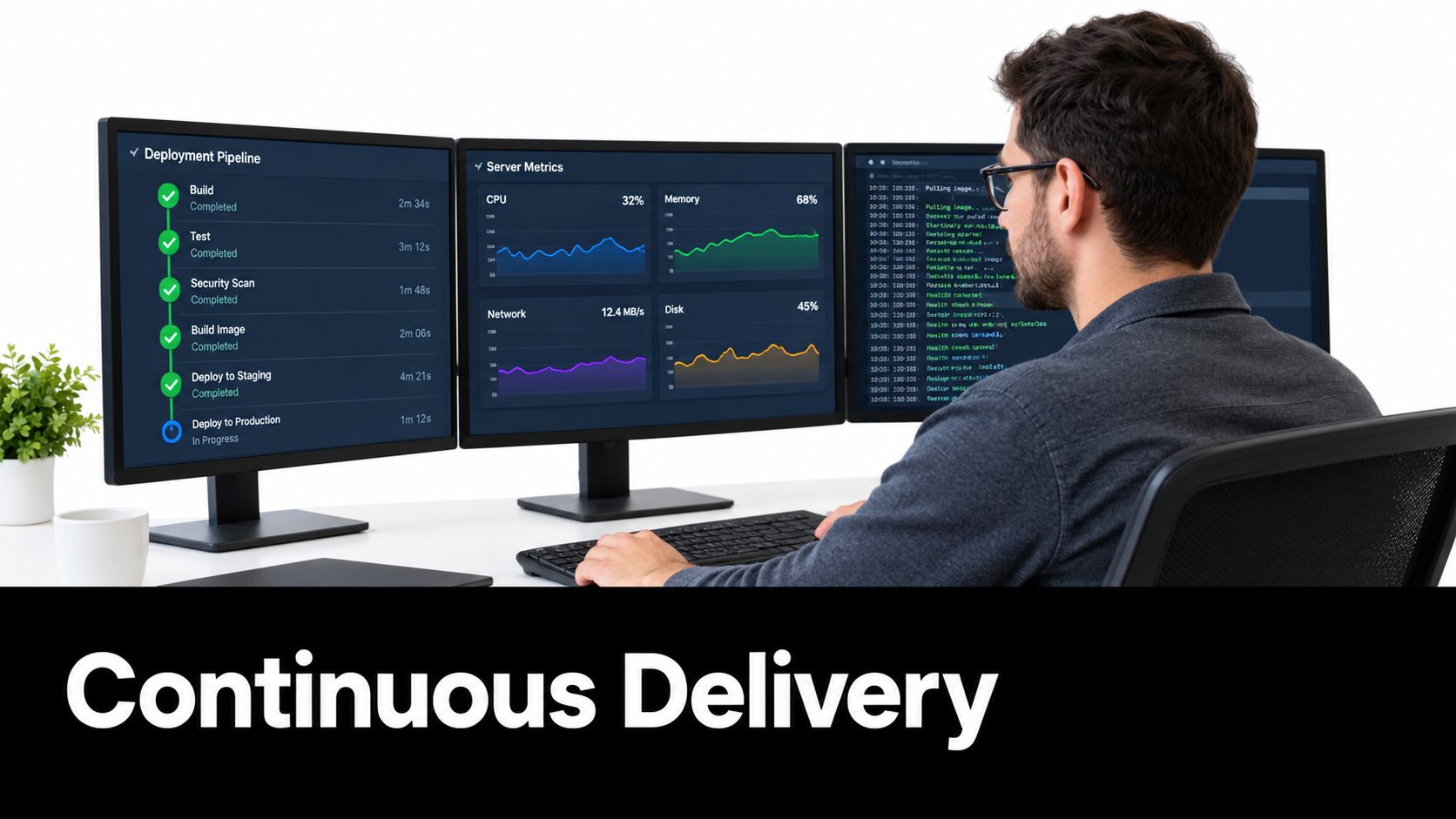
Schedule architecture and optimization reviews, and keep credential management under strict client-controlled protocols. The difference between platform engineering and DevOps helps clarify whether the engagement should build an internal developer platform, operate delivery infrastructure, or combine both.
A managed service fails when the provider monitors dashboards without improving the underlying system. Require post-incident reviews, infrastructure documentation, tested runbooks, and visible backlog reduction.
3. Managed AI and Machine Learning Engineering Services
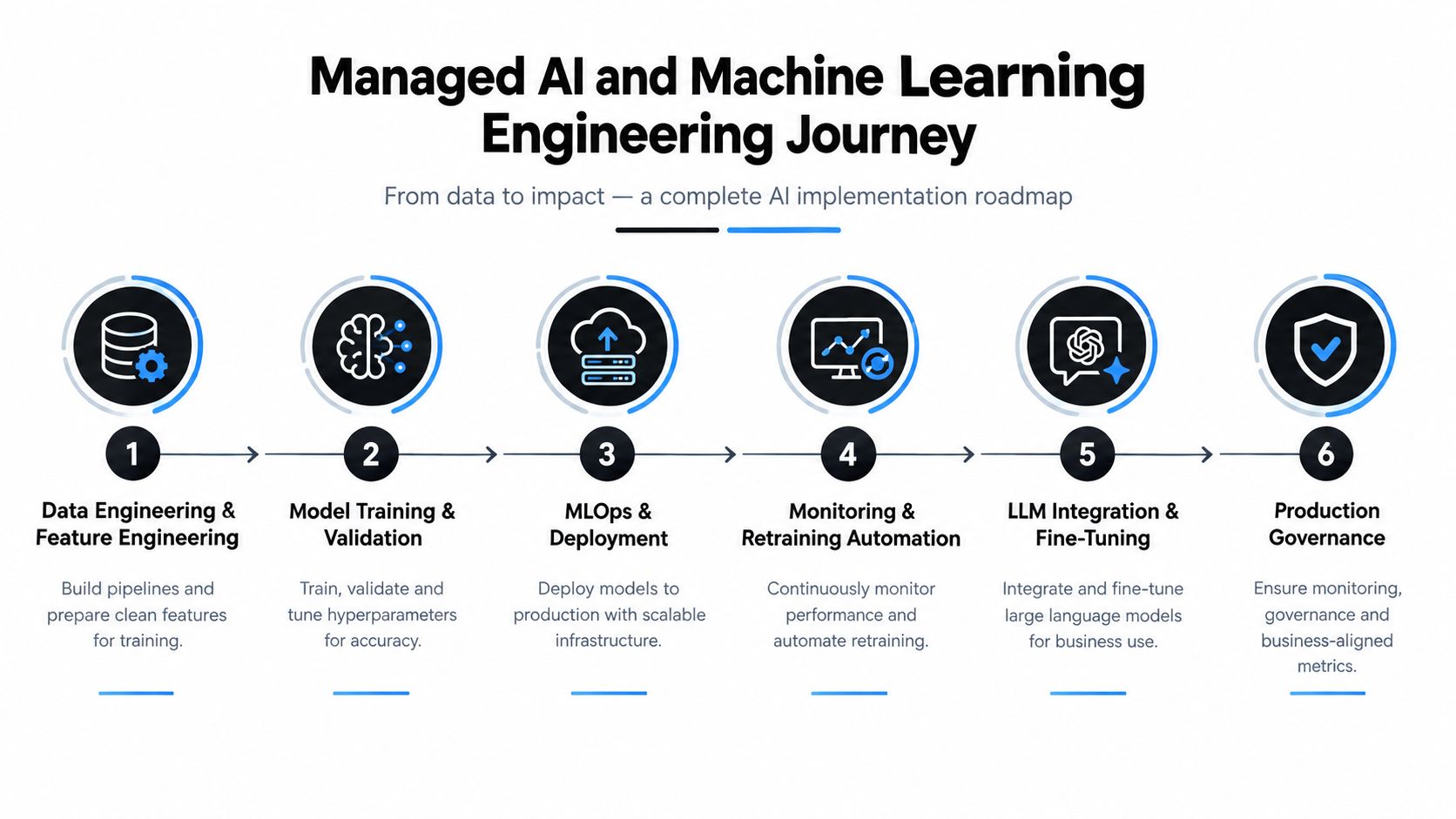
AI and machine learning services require a longer ownership horizon than a one-time model prototype. A managed AI team may prepare data pipelines, train and optimize models, integrate inference into production systems, monitor performance, manage feedback loops, and coordinate retraining. The service is valuable when a company has a meaningful use case but lacks the internal combination of data engineering, machine learning, software engineering, and production operations.
Consider a predictive analytics platform for a B2B SaaS business intended to reduce churn by 23%. The relevant question isn't only whether the model achieves acceptable accuracy. Product teams must know how predictions enter workflows, how customer-facing teams act on them, and how the business measures the result. A computer vision system for manufacturing quality control presents a different challenge, with image quality, edge deployment, latency, and human review affecting the outcome. Generative AI for customer service automation handling 60% of inquiries also requires escalation paths, evaluation procedures, and safeguards against unreliable responses.
The strongest engagements define business metrics before selecting model architecture. Accuracy, precision, recall, latency, cost per inference, and drift matter, but they must connect to operational outcomes such as resolution quality, conversion, defect detection, or support workload.
Validate the data first: Check training data coverage, labeling quality, permissions, bias, and production representativeness.
Design monitoring early: Track model behavior, data drift, failures, human overrides, and changes in business conditions.
Plan retraining: Establish who reviews feedback, approves new data, validates a new model, and manages rollback.
Data governance can't be postponed until deployment. A provider handling custom AI development services should also document model ownership, evaluation criteria, access controls, and production responsibilities.
The trade-off is speed versus institutional learning. An external team can supply scarce expertise quickly, but internal product and domain owners still need to understand decisions well enough to govern the system. Treat model documentation and knowledge transfer as deliverables, not optional extras.
4. Managed Cloud Infrastructure and Systems Engineering
Cloud infrastructure services cover architecture design, migration planning, reliability engineering, security configuration, performance management, and ongoing optimization. They differ from managed DevOps services when the central challenge is broader systems transformation, such as moving a complex estate from on-premises infrastructure, designing a multi-cloud operating model, or establishing disaster recovery across business-critical environments.
An enterprise migration from on-premises systems to AWS with zero production downtime illustrates the need for phased planning, dependency mapping, replication, testing, and controlled cutover. A healthcare provider may need a HIPAA-compliant multi-region architecture, where security, availability, data location, and recovery procedures must work together. A global fintech company implementing disaster recovery across three cloud providers faces another layer of complexity, including identity, networking, observability, data consistency, and recovery testing across different platforms.
Start with a cloud readiness assessment. Inventory applications, data flows, integrations, dependencies, performance requirements, compliance obligations, and recovery assumptions. A provider can't design a safe migration from a partial diagram or a list of subscriptions.
Make migration measurable
Break the work into waves rather than a big-bang move. Each wave should have entry criteria, rollback conditions, validation tests, ownership, and an explicit decision about what happens to the old environment. Track performance, cost, reliability, security findings, and migration progress using measures agreed before execution.
This model is a good fit when the organization needs specialized architecture capacity and operational continuity. It is less suitable when leadership expects the provider to make business-critical trade-offs without access to product owners, finance, security, or compliance stakeholders.
Use the service to create durable operating capability, not just a new cloud bill. The provider should leave behind architecture records, dependency maps, runbooks, access documentation, and tested recovery procedures. Without those artifacts, the company may complete a migration while increasing long-term operational dependence.
5. Managed Data Engineering and Analytics Services
Managed data engineering teams turn fragmented operational data into dependable pipelines, warehouses, analytical models, and reporting systems. Their responsibility can include ingestion, transformation, orchestration, data quality, lineage, governance, security, and the interfaces that let business users consume trusted information. This model is different from a reporting consultancy because it includes the ongoing health of the data platform.
An e-commerce business may commission a real-time analytics platform intended to reduce order processing time by 40%. A global retailer may need data warehouse consolidation across 12 systems, with the difficult work concentrated in definitions, duplicate records, historical reconciliation, and ownership. An adtech platform processing 500M+ events daily needs resilient streaming architecture, schema management, observability, retention policies, and cost controls. These examples show why data projects often fail through unclear semantics rather than inadequate tooling.
Before implementation, inventory every source and assess its quality, ownership, update frequency, sensitivity, and downstream use. Define business metrics in plain language. If finance, sales, product, and operations use different meanings for “active customer” or “recognized revenue,” a faster pipeline won't resolve the disagreement.
Build trust into the platform
Use incremental delivery. Start with a high-value domain, establish quality checks and lineage, and prove that users can trace a metric back to its source. Then expand the model. Governance should cover access, retention, classification, change approval, and incident handling.
A managed data service works well when the company needs specialized engineering capacity and repeatable platform operations. It works poorly when executives treat data as a dashboard project while refusing to assign data owners. The provider can build schemas and pipelines, but business leaders must decide which definitions and controls the organization will trust.
Measure pipeline freshness, completeness, failed-job recovery, data quality exceptions, adoption of governed datasets, and the reliability of critical reports. Avoid rewarding the team only for the volume of data ingested. More data can increase confusion if the platform doesn't improve decision quality.
6. Managed Cybersecurity and Infrastructure Hardening Services
Managed cybersecurity services provide continuous security engineering rather than a one-time assessment. A dedicated team can conduct vulnerability reviews, harden infrastructure, implement identity and access controls, monitor threats, support compliance management, and coordinate remediation. This model fits organizations that face meaningful security or regulatory exposure but can't staff every specialist function internally.
A fintech startup achieving SOC 2 Type II certification in 6 months might use a managed security team to coordinate controls, evidence, remediation, and operational practices. A healthcare provider implementing HIPAA-compliant infrastructure needs security architecture aligned with sensitive data handling. A SaaS company reducing security incident response time from 6 hours to 15 minutes would need tested detection, escalation, investigation, and containment processes, not merely more alerts.
Begin with a thorough audit and rank findings by business impact. A long list of vulnerabilities isn't a security strategy. The provider and client should agree on remediation ownership, risk acceptance authority, escalation paths, evidence requirements, and the circumstances that require immediate executive notification.
Control access deliberately: Separate administrative privileges, review service accounts, and manage credential changes through documented procedures.
Automate evidence collection: Continuous compliance monitoring can reduce the manual burden of proving that controls operate as designed.
Train the team: Security procedures should be part of onboarding, incident exercises, and everyday engineering workflows.
Industry priorities are moving beyond generic helpdesk outsourcing. KPMG's managed services outlook identifies AI management and cybersecurity as leading investment areas, while AIOps, multi-cloud orchestration, zero-trust security, and platform engineering are recurring themes in its 2026 outlook.
The trade-off is visibility versus trust. A provider may detect and contain threats faster, but the client still owns business risk, regulatory accountability, and decisions about acceptable exposure. Include independent reviews, clear reporting, and a documented exit plan.

7. Managed Salesforce and ERP Engineering Services
Salesforce and ERP services connect technical systems to revenue, finance, operations, and supply-chain processes. The provider may manage configuration, customization, integration, data migration, workflow automation, reporting, release management, and ongoing optimization. These engagements require more than platform familiarity because a technical change can alter how sales teams forecast, how finance closes books, or how manufacturing plans production.
A Fortune 500 company consolidating 15 legacy systems into a single Salesforce instance faces data ownership, integration sequencing, permissions, reporting, and adoption challenges. A mid-market B2B company pursuing a 3x faster sales cycle through Salesforce optimization must change process friction, not just add fields or automations. A manufacturer implementing NetSuite ERP for complete supply-chain visibility needs agreement across procurement, inventory, production, fulfillment, and finance.
Start with process documentation. Map how work happens today, where exceptions occur, which systems hold authoritative data, and which controls must remain intact. Only then should the team decide whether to configure, customize, integrate, or redesign a workflow.
Treat adoption as engineering work
Organizational change management belongs beside the technical plan. Users need role-specific training, clear ownership, migration support, and a way to report defects or process gaps. Data governance should define validation rules, duplicate handling, access permissions, retention, and stewardship before migration begins.
Managed Salesforce and ERP services fit when the platform is business-critical and requires continuous specialist attention. They don't fit when leadership expects a provider to “clean up Salesforce” without deciding which process the system should support. Require post-implementation optimization reviews, release calendars, integration monitoring, and documentation for administrators and business owners.
Security testing should also cover custom integrations, permissions, APIs, and exposed business workflows. Teams evaluating AI pentesting platforms and penetration testing with ThreatExploit AI can include those systems in a broader application and infrastructure risk program.
8. Managed Staff Augmentation with Continuous Training and Upskilling
Staff augmentation provides flexible capacity, but the client still owns delivery. Augmented engineers join the existing organization, follow its priorities and management structure, and fill a defined capability or workload gap. The provider can handle recruiting, onboarding, training, and skills development, while the client directs day-to-day work.
A startup scaling from 10 to 40 engineers in 4 months for a product launch may need contributors quickly without building a permanent structure. An enterprise adding specialized cloud engineers for a 6-month modernization project has a time-bound expertise gap. An agency can Hire Latin American virtual assistants or other specialists for a client engagement without hiring for every project profile.
The model works when the client can provide clear technical direction. Prepare the project brief, architecture documentation, coding standards, access requirements, team map, and definition of done before onboarding begins. Clarify whether augmented engineers will own components, pair with internal staff, or execute tasks under an existing lead. Without that clarity, flexible capacity can become coordination overhead.
Use it for capacity: Add engineers when the roadmap exceeds the current team's ability to deliver.
Use it for expertise: Bring in cloud, AI, security, data, or platform-transition specialists.
Protect continuity: Schedule check-ins, pairing, documentation, and knowledge-transfer sessions.
Continuous development prevents an augmented team from becoming a stagnant labor pool. A defined professional development approach helps maintain technical capability and cultural alignment as tools, architectures, and delivery expectations change.
The trade-off is flexibility versus management overhead. Staff augmentation lets the client scale people up or down, but the client remains responsible for prioritization, architecture, performance feedback, and integration. Choose this model when those responsibilities belong inside the business. Choose managed services when the provider must own the function and its outcomes.
8-Point Managed Services Comparison
Service | 🔄 Implementation Complexity | ⚡ Resource Requirements | 📊 Expected Outcomes | 💡 Ideal Use Cases | ⭐ Key Advantages |
|---|---|---|---|---|---|
Managed Software Development Teams | 🔄 Medium–High: end‑to‑end delivery, needs integration and clear requirements | ⚡ Dedicated, scalable teams; predictable budget and TekRecruiter-managed hiring/onboarding | 📊 Predictable delivery, faster scaling, improved product velocity | 💡 Rapid engineering scale-ups, full product builds | ⭐ High-quality vetted talent, accountability for delivery |
Managed DevOps & Platform Engineering Services | 🔄 High: infrastructure design, CI/CD, 24/7 ops, knowledge transfer required | ⚡ SRE/DevOps specialists, monitoring tools, cloud expertise | 📊 Improved reliability, faster deployments, cost optimization | 💡 Cloud modernization, Kubernetes migration, CI/CD automation | ⭐ Reduces on-call burden; enforces best practices and security |
Managed AI & Machine Learning Engineering Services | 🔄 High: data pipelines, model experimentation, MLOps complexity | ⚡ Significant data, compute, ML engineers; ongoing retraining | 📊 Production-ready models, faster time‑to‑value, measurable business metrics | 💡 Predictive analytics, computer vision, generative AI projects | ⭐ Access to advanced ML expertise without permanent hires |
Managed Cloud Infrastructure & Systems Engineering | 🔄 High: migration planning, multi-cloud architecture, phased rollout | ⚡ Cloud architects, migration teams, cross‑department coordination | 📊 Scalable secure infra, reduced downtime, cost & performance gains | 💡 Enterprise cloud migrations and modernization initiatives | ⭐ Expert architecture, disaster recovery, cost management |
Managed Data Engineering & Analytics Services | 🔄 Medium–High: ETL/ELT, governance, streaming complexity | ⚡ Data engineers, modern data stack (warehouses, streaming) | 📊 Faster time‑to‑insight, improved data quality and reliability | 💡 Data-driven orgs, real‑time analytics, warehouse consolidation | ⭐ Scalable data platforms and reduced maintenance overhead |
Managed Cybersecurity & Infrastructure Hardening Services | 🔄 Medium–High: audits, remediation, ongoing security ops | ⚡ Security engineers, monitoring, compliance tooling | 📊 Lower breach risk, compliance readiness, faster incident response | 💡 Regulated industries, security-first organizations | ⭐ Proactive threat detection and compliance automation |
Managed Salesforce & ERP Engineering Services | 🔄 High: complex business processes, integrations, migrations | ⚡ Specialized CRM/ERP engineers, integration and migration effort | 📊 Streamlined workflows, faster ROI, consolidated systems | 💡 Enterprise CRM/ERP implementations and process optimization | ⭐ Expert implementation reducing deployment risk and vendor reliance |
Managed Staff Augmentation with Continuous Training & Upskilling | 🔄 Low–Medium: integrates with existing teams; variable continuity | ⚡ On‑demand vetted engineers, continuous training provided | 📊 Rapid capacity scaling, flexible costs, targeted skill fill | 💡 Startups, short-term projects, temporary specialized needs | ⭐ Fast scale without headcount commitment; vetted, upskilled talent |
Choose the Model That Matches the Constraint
The right managed services example starts with the constraint, not the provider's service catalog. If the business needs end-to-end product delivery, a managed software development team can own execution from architecture through maintenance. If releases are slow or production reliability is weak, managed DevOps and platform engineering is the more direct fit. If the organization has a high-value AI use case but lacks machine learning production expertise, managed AI engineering addresses the capability gap.
Cloud infrastructure and systems engineering fits a migration, resilience, or multi-cloud transformation. Managed data engineering fits unreliable pipelines, fragmented systems, and poor visibility into business performance. Cybersecurity and infrastructure hardening fits exposure, compliance pressure, weak access controls, or inadequate incident operations. Salesforce and ERP engineering fits business-process friction inside systems that directly support revenue, finance, or supply-chain work. Staff augmentation fits temporary capacity or a specialized skill gap when internal leaders still need to own delivery.
Managed services are now a mainstream operating model. One industry summary reports that 78% of enterprises use at least one managed service, compared with 72% in 2021, and reports typical IT cost reductions of 15% to 30% among adopting organizations, as documented in this managed services statistics summary. Those figures don't make outsourcing automatically correct. They show why leaders should evaluate the operating model carefully rather than treating it as an unusual procurement decision.
Use this selection sequence:
Define the business outcome: State the result in operational terms, such as reliable releases, governed AI deployment, recovery readiness, trusted analytics, or faster product delivery.
Assign required ownership: Decide which party owns architecture, staffing, priorities, incidents, compliance evidence, documentation, and acceptance.
Map dependencies: Document applications, data flows, integrations, credentials, environments, business processes, and internal stakeholders.
Set KPIs and cadence: Agree on service measures, delivery measures, reporting, reviews, escalation, and decision-making forums before onboarding.
Choose the team shape: Use a dedicated managed team when the provider should own a defined function. Use augmentation when your leaders need flexible capacity under internal direction.
Benchmarking should happen before the contract, during delivery, and after the service is established. Research from a large IT outsourcing survey found that benchmarking across those stages improved cost and service outcomes, while benchmarking during the contract explained 10% of the variance in a success vector covering strategic, technical, cost, service, satisfaction, and value outcomes, according to the IT outsourcing benchmarking study.
Operational measures should match the model. Outsourced IT providers have been reported to achieve 99.95% average service availability, with 97% of organizations saying outsourced IT services met or exceeded agreed KPIs, according to outsourcing performance statistics. The same evidence set reports a 32.6x higher ticket-backlog recovery rate over 90 days and a 15% improvement in on-time delivery for outsourced project work. Use such measures as reference points for governance, not promises that every engagement will produce identical results.
The market's scale reinforces the strategic shift. The global managed services market was valued at USD 401.2 billion in 2025 and is projected to reach USD 847.4 billion by 2033, a near doubling over eight years at a 9.9% CAGR, according to Grand View Research's managed services market analysis. A separate market summary describes the market rising from USD 437.3 billion in 2026 to USD 847.4 billion in 2033, so leaders should examine methodology and scope when comparing market estimates rather than treating every headline as interchangeable.
For large enterprises, the operating model can span enormous geographic and technical boundaries. A 2026 market example describes an Atos and Johnson & Johnson renewal worth about USD 1.3 billion over 8 years, covering global IT infrastructure, workplace, and cloud operations for more than 130,000 employees across 60+ countries, as reported in this managed services market example. Scale alone doesn't guarantee quality. The same principles still apply, clear ownership, measurable service levels, technical transparency, and a credible transition plan.
TekRecruiter provides technology staffing, recruiting, and AI engineering services for companies that want to deploy the top 1% of engineers anywhere. Its delivery options include direct hire, staff augmentation, on-demand access to a bench of 30,000+ pre-vetted engineers, and managed services with outsourced engineering teams managed and trained to deliver defined business outcomes. The engineering specializations include software, AI, DevOps, SRE, platform, cloud, systems, data, Salesforce, ERP, and cybersecurity.
TekRecruiter can help you choose between a managed engineering team, staff augmentation, direct hire, or on-demand specialists based on your delivery constraint. Visit TekRecruiter to discuss the technical scope, ownership model, and engineering capabilities your next initiative requires.
Comments