_edited.png)
Vulnerability Assessment Explained and How to Run It Right
Your scanner has finished. The dashboard is full of findings, engineers are asking which tickets matter, and the executive team wants a clear answer about business exposure. Then a new vulnerability appears in a public-facing service, and everyone discovers that the asset inventory is incomplete, the ownership field is blank, and the highest severity score doesn't necessarily identify the fastest-moving threat.
That situation is common because vulnerability assessment is often treated as a report-generation task. In practice, it's a decision system. It should show what exists, connect weaknesses to real exposure, account for exploit velocity, and help technical teams verify that risk has been reduced.
Table of Contents
Why Vulnerability Assessment Matters Right Now - The better question is not “How many are open?”
What Vulnerability Assessment Really Means - Start with the boundary - Separate assessment from management
Types and Methodologies Behind Every Assessment - Match the method to the asset - Compare the methodology choices
Vulnerability Assessment Versus Penetration Testing - Two different jobs
The Vulnerability Assessment Lifecycle From Planning to Retest - 1. Scope the environment and inventory assets - 2. Discover and scan - 3. Analyze exploitability and exposure - 4. Report and coordinate remediation - 5. Retest and improve
Metrics Reporting and Tool Categories That Drive Action - Measure movement, not activity - Choose tools by function
Why Vulnerability Assessment Matters Right Now
A near miss often exposes the weakness in an organization's security process. An engineer discovers an exposed service while investigating an unrelated alert. The service runs software with a known vulnerability, yet nobody can confirm when it was deployed, who owns it, whether compensating controls protect it, or whether attackers are targeting it. The organization has a scanner. What it lacks is trustworthy context.
The volume of findings makes that gap harder to manage. Edgescan reported 48,185 CVEs published in 2025, while high and critical application vulnerabilities took an average of 54.81 days to close. Its report also states that the CISA Known Exploited Vulnerabilities catalog reached 1,484 entries, with 246 added during the year. These figures connect disclosure volume with the time required to reduce exposure. Edgescan's vulnerability statistics report shows why a patch backlog cannot be prioritized by severity labels alone.
A mature program protects more than servers. It supports release confidence, customer trust, engineering capacity, and decisions made before an incident forces them. It also informs practical planning, from how to protect your Atlanta business from common cybersecurity threats to internal practices for preventing data breaches.
The better question is not “How many are open?”
Ask four questions instead:
What can be exploited now? Check active exploitation signals, public exposure, reachable attack paths, and vulnerable services supporting authentication or sensitive workflows.
What matters to the business? A weakness on an isolated test asset may deserve less attention than a less severe issue on a public identity service.
What information is missing? An unscored advisory, a package without a CVE, or a delayed enrichment record still requires a risk decision.
Can the team prove closure? A ticket marked “fixed” is only a claim until a retest, configuration check, or equivalent validation confirms that exposure is gone.
Practical rule: Treat the backlog as evidence to analyze, not as the risk itself.
This reframes assessment as an exploit-velocity and exposure-prioritization problem. Leaders need reliable discovery, defined ownership, usable data, repeatable validation, and people who can turn scanner output into remediation decisions. Without those pieces, adding tools can increase the queue without improving security.
What Vulnerability Assessment Really Means
A public-facing login service has an unpatched weakness, while an isolated test server has a more severe software finding. Which belongs first in the queue? A vulnerability assessment answers that question by examining exposure, business context, and evidence, rather than sorting a backlog by severity alone.
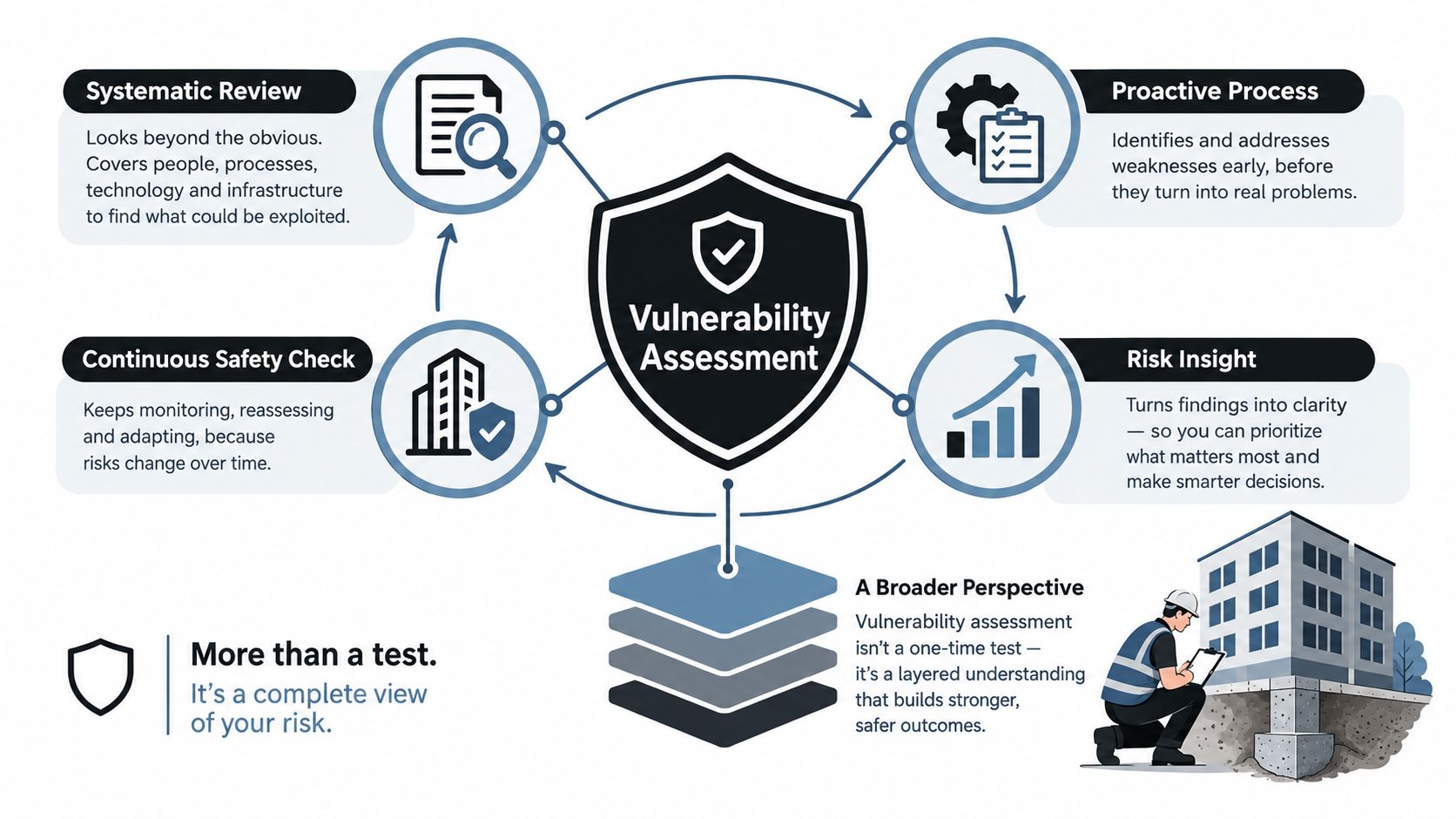
The work resembles a building safety inspection. An inspector checks foundations, exits, electrical systems, fire controls, records, and recent changes. The inspection identifies deficiencies, judges their significance, recommends action, and returns to verify repairs.
A digital assessment applies the same sequence to systems and products. It determines whether security measures are adequate, identifies deficiencies, supports predictions about proposed controls, and confirms those controls after implementation. NIST's definition of vulnerability assessment frames the activity as a control-validation feedback loop, not merely a scan.
Start with the boundary
Scope states what the assessment covers and what it excludes. It may include networks, hosts, cloud workloads, applications, databases, wireless infrastructure, software dependencies, identity configurations, or a selected combination. Document excluded systems, sensitive production services, unavailable credentials, and operational limits before collection begins.
A scan without scope is like inspecting a building without knowing which floors belong to it. The report can look detailed while leaving important areas unseen. Teams conducting a data risk assessment can apply the same discipline by mapping information assets to owners, business processes, and protection requirements. That mapping also supports broader cybersecurity risk management.
Separate assessment from management
Assessment creates visibility, classification, prioritization, and validation. Vulnerability management uses those outputs to coordinate patches, configuration changes, compensating controls, accepted risks, and retesting. They work together, but they answer different questions.
CVE supplies a shared identifier for a publicly disclosed vulnerability. NIST's IR 8011-4 explains that the CVE Program assigns an identification number, description, and at least one public reference, while the CVE list feeds the NVD. This language helps tools correlate findings. It does not establish whether a specific asset is reachable, exploitable now, or important to the business.
An assessment is finished when the team can explain what is exposed, why it matters, who owns the decision, and what evidence will show that exposure has been reduced. That standard turns scanner output into an exploitable-risk and exposure-prioritization process.
Types and Methodologies Behind Every Assessment
A public API may pass a network scan while allowing one customer to retrieve another customer's records. A source-code review may identify an unsafe function while missing a firewall rule that exposes the service to the internet. These examples show why assessment is an exposure-mapping problem, not a search for a patch backlog. Each method observes a different layer, and the gaps between those layers affect how quickly an attacker can exploit a weakness.
Match the method to the asset
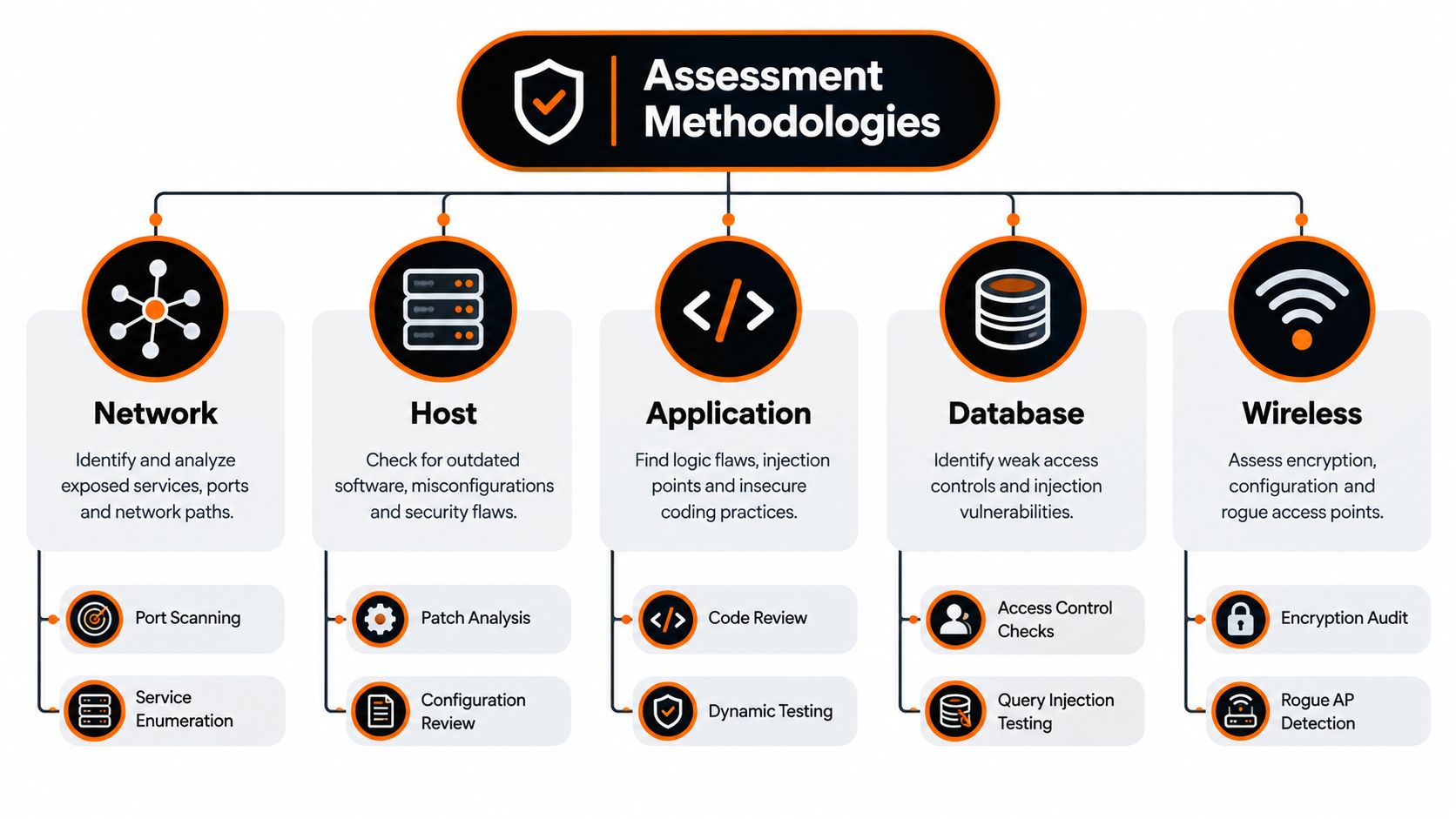
Network assessment: Examines reachable services, ports, segmentation, firewall behavior, and unexpected exposure. External testing shows what an outsider can see. Internal testing helps identify paths for lateral movement.
Host assessment: Reviews operating systems, installed packages, local services, permissions, and security configurations. Credentialed access usually produces better evidence because the assessor can inspect system state instead of inferring it from banners.
Application assessment: Combines static analysis, dynamic testing, dependency analysis, and manual review. It targets authentication, authorization, input handling, business logic, and insecure components.
Database assessment: Reviews accounts, privileges, encryption settings, network access, configuration, and query-related weaknesses. Findings should connect to the data and services that the database supports.
Wireless assessment: Examines encryption, access-point configuration, guest isolation, rogue devices, and the boundary between corporate and visitor networks.
The method must also match the threat model. An organization examining unusual signaling or surveillance risks may need specialist work such as bug sweeping Birmingham, rather than applying a checklist designed for servers and applications.
Compare the methodology choices
Credentialed and non-credentialed assessments answer different questions. Non-credentialed testing approximates an outsider's view. Credentialed testing exposes weaknesses that are invisible from the network, including missing local patches and unsafe permissions. Internal and external perspectives therefore complement each other.
Automation supplies repeatability and broad coverage. Manual analysis adds judgment, validates ambiguous findings, and identifies context that a rule-based engine cannot infer. The practical goal is not to collect the largest possible finding list. It is to identify which weaknesses are reachable, exploitable quickly, and attached to important assets, while recording the data-quality gaps that make those judgments uncertain.
Assessment Type | Best For | Methodology Notes |
|---|---|---|
Network | Internet-facing infrastructure and segmentation | Combine external and internal perspectives, then validate unexpected exposure |
Host | Servers, endpoints, and operating systems | Prefer credentialed evidence where safe, and account for configuration differences |
Application | Web applications, APIs, and dependencies | Combine automated analysis with manual review of authorization and business logic |
Database | Data stores and administrative surfaces | Review privileges, access paths, configuration, and supported services |
Wireless | Corporate, guest, and facility networks | Test encryption, isolation, rogue access points, and physical coverage |
CVSS helps teams communicate severity consistently. For CVSS v3.x and v4.0, NVD defines 0.1 to 3.9 as Low, 4.0 to 6.9 as Medium, 7.0 to 8.9 as High, and 9.0 to 10.0 as Critical. These bands are labels, not a remediation queue. Leaders should weigh them against exploitability, exposure, asset importance, and control effectiveness. NVD's CVSS guidance defines the bands and their limits.
Vulnerability Assessment Versus Penetration Testing
A vulnerability assessment doesn't answer the same question as a penetration test. Confusing the two creates false confidence in one direction and wasted effort in the other.
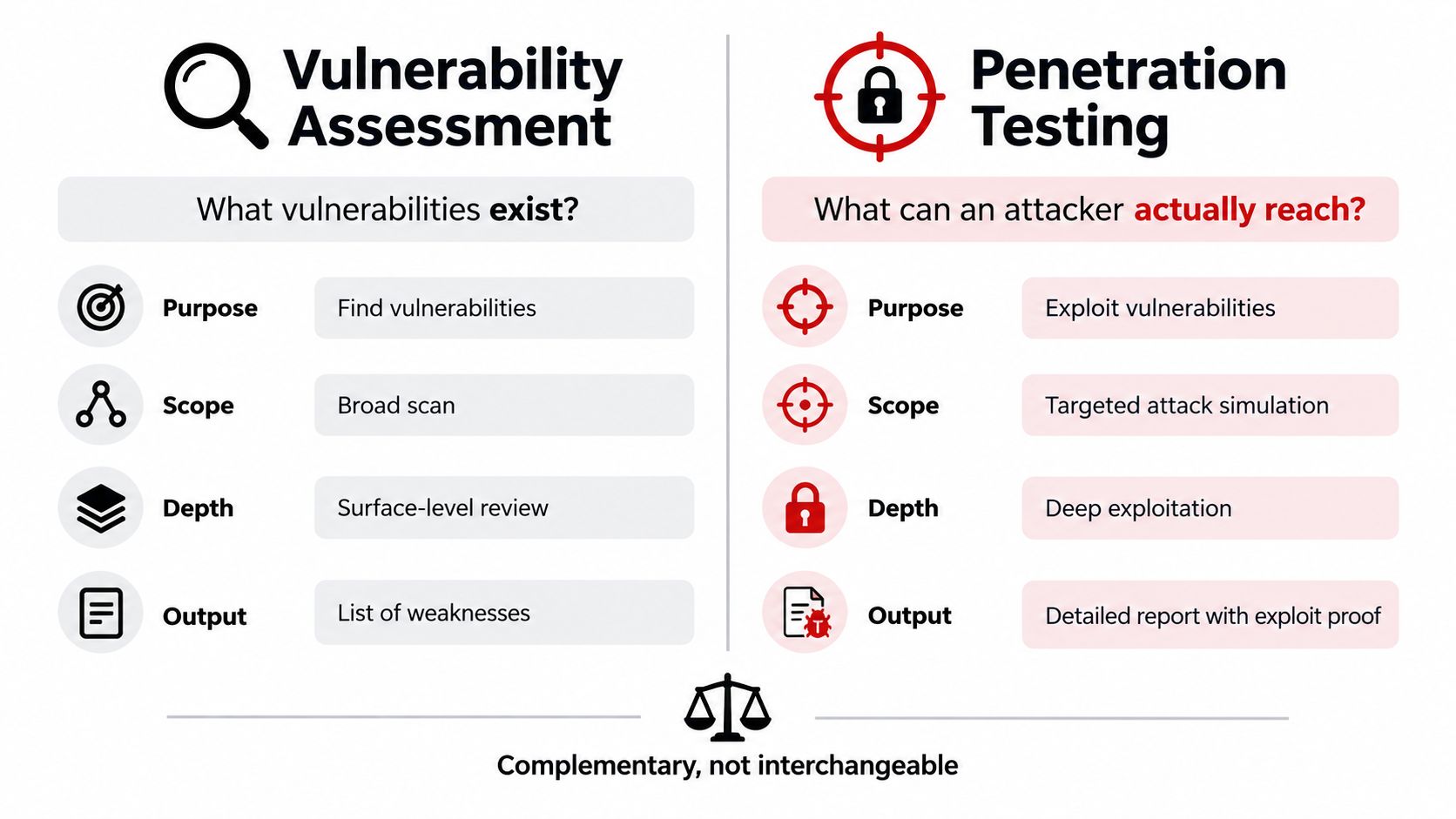
An assessment asks, “What vulnerabilities exist across the environment?” A penetration test asks, “What can an attacker reach, exploit, and chain together?” The first favors broad visibility. The second favors targeted depth and adversarial judgment.
Two different jobs
Dimension | Vulnerability Assessment | Penetration Testing |
|---|---|---|
Purpose | Identify and classify weaknesses | Demonstrate exploitability and impact |
Scope | Broad coverage across defined assets | Targeted systems, applications, or attack paths |
Method | Automated collection with analyst validation | Manual, adversarial testing with controlled exploitation |
Output | Prioritized findings and remediation context | Attack narrative, evidence, and demonstrated impact |
Best use | Continuous exposure awareness | Defense validation and deep testing of critical paths |
Consider a public application with a vulnerable library. An assessment can identify the component, affected version, severity, and exposure. A pen tester may then determine whether a reachable endpoint allows the weakness to become account access, data disclosure, or code execution. That result can validate the assessment's priority, expose a false positive, or reveal an attack chain the scanner couldn't model.
The reverse relationship matters too. Assessment data helps a testing team choose targets intelligently. Instead of spending the engagement on obvious, low-value findings, testers can examine the assets where exposure, business impact, and exploitability overlap.
A vulnerability assessment gives you the map. Penetration testing tests the roads an attacker could actually travel.
Mature security programs use both, but not as substitutes. Assessment supports ongoing hygiene and prioritization. Penetration testing challenges assumptions at selected points, such as before a major launch, after a meaningful architecture change, or when leadership needs evidence that a critical control works in practice.
The Vulnerability Assessment Lifecycle From Planning to Retest
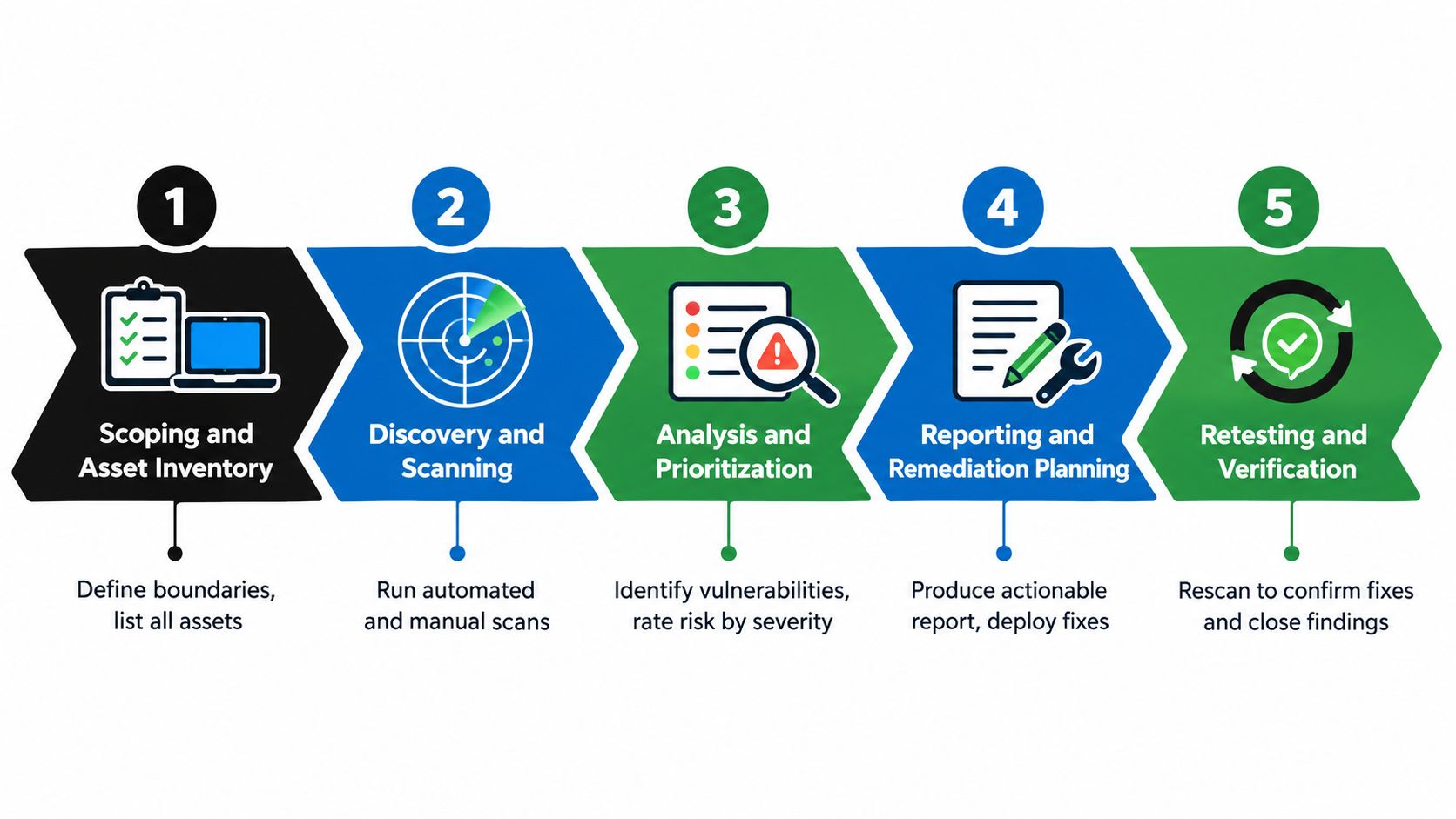
A useful lifecycle turns raw observations into verified risk reduction. Each stage creates an input for the next, so skipping discovery or ownership weakens every later decision.
1. Scope the environment and inventory assets
Document domains, networks, cloud accounts, applications, repositories, hosts, databases, wireless networks, and third-party connections in scope. Assign owners and note operational restrictions before scanning begins. The inventory should distinguish production, development, staging, and retired resources because identical findings can carry very different consequences in each context.
The output is a defensible assessment boundary and an asset list that can be reconciled with deployment and configuration systems.
2. Discover and scan
Use the method appropriate to each layer. Network scanners identify reachable services, host tools inspect system state, application tools analyze code and runtime behavior, and cloud or container tools inspect configurations and images. Run automated collection for scale, but preserve manual validation for sensitive systems and ambiguous results.
Credentialed data can confirm installed packages and configurations. Non-credentialed data can show an external attacker's view. You need both perspectives when exposure is the central question.
3. Analyze exploitability and exposure
The program stops treating every finding as an equal row in a spreadsheet. Start with severity, then add whether the issue is actively exploited, whether exploit development is accelerating, whether the asset is internet-facing, whether authentication is required, what data or privilege is at stake, and whether compensating controls reduce reachability.
VulnCheck reported that 14,000+ exploits were developed for 10,000+ unique CVE-2025 vulnerabilities, with same-year exploit coverage increasing 16.5% year over year. Recorded Future found 215 actively exploited CVEs in the first half of 2026, up 34% from the first half of 2025. VulnCheck's exploit intelligence report captures why disclosure and exploitation can be close together, or effectively overlap.
AhnLab reported that 75 new vulnerabilities were added to CISA's KEV list in Q2 2026, and 87% were rated High or Critical. The operational implication is direct: prioritize vulnerabilities according to how quickly attackers can use them, not only how severe a scoring system labels them.
4. Report and coordinate remediation
A finding needs an affected asset, evidence, severity, exploitability context, business owner, recommended action, and verification criteria. Give engineers enough technical detail to act without reconstructing the scanner's logic. Give executives a concise view of exposed business services, material changes, unresolved exceptions, and risk reduction.
Remediation may involve patching, configuration changes, access restrictions, segmentation, code changes, feature removal, or a documented exception. The handoff should enter the same operational workflow that manages engineering work and incident management, so urgent findings don't disappear between security and delivery teams.
5. Retest and improve
Rescan the affected asset or repeat the relevant test after remediation. Confirm that the vulnerability is gone, that the service still works, and that the fix didn't create a new exposure. Close the finding only when evidence supports closure.
Data quality must be reviewed during the lifecycle. Mondoo analyzed 768K+ security advisories and found 193K malware packages without CVE IDs and 11% missing CVSS scores. Zafran reported that only 28% of newly disclosed CVEs were fully analyzed by NVD in 2025, leaving 54,914 CVEs from 2024 to 2025 awaiting full enrichment. Mondoo's vulnerability intelligence analysis shows why package advisories, vendor intelligence, exploit feeds, and exposure context must supplement the public CVE record.
Metrics Reporting and Tool Categories That Drive Action
A report earns attention when it helps someone choose the next action. Finding counts describe workload, but they do not prove that exposure is falling. A smaller backlog can result from suppressed alerts, incomplete scans, or missing enrichment.
Measure movement, not activity
Start with coverage. Can the team account for assets across networks, hosts, cloud services, applications, databases, and containers? Did scans complete successfully, with working credentials? Which assets remain unassessed, and why?
Then measure signals that change priority:
Exploitability alignment: Separate KEV-listed and actively exploited findings from theoretical weaknesses. CISA's catalog helps focus review on vulnerabilities known to be exploited in the wild.
Exposure context: Record whether an asset is public, reachable from sensitive networks, tied to authentication, or protected by compensating controls.
Time to detect and close: Measure how long the team takes to identify a weakness and how long it remains exposed after discovery. An external benchmark previously cited in this article reported an average closure time of 54.81 days for high and critical application vulnerabilities. Use it as context, while treating internal trends as the stronger operating signal.
Retest quality: Track closures supported by evidence and findings that return after a fix.
Data completeness: Show records lacking CVSS, CVE identifiers, ownership, affected-version confirmation, or exploitability context.
Severity belongs in the report, but it needs interpretation. NVD explains that when a published vulnerability provides no details, its enrichment process assigns a score of 10.0, the highest rating. That rule shows why a score should not be separated from the evidence behind it. NVD's explanation of its scoring and acceptance process also describes its evaluation of CVSS v4.0 submissions, including comparison with the last 40 CVEs containing submissions or updates and 320 metric combinations.
A useful dashboard exposes exploit velocity and business exposure, not merely patch volume. If an internet-facing service has a newly usable exploit path, its position should change before a large backlog report does.
Choose tools by function
Use network scanners for exposed services and infrastructure weaknesses. Use web application scanners for runtime behavior. Use cloud and container scanners for identity, storage, images, orchestration, and configuration exposure. Use software composition and advisory tools for packages that may not map cleanly to a CVE. Use exposure management platforms when the problem is correlating assets, vulnerabilities, attack paths, ownership, and business impact.
Executive reporting should fit on a decision page. Engineering reporting should support reproduction, remediation, and verification. Neither audience benefits from an unranked export.
Building Your Assessment Capability With the Right Talent
Tools collect evidence, but people decide whether the evidence is trustworthy and actionable. A sustainable capability usually needs a vulnerability analyst to triage findings, an application security engineer to assess code and dependencies, a cloud security engineer to interpret identity and infrastructure exposure, and remediation owners embedded in platform and product teams.
The staffing model should follow the work pattern:
Direct hire: Use this when vulnerability assessment is a permanent core capability and you need institutional knowledge.
Staff augmentation: Add specialists for a migration, platform rollout, backlog reduction effort, or temporary capacity gap.
On-demand talent: Use a pre-vetted bench when demand changes quickly and the team needs focused engineering support without an immediate permanent hire.
Managed services: Consider an external team when you need an operating capability, defined processes, and ongoing delivery without building every role internally.
The build-versus-buy decision should also consider data sensitivity, response expectations, architecture complexity, and who owns remediation. Keep risk decisions and business context close to the organization. Augment specialized analysis, tooling integration, cloud expertise, or application security where internal capacity is thin.
A DevSecOps operating model can connect assessment findings to delivery workflows, and teams refining that connection may benefit from guidance on DevSecOps integration. TekRecruiter provides technology staffing and recruiting for engineering roles, including cybersecurity and AI engineering, using engineer-to-engineer technical conversations to match specialists with the environments where they'll work.
The practical target isn't the largest security team. It's a team that can maintain asset visibility, interpret incomplete intelligence, prioritize by exploit velocity and exposure, coordinate remediation, and prove closure.
TekRecruiter helps companies add cybersecurity, cloud, DevOps, and AI engineering talent through direct hire, staff augmentation, on-demand engineers, and managed services. Visit TekRecruiter to discuss the specialists you need to turn vulnerability assessment into a sustained, exposure-focused capability.
Comments