Master it project management outsourcing: A Practical Guide to Success
Learn how to optimize it project management outsourcing with smart vendor selection, clear models, and measurable performance.
Deciding to outsource your IT project management is a major strategic move. Let's be clear: this isn't just about shaving a few points off your budget. It’s about tapping into specialized expertise, hitting deadlines faster, and freeing up your in-house team to focus on the work that actually drives your business forward.
When you outsource, you're bringing in a partner to run your IT projects from the initial whiteboard session all the way through to launch and beyond.
Building the Business Case for Outsourcing
Before you even think about talking to vendors, you need a bulletproof internal argument for why this makes sense. If your entire case rests on "it's cheaper," you're setting yourself up for failure. The real wins are strategic—gaining the firepower to scale, innovate, and execute without getting bogged down.
The big players already get this. A staggering 92% of the top 2,000 global companies already outsource IT functions in some capacity. Sure, cost is a piece of the puzzle—about 32% of companies say it’s a key driver—but the smarter money is on accessing hard-to-find technical talent and just plain running a more efficient operation.
Conduct an Honest Skills Gap Analysis
First, you need to take a hard, honest look in the mirror. Where is your team falling short? And I don't just mean a missing certification for a specific technology. Think bigger.
Ask yourself these questions, and be brutally honest with the answers:
Do we have anyone who's actually delivered a project on this specific tech stack before? Successfully?
Is there a certified project manager on our payroll with a proven track record of bringing projects like this one in on time and under budget?
Is our team already running on fumes just keeping the lights on? If so, how can they possibly give a new, critical project the focus it deserves?
Nailing down these gaps makes it crystal clear where a partner adds immediate, undeniable value. It’s the difference between hitting the ground running and spending the next six months trying to hire or upskill your way out of a hole.
Define Your Project Scope with Precision
Nothing kills a project faster than a vague scope. It’s the number one reason budgets explode and deadlines get blown to pieces. Before a single vendor call, you must have your goals, deliverables, and success metrics documented. Think of a well-defined scope as the constitution for your project—it stops scope creep in its tracks and gets everyone marching in the same direction.
For a deeper dive, check out our guide on everything you need to know before outsourcing software projects.
A precise scope isn't just a laundry list of features. It's a shared definition of what "done" looks like. It has to clearly state what’s in scope and—just as critically—what’s out of scope. Leave no room for interpretation.
Calculate the True Cost of In-House Management
Finally, it’s time to run the numbers—the real numbers. The cost of an in-house project is so much more than just salaries. You have to account for all the direct and indirect expenses that are easy to conveniently forget.
Tally up everything:
Salaries and Benefits: Don't forget bonuses, healthcare, 401k matching, and payroll taxes for the entire team.
Recruitment and Training: What’s the real cost (and time suck) of finding and onboarding new talent or training up your existing staff?
Software and Tools: Add up the licenses for Jira, Slack, development environments, and whatever else you’ll need.
Overhead: Factor in office space, utilities, and the IT support needed to keep your project team running.
Opportunity Cost: This is the big one. What mission-critical work are your best people not doing because they’re tied up on this project?
When you add it all up, the financial argument for IT project management outsourcing often becomes painfully obvious. The right partner doesn’t just fill a skills gap; they deliver a more predictable, and often much lower, total cost of ownership.
With a rock-solid business case like this, you’re ready to start exploring which partnership model is right for you. At TekRecruiter, we connect companies with the top 1% of engineers and project managers who live and breathe this stuff. We can help you hire elite talent that closes your skill gaps and supports your most critical projects.
2. Finding the Right Outsourcing and Pricing Model
So, you’ve built a solid business case for outsourcing your IT project management. What’s next? You need to pick an engagement model. This is a huge decision—it literally defines the entire relationship, from who has day-to-day control to where the financial risk sits.
Get this wrong, and you're setting yourself up for misaligned expectations and painful budget overruns. But nail it, and you create the foundation for a real partnership that delivers.
The key is to match the model to your project's specific needs, not the other way around. Don't let a vendor box you into a structure that benefits them more than you. You have to understand the real-world differences between the common approaches to make a smart decision that protects your interests.
Comparing The Core Engagement Models
There are three main ways to structure an outsourcing deal, and each one solves a different problem. Staff augmentation is for plugging specific skill gaps. Managed services is about handing off an entire function. And project-based outsourcing is for self-contained work with a clear finish line.
Staff Augmentation: This is your go-to when your internal PM team is solid, but you're missing a few key players—maybe a cloud architect for a migration or a cybersecurity analyst for a compliance push. You keep 100% control over the project, and the new talent just slots right into your existing team. It’s flexible and lets you scale your team up or down on a dime.
Managed Services: You’d choose this when you need to offload an entire operational headache, like your IT helpdesk or network security monitoring. The vendor takes full ownership of the people, processes, and tools, all governed by a strict Service Level Agreement (SLA). This model is about buying outcomes, not just renting people.
Project-Based Outsourcing: This is the classic model for a well-defined project, like building a new mobile app from scratch or overhauling your database. You hand the whole scope over to a vendor who runs with it from start to finish. It demands less of your day-to-day attention but requires an incredibly detailed and buttoned-up scope from the get-go.
This decision tree can help you visualize which path makes the most sense based on what’s driving your decision—whether it’s a skills gap, a defined scope, or pure cost savings.
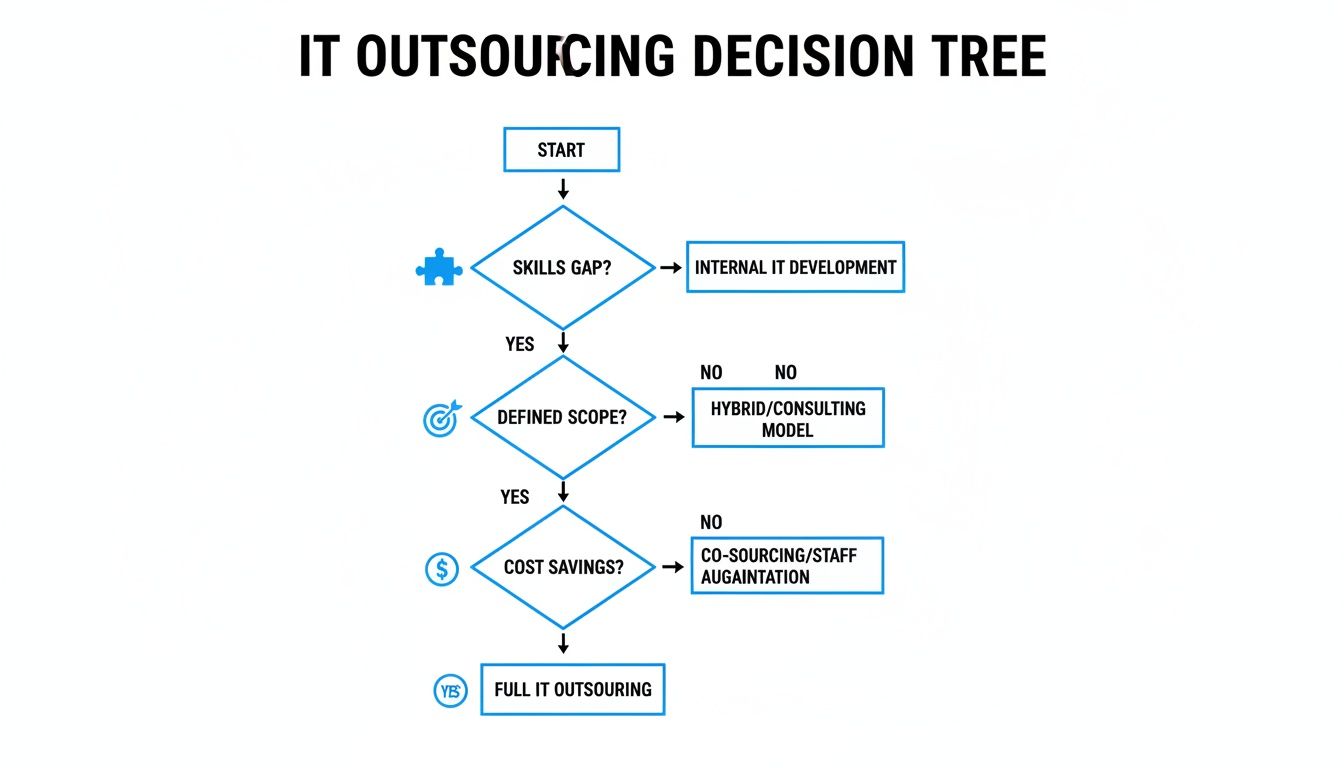
As the flowchart shows, if you have a crystal-clear scope, a project-based model is often the right call. If you just need specific expertise now, staff augmentation is probably a better fit. You can get a much deeper breakdown in our guide on staff augmentation vs outsourcing and which model fits you.
To make it even clearer, here’s a simple table breaking down the key differences.
Comparing IT Outsourcing Engagement Models
Model | Best For | Control Level | Cost Structure |
|---|---|---|---|
Staff Augmentation | Filling specific skill gaps; scaling teams quickly. | High (You manage the resources directly). | Time & Materials (hourly/daily rate). |
Managed Services | Offloading entire operational functions (e.g., IT support). | Low (Vendor manages outcomes based on an SLA). | Fixed monthly fee (often tiered). |
Project-Based | Well-defined, self-contained projects with clear deliverables. | Medium (You approve milestones; vendor manages the work). | Fixed-Price or Time & Materials. |
Choosing the right model is about aligning the structure with your project's DNA—its complexity, timeline, and your team's ability to manage it.
Aligning Price with Project Reality
Once you've landed on an engagement model, you have to pair it with the right pricing structure. This choice comes down to your project's predictability and your comfort level with risk. A mismatch here can create constant friction and nasty financial surprises.
Fixed-Price Contracts
This is exactly what it sounds like: a single, agreed-upon price for the entire project. It only works for projects with a scope that is meticulously documented and locked down.
The Good: Complete budget predictability. You know exactly what you’re paying, full stop. The Bad: Zero flexibility. Any change, no matter how small, triggers a formal change order and, almost always, more cost. Vendors bake in a risk premium to cover their own butts, so you might be overpaying from the start.
Time and Materials (T&M)
With a T&M model, you pay an hourly or daily rate for the people working on your project. This is built for projects where you know requirements will evolve or the scope isn’t fully fleshed out yet.
The Good: Maximum flexibility. You can pivot, adapt, and reprioritize as you learn more during the project. The Bad: Budget uncertainty. Costs can spiral if the scope isn't managed with an iron fist. This model requires intense oversight from your side to keep hours and progress in check.
Dedicated Team Model
This is a hybrid approach that offers the best of both worlds for many. You pay a fixed monthly fee for a dedicated team of professionals who work only on your projects. It’s perfect for long-term initiatives where you need a consistent team that builds deep knowledge of your business. It gives you more cost predictability than pure T&M but keeps the flexibility you need to adapt.
Picking the right combination of engagement and pricing is everything. For companies that would rather build the team themselves, there's another way. At TekRecruiter, we connect you with the top 1% of engineers and project managers, letting you build a world-class team under a model that’s built for your project’s unique demands—not a one-size-fits-all contract.
How to Vet and Select Your Outsourcing Partner
You’ve sorted out the engagement model and pricing. Now for the hard part—the single decision that will make or break your entire project: choosing the right partner.
Let's be clear. You aren't just looking for a vendor to check off tasks. You're searching for a true collaborator, a team that plugs into your own and genuinely cares about the outcome.

The market is absolutely flooded with options, and every single sales pitch sounds flawless. With the global IT outsourcing market expected to hit $519–$541 billion by 2025, it's a gold rush. That explosion of choice means you have to be disciplined and methodical to cut through the marketing noise.
Crafting a Request for Proposal That Gets Real Answers
A generic Request for Proposal (RFP) gets you generic, useless answers. Don't do it. Your goal is to design a document that forces potential partners to drop the sales-speak and show you what they can actually do. Think of your RFP as your first and most effective filter.
Forget broad questions like, "What is your project management process?" That's a waste of everyone's time. Instead, get surgical and demand proof.
Hit them with real scenarios. Present a hypothetical (but relevant) challenge. For instance: "Our user adoption for a new CRM is stuck at 15%. How would you manage a project to get that to 75% in six months?" Their response tells you everything about their strategic thinking.
Ask for methodology proof. Don't just ask if they use Agile. Ask for anonymized sprint planning docs, burndown charts, or retrospective reports from a past project. Show, don't tell.
Demand team specifics. Make them outline the exact roles they’d assign to your project. Insist on bios or resumes for key players, especially the project manager who would be your main point of contact.
This approach makes them demonstrate their expertise, not just talk about it.
Assessing True Technical and Industry Expertise
A partner’s technical chops and deep industry knowledge are non-negotiable. Glossy case studies are fine for a first look, but you have to dig way deeper to verify they actually understand the unique headaches of your specific sector.
When you get them on a call, focus on practical application and past performance.
"Tell me about a time a project in the [your industry] space was going off the rails. What specific steps did your team take to pull it back?"
"What project management tools are your team's daily drivers? How would you integrate them with our stack—we use Jira, Slack, and MS Teams."
"Walk me through your QA and testing protocol for a project of this complexity."
The detail (or lack thereof) in their answers will quickly separate the real experts from the pretenders. It's also a smart move to broaden your perspective by reading up on how to find the best IT staffing services to better understand the entire talent landscape.
Validating Claims Through Client References
This is your chance to get the unvarnished truth. Don't squander it with softball questions. Prepare targeted inquiries that get to the heart of what it’s really like to work with them.
When you call a reference, your goal isn't just to confirm they did the work. It's to find out how they work—how they communicate under pressure, handle curveballs, and integrate with an existing team.
Here are a few questions that always deliver honest feedback:
How did they handle scope creep or unexpected changes? This reveals their flexibility and whether they’re fair with change orders.
Describe the project manager's communication style. Proactive? Responsive? Transparent? This tells you everything about the day-to-day reality of working with them.
The bottom line: Was the project on time, on budget, and did it meet your quality standards?
And the killer question: Would you hire them again for a similar project without a second thought? The pause before they answer is often as telling as the answer itself.
Ultimately, choosing a partner is as much about cultural fit as it is about technical skill. A rigorous vetting process ensures you find a team that doesn't just have the right expertise but also shares your commitment to communication, transparency, and getting real results.
At TekRecruiter, we specialize in making that perfect connection. We recruit the top 1% of engineers and project managers, so innovative companies can hire talent that has been rigorously assessed for both technical excellence and professional integrity.
Building a Framework for Governance and Communication
So you've picked your outsourcing partner. The ink on the contract is barely dry, and now the real work begins. The success or failure of your entire IT project management outsourcing initiative rides on the structure you build around it right now.
Think about it: without clear rules of engagement, even the most talented teams will stumble. Confusion, delays, and misaligned expectations become the norm. This isn't about adding corporate red tape; it’s about creating the operating system for your partnership. It defines who calls the shots, how information flows, and what happens when things inevitably go sideways. Skipping this is like building a house without a blueprint.
Defining Roles with a Practical RACI Chart
Ambiguity is the enemy of progress, period. The fastest way to kill it is with a RACI chart. It’s a simple but powerful matrix that clarifies who is Responsible, Accountable, Consulted, and Informed for every key task. This little chart is a game-changer for preventing dropped balls and those endless "who owns this?" email chains.
Let's make this real. Imagine you need to make a critical call about changing a feature's scope. Here’s how it breaks down:
Responsible: The outsourced dev lead is the one who has to actually do the work of implementing the change.
Accountable: Your internal Product Owner is the one person who is ultimately accountable for the decision. The buck stops with them.
Consulted: The lead QA tester and the UX designer must have their input heard before the decision is locked in.
Informed: Your Head of Engineering and the outsourced Project Manager are kept in the loop once the decision is made. No surprises.
This structure ensures decisions happen efficiently and by the right people, without sidelining crucial experts. If you're running an Agile shop, mapping these responsibilities is critical. You can get more specific guidance by defining roles in Agile software development to sharpen your framework.
Establishing a Communication Cadence
A solid communication plan is the lifeblood of any outsourced project. It can't be just a series of random, ad-hoc meetings. You need an intentional, rhythmic cadence—a predictable flow of information that keeps everyone aligned without drowning them in pointless calls.
A good starting rhythm often includes:
Daily Stand-ups: A quick 15-minute sync for the core teams. No fluff, just facts.
Weekly Tactical Meetings: A focused one-hour session to review sprint progress, tackle roadblocks, and plan the week ahead.
Bi-Weekly Stakeholder Updates: A concise progress report or a 30-minute check-in for key business stakeholders who need the highlights, not the daily grind.
Formal Escalation Paths: A documented, no-questions-asked process for who to contact—and in what order—when a big issue pops up that the core team can’t solve.
Don't sleep on asynchronous communication. A centralized hub for project docs, technical specs, and meeting notes is non-negotiable. Learning how to build a knowledge base is a skill that empowers your outsourced team to find answers on their own instead of waiting for someone to wake up in another time zone.
Key Contract Clauses That Protect You
Your contract is more than just a payment schedule—it's your safety net. Your legal team will handle the fine print, but there are a few clauses you, as the project lead, need to ensure are rock-solid to protect your business.
Intellectual Property (IP) Ownership: This is non-negotiable. The contract must state, without any ambiguity, that your company owns 100% of all code, designs, and deliverables created for the project.
Data Ownership and Security: It should clearly define that you own all project-related data and specify the exact security protocols the vendor must follow, including compliance with regulations like GDPR or CCPA.
Exit Strategy and Termination Clause: Hope for the best, plan for the worst. This clause outlines the process for winding down the engagement, covering the smooth transfer of all assets, knowledge, and code back to your team. It ensures a clean break if things don't work out.
A well-defined governance and communication framework elevates your outsourcing relationship from a simple transaction to a true strategic partnership. It builds trust, creates transparency, and drives the accountability needed to actually deliver.
TekRecruiter connects you with the top 1% of engineers and project managers who not only bring technical excellence but also understand that clear governance is the bedrock of success from day one.
Setting KPIs To Manage Performance Effectively
You can’t steer a ship without a compass—and the same holds true for your IT project management outsourcing. Once governance is in place, defining how you’ll measure success becomes the linchpin for accountability and real results.
This isn’t about dashboard eye candy or reports that gather digital dust. It’s about agreeing up front what “done” really looks like, then watching progress in near real-time. Otherwise, you’re simply flying blind.

Moving Beyond Simple Metrics
True performance management digs deeper than “Are we finished?” You need a balanced mix of Key Performance Indicators (KPIs) and Service Level Agreements (SLAs) that span every phase—from budget discipline to end-user delight.
A smart SLA does more than hand out penalties for missed targets. It lays out reward structures and success benchmarks, turning a legal document into a living, breathing performance tool.
Defining Your Core KPIs And SLAs
Start by focusing on four critical areas. Together, these metrics build a comprehensive snapshot of your project’s health:
Financial Performance - Budget Variance: Difference between planned budget and actual spend. Watch for anything beyond ±5–10%. - Cost Performance Index (CPI): A CPI under 1.0 means you’re overspending for the value received.
Schedule Adherence - On-Time Completion Rate: Percentage of milestones met by their deadlines. - Schedule Performance Index (SPI): SPI below 1.0 signals slipping timelines.
Quality And Technical Excellence - Defect Density: Number of bugs per 1,000 lines of code—a direct gauge of code health. - Escaped Defects: Bugs discovered by users after release. Aim for zero.
Stakeholder And User Satisfaction - Net Promoter Score (NPS): How likely are users to recommend this product? - Stakeholder Surveys: Quick pulse checks on internal confidence and alignment.
This push toward data-driven partnerships comes at the right time. Corporate IT budgets earmarked for outsourcing jumped from 5.6% in 2022 to 8.1% in 2023—a 45% increase. And with 37% of companies planning to boost that spend even more, rigorous KPI tracking is now table stakes. You can explore more data on these IT outsourcing trends impacting businesses today.
Implementing A Performance Review System
With KPIs defined, set up a transparent dashboard everyone can access. This single source of truth keeps both your in-house team and your partner aligned on real-time progress.
Block out recurring meetings—biweekly or monthly—to scan the dashboard together. Early warnings let you course-correct before small hiccups become full-blown crises. To round out your toolkit, dig into these essential metrics for project management that should anchor your performance reviews.
By spelling out clear expectations and measuring relentlessly, you grab the reins of your outsourcing engagement—holding your partner to the results your business demands.
Finding a partner who not only accepts but embraces this level of transparency is key. TekRecruiter connects companies with the top 1% of engineers and project managers who understand that data-driven accountability is the foundation of a successful partnership. We can help you deploy elite talent ready to meet and exceed your performance standards from day one.
Wrapping It Up: Making Your Next Outsourced Project a Success
You now have a solid playbook for outsourcing your IT project management, from building a rock-solid business case to keeping a sharp eye on performance. Getting this right isn’t a matter of luck. It's about diligent planning, smart governance, and, most importantly, picking the right partner to de-risk the entire venture.
The frameworks we've walked through are designed to put you in the driver's seat. They give you the control and clarity needed to turn a simple vendor contract into a real strategic advantage. You're not just offloading tasks; you're intentionally plugging in specialized skills to deliver faster and drive outcomes that actually matter to the business.
The best outsourcing partnerships I've ever seen were built on a foundation of honest communication, shared goals, and mutual accountability. This isn't about hiring a contractor to throw work at. It's about integrating a high-performance extension of your own team.
Whether you need to augment your team with a specific skill set or hand the project to an outsourcing partner, TekRecruiter recruits the engineers or finds and vets the best IT outsourcing company for the work, and you contract with them directly. See how MSP & Outsourcing Search works.
Your Top Questions, Answered
When you're thinking about outsourcing IT project management, a lot of questions come up. It's smart to ask them. Here are the straight answers to the most common concerns.
What Are The Biggest Risks Of Outsourcing, And How Do I Sidestep Them?
Let’s be direct: the biggest pitfalls are losing a sense of control, communication breakdowns, and shaky quality. I've seen it happen. But you can get ahead of all three with some sharp planning before you sign anything.
The trick is to build a rock-solid governance framework from day one. Define who is responsible for what (a RACI chart is perfect for this), set up a non-negotiable communication schedule, and bake your KPIs and SLAs right into the contract. Your best defense, though? A ruthless vendor vetting process. Actually call their references and scrutinize their past projects. It's the single best way to avoid quality headaches later.
How Should I Handle Our Intellectual Property And Data Security?
This is non-negotiable: address IP and data security in the contract from the get-go. The agreement must state, without any ambiguity, that your company retains 100% ownership of all intellectual property created. Don't leave any wiggle room.
On the security front, you need to verify the vendor's compliance with any regulations that matter to your business, like GDPR or CCPA. Ask them to prove they have strong data encryption and strict access controls in place. And, of course, an NDA is mandatory before you even whisper a single sensitive project detail.
Never assume IP ownership is a given. Get it in writing, crystal clear, to protect your company's most valuable assets. This one simple step can save you from a world of legal and financial pain down the road.
Should I Go With A Nearshore, Offshore, Or Onshore Partner?
There's no single right answer here—it all comes down to what your project truly needs. Each model presents a different trade-off between cost, real-time collaboration, and cultural fit.
Here’s how I break it down for clients:
Onshore partners are great for seamless, same-time-zone collaboration, but they come with the highest price tag.
Offshore partners offer the biggest cost savings, hands down. The trade-off can be significant time zone delays and potential communication hurdles.
Nearshore partners often hit the sweet spot. You get significant cost savings with minimal time zone differences and much closer cultural alignment.
Think hard about how much daily, real-time interaction your project demands and weigh that against your budget. That will point you to the right model for your team.
 Ron SmithPresident & Lead RecruiterTekRecruiter