Your Guide to Software Engineering Recruitment Agencies
Discover how software engineering recruitment agencies find elite talent. This guide helps tech leaders choose the right partner, service model, and strategy.

Think of a software engineering recruitment agency as a specialized matchmaker. These firms don't just post jobs; they build relationships and connect companies with highly skilled, pre-vetted developers and engineers who are already excelling in their current roles.
They act as strategic partners, giving you a direct line to passive candidates—the top-tier talent that isn't actively looking for a new job. You won’t find these people on job boards. This kind of partnership helps you fill critical roles faster, scale your teams with precision, and get a serious leg up in a cutthroat talent market.
Why Top Tech Leaders Partner With Recruitment Agencies
Let's be honest: finding elite software engineers is a huge operational headache. The demand for specialized skills is completely out of sync with the available supply. Experts are forecasting a staggering shortage of 1.2 million unfilled tech jobs in the U.S. alone by 2026.
This scarcity makes the old ways of hiring—posting on job boards, running ads—feel like shouting into the void. It’s just not efficient anymore.
This is exactly where a software engineering recruitment agency proves its worth. They become a dedicated extension of your talent team, but with a much deeper and more focused reach into niche technical communities that you simply don't have time to cultivate.
Tapping Into the Hidden Talent Market
The best engineers are almost always happily employed and aren't scrolling through job listings. A specialized agency’s real value is its ability to map the entire market, pinpoint these high-performers, and actually get them to listen. They build these relationships long before you even have a role open.
This proactive approach delivers a few key advantages:
Accelerated Hiring Speed: These agencies maintain curated pipelines of qualified talent, which dramatically cuts down the time-to-fill for your most important positions.
Enhanced Candidate Quality: They handle the heavy lifting of rigorous technical vetting and cultural fit assessments, so you only spend time interviewing engineers who meet your high bar.
Strategic Market Insights: A great agency partner will give you invaluable data on compensation benchmarks and skill availability, helping you put together offers that actually get accepted.
A specialized recruitment partner transforms hiring from a reactive fire drill into a proactive, strategic function. You’re no longer just filling seats; you're intentionally building a resilient engineering organization with talent sourced specifically for your long-term goals and technical roadmap.
The infrastructure that powers this industry is also blowing up. The global recruitment software market is on track to grow from US$ 3.30 billion in 2025 to a massive US$ 6.20 billion by 2032, all because the demand for effective tech hiring solutions is so intense. You can read the full research on recruitment software market growth to see just how big this space has become.
Ultimately, teaming up with the right agency frees you up to focus on what you do best—building incredible products—while they take on the complex, time-consuming work of assembling your world-class engineering team.
Ready to build a world-class engineering team without the hiring headaches? Explore TekRecruiter’s technology workforce solutions and discover how our access to the top 1% of engineers can accelerate your growth.
Choosing the Right Recruitment Service Model
Picking a software engineering recruitment agency is just the first domino to fall. The next decision is arguably more important: choosing the right service model. Think of it like a specialized toolkit for building your team. Using a sledgehammer when you need a surgical scalpel is a fast way to waste time, money, and everyone’s patience.
Each service model is built for a specific strategic purpose. Getting this right means aligning the agency’s entire approach—and its cost structure—with exactly what you need to accomplish. Are you filling a single, mission-critical leadership role? Or are you trying to scale an entire project team on a brutal deadline? The answer changes everything.
Direct Hire for Permanent Placements
This is the classic, most straightforward model. Direct Hire (or permanent placement) is exactly what it sounds like. The agency becomes your dedicated search partner to find, vet, and introduce candidates for a full-time, permanent spot on your payroll. You only pay a fee—usually a percentage of the hire’s first-year salary—after you’ve successfully hired someone they brought to you.
This is the perfect fit when you are:
Filling critical, long-term roles. Think Senior DevOps Engineer, Principal AI Scientist, or a key Backend Architect.
Building out your core team. This is for adding permanent headcount to strengthen your organization's foundation.
A startup making its first key hires. You’re securing the foundational engineering talent that will define the company's entire trajectory.
The real benefit here is commitment. You're bringing someone into the fold for the long haul. The agency’s goal isn’t just to fill a seat, but to find a candidate whose technical skills and cultural vibe will ensure they stick around, contribute, and grow with you for years.
This simple decision tree shows when to lean on an agency versus a standard job board.
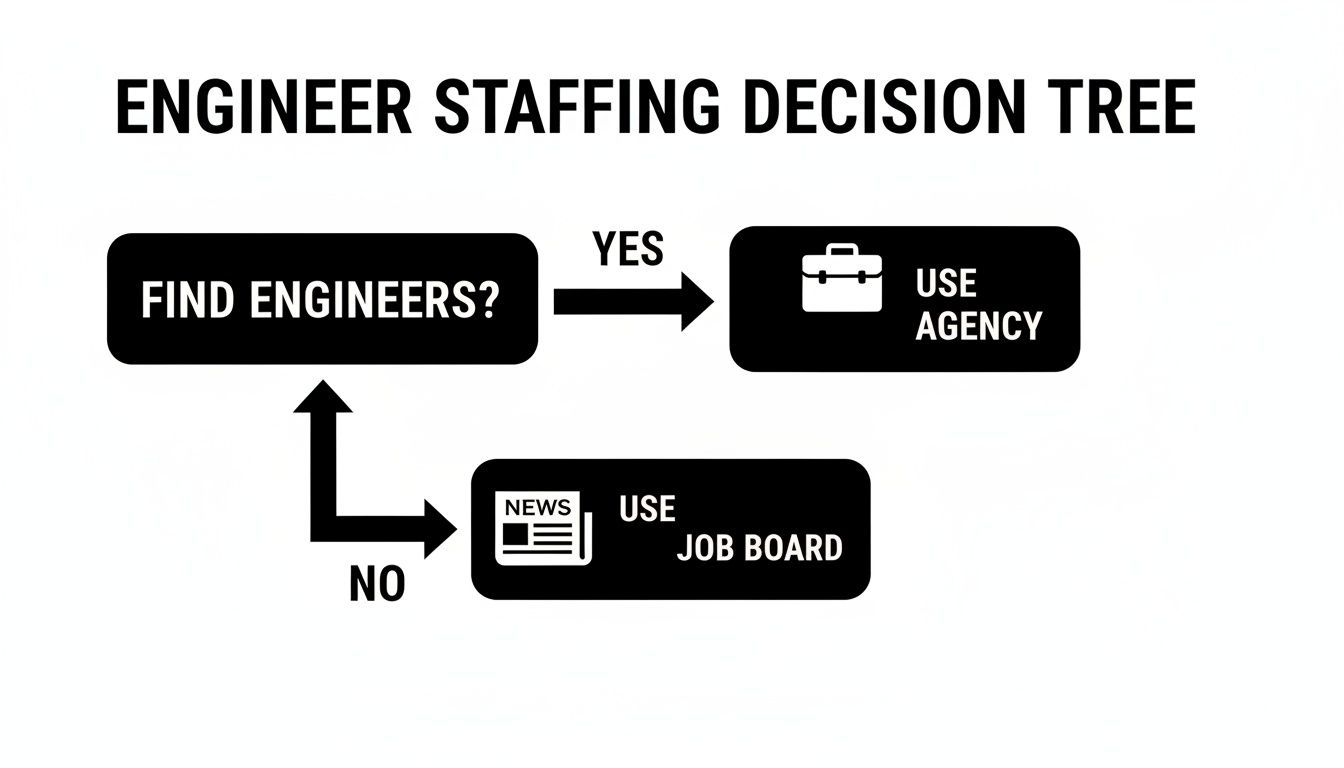
As the visual makes clear, the more specialized your engineering needs get, the more you need the focused, expert-driven approach an agency provides.
Staff Augmentation for Flexible Talent
But what if you don't need a permanent hire? Maybe you have a specific project with a hard deadline, a temporary skills gap, or an unexpected surge in workload. This is exactly where Staff Augmentation shines.
With this model, the agency provides you with skilled engineers who technically remain on their payroll but work as a fully integrated part of your team. You pay an hourly or monthly rate for their time, giving you incredible flexibility to scale your team up or down as the project demands.
This is the go-to model for adding specialized expertise for a six-month cloud migration or bringing on two extra frontend developers to crush a product launch deadline. Its flexibility is why the market for staffing agency software is projected to rocket from USD 634.0 million in 2025 to USD 1,244.5 million by 2032. With 65% of tech leaders planning to use more contract talent, this model delivers the speed and compliance they demand.
Comparing Recruitment Agency Service Models
To make the choice clearer, here’s a quick-reference guide. Use this table to match your specific hiring needs, timeline, and budget to the best engagement model.
Service Model | Best For | Typical Cost Structure | Key Benefit |
|---|---|---|---|
Direct Hire | Filling critical, long-term roles and building a core team. | Contingency fee (percentage of first-year salary) paid upon successful hire. | Secures permanent, committed talent aligned with company culture. |
Staff Augmentation | Short-term projects, filling skill gaps, or managing workload surges. | Hourly, daily, or monthly rate for each temporary engineer. | Maximum flexibility to scale engineering capacity up or down on demand. |
Retained Search | Executive leadership (VP of Eng) or highly specialized, hard-to-find roles. | Upfront retainer fee plus subsequent payments at key milestones. | Guarantees a dedicated, exhaustive search for top-tier, passive candidates. |
RPO | High-volume hiring, rapid scaling, or building a new recruiting function. | Monthly management fee, often with per-hire performance bonuses. | Outsourced, expert-led talent acquisition that acts as an extension of your company. |
Each model serves a distinct purpose. The key is to be honest about what you need right now versus what you might need later. That clarity will save you headaches and budget down the road.
Retained Search for Executive and Niche Roles
For the roles that absolutely cannot stay open—like a VP of Engineering or a hyper-specialized Machine Learning researcher—a Retained Search is the only way to go. In this model, you pay an upfront fee to "retain" the agency's exclusive services for a specific search.
That exclusivity and financial commitment forge a much deeper, more intense partnership. The agency dedicates a specialized team to meticulously map the entire market, conduct exhaustive research, and engage top-tier candidates who are almost never actively looking for a new role.
Retained search is an investment in certainty. It's for roles where the cost of the vacancy is far greater than the cost of the search itself. It demands a meticulous, high-touch process that guarantees you see the absolute best talent the market has to offer.
This model is about filling your most important leadership and technical roles with precision, not chance. It’s a premium service for a premium need. Companies filling an engineering leadership seat this way can see how TekRecruiter runs executive search.
Recruitment Process Outsourcing for Total Talent Management
Finally, Recruitment Process Outsourcing (RPO) is the most comprehensive model of all. With RPO, you outsource your company's entire recruitment function—or a significant part of it—to an agency. They effectively become your internal recruiting department, handling everything from sourcing and screening to offer management and onboarding.
RPO is a strategic, long-term partnership. It’s best suited for companies experiencing rapid growth or those that want to install expert-led hiring processes without the overhead of building a large in-house talent acquisition team. It delivers scalability, process efficiency, and immediate access to advanced recruiting tech and analytics.
Choosing the right service model is the foundation of a successful agency partnership. When you match your specific hiring need to the right model, you set the stage for a collaboration that delivers the right engineering talent, on your timeline, and within your budget.
At TekRecruiter, we specialize in understanding these unique needs. We help innovative companies hire the top 1% of engineers and match each role to the right model, from a permanent hire backed by a 90-day guarantee to contractors who can start in as little as 3 days.
How to Select the Best Agency for Your Needs
Picking the right recruiting partner from a sea of agencies can feel like a shot in the dark. But getting this decision right is a massive force multiplier for your hiring. The first, and most critical, fork in the road is deciding between a specialist and a generalist firm.

This choice fundamentally shapes the talent pool you can tap into and the expertise you'll have on your side.
Niche vs. Generalist Agencies
A generalist agency is the department store of recruiting. They have a little bit of everything—candidates across sales, IT, finance, you name it. Their broad reach might seem appealing if your needs are all over the map and not deeply technical.
A niche agency, on the other hand, is a boutique specialist. They focus exclusively on a specific domain, like AI/ML engineering, cloud infrastructure, or cybersecurity. They live and breathe this stuff, building deep, personal networks within very specific talent communities.
A niche agency doesn’t just match keywords on a resume. They get the nuances of the tech, understand the culture of the domain, and know where to find the passive candidates who aren’t scrolling through job boards. This specialization almost always translates to higher-quality candidates and a faster hire for complex roles.
For most tech leaders, the debate ends right there. When you need a senior Go developer with serious Kubernetes experience, a generalist recruiter will likely drown you in mismatched profiles. A niche partner probably already knows a handful of top performers in that exact space. When vetting an agency, you have to dig into their real understanding of what recruiters seek in resumes to make sure they can actually spot top-tier talent.
Onshore vs. Nearshore vs. Offshore Models
Once you've settled on a specialist, the next big question is geography. Where your agency sources talent has huge implications for cost, collaboration, and how easily new hires will integrate with your team.
Each of the three main models comes with a distinct set of trade-offs:
Onshore: Sourcing talent from right here in your own country. This gives you maximum cultural and time-zone alignment, but you’re also dealing with the highest salaries and the most cutthroat competition for talent.
Offshore: Sourcing talent from far-flung countries, often on the other side of the world (e.g., a U.S. company hiring in Asia). This offers the biggest potential for cost savings but introduces major headaches with time zones, communication barriers, and cultural gaps.
Nearshore: Sourcing talent from nearby countries, usually within a similar time zone (e.g., a U.S. company hiring in Latin America). This model hits the sweet spot, delivering significant cost benefits while keeping cultural affinity and collaborative working hours intact.
Your decision needs to go way beyond the hourly rate.
Key Factors for Geographic Models
When you’re weighing these geographic models, look past the price tag and think about the total operational impact. A 12-hour time difference can easily wipe out any salary savings with endless collaboration friction.
Collaboration and Time ZonesFor agile teams, seamless communication isn’t a nice-to-have; it’s everything. A nearshore model allows for real-time collaboration during your core business hours. Stand-ups, code reviews, and quick problem-solving sessions just happen naturally, without the frustrating delays that plague offshore teams.
Cultural AffinityA shared cultural context and similar work ethic make for faster team integration and a more cohesive engineering culture. This is an often-overlooked factor, but it’s fundamental to long-term success. Nearshore talent often shares cultural values with U.S. teams, leading to smoother collaboration and genuine connections. For a deeper look at navigating these choices, check out TekRecruiter's guides to building elite tech teams.
Intellectual Property ProtectionWorking with agencies in regions with strong, U.S.-aligned legal frameworks for intellectual property adds a critical layer of security. This isn’t just a detail; it's a core risk-management factor that should heavily influence your decision.
Choosing the right agency isn't just about filling a role. It's about building a sustainable talent pipeline that clicks with your budget, project complexity, and team culture. By carefully weighing the niche specialization against the geographic delivery model, you can find a true strategic partner.
At TekRecruiter, we deliver the best of both worlds: a specialized focus on the top 1% of engineers and a strategic nearshore model. Our U.S. offices and overlapping time zones make integration easier, giving you access to elite global talent without sacrificing quality or collaboration.
A Practical Checklist for Vetting Recruitment Agencies
Before you sign any contract, you need a way to tell a true strategic partner from just another vendor. A slick sales pitch is easy to deliver, but the real value of a software engineering recruitment agency is hidden in the depth and rigor of its process. This checklist will give you the framework to properly evaluate any potential partner.

Use these questions to cut through the marketing fluff. You'll get a clear picture of an agency’s real capabilities, helping you dodge common headaches and pick a partner that actually gets your technical world and business goals.
Scrutinize Their Technical Vetting Process
This is it. This is the most important thing to dig into. A weak technical screening process means your team wastes precious time interviewing unqualified candidates, which defeats the whole purpose of bringing in a partner.
Don’t let them get away with vague answers. Get into the weeds of how they validate skills.
Who runs the technical interviews? Ask if their own senior engineers or subject matter experts are involved. A recruiter with a technical background is a huge plus, but an agency that uses actual engineers to vet other engineers shows a serious commitment to quality.
What does your screening actually involve? Are they just throwing LeetCode problems at people? Or do they use live coding challenges, system design questions, or take-home assignments? The best agencies tailor their assessments to the specific role you're trying to fill.
How do you know if someone is truly senior? Push them on how they tell the difference between a mid-level developer and a senior or principal engineer. A solid answer will focus on how they evaluate experience with architecture, mentorship, and project leadership—not just years on a resume.
A top-tier partner won't hesitate to walk you through their methodology. They should sound less like a salesperson and more like an engineering manager who knows what it takes to build a high-performing team.
Evaluate Their Approach to Cultural Fit
A brilliant engineer who torpedoes your team’s culture is a net negative. A great agency gets this. They know that long-term success is about more than just technical chops; it requires a genuine alignment with your company’s values and how you work.
The right agency acts as a cultural ambassador, filtering for candidates who will not only contribute code but also enhance your team’s collaborative dynamic. Their ability to assess this alignment is a key indicator of their value as a long-term partner.
Drill down into their process for finding a strong cultural match:
How do you learn our company culture? A good partner will ask sharp questions about your team’s communication style, work-life balance, collaboration tools, and approach to code reviews.
What behavioral questions do you ask? They should be able to give you real examples of how they screen for soft skills like problem-solving, teamwork, and adaptability.
Tell me about a time a cultural match went wrong. Ask for a story about a candidate who was technically strong but a poor cultural fit, and find out how they handled it. This reveals their honesty and how they solve problems when things get messy.
Demand Transparency on Pricing and SLAs
Clarity here is non-negotiable. Before you move forward, you need a crystal-clear understanding of the money and the service level you can expect. Any fuzziness is a massive red flag.
Ask direct questions about how they do business:
What’s your fee structure? Whether it’s a percentage-based contingency fee, a retained search model, or hourly rates for staff augmentation, the math should be simple and transparent.
What are your guarantees? The industry standard is usually a 90-day replacement guarantee for direct hires. If an agency doesn't offer this, you need to know why. That guarantee is your main protection against a bad hire.
What are your standard Service Level Agreements (SLAs)? Ask about their typical time-to-submit for the first batch of candidates and their average time-to-fill for similar roles. This sets clear expectations from day one.
Choosing the right recruitment partner is a critical business decision. To help you dig even deeper, use the questions in this table during your initial conversations.
Key Questions to Ask a Potential Recruitment Partner
Category | Question to Ask | What a Good Answer Looks Like |
|---|---|---|
Sourcing & Talent Pool | Where do you find your candidates? What does your active vs. passive talent network look like? | "We have a proprietary database of 50,000+ engineers, supplemented by active sourcing on platforms like GitHub and targeted outreach within specific tech communities. About 70% of our placements come from our passive network." |
Technical Vetting | Walk me through your entire technical screening process, from the first touchpoint to the final submission. | A multi-stage process involving a technical recruiter screen, a timed coding challenge relevant to the role (e.g., system design for senior roles), and a final interview with one of our in-house senior engineers. |
Client Communication | What is your communication cadence? Who will be my primary point of contact? | "You'll have a dedicated account manager who provides weekly check-ins via email or a brief call, your preference. You'll receive a candidate slate with detailed notes within 5-7 business days." |
Metrics & Performance | What is your average time-to-fill for a Senior Software Engineer role? What's your submission-to-interview ratio? | "Our average time-to-fill for that role is 35 days. We aim for a 3:1 submission-to-interview ratio, meaning for every three candidates we submit, at least one moves to an interview. This shows we're not just throwing resumes over the wall." |
Guarantees & SLAs | What is your replacement guarantee policy for direct hires? | "We offer a 90-day, no-questions-asked replacement guarantee. If the candidate leaves for any reason within that period, we will find a replacement at no additional cost." |
This structured approach to vetting ensures you find a partner that can actually deliver the elite engineering talent you need. This level of detail is even more crucial for specialized roles, like those filled by skilled DevOps engineers.
At TekRecruiter, we welcome this kind of scrutiny. We connect innovative companies with the top 1% of engineers by using a rigorous, transparent process designed to meet your highest standards. Let us show you how our quality-first approach to staffing can build the engineering team that drives your success.
Measuring Success in Your Agency Partnership
Signing the contract isn’t the finish line. It’s the starting gun. The real work of building a valuable partnership with a software engineering recruitment agency begins now. If you want to see a real return on your investment, you need a clear framework for managing the relationship and measuring what actually matters.
This isn't about tracking invoices. It’s about moving past simple transactional metrics to the Key Performance Indicators (KPIs) that tell you the real story—the impact the partnership is having on your engineering team's health and velocity. Get this right, and a simple service transforms into a powerful strategic alliance.
Defining Your Core Recruitment KPIs
To figure out if this is actually working, you need to track a handful of essential KPIs. These numbers give you a data-driven view of your agency's performance and let you have productive, objective conversations about what to keep doing and what needs to change.
Start by zeroing in on these four critical indicators:
Time-to-Fill: The classic. This is simply the number of days from opening a role to getting a signed offer. It’s a direct measure of your agency’s speed and efficiency.
Candidate Quality Ratio: This one is huge. It tracks the ratio of candidates submitted to candidates who actually pass your initial screen and move to a full interview. A high ratio (think 3:1) proves the agency is sending you well-vetted talent, not just flooding your inbox with resumes.
Offer Acceptance Rate: How many of your offers are actually getting accepted? A high rate here means the agency is doing its job managing candidate expectations, selling your value prop, and navigating negotiations.
First-Year Retention Rate: This is the ultimate proof of a great hire. A high retention rate shows the agency found someone who wasn't just a technical match but a genuine cultural fit—someone who is in it for the long haul.
Best Practices for a Successful Engagement
Metrics are critical, but they don’t tell the whole story. The quality of your day-to-day engagement is what separates a decent partnership from a great one. You have to treat the agency like a true extension of your own team.
True partnership is built on a foundation of open communication and mutual respect. When you give an agency clear, consistent, and honest feedback, you empower them to refine their search and act as a more effective ambassador for your brand in the talent market.
Establish clear and frequent feedback loops. After every single interview, send detailed notes on what worked and what didn't for each candidate. This granular feedback is the most valuable data you can give them, allowing them to recalibrate their search with incredible precision.
The impact of a truly specialized partner is immense. For example, top software developer recruitment agencies can slash hiring costs by 30% and cut the average time-to-hire from a painful 42 days down to under two weeks. In a market where developer shortages are a constant threat, that level of efficiency is a game-changer. You can discover more insights about this hiring efficiency to see how it could impact your bottom line.
By tracking the right KPIs and building a collaborative, transparent relationship, you create a high-performance hiring engine. This proactive approach ensures your agency delivers a consistent flow of top-tier talent that actually drives your business forward.
At TekRecruiter, we believe in building these kinds of deep, data-driven partnerships. We provide access to the top 1% of engineers through a process designed for transparency and results, ensuring you not only fill roles but build the world-class team you need to win.
Time to Build Your Elite Engineering Team? Let's Talk.
You’ve got the playbook. You know the different models, the pros and cons, and what to look for in a software engineering recruitment agency. Now comes the hard part: choosing a partner who can actually execute and turn that strategy into a real competitive advantage.
This is where TekRecruiter comes in. We’re not just another staffing firm; we were built from the ground up for innovative companies that refuse to compromise on talent. We tackle the core challenges of sourcing, vetting, and scaling head-on by giving you direct access to the top 1% of engineers. Our quality-first approach to staff augmentation and direct hire is designed to give you a decisive edge.
Specialized Expertise for Modern Problems
Look, old-school recruiting doesn't cut it anymore. We go deeper, with specialized expertise in the fields that actually matter today—especially AI engineering. We know you're not just looking for a coder; you're looking for someone who can build the complex, intelligent systems that will define your future. We understand the specific skill sets and, just as importantly, the mindsets needed to drive real results. For any company serious about building a top-tier team, knowing how to hire software engineers through a partner who gets this is critical.
Choosing a recruiting partner isn't just about filling a role; it's about investing in a capability. It’s a strategic decision that directly impacts your product velocity, innovation capacity, and long-term market position.
Our entire model is built for fit and outcomes, not just placements. We offer nearshore staffing, sourcing elite talent in Latin America, including Brazil. Here's the key difference: nearshore engineers work in time zones that overlap with yours. This eliminates the communication gaps and time-zone friction that so often derail global teams. It’s a hybrid approach that costs about 50% less than US hires while keeping the tight, collaborative feel of an onshore team.
Got Questions? Let's Talk Specifics.
Partnering with a software engineering recruitment agency is a big move, and you've probably got questions. Let's cut through the noise and get you some straight answers on the things that matter most to tech leaders.
What’s This Going to Cost Us?
The price tag depends entirely on the model you go with, but a good partner is always transparent about their numbers.
For direct hire roles, you're typically looking at a contingency fee. The industry standard is anywhere from 20% to 30% of the engineer's first-year base salary, and you only pay up once your new hire is officially on board. No hire, no fee. Simple as that.
If you go the staff augmentation route, it's a different game. You'll usually pay a straightforward hourly or monthly rate for each engineer. That single number covers their pay, employer costs, insurance, and the agency’s fee, making it a predictable operational expense without any big upfront costs.
How Do We Get Agency Hires Up to Speed with Our Team?
This is where great partnerships show their value. True integration starts by treating every new engineer—whether they're a permanent hire or a contractor—like part of your crew from the moment they start. That means they're in the stand-ups, the planning meetings, and the team's Slack channels.
A top-tier agency will have already prepped the candidate on your company culture, giving them a head start. Your job is to meet them halfway. Assign a team buddy to help them get the lay of the land, from navigating your codebase to understanding the unwritten rules of the team. Solid onboarding docs are non-negotiable here; they’re the key to getting someone contributing fast.
Integration is a two-way street. The agency is responsible for finding talent that genuinely fits your culture. Your team is responsible for building an environment where that talent can actually do their best work. When both sides own their part, you get results that last.
What Kind of Guarantees Should I Expect?
For any direct hire, a 90-day replacement guarantee isn't just a nice-to-have—it's the industry standard. If the new hire quits or you have to let them go for performance reasons within that first 90 days, the agency should find you a replacement at no extra charge. It’s how they stand behind their work and protect your investment.
With staff augmentation, the agreements are a bit different but should always include clauses for swapping out an engineer who isn't clicking, usually within the first few weeks.
 Ron SmithPresident & Lead RecruiterTekRecruiter