A Complete Guide to AI Engineering Services
Unlock business value with expert AI engineering services. This guide covers core offerings, engagement models, and how to choose the right partner.
AI engineering services are what take a brilliant artificial intelligence model out of the lab and plug it into the real world. These services are the bridge between a theoretical algorithm and a secure, scalable business asset that actually does something useful.
What Exactly Are AI Engineering Services?
Think of it like building a world-class race car. You might have the most powerful engine ever designed—that’s your AI model. But without a custom chassis, advanced electronics, and a top-tier pit crew, it's just a lump of metal sitting on a garage floor. It has potential, but no performance.
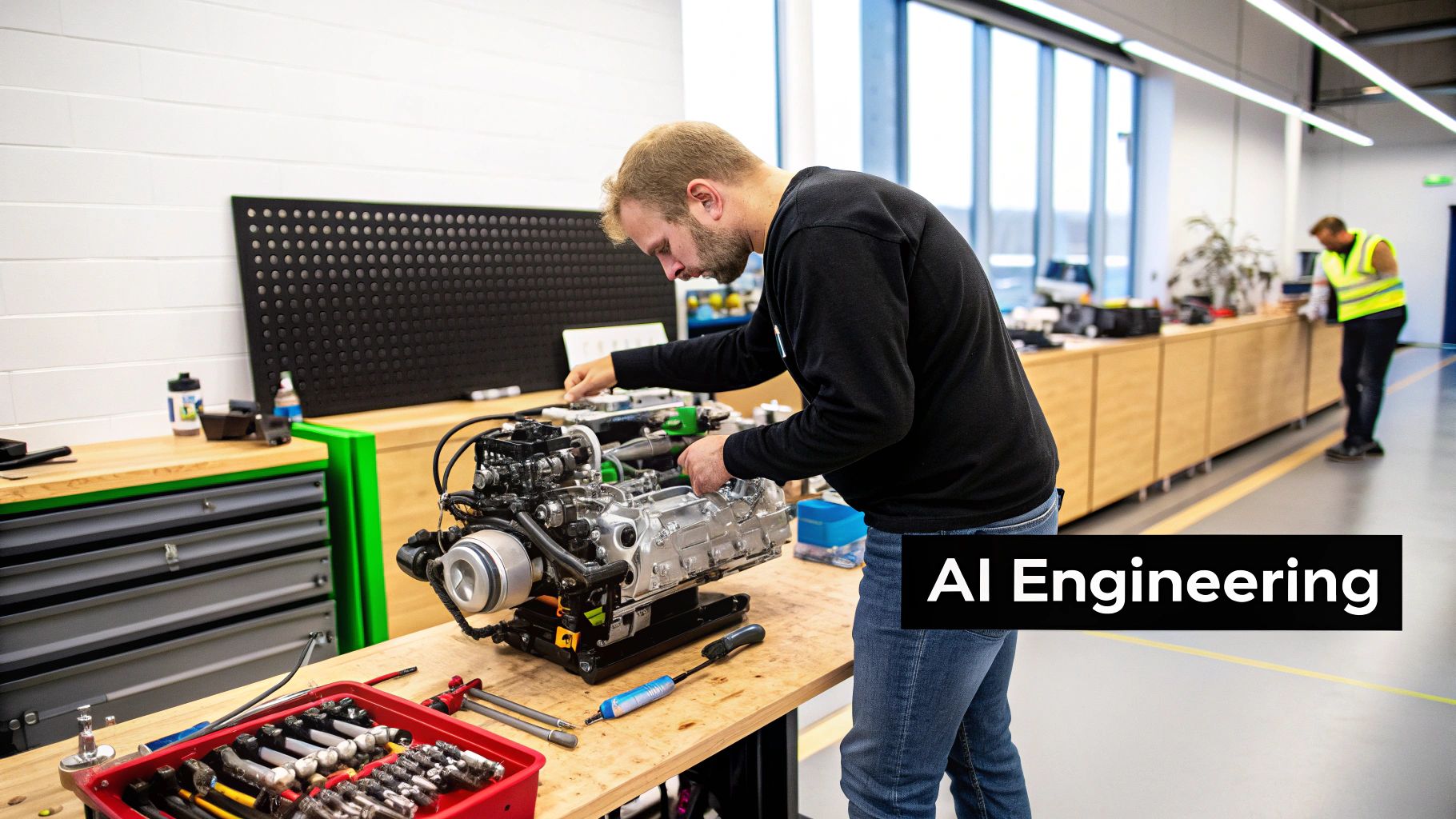
AI engineering services are that expert team. They’re the ones who build the entire race car around your engine, connecting it to your business systems, making sure it runs reliably at full throttle, and keeping it tuned for peak performance.
Beyond the Algorithm
Too many companies get fixated on the data science—just creating the algorithm. That’s a critical piece, but it’s only one part of the puzzle. The real business value is only unlocked when that algorithm is properly engineered to work inside your existing operations. You can get a sense of the different roles and applications by exploring the broad field of AI Engineering.
This distinction is what’s fueling massive market growth. The global AI engineering market is projected to hit USD 83.3 billion by 2034, showing just how vital these specialized services are for making AI work in the real world. This is part of a much bigger trend, with the total AI market expected to reach USD 371.71 billion this year.
AI engineering isn't just about making models work; it's about making them work reliably, securely, and at scale. It’s the disciplined practice of turning an AI prototype into an enterprise-grade solution that delivers consistent ROI.
The Core Components of Service
So what does this "pit crew" actually do? Expert AI engineering services focus on three core areas that turn experimental tech into real-world business tools:
AI Systems Engineering: This is the architecture. It’s about designing the infrastructure, setting up deployment pipelines, and ensuring the AI can handle real-world traffic and security threats without crumbling.
Data Preparation and Management: High-quality data is the fuel for any AI. This service covers the grunt work of cleaning, structuring, and governing data so your models produce accurate, unbiased results. No shortcuts here.
Managed Intelligence: An AI model isn’t a "set it and forget it" tool. Its performance can degrade over time. This ongoing support involves monitoring the model, retraining it with new data, and constantly optimizing its performance to guarantee long-term value.
Ultimately, these services are what separate a cool proof-of-concept from a production-ready system.
The Three Pillars of AI Engineering
If you think building successful AI is just about finding the right algorithm, you’re missing the bigger picture. A powerful model is just the engine. For that engine to actually move your business forward, it needs a chassis, a fuel system, and a dedicated crew to keep it running.
This is where true AI engineering services come in. It’s a practice built on three essential pillars that work together to turn a promising piece of code into a reliable business asset. These aren’t separate functions you can pick and choose from; they are deeply interconnected. Without all three working in sync, even the most brilliant model is destined to stall out.
Pillar One: AI Systems Engineering
The first pillar, AI Systems Engineering, is the architectural backbone. It answers the critical question: how do we plug this incredible algorithm into our real-world operations without everything breaking?
This is all about building a production-grade, battle-tested environment for your AI. It means designing infrastructure on platforms like AWS or Azure that can scale on demand. It's about creating secure APIs so your other applications can actually talk to the model. And it involves setting up automated deployment pipelines (MLOps) so you can update and manage the system without constant manual intervention.
Think about integrating a new fraud detection model into a live payment gateway. That’s a massive systems engineering challenge. The team has to guarantee the model can process millions of transactions in real-time with virtually zero latency, all while keeping sensitive financial data locked down tight.
Pillar Two: AI Data Preparation and Management
If systems engineering is the architecture, AI Data Preparation and Management is the foundation and the high-octane fuel. An AI model is a direct reflection of the data it’s trained on, and this pillar covers the unglamorous but absolutely essential work of getting that data right.
Frankly, this is where most of the hard work in any AI project happens. It involves pulling data from dozens of different sources, cleaning out all the errors and junk, and structuring it in a way the model can actually learn from. Some reports show that data scientists can spend up to 80% of their time just on this part.
A model trained on messy, incomplete, or biased data will produce messy, incomplete, and biased results. This pillar ensures the integrity of the AI's output by guaranteeing the quality of its input.
Imagine a retail company building a customer service chatbot. The data team would need to collect and sanitize years of customer chat logs. They’d have to scrub all personally identifiable information to comply with GDPR and then organize the conversations so the bot can learn to respond like a human. Skip this step, and you get a chatbot that spouts nonsense.
Pillar Three: Managed Intelligence
The third and final pillar is Managed Intelligence. This is the ongoing, operational support that keeps the AI performing at its peak long after you’ve flipped the switch. An AI model isn’t a one-and-done piece of software; its performance naturally degrades over time as it runs into new data and changing business conditions.
This decay is called "model drift." Managed intelligence services are designed to fight it. Through continuous monitoring, periodic retraining with fresh data, and performance tuning, this team makes sure the model stays accurate, relevant, and keeps delivering a positive ROI.
A perfect example is predictive maintenance on a factory floor. An AI model is trained to predict when a machine will fail based on sensor data. But over time, new equipment gets installed and old parts are replaced, changing the data patterns entirely. The managed intelligence team is there to monitor the model's accuracy, retrain it with the new data, and ensure its predictions stay sharp, preventing millions in costly downtime.
These three pillars are the complete package for building AI that works.
We’ve created a quick-reference table below to break down how these core services translate into direct business results.
Core AI Engineering Services Explained
This table summarizes the three pillars, showing what each one does and the concrete value it brings to your business.
Service Pillar | Core Function | Key Business Value |
|---|---|---|
AI Systems Engineering | Building and maintaining the scalable, secure infrastructure for AI models. | Ensures reliability, high performance, and seamless integration with existing business systems. |
AI Data Preparation | Sourcing, cleaning, structuring, and managing the data used to train AI models. | Guarantees model accuracy and prevents biased or flawed outcomes by ensuring high-quality inputs. |
Managed Intelligence | Continuously monitoring, retraining, and optimizing AI models post-launch. | Combats performance degradation ("model drift") and maximizes the long-term ROI of AI investments. |
Mastering these three disciplines—Systems Engineering, Data Management, and Managed Intelligence—is non-negotiable for anyone serious about AI.
Building this kind of foundation requires a specialized and diverse skill set that very few companies have in-house. TekRecruiter bridges this gap by giving you access to the top 1% of engineers who are experts across all three pillars. Whether you need to augment your team, hire permanent talent, or add nearshore engineers, we recruit the expert team you need to turn your AI vision into reality.
Finding the Right Engagement Model
Once you get a handle on the three pillars of AI engineering, the next big question is how you bring that expertise into your organization. This isn’t just about filling a seat; it’s a strategic decision that hinges on your project goals, your timelines, and where you see your company in the long run.
Picking the right way to engage talent is just as crucial as picking the right tech stack. We're talking about surgically acquiring the exact skills you need, right when you need them. Let's break down the three models that smart tech leaders use to build their AI teams. Each one is built for a different business scenario.
Injecting Skills with Staff Augmentation
Think of Staff Augmentation as a precision strike. It’s your most flexible option for injecting a highly specialized skill set directly into your current team to crush a specific roadblock or light a fire under a project.
You’re not hiring a permanent employee. You're bringing in a top-tier expert for a set mission.
Say you're a startup racing to launch a product. You might need a senior machine learning engineer for six months to nail the core algorithm. Staff augmentation lets you tap into the top 1% of engineers immediately, skipping a painful and expensive hiring cycle. It's the perfect play for hitting aggressive deadlines or filling a temporary knowledge gap without bloating your permanent headcount.
Building Your Core with Direct Hire
When you're ready to build permanent, in-house AI muscle, Direct Hire is the only way to go. This is the classic approach: hiring a full-time, long-term employee who becomes part of your company's DNA. This model is all about cultivating deep, institutional knowledge and building a real AI culture from the ground up.
A large enterprise spinning up a new AI Center of Excellence would go the direct hire route. The goal isn't just to complete a project; it's to recruit a world-class team of data scientists and ML engineers who will drive the company’s AI strategy for years. It’s slower than augmentation, but it's the right move for those core, mission-critical roles that define your competitive edge.
This flowchart shows the essential components any AI team needs to master, no matter how you decide to build it.
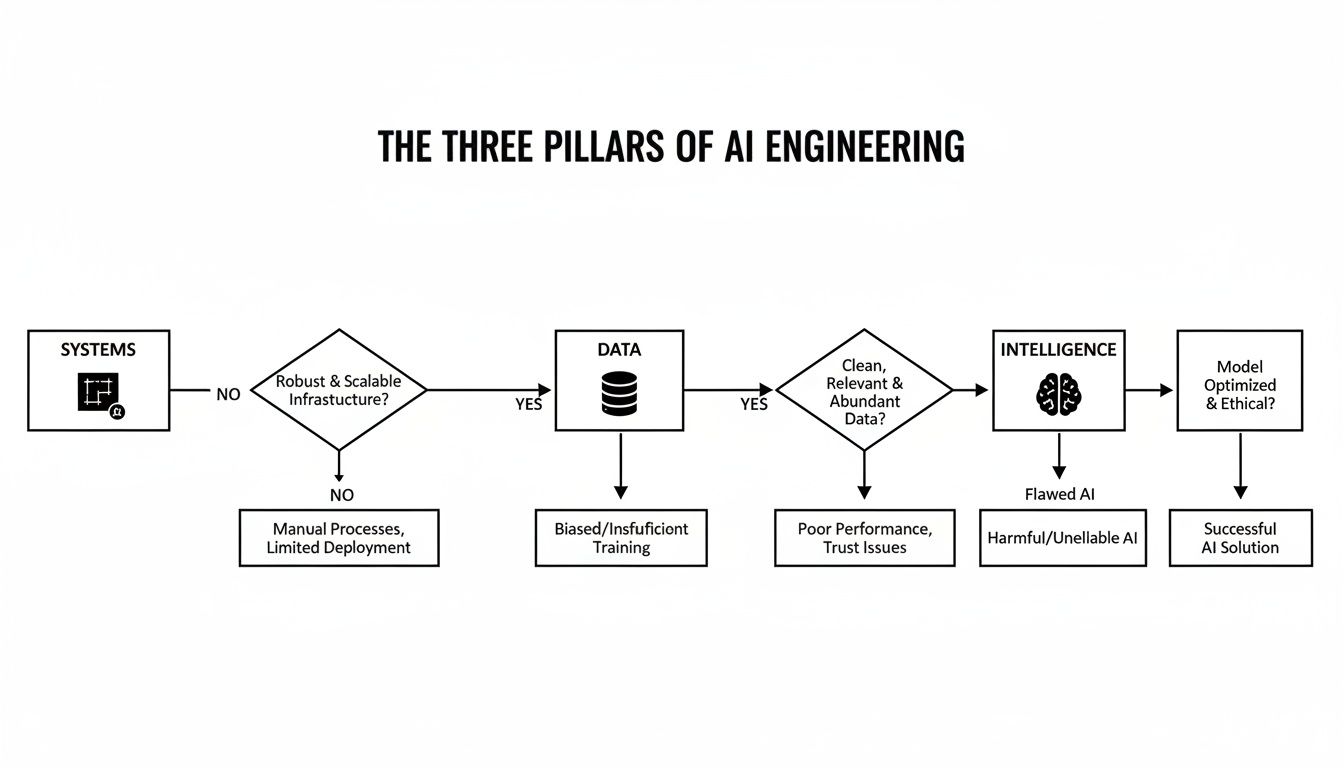
You can see how disciplined systems engineering, clean data, and ongoing intelligence are all locked together. Get one wrong, and the whole thing fails.
Gaining a Strategic Edge with Nearshore Delivery
Nearshore Delivery is a powerful hybrid, giving you access to global talent without the operational headaches. This model means partnering with a firm that provides a dedicated team of engineers from a nearby country, usually in Latin America. The payoff is massive: serious cost savings, great time-zone alignment, and a huge pool of elite engineers.
But here’s the critical part: the best nearshore models are run under expert U.S. project leadership. This guarantees communication is seamless and everyone is on the same page culturally. This isn't just outsourcing; it's a true strategic partnership.
With global enterprise AI spending hitting USD 500–600 billion in 2024, the market is shifting hard toward full-scale execution. You can read the full report on AI's enterprise alignment to see where this is headed. For businesses that need to scale their AI work efficiently, you can check out the benefits of building a team with our nearshore engineers.
TekRecruiter lives and breathes these choices. Whether you need to augment your team with a top 1% engineer, hire a permanent AI leader, or add nearshore engineers, we recruit the elite team you need to turn your AI vision into reality.
How to Evaluate an AI Engineering Partner
Picking the right partner for your AI engineering services is one of the most important calls you'll make. Get it right, and you’ve got a strategic ally who pushes projects forward and dodges risks. Get it wrong, and you’re looking at expensive delays, a mountain of technical debt, and a stalled AI roadmap.
This is about seeing past the slick sales pitch to find a team that genuinely gets your vision and has the raw talent to make it happen.

As a VP of Engineering or a development leader, your evaluation process has to be as tough as your own code reviews. It’s all about verifying claims, testing their real-world problem-solving, and making sure they’ll actually fit with your team’s culture and workflow.
Assess Their Talent Vetting Process
Any firm can say they have "elite engineers." The real question is, how do they prove it? A top-tier partner won’t just give you a vague answer; they’ll have a transparent, multi-layered vetting process that goes way beyond a simple coding quiz.
You need to get into the weeds of their methodology. Ask them to walk you through, step-by-step, how they source, screen, and select their people. If they can't, that's a huge red flag.
A partner’s value is a direct reflection of their talent's quality. If their vetting process is weak, the engineers they provide will be too. Demand concrete details on how they find and validate the "top 1%."
Look for specific, non-negotiable stages in their process:
Initial Technical Screening: Do they use automated tests or live coding challenges to set a baseline for raw skill?
Deep Technical Interview: Is there a panel interview with senior engineers who can really dig into deep architectural knowledge?
Problem-Solving Assessment: How do they test a candidate's ability to handle ambiguous, messy, real-world problems?
Soft Skills and Communication: What’s their method for making sure their engineers can communicate clearly and work well with your team?
Verify Technical Certifications and Partnerships
Certifications aren't just for show. They're proof of a validated level of expertise and a formal relationship with the big tech players. A partner with certified expertise across key platforms like AWS, Azure, and Google Cloud Platform (GCP) is bringing a proven, recognized skill set to your project.
These partnerships also show that the provider is serious about staying current with best practices and has a direct line to platform support when things go wrong. This is especially critical for complex AI systems engineering that leans heavily on cloud infrastructure. Don’t just take their word for it—ask to see proof of their partnership status.
Scrutinize Their Project Management Methodologies
When you’re working with nearshore or remote teams, project management and communication aren't just nice-to-haves; they're everything. A partner has to have a battle-tested methodology for making sure their engineers and your in-house devs operate as one seamless unit.
Ask them to describe their approach. Do they run Agile, Scrum, or some kind of hybrid? How do they manage daily stand-ups, sprint planning, and retrospectives when teams are in different time zones? A partner who can't clearly explain a structured process for nearshore collaboration is setting you up for friction and failure.
Provider Evaluation Checklist
To help you cut through the noise, here's a practical checklist. Use these questions to get straight to the heart of a potential partner's true capabilities.
Evaluation Criteria | Key Questions to Ask | Why It Matters |
|---|---|---|
Talent Quality | "Walk me through your vetting process, from sourcing to final placement. How do you validate the 'top 1%' claim?" | Reveals the true quality of their engineering talent. A vague answer means they don't have a rigorous process. |
Technical Expertise | "Can you show me proof of your certifications with AWS, Azure, or GCP? What's your partnership level?" | Confirms they have validated, up-to-date skills and access to crucial platform resources. |
Operational Readiness | "Describe your protocol for handling a critical model performance drift issue post-deployment." | Tests their understanding of managed intelligence and their ability to provide long-term operational support, not just build-and-run. |
Collaboration & Culture | "How do you ensure seamless integration between your nearshore team and our developers, both culturally and technically?" | Probes their experience with cross-border collaboration and their plan for creating a single, cohesive team. |
Problem-Solving Ability | "Give me an example of a project where you had to pivot your technical approach due to unforeseen data quality issues." | Assesses their real-world adaptability and proves they can handle the inevitable curveballs of an AI project. |
Project Management | "What is your specific methodology for managing remote/nearshore teams? How do you handle time zone differences for stand-ups and planning?" | Determines if they have a structured, proven process for remote collaboration or if they're just winging it. |
This framework isn't just about ticking boxes. It's about finding a partner who not only provides exceptional talent but also aligns with your operational and strategic goals.
If you would rather not run this evaluation across a dozen firms yourself, we find and vet the best AI engineering company for the build, and you contract with that company directly. See how MSP & Outsourcing Search works.
Seeing AI Engineering in Action
Theory is one thing, but the real value of professional AI engineering services clicks when you see the results firsthand. Let’s move past the "how" and look at the "what"—how expert engineers turn messy business problems into real financial gains. These illustrative scenarios show the kind of direct ROI that comes from deploying the right talent.
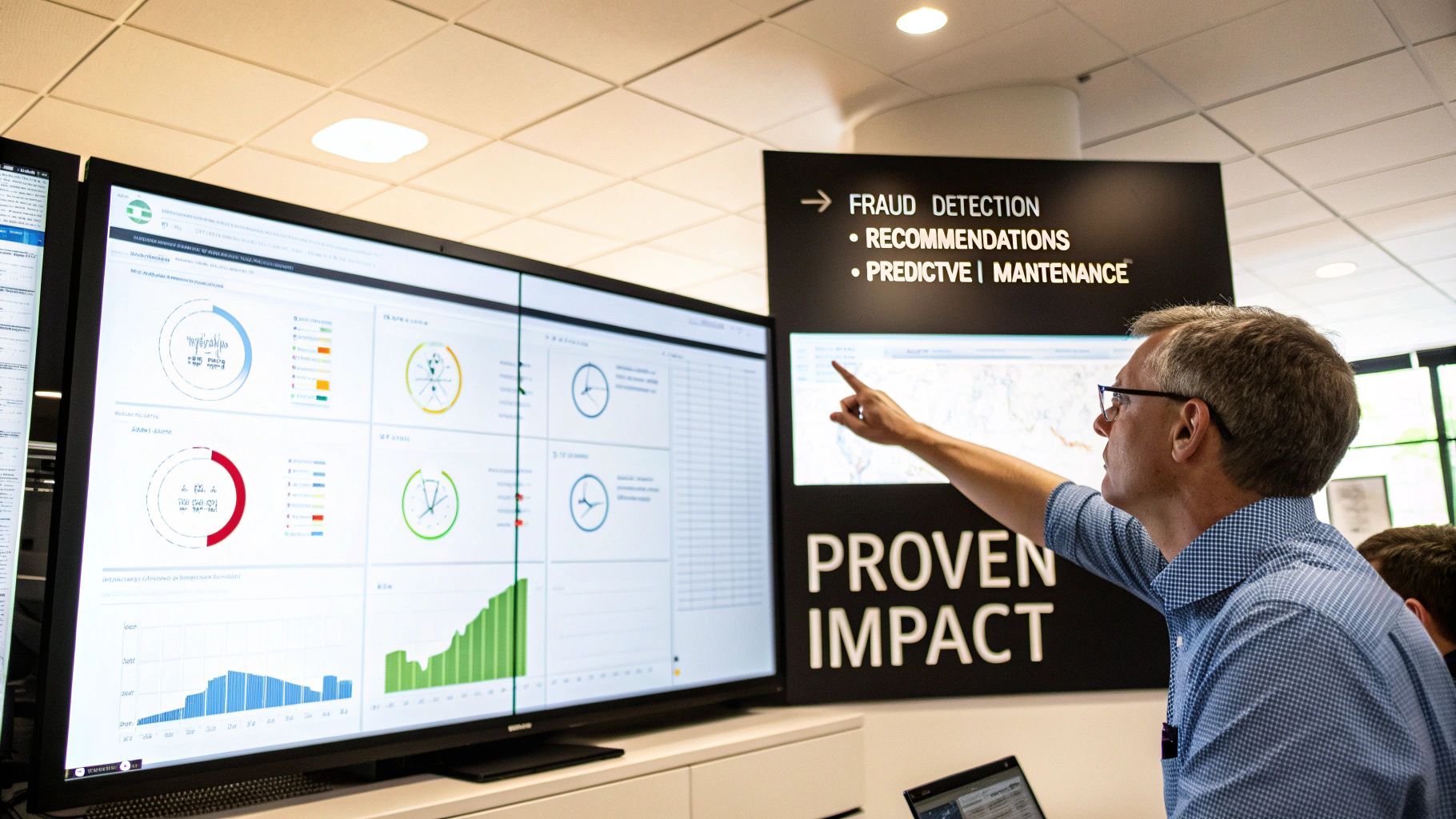
Fintech Fraud Detection
Picture a fintech startup growing so fast its fraud detection system can't keep up. Their old rules-based engine was flagging way too many legitimate transactions. Good customers were getting frustrated, and the manual review team was drowning. The problem was obvious: they needed a smarter system that could actually scale.
Using a staff augmentation model, they brought in a senior ML engineer who lived and breathed financial systems. This expert didn't just tweak the old system; they built and deployed a new, self-learning fraud detection model from the ground up.
The results hit hard and fast:
A 40% drop in false positives, which immediately smoothed out the customer experience.
A massive reduction in manual review work, freeing up the ops team to hunt down actual threats.
Higher transaction throughput, letting the platform grow without compromising security.
E-commerce Personalization
Now think about an e-commerce giant getting squeezed by competitors. Their generic product recommendations just weren’t landing, and it showed in their stagnant sales and low average order value (AOV). They had to get personal—and fast—to predict what shoppers wanted and encourage bigger buys.
They spun up a nearshore delivery team to build and manage a sophisticated recommendation engine running on deep learning. The nearshore model gave them a full squad of data engineers and AI specialists with the exact skills they needed, without breaking the bank.
This was never about just showing "related products." The goal was to build a system that understands user behavior in real-time, creating a unique one-to-one shopping journey for every single customer.
The outcome was a huge win for their bottom line: a 15% lift in average order value. It’s proof that targeted AI engineering can turn a standard e-commerce site into a revenue-driving machine.
Manufacturing Predictive Maintenance
Finally, imagine a major manufacturing firm constantly blindsided by equipment failures. Every time a machine went down unexpectedly, production schedules went out the window and profits took a hit. They had to stop reacting to problems and start predicting them.
The company opted for a managed intelligence service to build and run a predictive maintenance system. This solution tapped into IoT sensor data, training models to forecast exactly when a piece of equipment was about to fail. The "managed" part was critical; an external team continuously monitored model performance and retrained it on the fly. This hands-off approach let the firm get all the benefits of AI without building an in-house team from scratch.
The result? A 30% reduction in machine downtime, saving the company millions in lost productivity and repair costs.
The demand for this level of expertise is exploding. Generative AI spending alone is projected to hit USD 37 billion in 2025—a colossal jump from the year before—with applications in coding and healthcare leading the charge. You can discover more about the state of generative AI in the enterprise to get a sense of just how big this shift is.
These stories aren't just feel-good anecdotes. They prove that AI engineering isn't some abstract cost center—it's the most direct path to solving your toughest business challenges. At TekRecruiter, we connect companies with the top 1% of engineers who build these exact kinds of solutions.
AI Engineering FAQs
When you start digging into specialized AI engineering, a lot of practical questions pop up. Getting straight answers is key to making the right call. Here are some of the most common things we hear from tech leaders weighing their options.
AI Engineering vs. Data Science
One of the biggest points of confusion is the difference between a data scientist and an AI engineer. It trips up a lot of people, but the distinction is pretty simple.
Think of it this way: a data scientist is the brilliant specialist who builds and trains the AI model. They create the powerful engine. But an engine on its own doesn't get you very far.
AI engineering services are the team that builds the entire high-performance vehicle around that engine. They're the ones handling the infrastructure, security, data pipelines, and ongoing monitoring needed to make that model work reliably in the real world. They turn a theoretical concept into a practical asset that actually generates value.
Onboarding Speed for Staff Augmentation
"How fast can we get an engineer working with our team?" This question gets right to the heart of why staff augmentation is so powerful. Traditional hiring can be a months-long slog, but a modern approach flips the script.
Through IT staff augmentation, consultants can start in as little as 3 days, with no minimum term. That kind of speed is a massive competitive advantage. It lets you jump on development opportunities, hit critical market windows, and move faster than competitors who are stuck in endless hiring cycles. You can learn more about the philosophy that drives this speed by reading about our company.
The ability to deploy elite talent in days, not months, is a significant strategic advantage. It transforms your team's capacity to execute on key initiatives almost immediately.
Ensuring Nearshore Team Quality
It's natural to have concerns about nearshore teams. "How can we be sure a team in another country will deliver top-quality work and fit in with our culture?" It’s a question of trust and process.
Our vetting process is the answer, and it goes way beyond a simple coding test. We look at the whole picture to make sure we find a perfect match for your organization’s workflow and goals.
Advanced Problem-Solving Skills: We throw complex, real-world challenges at them, not just textbook problems. Can they think on their feet?
Clear Communication Abilities: We screen for excellent communication. They need to be able to explain technical concepts clearly and collaborate seamlessly with U.S.-based teams.
Cultural Adaptability: We look for engineers who can jump right into your company culture and development style without missing a beat.
On top of that, we recruit nearshore engineers who work in your time zone, so the team stays aligned with your objectives. For other common questions about AI solutions, you might find some useful perspectives on ekipa's AI FAQ page.
 Ron SmithPresident & Lead RecruiterTekRecruiter