_edited.png)
Outsourcing Custom Software Development A CTO's Practical Guide
So, you’re thinking about outsourcing custom software development. It’s a smart move. You bring in a specialized team to design, build, and run the software that powers your business. This frees you up to focus on your core operations instead of getting bogged down by the overhead of hiring an in-house engineering team.
It’s all about finding the right partner to turn your vision into a real, scalable product.
Setting the Stage for Outsourcing Success
Here’s where a lot of companies get it wrong: they jump straight into vendor searches and RFPs without a clear internal game plan. I’ve seen it happen time and again. The most successful outsourcing partnerships don’t start with sales calls. They start with a rock-solid foundation built inside your own organization. For any CTO or engineering leader, this prep work is non-negotiable.
This isn’t about just slapping together a feature list. It's about a serious needs analysis—what's an absolute must-have for the business versus what’s just a "nice-to-have"? Getting this crystal clear from the get-go is the best way to prevent scope creep and make sure every dollar you spend is driving real impact. Your goal isn't just to hire coders; it's to find a true strategic partner.
Defining Your Project's True North
Before you can even think about evaluating a partner, you have to know what a "win" looks like for your project. This means getting super specific with your goals—making them measurable and tying them directly to bigger business objectives. Vague goals like "improve the user experience" are basically useless. They give no one anything to aim for.
Instead, get granular. Your goals should sound more like this:
Reduce customer support tickets related to software bugs by 30% within six months after launch.
Slash user onboarding time from 15 minutes down to under 5 by completely redesigning the setup flow.
Boost mobile conversion rates by 15% by building a native app with a dead-simple checkout process.
Targets like these give your team and your future partner a clear, shared benchmark for success. There’s no ambiguity.
Articulating the Technical Roadmap and Budget
Once your goals are locked in, it’s time to talk tech. A well-documented technical roadmap is your project's blueprint. It ensures any potential partner understands the scope and complexity right out of the gate. For a deeper dive, you can read our detailed breakdown on everything you need to know before outsourcing software projects.
A huge part of this initial stage is committing to solid architectural principles. For instance, frameworks like Robert Martin Clean Architecture are great for ensuring the software you build is maintainable and flexible for the long haul. Doing this groundwork now prevents incredibly expensive and painful refactoring projects later.
A project without a realistic budget is just a wish list. Define your financial constraints early to filter out vendors that are not a good fit and to frame conversations around what is achievable within your budget.
This level of preparation lets you have real, grounded conversations about the trade-offs between cost, timeline, and features. It’s a pragmatic approach that sets realistic expectations for everyone involved from day one.
The numbers back this up. The global software development outsourcing market is expected to hit $618.38 billion in 2026, a big leap from $564.22 billion in 2025. This isn’t just about saving money anymore; leaders are outsourcing to tap into specialized skills and drive real innovation.
Achieving Internal Alignment
This last piece is probably the most overlooked. You absolutely have to get buy-in across your entire organization. Product, finance, and leadership all need to be on the same page with the outsourcing strategy.
Put together a clear business case that spells out the expected ROI, timelines, and strategic wins. When everyone understands why you're making this move, you create a supportive environment where your external partner can actually deliver their best work.
Navigating all these moving parts requires a partner who gets it. At TekRecruiter, we specialize in helping innovative companies deploy the top 1% of engineers anywhere, turning what could be a simple outsourcing decision into a powerful competitive advantage.
Choosing the Right Outsourcing Model for Your Team
Picking the right outsourcing model is one of the most critical calls you’ll make. This isn't just about finding the cheapest option; it’s about finding a partner whose entire way of working clicks with your own team's rhythm, communication style, and long-term goals. Get this wrong, and you're looking at friction, missed deadlines, and a final product that doesn't hit the mark.
Think of it like choosing a vehicle. You wouldn't buy a two-seater sports car to haul a family of five around, just like you wouldn't use a massive SUV for a tight city commute. The perfect outsourcing setup for a nimble startup is going to look completely different from what a massive, process-driven enterprise needs.
This decision tree can help you start connecting the dots between your needs, goals, and budget to find the right path forward.
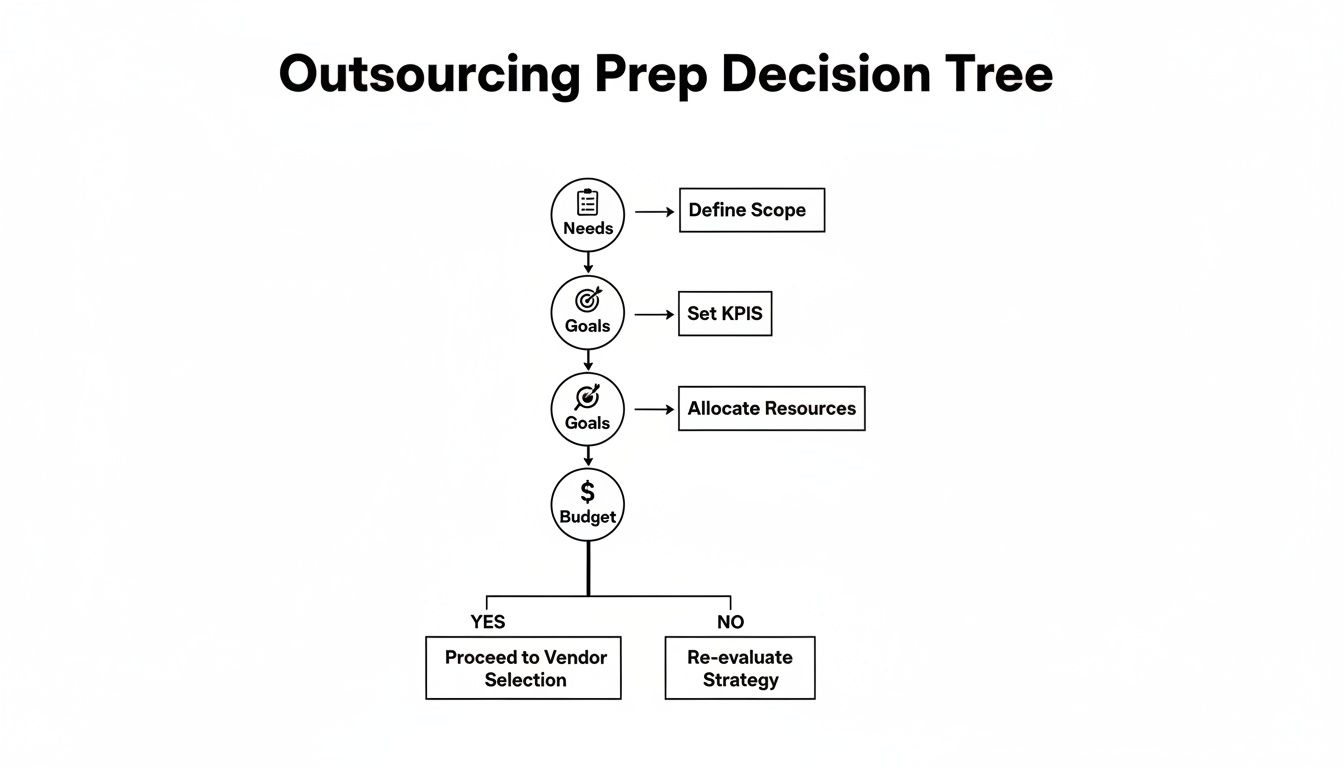
As you can see, a clear-eyed assessment of what you really need internally is the bedrock of any successful outsourcing strategy.
Location, Location, Location: Onshore vs. Nearshore vs. Offshore
Your first big decision point is geography. Each option comes with its own unique blend of trade-offs across cost, collaboration, and cultural alignment.
Onshore: Your partner is in the same country. This gives you maximum time zone overlap and zero cultural friction, making real-time collaboration feel effortless. The downside? It’s easily the most expensive route, with costs that often rival hiring in-house.
Nearshore: The partner is in a neighboring country, usually in a very similar time zone (think U.S. companies partnering with firms in Latin America). Nearshoring strikes a fantastic balance, offering serious cost savings while maintaining strong cultural similarities and minimal time zone headaches.
Offshore: The partner is halfway across the world, perhaps in Eastern Europe or Asia. This model delivers the biggest cost savings by a wide margin, but it demands rock-solid project management to navigate the huge time zone gaps and potential cultural differences.
The brutal reality of the global talent shortage makes this decision even more pointed. A jaw-dropping 74% of employers worldwide report they can't find the software developers they need, and that trend isn't expected to let up through 2026. This skills gap is exactly why so many companies are now looking to nearshore partners in places like Latin America.
Defining the Engagement Structure
Once you’ve settled on a geography, you need to decide how you’ll actually work together. This is less about where your team is and more about who holds the reins.
The table below breaks down the most common engagement models to help you figure out which one aligns best with your needs for control, scale, and cost.
Engagement Model Decision Matrix
Model | Best For | Level of Control | Scalability | Typical Use Case |
|---|---|---|---|---|
Project-Based | Clearly defined, one-off projects with a fixed scope. | Low. You define the "what," they handle the "how." | Low. Scaling requires a new contract/project. | Building a simple marketing website or a standalone mobile app. |
Managed Team | Long-term initiatives where you need a partner to own an entire function. | Medium. You set strategic goals, they manage execution. | Medium. Can scale the team, but it's a planned effort. | Outsourcing the development and maintenance of an entire product line. |
Staff Augmentation | Filling specific skill gaps and scaling your existing team quickly. | High. New hires report directly to your managers. | High. Easily add or remove engineers as needed. | Adding 3 senior backend engineers to accelerate a key feature launch. |
Let's unpack what these feel like in practice.
Project-Based Model This is the classic "black box" approach. You hand over a detailed spec for a project, agree on a fixed price, and the vendor delivers the finished product. It's great for projects where the scope is set in stone and you don’t expect any surprises.
The big risk here is rigidity. Software requirements always evolve. If you're locked into a fixed-price contract, every little change turns into a painful cycle of change orders and renegotiations, quickly eating up any initial savings.
Managed Team With this model, the vendor provides a dedicated, self-contained team—complete with its own project manager—to run a specific product or business function. You're not in the weeds of daily stand-ups; you're managing the relationship at a strategic level and focusing on the outcomes. It’s a solid choice for big, long-term initiatives where you need a partner to take complete ownership.
Staff Augmentation In staff augmentation, you’re essentially extending your own team. You get to hand-pick individual engineers from a partner, and they integrate directly into your existing squads, reporting to your managers and adopting your culture. For a deeper dive, you can explore our guide comparing staff augmentation vs outsourcing in more detail.
This model gives you maximum control and flexibility. You can ramp your team up or down on a dime to hit deadlines, fill niche skill gaps, and accelerate development without ever losing direct oversight. It’s the go-to for companies that have a strong internal engineering culture but just need more firepower.
Choosing the right model is a strategic move, not just a logistical one. At TekRecruiter, we specialize in building elite, borderless engineering teams that are matched to your specific technical and cultural needs. We connect you with the top 1% of global talent through flexible models like staff augmentation, making sure you get the exact skills you need, integrated exactly the way you want.
How to Vet Partners and Craft an Effective RFP
Let’s be honest: finding the right outsourcing partner is more like a strategic courtship than a simple procurement process. The slickest marketing presentations and most polished sales decks mean nothing if the team behind them can't deliver clean, scalable code that actually moves your business forward. This is where your vetting process becomes your most powerful tool.
You need to look past the surface to see a firm’s true technical depth, understand their preferred development methodologies, and get a feel for their communication style. The goal isn’t just to find a vendor with the right skills, but a partner who slots seamlessly into your company culture and workflow.

Looking Beyond the Portfolio
Every outsourcing firm is going to show you a portfolio of their greatest hits. While these case studies are a good starting point, they rarely tell the whole story. Your job is to dig deeper and ask the questions that reveal their real-world capabilities.
Start by asking for references—and not just the ones they hand you on a silver platter. Ask to speak with a recent client whose project was similar in scope and complexity to yours. Better yet, ask for a reference from a client whose project hit a few bumps. How a team navigates adversity is often far more telling than how they handle a perfect project.
Here are a few questions I always ask when checking references:
How did the team handle unexpected changes or scope creep?
What was their communication like during critical moments or roadblocks?
Were you satisfied with the quality of the code and the final product?
Would you hire this team again for another mission-critical project?
The answers will give you a much clearer picture of what it's truly like to work with them day in and day out.
Crafting an RFP That Gets Results
A well-crafted Request for Proposal (RFP) is your secret weapon for cutting through the noise. It forces potential partners to give you specific, comparable answers, which makes your evaluation process far more objective. Forget vague, open-ended questions and focus on specifics that reveal how they think and operate.
Your RFP shouldn't just be a feature checklist. It should be a document that tests a vendor's problem-solving skills, technical expertise, and understanding of your business context. The quality of their responses will tell you everything you need to know.
A strong RFP should demand absolute clarity on several key areas:
Team Composition: Who exactly will be working on your project? Request anonymous resumes or detailed skill profiles for the proposed team members.
Technical Approach: Ask them to outline their proposed tech stack and architecture. More importantly, ask them why they chose those specific technologies for your project.
Security Practices: How do they handle data security, code access, and your intellectual property? Do they have key certifications like SOC 2 or a deep understanding of GDPR?
Development Methodology: Do they actually practice Agile, Scrum, or something else? Ask for a sample project plan or sprint structure to see it in action.
Pricing Structure: Request a detailed breakdown of costs. This should include hourly or daily rates for different roles, management fees, and any other potential expenses.
By making your RFP this detailed, you’ll quickly filter out the firms that aren't serious and get high-quality, actionable proposals from those that are.
The Technical Interview Is Non-Negotiable
Never, ever hire a partner without directly interviewing the key technical talent they plan to assign to your project. This is your one chance to assess the actual skills of the senior developer, tech lead, or architect who will be making critical decisions.
This interview shouldn't be a generic Q&A session. Give them a real, albeit small, problem to solve. It could be a short coding challenge or a system design question directly related to your project. You're not looking for a perfect answer on the spot; you're evaluating their thought process, how they communicate their ideas, and how they approach solving a problem under a bit of pressure. For more insights on this, you might find our guide on how to outsource web development effectively helpful.
This step ensures there’s no gap between the "A-team" they sold you on and the team that actually shows up to work on day one. Think of it as the final, critical check to validate that their technical talent truly matches your needs.
Finding and vetting the perfect team for outsourcing custom software development is a complex puzzle. At TekRecruiter, we simplify it. Our rigorous vetting process ensures you only connect with the top 1% of global engineers, matched to your specific technical needs and company culture. We handle the heavy lifting of sourcing and validation, so you can focus on building your next great product.
Getting the Paperwork Right: How to Structure Contracts That Actually Protect You
Once you’ve found the right partner and are ready to get started, the legal paperwork you put in place becomes the single most important factor for success. A solid contract isn't just a formality—it's the blueprint for the entire relationship. It’s what stops misunderstandings before they start, protects your most valuable assets, and makes sure everyone is on the same page.
You'll mainly be dealing with two documents: the Master Service Agreement (MSA) and the Statement of Work (SOW). The MSA is the high-level rulebook for your relationship. The SOW gets into the nitty-gritty of each specific project. Getting both of these right is non-negotiable.
Who Owns the Code? Nail Down Your IP Clause
Let's cut right to the chase: your intellectual property (IP) is everything. Depending on where your vendor is located, the default ownership of the code they write can get murky. You absolutely cannot afford any gray areas here.
Your contract must state, in plain English, that your company owns 100% of the custom code and any related IP the moment it’s created.
This is often handled through a "Work for Hire" clause. It needs to be crystal clear that everything the team produces—source code, documentation, designs, you name it—is your exclusive property as soon as you've paid for it. A big part of this is making sure your legal team understands the fundamentals of intellectual property protection so your clauses are rock-solid and enforceable.
Don't forget to cover these points, too:
Pre-existing IP: Your vendor needs to declare any code, libraries, or tools they’re bringing to the table. The contract should give your company a permanent, royalty-free license to use their pre-existing IP within the final product.
Third-Party Components: If the team plans to use open-source or third-party code, they must list it out and confirm the licenses won't create a conflict for your commercial product. The last thing you want is a licensing issue blowing up your launch plans.
Confidentiality and Data Security Are Not Optional
Your development partner is going to have the keys to the kingdom—your source code, customer data, future roadmaps. A basic Non-Disclosure Agreement (NDA) is just the starting point. The MSA needs to lay out very specific rules for data security.
These rules should dictate exactly how your data is handled, stored, and accessed. Get specific. Demand things like encryption, strict access controls, and proof of regular security audits. If you're in a regulated field like healthcare or finance, the contract must require compliance with standards like HIPAA or GDPR.
A security breach can be an extinction-level event for a project, costing you far more than you ever planned to spend. Your contract must have teeth, with clear financial penalties if the vendor is responsible for a breach.
Defining "Done": SLAs, KPIs, and Acceptance Criteria
How do you know if you're getting what you paid for? Your SOW needs to move past vague promises and establish hard, measurable metrics. This is where you define what success actually looks like.
Service Level Agreements (SLAs): These are promises about performance. For example, an SLA might guarantee 99.9% uptime for a production server they manage or set a 4-hour response time for critical bug fixes.
Key Performance Indicators (KPIs): These track the team's effectiveness. Think code quality metrics (like bug density), sprint velocity, and whether they’re hitting deadlines.
Acceptance Criteria: This is where you define what "done" truly means for every feature. It’s not just "it works." It’s a checklist: passed all unit tests, meets performance benchmarks, signed off by your product owner. Clear criteria prevent those endless back-and-forth arguments over whether the work is actually finished.
Putting together a bulletproof contract takes work, but it's the best investment you can make in a healthy outsourcing partnership. It turns a simple vendor relationship into a real alliance built on clarity, trust, and mutual understanding.
Navigating these legal and operational details is where having a seasoned partner changes the game. At TekRecruiter, we connect innovative companies with the top 1% of global engineers. Our entire model is built on transparent, protective contracts designed to secure your IP and set your projects up for success from day one.
Making Remote Development Teams Actually Work
You’ve signed the contract. The ink is dry. Now the real work begins.
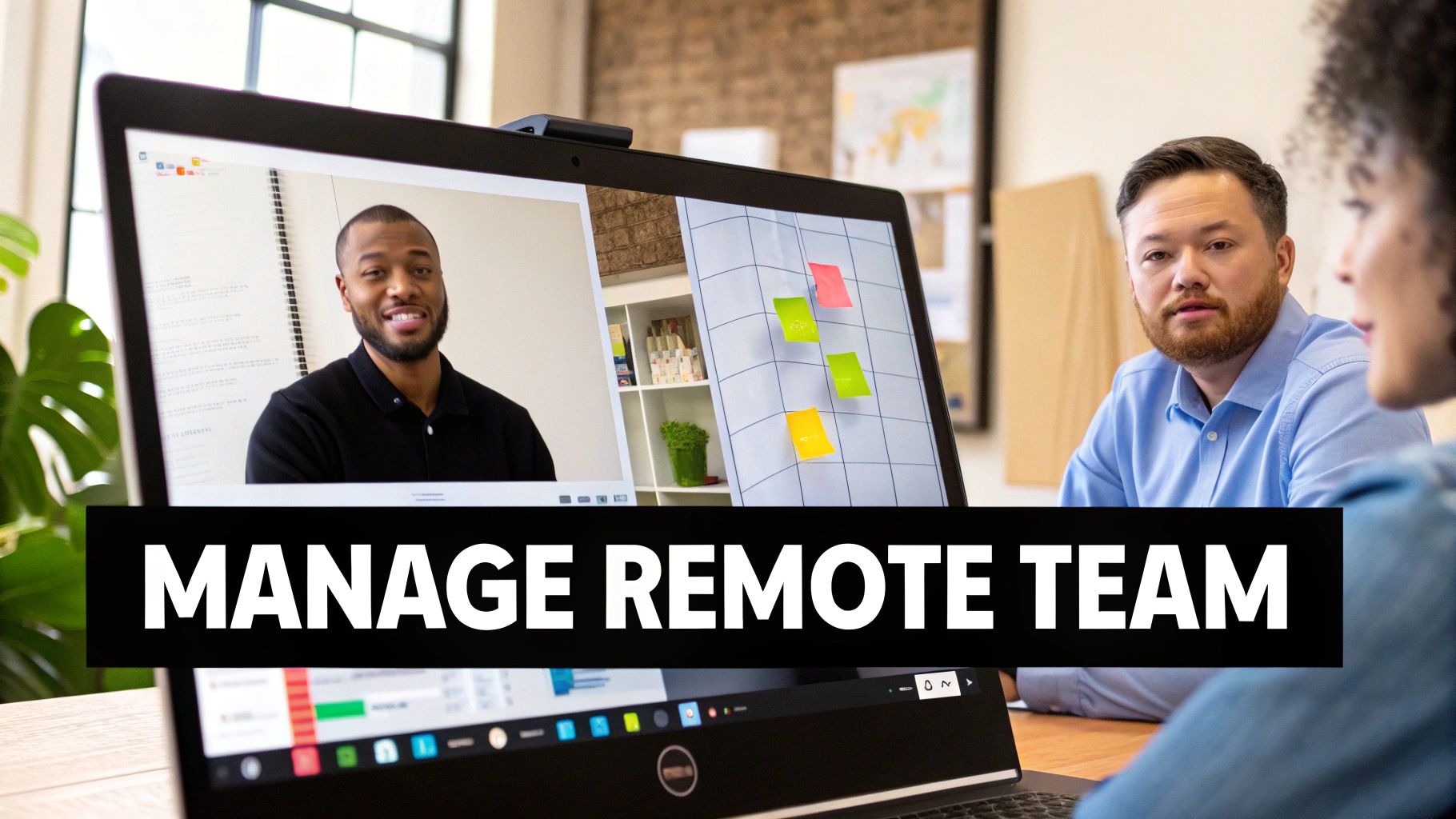
Success in outsourcing isn't just about finding talent; it's about making that talent part of your team. This is where most outsourcing relationships live or die—in the day-to-day grind of managing a distributed team. It takes real, deliberate effort to shrink the distance, sync up your workflows, and build a culture that isn't divided by an ocean.
Your goal is to get past the "vendor" mindset. You don't want hired guns counting hours. You want partners who are genuinely invested in seeing the project succeed. That means you need to set the operational rhythm from day one.
Lock in Your Communication Cadence
In any remote setup, good communication is everything. It's the glue. Without a consistent, structured cadence, crucial details fall through the cracks, and alignment crumbles fast. Consistency is the name of the game.
Your communication framework needs a few non-negotiable ceremonies:
Daily Stand-ups: Keep them short and to the point. Even with a massive time zone gap, you have to find that small window of overlap for a real-time check-in. It's non-negotiable.
Sprint Planning: This has to be a collaborative session where your in-house and outsourced folks agree on the sprint's scope together. It kills ambiguity and ensures everyone’s pulling in the same direction.
Retrospectives: After every sprint, hold a blameless retro. This is your team's safe space to talk about what worked, what was a mess, and how to fix the process for next time.
These meetings create a predictable rhythm that builds trust and keeps the whole machine running smoothly. For a deeper dive, check out our guide on creating a modern playbook for managing distributed teams.
Standardize Your Tools and Workflows
Managing a scattered team is impossible without a centralized toolkit. You need a single source of truth for every single thing related to the project. This is where you have to get disciplined about standardizing your CI/CD (Continuous Integration/Continuous Deployment) pipelines, code repos, and project management tools.
Getting everyone on the same page with tools like Jira, GitHub, and Slack means everyone operates from the same playbook. It makes progress visible to anyone who needs to see it, which is the bedrock of accountability. A solid CI/CD pipeline, for example, automates your builds and tests, catching bugs early and keeping code quality high no matter where a developer is physically located.
Fostering a real team culture is just as critical as the tech stack. Small things, like a "watercooler" channel in Slack for non-work chat or celebrating wins publicly, go a long way in making outsourced developers feel like they belong. That feeling builds ownership.
Track What Matters: KPIs That Drive Performance
Those KPIs and SLAs you put in the contract? They aren't just for the lawyers. They are your dashboard for managing this entire engagement. Tracking them religiously is how you keep the project on schedule, on budget, and up to your quality standards.
Focus on the metrics that give you a clear, honest picture of both productivity and quality.
Here are the essential metrics we track to monitor the performance, quality, and efficiency of our custom software development partners.
Key KPIs for Outsourced Development Teams
KPI Category | Metric | What It Measures | Target/Benchmark |
|---|---|---|---|
Productivity | Sprint Velocity | The amount of work a team gets done in a single sprint. | A stable or gradually increasing trend. |
Quality | Code Churn | How often code is rewritten, refactored, or deleted after being committed. | Low churn suggests the code was well-planned from the start. |
Quality | Bug Escape Rate | The percentage of bugs discovered in production versus during QA. | Aim for < 5% of bugs being found by actual users. |
Timeliness | Cycle Time | The total time from when work starts on a task to when it’s completed. | Shorter cycle times point to a more efficient workflow. |
Bringing these numbers into your sprint retrospectives turns subjective arguments into data-driven conversations. It lets you pinpoint bottlenecks and solve real problems before they have a chance to derail the whole project.
Managing a remote team is a learned skill, but the right partner changes everything. TekRecruiter doesn't just find you developers; we deploy the top 1% of global engineers and provide the U.S.-based project management needed for seamless integration. We help you build an elite, borderless team that delivers from day one.
Common Questions About Outsourcing Software Development
Let's cut to the chase. When you're thinking about outsourcing software development, a handful of questions always come up. Leaders I talk to are wrestling with the same concerns, so let's tackle them head-on. Getting these answers right can be the difference between a successful partnership and a project that goes off the rails.
What Is the Biggest Mistake in Outsourcing?
Easy. The single biggest mistake is viewing outsourcing as just a line item on a budget—a race to the bottom on cost. When companies pick the cheapest vendor without doing the hard work of vetting their technical chops, communication style, and cultural alignment, they almost always pay for it later in delays and shoddy code.
A successful engagement isn't a transaction; it's a strategic partnership. It means investing real time to find a team that gets your long-term vision and then integrating them so deeply into your workflow that they feel like an extension of your own team.
The best outsourcing relationships don't feel like a client-vendor dynamic at all. They feel like you’ve just onboarded a new, highly effective squad that’s fully embedded. That level of integration is what separates the struggling projects from the wildly successful ones.
How Do I Protect My IP and Data?
This starts with a rock-solid legal framework. You need an ironclad Non-Disclosure Agreement (NDA) and a Master Service Agreement (MSA) that leaves no room for interpretation: your company owns 100% of the code and all intellectual property generated. Period.
But legal documents are just the starting point. You have to dig into your partner's security posture.
Audit their security practices: Ask them point-blank about network security, access controls, and if they're compliant with standards that matter to you, like SOC 2 or GDPR.
Enforce secure workflows: This is non-negotiable. Use secure code repositories and live by the principle of least privilege—people only get access to what they absolutely need to do their job.
Staff Augmentation Versus a Managed Team
Knowing the difference here is critical because they solve completely different problems.
With staff augmentation, you're essentially "renting" engineers from a vendor to plug directly into your existing team. You manage them day-to-day. It’s perfect when you have a specific skill gap to fill or need to ramp up headcount for a big push.
A managed team, on the other hand, is a self-contained unit. The vendor provides a dedicated team—often with its own project manager—to take a whole project off your plate. You manage the outcomes, not the nitty-gritty tasks.
Build Your Elite Engineering Team with TekRecruiter
Navigating the world of outsourcing custom software development is complex, but the right partner makes all the difference. Instead of just hiring a vendor, you need a strategic ally who can deliver a genuine engineering asset that drives your business forward.
At TekRecruiter, we are a technology staffing, recruiting, and AI Engineer firm that allows innovative companies to deploy the top 1% of engineers anywhere. Our entire model is designed to eliminate the friction of traditional outsourcing by connecting you with elite global talent that integrates seamlessly into your team. We don't just fill seats; we build the high-performing, borderless teams that become your competitive edge.
Ready to stop searching and start building?
Comments