A Practical Guide to Technology Staffing Services
Discover how technology staffing services can accelerate your projects. Learn to choose the right model, vet partners, and scale your engineering team.
Think you’re building a Formula 1 car. You wouldn’t hire a full-time transmission expert if you only need them for a single, critical phase of development. You’d bring in the best specialist for that specific job, get it done, and move on.
That’s the core of modern technology staffing services.
What Are Technology Staffing Services?
Forget the old idea of “temps” filling empty seats. This is a strategic play to get specialized talent exactly when and where you need it. It’s about building a flexible, high-performance extension of your existing team on demand.
Instead of getting bogged down in traditional hiring cycles that can take months and stall your roadmap, you partner with a firm that gives you immediate access to a curated pool of vetted professionals.
A Strategic Extension Of Your Team
This model lets you scale your team up or down based on project demands, giving you a level of agility that’s impossible with a fixed workforce.
Here’s where it really makes a difference:
Access to Specialized Skills: Instantly tap into a global network of experts in hyper-specific fields like AI model training, cloud infrastructure, or cybersecurity. No training required.
Accelerated Project Timelines: Fill skill gaps in days, not months. This prevents bottlenecks and keeps your development sprints moving at the speed you need.
Reduced Hiring Overhead: The staffing partner handles all the sourcing, screening, and initial vetting. That saves your internal teams hundreds of hours they can spend on what matters.
Technology staffing isn't about temporary help. It's about strategic resource allocation. It gives you the power to build a dynamic, high-impact team ready for any technical challenge—without the fixed costs of a massive permanent workforce.
The market growth tells the story. The IT staffing market hit USD 240.77 billion in 2024 and is on track to reach a staggering USD 431.27 billion by 2035. That’s not a trend; it's a fundamental shift in how modern companies build. You can dig into the IT staffing market trends data to see just how big this is getting.
By ditching the old hiring model, you can innovate faster and build a real competitive edge. The ability to deploy the right expert for the right task is how you build a resilient, future-proof engineering organization.
Ready to build your high-performance team on demand? TekRecruiter connects innovative companies with the top 1% of engineers anywhere, providing the specialized talent you need to accelerate your most critical projects.
Choosing Your Staffing Engagement Model
Once you've decided you need outside help, the next big question is how you bring that talent on board. This isn't a one-size-fits-all situation. The right engagement model depends entirely on your project's scope, your timeline, and where your company is headed long-term.
Think of it like choosing the right tool for a job—picking the wrong one will cost you time, money, and control. Some models give you temporary, specialized backup for your existing crew. Others are designed to find permanent team members who will grow with you. Getting this choice right is the first step to building a flexible, high-powered team.
To make it simple, this flowchart breaks down the basic decision path based on how long you need the help.
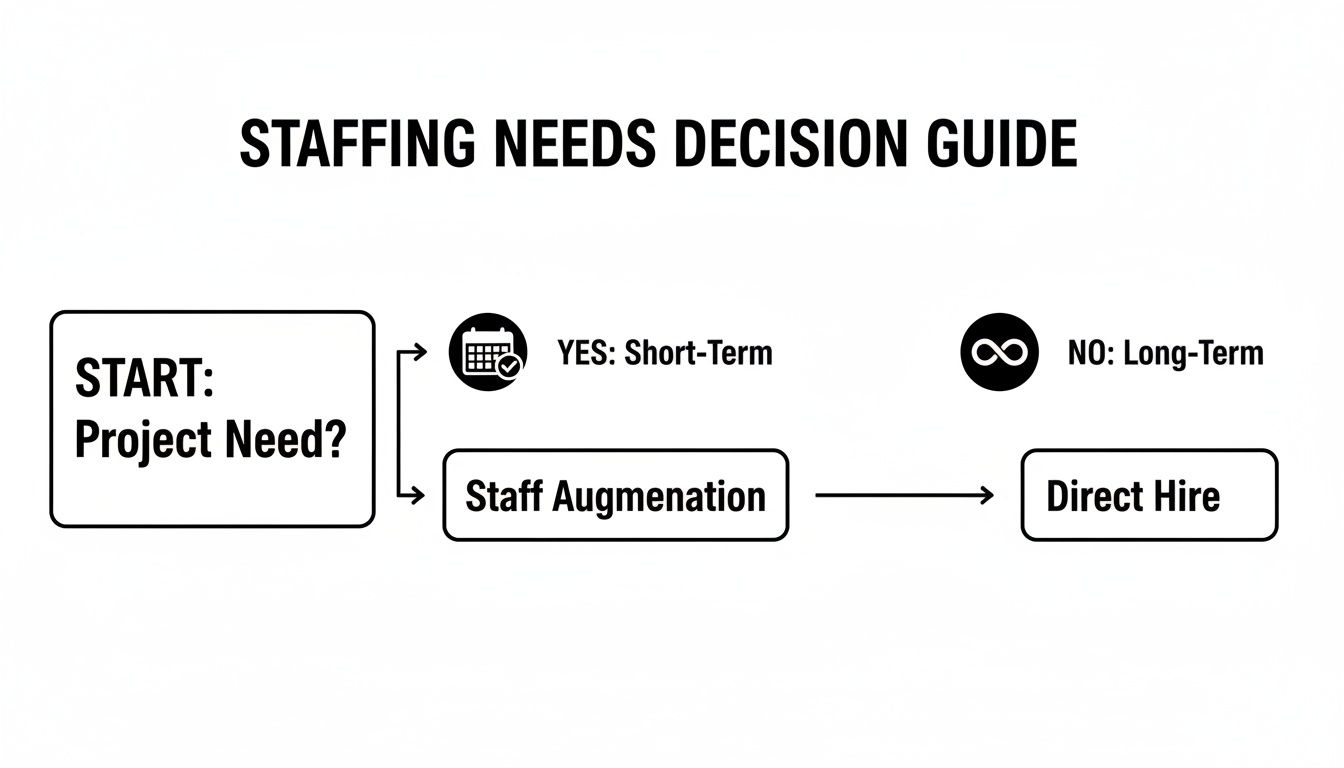
As you can see, the core question—short-term project vs. long-term need—is the best place to start.
H3: Staff Augmentation For Targeted Expertise
Think of staff augmentation as bringing in a specialist surgeon for a complex operation. You don’t put them on the payroll forever; you bring them in for their specific, high-level skills to solve an immediate problem. This is your go-to model for filling a temporary skills gap, hitting a tight deadline, or getting access to niche expertise you just don't have in-house.
With staff aug, the engineer slots directly into your team. They report to your managers and follow your internal processes, giving you full control over their daily work. It’s perfect for situations like:
Short-term projects: You need a cloud security expert for a three-month audit.
Skill gaps: Your team crushes backend development but needs a frontend wizard for a new UI.
Sudden workload spikes: A major client just dropped a ton of new feature requests, and you need to scale up now.
H3: Direct Hire For Long-Term Growth
On the flip side, direct hire is like finding a permanent co-pilot for your company. The goal isn't just to fill a temporary gap—it's to find a core team member who will shape your culture, drive your vision, and stick around for the long haul.
Here, a staffing partner acts as your dedicated recruitment engine. They do the heavy lifting of sourcing, vetting, and presenting only the best-fit candidates for you to interview. This is the right move when you're building out your core team and investing in talent that will grow with the business, especially for leadership roles or positions that require deep institutional knowledge.
H3: AI Engineering Outsourcing For End-to-End Solutions
Sometimes you don't just need another person—you need a whole solution built from scratch. AI engineering outsourcing is like commissioning an expert firm to design and build a custom engine for your car. Instead of adding a person to your team, you delegate an entire project to an external team of specialists.
This model is ideal when you lack the internal expertise or infrastructure to tackle something complex, like developing a custom machine learning model. You define the "what," and the partner delivers the final, working product. For a deeper dive, check out our guide on staff augmentation vs outsourcing. If the work belongs with an outside team, we can find you the best AI engineering company for the build. See how MSP & Outsourcing Search works.
The global talent acquisition and staffing technology market is expanding rapidly, valued at USD 169 billion in 2025 and projected to hit USD 308.4 billion by 2035. This growth highlights the shift toward strategic talent models that drive efficiency and innovation.
H3: Nearshore Delivery For Balanced Collaboration
Nearshore delivery strikes a strategic balance, giving you access to a global talent pool without the headaches of wildly different time zones. This model involves partnering with talent in nearby countries, like a U.S. company working with engineers in Latin America.
You get the cost benefits and talent access of a global workforce, but collaboration stays seamless. This makes it a great fit for roles that require frequent, real-time communication with your core team.
Comparing Technology Staffing Engagement Models
To help you visualize the trade-offs, here’s a side-by-side comparison of the four main engagement models. Use this to map your specific needs to the right solution.
Model | Best For | Control Level | Cost Structure | Time to Productivity |
|---|---|---|---|---|
Staff Augmentation | Short-term projects, filling skill gaps, meeting tight deadlines. | High | Hourly/Daily Rate | Very Fast (days) |
Direct Hire | Building core teams, long-term roles, leadership positions. | Full | One-time fee (% of salary) | Slower (weeks/months) |
AI Outsourcing | Complex, specialized projects where you lack internal expertise. | Low (outcome-focused) | Project-based or Retainer | Varies by project scope |
Nearshore Delivery | Long-term team extensions requiring real-time collaboration. | High | Monthly Rate per resource | Fast (weeks) |
Each of these models has its place. The key is to be honest about what you're trying to achieve—whether that's plugging a temporary hole, building a foundational team, offloading a complex project, or finding that perfect balance of cost and collaboration.
Understanding these options puts you in the driver's seat. Whether you need a temporary expert, a permanent leader, or a dedicated project team, picking the right engagement model is your first real step toward success.
How to Select the Right Technology Staffing Partner
Picking a technology staffing partner is a lot more than a simple procurement decision. It’s a strategic move that can literally make or break your projects.
The wrong partner will flood your inbox with a firehose of mismatched resumes, burning your team’s valuable time. The right one? They act like a true extension of your company. They get your technical needs and your cultural DNA, delivering talent that slots in and starts contributing from day one.
Finding that kind of strategic partner means looking way past a slick sales deck or a rock-bottom hourly rate. You have to dig into their process, the real quality of their network, and whether they genuinely understand the tech world you live in. A great staffing partner doesn't just fill seats—they elevate your entire engineering organization.

This is all about separating the resume mills from the true talent advisors. To pull that off, you need to ask the right questions and, just as importantly, know what a great answer actually sounds like.
Go Beyond Keyword Matching
The single biggest differentiator is the technical vetting process. It’s that simple. Too many agencies just have recruiters matching keywords on a resume to your job description. This is a recipe for disaster. You end up with candidates who look perfect on paper but completely fall apart in a real-world technical interview.
A top-tier partner has a fundamentally different playbook.
Engineer-Led Vetting: Do they have actual senior engineers screening their candidates? A partner who uses seasoned technologists to run technical interviews can sniff out problem-solving skills, code quality, and system design thinking in a way a non-technical recruiter never could.
Practical Assessments: What does their screening actually involve? Look for partners who use live coding challenges, take-home projects, and system design deep-dives that mirror the real work your team does every day.
Niche Skill Verification: How do they prove someone is an expert in a specialized field like AI, cloud architecture, or cybersecurity? Ask for specific, detailed examples of how they’ve vetted candidates for similar roles in the past.
A partner who invests in a rigorous, engineer-led screening process is signaling a commitment to quality over quantity. They are filtering out the noise for you, making sure every single candidate you meet has already cleared a high technical bar.
Assess Their Talent Pool and Industry Focus
Let’s be clear: not all talent pools are created equal. A generalist firm might boast about a massive database, but a specialist partner will have a deep, curated network within your specific domain. That distinction is everything when you’re hunting for highly specialized or hard-to-find skills.
Here’s a quick checklist to gauge the depth and relevance of their network:
Niche Specialization: Do they have a proven track record in your sandbox, whether it’s FinTech, HealthTech, or enterprise SaaS? Don’t be shy—ask for case studies or references from companies that look like yours.
Access to Elite Talent: How do they find people beyond LinkedIn and the usual job boards? The best firms actively build communities and attract the top 1% of talent through referrals, reputation, and direct, personal outreach.
Proactive Sourcing: Are they constantly building their network, or do they only start scrambling when you send them a job order? A great partner anticipates your needs and already has a pipeline of qualified people ready to go. To really nail this, you should be up-to-speed on the current workforce planning best practices that top agencies use themselves.
Evaluate Cultural and Strategic Alignment
At the end of the day, the best partnerships are built on more than just technical chops. A candidate can have all the right skills but still fail to thrive if they don’t click with your team's communication style, work ethic, and values. A true strategic partner gets this and makes cultural fit a core part of their screening.
They should be asking you insightful questions about your team's culture, your project management style (Agile, Scrum, etc.), and the soft skills that really matter in your environment. This shows they see themselves as a long-term advisor, not just a transactional vendor. If you want a more detailed breakdown of what to look for, check out our guide on how to find the best IT staffing services for a more exhaustive checklist.
Finding the right technology staffing partner is about finding an ally who is as invested in your success as you are. By focusing on their vetting process, the quality of their network, and their strategic alignment, you can build a partnership that delivers exceptional talent and drives real results.
TekRecruiter specializes in connecting companies with the top 1% of vetted engineers for staff augmentation, direct hire, and contract-to-hire. Our conversation-based screening process ensures you only meet candidates who are ready to make an immediate impact.
Navigating Contracts and Uncovering Hidden Costs
Bringing on a technology staffing partner isn't just a talent decision—it's a major financial one. To build a partnership that actually works, you have to get granular on the contract structures and, more importantly, the hidden costs that almost always pop up. Without a clear financial picture from day one, you’re setting yourself up for budget overruns and mismatched expectations that can kill a project.
The initial price tag you see, whether it's an hourly rate or a one-time placement fee, is just the start. A solid, well-defined agreement protects everyone involved. A vague one is a recipe for expensive surprises down the road. Think of the contract as the blueprint for your financial relationship; the more detail and clarity you demand upfront, the less likely things are to crumble later.
Decoding Common Pricing Structures
Tech staffing services generally operate on a couple of core pricing models, each tied directly to the kind of help you need. The two you'll see most often are hourly rates for temporary talent and placement fees for permanent hires.
Hourly/Daily Rates (Staff Augmentation): This is as straightforward as it gets. You pay a pre-negotiated hourly or daily rate for a contract engineer. That rate is all-inclusive, meaning the staffing firm is on the hook for the engineer’s salary, benefits, taxes, and all the administrative headaches. It gives you maximum flexibility to scale your team up or down as your project demands shift.
Placement Fees (Direct Hire): When you're looking for a permanent addition to your team, the model flips. The staffing partner charges a one-time fee, which is almost always a percentage (20-30%) of the candidate's first-year salary. They only get paid if you actually hire a candidate they brought to you. It's a success-based model.
The money flowing into this space is massive and getting bigger. The global staffing market is on track to hit USD 650 billion in 2025, with the U.S. market alone projected to reach USD 198.17 billion. As more and more capital fuels these services, knowing how the money works isn't just smart—it's critical. You can get more details on global staffing market trends to see where things are headed.
Shining a Light on Hidden Costs
The biggest budget-killers are the costs that never show up on an invoice. These "hidden" expenses are easy to overlook, but they can quickly turn a supposedly cost-effective solution into a financial drain if you're not ready for them.
The sticker price is rarely the final price. A true cost analysis means looking past the hourly rate and accounting for the internal time and resources your own team will pour into making the engagement work.
Make sure you're factoring in these all-too-common costs:
Onboarding and Knowledge Transfer: Even a brilliant engineer needs time to get up to speed on your specific systems, codebase, and team dynamics. That ramp-up period, which could be days or even weeks, is a real productivity cost.
Administrative Overhead: Someone on your team has to manage the vendor relationship, process invoices, and provide regular feedback. That’s time your managers and admin staff aren't spending on their core jobs.
Tool and License Costs: Your new team members will need access to the same software, platforms, and dev environments as your full-time employees. Those licenses aren't free.
Turnover and Replacement: What happens if a contractor isn't the right fit? The time you spent finding, onboarding, and then replacing them is a huge, often unbudgeted, expense. To see just how painful this can be, check out our cost of employee turnover calculator and put real numbers to the problem.
By getting ahead of these costs, you can build a realistic budget and judge partners not just on their rates, but on their ability to minimize these downstream expenses through better vetting, support, and overall quality.
Ready to build a staffing partnership that’s both transparent and predictable? TekRecruiter is open about rates, with senior nearshore engineers at about $39 to $57 per hour all in, and connects you with the top 1% of engineers who start delivering value sooner.
Integrating and Retaining Top Technical Talent
Sourcing and hiring an elite engineer is just the opening move. The real strategic win comes from what happens next: seamlessly integrating them into your team and creating an environment where they want to stay and do their best work.
Without a deliberate plan, even the most skilled contractor can feel disconnected, which quickly leads to low engagement and high turnover.
The first few weeks are absolutely critical. A chaotic or isolating onboarding experience is a fast track to failure. Instead, a structured approach transforms a temporary arrangement into a high-impact collaboration from day one. True success in using technology staffing services depends on making every new engineer feel like an integral part of the mission.

A Structured 30-60-90 Day Plan
A well-defined onboarding plan isn’t just about ticking boxes; it’s about eliminating ambiguity and setting clear expectations. It gives new hires a roadmap to understand their role, their objectives, and how they can start adding value right away.
A solid plan should look something like this:
First 30 Days: This is all about immersion and learning. Get them system access, help with environment setup, and walk them through the codebase. Most importantly, introduce them to key team members and assign a dedicated mentor—a go-to person for all those small questions that can otherwise become big roadblocks.
Next 30 Days (60-Day Mark): Now, the focus shifts to contribution. The engineer should be taking on small- to medium-sized tasks, contributing to sprints, and becoming an active voice in team ceremonies like stand-ups and retrospectives.
Final 30 Days (90-Day Mark): The goal here is autonomy. By now, the engineer should be tackling more complex challenges with minimal hand-holding and showing a real grasp of your team's workflow and technical standards.
The goal of onboarding isn't just to grant system access. It's to build connection and psychological safety, empowering new talent to contribute their best work faster. A great plan accelerates time-to-productivity and lays the foundation for long-term success.
Fostering Long-Term Retention and Growth
Retention isn’t just for permanent employees. Keeping high-performing augmented staff engaged for the long haul requires a conscious effort to make them feel valued and woven into your company's culture.
This means treating them like part of the core team. It’s that simple. Recognize their wins in public forums, invite them to team-building events, and give them challenging work that aligns with their skills and career goals.
When engineers feel connected to the mission and see opportunities to grow, they are far more likely to stick around. For a deeper dive into retention, our guide offers practical ways on how to reduce employee turnover that tech leaders can implement immediately.
Great integration and retention also rely on solid systems for tracking and nurturing these professional relationships. Exploring different contact management software options can help streamline this entire process. Ultimately, a strong retention strategy ensures you get the maximum return on your staffing investment by turning temporary expertise into a sustained competitive advantage.
Ready to not only find but also retain the top 1% of engineering talent? TekRecruiter helps you build high-impact teams that are integrated for success from day one. We connect you with elite engineers who are ready to elevate your projects and become invaluable members of your team.
Measuring the True ROI of Your Staffing Strategy
How do you prove the value of your staffing investment to the C-suite? In a world driven by data, just saying you "saved time" or "filled a gap" won't cut it anymore. To justify continued investment in a flexible engineering team, you need to move beyond simple cost-per-hire metrics and show real, strategic value.
Proving the return on investment (ROI) for technology staffing services is all about connecting your spending to actual business outcomes. It’s showing how adding specialized talent directly impacts your ability to ship products faster, improve code quality, and drive innovation. This is how you shift the conversation from staffing as a cost center to staffing as a strategic growth engine.
Moving Beyond Basic Cost Metrics
Traditional metrics like cost-per-hire only tell a tiny fraction of the story. Sure, they're important for budgeting, but they completely miss the downstream value a high-quality engineer brings to the table. A truly effective measurement system has to focus on performance, speed, and contribution.
To get the full picture, you need to track more meaningful Key Performance Indicators (KPIs) that tie directly into your engineering and product goals. This is how you connect the dots between your staffing partner and your bottom line.
Key Metrics for a Modern Staffing Dashboard
A simple, focused dashboard is your best friend here. Instead of drowning stakeholders in dozens of data points, concentrate on a few high-impact metrics that clearly tell the story.
Here are three powerful KPIs to get you started:
Time to Productivity: This is arguably the most critical metric. It measures how quickly a new engineer starts contributing meaningful code to your repository. A shorter time to productivity means a faster return on your investment and less drain on your existing team for onboarding. A top-tier partner vets for this, delivering talent that can hit the ground running.
Project Velocity: Track your team's sprint completion rate or the story points they knock out before and after bringing on augmented staff. A noticeable jump in project velocity is a powerful sign that your staffing strategy is successfully accelerating your product roadmap and fighting off team burnout.
Innovation Contribution: This is a bit more qualitative, but it tracks the new ideas, process improvements, or architectural suggestions brought in by your augmented staff. You can measure this through peer feedback, manager reviews, or by tracking their contributions in brainstorming sessions. This KPI proves you're not just getting more hands on deck—you're getting new perspectives that push your technology forward.
Measuring ROI is all about quantifying impact. When you can show that a new engineer was contributing production-level code in their second week and helped increase sprint velocity by 15%, you're making an undeniable business case for strategic staffing.
A Simple Dashboard Framework
Putting this into practice doesn't have to be complicated. The goal is to create a dashboard that tells a clear, data-backed story about the value your staffing partners deliver.
Here’s a look at some of the most effective KPIs to track.
Key Metrics for Measuring Staffing ROI
A dashboard of key performance indicators to track the effectiveness and value of your technology staffing partnerships.
Metric | How to Measure | Why It Matters |
|---|---|---|
Time to Productivity | Days from start date to first merged pull request. | Directly shows how quickly new talent starts delivering value. |
Project Velocity | Change in sprint points completed per cycle. | Quantifies the impact on your team's overall output and speed. |
Innovation Contribution | Number of new processes or ideas adopted by the team. | Highlights the strategic value beyond just completing assigned tasks. |
By tracking these more advanced metrics, you build a clear narrative that proves the strategic worth of your technology staffing services. This empowers you to have smarter conversations with leadership, justify your budget, and build a truly high-performing, flexible engineering organization.
Ready to build a team that delivers measurable ROI? TekRecruiter connects you with the top 1% of engineers who are pre-vetted to deliver value from day one. Let us help you deploy elite talent that accelerates your roadmap and drives real, quantifiable results.
Ready to Build Your Elite Engineering Team?
Let's be honest: navigating the world of tech staffing is a minefield. But finding the right partner isn't just about filling a seat—it's about gaining a strategic advantage. At TekRecruiter, we're a technology staffing and recruiting firm built to connect you with the top 1% of engineers globally. We get that building the future requires truly elite talent, not just a bump in headcount.
Whether you need to accelerate a critical project right now or build out your core engineering team for the long haul, our entire model is designed for your success. We don't do one-size-fits-all.
Quality-Focused Staff Augmentation: Get highly skilled, deeply vetted engineers embedded directly into your teams. Fill immediate skill gaps and inject serious velocity into your projects.
Strategic Direct Hires: We'll help you land the long-term technical leaders and core contributors who will define your company's trajectory.
Flexible Nearshore Staffing: Tap into elite talent from Latin America. You get world-class expertise with the massive advantage of aligned work hours.
We do the heavy lifting—the intense sourcing, vetting, and qualifying of world-class engineers—so you don't have to. Our process lets you bypass the noise of the hiring market and get back to what you do best: building incredible things.
TekRecruiter clears the path to your dream team. We deliver the elite talent you need to crush your roadmap and launch your next breakthrough.
Ready to deploy the world's best engineers? Contact TekRecruiter today and let's talk about how our specialized technology staffing services can help you win.
Common Questions on Tech Staffing
Even with the best strategy, you're going to have questions. Everyone does. Whether you're a CTO, an engineering manager, or in HR, you need direct answers before you can move forward with confidence.
Let's cut through the noise and tackle the questions we hear most often.
How Fast Can I Get a New Engineer Onboard?
A traditional hiring process drags on for months. A specialized staffing partner moves at the speed of your project. The biggest difference is that we're not starting from scratch—we have a curated network of elite, pre-vetted engineers ready to go.
This means you’re seeing qualified candidates in days, not weeks.
While the exact timeline depends on how niche your requirements are, you can usually have a new engineer integrated and pushing code in a fraction of the time a full internal recruiting cycle takes.
What’s the Difference Between Onshore, Nearshore, and Offshore?
These terms are just shorthand for where your talent is located, and each has its own trade-offs for collaboration and cost. It’s pretty straightforward:
Onshore: The talent is in the same country as your business.
Nearshore: The talent is in a neighboring country, usually with a similar time zone (like a US company working with engineers in Latin America). This is perfect for real-time, seamless collaboration.
Offshore: The talent is in a country with a significant time zone difference. This is often a move to manage costs, especially for projects that don’t need constant, real-time overlap.
How Do I Know the Engineers from a Staffing Firm are Actually Good?
You start by picking a partner with a ridiculously tough, transparent vetting process. Don't be shy here. Ask them how they evaluate talent beyond a resume. Do they use live coding challenges? System design interviews? Do senior engineers—not recruiters—conduct the technical screens?
A quality-first firm is obsessed with sourcing from the top echelon of global talent. But it doesn't stop there. Great communication, crystal-clear project goals, and a structured onboarding process are just as critical for making sure every new hire meets your technical bar.
At TekRecruiter, a premier technology staffing and recruiting firm, we connect innovative companies with the top 1% of global engineers. Our vetting centers on deep technical conversations with every candidate, so you only meet people who can make an immediate impact. We help you deploy the world's best talent to build what's next. Discover how we find elite engineers at https://www.tekrecruiter.com.
 Ron SmithPresident & Lead RecruiterTekRecruiter