Finding the Right Software Development Team Structure
Discover the ideal software development team structure for your project. Compare agile squads, functional teams, and hybrid models to boost productivity.
A software development team structure isn't just a diagram on a whiteboard. It’s the blueprint that dictates how your engineers collaborate, who owns what, and ultimately, how fast you can ship valuable software. Think of it as the operating system for your engineering organization.
Getting it right is a massive force multiplier for innovation. Getting it wrong? That just creates friction, slows everyone down, and burns through your most valuable resource: your team's time and energy.
Your Blueprint for Engineering Success
Choosing a team structure is far more than just shuffling names on an org chart; it's about deliberately architecting an engine for execution. This single decision will fundamentally shape your team's velocity, the quality of their code, and their ability to tackle hairy, complex problems.
A smart structure aligns directly with your business goals. Are you a startup in a dead sprint to build an MVP and find product-market fit? Or are you a scaling enterprise trying to manage a mature, complex product? The right answer looks very different for each.
Before you even think about hiring, it’s worth digging into the fundamentals of organizational design. It gives you a solid framework for thinking about how roles, responsibilities, and information should flow. This guide will take you beyond the theory and give you a practical playbook for picking, building, and evolving the right model for your team.
Quick Comparison of Popular Team Structures
Before we dive deep, here’s a high-level look at the most common models. This table should give you a quick feel for the landscape and help you start thinking about which direction might be right for you.
Team Structure Model | Core Principle | Best For |
|---|---|---|
Functional | Grouping by skill (e.g., all backend engineers together). | Deepening technical expertise; smaller companies with a single product. |
Component | Teams own a specific part of the system (e.g., the API team). | Large, complex systems where clear boundaries are needed. |
Feature/Product | Cross-functional teams own a user-facing feature end-to-end. | Fast-paced product development; aligning teams with business value. |
Platform/Enablement | Teams build tools and services for other internal engineering teams. | Scaling organizations; reducing cognitive load on feature teams. |
Matrix | Engineers report to both a functional manager and a project manager. | Large enterprises needing to share specialized talent across projects. |
Each of these has its place, but the key is understanding the trade-offs. What you gain in one area, you often sacrifice in another.
Aligning Structure with Your Goals
The first question you have to answer is brutally simple: What are we trying to achieve right now?
Are you optimizing for raw speed and market validation? Or are you building for long-term stability and massive scale? Your answer changes everything.
This decision tree helps visualize how your core business goals should point you toward a specific team structure.
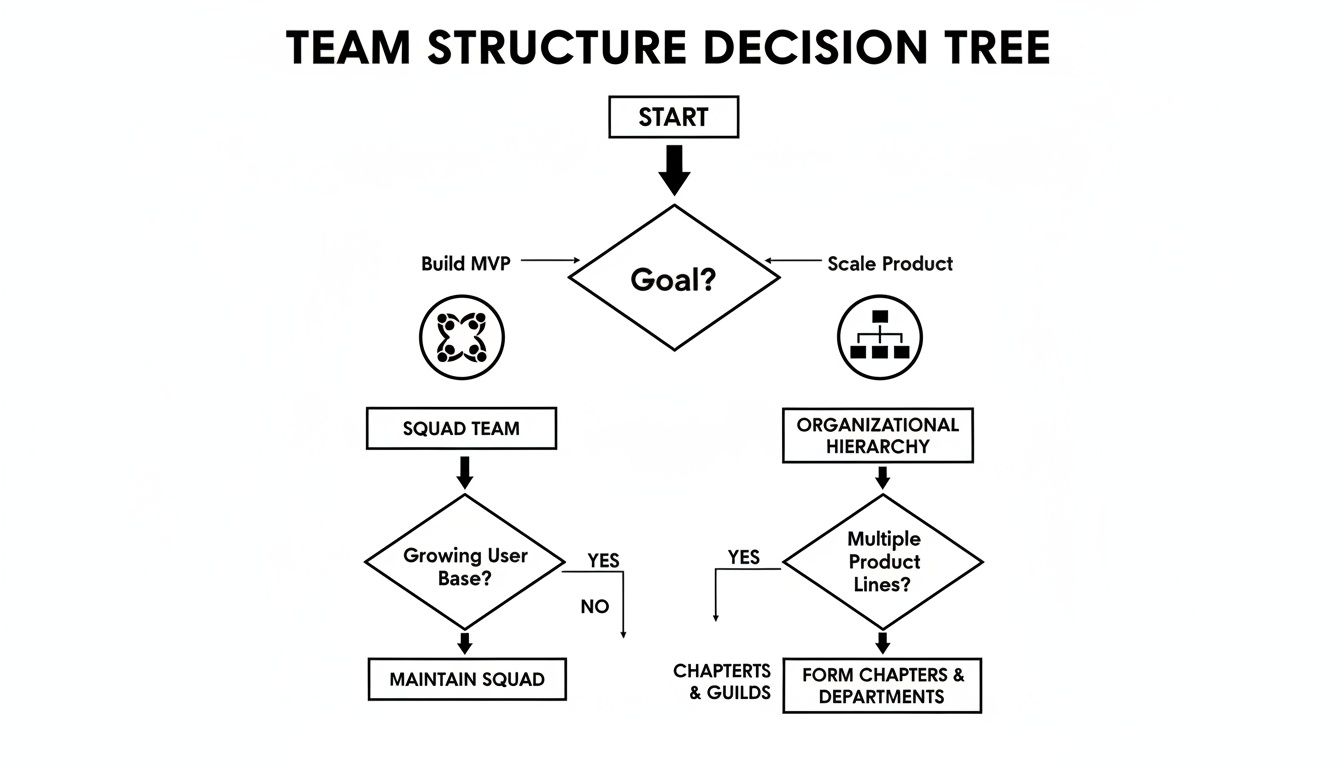
As you can see, the path to building something brand new almost always favors small, autonomous squads that can iterate and pivot in a heartbeat. On the other hand, scaling an existing product demands a more organized approach to manage the growing complexity and keep the quality bar high.
An effective team structure acts as a force multiplier. It empowers engineers by providing clarity and autonomy, removing roadblocks, and enabling them to focus on what they do best: building great software.
Ultimately, the goal is to create an environment where collaboration feels effortless and productivity soars. In the sections that follow, we'll break down the specific models—from traditional functional teams to agile pods—that will help you get there.
Of course, the perfect structure is useless without the right people. Building a high-performing engineering team is the real challenge, especially in today's market. Many leaders are looking at different technology workforce solutions to find the talent and flexibility they need to bring their blueprint to life.
Exploring Foundational Team Models
To build the future, you have to understand the past. The foundational software development team structures were the original blueprints for organizing engineering talent. While many teams have ditched them for more agile setups, these classic models still offer valuable lessons and can be surprisingly effective in the right context.

The most traditional of these is the Functional model. Think of it like a classic factory assembly line. All your frontend developers are in one group, all the backend engineers are in another, and the QA folks are in a third. Each department is a center of excellence for its specific discipline.
The Functional Assembly Line
In a Functional structure, work moves sequentially from one specialized group to the next. The project kicks off with the backend team building out the APIs. It's then handed off to the frontend team to build the UI, and finally, it lands with the QA team for testing before it ever sees the light of day.
This approach has some obvious upsides:
Deep Expertise: When you group specialists together, they get really, really good at what they do. Junior engineers learn directly from the senior experts in their field, which creates a fantastic mentorship pipeline.
Clear Career Paths: The ladder is easy to see. A junior backend developer knows exactly what they need to do to become a senior backend developer right within their own department.
Resource Efficiency: It’s a breeze for managers to shuffle specialists between projects based on who needs what. This prevents your best talent from getting stuck on a single, slow-moving initiative.
But here’s the catch: the model's greatest strength is also its most glaring weakness. The handoffs between departments are natural bottlenecks. If the frontend team is sitting around waiting for the backend team, progress grinds to a halt.
Communication turns into a painful game of telephone where requirements get twisted and lost in translation. This almost always breeds an "us vs. them" mentality between departments, which kills collaboration.
In a Functional model, teams optimize for technical excellence within their silo. The big risk is that they lose sight of the end-to-end customer experience, focusing only on their piece of the puzzle instead of the finished product.
The Matrix: A Hybrid Approach
To patch the communication holes in the Functional model, the Matrix structure was born. It tries to give you the best of both worlds by creating a dual-reporting system. An engineer reports to their functional manager (like the Head of Frontend) for skill development, reviews, and career growth.
At the same time, that very same engineer is assigned to a project team, where they report to a project manager for their day-to-day tasks. This creates a grid—or matrix—of reporting lines. The goal is to keep that deep functional expertise while forcing better collaboration across departments on specific projects. For a deeper dive, this guide on organizational structure models is a great resource.
It’s a good idea in theory, but the Matrix model often brings its own brand of chaos. Engineers suddenly find themselves serving two masters whose priorities are often in direct conflict. The functional manager wants them to pay down tech debt, but the project manager is pushing to hit a feature deadline. This can lead to a lot of confusion, divided loyalties, and a mountain of administrative overhead.
These foundational models absolutely laid the groundwork for how we organize engineers today. But the relentless need for faster delivery and tighter business alignment pushed the industry toward more agile, autonomous structures. Understanding the limitations of these old-school models is the first step toward building a modern, high-performing team that can actually ship product.
Of course, building the right team is about more than just org charts; it's about finding the right people who will thrive in your chosen structure. TekRecruiter's expertise in technology recruiting and staffing connects you with the top-tier talent you need to make any team model a success.
The Agile Shift to Squads and Pods
The old ways of building software—the rigid, sequential models—just weren't cutting it. They were too slow, too siloed, and too disconnected from what the business actually needed. This frustration created a huge demand for something better, faster, and more responsive. It sparked an agile revolution that completely reshaped the modern software development team structure, giving us the cross-functional team, better known today as a squad or pod.

Stop thinking of a dev team as a factory assembly line. A squad is more like a special ops team. It’s a small, self-sufficient unit packed with every skill needed to complete a mission from start to finish. This single team has its own frontend and backend developers, a QA engineer, a product manager, and a UI/UX designer, all working in lockstep.
Their mission isn't just to "code the backend" or "test the UI." It's to own an entire piece of customer value, like "overhaul the checkout flow" or "launch the new user dashboard." This is the heart of modern agile development: a fundamental shift from functional silos to mission-driven teams.
The Power of Autonomy and Ownership
The single biggest win from the squad model is the radical boost in autonomy and ownership. When one team has all the skills and authority to ship a feature, those painfully slow handoffs that cripple traditional teams just vanish.
Decisions get made fast, right inside the team, without waiting for approvals up the chain of command. This empowerment creates a real sense of ownership. The team isn't just building a component anymore; they're on the hook for the success of the feature in the hands of actual users.
This structure delivers some serious benefits:
Faster Delivery Cycles: With fewer dependencies and no more waiting on other departments, squads can iterate and ship features at a blistering pace.
Tighter Collaboration: When a designer, developer, and tester are in the same daily stand-up, communication is seamless. Problems get solved in minutes, not days.
Higher Quality: The team owns quality from end to end. QA stops being a final gate and becomes an integral part of the process from day one.
The industry has taken notice. The move to cross-functional teams marks a massive evolution, with around 50% of developers now working in small teams of 2 to 7 people. This setup fuels agility and ownership, and in agile circles, the sweet spot for a squad is typically 5–9 members. It makes sense, especially when you see that 65% of developers prioritize work-life balance—these focused teams cut down on the friction and delays caused by constant handoffs. For a deeper dive, you can explore the full software development statistics.
Scaling Agility with Tribes and Guilds
But what happens when your company grows and you have dozens of squads? How do you keep everyone aligned without slipping back into rigid, top-down management? This is where the patterns made famous by Spotify—often called the "Spotify Model"—offer a brilliant blueprint for scaling your software development team structure.
In this model, you group multiple squads working on a related mission (like "Music Discovery") into a larger unit called a Tribe. Think of the Tribe as a mini-startup within the company, with a clear purpose and the autonomy to achieve it.
A Tribe provides the strategic context and alignment for its squads, ensuring that while each team is autonomous, they are all rowing in the same direction toward a larger business goal.
To stop the old functional silos from creeping back in, the model adds two other crucial concepts:
Chapters: These are like home bases for specialists within a Tribe. For instance, all the backend engineers in the Music Discovery Tribe belong to the Backend Chapter. The Chapter Lead is their line manager, responsible for mentorship, career growth, and keeping the technical bar high for that discipline.
Guilds: These are lightweight, company-wide communities of interest. Anyone passionate about a topic—like "API Design" or "Web Performance"—can join a guild to share knowledge, hash out best practices, and collaborate across different Tribes.
This layered structure strikes a brilliant balance between autonomy and alignment. Squads get the freedom to execute, Chapters guarantee technical excellence, and Guilds build a culture of continuous learning across the entire organization. It's a powerful playbook for any growing company that wants to stay fast and empower its engineers as it scales.
Of course, building and staffing these high-performing squads with the right mix of talent is a specialized skill. At TekRecruiter, we help innovative companies deploy the top 1% of engineers anywhere, providing the elite talent needed to make agile structures like squads and pods a resounding success.
Defining Key Roles for Peak Performance
An org chart gives you the skeleton of a team, but it’s the people and their roles that bring it to life. A group of talented individuals only becomes a high-performing unit when everyone understands exactly what they own and how their piece fits into the bigger picture. Vague job titles just don’t cut it.

Clarity starts with a simple distinction: the "what" versus the "how."
The Product Owner (or Product Manager) is the champion of the "what." They are the voice of the customer, the person responsible for the product vision, backlog, and prioritizing features that actually move the needle for the business.
On the other side, the Tech Lead owns the "how." This isn't necessarily a management role; they are the go-to technical expert who guides architectural decisions, ensures code quality, and mentors other engineers. They make sure the team builds a solution that’s not just functional, but robust and scalable.
Engineering Levels and Team Balance
Beyond the leadership roles, the mix of your engineering talent is a massive factor in your team's success. The ratio of senior, mid-level, and junior developers directly impacts everything from mentorship and knowledge sharing to raw velocity. Get this balance wrong, and you’re setting yourself up for bottlenecks and burnout.
Senior Developers: These are your seasoned experts. They tackle the gnarliest problems, elevate the team's technical standards, and act as force multipliers by mentoring others.
Mid-Level Developers: The core of most teams. These engineers are proficient, can work independently on defined tasks, and are the engine driving most of the day-to-day coding.
Junior Developers: Eager and ready to learn, they handle smaller, supervised tasks. They are absolutely vital for building a sustainable talent pipeline but require significant investment from your senior staff.
A common guideline is the 30/50/20 split: 30% senior, 50% mid-level, and 20% junior developers. This isn't just a random ratio. Top tech organizations have found it boosts sprint completion rates by 42%, especially in distributed teams. Research also shows that teams following this structure achieve 35% better code quality and 45% higher deployment success rates. With 78% of software teams now working remotely, ignoring this balance is a recipe for inefficiency.
Critical Supporting Roles
A great software team is much more than just developers and a PO. You need a handful of critical supporting roles that act as the connective tissue, ensuring the entire process runs smoothly and the quality bar stays high.
A great software team is a symphony of specialized skills. Supporting roles like QA and DevOps aren't just add-ons; they are the conductors ensuring every part works in harmony to deliver a flawless performance.
Here are the key players who make it all happen:
Scrum Master: In an agile world, the Scrum Master is the ultimate facilitator. They aren't the boss; they're a servant leader who removes roadblocks, shields the team from distractions, and makes sure the agile process is actually working.
QA Engineer: Quality Assurance isn't about finding bugs at the end—it's about preventing them from the start. A great QA Engineer is involved early, helping define acceptance criteria and building out automated tests to lock in quality.
DevOps Engineer: This role is the bridge between writing code and running it. They own the CI/CD pipeline, manage the cloud infrastructure, and empower the team to ship code reliably and often. Finding the right person here is a game-changer, which is why many leaders turn to expert DevOps consultants to build a solid foundation for delivery.
When you clearly define these roles, you kill confusion, set crystal-clear expectations, and empower every single person on your team to do their best work.
How Team Size Impacts Project Success
Getting your team structure right often boils down to something surprisingly simple: size. Throwing more engineers at a problem doesn’t just inflate payroll; it creates a web of communication overhead that slows down decisions and absolutely kills agility. It’s the classic engineering paradox—adding more people to a late project only makes it later.
This is where the famous “two-pizza rule” comes in. The idea is simple: if you can't feed your team with two large pizzas, your team is too damn big. This isn't just some quirky startup mantra; it's a battle-tested guideline for keeping teams nimble, focused, and deeply collaborative. Smaller teams force you to be crystal clear in your communication and build a powerful sense of shared ownership.
Once a team balloons to 15 or 20 people, the communication lines become a tangled mess. You get buried in status meetings and Slack threads, and the actual work—building great software—grinds to a halt. Keeping teams lean is probably the single most effective way to maintain speed and efficiency.
Right-Sizing Teams for the Project Phase
But here’s the thing: the perfect team size and structure aren't static. They shift dramatically based on what you’re building and where you are in the product lifecycle. A team designed to crank out a new MVP is a totally different beast from one built to scale a mature enterprise application.
For an MVP (Minimum Viable Product), speed and iteration are everything. Your only job is to get a working product in front of users fast, so you can see if your big idea actually has legs.
This calls for a small, scrappy team of generalists.
Ideal Size: The sweet spot is 4-6 members.
Composition: Mostly full-stack developers who can jump between the database, the API, and the UI without missing a beat.
Focus: Rapid prototyping, quick pivots, and shipping core features. Don't get bogged down in perfecting every little detail.
On the flip side, scaling an enterprise product brings a whole new set of headaches—security, compliance, performance, and gnarly integrations. The focus shifts from raw speed to rock-solid stability and deep specialization.
For an enterprise product, you need to structure your team for depth, not just breadth. That means bringing in specialists who can solve complex, domain-specific problems and ensure the platform doesn't crumble as it grows.
Generalists vs. Specialists: The Strategic Tradeoff
The decision to hire generalists (full-stack developers) versus specialists (AI/ML engineers, security experts) is a critical one. Generalists give you flexibility, which is invaluable in early-stage projects where roles are fluid and priorities change by the hour. They can tackle whatever needs to be done.
Specialists, however, bring a level of expertise that becomes non-negotiable as a product matures. You can’t afford to have a generalist winging it on a critical security architecture or a complex machine learning model. That’s how you get into real trouble.
The end goal is a hybrid team that offers the best of both worlds. Keep a core of versatile full-stack engineers and strategically embed specialists where they can make the biggest impact. This balanced approach gives you the flexibility to innovate and the deep expertise to scale without breaking everything.
The data backs this up. MVP projects thrive with teams of 4-6, while larger, more complex work requires scaling into bigger squads. Agile best practices suggest capping teams at 5-9 members to keep velocity high. This matters, especially when you consider that half of all developers work in teams of 2-7 people and report higher satisfaction.
While enterprises lean on specialist-heavy teams for regulated apps, startups bet on generalists for pure speed. In an era where 78% of teams are remote, small team sizes are non-negotiable for cutting through communication overhead, leading to 42% higher sprint rates. You can get more details on this by exploring these insights on software development team structure.
Finding that perfect mix of generalists and specialists is often the hardest part of building an elite engineering team. TekRecruiter is a technology staffing and recruiting firm that helps innovative companies deploy the top 1% of engineers, anywhere. We help you source the exact talent you need to perfect your team’s composition.
Ready to Build Your Elite Engineering Team?
Let's be honest. The perfect software development team structure isn’t a blueprint you can just download and install. It’s a living framework that has to sync with your company’s real-world goals, its culture, and—most importantly—where you are on your growth curve. As we've seen, this isn't a one-time choice. It’s an evolution that demands constant attention.
But even the most brilliant org chart is just lines on a page without the right people to bring it to life. The best structure in the world will absolutely crumble if you don't have exceptional engineers driving it. This is where having a real partner makes all the difference.
From Blueprint to High-Performing Reality
TekRecruiter exists to bridge that gap between your structural blueprint and a high-performing team. We specialize in finding, vetting, and placing the elite technical talent you need to actually execute your vision. Our entire mission is built around helping you deploy the top 1% of engineers, no matter where they are in the world.
We get it—modern teams need a mix of skills and experiences that are getting harder and harder to find. That’s why our expertise is built for today's challenges:
Specialized Roles: We connect you with talent that’s notoriously tough to find, like dedicated AI and ML engineers who can push your most ambitious projects from idea to reality.
Flexible Engagement: Need to bring someone onsite to strengthen your local team? Or are you ready to tap into the power of a distributed workforce? We recruit for the model that fits.
Global Reach: We take the friction out of recruiting for global teams. If you're looking to expand your talent pool, our page on nearshore software engineers shows you exactly how to get it done right.
Choosing a team structure defines what you can do. Staffing it with world-class talent defines what you will do. The two have to work in perfect sync.
Ultimately, the structure you choose sets the stage, but it's the people on that stage who deliver the performance. Stop letting the hunt for talent be the bottleneck that kills your innovation. It’s time to move from planning your ideal software development team structure to actually building it.
Stop searching and start building. Contact TekRecruiter today and let's assemble an engineering team ready to turn your vision into reality.
Common Questions, Answered
Even with a solid grasp of the different models, you'll always have practical questions when it's time to actually build your team. Let's tackle some of the most common ones I hear from engineering leaders.
What’s the Most Common Software Development Team Structure?
Hands down, it's the cross-functional squad. You see it everywhere, especially in companies that live and breathe Agile. The idea is to bring everyone you need—backend, frontend, QA, product, design—into one self-sufficient unit focused on a single feature or business goal.
Its popularity is no accident. This model absolutely slashes dependencies, makes communication direct and simple, and helps you ship faster. While the squad model is king, you'll still find traditional functional structures in smaller companies or businesses with a very narrow, specialized product roadmap.
How Should You Structure a Small Development Team?
When you’re working with a small team of 3-5 developers, keep it simple. A flat, generalist structure is your best bet. In this setup, developers are usually T-shaped or full-stack, meaning they can jump in and handle work across the entire application.
Forget rigid roles; communication is constant and direct. You'll have a product owner or a lead dev setting priorities, but the whole team owns the product from the first line of code to deployment. It’s a lean approach that gives you the speed and flexibility you desperately need in an early-stage startup or when you're building an MVP.
For a small team, the game is all about minimizing overhead and maximizing velocity. A flat structure empowers everyone to contribute across the stack, which is exactly how you prevent bottlenecks and keep the momentum going.
What's the Real Difference Between a Squad and a Scrum Team?
People use these terms interchangeably all the time, but there's a slight technical difference. A "Scrum Team" is a formal term from the Scrum framework, specifically made up of a Product Owner, a Scrum Master, and the Developers.
A "Squad" is a label that got famous thanks to Spotify, and it’s a more general name for a small, autonomous, cross-functional team. In the real world, the concepts are practically identical because most squads use Scrum principles to operate. So, you can pretty much say a squad is a Scrum Team. Both are built on the same core idea: a self-contained unit that can ship value without waiting on anyone else.
At TekRecruiter, we specialize in technology staffing and recruiting that allows innovative companies to deploy the top 1% of engineers anywhere in the world. When you're ready to turn your ideal team structure into a high-performing reality, we have the expertise and talent network to make it happen. Build your elite engineering team with us.
 Ron SmithPresident & Lead RecruiterTekRecruiter