Hiring dedicated development team: Your practical playbook
Discover hiring dedicated development team best practices: define needs, vet partners, and scale your engineering talent with confidence.
Hiring a dedicated development team isn't just another outsourcing model. Think of it as a strategic partnership where you get a full-time, exclusive team that functions as an extension of your in-house staff. The external partner handles all the headaches—recruitment, HR, infrastructure—while you maintain complete control over the project's direction.
It’s a powerful way to tap into specialized skills and accelerate your roadmap without the months-long delays and steep costs of traditional hiring.
To hire a dedicated development team, define the skills, tech stack and working style you need, choose an engagement model, vet partners through reference calls and security evidence such as ISO 27001, and onboard the team into your tools within its first 48 hours.
Why a Dedicated Team Is Your Next Strategic Move
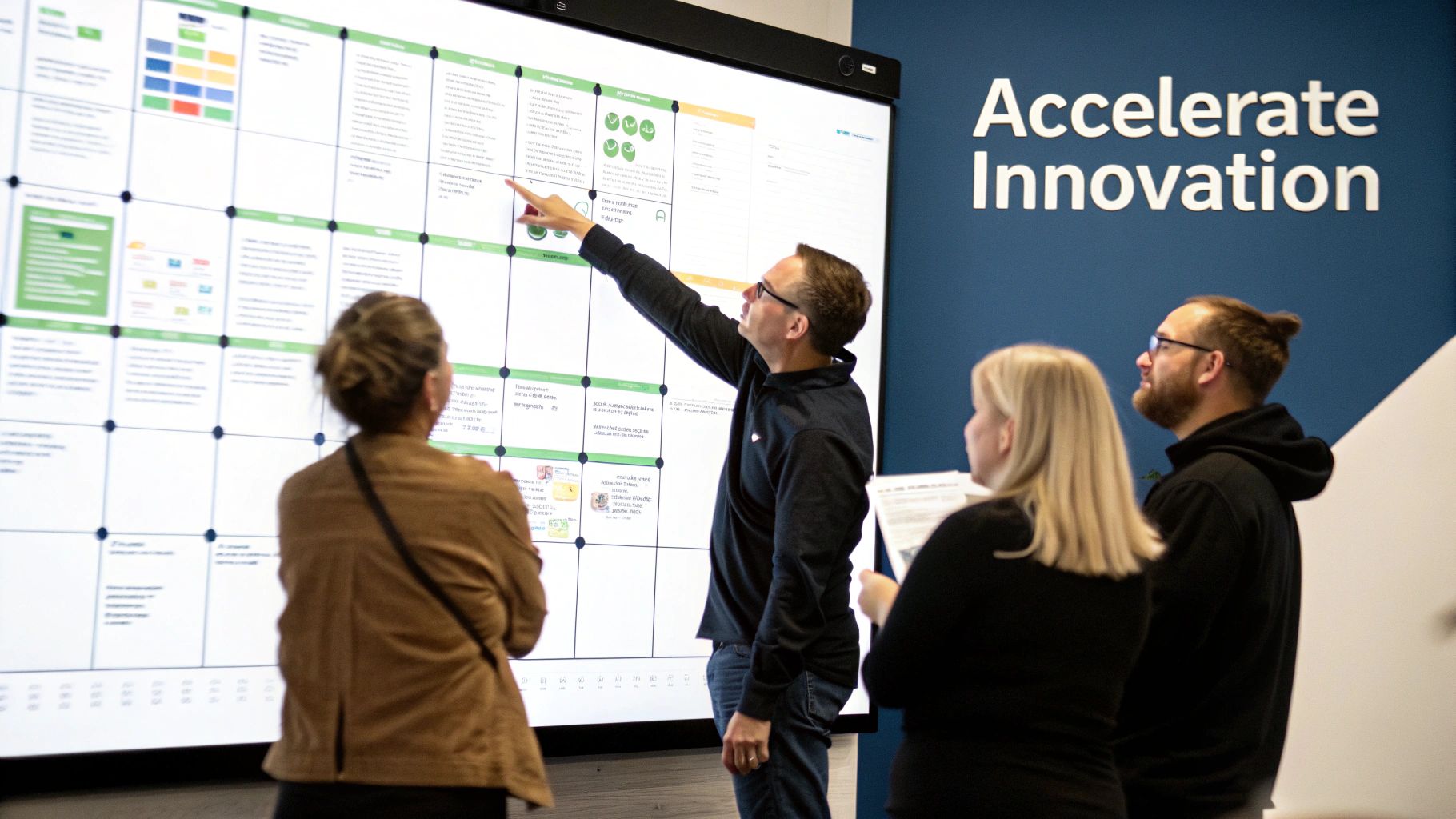
Does this sound familiar? You’re running a promising SaaS company with a brilliant product roadmap, but your engineering team is completely swamped. Every new hire takes months, and the competition for local talent with niche skills—like AI or cloud-native development—is brutal.
The result? Your roadmap stalls and you miss key market opportunities. This isn’t just a hypothetical problem; it's the daily reality for countless businesses trying to scale.
This is exactly where a dedicated team flips the script. It stops being a simple cost-cutting tactic and becomes a real strategic advantage. You’re not just tossing a project over the wall and hoping for the best; you're building a cohesive, long-term extension of your own crew.
Overcoming Modern Hiring Bottlenecks
The demand for software engineers is projected to explode by 25% through 2032—that's nearly eight times faster than the average for all other jobs. This massive skills gap makes traditional hiring painfully slow and ridiculously expensive.
A dedicated team model helps you sidestep these issues entirely by giving you immediate access to a global talent pool.
Instead of fighting over the same handful of local experts, you can tap into specialized tech hubs around the world. This is a game-changer for complex projects that demand a unique mix of skills.
By building a team with a specific purpose, you're not just filling seats. You're creating a high-performance unit from day one. This approach allows you to truly Build High Performing Teams that are tailored to your goals and company culture.
Debunking Common Myths About Control and Quality
A lot of leaders hesitate because they're worried about losing control or seeing quality dip. That's a valid concern, but the dedicated model is specifically designed to prevent that.
Unlike old-school outsourcing, you manage the team’s daily work, set their priorities, and plug them directly into your existing tools like Slack and Jira. They become part of your workflow.
This team works only for you. Over time, they absorb your company culture and develop deep product knowledge. This long-term integration delivers some serious benefits:
Greater Ownership: The team gets invested. They start caring about the product's success and proactively contribute ideas.
Enhanced Stability: Low turnover means critical project knowledge stays within the team, preventing the costly delays that come with constantly retraining new people.
Seamless Collaboration: When you work with nearshore partners in aligned timezones, your dedicated team can collaborate in real-time with your in-house staff. Check out the advantages of nearshore outsourcing to see how powerful this can be.
Ultimately, bringing on a dedicated development team transforms your biggest operational hurdles into a competitive weapon, letting you build faster and scale smarter.
Struggling to find the elite engineers needed to drive your projects forward? TekRecruiter specializes in recruiting the top 1% of global talent. We recruit the engineers who make up dedicated, high-performing teams, so you can accelerate your roadmap with confidence.
Defining Your Needs to Attract the Right Talent
Trying to hire a dedicated development team without a crystal-clear plan is like setting sail without a map. You’ll eventually hit land, but it almost certainly won't be where you intended to go. Before you even think about posting a job, you need a precise blueprint of what success actually looks like for your project.
This initial definition phase is the single most important factor in attracting top-tier talent. A vague brief gets you generalist candidates. A detailed, thoughtful plan acts as a magnet for the specialized experts you actually need.
Conduct a Ruthless Skills Gap Analysis
First, you have to look inward. A skills gap analysis isn't just about listing technologies you don't have; it's a strategic teardown of the capabilities standing between you and your goals. What specific expertise is missing that's actively holding back your product roadmap?
Be brutally honest and get granular. Don't just say, "we need a cloud engineer." That’s useless.
Instead, pinpoint the exact need: "We need a senior DevOps engineer with deep AWS expertise, specifically for setting up CI/CD pipelines with GitLab for a serverless architecture using Lambda and API Gateway." See the difference?
Break it down by focusing on these areas:
Technical Gaps: Are you missing Python proficiency for that new AI feature? Do you lack Kubernetes experts to scale your microservices?
Domain Knowledge: Does your project demand an understanding of fintech compliance, healthcare data security like HIPAA, or complex e-commerce logistics?
Process Deficiencies: Is your team weak in Agile methodologies? What about automated testing or security best practices?
Getting this level of detail ensures your search is laser-focused from day one. You can learn more about how this clarity impacts your search by exploring different approaches to building your ideal software development team structure.
Craft a Precise Technical Requirements Document
Your technical requirements document needs to be more than a shopping list of languages and frameworks. It's the project's constitution—a comprehensive guide to the entire technical ecosystem your new team will live in.
A strong document always includes:
The Full Tech Stack: Detail the front-end, back-end, database, and cloud infrastructure. No skipping.
Architectural Vision: Briefly explain the current or desired architecture (e.g., monolithic, microservices, event-driven).
Coding Standards: Mention any specific standards, style guides, or best practices the team absolutely must follow.
Tooling and Workflow: List the tools they'll be using every day—project management (Jira, Asana), version control (Git), and communication platforms (Slack, Teams).
A well-defined technical brief prevents incredibly expensive misunderstandings down the line. It ensures every candidate knows exactly what they're walking into and can confirm they have the right experience to start contributing immediately.
Define the Human Element: Culture and Communication
Technical skills are only half the battle. A brilliant developer who can't sync up with your team is a recipe for friction, missed deadlines, and endless frustration. Defining your cultural and communication style is just as critical as outlining the tech stack.
Ask yourself these questions:
What is our project management style? Are you a strict Scrum shop with rigid ceremonies, or is it a more flexible Kanban approach? Be honest.
What are the communication protocols? Set clear expectations for daily stand-ups, response times on Slack, and how often you expect progress reports.
What cultural attributes matter most? Do you value proactive problem-solvers? Or are you looking for highly collaborative team players who thrive on pairing? Maybe you need independent heads-down contributors who require minimal oversight.
Once you’ve nailed down these needs, referencing a modern recruiter's guide to sourcing candidates can give you practical strategies to find and attract the right people for your dedicated development team.
Defining these needs with this level of precision ensures you aren't just hiring developers; you're building a cohesive, high-performing extension of your core team.
Finding engineers who check all these boxes—both technical and cultural—can feel like searching for a needle in a haystack. This is exactly what TekRecruiter specializes in. We go beyond resumes to connect you with the top 1% of engineers who not only have the right skills but also the ideal mindset to integrate seamlessly into your projects.
Finding the Right Partner and Engagement Model
Once you've mapped out exactly what you need—both technically and culturally—it's time to choose your partner and the engagement model that will define the relationship. This is a big one. Get it right, and you've got a foundation for a killer long-term partnership. Get it wrong, and you're looking at misaligned expectations, budget headaches, and a whole lot of friction.
Not all partners or pricing structures are built the same. The landscape is dominated by a few key models, and picking the right one depends entirely on your project. Are you building a well-defined MVP, or is this an evolving platform that needs constant love and iteration?
Choosing Your Engagement Model
The way you structure the contract dictates how you'll work together. A Fixed Price model can feel safe if your scope is set in stone, but it leaves zero room for the unexpected pivots that every real-world project faces. A Time & Materials model offers that flexibility but can make your CFO nervous with its unpredictable costs.
For long-term, complex projects, the Dedicated Team model is where the magic happens. It's a sweet spot of stability and control. You pay a flat monthly rate for each team member, and in return, you get developers who are 100% focused on your project. This isn't just about coding; it's about building deep product knowledge and a genuine sense of ownership.
Whichever model you choose, it rests on the definition work from the previous section. This is the blueprint we follow to align needs with the right talent.
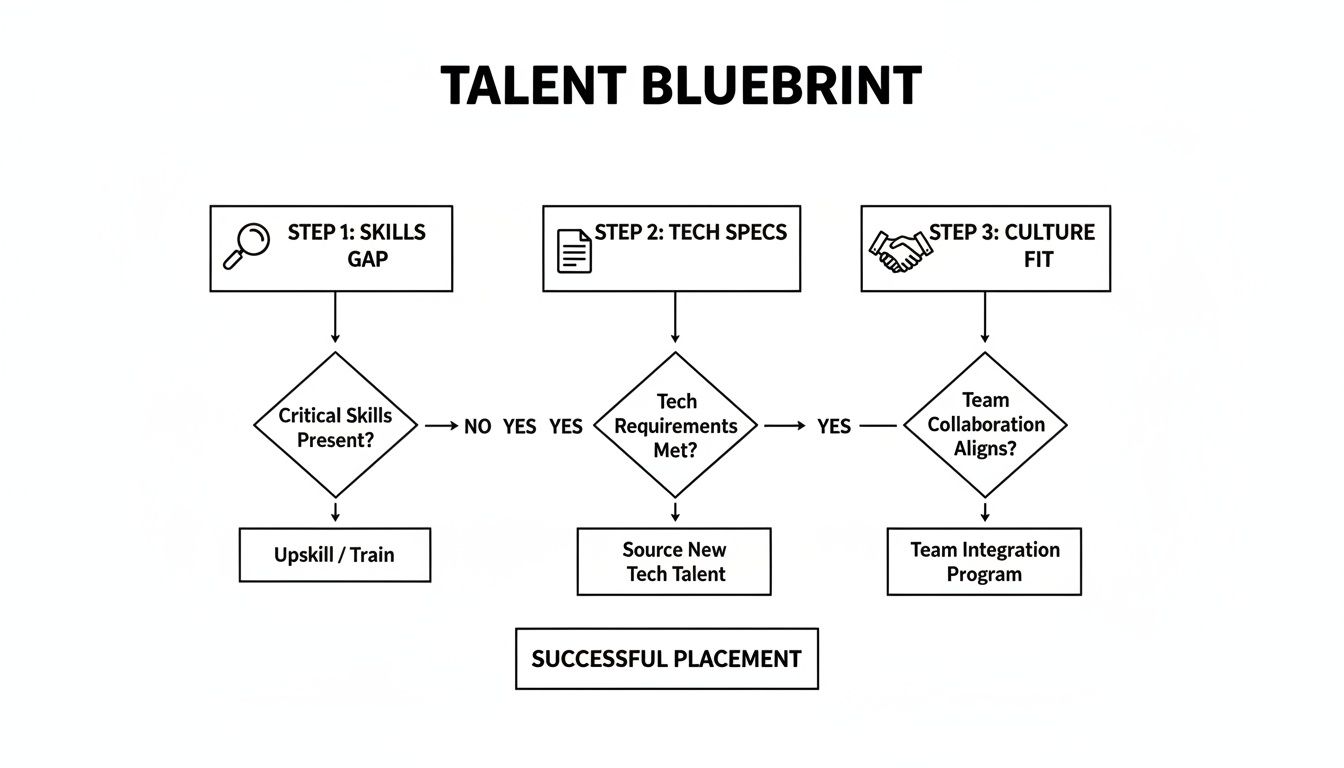
When you nail the definition of skills, tech specs, and cultural fit upfront, you attract the right experts from the get-go.
To make things even clearer, let's look at how the different models stack up.
Comparing Engagement Models for Development Teams
Deciding between a dedicated team and a traditional in-house hire involves more than just salary numbers. You have to consider everything from recruitment overhead to long-term scalability. This table breaks down the real-world implications of each path.
Factor | Dedicated Development Team | In-House Team |
|---|---|---|
Recruitment & Hiring | Fast (days/weeks). Partner handles sourcing, vetting, and initial screening. | Slow (months). Involves job postings, multiple interview rounds, and HR processes. |
Total Cost | Lower overall. No overhead for benefits, taxes, or office space. | Higher. Includes salary, benefits, payroll taxes, equipment, and office costs. |
Time to Productivity | Rapid. Pre-vetted experts onboard quickly and start delivering value almost immediately. | Slower. Requires company-wide onboarding, training, and a ramp-up period to learn systems. |
Flexibility & Scalability | High. Easy to scale the team up or down based on project needs without HR hurdles. | Low. Scaling requires a lengthy hiring process; downsizing involves complex legal/HR issues. |
Operational Overhead | Minimal. The partner manages payroll, HR, and administrative tasks. | Significant. Requires internal HR, payroll, and IT departments to manage employees. |
Talent Pool Access | Global. Access to top-tier talent from international hubs without geographical limits. | Local. Limited to the talent available in your immediate geographical area. |
While building an in-house team offers direct, long-term control, the dedicated team model provides a level of speed, cost-efficiency, and flexibility that's hard to beat, especially for companies looking to innovate quickly.
For a deeper dive into how these models compare to other staffing solutions, our guide on staff augmentation vs outsourcing can help clarify which approach is the perfect fit for your business.
How to Properly Vet Potential Partners
Picking a partner is more than scrolling through slick websites and comparing price quotes. You need to get under the hood to verify their capabilities, their security practices, and their actual track record.
Start by demanding proof. Don't settle for vague claims of success—ask for detailed case studies that are actually relevant to your industry or tech stack. Client testimonials are nice, but direct reference calls are where you get the real story. Go in with specific questions about communication, problem-solving, and—most importantly—how the partner handled it when things went wrong.
A partner’s true value is revealed not when things are going perfectly, but when they encounter inevitable roadblocks. How they navigate those challenges is the ultimate test of their reliability and expertise.
Security is absolutely non-negotiable. Ask potential partners about their security certifications. An ISO 27001 certification, for instance, is a huge green flag. It tells you they have serious, audited systems in place to manage information security, which is critical for protecting your IP and data.
If you’d rather not run that vetting yourself, we find and vet the best dedicated development team partner for your stack, and you contract with them directly. See how MSP & Outsourcing Search works.
The Strategic Advantage of Nearshore Collaboration
When you're vetting partners, geography matters. A lot. While offshore locations might dangle lower costs, nearshore partners in regions like Latin America offer a powerful blend of benefits that often get overlooked.
The biggest win is timezone alignment. Working with a team in your same business hours kills the communication lag that plagues projects spread across the globe. This means real-time problem-solving, productive daily stand-ups, and a truly agile, integrated workflow. No more waiting 12 hours for an answer to a simple question.
Beyond that, there's cultural affinity. Partners in Latin America often share similar business practices and communication styles with North American companies. This massively reduces friction and makes for a much smoother, more natural integration. This cultural sync, combined with a deep and growing talent pool, makes nearshore a no-brainer for companies that value efficiency and close collaboration.
The key to all of this is finding a partner who does the heavy lifting—providing elite, vetted talent and taking the sourcing headaches off your plate. At TekRecruiter, we connect innovative companies with the top 1% of engineers from premier nearshore hubs. We recruit engineers who become a true extension of your own team, letting you add world-class talent and accelerate your roadmap without the pain of traditional hiring.
Getting Your New Team Vetted and Onboarded

This is where the rubber meets the road. You’ve defined what you need and found a partner that looks promising—now it's time to make sure their talent is legit and figure out how to plug them into your workflow.
Get this part wrong, and you can sink a project before anyone writes a single line of code.
The idea isn't to create roadblocks but to build absolute confidence. A sharp technical vetting process confirms you're getting the high-caliber engineers you were sold on. A tight, structured onboarding plan makes them feel like part of your crew from day one, not just hired guns.
Technical Interviews That Actually Tell You Something
Let’s be honest: brain teasers and trivia questions are useless for judging if an engineer can actually ship code. When you’re bringing on a dedicated team, your vetting has to be about practical, real-world problem-solving. This is how you filter out the talkers from the builders.
Your interview process should hit them from a few different angles to test a range of skills. A solid approach looks something like this:
Live Coding Challenge: This isn't about finding the perfect algorithm under pressure. It's about seeing how a developer thinks. Give them a realistic, bite-sized problem from your domain and just watch. Do they ask smart questions? Can they talk you through their approach? Is the code clean and logical?
System Design Session: For any senior role, this is non-negotiable. Throw them a high-level challenge like, "Sketch out a basic API for a ride-sharing service." This quickly reveals if they get the big picture—architecture, scalability, database choices, and the inevitable trade-offs. You'll see if they think like an engineer or just a coder.
Code Review Exercise: Hand them a small chunk of buggy code and ask for a review. This tests their eye for detail, knowledge of best practices, and—critically—their ability to give constructive feedback. These are all essential skills for working on a real team.
The best technical interviews feel like a normal day on the job. You’re there to see how a candidate solves problems, communicates, and thinks about architecture—not whether they memorized a specific algorithm.
For a deeper look at modern evaluation techniques, it's worth understanding how you can improve the process of assessing programming skills with online coding tests. These can be a powerful first filter to weed out unqualified candidates early.
Building a Killer Onboarding Plan
The moment you’ve made your picks, the onboarding clock starts ticking. A great experience can shrink the time it takes for them to become productive from weeks down to just a few days. It sets the tone for the entire relationship and makes your new team members feel like they belong.
A sloppy, disjointed onboarding is a classic mistake. To avoid it, your plan needs to be comprehensive, documented, and ready to execute.
The Critical First 48 Hours
Those first two days are your chance to make a killer impression and kill any early frustrations before they start. Have this checklist ready to go before they even log in for the first time.
Grant Secure Access: This is job number one. Get them into all the necessary tools: Git for code, Jira or Asana for tasks, Slack or Teams for communication, and your cloud environment. Use role-based access to keep things secure.
Set Up Communication: Create a dedicated Slack channel for the new team and your key internal people. Get all recurring meetings—daily stand-ups, sprint planning, retros—on the calendar and send the invites out immediately.
Provide the Docs: Don't make them hunt for information. Give them direct access to your architectural diagrams, coding standards, API documentation, and that project brief you worked so hard on.
Assign an Onboarding Buddy: Pair each new developer with one of your in-house engineers. This gives them a safe person to ask the "stupid" questions they might not want to ask in a group setting.
Running a Kickoff Meeting That Matters
The kickoff meeting is the official starting pistol. It's more than a round of introductions; it's a strategic session to get everyone aligned on the project’s vision, goals, and the way you’ll work together. Make it interactive and focus on the "why" behind the project, not just the "what."
Walk them through the product roadmap, explain who the users are, and talk about the business goals you're trying to hit. Giving them that context is incredibly motivating and helps them make better decisions on their own.
Finding and integrating the top 1% of engineers requires a partner who knows this process cold. At TekRecruiter, we don’t just find talent; we recruit engineers who work well as a team. We handle the vetting so your project is accelerating from day one.
Managing Performance and Driving Long-Term Success

The contracts are signed and your new team is in place. This is where the real work—and the real opportunity—begins. The true measure of a dedicated development team isn't the launch; it's about sustaining momentum and building a partnership that keeps delivering value year after year.
Effective management is a tough balancing act. You need to keep an eye on progress and hold the team accountable, but you absolutely have to avoid the trap of micromanagement. Nothing kills motivation faster. The trick is to focus on outcomes, not just output, by setting up clear performance indicators that actually tie back to your business goals.
Key Performance Indicators That Actually Matter
Let's get rid of the vanity metrics. Counting lines of code or hours logged tells you next to nothing about whether you're winning. Instead, you need to track KPIs that measure what really matters: efficiency, quality, and the overall health of your project. These give you a data-driven view of how things are really going.
Here are a few of the most impactful KPIs I've seen work in the real world:
Velocity: This classic Agile metric tracks how much work a team gets done in a single sprint. Watching your velocity over time is the best way to get accurate timelines and spot roadblocks before they become full-blown crises.
Cycle Time: How long does it take for a task to go from "in progress" to "done"? A short cycle time means you have an efficient workflow without a bunch of frustrating bottlenecks holding things up.
Code Quality Metrics: Use your tools to keep an eye on things like code churn (how often code gets rewritten) and bug density. If you see high churn or a spike in bugs, it's often a red flag for deeper issues or growing technical debt.
Deployment Frequency: How often are you shipping code to production? Shipping more often is almost always a sign of a healthy, agile development process.
Remember, these numbers aren't for pointing fingers. They're conversation starters. They help you and your team pinpoint what needs to be improved and give you a reason to celebrate wins based on tangible results.
Fostering a Culture of Retention and Growth
At the end of the day, the human element is everything. High turnover will absolutely cripple a project, wiping out valuable institutional knowledge and destroying team chemistry. Keeping your dedicated team engaged and motivated takes a conscious, deliberate effort.
Retention is about so much more than a competitive salary. It’s about building an environment where developers feel valued, challenged, and genuinely connected to your company’s mission. This is where a nearshore model can be a massive advantage. Having significant timezone overlap allows for the kind of real-time, human interaction that builds strong bonds and lets people solve problems together—as a single, cohesive unit.
A dedicated team thrives when they feel like a true extension of your company, not just a vendor. Investing in their professional growth and creating open feedback channels are the most powerful retention tools you have.
To build this kind of environment, focus on a few key areas:
Provide Meaningful Professional Development: Give them access to training, certifications, or conference tickets. When you invest in their career, they invest back in you. It builds incredible loyalty.
Run Effective Feedback Sessions: Regular, constructive feedback is non-negotiable. Use one-on-ones to talk about career goals, tackle challenges, and recognize their hard work.
Celebrate Wins Together: When the team hits a big milestone, make sure they get the credit they deserve. Acknowledge their success publicly across the whole company.
Ultimately, managing a dedicated team is about building a true partnership. By focusing on the right metrics, investing in your people, and fostering a culture they want to be a part of, you turn a team engagement into a long-term strategic asset.
Navigating the complexities of managing a global team can be a lot to handle. At TekRecruiter, this is where we help. We connect you with the top 1% of engineers, and we vet for the communication skills and cultural fit that make a global team work.
Build Your Elite Engineering Team with TekRecruiter
Let's be honest. Hiring a dedicated development team is a massive lever for growth, but the real challenge isn’t just finding developers. It’s sourcing that top 1% of engineering talent and making them feel like a genuine part of your company from day one. This is where a strategic partner doesn't just help—it changes the game entirely.
TekRecruiter was built to cut through the noise. We connect innovative companies with elite, pre-vetted engineers from top-tier nearshore hubs. You get world-class skills without the headaches of wildly different time zones.
How We Recruit for Dedicated Teams
We vet every engineer for communication skills and cultural alignment right from the start.
This isn’t about finding a few extra hands. It’s about building a true extension of your in-house staff—a team that’s fully embedded in your projects, your goals, and your success.
With deep roots in high-demand fields like AWS, Azure, and GCP, we specialize in recruiting engineers ready to tackle your biggest challenges:
Artificial Intelligence and Machine Learning
Cloud-Native Development
Advanced DevOps and Automation
We don't just find developers. We recruit people who fit together as cohesive, high-performing teams for the long haul. Our entire focus is on finding stable, motivated engineers who dive deep into your product and become the engine that drives your roadmap forward.
If you’re ready to stop searching and start building, TekRecruiter can help you hire the world-class talent you need to get your projects across the finish line, faster.
Your Questions About Dedicated Teams, Answered
Thinking about bringing on a dedicated team? Smart move. But it's natural to have questions. Here are the straight-up answers to the things leaders usually ask us, covering everything from cost and security to making sure your new team feels like your team.
How Much Does Hiring a Dedicated Development Team Cost?
There's no single price tag, of course—it all depends on the location, how many engineers you need, and the specific skills you're after. But here's the bottom line: it's almost always more cost-effective than hiring in-house.
When you partner with a nearshore provider in a talent hub like Latin America, you can often trim your overall expenses substantially. Why? Because your partner handles all the overhead—benefits, office space, payroll, and all the administrative headaches you'd rather not deal with.
What Is the Difference Between a Dedicated Team and Other Models?
The biggest difference comes down to two words: exclusivity and integration.
Unlike a fixed-price project where you basically hand over the specs and hope for the best, or a Time & Materials model where engineers might be juggling multiple clients, a dedicated team is 100% yours. They aren't just contractors; they become a true extension of your in-house staff, fully embedded in your projects, culture, and long-term vision.
How Do You Manage a Dedicated Team Effectively?
The secret isn't micromanagement—it's seamless integration. You get the best results when you treat them exactly like you treat your local engineers.
Plug them into your ecosystem. Get them on your company's Slack, give them access to your Jira boards, and add them to the right channels and repos from day one.
Invite them to the table. This means including them in everything from daily stand-ups and sprint planning to the big-picture strategy sessions. They can't contribute if they're kept in the dark.
Focus on what matters: results. Your focus should be on clear goals and KPIs, not obsessing over logged hours. Trust them to get the job done.
This all becomes infinitely easier when you're working with teams in similar time zones. The goal is to build a real sense of shared ownership and collaboration.
Remember, the success of hiring a dedicated development team often hinges on treating them as true partners. When they feel invested in your company’s vision, their performance and loyalty skyrocket, creating a stable, high-impact engineering unit.
Building an elite team is a complex process, but you don’t have to do it alone. As a technology and engineering staffing and recruiting agency, TekRecruiter helps innovative companies hire the top 1% of engineers anywhere in the world. We specialize in sourcing and vetting elite, dedicated engineers who are ready to fit into your team.
Ready to build a world-class team to crush your roadmap? Connect with us to get started.
 Ron SmithPresident & Lead RecruiterTekRecruiter