_edited.png)
How to Find Elite DevOps Consulting Firms
Are you getting bogged down by slow software releases, constant outages, or infrastructure that just won’t scale? You're not alone. The best DevOps consulting firms aren't just tool installers; they are strategic partners who get in the trenches with you to drive real cultural and operational change. They’re the specialists you bring in to accelerate your entire software delivery lifecycle through practices like automation and cloud-native development.
Why Partnering With a DevOps Firm Is a Strategic Move
In today's market, the speed and reliability of your software aren't just IT metrics anymore—they’re what separate you from the competition. While building a world-class in-house team is a great long-term goal, a specialized firm gives you immediate access to deep expertise and battle-tested methods.
This kind of partnership lets you skip the painful learning curve. Instead of figuring out complex tech like Kubernetes or Infrastructure as Code (IaC) from scratch, you can lean on a team that has already rolled out these solutions for companies of all shapes and sizes.
The Catalyst for True Transformation
Here's the thing: the real value of a great DevOps consultant isn't just their technical chops. It's their strategic guidance. They act as a catalyst, helping you spot and break down the silos between your development, operations, and security teams that are holding you back.
A top-tier partner looks beyond the tools. They help you build a culture of shared ownership, continuous feedback, and constant improvement. That cultural shift is almost always the hardest part of the journey, and it's where expert guidance becomes invaluable. To get a better sense of what these partnerships look like, it's worth exploring different DevOps consulting services.
This strategic need is why the global DevOps consulting market is on a rocket ship, projected to hit around $25 billion by 2025. Enterprises are finally treating automation and cloud migration as fundamental business strategies, not just IT projects.
Key Triggers Signaling a Need for Expert Help
So, how do you know it’s time to call in the experts? There are a few tell-tale signs that you could use some outside help:
Inconsistent Release Cycles: Your teams can't seem to ship updates on a predictable schedule, causing you to miss key market opportunities.
System Reliability Issues: You’re dealing with frequent downtime, performance bottlenecks, and manual fire-drills that are killing customer trust and hitting your bottom line.
Difficulty Scaling: Your infrastructure buckles under pressure, leading to poor performance right when traffic spikes.
Security and Compliance Gaps: You know you need to bake security into your development process (DevSecOps), but you don't know where to start.
By bringing in an external firm, you gain an objective perspective on your processes and a clear roadmap for improvement, enabling you to focus on innovation rather than firefighting.
Of course, a great strategy is useless without the right engineers to execute it. TekRecruiter bridges that gap. We connect you with the top 1% of pre-vetted, nearshore engineers who live and breathe AI, cloud, and DevOps. Let's talk about getting the right talent in place to make your transformation happen.
A Practical Framework for Evaluating DevOps Consultants
Picking the right DevOps consulting firm is about more than just checking boxes on a vendor list. It’s about finding a true partner—one who gets your tech stack, understands your business goals, and actually fits with your company culture. A solid evaluation framework helps you cut through the marketing fluff and focus on what really drives results.
First things first: you have to dig into their technical depth. Vague claims of "DevOps expertise" won't cut it. You need proof they can handle the specific tools and platforms that run your infrastructure, or the ones you’re planning to bring in.
Technical Expertise and Platform Proficiency
A top-tier firm will have verifiable mastery in the areas that matter most to you. This shouldn't be theoretical knowledge; it needs to be backed by serious certifications and a portfolio of projects they’ve actually delivered.
Think about the non-negotiables of modern DevOps:
Cloud Platforms: Do they have advanced certifications for AWS, Azure, or Google Cloud Platform (GCP)? Your partner should have intimate knowledge of your specific cloud provider, including its quirks around automation, security, and cost management.
Infrastructure as Code (IaC): Ask for real-world examples of how they’ve used tools like Terraform or Pulumi to manage complex environments. Can they talk intelligently about managing state, building a modular architecture, and embedding IaC into CI/CD pipelines?
Containerization and Orchestration: For most modern applications, deep expertise in Docker and Kubernetes is a given. You need to assess their ability to design, roll out, and manage Kubernetes clusters that can scale, complete with the right networking, security policies, and service mesh implementations.
A truly great partner doesn't just know the tools; they understand the architectural patterns that make them effective. They can explain why they would choose one tool over another for your specific use case, demonstrating strategic thinking over mere technical execution.
Cultural Transformation and Change Management
Let's be honest—the biggest roadblock to a successful DevOps adoption is usually cultural resistance, not a technical problem. The best consultants know this. They act as change agents, not just an implementation crew.
You have to evaluate their approach to the human side of this shift. How do they actually foster collaboration between teams like development, operations, and security that have been siloed for years? A strong partner will have a proven method for tearing down those walls.
This goes way beyond hosting a few workshops. Look for firms that put a heavy emphasis on:
Empowerment and Knowledge Transfer: Their main goal should be to make your team self-sufficient. Ask them how they document processes and train your engineers to ensure you don't become dependent on them forever.
Metrics-Driven Improvement: How do they define and measure success? They should be able to track key performance indicators (KPIs) that matter, like change failure rate, mean time to recovery (MTTR), and lead time for changes—not just vanity metrics like deployment frequency.
DevSecOps Integration: Security can't be bolted on at the end anymore. A forward-thinking firm will show you how they bake security practices and automated testing directly into the development pipeline from day one. This "Shift Left" mentality is critical for cutting risk and shipping faster.
Demonstrating Value and ROI
At the end of the day, any big investment has to be justified by a clear return. The best DevOps consulting firms are pros at connecting their technical work to real business outcomes.
They should be able to help you build a compelling business case for the engagement. That means spelling out how their work will lead to measurable improvements, like slashing operational costs by 30% through cloud optimization or boosting revenue by getting new features to market faster. For a deeper look at vetting technical partners, our guide on how to find the best IT staffing services in 2023 is a great resource.
Choosing a partner is about finding that perfect mix of technical skill, strategic vision, and cultural chemistry. This framework gives you the criteria to see past the sales pitch and find a firm that can deliver a transformation that actually sticks.
While plenty of firms can offer strategic advice, executing that vision takes world-class engineering talent. TekRecruiter specializes in deploying the top 1% of engineers anywhere, connecting you with the hands-on experts needed to turn your DevOps roadmap into reality.
Comparing DevOps Consulting Engagement Models
Picking a partner from the sea of DevOps consulting firms isn't just about their tech stack. It's about finding an engagement model that actually fits your goals, your budget, and the way your team works. The structure of the relationship is just as important as the code they write—it dictates the scope, the cost, and whether you’ll hit your targets or just spin your wheels.
Not all partnerships are built the same. Understanding the difference between a one-off project, ongoing managed services, and high-level strategic advice is critical. Get it wrong, and you're looking at misaligned expectations, blown budgets, and a project that never quite delivers. Let's break down the common models so you can make the right call.
This flowchart maps out the core factors—technical needs, cultural alignment, and ROI focus—that should point you toward the right partner and engagement model.
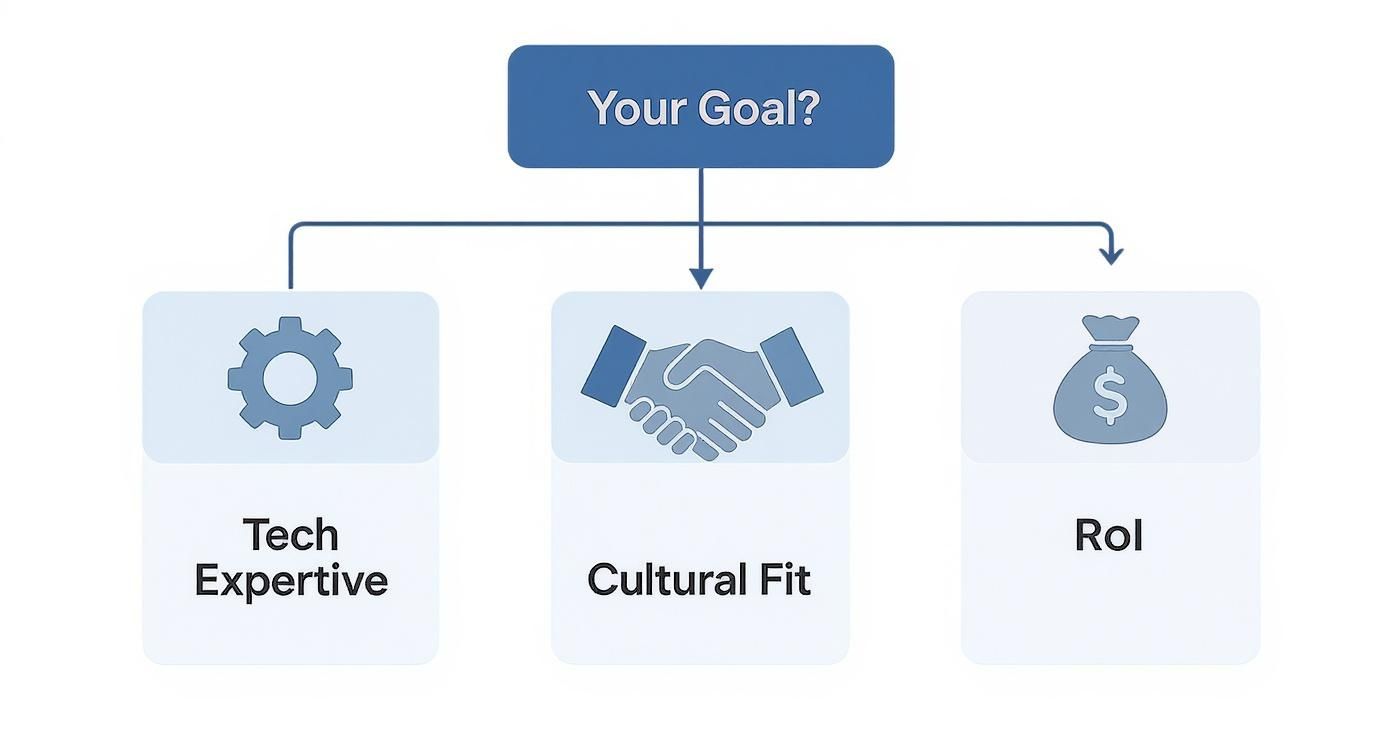
As you can see, the best structure is a direct reflection of your primary business goal. Are you trying to solve a specific technical problem, evolve your team's culture, or just get the best possible financial return?
Project-Based Engagements
The project-based model is as straightforward as it gets. It comes with a clearly defined scope, a fixed timeline, and a concrete deliverable. This is the perfect fit when you have a specific, measurable goal you need to nail.
Think of it as hiring a specialist for a single, high-impact mission.
Use Case Example: A mid-sized e-commerce company needs to build a CI/CD pipeline from the ground up to automate its software releases. The project has a clean start and finish. Once the pipeline is built, tested, and handed over to the internal team, the job is done.
The biggest win here is predictability. You know what you're getting and exactly what it will cost, which simplifies budgeting. The catch? Scope creep. If new requirements pop up mid-project, you're heading for contract renegotiations and a bigger bill.
Managed Services Model
Unlike the finite nature of a project, a managed services model is about ongoing support. The consulting firm essentially becomes an extension of your team, handling the day-to-day operations, maintenance, and optimization of your DevOps environment.
This is for organizations that want to offload the operational grind and guarantee their systems stay healthy and performant.
Use Case Example: A SaaS startup has a lean engineering team focused on building new features. They bring in a managed services partner to provide 24/7 monitoring, security patching, and performance tuning for their AWS infrastructure. This ensures high availability without having to hire a full-time, in-house ops team.
This model isn't about a one-time deliverable; it’s a long-term partnership governed by service-level agreements (SLAs). You get proactive maintenance and instant access to a bench of experts, but it comes with a recurring monthly cost and a certain level of dependency.
This approach is often called DevOps as a Service (DaaS). If you're leaning this way, it's worth digging into the nuances of considering DevOps as a Service solutions to make sure it aligns with your long-term vision.
Strategic Advisory Retainers
The strategic advisory model is the most high-level of the bunch. It’s less about hands-on keyboard work and more about expert guidance, roadmap development, and executive-level strategy. You bring in an advisor to guide your internal leadership through complex transformations.
This is a go-to for large enterprises or companies in the middle of a massive organizational shift.
Use Case Example: A large financial institution is kicking off a multi-year cloud migration and DevOps transformation. They put a strategic advisory firm on retainer to help their CTO build a comprehensive roadmap, evaluate organizational readiness, and steer the cultural change needed to make it all work.
This model gives you invaluable direction and helps you sidestep expensive mistakes. The cost is typically a monthly retainer, and the risk is that the advice remains theoretical if your internal team isn't equipped to execute. It demands a mature organization that's ready to act on that high-level guidance.
Deciding on an engagement model isn’t one-size-fits-all. It really comes down to what you’re trying to accomplish. To help you weigh the trade-offs, here’s a quick comparison of the models we've discussed.
Choosing Your DevOps Engagement Model
Engagement Model | Best For | Typical Cost Structure | Primary Advantage |
|---|---|---|---|
Project-Based | Organizations with a well-defined, one-time goal and a clear finish line. | Fixed Price or Time & Materials (T&M) | Predictability: Clear scope, timeline, and cost from the start. |
Managed Services (DaaS) | Companies that need to offload ongoing operational tasks and ensure continuous system health. | Monthly Recurring Fee (based on SLAs) | Proactive Support: Frees up internal teams to focus on core business objectives. |
Strategic Advisory | Enterprises navigating complex transformations who need high-level guidance and roadmap development. | Monthly Retainer | Strategic Direction: Access to executive-level expertise to avoid costly missteps. |
Ultimately, the right model depends entirely on your situation. Are you putting out a specific fire, offloading a persistent burden, or charting a new course for the entire organization? Answering that question is the first step toward finding the perfect partner.
Critical Questions to Ask Potential DevOps Partners
Choosing the right partner from a sea of DevOps consulting firms means you have to get past the polished sales decks and dig into how they actually operate. The right questions will show you their real problem-solving chops, how they collaborate, and if they're actually committed to your long-term success. Generic questions won't get you anywhere; you need to probe their methodology and see if they're a cultural fit.
Asking sharp, outcome-focused questions is the only way to tell the difference between a firm that just installs tools and one that drives real change. This isn't just an interview. It's the first real step in your due diligence.
Probing Their Strategic Methodology
Start by digging into how they think, not just what they do. A great partner has a battle-tested methodology that’s more than just a boilerplate project plan. Their answers here will reveal their strategic depth and whether they can handle the messy reality of a complex environment.
Here are a few questions to gauge their strategic thinking:
How do you measure the success of a DevOps initiative beyond technical metrics like deployment frequency? Their answer needs to include business-focused KPIs. Think reduced operational costs, faster time-to-market for new features, or even improved customer satisfaction scores.
Can you describe your process for assessing our current state and building a transformation roadmap? Look for a structured approach. They should be talking about stakeholder interviews, value stream mapping, and deep technical audits. A vague answer means you're likely getting a one-size-fits-all solution.
What is your framework for selecting the right tools for a client's specific needs, and when have you recommended not using a popular tool? This question is a stress test. It shows if they prioritize practical solutions for your outcomes over pushing their preferred tech stack or chasing trends.
Assessing Cultural Fit and Problem-Solving Skills
Technical skills are table stakes. The real differentiator is how a firm handles the human side of change and what they do when things inevitably go wrong. Cultural friction is one of the biggest killers of DevOps initiatives, so getting a read on a partner’s approach here is non-negotiable.
The most skilled DevOps consultant is useless if they can't bring your teams along for the ride. Their ability to manage resistance, facilitate communication, and build consensus is just as critical as their knowledge of Kubernetes.
Use these questions to understand their soft skills and resilience:
Describe a past project where you overcame significant cultural resistance to a new process. What specific steps did you take? This reveals their experience with change management. You're looking for a partner who acts as a coach and mentor, not just an implementer.
Walk us through a time an engagement went off-track. What caused the issue, how did you communicate it to the client, and what was the resolution? Every complex project hits a few bumps. You want a partner who demonstrates transparency, accountability, and a calm, structured approach to fixing problems.
Verifying Their Approach to Knowledge Transfer
The whole point of a consulting engagement should be to empower your internal team, not to create a long-term dependency. A top-tier firm is obsessed with making themselves redundant by upskilling your people. Before you sign anything, make sure your evaluation is airtight. A comprehensive vendor due diligence checklist can provide some valuable structure here.
What is your formal process for knowledge transfer and documentation to ensure our team can manage the new systems independently? They should have a clear plan that involves things like paired programming, detailed runbooks, and hands-on training sessions. Our guide answers many staff augmentation questions that touch on integrating external experts, which is relevant here.
How do you structure your engagement to foster collaboration and co-ownership with our internal engineers from day one? The best firms don’t operate in a silo. They embed their consultants within your teams, working side-by-side to solve problems together.
These questions will arm you to see past the sales pitch and find a true strategic partner. While these firms provide guidance, TekRecruiter provides the talent. We allow innovative companies to deploy the top 1% of engineers anywhere, giving you the elite, hands-on expertise needed to execute your vision.
A Curated List of Top DevOps Consulting Firms
Trying to find the right DevOps consulting firm can feel like searching for a needle in a haystack. The market is packed. To cut through the noise, we've put together a shortlist of top partners, from massive global players to highly focused boutique agencies.
Every firm brings something different to the table. This breakdown is designed to help you match their unique strengths to your industry, tech stack, and what you’re actually trying to achieve. This isn't just a list; it’s a cross-section of the best players out there.
Global System Integrators
These are the giants. Large, established firms that offer incredible scale and a massive portfolio of services. They’re the usual suspects for Fortune 500s tackling complex, multi-year transformations that touch every corner of the business and cross multiple continents.
Accenture: A true powerhouse in digital transformation, Accenture treats DevOps as a fundamental piece of its wider cloud and enterprise agility offerings. They shine in large-scale, strategic projects where DevOps is just one part of a much bigger business reinvention. Their real strength is managing immense complexity and tying technology directly to C-suite goals.
IBM Consulting: With deep roots in hybrid cloud and AI—thanks to products like Red Hat OpenShift—IBM delivers seriously robust DevOps solutions for the enterprise. They’re a natural fit for companies already in the IBM ecosystem or those navigating the tricky compliance waters of finance and government.
Global integrators bring huge resources and a proven track record. The trade-off? Their engagement models can be rigid, and their size can sometimes make them less nimble than smaller, more specialized competitors.
Specialized Boutique and Mid-Sized Firms
Boutique firms win by going deep, not wide. They build their reputation on hyper-focused expertise in specific technologies or industries. This often translates to a more hands-on, high-touch experience, making them a fantastic choice for mid-market companies or enterprises needing niche skills for a mission-critical project.
Capgemini: While still a global heavyweight, Capgemini often moves with the agility of a smaller shop. They provide end-to-end DevOps and governance, with a notable strength in using cloud-native solutions to push innovation. Their approach hits the sweet spot for organizations needing both scale and specialized technical depth.
SG Analytics: This firm carves out a unique space by blending practical DevOps with serious chops in DataOps, MLOps, and data governance. SG Analytics is the perfect partner for data-heavy businesses that need to streamline not just software delivery but their entire data pipeline, from ingestion to insight.
The real advantage of a specialized firm is their concentrated expertise. They solve a specific set of problems exceptionally well, often bringing battle-tested frameworks and accelerators that a generalist firm might lack.
This dynamic is reshaping the market. In fact, research points to North America leading the charge. As far back as 2018, the region claimed nearly 49% of the global DevOps consulting market and is expected to hold that lead. You can dig into these global market dynamics on 360iResearch.
A New Model Blending Consulting and Staffing
The traditional consulting model isn't your only option. A new approach is taking hold—one that bridges the gap between high-level strategy and the absolute need for elite, hands-on engineers to actually build the thing. It’s a powerful alternative for companies that need both the roadmap and the muscle.
TekRecruiter is championing this model. While the firms listed above deliver excellent strategic frameworks, turning those plans into reality comes down to world-class engineers. We specialize in deploying the top 1% of pre-vetted, nearshore engineers with deep expertise in AI, cloud platforms, and DevOps.
Our model gives you a distinct advantage:
Elite Talent on Demand: We provide direct access to a pool of certified AWS, Azure, and GCP engineers ready to build, automate, and optimize your infrastructure from day one.
Cost-Effective Nearshore Delivery: You get top-tier talent from Latin America and Europe, managed under a U.S. framework. This delivers a significant cost advantage over pricey onshore consultants.
Flexible Engagement: We can augment your team for a specific project or build out a dedicated crew to manage your entire DevOps lifecycle. It's the best of both staffing and consulting.
This approach is built for innovative companies that need to move fast. Instead of paying a premium for a big consulting firm to manage a project, you deploy elite engineers directly, keeping control and hitting your roadmap goals faster.
While traditional DevOps consulting firms offer invaluable strategic guidance, the success of your initiative ultimately rests on the quality of the engineers doing the work. TekRecruiter gives you a direct line to that world-class talent. Let's talk about deploying the right engineers to build your competitive edge.
Deploy the Top 1% of DevOps Engineers With TekRecruiter
Let's be honest. Finding and keeping elite DevOps talent is the single biggest bottleneck in any real digital transformation. Traditional DevOps consulting firms sell you a strategic roadmap, but execution falls flat if you don't have world-class engineers to build it.
This is where TekRecruiter flips the model. We give innovative companies direct access to the top 1% of pre-vetted, nearshore engineers who live and breathe AI, cloud platforms, and modern DevOps.
Our approach is flexible. You can deploy this talent exactly where it’s needed most, whether that’s for high-level strategic guidance or hands-on, in-the-weeds implementation. It’s a model that delivers massive value, especially when you consider the costs detailed in our senior DevOps engineer salary in 2024 guide, which breaks down the financial advantage of top-tier nearshore talent.
Stop navigating the complex and overpriced consulting market. Instead, build a high-performing, dedicated team that actually accelerates your roadmap and locks in a lasting competitive edge. Our engineers don't just work for you; they integrate and become a core part of your organization.
This isn’t just staffing. It’s the strategic insight of a consultancy combined with the raw execution power of a dedicated in-house team, all without the crippling overhead.
Why settle for just a plan when you can have the elite team to make it a reality? Let's talk about building that team today.
DevOps Consulting FAQs
When you're looking to bring in a DevOps consulting firm, you'll naturally have questions about cost, timelines, and exactly who does what. Getting straight answers is the only way to make a good decision, so let's cut through the noise.
Think of this as the essential briefing you need before signing any contracts. Knowing these details helps you set the right expectations and find a partner who actually fits your goals and budget.
What's the Real Cost of DevOps Consulting?
The price tag on DevOps consulting is all over the map—it really depends on the engagement model, the sheer complexity of your project, and the firm’s reputation. You can expect hourly rates for individual consultants to fall anywhere between $150 and $350+. For a specific, well-defined project, like getting a modern CI/CD pipeline built from scratch, you might be looking at a $50,000 to $100,000 engagement.
But if you're talking about a full-scale enterprise transformation—one that involves changing your culture and re-platforming significant parts of your tech stack—the cost can easily climb into the hundreds of thousands. My advice? Never move forward without a detailed proposal that breaks down every single cost and deliverable. No surprises.
How Long Does a Typical Engagement Last?
There’s no "typical" duration; it's entirely dictated by the scope of work. A targeted, tactical project—say, an infrastructure security audit or automating one particularly painful deployment process—might only take three to six months. These are great for scoring quick wins and showing immediate value to the business.
On the other hand, a complete organizational overhaul that involves coaching your teams, driving cultural adoption, and training multiple departments is a much bigger commitment. These strategic partnerships often run for 12 to 24 months and can even evolve into ongoing managed services contracts that you renew each year.
The key is to match the engagement duration to your business goals. Short-term projects solve immediate pain points, while long-term partnerships drive foundational change and continuous improvement.
What’s the Difference Between a DevOps Consultant and a DevOps Engineer?
This is a critical distinction, and one that trips a lot of people up. A DevOps engineer is your hands-on practitioner. They are in the trenches, building, managing, and maintaining the tools and infrastructure that make your software delivery lifecycle tick. They write the code and configure the systems—they’re the builders.
A DevOps consultant operates at a higher, more strategic level. They are the architects and the strategists. They come in to assess where you are today, design a roadmap for transformation, help you choose the right tech, and guide the cultural shifts needed to make it all stick. They figure out the "why" and the "how," which empowers your engineers to execute the "what."
While traditional DevOps consulting firms provide the roadmap, execution requires elite talent. As a premier technology staffing, recruiting, and AI Engineer firm, TekRecruiter allows innovative companies to deploy the top 1% of engineers anywhere. We provide the hands-on expertise to turn your strategic vision into a reality. Find the world-class talent you need to build a lasting competitive advantage at TekRecruiter.
Comments