_edited.png)
Hybrid Cloud vs. Multi-Cloud: A Complete Comparison Guide
When you're sorting through cloud architectures, "hybrid" and "multi-cloud" get tossed around like they're the same thing. They're not. Knowing the difference is critical, because choosing the wrong one builds complexity and technical debt right into your foundation.
Let's cut through the noise. The core distinction between hybrid cloud vs. multi-cloud boils down to one thing: architecture versus strategy. Hybrid cloud is an architectural choice that integrates your private infrastructure with a single public cloud to create one cohesive, managed environment. Multi-cloud is a strategy that cherry-picks services from multiple public cloud providers, often without any deep integration between them.
Understanding The Core Cloud Models
As you scale, this decision becomes one of the most important ones an engineering leader can make. These aren't just buzzwords; they represent fundamentally different philosophies on how to build resilient, cost-effective infrastructure. Getting it right starts here.
To really get hybrid cloud, you first have to understand the dynamic between private cloud vs public cloud. A hybrid model is the intentional marriage of these two. It's about connecting your on-prem data center or private cloud with a provider like AWS or Azure, creating a bridge that lets data and apps move between them. The whole point is workload portability and operational consistency.
A multi-cloud strategy, on the other hand, doesn't need a private component at all. You're multi-cloud the second you use Google Cloud for data analytics and AWS for compute instances. And here's a key point: these aren't mutually exclusive. You can absolutely run a hybrid cloud setup as one piece of a much larger multi-cloud strategy.
Hybrid Cloud vs Multi-Cloud at a Glance
The data shows a split focus. A solid 56% of large enterprises lean into a hybrid model because they need that extra layer of control. At the same time, an overwhelming 92% of all organizations are using a multi-cloud strategy, mostly to avoid vendor lock-in and get the best features from everyone.
This simple table breaks down the core differences in their approach.
Attribute | Hybrid Cloud | Multi-Cloud |
|---|---|---|
Core Components | Private infrastructure + a single public cloud | Two or more public cloud providers |
Primary Objective | Extend on-premises capabilities, data control | Leverage best-in-class services, avoid lock-in |
Integration Focus | Deep integration and orchestration | Minimal or service-level integration |
Typical Use Case | Regulated industries, legacy system modernization | Application resilience, feature optimization |
At the end of the day, the choice comes down to balancing tight control with strategic flexibility.
The key takeaway is this: Hybrid is about architecture—blending public and private domains. Multi-cloud is about strategy—using the best tool for the job, regardless of the provider.
Navigating these architectures isn't for generalists. Whether you're engineering a deeply integrated hybrid system or orchestrating services across multiple providers, you need specialized expertise. Having the right talent is non-negotiable. TekRecruiter connects companies with the top 1% of cloud engineers who have the specific skills needed to build and manage these sophisticated environments anywhere in the world.
Comparing Architectural Philosophies and Implementation

Knowing the definitions is just the start. The real meat of the hybrid cloud vs. multi-cloud debate is in the architecture and the messy reality of implementation. These aren't just different setups; they're entirely different philosophies that demand unique engineering approaches, skill sets, and tools to pull off.
A hybrid cloud architecture is all about making two very different environments—your on-prem data center and a single public cloud—act like one cohesive system. The core engineering problem? Seamless integration. You're building a secure, high-performance bridge that makes the line between your servers and the cloud provider virtually disappear for your applications.
This isn't a weekend project. Deep integration requires painstaking planning around network connectivity, data sync, and how you manage workloads.
Hybrid Cloud Implementation: The Integration Challenge
To make hybrid cloud work, you have to solve for consistency. How do you guarantee an application runs the same way on a local server as it does on a cloud VM? This is where the right tools and platforms are non-negotiable.
Here’s what that looks like on the ground:
Secure Network Connectivity: Forget a standard VPN. For real performance and security, you need a dedicated, low-latency link like AWS Direct Connect or Azure ExpressRoute.
Unified Workload Management: Platforms like Azure Arc or AWS Outposts are game-changers here. They extend the cloud provider's control plane right into your data center, letting you manage on-prem gear with the same APIs and tools you use in the cloud. That’s how you get a truly consistent operational feel.
Data Synchronization Strategies: Getting data to be consistent and available across both environments is a tough nut to crack. It demands complex replication and caching strategies that need careful design and constant upkeep. For a real-world look at the complexities, a successful SharePoint hybrid migration offers some great insights.
The market shows this model has serious legs. The hybrid cloud market is projected to hit USD 194.14 billion this year and is on track to explode to USD 347.82 billion by 2031, growing at a 12.37% CAGR. That kind of growth tells you that CTOs and VPs of Engineering see real value in balancing on-prem control with public cloud agility.
The core philosophy of hybrid cloud is integration. The goal is to build a single, unified environment where workloads can move fluidly based on security, performance, or cost requirements.
Multi-Cloud Implementation: The Orchestration Puzzle
Multi-cloud throws an entirely different set of engineering problems at you. The philosophy isn't deep integration but strategic orchestration. The aim is to pick and choose the best services from different providers—like AWS, GCP, and Azure—without forcing them to act like a single, unified system.
The main technical challenge shifts from integration to interoperability and abstraction. How do you manage a mess of different services, security policies, and APIs without creating total operational chaos? You build a governance layer that sits above the individual clouds.
This means tackling a few key areas:
A Unified Control Plane: This is the holy grail of multi-cloud management. Tools like Terraform and Kubernetes are your best friends here, creating an abstraction layer that lets you deploy and manage apps consistently, no matter which cloud they're on.
Centralized Identity and Access Management (IAM): Juggling user identities and permissions across multiple providers is a massive security headache. A centralized IAM solution is critical to enforcing consistent policies and stopping misconfigurations before they happen.
Application Portability: True portability comes from containerization (Docker) and orchestration (Kubernetes). These tools decouple your apps from the underlying cloud infrastructure, giving you the freedom to move them. For a deeper dive, check out our guide on developing in the cloud for maximum impact.
Pulling off either strategy comes down to having the right engineering talent. Whether you're building a deeply integrated hybrid environment or a slick multi-cloud orchestration platform, you can't do it without experts. TekRecruiter connects companies with the top 1% of cloud engineers who can navigate these architectural minefields and deliver solutions that work.
Analyzing Operational and Security Implications
Choosing between a hybrid and multi-cloud model is about more than just architecture diagrams—it fundamentally changes how your teams work and how you defend your infrastructure. Each path brings its own unique operational headaches and security blind spots that engineering leaders need to get ahead of.
The decision you make in the hybrid cloud vs. multi-cloud debate will dictate your entire operational and security playbook for years to come.
In a hybrid cloud, the biggest struggle is stitching together a consistent operational and security model across two wildly different worlds: your private, on-prem data center and a public cloud. These environments are fundamentally different, but your architecture demands they act as one. This creates a dangerous attack surface right at the seam where they meet.
This means your teams need to be masters of both legacy hardware and cloud-native services—a rare and incredibly valuable skill set.
The Hybrid Cloud Security Posture
With a hybrid setup, security isn't just about what's in the cloud or what's in your data center; it's about the fragile connection between them. The real heavy lifting is creating and enforcing a single security policy that actually works across both sides of that divide.
You'll run into a few key challenges:
Consistent Policy Enforcement: Making sure a security rule you set on-prem is perfectly mirrored in your public cloud requires specialized tools and a ton of discipline. One tiny misstep can punch a massive hole in your defenses.
Data in Transit Security: That link between your private and public clouds? It's a prime target for attackers. Securing it isn't just about encryption; it requires constant monitoring and threat detection to stop breaches before they happen.
Compliance and Data Sovereignty: Just keeping track of where your data lives is a huge operational burden. Your teams have to ensure every piece of data—whether it's on a server rack down the hall or a VM in another country—is compliant with regulations like GDPR or HIPAA.
The core operational challenge in a hybrid cloud is consistency. Your security is only as strong as its weakest link, which is almost always the seam between your private and public environments.
Multi-Cloud Operational Complexity
If you go the multi-cloud route, you trade the integration nightmare of hybrid for the sheer complexity of managing totally separate ecosystems. Every cloud provider—AWS, Azure, GCP—has its own security tools, APIs, and identity systems. Without a central strategy, this setup quickly becomes an operational disaster and a security free-for-all.
The biggest risk in a multi-cloud world is misconfiguration. When different teams are working in different clouds, the odds of an improperly configured S3 bucket or a botched firewall rule go through the roof. It's no surprise that research consistently points to misconfigurations as a top cause of cloud data breaches.
To keep things under control, leaders need to focus on:
Centralized Security Management: Using a Cloud Security Posture Management (CSPM) tool is not optional. These platforms give you a single view to monitor configurations, spot threats, and enforce policies across all your cloud providers.
Mastering Infrastructure as Code (IaC): Tools like Terraform become your best friend. IaC is essential for creating standardized, repeatable, and secure infrastructure deployments, no matter which cloud you're on. For a deeper dive, check out our guide on top Infrastructure as Code best practices.
Skill Diversification: Your team can't just be AWS gurus anymore. You need people who are proficient across multiple platforms, which is a difficult and expensive skill set to build and keep.
Both models demand very specific talent. A hybrid strategy needs engineers who get both the old world of data centers and the new world of cloud. A multi-cloud strategy needs teams who can orchestrate and secure everything across multiple, distinct platforms.
Finding people with these high-demand skills is a major bottleneck for most companies. TekRecruiter specializes in connecting organizations with the top 1% of engineers who have already mastered these complex operational and security challenges. Whether you need to lock down a hybrid environment or govern a sprawling multi-cloud estate, our global talent pool gives you access to the right expertise, right when you need it.
Choosing Your Strategy with Practical Use Cases
Theoretical comparisons only get you so far. The real decision between hybrid cloud vs. multi-cloud boils down to your specific business needs, regulatory pressures, and technical goals. Picking the right path means matching the architecture to the actual, real-world problems you need to solve.
To help frame your thinking, this decision tree maps out the key strategic questions you should be asking, starting with where your data absolutely must live.
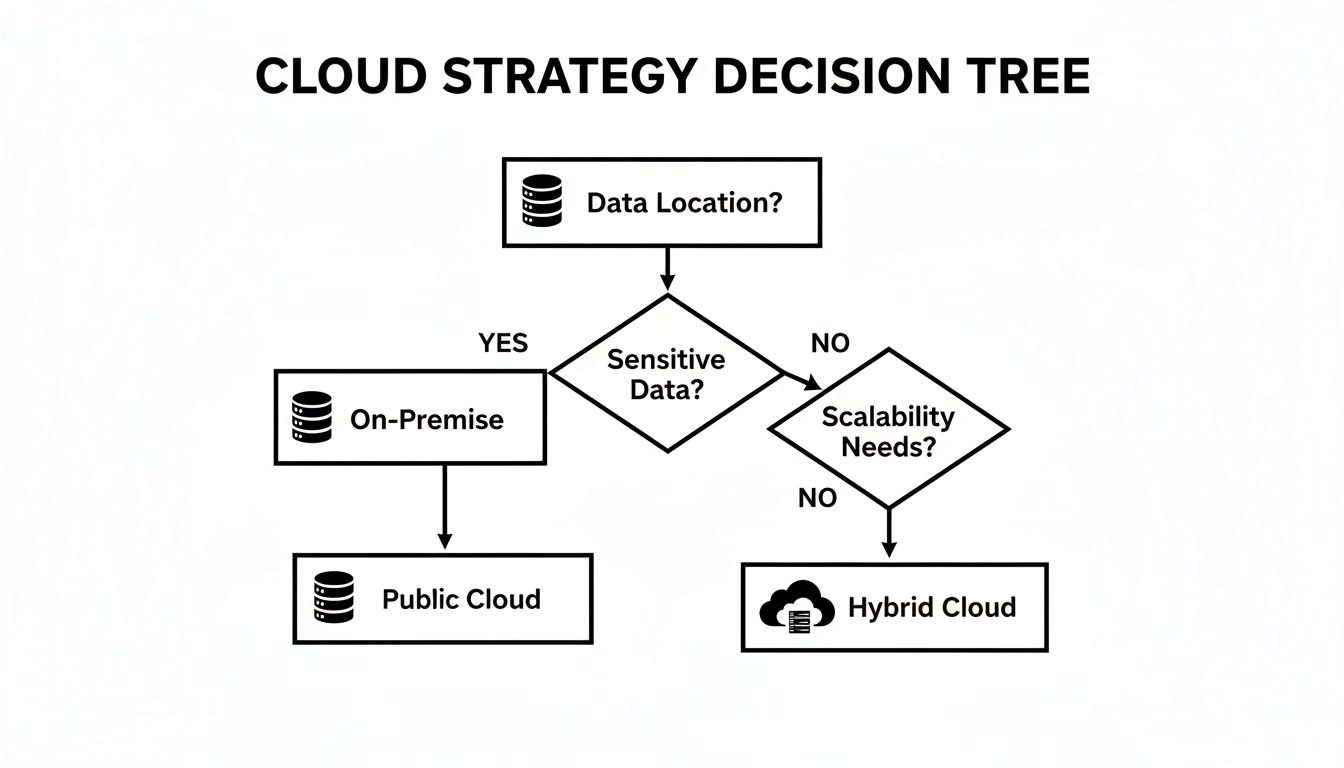
This flowchart shows how critical factors like data location and control are the fundamental starting points. Answering those first will naturally lead you toward either a hybrid model or a more distributed cloud approach.
When Hybrid Cloud Is the Right Choice
A hybrid cloud strategy is your best bet when you need to balance the tight control of on-premises infrastructure with the massive scale and services of a public cloud. It's the go-to model for any organization that can't—or simply won't—move everything off-site.
Here are a few scenarios where a hybrid model is the clear winner:
Strict Data Residency and Compliance: For industries like finance, healthcare, and government, regulations like GDPR or HIPAA dictate exactly where sensitive customer data can be stored. A hybrid model lets you keep this data locked down on-premises while using the public cloud for less sensitive workloads, like application development or data analytics.
Cost-Effective Disaster Recovery (DR): Let's be honest: maintaining a fully redundant, off-site DR facility is incredibly expensive. A hybrid approach lets you use a public cloud as a cost-effective failover target. You only pay for significant compute resources when you actually need them during a disaster.
Modernizing Legacy Systems: Many organizations are running on legacy applications that are difficult, if not impossible, to refactor for the public cloud. A hybrid architecture lets you keep these systems running on-premises while you gradually build new, cloud-native services that can securely interact with them.
When to Embrace a Multi-Cloud Strategy
A multi-cloud strategy is all about strategic flexibility and optimization. Instead of locking yourself into one ecosystem, you intentionally pick and choose services from multiple providers to build the best possible solution for each specific need.
This approach is ideal when you want to:
Avoid Vendor Lock-In: Relying on a single cloud provider creates massive business risk. A multi-cloud strategy gives you leverage and stops any one vendor from having too much control over your infrastructure and your pricing.
Leverage Best-in-Class Services: Different clouds excel at different things. You might use Google Cloud for its unmatched data analytics with BigQuery, AWS for its powerful serverless computing with Lambda, and Azure for its deep integration with Microsoft enterprise tools. This lets you build a far superior product by using the best tool for every job.
Improve Application Resilience and Availability: By deploying critical applications across two or more cloud providers in different geographic regions, you build a highly resilient system. If a major outage hits one provider, your application can fail over to another, ensuring continuous availability for your users. For more on this, check out these essential cloud migration best practices.
The trend is clear: multi-cloud strategies dominate, with a staggering 92% of organizations embracing them by combining public and private providers. This approach is far outpacing single-cloud holdouts, which sit at just 9%. This shift highlights why leaders turn to talent providers for DevOps experts versed in AWS, Azure, and GCP. Discover more insights about cloud computing adoption stats.
Ultimately, the best strategy is the one that aligns with your unique business goals. A financial services firm with strict data laws will lean hybrid, while a fast-moving SaaS company will likely embrace a multi-cloud model to maximize innovation and resilience.
Executing either strategy demands elite engineering talent. Whether you need experts to build a secure bridge for a hybrid environment or orchestrate a complex multi-cloud architecture, finding the right skills is the biggest challenge. TekRecruiter provides access to the top 1% of cloud and AI engineers globally, allowing innovative companies to build their expert teams and deploy solutions anywhere.
Breaking Down Costs and Essential Tooling

Beyond the architecture diagrams and security protocols, the real decision between hybrid cloud vs. multi-cloud often boils down to dollars and cents. The financial models and the toolchains required for each strategy are fundamentally different, and they will directly shape your budget, operational load, and ability to grow.
A hybrid cloud setup is a classic mix of Capital Expenditure (CapEx) and Operational Expenditure (OpEx). You have to factor in the Total Cost of Ownership (TCO) for your on-premise hardware—servers, storage, networking gear—plus the ongoing costs of power, cooling, and maintenance. That initial investment can be a gut punch, but it gives you a predictable cost baseline for the workloads you keep in-house.
On the flip side, a multi-cloud strategy is almost entirely OpEx. You’re in a pay-as-you-go model, consuming resources from multiple vendors. While this kills the need for upfront hardware purchases and offers incredible flexibility, it also opens the door to serious financial complexity and the very real risk of runaway spending.
Navigating FinOps Across Different Models
Financial Operations, or FinOps, is a non-negotiable discipline in either scenario, but the headaches are different. In a hybrid world, FinOps is all about optimizing workload placement. You're constantly asking: is it cheaper to run this app on-prem or in the public cloud, considering performance needs and data egress fees?
Multi-cloud FinOps is a whole different beast. Trying to manage spending across multiple providers, each with its own bizarre pricing model and billing cycle, can descend into chaos fast. When managed correctly, companies going multi-cloud can slash operational expenses by up to 30%, but that’s a big "if"—it demands a rock-solid strategy.
Hybrid FinOps Challenge: Accurately calculating the TCO of your on-prem gear to make intelligent workload placement calls.
Multi-Cloud FinOps Challenge: Getting a single, unified view of spending across all vendors to spot waste and optimize where your money is going.
The core financial trade-off is this: Hybrid gives you predictable on-prem costs but demands significant upfront CapEx. Multi-cloud provides OpEx flexibility but requires intense FinOps discipline to keep from blowing your budget.
If you want to get a better handle on your cloud budget, it's worth digging into these 10 essential cloud cost optimization strategies.
Comparing Essential Technology Stacks
Without the right tools, both models will collapse under their own complexity. The orchestration, management, and monitoring tools you choose will be dictated entirely by which path you take.
A hybrid environment needs tools that can bridge the gap between your private data center and a public cloud, creating a single pane of glass for management. It’s all about integration and consistency. In contrast, a multi-cloud toolchain is built on abstraction and interoperability, letting you manage a zoo of disparate services from one unified control layer.
Here’s a practical breakdown of how the financial and tooling considerations stack up for hybrid and multi-cloud environments.
Comparative Cost and Tooling Factors
Consideration | Hybrid Cloud Impact | Multi-Cloud Impact |
|---|---|---|
Primary Cost Model | Blend of CapEx (on-prem hardware) and OpEx (public cloud usage). Requires TCO analysis. | Almost entirely OpEx. Pay-as-you-go model across multiple vendors, risking cost complexity. |
Orchestration | Relies on tools like Azure Arc or AWS Outposts to extend a cloud control plane on-prem. VMware is also a major player here. | Heavily dependent on vendor-agnostic tools like Kubernetes and Terraform for consistent deployment. |
Cost Management | Uses vendor-native tools (e.g., Azure Cost Management) for the cloud portion, combined with manual TCO tracking for on-prem. | Demands third-party platforms like CloudHealth or Flexera to aggregate and analyze spend from all providers. |
Monitoring | Uses the same tools (e.g., Datadog, New Relic) but configured to ingest and correlate data from AWS, GCP, and Azure all at once. |
Mastering these complex financial models and toolchains isn't easy—it takes highly specialized engineering talent. Whether you need a FinOps guru to tame your multi-cloud spend or a seasoned infrastructure engineer to build that seamless hybrid bridge, finding the right people is often the biggest hurdle.
Building Your Expert Cloud Team with TekRecruiter
Choosing between a hybrid and multi-cloud strategy is just the first step. The real challenge—the one that makes or breaks the entire initiative—is execution. And execution hinges entirely on having the right engineering talent.
A brilliant cloud strategy on a whiteboard is worthless without the specialized teams needed to build, secure, and manage it. This is where most initiatives stall, hitting a talent wall that slows progress and inflates costs.
The debate over hybrid cloud vs. multi-cloud isn't just about technology; it's a referendum on your team's skills. Each path demands a completely different blend of expertise. A generalist approach just won’t cut it. You need specialists who have lived and breathed the complexities of your chosen architecture.
Assembling Your Hybrid Cloud Team
A successful hybrid cloud requires a rare combination of old-school infrastructure knowledge and new-school cloud-native talent. Your team must be equally comfortable managing on-premises hardware and public cloud services. Finding people fluent in both is tough. Building that team internally is even tougher.
The essential skills for a high-performing hybrid team include:
Deep Network Engineering: Experts who can design and manage secure, low-latency connections between your data center and a public cloud. This isn't your standard networking gig.
Data Center and Virtualization Mastery: Profound knowledge of VMware, storage systems, and traditional infrastructure is absolutely non-negotiable.
Integrated Security Skills: Professionals who can create a single, consistent security posture that spans both private and public environments, closing gaps before they can be exploited.
Crafting a Multi-Cloud Center of Excellence
A multi-cloud strategy demands a team of vendor-agnostic experts who think in terms of abstraction and orchestration. Their job is to tame the complexity of multiple platforms, creating a unified governance and operational layer that prevents chaos and runaway costs.
Key roles for a multi-cloud team focus on:
Cross-Platform Cloud Expertise: Deep, hands-on knowledge of AWS, Azure, and GCP is critical to leverage the best services from each provider without getting locked in.
Infrastructure as Code (IaC) Specialists: Engineers who have mastered tools like Terraform to automate and standardize deployments across any cloud.
Advanced FinOps Professionals: Experts who can analyze complex, multi-vendor billing to optimize spending and drive financial efficiency. They don't just track costs; they predict and control them.
The talent gap is the single biggest risk to any cloud initiative. A flawed strategy can be fixed, but a team without the right skills will fail before it even starts.
Closing this gap is the difference between a successful cloud deployment and a costly, high-profile failure. The problem is, finding engineers with these specific, high-demand skill sets is a major bottleneck for any company trying to move fast.
This is the precise challenge TekRecruiter solves. We connect you with the top 1% of cloud and AI engineers from our nearshore talent pools in Latin America and Europe.
Whether you need to master hybrid orchestration with a VMware expert or build robust multi-cloud governance with a Terraform specialist, we deliver the elite talent you need to execute your vision. Through flexible staff augmentation and direct hire services, we empower you to build your expert cloud team without compromise.
Frequently Asked Questions
As the lines between architectures blur, common questions always pop up when deciding between a hybrid or multi-cloud strategy. Getting the nuances right is the key to making a confident, future-proof decision that lines up with both your tech requirements and your business goals. Let's tackle some of the most pressing questions engineering leaders face.
Can a Company Use Both Hybrid and Multi-Cloud?
Absolutely. In fact, it's becoming the standard. The two concepts aren't mutually exclusive at all. A company can easily run a hybrid cloud (say, an on-prem data center integrated with AWS) as just one piece of a bigger multi-cloud strategy that also uses Google Cloud for data analytics and Azure for its enterprise services.
In that scenario, the hybrid setup is there to solve specific problems like data sovereignty or supporting legacy systems, while the broader multi-cloud approach gives you strategic flexibility across the board. The reality is that the 89% of enterprises now running a multi-cloud strategy often have hybrid components tucked inside that footprint.
Which Cloud Model Is Better for a Startup?
For most startups, a multi-cloud or pure public cloud approach is the only logical starting point. Startups don't have the capital for on-premise hardware (CapEx) or the legacy systems that usually push bigger companies toward a hybrid model. A multi-cloud strategy gives them maximum agility and immediate access to best-in-class services without a massive upfront investment.
This lets them build fast, scale when needed, and dodge vendor lock-in right out of the gate. A hybrid model only really enters the conversation later on, and only if very specific regulatory or performance needs demand on-premise infrastructure.
Key Insight: Startups live and die by agility and an OpEx model. A multi-cloud strategy lets them innovate faster by picking the best tools for the job, without the dead weight of managing physical hardware.
What Are the Future Trends in Cloud Architecture?
The future of cloud is all about more abstraction and interoperability. Technologies like Kubernetes are becoming the universal control plane, making it possible for applications to run the same way everywhere—on-premise, AWS, GCP, or Azure. This trend is what really blurs the lines in the hybrid cloud vs. multi-cloud debate, because the focus is shifting from where workloads run to how they're managed.
We're going to see a continued rise of platform engineering. Internal teams will build a unified "paved road" for developers that completely abstracts away the messiness of the underlying cloud providers. The end goal is to give developers a seamless experience, no matter what infrastructure is running underneath.
Executing a modern cloud strategy—whether it's hybrid, multi-cloud, or some mix of the two—demands elite engineering talent. Finding the specialists who can actually manage these complex, distributed systems is the single biggest roadblock to a successful rollout.
TekRecruiter is a technology staffing, recruiting, and AI Engineer firm that helps innovative companies deploy the top 1% of engineers, anywhere. Let us help you build the expert team you need to turn your cloud vision into a reality. Learn more at https://www.tekrecruiter.com.
Comments