Hiring remote developers: Practical strategies for global engineering teams
A practical guide to hiring remote developers: learn proven sourcing, vetting, onboarding, and managing top global engineering talent.
Hiring remote developers isn't a temporary fix anymore; it’s a core strategy for finding elite engineering talent. It’s about making a fundamental shift from a local-first mindset to a global one. This lets you tap into highly specialized skills, hit product deadlines faster, and build a more resilient team. Forget the pandemic-era scramble—this is a structured playbook for sourcing, vetting, and integrating the world's best engineers, no matter where they live.
The New Playbook For Global Engineering Talent

The gravitational center of tech talent has shattered. For decades, building a world-class engineering team meant setting up shop in a few expensive, cutthroat tech hubs. That era is over. Today, the sharpest companies know that exceptional engineers are scattered across the globe. Tapping into that worldwide talent pool isn't just a perk; it's a massive competitive advantage.
This isn't some fleeting trend. Remote positions have swelled from 4% to over 15% of all U.S. job opportunities—a staggering 275% increase. And while office-based roles are declining, fully remote tech jobs just keep growing. This is a structural change, and it's permanently reshaping how we hire.
Why Global Hiring Is Now Essential
Going global with your hiring strategy lets you move faster and build better products, period. Instead of fighting over the same small pool of local candidates, you get access to engineers with rare, specialized skills in fields like AI, blockchain, or specific cloud architectures.
This approach gives you a few key advantages:
Access to Specialized Expertise: Find developers with deep experience in niche technologies that are nearly impossible to source in a single city.
Accelerated Product Roadmaps: Scale your team on your timeline, not the local talent market’s. Meet aggressive deadlines without compromise.
Increased Team Resilience: A geographically distributed team means operational continuity and a diversity of perspectives that fuels creative problem-solving.
The modern framework for hiring remote developers is about designing a system, not just filling a role. It requires a deliberate approach to sourcing, vetting, onboarding, and management that is built for a distributed world.
For a deeper dive into the nuts and bolts of securing global engineering talent, check out this definitive guide on how to hire remote developers.
Choosing Your Remote Hiring Approach
Before you jump in, you need to decide how you'll engage with remote talent. There are a few primary models, each with its own pros and cons.
Hiring Model | Best For | Key Benefit | Management Overhead |
|---|---|---|---|
Direct Hire (EOR) | Long-term, core team members where cultural integration is critical. | Full control over the employee and their integration into your company culture. | High (You manage everything from payroll and compliance to day-to-day tasks). |
Staff Augmentation | Filling specific skill gaps for a project or scaling a team quickly without long-term commitment. | Speed and flexibility. Access to pre-vetted talent in days, not months. | Medium (You manage the work, but the partner handles HR and payroll). |
Managed Services | Outsourcing an entire project or function to a specialized team that handles everything. | Low internal overhead. You provide the goals, and the team delivers the outcome. | Low (The partner manages the team and is accountable for deliverables). |
Picking the right model depends entirely on your immediate needs, long-term goals, and how much direct management you're prepared to handle.
Building Your Global Framework
Hiring remote developers successfully means ditching the old recruiting tactics. You need a new playbook that covers everything from finding talent in unconventional places—like open-source projects or niche international communities—to integrating them seamlessly into your culture.
Navigating this new terrain involves international compliance, secure remote infrastructure, and new management techniques. It’s not easy, but the reward is an elite engineering team capable of building the future.
Finding, vetting, and integrating the world's best remote developers requires expertise. At TekRecruiter, we specialize in connecting innovative companies with the top 1% of engineers, wherever they are. Let us handle the search and vetting so you can focus on what you do best—building incredible products.
How to Source and Vet World-Class Developers
Finding truly top-tier remote developers means looking where nobody else is. The best engineers aren't scrolling through job boards; they're neck-deep in code, pushing commits to open-source projects, or debating new frameworks in niche communities scattered across the globe. If you want to build a world-class team, you have to stop posting and start hunting.
This isn't about just waiting for applications to trickle in. It's about building a proactive pipeline by showing up where the talent already is. That might mean keeping an eye on pull requests in a key GitHub repo or actually participating in technical discussions on a Discord server for developers in Latin America or Europe.
Uncovering Talent In Unconventional Channels
The engineers you really want are almost always passive candidates. They aren't looking for a job, but they might be open to the right opportunity if it’s compelling enough. To find them, you need to think like they do.
So, where do they hang out online?
Open-Source Projects: Platforms like GitHub and GitLab are living résumés. Look for consistent, high-quality contributors to projects that use your tech stack. Their public work tells you everything you need to know about their coding chops, collaboration style, and passion.
Niche Online Communities: Forget Stack Overflow. Dive deeper. Think specific subreddits, private Slack channels, or regional tech forums. When you engage authentically in these spaces, you build credibility and find talent that flies completely under the radar of traditional recruiters.
Global Tech Hubs: Your next great hire might not be in your city—or even your country. Emerging tech hubs across Latin America and Eastern Europe are pumping out incredible engineering talent from top-tier schools. Tapping into these ecosystems gives you access to a deep pool of highly skilled, motivated developers.
Finding a world-class developer often starts with a single, insightful code contribution. One of Turso's recent hires, a talented software engineer, was discovered after he started contributing to their open-source database project from his prison cell, demonstrating that exceptional talent can truly be found anywhere.
A Vetting Process Built For Remote Work
Once you've found a promising candidate, your vetting process needs to be built for the reality of remote work. An interview process designed for an office job will completely miss the mark. You need to screen for the traits that actually predict success in a distributed team: autonomy, asynchronous communication skills, and self-discipline.
Your goal is to figure out how they work, not just what they know. When you're trying to hire remote Angular 6 developers or another specialist, you have to evaluate their real-world problem-solving abilities and, just as importantly, their communication clarity.
Evaluating Asynchronous Communication
In a remote team, clear writing isn't a "soft skill"—it's a core competency. A developer who can't explain a complex idea clearly in a Slack message or a document will create bottlenecks for everyone.
The easiest way to test this is with a short, written challenge early on. Ask them to explain a technical concept they recently learned or describe the architecture of a past project in a brief document. This simple task reveals far more about their communication style than an hour-long video call ever could. You're looking for clarity, conciseness, and the ability to structure information logically.
The Practical Take-Home Assignment
Let's be honest: algorithmic whiteboard challenges rarely simulate the actual day-to-day work of a developer. A well-designed, practical take-home assignment is a much better way to see how someone tackles real-world problems.
Here’s how to make it work:
Keep it Small and Focused: The task should take 3-4 hours, max. Respect the candidate’s time. Anything longer is an unpaid project, and the best people will walk away.
Make it Relevant: Give them a problem that mirrors a real challenge your team has actually faced. This gives you direct insight into how they'd contribute from day one.
Define Success Clearly: Provide clear instructions and spell out what a "good" submission looks like. The goal is to see how they think, not to play "guess what the interviewer is thinking."
The code they submit is only half the picture. The other half is how they document their work, explain their decisions in a README, and structure the project. This is a massive indicator of their professionalism and how they’ll operate on your team. For more ideas on finding talent that isn't actively searching, you can learn more about sourcing techniques for talent who aren't job hunting.
The final interview shouldn't be another whiteboard test. Instead, make it a deep dive into their take-home project. This structured conversation lets you dig into their thought process, challenge their assumptions, and see how they handle constructive feedback—all critical skills for a high-performing remote developer.
Sourcing and vetting elite remote engineers isn’t luck; it’s a deliberate, systemized process. TekRecruiter’s expertise lies in identifying and rigorously vetting the top 1% of global talent, ensuring you connect with developers who not only have the technical skills but also the communication and self-management capabilities to thrive. Let us recruit your world-class engineering team.
Picking The Right Remote Engagement Model
Once you've figured out where to find great remote developers, the next big question is how you’ll bring them into your organization. This isn’t just an HR decision; it's a strategic one that will shape your team's flexibility, your budget, and even your long-term product roadmap. Getting the model right is just as important as picking the right person for the job.
It all comes down to a trade-off between control, cost, and commitment. Each model serves a different purpose, and as an engineering leader, you need to know which one fits what you're trying to accomplish right now—and what you'll need six months from now.
This decision tree gives you a high-level look at how to think through the sourcing, vetting, and hiring process.
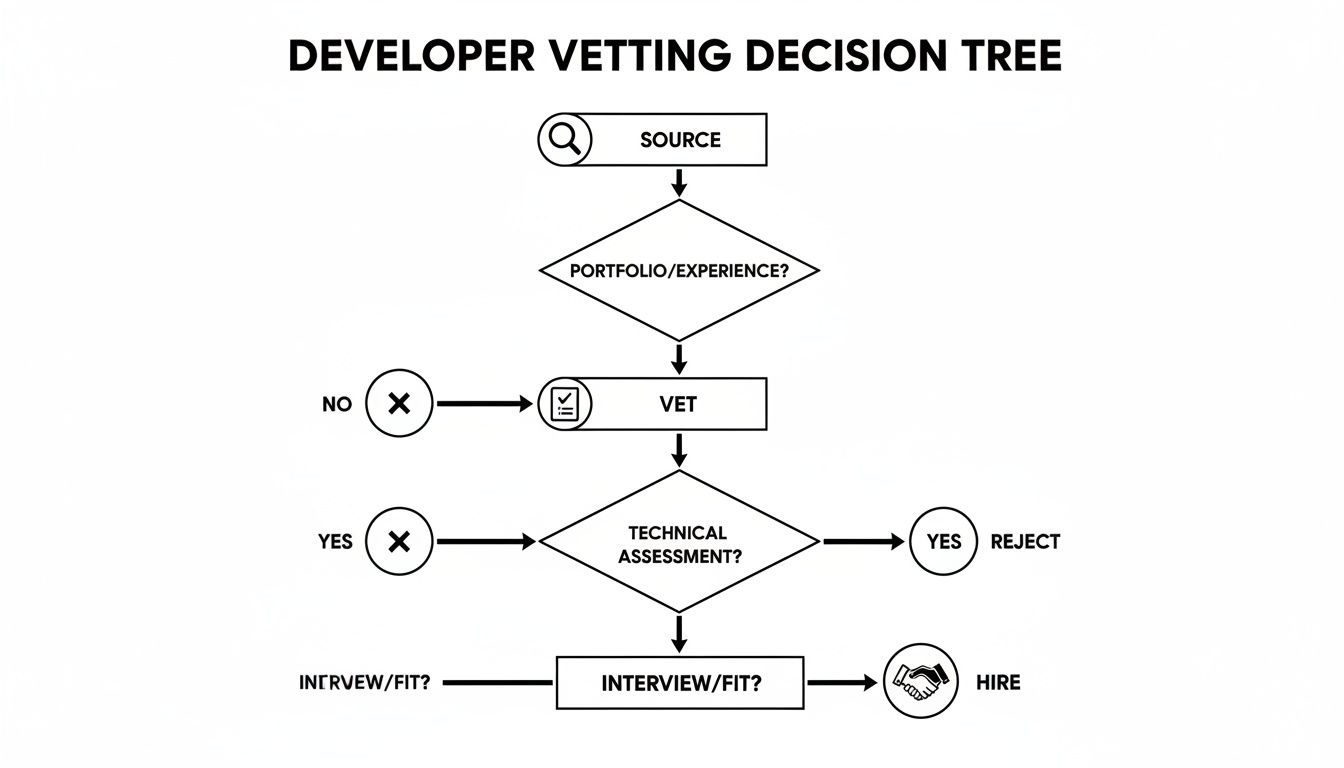
The point is to move from sourcing to hiring with a clear, logical flow. It removes the guesswork and, frankly, leads to much better outcomes.
Direct Hire: The Long-Term Investment
This is the classic approach, just adapted for a global workforce. You find, hire, and employ a developer as a full-time, permanent member of your team. This is the path you take when you're building a core team and need engineers who are all-in on your company culture and long-term vision.
With a direct hire, you get the highest level of integration and control. That developer is 100% yours. They're in your all-hands meetings, they're contributing to architectural decisions, and they're growing with the company.
But it also comes with the biggest administrative headache. You’re on the hook for everything:
International Compliance: Figuring out local labor laws, tax rules, and benefits in another country is no small task.
Payroll and HR: You'll need to set up international payment systems and manage all the cross-border HR functions.
Full Onboarding: A deep, comprehensive onboarding is non-negotiable to get them fully plugged into your culture and tech stack.
A direct hire is an investment in your company's DNA. Go this route when the role is critical to your core product, and you need someone who will bleed your company colors for years. This model is powerful, but it's also slow. The hiring process can drag on for months, and the legal and financial setup is complex enough that you’ll likely need an Employer of Record (EOR) service to handle compliance.
Staff Augmentation: Speed And Flexibility
What if you just need a machine learning expert for a six-month project? Or you have to scale your frontend team by three developers before the end of the quarter? This is where staff augmentation is a game-changer.
This model lets you bring pre-vetted, specialized developers onto your team fast to fill a specific gap or push a project over the finish line.
Think of it as "renting" an expert. A third-party firm handles all the messy HR, payroll, and compliance work. You get a skilled developer who integrates directly into your existing team, reports to your managers, and works on your projects—but they technically remain an employee of the partner firm.
The biggest win here is speed. You can often have a developer onboarded and writing code in a week or two, not months. It’s perfect for:
Hitting aggressive project deadlines without the long-term cost of a full-time hire.
Tapping into specialized skills for a single feature build.
Scaling your team up or down as business needs fluctuate.
The main trade-off? While the developer is part of your daily scrum, they aren't a permanent fixture in your company culture. Their long-term loyalty is to their actual employer. For a deeper dive, our guide on staff augmentation vs. managed services breaks down the strategic differences.
Nearshore Outsourcing: The Outcome-Based Partnership
Nearshore outsourcing is a completely different beast. Here, you aren't hiring an individual; you're engaging a dedicated team in a nearby time zone (like Latin America for U.S.-based companies) to own and deliver an entire project from start to finish. You define the "what," and they handle the "how."
This isn't about adding headcount—it's about achieving a specific business outcome. You hand over the product requirements, and the nearshore partner manages their own developers, the project plan, and the final deliverable. Your management overhead is minimal because you're focused on the result, not the day-to-day tasks.
You should seriously consider nearshore outsourcing when:
You have a well-defined project (like building a mobile app or a new API) that can be managed as a self-contained unit.
You just don't have the internal expertise or bandwidth to manage the project yourself.
Your main goal is to get a specific outcome on a predictable budget and timeline.
The obvious downside is that you give up direct, daily control over the development process. You have to place a massive amount of trust in your partner to manage their team effectively and deliver high-quality work, so choosing the right one matters. TekRecruiter can find and vet the best nearshore software development company for the project, and you contract with it directly. See how MSP & Outsourcing Search works.
Comparing Direct Hire, Staff Augmentation, And Nearshore
Each model offers a distinct set of benefits and trade-offs. Choosing the right one depends entirely on your specific goals—whether you're prioritizing speed, long-term cultural integration, or hands-off project delivery. The table below breaks down the key differences to help you decide which path makes the most sense for your team.
Feature | Direct Hire | Staff Augmentation | Nearshore Outsourcing |
|---|---|---|---|
Control Level | High. Full control over developer's tasks, career growth, and integration. | Medium. Direct control over daily tasks, but no control over long-term career. | Low. Control over project outcomes and deliverables, not daily management. |
Speed to Hire | Slow. Often 2-4 months due to sourcing, interviews, and legal setup. | Fast. Typically 1-3 weeks to get a pre-vetted developer started. | Medium. 3-6 weeks to define scope, select a partner, and kick off the project. |
Cost Structure | High upfront cost (recruiting fees) and high ongoing cost (salary, benefits, taxes). | Medium ongoing cost (hourly/monthly rate). No upfront recruiting fees. | Predictable project-based or retainer cost. Often lower total cost for defined scopes. |
Administrative Burden | High. You manage payroll, compliance, benefits, and HR for each hire. | Low. The partner firm handles all HR, payroll, and legal compliance. | Very Low. The partner manages their entire team and all associated overhead. |
Integration | Deep. Fully integrated into company culture, vision, and long-term plans. | Partial. Integrated into the project team and daily workflows, but not the company. | Minimal. The outsourced team operates as a separate unit, focused on deliverables. |
Best For | Building a core, long-term engineering team and owning institutional knowledge. | Filling skill gaps, accelerating projects, and scaling the team flexibly. | Delivering well-defined projects with minimal internal management overhead. |
Ultimately, the right model is a strategic choice that directly impacts your ability to scale and innovate. Whether you need the deep integration of a direct hire, the flexible expertise of staff augmentation, or the project ownership of a nearshore team, the goal is to build a world-class team on your terms.
Navigating Global Compliance And Security

Hiring remote developers across borders unlocks a world of talent, but it also throws you into a maze of legal, financial, and security challenges. Let’s be clear: overlooking these details isn't a minor slip-up. It can expose your company to major legal risks, crippling financial penalties, and data breaches that can stop you in your tracks.
Getting this right from the very beginning is non-negotiable. A proactive approach to compliance and security builds your global team on a solid, protected foundation. That way, you can focus on building great products instead of constantly putting out fires.
Creating Compliant International Contracts
Your employment contract is the first line of defense. A generic, one-size-fits-all template just won't cut it here. Every country has its own unique labor laws, and your contracts must reflect those local requirements to be legally sound.
A well-drafted international contract needs to lock down several key areas to protect your company's interests:
Intellectual Property (IP) Rights: The contract must clearly state that all work product, code, and inventions created by the developer belong exclusively to your company. This is your classic "work-for-hire" clause, and it's absolutely critical for protecting your core assets.
Confidentiality and NDAs: You need robust non-disclosure agreements that are actually enforceable in the developer's home country. This is how you protect your trade secrets and sensitive business info from getting out.
Termination Clauses: The contract has to outline the specific conditions and notice periods for termination, making sure they comply with local labor laws—which are often much stricter than what you might be used to in the U.S.
Misclassifying an employee as an independent contractor is one of the most common—and costly—mistakes in global hiring. The legal tests for classification vary wildly by country. Getting it wrong can lead to back taxes, fines, and mandated benefits payments.
Managing International Payroll And Taxes
Paying a developer in another country isn't as simple as wiring some cash. You have to navigate a complex web of international payroll rules, tax obligations, and currency conversions. Dropping the ball here can result in severe penalties from foreign tax authorities.
To handle this right, you need a system that can manage:
Local Tax Withholding: Correctly calculating and remitting income taxes, social security, and any other mandatory deductions required by the developer's country.
Benefits and Pensions: Understanding and administering statutory benefits like healthcare, paid leave, and pension contributions, which are often legally required.
Currency Fluctuation: Managing payments in the developer's local currency to give them stable, predictable income, while you account for exchange rate risks.
For a lot of companies, the administrative headache of doing this in-house is just too much. This is where services like an Employer of Record (EOR) are a lifesaver. An EOR acts as the legal employer in the host country, taking care of all compliance, payroll, and HR functions for you. For more on how this works, check out our guide on what an Employer of Record is.
Implementing Robust Cybersecurity For Distributed Teams
When your team is spread across the globe, your security perimeter basically disappears. A developer's home network on another continent is now a potential entry point to your company's systems. This forces a mindset shift from protecting a central office to securing every single endpoint.
A zero-trust security framework is essential. The model is simple: "never trust, always verify." No user or device gets a free pass, whether they're inside or outside your network.
Here are the key security measures you need to put in place:
Secure Device Management: Provide company-owned and managed laptops. Pre-configure them with full-disk encryption, endpoint protection, and regular software updates. And make it a rule: no personal devices for work.
Strict Data Access Policies: Use the principle of least privilege. Grant developers access only to the specific data and systems they absolutely need to do their jobs. Role-based access control (RBAC) is your friend here.
Mandatory Multi-Factor Authentication (MFA): Enforce MFA for everything—email, code repos, internal tools. It’s a critical layer of security that stops credential theft cold.
Regular Security Training: Run ongoing training on phishing awareness, secure coding practices, and data handling protocols. A well-informed team is your strongest defense.
Navigating the complexities of global compliance and security is a full-time job. At TekRecruiter, we help you find engineers who are ready for it. We recruit and vet remote developers, and an Employer of Record or your legal team can handle the payroll and compliance details. Let us handle the search so you can focus on building your elite engineering team with confidence.
Onboarding And Managing A High-Performing Remote Team

The work doesn’t stop once the contract is signed. In fact, that’s when the most critical phase really begins. You can lose a world-class engineer in the first 90 days if their onboarding is unstructured, leaving them isolated and unproductive.
Intentional onboarding is the bridge that turns a great hire into a high-performing team member. It’s how you integrate them into your company’s culture, workflows, and communication rhythms, setting the tone for their entire tenure. Without it, you’re just gambling with disengagement and early turnover.
The global appetite for remote work is undeniable. A staggering 80% of tech professionals are open to working for foreign companies. This isn't just a preference anymore; 18.6% are already working remotely for companies in other countries. On top of that, 79% of professionals say they’d show greater loyalty to employers offering flexible work. This makes a rock-solid remote onboarding and management strategy absolutely critical for retention. You can discover more insights about tech hiring statistics that drive home just how essential this process is.
A Structured 30-60-90 Day Plan For Engineers
A standardized plan is non-negotiable. It ensures every new remote developer gets the same foundational experience, providing clarity, setting clear expectations, and creating measurable milestones for both the new hire and their manager.
The First 30 Days: Immersion and Setup
The initial month is all about foundational learning and human connection. Forget about massive code output; the goal is for them to absorb information and build relationships.
Week 1: This week is purely for setup and introductions. That means getting access to all the tools, having a clear "first-day" document ready to go, and scheduling 1-on-1s with every single person on the team. Assign a dedicated onboarding buddy—this is key.
Weeks 2-4: Start them on small, low-risk bugs or features. This is the perfect way to get them into the codebase and comfortable with your deployment process without the pressure of a major deadline. Their primary KPI here is learning, not shipping code.
The Next 30 Days: Contribution and Collaboration
During month two, your new developer should start taking on more ownership. They’ll begin to shift from just learning the "how" to truly understanding the "why" behind your team's technical decisions.
Tasks: Give them a moderately complex feature to own from start to finish.
Collaboration: Expect them to actively participate in code reviews, not just be on the receiving end. They should be providing thoughtful feedback to other engineers.
The Final 30 Days: Ownership and Impact
By day 90, the developer should be a fully integrated, contributing member of the team. The training wheels come off, and they should start operating with real autonomy.
Goals: They should be capable of leading a small project or taking full ownership of a significant component of your application.
Feedback: This is the time for a formal 90-day review. Discuss their progress against the initial goals and work together to set new ones for the coming quarters.
Long-Term Management Routines
Once a developer is fully ramped up, your focus has to shift to sustained performance and engagement. This requires a different set of routines built on trust, clarity, and deliberate communication. For a much deeper look at this, check out our modern playbook for managing distributed teams.
The key to managing a remote team is to measure outcomes, not hours. Trust your engineers to manage their time, but hold them accountable for delivering high-quality work on schedule. This culture of trust and accountability is what separates high-performing remote teams from the rest.
Running Effective Remote Engineering Practices
You have to adapt your core engineering ceremonies for a distributed team. It's not optional.
Asynchronous Code Reviews: Use tools like GitHub or GitLab for reviews, but establish crystal-clear SLAs. For instance, a commitment to review all pull requests within four business hours ensures no one gets blocked by time zones.
Focused Sprint Planning: Keep these meetings concise and agenda-driven. Use a digital whiteboard tool like Miro to keep things interactive. The goal is simple: leave with a clear plan that everyone understands.
Meaningful One-on-Ones: These are more important than ever in a remote setting. Dedicate this time to career growth, honest feedback, and genuine personal connection—not status updates. Handle those asynchronously.
Building and managing a high-performing remote team is a continuous process. It demands structure, clear communication, and the right tools to foster connection and productivity, no matter the distance.
The entire lifecycle—from onboarding to long-term management—is complex. TekRecruiter simplifies this by not only sourcing the top 1% of global engineers but also vetting them for the communication and self-management skills remote teams need. From there, clear routines on your side keep high-performing remote teams thriving, so you can get back to focusing on innovation.
Build Your Elite Engineering Team With TekRecruiter
Let's be honest. Sourcing, vetting, and hiring world-class remote developers is a massive undertaking. When you add in the complexities of global compliance, cross-border payroll, and secure onboarding, it can easily derail your team from what you're actually supposed to be doing: building great products.
Trying to run this playbook in-house is a recipe for distraction. Suddenly, you’re an amateur expert in international labor laws and distributed team management, all while your roadmap grinds to a halt. This is where a real partner makes all the difference.
Stop Managing Global Hiring, Start Building Your Vision
At TekRecruiter, we’re a staffing and recruiting firm for technology and AI engineering roles, built to handle the hiring side of these headaches. We exist to take the search for elite remote engineers off your plate. You focus on innovation, we handle the recruiting grind.
Our entire model is designed to give you direct access to the world's best talent without the administrative drag that comes with it.
We connect you with the top 1% of engineers from thriving tech hubs across Latin America. This isn't just about finding someone who can code; it's about finding professionals who are deeply aligned with the communication, work ethic, and drive that define high-performing teams.
The goal isn't just to fill a role. It's to build a resilient, world-class engineering team that becomes a long-term competitive advantage. That requires a partner who understands both the art of finding global talent and the science of making distributed teams click.
Whether you need a direct hire for a key leadership role, flexible staff augmentation to hit a tight deadline, or a full team of AI engineers hired from the ground up, we recruit for it. You get the elite talent you need.
Don't let the friction of global hiring slow you down. Let's work together to recruit your elite engineering team and accelerate what's next.
Common Questions About Hiring Remote Developers
Let's be honest, even if you've been leading engineering teams for years, hiring remote developers—especially globally—opens up a whole new set of questions. Getting straight answers is the only way to build a team that actually works.
I’ve seen a few common pitfalls trip up even the best leaders. The biggest one? Using an interview process designed for an office, which completely fails to test for the skills that really matter in a remote setting, like asynchronous communication and self-management. Another classic mistake is unstructured onboarding that leaves a new hire feeling isolated and spinning their wheels for weeks.
And then there's the big one: underestimating the mess of international compliance and tax laws. It’s a surefire way to expose your company to serious legal risk. Treating your remote engineers like contractors or temporary help instead of core team members is just as damaging—it kills morale and productivity faster than anything else.
Aligning On Culture And Time Zones
When your team is spread across the globe, "culture fit" isn't about finding people you'd grab a beer with. It's about aligning on core values and, more importantly, how you work.
During interviews, skip the fluff and get into behavioral questions. Ask how they handle feedback, what their approach to collaboration looks like, and how they navigate disagreements when they can't just walk over to someone's desk. Your onboarding process needs to be crystal clear about your mission and your communication norms from day one.
The goal isn't to build a team of people who are all the same. It's to build a team that is united by how they work together, no matter their location or background. That shared operational philosophy is the real bedrock of a strong remote culture.
Managing time zones isn't about forcing everyone to be online at the same time. That’s a recipe for burnout. The key is mastering asynchronous work.
Establish a small window of 2-4 hours of "core overlap" for the meetings that absolutely have to be real-time, like sprint planning or critical syncs.
For everything else, you need to empower your team with the right tools and processes to work effectively on their own schedules. This means:
Fanatical Documentation: Your internal wiki (Confluence, Notion) needs to be the single source of truth. No exceptions.
Airtight Task Management: Use tools like Jira or Asana to define tasks with absolute precision. Leave no room for ambiguity.
Smart Asynchronous Comms: Instead of another meeting, encourage short video messages with tools like Loom to explain complex ideas. It’s faster and respects everyone’s time.
This approach gives your team the autonomy they need while keeping everyone perfectly in sync and moving forward.
You don't have to figure all this out on your own. TekRecruiter is a technology and engineering staffing and recruiting agency. We connect companies with the top 1% of engineers, wherever they are, and we handle the search so you can stay focused on building. Let us help you deploy the world's best talent. Find out more at TekRecruiter.
 Ron SmithPresident & Lead RecruiterTekRecruiter