Lead the Way in managing software development
Discover practical strategies for managing software development: build elite teams, adopt Agile and DevOps, and leverage AI to deliver better software.

Managing software development used to be about tracking tasks and hitting deadlines.Not anymore. Today, it’s about architecting an entire environment where talented teams can truly innovate and deliver exceptional value. This is the modern playbook, and it’s focused on building resilient, high-performance engineering organizations through smart team structures, efficient delivery practices, and data-driven decisions.
The New Rules for Engineering Leadership
Welcome to your guide for leading engineering in the modern era. In a world where speed and quality are everything, the old top-down management methods are breaking down. Success now demands a deliberate, strategic approach—one that combines intelligent team design, proven lifecycle methodologies, and a relentless focus on getting better every single day.
This guide will unpack the core pillars of that new approach. We're moving beyond vague theories to give you actionable strategies for building a competitive, resilient engineering organization from the ground up.
Understanding the Modern Landscape
The stakes for getting software development management right have never been higher. The global software development market is on track to hit somewhere between $570 billion and $741 billion by 2025, a massive jump from where it was in 2022. You can dig into more of the software development market trends on manektech.com.
That kind of explosive growth means leaders who can build and scale effective teams are in critical demand. This isn't just about pushing code out the door faster; it’s about creating sustainable systems that produce high-quality work, consistently.
To get there, you have to nail a few key areas:
Team Structure: Are your teams agile, scalable, and plugged directly into business goals? This is where models like nearshore development or strategic staff augmentation can be game-changers.
Delivery Practices: You need to implement battle-tested frameworks like Agile and DevOps to shorten feedback loops and get value into the hands of users faster.
Quality and Security: This can’t be a checklist item at the end. Governance has to be baked into the process from the very beginning.
Data-Driven Decisions: Use key metrics and KPIs to see what's really happening. Find the bottlenecks, measure what matters, and drive real, continuous improvement.
The real goal here is to shift your mindset from project manager to an architect of high-performing systems. Your primary job is to create the conditions for your team to thrive and innovate.
Before we dive deeper, let's pull these concepts together for a quick overview.
Key Pillars of Modern Software Development Management
This table breaks down the core pillars we'll be covering. Think of it as your cheat sheet for building a world-class engineering organization.
Pillar | Core Focus | Primary Goal |
|---|---|---|
Organization & Team Models | Designing team structures (in-house, nearshore, staff augmentation) that align with business needs and promote agility. | To build a scalable, flexible workforce that can adapt to changing project demands and market conditions. |
Development & Delivery | Implementing Agile, DevOps, and CI/CD practices to streamline the software development lifecycle. | To accelerate the delivery of high-quality software, shorten feedback loops, and increase release frequency. |
Quality & Security | Integrating quality assurance and security protocols (DevSecOps) throughout the entire development process. | To build secure, reliable, and high-performing software while minimizing risk and technical debt. |
Metrics & KPIs | Utilizing data-driven insights (DORA metrics, cycle time, etc.) to monitor performance and identify areas for improvement. | To foster a culture of continuous improvement, optimize workflows, and demonstrate engineering's value. |
Hiring & Scaling | Developing strategies for attracting, hiring, and retaining top engineering talent to build high-performing teams. | To create a world-class engineering organization capable of tackling complex challenges and driving innovation. |
Tooling & Automation | Leveraging modern tools, including AI-enabled solutions, to automate repetitive tasks and enhance productivity. | To empower engineers to focus on high-value work, reduce manual error, and improve development velocity. |
Each of these pillars is a critical component of a larger, interconnected system designed for one thing: execution.
Ultimately, managing software development successfully comes down to having the right people on your team. It’s that simple and that difficult. Finding, hiring, and keeping top-tier talent is the single most important factor, yet it remains one of the biggest headaches for leaders.
Building that dream team requires a specialized approach. TekRecruiter is a technology staffing and recruiting firm built to connect innovative companies with the top 1% of engineers on the planet. Whether you need to scale your team with elite talent or drop in a specialized AI engineer for a critical project, we provide the expertise to help you build a world-class organization.
Structuring Your Engineering Teams for Peak Performance
How you structure your engineering teams is the bedrock of your entire development operation. Get it right, and you create clear communication channels, a strong sense of ownership, and real momentum. Get it wrong, and you're stuck with bottlenecks, confusion, and sluggish delivery.
There's no single "perfect" model. A leader's real job isn't to copy-paste a trendy structure like Spotify's famous "squads and tribes," but to architect a system that fits their company's goals and culture. You wouldn't use the same blueprint for a skyscraper as you would for a single-family home. The same logic applies here—the key is to design for agility and crystal-clear responsibility.
Common Team Models and When to Use Them
Let's break down a few battle-tested structures. Each has its own distinct advantages, and knowing which one to apply is what separates good leaders from great ones.
Functional Teams: This is the classic model, grouping engineers by their specialty (all front-end devs together, all back-end devs together, etc.). It’s fantastic for building deep, specialized expertise. The downside? It can create silos and slow things down with endless handoffs between teams just to ship a single feature.
Cross-Functional Squads: Made popular by Agile, these teams are small, autonomous units with all the skills needed to take a feature from concept to launch—front-end, back-end, QA, design, you name it. This fosters intense ownership and dramatically speeds up delivery, making it ideal for product-focused work.
Team of Teams (Tribes/Guilds): Think of this as scaling the squad model. A "tribe" is a collection of squads working on the same product area. To prevent silos from forming between squads, "guilds" connect specialists across the organization (e.g., all mobile developers) to share knowledge and maintain high standards.
No matter which model you choose, none of it works without absolute role clarity. For a deeper dive, check out our guide on defining roles in Agile software development. It provides a full breakdown of who does what.
The Rise of Flexible Staffing Strategies
Today's market demands a level of flexibility that a purely in-house team often struggles to provide. This is where strategic staffing becomes a game-changer, allowing you to scale up capacity or inject specialized skills exactly when—and only when—you need them.
An engineering team's structure should be treated like a product—continuously iterated upon and improved based on feedback and performance data. What works today might be a bottleneck tomorrow.
Two powerful strategies have emerged to meet this demand:
Staff Augmentation: This is about surgically adding individual experts to your existing teams to fill a specific gap. It's the perfect move when you need a senior cloud architect for a 3-month migration or a machine learning specialist to prototype a new recommendation engine.
Nearshore Development: Instead of just one person, this strategy involves partnering with an entire dedicated team located in a nearby time zone, like Latin America. You get the cohesion of a managed team without the communication headaches and late-night calls that come with traditional offshoring.
Deciding between building in-house, augmenting your staff, or partnering with a nearshore team isn't a one-and-done choice. It's a constant strategic calculation based on your roadmap, budget, and deadlines. The smartest organizations blend these approaches, creating a hybrid model that gives them a stable core team backed by on-demand expertise.
Ultimately, designing the right team structure is about enabling great people to do their best work. To do that, you have to master the strategies for building high-performing teams, whether they're sitting down the hall or a continent away.
When you're ready to accelerate your timeline or fill a critical skill gap, finding the right talent shouldn't slow you down. TekRecruiter specializes in deploying the top 1% of engineers anywhere, providing the flexible staffing and recruiting solutions innovative companies need to build world-class teams.
Implementing Agile and DevOps Lifecycles
Your development methodology is the engine that powers your team’s output. If your team structure is the chassis, your processes are what determine how fast you can actually move. In modern software development, this means getting rid of rigid, sequential workflows and embracing something far more fluid and integrated.
Think of it like a Formula 1 team. Your success depends on three systems working in perfect harmony.
Agile is your race strategy. It's how you adapt to changing track conditions in real time. Instead of sticking to a rigid plan made months ago, you break the race down into laps (sprints), constantly gathering data and adjusting your approach to win.
DevOps is the constant communication between your driver and the pit crew. It’s the seamless collaboration between the developers writing the code (the driver) and the operations team keeping the infrastructure humming (the pit crew). Without this, the driver might pit unexpectedly, causing total chaos and costing you the race.
CI/CD is your automated, high-speed pit stop. Continuous Integration (CI) and Continuous Delivery/Deployment (CD) are the automated systems that build, test, and release your software. A perfect pit stop gets the car back on the track in seconds, fully serviced and ready to perform.
These three aren’t separate philosophies you pick and choose from. They are interlocking gears in a high-performance machine built for speed and reliability.
Building Your CI/CD Pipeline
The absolute heart of effective DevOps is the CI/CD pipeline. This is the automated assembly line that moves code from a developer's machine all the way to production. A well-oiled pipeline is your best defense against human error and your single biggest delivery accelerator. It acts as a series of automated quality gates that every single change must pass through.
The core stages look something like this:
Commit: A developer pushes new code to a central repository.
Build: The system automatically compiles the code into a runnable application.
Test: Automated tests fire off to check for bugs, regressions, and security holes.
Deploy: If everything passes, the new code is automatically pushed to a staging or production environment.
Building this pipeline isn't just about speed; it's about discipline. It creates incredibly tight feedback loops. Developers know instantly if their changes broke something, not days later during a painful manual QA cycle. That immediate feedback is what makes it possible to manage software development at scale and stop small issues from snowballing into major disasters.
Creating a Culture of Continuous Improvement
Here’s the thing—implementing these lifecycles is as much about culture as it is about tools. Agile and DevOps only work with a mindset of continuous improvement, where teams feel empowered to experiment, learn, and iterate.
This is where the "Expert Beginner" becomes a massive risk. We've all seen them: a developer who masters a specific, often inefficient, way of doing things and then just... stops learning. They're convinced they've reached the pinnacle of their craft.
The real danger of the Expert Beginner is that they stop seeking improvement. They perfect a suboptimal process and resist change, creating a drag on the team's ability to adopt better practices like automation or new testing frameworks.
To fight this, you have to create an environment that rewards learning and even celebrates smart failures. Encourage your team to question every process, carve out time for professional development, and treat failures as lessons learned. For a deeper dive, our guide on the 10 Agile development best practices offers concrete tips to help your team ship faster and more reliably.
This infographic outlines the progression of team staffing models, from building a core in-house team to expanding capabilities with nearshore partners and strategic staff augmentation.
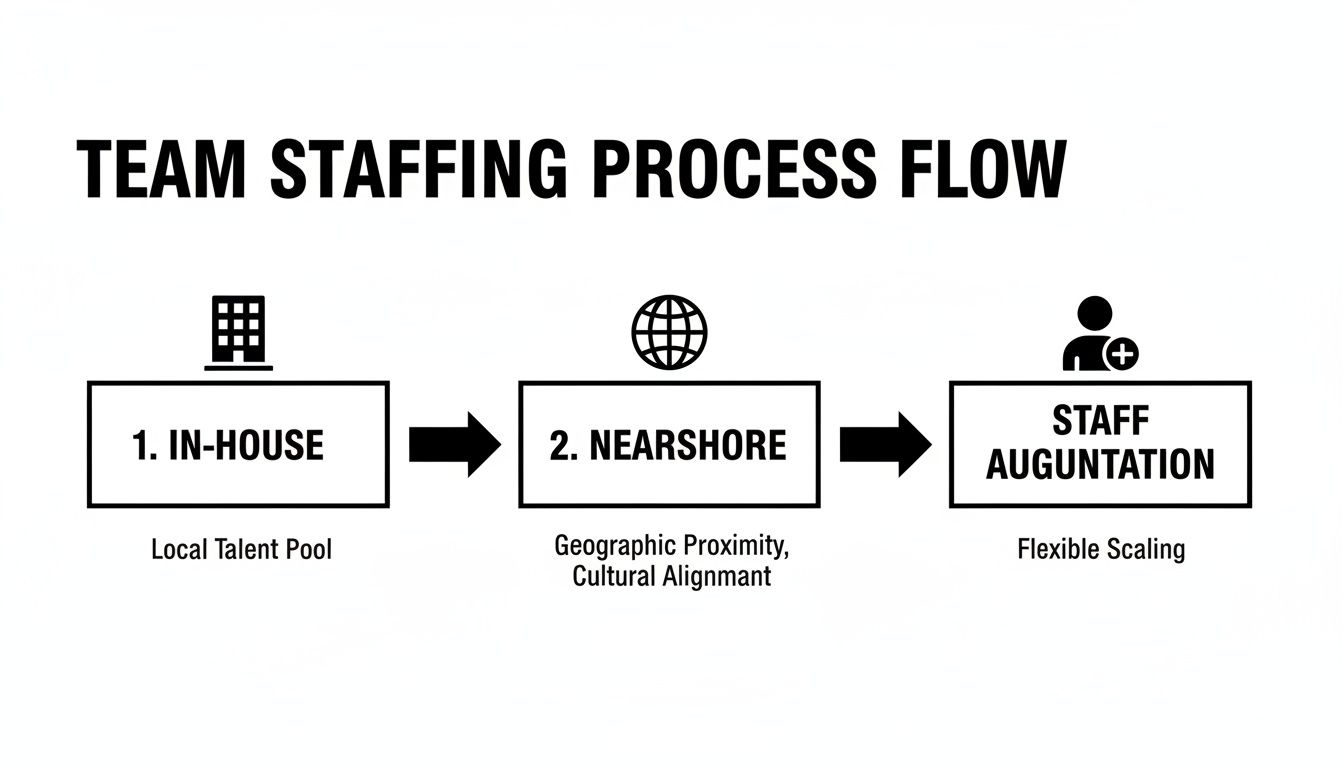
The visualization shows that effective team structure isn't static but evolves to meet strategic needs, blending internal expertise with external talent for maximum flexibility and impact.
Successfully managing software development means integrating your people, processes, and tools into a cohesive system. When your team structure, Agile practices, and DevOps automation are aligned, you create an organization that can deliver value quickly, reliably, and sustainably.
Embedding Quality and Security from Day One
For a long time, quality and security were afterthoughts—inspection stations at the very end of the assembly line. A feature got built, then tossed over the wall to QA to find bugs, and then to another team to scan for vulnerabilities.
That model is dangerously slow and ridiculously expensive. The only way to win today is to "shift left," yanking these critical checks to the very beginning of the process, where they belong.
This means quality and security are no longer someone else's problem. They're baked into every developer's workflow from the first line of code. Think about it like building a house. You wouldn't frame the entire structure and then check if the foundation was poured right. You make damn sure the foundation is perfect before you build anything on top of it. That’s the mindset you need for building software that people can trust.
Adopting a Proactive Quality Mindset
First things first: you have to kill the reactive "bug hunting" culture and replace it with a proactive "quality building" one. This isn't just about good intentions; it's about giving developers the tools and methodologies to own the quality of their work. The most powerful technique for this is Test-Driven Development (TDD).
TDD flips the usual process on its head:
Write a Failing Test: Before you write a single line of feature code, you write an automated test that defines exactly what the new code is supposed to do. Of course, it fails. The code doesn't exist yet.
Write Code to Pass the Test: Now, you write the absolute minimum amount of code required to make that one test pass. No more, no less.
Refactor: With the safety net of a passing test, you can go back and clean up your code, making it better and more efficient, confident that you haven't broken its core function.
This cycle builds an ever-growing safety net of automated tests that catches regressions instantly. It forces you to think clearly and ensures every piece of code has a clear, testable purpose. To really get a handle on this, check out our complete guide on what quality assurance in software development truly means and how it fits into the whole picture.
Building Your DevSecOps Framework
Just like quality, security has to shift left, too. The practice of weaving security into every single phase of the development lifecycle is what we call DevSecOps. The goal is simple: make security a shared responsibility, not something locked away in a siloed security team. You do this by automating security checks right inside your CI/CD pipeline.
Finding and fixing security flaws early in the development cycle can slash the cost of remediation by more than 60%. A vulnerability caught on a developer's laptop is a minor fix. That same vulnerability in production is a five-alarm fire.
Getting DevSecOps right means putting specialized tools to work for you:
Static Application Security Testing (SAST): Think of these tools as a spellchecker for your source code. They scan for known vulnerability patterns before the code is even compiled or run.
Dynamic Application Security Testing (DAST): These tools attack your running application from the outside, just like a real hacker would, to find exploitable weaknesses.
When you embed SAST and DAST scans directly into your CI/CD pipeline, you create automated security gates. If a critical vulnerability pops up, the build automatically fails. Insecure code never even gets close to production. This makes security transparent, immediate, and a core part of the daily development flow.
Measuring What Matters with Key Engineering Metrics
"You can't improve what you don't measure." It’s an old saying, but it’s the absolute truth in software development. It's dangerously easy to get lost in a sea of "vanity metrics"—numbers that look impressive on a slide but don’t actually signal the health or performance of your engineering org.
The real goal is to zero in on the key performance indicators (KPIs) that act as a true diagnostic tool. These metrics aren't just for tracking progress; they're the language you use to communicate your team's impact to the rest of the business. Get them right, and you can illuminate bottlenecks, justify investments, and guide your team toward work that actually moves the needle.
The Gold Standard: DORA Metrics
Any serious conversation about elite engineering performance inevitably starts with the DORA metrics. These aren't just buzzwords; they're four battle-tested indicators validated by years of research that measure the true effectiveness of your development and delivery lifecycle.
Deployment Frequency: How often are you pushing code to production? Elite teams don’t wait for a "release day"—they deploy on-demand, multiple times a day.
Lead Time for Changes: Once code is committed, how long does it take to get it live? This is a raw measure of your process efficiency, from a developer’s keyboard to your customer’s screen.
Change Failure Rate: What percentage of your deployments blow up in production? This is a direct, unfiltered look at your quality and stability.
Mean Time to Recovery (MTTR): When something does break, how fast can you fix it? This isn’t just about bugs; it’s about your team's resilience under pressure.
Focusing on these four metrics provides a balanced view. You can't improve speed (Deployment Frequency, Lead Time) by sacrificing stability (Change Failure Rate, MTTR). They force you to get better at the entire system, not just one part of it.
Improving your DORA metrics is one of the most powerful things you can do to accelerate value delivery and build a more reliable system. They give you a clear, data-backed picture of what your team is truly capable of.
Beyond DORA: Other Vital Signs
While DORA provides an excellent foundation, other metrics can offer deeper insights into specific areas of your engineering health, from code quality to team productivity. Think of them as the next layer of diagnostic tools. They help you pinpoint the root cause when one of your core DORA metrics starts to slip.
A few worth watching:
Code Churn: This metric tracks how often code is rewritten or deleted shortly after being committed. High churn is often a symptom of unclear requirements, scope creep, or mounting technical debt.
Cycle Time: This is the stopwatch for your internal process—it measures the time from when a developer picks up a ticket to when the work is done. It’s a fantastic indicator of friction inside the team.
Team Velocity: A classic Agile metric, velocity tracks the amount of work a team can knock out in a sprint. It's not a productivity score, but it’s invaluable for making your planning and forecasting more predictable.
Essential KPIs for Engineering Leaders
This table breaks down some of the most critical KPIs, showing what they measure and, more importantly, why you should care.
Metric Category | Example KPI | What It Measures | Why It Matters |
|---|---|---|---|
Delivery Throughput | Deployment Frequency | The rate of successful releases to production. | Indicates team agility and the ability to deliver value quickly. |
Process Efficiency | Lead Time for Changes | The time from code commit to production deployment. | Reveals bottlenecks in your CI/CD pipeline and review processes. |
System Stability | Change Failure Rate | The percentage of deployments causing production issues. | Highlights the quality and reliability of your release process. |
Team Predictability | Velocity | The amount of work completed in an iteration. | Helps with forecasting and managing stakeholder expectations. |
Ultimately, the right metrics tell a story. They show you where your team is today, where the roadblocks are, and how you’re strategically getting better over time.
Of course, building a team that can hit elite performance benchmarks requires elite talent. TekRecruiter specializes in connecting companies with the top 1% of engineers who can turn these metrics into a reality. We provide the staffing and recruiting solutions to help you build a truly data-driven, high-performing engineering organization.
Leveraging AI and Automation in Your Toolchain

The next real frontier in software development isn't just about tweaking your processes—it's about injecting intelligence into every single part of your workflow. AI and automation are completely reshaping the modern toolchain, acting as force multipliers that let leaner teams do more, faster. This isn't some far-off concept; it’s happening right now.
Think of it this way: if your CI/CD pipeline is the automated assembly line, AI is the smart robotic arm that doesn't just perform tasks but actually suggests how to make the whole line better. These tools are evolving from simple code completers into active collaborators in the dev process.
Accelerating Code Creation and Testing
One of the most immediate impacts is right where the code gets written. AI-powered coding assistants like GitHub Copilot are no longer a novelty item; they're a core part of a modern developer's toolkit. They speed up development by suggesting code snippets, completing entire functions, and even writing unit tests. This frees up your engineers to focus on high-level architecture and complex problem-solving.
This intelligence goes beyond just writing code. AI-driven testing platforms are now capable of automatically generating test cases, sniffing out edge cases a human might miss, and even predicting which parts of the codebase are most likely to break. The result is more resilient software with a fraction of the manual QA effort.
The new job of a software engineer, by the end of this year, will involve little direct coding, and a lot of agent babysitting. The sooner you get on board with that, the easier your life will be.
Automating Infrastructure and Project Management
Automation's reach extends far past the codebase. There's a reason Infrastructure as Code (IaC) tools like Terraform and Ansible have become the industry standard. They give teams the power to define and manage their entire tech stack with code, making environment provisioning repeatable, predictable, and incredibly fast.
What does that mean in practice? Spinning up a new testing environment is no longer a multi-day process bogged down by tickets. It's an automated script that runs in minutes.
AI is also seeping into project management tools, offering scarily accurate effort estimations and risk predictions. By analyzing historical project data, these systems can flag potential roadblocks and timeline risks before they become five-alarm fires. This gives leaders a powerful new lens for strategic planning. The future of managing software development is all about partnering with these intelligent systems.
Building a team that can actually use these advanced tools means you need access to a very specific kind of talent. TekRecruiter is a technology staffing and recruiting firm that connects innovative companies with the top 1% of engineers, anywhere. Whether you need an expert in AI-driven automation or a seasoned IaC specialist, we deploy the elite talent you need to build a future-ready engineering organization.
Build Your Elite Engineering Team with TekRecruiter
When it's all said and done, every strategy, framework, and tool for managing software development comes down to one thing: talent. Nothing else matters more. Building a world-class engineering team is the single most important investment you can make, but actually finding, vetting, and keeping that top 1% of engineering talent is a massive undertaking for any company.
This is where your focus as a leader has to be. The slickest development lifecycle or the most advanced AI toolchain on the planet will fall flat without the right people to bring the vision to life. You need engineers who don't just have killer technical chops but who live and breathe a culture of ownership and constant improvement.
The Real Challenge of Finding Talent Today
Here’s the thing: finding this kind of elite talent has become a full-time job in itself. The market is brutally competitive, and the engineers you really want aren't scrolling through job boards. They’re already deep in challenging work, which makes them incredibly hard to reach and even harder to pull away. This is how leaders end up spending more time hunting for candidates than actually leading their teams.
If you want to go deeper on just how complex it is to attract top developers right now, check out our ultimate guide to recruiting and hiring software engineers. It breaks down what it truly takes to build a winning team today.
The real cost of a slow hiring process isn’t just an empty seat. It’s the lost momentum, the missed deadlines, and the delayed innovation that sends ripples across your entire organization.
Stop losing your most valuable asset—your time—trying to find a needle in a haystack. To manage software development effectively, you need to be leading your team, not running a recruitment agency on the side. This is where partnering with a specialist gives you a massive advantage, opening up a direct line to a pre-vetted talent pool you simply won't find on your own.
At TekRecruiter, we are a premier technology staffing, recruiting, and AI Engineer firm that empowers innovative companies to deploy the top 1% of engineers anywhere in the world. Whether you need to scale your team with staff augmentation, hire a permanent leader, or inject specialized AI expertise for a mission-critical project, we deliver the engineering firepower you need to innovate and win.
Don't let the talent gap slow your progress. Contact us today to start building your dream team.