_edited.png)
Mastering Project Management and Resource Allocation
For any tech leader worth their salt, project management and resource allocation isn't just another box to check—it's the engine that turns your entire strategy into something real. It’s how you make sure your most valuable assets, your people, are pointed at the right problems at the right time. Get this wrong, and you’re staring down the barrel of failed projects, blown budgets, and a burned-out team.
Why Resource Allocation Is Your Most Critical Leadership Skill
Think of a CTO or VP of Engineering as the air traffic controller for a global airline. You're not just watching planes. You're managing a complex fleet of projects, each with its own destination (goals), crew (engineering teams), and fuel load (resources). Your job is to make sure every flight gets off the ground on time, follows a clear path, and lands safely—without crashing into another project or running out of gas mid-air.
That’s what strategic leadership in tech looks like today.
The True Cost of Poor Allocation
When you treat resource allocation like a simple administrative chore, the damage ripples through the whole organization. It’s not just about one missed deadline. It’s a cascade of problems that systematically destroys efficiency and morale.
What does it look like on the ground?
Constant Firefighting: Your teams are constantly getting yanked off planned work to deal with the latest "urgent" request. This context-switching is a productivity killer. Studies show that even a small interruption can blow up an engineer's focus for over 20 minutes.
Hidden Burnout: Your best engineers—the ones you count on to deliver—are always over-allocated. They become the default solution for every problem, which leads directly to exhaustion and, eventually, turnover.
Strategic Drift: Those critical, long-term initiatives that will actually move the needle? They get pushed back again and again because everyone is tied up in low-value, high-visibility tasks.
In project management, resource allocation is the strategic deployment of your company’s assets—people, time, and budget—to get the job done. It's about matching the right resources to the right tasks to hit your goals without waste.
From Reactive Tasking to Strategic Deployment
Getting this right means shifting from a reactive, "whack-a-mole" state to a proactive, strategic one. It takes a system that aligns every engineer's time with the company's biggest priorities. For leaders who are serious about this, understanding the core principles of resource allocation is the perfect place to start.
This guide is your playbook. We'll break down actionable frameworks, the KPIs that actually matter, and the modern tools you need to manage distributed engineering teams and deliver results, every single time.
Of course, executing a great strategy requires more than just a plan; you need the right talent ready to go. TekRecruiter specializes in connecting you with the top 1% of engineers, so you can fill critical skill gaps and scale your teams exactly when you need to.
Contact us today and let's build a world-class engineering team that can execute any project with precision.
Mastering Core Resource Allocation Frameworks
Moving from a reactive, fire-fighting mode to strategic leadership demands a solid mental toolkit. Real project management and resource allocation isn’t about just plugging names into a calendar; it’s about applying proven frameworks to sharpen your decision-making. These models give you the structure to see around corners, get the most out of your teams, and actually deliver what you promised.
Let’s unpack three foundational frameworks that will completely change how you think about your team’s capacity and project timelines.
This isn’t just abstract theory. Great leadership is about translating a high-level vision into the day-to-day reality of projects getting done.
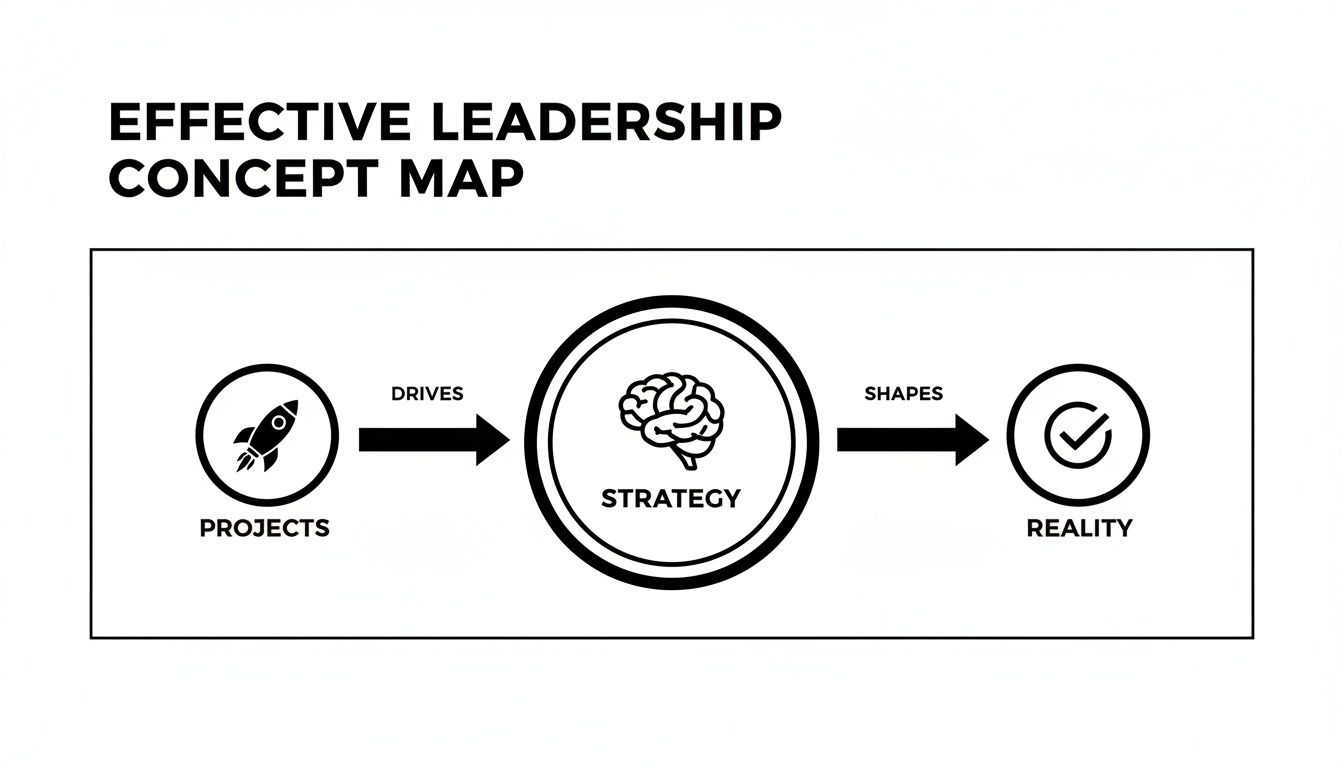
This flow makes it clear: projects are the engine that turns a brilliant idea into a successful outcome. That's why having a handle on resource frameworks is non-negotiable.
Capacity Planning: The Power Grid Analogy
Think of your entire engineering department as a city's power grid. Capacity planning is how you measure the total amount of "engineering electricity" you can generate versus the demands of every project plugged into the system. It’s about knowing your absolute limits before you say yes to the next big thing.
Without this, you're just asking for system-wide blackouts (team burnout) or wasting precious energy (underutilization). Good capacity planning boils down to a few key activities:
Calculating Total Capacity: Add up the available work hours for every single engineer. Don't forget to factor in PTO, holidays, and all the non-project work like meetings, code reviews, and training.
Forecasting Demand: Map out the resource hours needed for all current and upcoming projects on the roadmap.
Identifying the Gaps: Compare your total capacity against the forecasted demand. This is where you’ll immediately see where you have a surplus or, more likely, a deficit.
This framework gives you a high-level, strategic view to answer the big questions: Can we take on this new project? Do we need to hire more people? Nailing the demand forecast is critical, and you can get a better handle on that process with our guide on software development cost estimation.
By proactively managing your "power grid," you ensure a steady, reliable flow of work. You stop overloading circuits and make sure every project gets the energy it needs to succeed.
Resource Leveling: The Traffic Control Analogy
If capacity planning is the power grid, then resource leveling is the traffic control system for a busy highway. It’s a tactical move you use when you know you have enough total capacity, but every project needs your lead DevOps engineer at the exact same time—creating a massive bottleneck.
Instead of letting work pile up and cause gridlock, resource leveling smooths out the flow. This often means adjusting project timelines or staggering start dates to make sure no single person is over-allocated at any given moment. It creates a more manageable and sustainable pace for the whole team, which is a cornerstone of effective resource allocation strategies.
Critical Chain Project Management: The Relay Race Analogy
Critical Chain Project Management (CCPM) flips the script. Instead of focusing on individual task deadlines, it's all about protecting the overall project completion date. Think of it like coaching a relay race team. You don't care about each runner's individual split time as much as you care about the baton crossing the finish line as fast as possible.
In CCPM, the "baton" is the project timeline, and your resources are the "runners." The framework identifies the longest string of dependent tasks (the critical chain) and focuses every effort on protecting it. This is done by adding strategic time buffers to the end of the project, not by padding every single task. This simple shift stops small delays from cascading and keeps the entire team locked in on the ultimate goal.
To give you a sense of just how important these frameworks are becoming, the Project Management Institute estimates the world will need 30 million more project management professionals by 2035 just to keep up with demand. For tech leaders, this talent gap means the risk isn't just about budgets anymore; it's about whether you can even find the qualified people you need.
To help you decide which framework fits a given situation, here’s a quick comparison.
Comparing Resource Allocation Frameworks
Framework | Primary Focus | Ideal for Projects That Are... | Potential Challenge |
|---|---|---|---|
Capacity Planning | Strategic, long-term availability vs. demand | High-level, roadmap-driven, and involve multiple teams | Can be too coarse for day-to-day task management |
Resource Leveling | Tactical, short-term workload balancing | Predictable, with well-defined tasks and known dependencies | Can extend project timelines if not managed carefully |
Critical Chain (CCPM) | Project-level, protecting the final delivery date | Complex, with many dependencies and a high risk of delays | Requires a significant cultural shift away from task-level deadlines |
Each of these models offers a different lens for looking at the same problem. The real skill is knowing which one to apply and when.
Mastering these frameworks is a huge step forward, but they only work if you have the right talent in place. TekRecruiter connects you with the top 1% of engineers globally, so you can fill those critical skill gaps and build teams that can execute any project with precision.
Tracking KPIs That Actually Matter

If you're going to build a winning strategy, you need to measure what actually moves the needle. It's shockingly easy to drown in data that looks good on a slide deck but tells you absolutely nothing about the health of your engineering operations.
Forget the vanity metrics. We need to focus on the key performance indicators (KPIs) that tell the true story of your team’s capacity, your project's momentum, and your financial discipline.
These aren't just numbers to fill a report. Think of them as the vital signs for your entire engineering org. They give you the hard data to make smart, proactive decisions instead of just running on gut feel.
Resource Utilization: The Heartbeat Monitor
First up is the Resource Utilization Rate, which is probably the most fundamental metric in resource allocation. It's the heartbeat monitor for your team's workload, showing you exactly what percentage of an engineer's time is spent on productive, billable project work.
This one metric tells you a ton about both efficiency and employee well-being. If the rate is consistently low, you might have an efficiency problem or a forecasting miss. But if it's pegged to the max? That’s a five-alarm fire drill for burnout.
An ideal utilization rate typically falls between 70% and 85%. Rates consistently above 90% almost always lead to burnout and a drop in quality. Anything below 70% suggests you either have room to take on more work or your current projects are poorly scoped.
Keeping an eye on this KPI is how you balance workloads, protect your team from overload, and make sure you’re getting real value from your people.
Schedule Variance: The Project GPS
Next, you need a GPS for your project roadmap. That's Schedule Variance (SV). It measures the gap between where you planned to be on a project and where you actually are, telling you precisely how far you’ve drifted off course.
A positive SV means you're ahead of schedule—great news. A negative SV means you're falling behind.
The calculation is simple: Earned Value (EV) - Planned Value (PV). But its power is in early risk detection. It forces you to answer the tough questions before it's too late:
Are we really on track to hit our deadline?
Do we need to shift people around to get a critical project back on course?
What hidden bottlenecks are slowing us down that nobody's talking about?
Tracking SV is the difference between hoping you'll hit your dates and knowing where you stand.
Planned Vs. Actual Hours: The Financial Audit
Finally, comparing Planned vs. Actual Hours is the financial audit for your team's time. It's a direct comparison of the hours you thought a task would take versus the hours it really took. This is an incredibly powerful tool for getting better at forecasting and truly understanding your team's efficiency.
When you see a big gap between planned and actual, it usually points to one of three things:
Scope Creep: The project is getting bigger than you signed up for.
Bad Estimates: Your initial planning was way too optimistic or missed some key complexities.
Performance Issues: Someone might be struggling with a task or doesn't have the right skills for the job.
Tracking this KPI creates the feedback loop you need to tighten up your estimation process. Over time, this leads to more predictable projects and budgets that don't get blown to bits. Build a simple dashboard with just these three KPIs, and you'll fundamentally change how you manage your teams.
Of course, hitting your KPIs isn't just about metrics; it's about having the right talent. TekRecruiter allows innovative companies to deploy the top 1% of engineers anywhere, ensuring you have the elite skills needed to keep your projects on track and your KPIs in the green.
How Modern Tools Automate Smarter Allocation
Trying to manage a complex engineering team with spreadsheets is like navigating a modern city with a hand-drawn map. It’s an outdated approach that guarantees you'll get lost, hit traffic jams, and ultimately fail to reach your destination. To succeed at scale, you need a GPS—dedicated project management and resource allocation software that gives you real-time visibility and powerful automation.

These platforms move you past guesswork and manual tracking. They offer a single source of truth for your entire operation, giving you the clarity needed to see who is working on what, connect globally distributed teams, and make data-driven decisions on the fly.
From Manual Tracking to a Single Source of Truth
The real problem with manual systems like spreadsheets is fragmentation. Information is scattered across different files, often outdated, and completely disconnected from the actual work getting done. Modern project management tools solve this by centralizing everything.
When your entire team’s capacity, project timelines, and task assignments live in one system, you gain immediate, powerful insights. Leaders can instantly spot potential bottlenecks, identify underutilized talent, and shift resources around before a small issue becomes a full-blown crisis.
This unified view is a total game-changer. While the project management software market is set to hit $12.02 billion by 2030, a shocking 23% of organizations are still flying blind without these dedicated tools. For the companies that do invest, 77% of their high-performing projects are directly tied to these platforms, proving just how much they move the needle.
Key Features That Drive Smarter Allocation
Not all tools are created equal, but the best platforms share a few critical features built to automate and simplify resource management. These capabilities free you from tedious admin work, letting you focus on high-impact strategic decisions instead.
Look for tools that provide:
Real-Time Dashboards: At-a-glance visibility into team workloads, project progress, and resource utilization rates.
Automated Alerts: Notifications for over-allocation, upcoming deadlines, or budget risks, so you can intervene proactively.
Skills-Based Assignment: The ability to tag engineers with specific skills, making it dead simple to find the right person for a new task.
Scenario Planning: "What-if" features that let you model the impact of a new project on your existing resource plan.
Automation is the key to unlocking strategic leadership. When the system handles the tedious work of tracking and alerting, you are free to focus on aligning your team with the business's most important goals.
The Spectrum of Allocation Tools
The market for these tools is broad, ranging from comprehensive, all-in-one solutions to highly specialized software. Understanding the different types helps you choose the right fit for your team's maturity and specific needs.
All-in-One Project Management Platforms: Tools like Jira, Asana, and monday.com combine task management, collaboration, and resource planning features. They are excellent for teams that want a single system to manage the entire project lifecycle.
Specialized Resource Management Software: Platforms like Float or Resource Guru focus exclusively on resource scheduling and capacity planning. These are ideal for organizations with complex resource pools or for supplementing an existing task management tool.
Professional Services Automation (PSA) Tools: Solutions like Kantata are designed for service-based businesses, integrating project management with time tracking, billing, and financial reporting.
The core takeaway is that automation is no longer a luxury; it’s a necessity for effective project management and resource allocation. By implementing the right tools, you connect your entire global team, ensure everyone is aligned and productive, and create the operational excellence needed to deliver consistently. For a deeper look at how this works, you can learn more about what AI automation is and how it works in our detailed guide.
Finding the right tool is a big step, but a tool is only as good as the talent using it. TekRecruiter gives you on-demand access to the top 1% of engineers and AI specialists anywhere in the world. Contact us to build an elite, globally distributed team that can execute your most ambitious projects with precision.
Building Governance for Global Engineering Teams
In a distributed world, tools and frameworks only get you so far. What truly separates a high-performing global team from a chaotic, disconnected one are the unsexy fundamentals: clear processes and deliberate communication.
Without a shared rulebook, even the most brilliant engineers spread across different time zones will inevitably struggle to stay aligned.
Think of it like conducting an orchestra. The project leader is the conductor, but they need clear sheet music (governance) and cues (communication) to make sure every engineer—whether they’re in the same room or a continent away—plays in perfect harmony.
This is the structure that allows your onshore, nearshore, and augmented teams to deliver a flawless performance together.
Clarifying Roles with a RACI Chart
Ambiguity is the fastest way to inject friction into a global team. When roles are fuzzy, tasks get dropped, decisions stall, and accountability evaporates. The RACI chart is a dead-simple, yet incredibly powerful, tool to cut through that confusion.
RACI is just an acronym that defines who does what:
Responsible: The person actually doing the work.
Accountable: The single person with ultimate ownership for the task's success. There can only be one.
Consulted: The subject matter experts you need input from before work can happen.
Informed: People who just need to be kept in the loop on progress. No action is needed from them.
When you map out your key project deliverables and assign a RACI designation for each team member, you create an undeniable source of truth. No more guessing games about who owns a decision or who needs to approve a release.
This clarity is non-negotiable when you’re managing a mix of employee types and locations. As you bring on specialized talent, understanding what nearshore outsourcing is and how it works helps you define these roles effectively from day one.
A good RACI matrix is a social contract for your team. It proactively answers the questions, "Who do I talk to about this?" and "Is this my call to make?"—saving countless hours of back-and-forth.
Establishing Cross-Time-Zone Protocols
Once everyone knows their role, the next hurdle is communication that respects geography. Forcing your team in Europe to join a daily stand-up at 7 PM their time is a fast track to burnout and resentment. Smart governance for distributed teams means building intentional, asynchronous-first communication habits.
This boils down to a few practical rules everyone agrees to live by.
Define Core Overlap Hours: Find a 2-4 hour window where everyone, across all time zones, is expected to be online for real-time collaboration. Protect this time fiercely. It's for high-stakes syncs, brainstorming, and critical decisions—not for status updates that could have been an email.
Standardize Reporting Formats: Create simple, consistent templates for daily or weekly updates. A project manager in the US should be able to instantly grasp the progress made by an engineer in Latin America without needing a live call.
Document Everything: Make decisions and important conversations visible and accessible to the whole team, no matter when they log on. Use shared documents, a company wiki, or comments in your project management tool as the official record. This kills the "you had to be there" meeting culture.
By building this operational blueprint, you create a system where performance isn't tied to a physical location. Every engineer, whether they’re down the hall or an ocean away, knows the rules of engagement and sees exactly how their work connects to the bigger picture.
This structured approach is the foundation for scaling global teams effectively. But governance alone isn't enough; you also need access to the right talent. TekRecruiter specializes in connecting innovative companies with the top 1% of engineers anywhere in the world. We help you build the elite onshore, nearshore, or augmented teams that can execute within any governance framework.
Build Your Elite Engineering Team with Strategic Staffing
Even the sharpest frameworks and most precise KPIs fall flat without one thing: the right people. At the end of the day, effective project management and resource allocation comes down to talent. This is where strategic staffing flips the entire script, turning what used to be a frustrating bottleneck into a serious competitive advantage.
That global engineering talent gap you hear about? It’s not a barrier. It’s an opportunity to build a team that’s more flexible, skilled, and resilient than ever before.
When your internal team is slammed or a project suddenly requires niche skills you don’t have, your roadmap shouldn’t have to grind to a halt. Instead of seeing hiring as that same old slow, traditional process, modern leaders treat staffing as a dynamic extension of their resource strategy. It's about being able to deploy elite talent exactly when and where you need it.
Moving Beyond Traditional Hiring Constraints
Let’s be honest: traditional hiring is almost always too slow for the speed of modern projects. The whole cycle of sourcing, vetting, and onboarding can drag on for months, leaving your most critical initiatives in limbo. Strategic staffing turns that model on its head.
It gives you on-demand access to a global pool of specialists, letting you:
Fill Critical Skill Gaps Instantly: Need a machine learning expert for a three-month sprint? Augment your team with a specialist tomorrow instead of waiting months to find a full-time hire.
Scale for New Initiatives: Seamlessly add engineers to attack a new product launch without the long-term overhead of permanent roles.
Deploy Specialized Expertise: Bring in certified cloud architects or cybersecurity pros to handle those complex, high-stakes tasks that can’t wait.
Strategic staffing isn’t just about filling seats. It’s a deliberate method for ensuring your project teams have the exact skills required to succeed at every stage, completely eliminating talent-related bottlenecks.
The Power of a Flexible, Global Workforce
Building a world-class team no longer means restricting your search to a 30-mile radius around your office. When you embrace a globally distributed model, you unlock a much wider range of skills and experience. It’s about building a blended team of onshore, nearshore, and augmented pros who can execute with precision, around the clock.
This kind of flexible workforce is the secret to mastering modern project management and resource allocation. It gives you the agility to react to market shifts, crush development timelines, and ensure your most important projects are always in the hands of top-tier talent.
Navigating this new landscape can feel complex, but our guide to recruiting and hiring software engineers breaks down the modern best practices. It’s time to stop letting talent constraints dictate your roadmap.
TekRecruiter provides on-demand access to the top 1% of engineers and AI specialists on the planet. Partner with us to build a world-class, globally distributed engineering team that can execute any project with precision. Discover how our staff augmentation, direct hire, and managed AI solutions can power your success.
Common Questions, Straight Answers
Even with the best game plan, you're going to have questions as you dial in your resource allocation. Here are some of the most common ones I hear from tech leaders, along with no-fluff answers.
Where Do We Even Start Improving Our Resource Allocation?
It all starts with visibility. You can't manage what you can't see. Your very first move is to get a crystal-clear picture of your current resource pool and the work piled on their plates.
This means building a real skills inventory—knowing exactly what each person on your team can do. At the same time, you need to audit every single active and upcoming project to map out what they actually require. Too many teams get this wrong, relying on gut feel instead of data.
The fastest way to do this is to get everything out of those scattered spreadsheets and into a single source of truth, like a real project management tool. This simple step gives you the baseline you need to start applying frameworks like capacity planning and immediately spot where your engineers are overloaded or where you have glaring skill gaps.
How Do We Handle Last-Minute, "Everything's on Fire" Projects?
Surprise high-priority projects are a fact of life. The trick is to plan for the unexpected by building flexibility right into your allocation strategy. If you don't, you'll be in a constant state of chaos.
A solid best practice is to stop scheduling your engineers at 100% capacity. It’s just not realistic. Intentionally leave a buffer of 10-15% for urgent bugs, stakeholder requests, or those inevitable "drop everything" tasks. This buffer is your shock absorber; it prevents every little emergency from derailing your entire roadmap.
You also need a clear triage process. Set up a steering committee with key stakeholders who can objectively weigh a new request against the business impact of ongoing work. This stops the ad-hoc "he who yells loudest" decision-making and gives you a structured way to delay, descope, or consciously re-prioritize other initiatives.
Resource Allocation is the specific action of assigning and scheduling available resources to tasks for a defined period. Resource Management is the broader, ongoing strategic process that includes allocation, capacity planning, forecasting, and skills development across the organization.
What’s the Difference Between Resource Allocation and Resource Management?
People use these terms interchangeably all the time, but they're not the same. It’s the difference between a single action and an entire strategy.
Think of it like this:
Resource Allocation: This is the tactical move. It's the "who, what, and when"—assigning a specific engineer to a specific task for a set amount of time.
Resource Management: This is the strategic discipline. It’s the whole game. It includes allocation, but it also covers forecasting future needs, managing team capacity, developing skills, and making sure all your resources are being used effectively to hit long-term business goals.
Simply put, allocation is one crucial play you run within the much larger game of resource management.
Nailing your project management and resource allocation is far easier when you have the right talent on demand. TekRecruiter is a technology staffing and recruiting firm that allows innovative companies to deploy the top 1% of engineers anywhere in the world.
Don't let talent shortages dictate your roadmap. Build a world-class team that can execute any project with precision. See how our flexible staffing and AI engineering solutions can power your next win.
The dryer gave me one warning before it quit: a hot electrical smell that disappeared after I stopped the cycle. I did not ignore that. I unplugged the dryer, opened it up, and checked the belt, drum rollers, and blower area. Everything pointed to a tired drive motor. Appliance Parts 4 All had the Whirlpool motor assembly listed under the number I found, and the product details confirmed it included the threaded shaft and integrated pulley. The replacement I bought was WP2200376, the Whirlpool dryer drive motor assembly for turning the drum through the belt system. I ordered it because the dryer cabinet and heating system were still in decent condition, and replacing the motor made more sense than buying…
My experience with company formation in UAE started after several years of running an online business from Europe. As the company grew, I wanted a more international structure that would support future expansion. The UAE appeared repeatedly during my research because of its strong business infrastructure and reputation among entrepreneurs. Before making a decision, I spent weeks reading guides and comparing jurisdictions. One of the resources that helped me understand the landscape was https://sorp.ae/en/. I found useful explanations regarding business licensing, market entry strategies, and company registration options. What many people don't realize is that choosing the correct structure is just as important as registering the company itself. Different business models require different approaches, and understanding these differences early prevents…
Иногда самые простые категории товаров оказываются самыми востребованными. Именно такую ситуацию я заметил в своем магазине, когда проанализировал продажи за несколько месяцев. В лидерах оказались футболки и майки, поэтому я решил расширить ассортимент в этом направлении. В процессе поиска интересных предложений наткнулся на https://turanline.com/ru/men/mens_clothing/men_tank_tops_t-shirts и начал изучать представленные варианты. Меня привлекло разнообразие моделей и возможность подобрать товары для разных покупателей. Особенно понравилось качество материалов и современный внешний вид продукции. После первой поставки многие модели быстро появились в заказах постоянных клиентов. Некоторые покупатели специально возвращались за другими расцветками тех же моделей. Такой результат подтвердил, что направление выбрано правильно. Сейчас продолжаю регулярно пополнять ассортимент этой категорией товаров.
Traveling to the Caribbean has always been an experience I thoroughly enjoy, but I am also aware of the importance of being prepared for any medical unforeseen events during the trip. That is why, before my trip to Antigua and Barbuda, I decided to look for a suitable policy that offered comprehensive protection abroad. I needed international medical assistance, emergency coverage, hospitalization benefits, and support in the event of any incident during my stay. I found a very practical option that allows everything to be handled quickly and entirely online, which made trip planning much easier. This enabled me to avoid complications and travel with greater peace of mind. I purchased the policy via https://auras.insure/travel-insurance-america/antigua-and-barbuda/ and had everything confirmed within…
Antes de reservar mi vuelo a Bermudas, decidí revisar cuidadosamente todos los aspectos de seguridad del viaje, especialmente la cobertura médica, ya que no quería correr riesgos innecesarios en un destino tan particular. Sabía que era importante contar con asistencia médica internacional, emergencias y hospitalización durante toda la estancia, así que busqué una solución completa y fácil de gestionar. Encontré un servicio muy práctico que permite contratar todo de forma digital, sin papeleo ni procesos largos, lo que me ahorró tiempo en la preparación. Esto me dio mucha confianza antes de viajar. El sistema es simple y rápido, ideal para resolver todo antes de la salida. Utilicé https://auras.insure/travel-insurance-america/bermuda/ y recibí la confirmación casi al instante. Desde entonces viajo con mayor…