_edited.png)
Top 10 Infrastructure as Code Best Practices for Scalable DevOps in 2026
In today's fast-paced digital landscape, simply automating infrastructure isn't enough. The true competitive advantage lies in building resilient, secure, and scalable systems with velocity. Infrastructure as Code (IaC) is the foundational practice that makes this possible, transforming infrastructure management from a manual, error-prone task into a disciplined, software-driven process. However, adopting IaC without a clear strategy can lead to technical debt, security vulnerabilities, and operational chaos. This guide cuts through the noise to provide a comprehensive roundup of the top infrastructure as code best practices that elite engineering teams use to deliver excellence.
This article moves beyond basic principles to offer a detailed, practitioner-focused roadmap. We will explore how to implement rigorous version control, build modular and reusable components, and integrate comprehensive testing directly into your CI/CD pipelines. You will learn advanced techniques for state management, secrets handling, and maintaining environment parity to eliminate the "it works on my machine" problem. To truly master modern infrastructure delivery, it's essential to understand the principles of automated infrastructure management.
Ultimately, the goal is to treat your infrastructure with the same discipline and rigor as your application code. By mastering these concepts, your organization can accelerate deployments, reduce risk, and build a more stable and predictable operational environment. The following ten practices are not just suggestions; they are the core tenets that separate high-performing teams from the rest. They form a blueprint for building a robust, secure, and future-proof foundation for all your cloud operations, enabling you to innovate faster and more reliably.
1. Version Control for All Infrastructure Code
The foundational principle of infrastructure as code (IaC) is treating your infrastructure with the same rigor and discipline as your application code. This begins with storing all infrastructure definitions, from Terraform configurations to Kubernetes manifests, in a version control system (VCS) like Git. Using platforms such as GitHub, GitLab, or Bitbucket centralizes your infrastructure's source of truth, creating an immutable and auditable history of every change.

This practice is essential for collaboration, especially in distributed teams. When infrastructure code lives in a VCS, developers and operations engineers can work on different features in parallel using separate branches, later merging changes through a structured code review process. This prevents conflicting modifications and ensures all changes are vetted before impacting production environments, which is a core tenet of modern infrastructure as code best practices.
Why It's a Best Practice
Adopting version control moves infrastructure management from manual, error-prone tasks to a transparent, automated, and collaborative workflow. It provides a complete audit trail, showing who changed what, when, and why. This visibility is invaluable for compliance, security audits, and debugging. If a change introduces an issue, you can quickly identify the problematic commit and revert it, drastically reducing Mean Time to Recovery (MTTR).
Actionable Implementation Tips
Implement Branch Protection Rules: In GitHub or GitLab, configure rules to prevent direct commits to main branches like or . Require pull requests (PRs) or merge requests (MRs) with at least one peer review before merging.
Use a Clear Branching Strategy: Adopt a consistent model like Git Flow for feature-based development or a simpler trunk-based development strategy for faster iteration. Ensure the team understands and follows the chosen strategy.
Write Meaningful Commit Messages: Enforce a commit message convention that includes context and references a ticket ID from your project management system (e.g., Jira, Asana). A message like is far more useful than .
2. Infrastructure as Code Testing and Validation
Just as application code undergoes rigorous testing, your infrastructure code must be validated before it reaches production. Implementing automated testing prevents costly misconfigurations, security vulnerabilities, and compliance violations. This practice involves a layered approach, including static analysis of code syntax, policy validation against organizational standards, security scanning for known vulnerabilities, and integration testing to ensure components work together as expected.
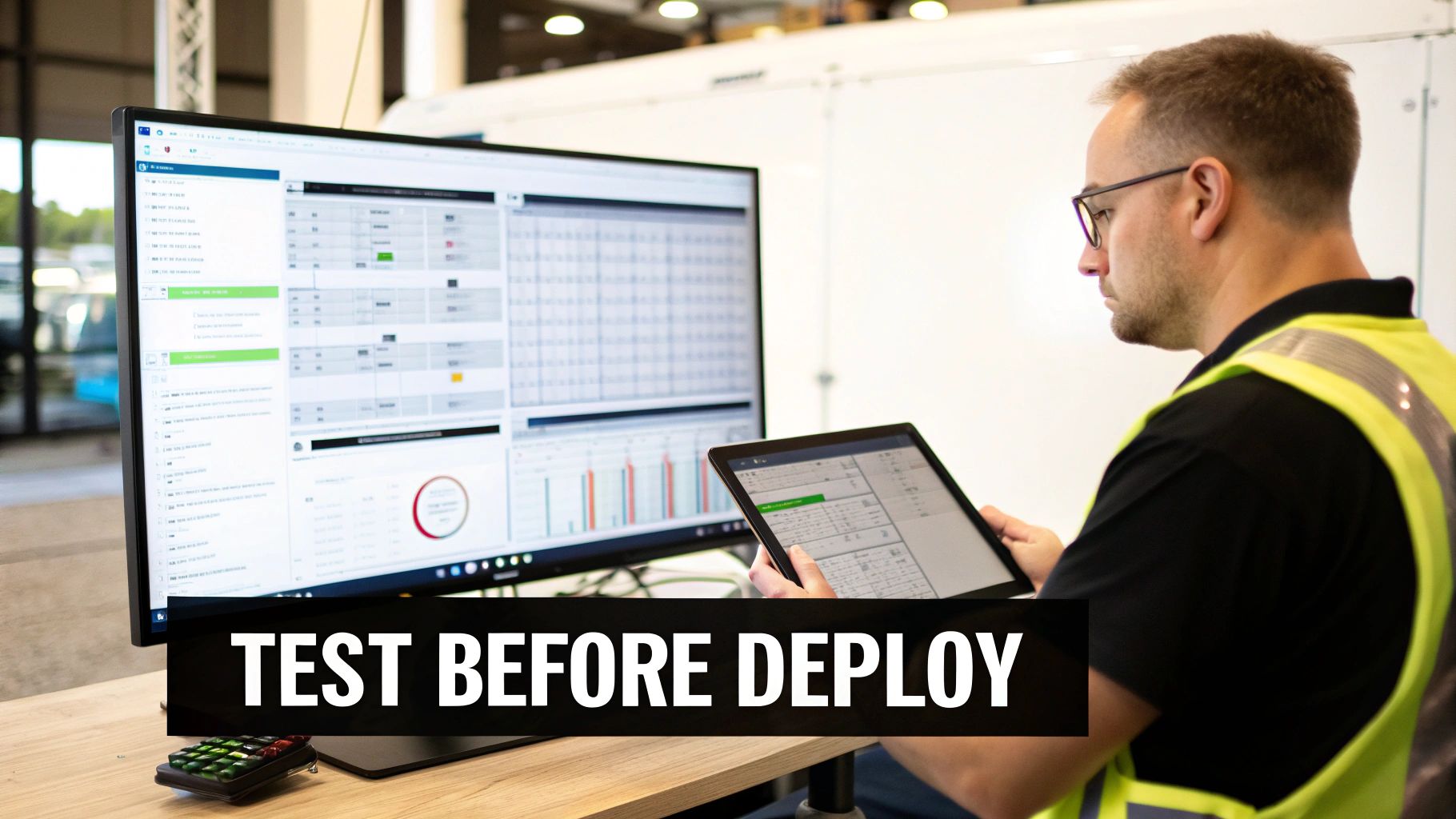
This shift-left approach to security and compliance embeds quality control directly into the development lifecycle. By catching errors early, teams can fix them faster and cheaper than if they were discovered post-deployment. Tools like Checkov or Bridgecrew can scan Terraform or CloudFormation templates within a CI/CD pipeline, automatically flagging issues like overly permissive IAM roles or unencrypted S3 buckets before they ever become a reality in your cloud environment. This is a critical component of modern infrastructure as code best practices.
Why It's a Best Practice
Automated testing transforms infrastructure deployment from a high-risk event into a predictable, repeatable process. It provides a crucial safety net that enforces security and governance standards programmatically, reducing the burden on manual reviews. This not only enhances security posture but also accelerates delivery by giving developers immediate feedback on their code. By building confidence in every change, teams can deploy more frequently and with less fear of causing an outage.
Actionable Implementation Tips
Integrate Testing into CI/CD: Add automated validation steps to your pipelines that run on every commit or pull request. Use tools like Checkov, tfsec, or Terratest to perform static analysis, security scanning, and unit tests.
Implement Policy as Code (PaC): Use frameworks like Open Policy Agent (OPA) or HashiCorp Sentinel to define and enforce custom organizational rules. This ensures all infrastructure adheres to specific governance, such as resource tagging conventions or approved instance types.
Start Small and Iterate: Begin by implementing a few high-impact security and compliance policies. As your team grows accustomed to the workflow, gradually expand your test suite to cover cost controls, architectural patterns, and more complex scenarios. This approach is similar to building an automated regression testing strategy for software.
3. Modular and Reusable Infrastructure Components
As your infrastructure grows, managing monolithic configuration files becomes unsustainable. The solution is to break down your IaC into smaller, composable, and reusable modules. This approach involves creating standardized building blocks for common infrastructure patterns, such as a VPC with standard subnetting, a secure S3 bucket, or a containerized service deployment. By treating these components like functions in an application, you promote consistency, reduce duplication, and accelerate development.
This modular strategy, popularized by tools like the Terraform Registry and AWS CloudFormation templates, allows teams to assemble complex environments from a library of trusted components. Instead of rewriting networking logic for every new project, an engineer can simply instantiate a pre-approved networking module with specific parameters. This is a core tenet of effective infrastructure as code best practices, enabling teams to scale reliably and securely.
Why It's a Best Practice
Modular design drastically improves the maintainability and scalability of your infrastructure codebase. When a change is needed, such as updating a security group rule, you only have to modify the single source module. That change can then be propagated consistently across all environments that use it by simply updating the module version. This reduces the risk of configuration drift and human error, while also enforcing organizational standards for security, tagging, and architecture.
Actionable Implementation Tips
Create an Internal Module Registry: For larger teams, establish a private registry to host and share your organization's custom modules. This makes components discoverable and simplifies version management.
Document Modules Thoroughly: Every module should have a file that clearly documents its purpose, required inputs (variables), and generated outputs. Include a simple usage example to guide other engineers.
Use Semantic Versioning: Apply versioning (e.g., ) to your modules. This allows teams to adopt updates deliberately, preventing breaking changes from being automatically deployed to production environments.
Start with High-Impact Components: Begin by modularizing the most frequently used and complex parts of your infrastructure, like networking, databases, or Kubernetes clusters, to gain the most significant initial benefits.
4. Immutable Infrastructure and Containerization
The principle of immutability elevates Infrastructure as Code by treating infrastructure components like servers and containers as disposable artifacts. Instead of logging into a server to apply patches or update configurations, you build an entirely new, updated version from code and replace the old one. This approach, heavily popularized by cloud-native pioneers like Netflix and enabled by technologies like Docker and Kubernetes, eliminates configuration drift and creates a highly predictable, reliable system.
This practice fuses IaC with containerization to achieve unparalleled consistency. When a change is needed, a new container image is built through an automated pipeline, tested, and then deployed to replace the existing containers. This ensures that every running instance is an exact replica of what is defined in your version-controlled code, making environments from development to production nearly identical. This is a cornerstone of effective infrastructure as code best practices.
Why It's a Best practice
Embracing immutability drastically reduces the complexity of infrastructure management and minimizes errors caused by manual changes. Since infrastructure is never modified in place, you eliminate an entire class of "it worked on my machine" problems. Rollbacks are simplified and lightning-fast; if a new deployment introduces an issue, you simply deploy the previous, known-good version. This significantly improves system reliability and developer confidence.
Actionable Implementation Tips
Adopt Minimal Base Images: Start your containers with minimal, security-hardened base images (like Alpine or Distroless) to reduce the attack surface and image size.
Automate Image Building and Scanning: Integrate tools like Docker, Kaniko, or Buildpacks into your CI/CD pipeline to automatically build new images on every code commit. Scan these images for vulnerabilities using tools like Trivy or Snyk before they are pushed to a registry.
Use GitOps for Declarative Management: Employ GitOps tools like Argo CD or Flux to manage your container orchestrator's state. These tools continuously reconcile the live state of your Kubernetes cluster with the desired state defined in your Git repository. If you're looking to accelerate your journey, exploring expert guidance on Kubernetes consulting services for seamless cloud-native adoption can provide a structured path forward.
5. Automated Deployment Pipelines and Continuous Integration/Continuous Deployment (CI/CD)
Manually applying infrastructure changes is a recipe for inconsistency and human error. The goal of IaC is automation, and the engine for that automation is a robust Continuous Integration/Continuous Deployment (CI/CD) pipeline. By integrating infrastructure changes into automated workflows, you ensure every modification is validated, tested, and deployed in a consistent, repeatable, and audited manner.
This approach transforms infrastructure management from a high-risk manual task into a low-friction, automated process. Systems like GitHub Actions, GitLab CI/CD, or Jenkins can be configured to automatically trigger a plan or deployment whenever code is merged into a specific branch. This creates a direct, observable link between a code change and its effect on the live environment, which is a cornerstone of modern infrastructure as code best practices.
Why It's a Best Practice
Automating infrastructure deployments via CI/CD pipelines dramatically increases both speed and reliability. It removes the "it worked on my machine" problem by running all changes through a standardized environment. This practice enforces quality gates, such as automated testing and security scans, before any infrastructure is provisioned or modified. Furthermore, it provides complete visibility into the deployment process, with detailed logs and notifications that are essential for rapid troubleshooting and maintaining operational stability. This level of automation is a key differentiator between traditional operations and a true DevOps culture, a topic further explored in our guide on Agile vs. DevOps for engineering leaders.
Actionable Implementation Tips
Implement Staged Deployments: Create a multi-stage pipeline that progresses changes through environments like , , and finally . Use manual approval gates for sensitive environments like production to ensure a final human review.
Require Automated Tests: Integrate automated validation and testing steps into your pipeline. Use tools like , static analysis tools (e.g., Checkov), and integration tests to catch errors before they reach production.
Establish Clear Rollback Procedures: Define and test a clear process for rolling back a failed deployment. This could involve reverting the commit in Git and re-running the pipeline or using IaC-native features to revert to a previous state.
Use Gradual Rollout Strategies: For critical changes, implement blue-green or canary deployment patterns. This allows you to deploy the new infrastructure alongside the old, test it with a small subset of traffic, and switch over only when confident.
6. State Management and Secrets Handling
Effective infrastructure as code (IaC) hinges on two critical, interconnected components: managing the state of your infrastructure and securely handling sensitive credentials. State files, like Terraform's , are a map of your real-world resources to your configuration. Properly managing this state prevents conflicts and ensures your code accurately reflects your deployed infrastructure. Equally important is protecting secrets like API keys, passwords, and certificates from exposure.

Treating these two areas as afterthoughts is a common pitfall that leads to security vulnerabilities and operational chaos. A robust strategy involves using centralized, secure backends for state files and dedicated secrets management tools. This approach ensures that only authorized personnel and processes can access or modify your infrastructure's state or its sensitive credentials, forming a cornerstone of secure and reliable infrastructure as code best practices.
Why It's a Best Practice
Separating state and secrets from your codebase prevents catastrophic security breaches and operational failures. Committing state files or plaintext secrets to version control exposes sensitive information to anyone with repository access. Centralized state management with locking mechanisms prevents team members from making conflicting changes simultaneously, which can corrupt the state and lead to resource drift or destruction. Using a dedicated secrets manager like HashiCorp Vault or AWS Secrets Manager provides a secure, auditable, and automated way to inject credentials at runtime, adhering to the principle of least privilege.
Actionable Implementation Tips
Never Commit Secrets to Version Control: Add , , and any secret files like or to your file immediately. Use pre-commit hooks to scan for secrets before they ever reach the repository.
Use Remote State with Locking: Configure your IaC tool to use a remote backend like an AWS S3 bucket with DynamoDB for locking or Terraform Cloud. This centralizes the state file, enables team collaboration, and prevents dangerous race conditions.
Integrate a Dedicated Secrets Manager: Leverage tools like HashiCorp Vault, AWS Secrets Manager, or Azure Key Vault. Your CI/CD pipeline should be configured with an identity that has just-in-time, read-only access to fetch the required secrets during deployment.
Automate Credential Rotation: Implement policies within your secrets manager to automatically rotate database passwords, API keys, and certificates. This limits the window of opportunity for attackers if a credential is ever compromised.
7. Documentation and Code Comments for Infrastructure
Infrastructure as code treats infrastructure components as software artifacts, and just like application code, it requires clear documentation to be maintainable and scalable. Maintaining comprehensive documentation and inline comments ensures that team members, regardless of their location or tenure, can understand the purpose, design decisions, and operational context behind your cloud architecture. This practice is crucial for breaking down knowledge silos and accelerating the onboarding process for new engineers.
This approach transforms your IaC repository from a simple collection of scripts into a living, well-documented system. When a developer encounters a Terraform module, a detailed file, clear variable descriptions, and insightful inline comments can explain why a specific network ACL was configured a certain way or what the intended purpose of a particular IAM role is. This context is invaluable for future modifications and troubleshooting.
Why It's a Best Practice
Well-documented infrastructure code minimizes ambiguity and reduces the cognitive load on engineers. It provides a clear rationale for architectural choices, preventing future team members from accidentally undoing critical configurations. This is one of the most vital infrastructure as code best practices for long-term project health, as it ensures the system remains understandable and operable even as teams change. Comprehensive documentation also serves as a critical reference during incident response, helping engineers quickly grasp component dependencies and expected behaviors.
Actionable Implementation Tips
Document the 'Why,' Not Just the 'What': Your code shows what is being created (e.g., an S3 bucket). Use comments and files to explain why it needs a specific lifecycle policy or logging configuration.
Use Architecture Decision Records (ADRs): For significant infrastructure changes, create an ADR to document the context, decision, and consequences. This provides a formal, historical record of key architectural choices.
Maintain Updated Variable Documentation: In your Terraform modules or CloudFormation templates, provide detailed descriptions and examples for each input variable. This makes modules easier to consume and reuse.
Include Troubleshooting and Operational Guides: Add a section to your documentation that outlines common issues, diagnostic steps, and links to relevant monitoring dashboards to streamline incident resolution.
8. Environment Parity and Configuration Management
A core challenge in software development is the "it works on my machine" problem, which often stems from inconsistencies between development, staging, and production environments. Achieving environment parity means making these environments as similar as possible, ensuring that code behaves predictably as it moves through the deployment pipeline. This practice uses parameterized infrastructure code to manage environment-specific customizations while maintaining a single, unified codebase as the source of truth.
By defining environments through code, you can provision identical infrastructure stacks on demand, differing only by specific variables like instance sizes, database credentials, or API endpoints. This approach, heavily influenced by the Twelve-Factor App methodology, drastically reduces bugs that only appear in production. Tools like Terraform workspaces or AWS CloudFormation parameter files allow you to apply the same template across different stages, simply swapping out configuration values for each target environment.
Why It's a Best Practice
Environment parity is a critical component of reliable, high-velocity software delivery. When your staging environment faithfully mirrors production, you can test changes with high confidence, catching bugs and performance issues long before they impact customers. This practice minimizes surprises during deployment, streamlines debugging, and enables developers to onboard and contribute more quickly. It’s a foundational element for building a robust and predictable continuous integration and continuous delivery (CI/CD) process, making it one of the most impactful infrastructure as code best practices.
Actionable Implementation Tips
Use Environment-Specific Configuration Files: Separate configuration from logic. Use files like for each environment (e.g., , ) to manage variables such as instance counts, network CIDR blocks, and resource tags.
Minimize Environmental Drift: The goal is to keep environments as alike as possible. The only differences should be intentional and declared in code, such as scaling parameters or credentials. Avoid one-off manual changes in any environment.
Automate Environment Provisioning: Use your CI/CD pipeline to create and destroy non-production environments automatically. This ensures they are always built from the latest code and prevents configuration drift from accumulating over time.
Leverage Parameter Stores for Secrets: Store sensitive data like API keys and database passwords in a secure service like AWS Secrets Manager or HashiCorp Vault, not in your configuration files. Reference these secrets dynamically during deployment.
9. Infrastructure as Code for Disaster Recovery and Multi-Region Deployments
Relying on manual processes for disaster recovery (DR) is a recipe for extended downtime and data loss. Infrastructure as code transforms DR from a reactive, high-stress event into a proactive, automated, and testable strategy. By defining your entire failover environment in code, you can provision a complete, production-ready replica in a secondary region with speed and precision, ensuring business continuity when a primary region fails.
This approach is central to building resilient, globally distributed applications. Using IaC tools like Terraform or native cloud solutions such as AWS CloudFormation, you can codify the creation of networking, compute, and data services in multiple regions. This not only automates failover but also simplifies the management of complex active-active or active-passive architectures, a key element of modern infrastructure as code best practices. The decision between multi-region and multi-cloud strategies often depends on balancing resilience and operational complexity, a critical consideration for CTOs. For a deeper analysis, exploring a strategic CTO's guide to hybrid vs. multi-cloud can provide valuable insights.
Why It's a Best Practice
Codifying disaster recovery and multi-region deployments drastically reduces Recovery Time Objective (RTO) and Recovery Point Objective (RPO). Automation eliminates the risk of human error during a high-pressure failover event. Most importantly, it makes DR plans testable. You can regularly spin up and tear down your recovery environment to validate the process without impacting production, turning a theoretical plan into a proven capability. This verifiable resilience is invaluable for meeting compliance requirements and guaranteeing service availability.
Actionable Implementation Tips
Codify RTO/RPO Targets: Before writing code, clearly document the RTO and RPO for each application. These metrics will dictate your architecture, such as choosing between a pilot light, warm standby, or hot-site (active-active) DR strategy.
Automate Data Replication: Use IaC to provision and configure cross-region data replication services like Amazon RDS Read Replicas, Azure Geo-Replication, or Google Cloud Spanner multi-region instances.
Implement Health Checks and Automated Failover: Configure monitoring and alerting to automatically detect a primary region failure. Use services like AWS Route 53 health checks or Azure Traffic Manager to trigger automated DNS failover to the secondary region.
Regularly Test Your DR Plan: Schedule and automate regular DR drills. Use your IaC scripts to deploy the recovery environment, fail over services, and validate application functionality before tearing it all down. This ensures your plan works when you need it most.
10. Monitoring, Logging, and Observability Infrastructure as Code
Just as you codify your compute, network, and storage, your monitoring and observability stack should also be defined and managed as code. This approach involves using IaC tools to provision, configure, and manage your entire observability pipeline, from metric collectors and log aggregators to alerting rules and dashboards. By doing so, you ensure that visibility is a built-in, repeatable component of your architecture, not an afterthought.
Treating observability as code eliminates configuration drift between environments. A developer can spin up a new feature environment and automatically get the same sophisticated monitoring, logging, and tracing capabilities that exist in production. This consistency is crucial for accurately diagnosing issues, as you can trust that the data you see in a lower environment will behave the same way in production. This practice is a cornerstone of elite infrastructure as code best practices for building resilient, transparent systems.
Why It's a Best Practice
Defining observability in code transforms it from a manual, often inconsistent setup task into an automated, version-controlled, and scalable process. It allows you to programmatically enforce monitoring standards across all services and environments. When a new application is deployed, its necessary dashboards, alerts, and log-shipping configurations are deployed with it. This creates a tight feedback loop, enabling teams to understand application performance and health from the very first commit, which is vital for rapid, reliable delivery.
Actionable Implementation Tips
Codify Alerting Rules: Define alert thresholds, notification channels (e.g., Slack, PagerDuty), and escalation policies directly in your IaC configuration. This ensures alerts are standardized and version-controlled.
Automate Dashboard Creation: Use tools like the Grafana Terraform provider or Datadog's API to programmatically create and manage dashboards. Link dashboard templates to service modules so that every new microservice gets a pre-configured dashboard.
Deploy Agents via IaC: Integrate the deployment of monitoring agents (e.g., Datadog, Prometheus Node Exporter) into your base machine images (AMIs) or container definitions. This guarantees that every host and container is monitored by default.
10-Point Comparison of IaC Best Practices
Practice | Implementation Complexity 🔄 | Resource Requirements ⚡ | Expected Outcomes ⭐ | Ideal Use Cases 📊 | Key Advantages 💡 |
|---|---|---|---|---|---|
Version Control for All Infrastructure Code | 🔄 Medium — process & branching setup | ⚡ Low–Medium — Git hosting + training | ⭐ High — auditability, rollback, collaboration | Distributed teams, GitOps foundation, multi-environment projects | 💡 Clear history, code review enforcement, CI/CD integration |
Infrastructure as Code Testing and Validation | 🔄 High — test suites, policy-as-code | ⚡ High — testing infra, scanners, expertise | ⭐ Very High — fewer failures, compliance assurance | Regulated environments, multi-cloud deployments, security-sensitive infra | 💡 Early defect detection, automated policy enforcement, cost checks |
Modular and Reusable Infrastructure Components | 🔄 Medium — module design & versioning | ⚡ Medium — library + governance effort | ⭐ High — reuse, consistency, faster provisioning | Multi-project organizations, repeated patterns across clients | 💡 Reduced duplication, faster delivery, easier maintenance |
Immutable Infrastructure and Containerization | 🔄 High — container orchestration & workflows | ⚡ High — container runtime, orchestration, storage | ⭐ High — consistency, reliability, easy rollback | Cloud-native apps, AI workloads, teams needing portability | 💡 Eliminates drift, predictable behavior, scalable deployments |
Automated Deployment Pipelines and CI/CD | 🔄 High — pipeline design, gating & tests | ⚡ Medium–High — CI/CD tooling and test automation | ⭐ High — repeatable, faster deployments, auditability | Frequent release cycles, distributed teams, production-critical infra | 💡 Reduced human error, staged rollouts, deployment traceability |
State Management and Secrets Handling | 🔄 Medium — remote state and access policies | ⚡ Medium — secret stores, backups, access controls | ⭐ High — secure credentials, consistent state | Multi-team environments, sensitive client data, shared state setups | 💡 Centralized secrets, state locking, improved disaster recovery |
Documentation and Code Comments for Infrastructure | 🔄 Low–Medium — documentation standards & upkeep | ⚡ Low — authoring tools and time investment | ⭐ Medium — faster onboarding, fewer knowledge silos | Distributed teams, complex architectures, high staff turnover | 💡 Captures rationale, runbooks, and troubleshooting guidance |
Environment Parity and Configuration Management | 🔄 Medium — parameterization and workspace management | ⚡ Medium — config stores, environment testing | ⭐ High — predictable behavior across envs | Applications requiring reliable staging-to-prod parity | 💡 Fewer surprises, reproducible tests, drift detection |
IaC for Disaster Recovery & Multi-Region Deployments | 🔄 High — replication, failover automation | ⚡ High — cross-region resources, testing costs | ⭐ High — rapid recovery, business continuity | Mission-critical systems, compliance-driven applications | 💡 Automated failover, tested RTO/RPO processes, regional resilience |
Monitoring, Logging & Observability as Code | 🔄 Medium–High — instrumenting and dashboards | ⚡ High — storage, agents, visualization tooling | ⭐ High — faster detection, lower MTTR, capacity insights | Production systems, AI pipelines, high-availability services | 💡 Centralized logs/metrics, SLOs/SLIs, proactive alerting |
Build Your Elite Engineering Team with TekRecruiter
The journey from manual infrastructure management to a fully automated, code-driven environment is a profound transformation. Mastering these infrastructure as code best practices is not just about adopting new tools; it's about fundamentally changing how your organization approaches technology delivery, risk management, and innovation. By treating your infrastructure with the same discipline as your application code, you unlock a new level of operational maturity.
The successful implementation of these advanced IaC strategies hinges on having the right people at the helm. These are not entry-level concepts; they require seasoned DevOps, SRE, and cloud engineers who have navigated these transformations before. An elite engineer doesn't just write code; they design systems, anticipate failure modes, and build the resilient, automated platforms that enable an entire organization to innovate at scale. Finding this caliber of talent is the most crucial investment you can make in your technological future.
Don't let a talent gap prevent you from building a world-class infrastructure. TekRecruiter is a technology staffing, recruiting, and AI Engineer firm that allows innovative companies to deploy the top 1% of engineers anywhere. We specialize in connecting you with the elite cloud, DevOps, and AI engineers who can turn these best practices into your competitive advantage. Accelerate your IaC adoption and build a truly resilient platform by partnering with us to hire the industry's best talent.
Comments