_edited.png)
Hybrid Cloud vs Multi Cloud A Strategic CTOs Guide
It really boils down to this: a hybrid cloud links your on-premise, private infrastructure to a single public cloud. A multi-cloud strategy, on the other hand, means you’re using services from two or more public cloud providers.
The right call isn't about the tech itself—it's about your core business goals. Are you focused on deep infrastructure integration and control? That points to hybrid. Or is provider diversification and best-in-class features your priority? That’s a multi-cloud conversation.
Decoding Your Cloud Infrastructure Strategy
For any CTO, choosing between a hybrid and multi-cloud architecture is a monumental decision. This choice will directly impact everything from your budget and security posture to performance and your team's ability to innovate. While people often toss the terms around interchangeably, they are fundamentally different ways to build and run your IT environment.
The best path forward depends entirely on your specific business drivers, whether that’s satisfying strict regulatory demands or getting to market faster than the competition.
Getting a handle on the core components of each model is the only way to make a smart decision. These differences don't just exist on paper; they shape your daily operations and long-term strategic plans. To really dig into the details and sharpen your thinking, check out our practical guide to Multi Cloud vs Hybrid Cloud.
Foundational Definitions at a Glance
Let's cut through the noise and break down what makes these two models tick. This quick comparison gets right to the point, highlighting their unique makeups and strategic goals.
Aspect | Hybrid Cloud | Multi-Cloud |
|---|---|---|
Core Components | Private infrastructure (on-premises) connected to one public cloud. | Services from two or more different public cloud providers. |
Primary Goal | Balance control and security with public cloud scalability. | Avoid vendor lock-in and leverage best-of-breed services. |
Main Challenge | Complex integration between on-premises and cloud environments. | Managing consistent security and operations across providers. |
Best For | Organizations with significant on-premises investments or strict compliance needs. | Businesses seeking flexibility, innovation, and performance optimization. |
The distinction is strategic: Hybrid cloud is about integration—blending what you own with the public cloud's power. Multi-cloud is about diversification—selecting the best tools from different providers to build a superior solution.
Ultimately, a winning cloud strategy is about more than just architecture; it’s about execution. For a deeper look at building a powerful cloud development plan, this CTO's guide to developing in the cloud for maximum impact is a must-read.
No matter which path you take, turning your vision into a reality demands elite engineering talent. TekRecruiter specializes in deploying the top 1% of cloud engineers and AI specialists who thrive in these complex environments. We can help you build the high-performing team you need to hit your goals.
Analyzing Core Architectural Differences
To really get what’s at stake in the hybrid vs. multi-cloud debate, you have to look past the simple definitions and get into the architecture. How data moves, where apps live, and how everything connects—these aren't just tech specs. They shape your day-to-day operations, your security reality, and your ability to innovate. These two models are built on fundamentally different ideas: integration versus orchestration.
A hybrid cloud architecture is all about a tightly coupled relationship between a private environment (like your on-prem data center) and a single public cloud (think AWS or Azure). The real architectural puzzle is building a secure, seamless bridge between the two.
This tight integration enables some powerful operational patterns, blending the control you get from private infrastructure with the massive scale of the public cloud.
Hybrid Cloud Integration Patterns
Hybrid isn't just about connecting two things; it's about making them work together as one cohesive unit. This is usually done through specific strategies for distributing workloads to get the best mix of cost, performance, and security.
Cloud Bursting: This is the classic hybrid move. An application runs day-to-day in your private cloud, but when demand skyrockets—like during a Black Friday sale—it "bursts" into the public cloud for extra computing power. This saves you from buying a ton of expensive on-prem hardware you’d barely ever use.
Data Tiering: This pattern is all about smart storage management for cost and compliance. You keep sensitive or frequently accessed "hot" data on-premises for tight control and low latency. Meanwhile, less critical "cold" data gets archived to cheaper object storage in the public cloud for the long haul.
At its core, hybrid architecture is about creating a single, extended infrastructure. The public cloud should feel like a natural extension of your own data center, all managed under one security and operational framework.
In sharp contrast, a multi-cloud architecture isn’t focused on deep integration between clouds. Instead, the game is all about orchestrating and managing workloads across multiple, distinct public cloud platforms.
Multi-Cloud Orchestration Strategies
The multi-cloud model treats different public clouds like a portfolio of specialized tools. The architectural challenge isn't integration; it's making sure everything works together and is governed consistently across disconnected systems. And this approach has taken off.
The industry is clearly shifting away from single-provider strategies. By 2026, a massive 92% of organizations are expected to have a multi-cloud strategy, mixing and matching various public and private cloud services. The average company today already uses 2.2 public clouds, showing a clear preference for picking the best tool for the job from different vendors instead of going all-in with one. You can dig into more data on this trend by exploring these multi-cloud strategy insights.
This move is driven by the desire for "best-of-breed" services. For example, a company might use Google Cloud for its top-tier machine learning tools while running its data warehouse on AWS Redshift for its raw performance and ecosystem. The key to managing this complexity is a universal control plane, where tools like Kubernetes are absolutely essential. You can see how to get a handle on these environments with expert Kubernetes consulting services for seamless cloud-native adoption.
Ultimately, the architectural differences dictate the skills, tools, and mindset you need. A hybrid model demands serious expertise in networking and legacy system integration. A multi-cloud model requires mastery of cross-platform orchestration and abstraction layers.
Navigating these architectural decisions and finding the talent to execute them is no small feat. TekRecruiter connects innovative companies with the top 1% of engineers who specialize in designing and managing these exact kinds of sophisticated hybrid and multi-cloud environments. We deliver the elite talent needed to turn your architectural vision into a secure, scalable, and high-performing reality.
Comparing Key Decision Factors
When you're staring down the hybrid vs. multi-cloud decision, it's easy to get lost in the weeds. But let’s be real: this isn't just a technical choice. It's a strategic one with massive financial and operational ripple effects. Getting it right means looking past the definitions and digging into how each model actually performs where it counts—cost, security, and performance.
The best way to simplify this is to start with your biggest business driver. Are you trying to lock down sensitive data or are you chasing best-in-class services from multiple vendors? This quick decision tree can help you find your starting point.
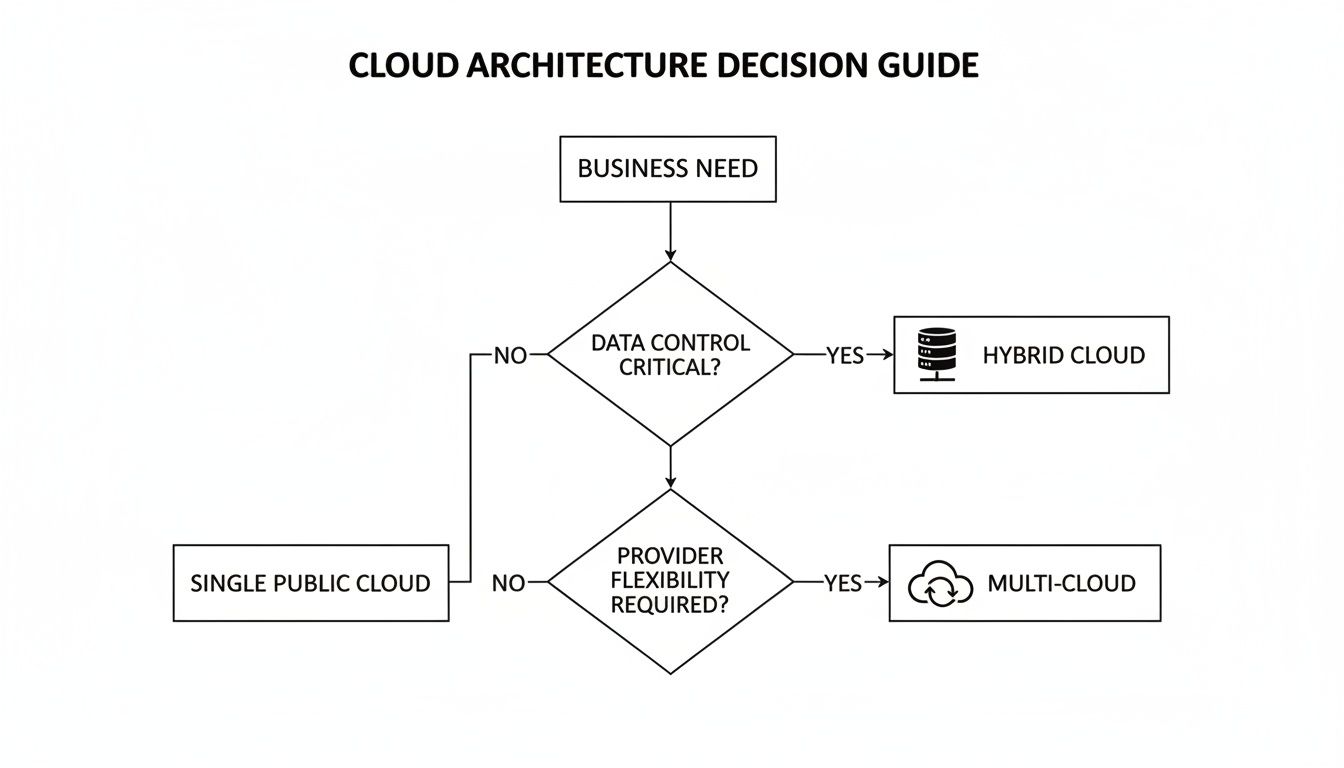
As you can see, if granular data control and ironclad compliance are non-negotiable, you’re probably leaning hybrid. If your goal is ultimate flexibility and avoiding vendor lock-in, multi-cloud is likely your path.
Cost Management And Financial Models
The money conversation is radically different for these two models, and it goes way beyond the monthly invoice. A hybrid cloud strategy is a blend of Capital Expenditure (CapEx) for your on-prem gear and Operational Expenditure (OpEx) for what you use in the public cloud. This approach is perfect for squeezing every last drop of value out of your existing data center investments.
Multi-cloud, on the other hand, is almost pure OpEx. No big upfront hardware costs, which sounds great, but it introduces a monster of a new problem: tracking spend across a dozen different pricing models and billing cycles. Without a rock-solid FinOps practice, costs can absolutely spiral.
The core financial trade-off is clear: Hybrid cloud balances upfront investment with predictable long-term costs for stable workloads, whereas multi-cloud offers pay-as-you-go flexibility that demands constant vigilance to remain cost-effective.
This financial reality is fueling hybrid's explosive growth. The global hybrid cloud market is on track to hit $262 billion by 2027, a massive jump from $85.3 billion in 2021. The driver? Proven cost wins. In fact, 50% of organizations have successfully cut costs across both on-prem and public cloud by going hybrid. You can get more details from these compelling hybrid cloud statistics.
Security And Compliance Posture
With a hybrid cloud, your security perimeter is clearly defined. You can keep your crown jewels—the most sensitive data and critical apps—tucked away in your private data center, where you have total control over every physical and network layer. This makes ticking the boxes for tough regulations like GDPR or HIPAA much more straightforward.
Multi-cloud security is a whole different beast. Trying to enforce consistent security policies, identity management, and threat detection across multiple, totally separate cloud platforms is a nightmare. Each provider has its own tools and APIs, meaning your team either becomes experts in multiple ecosystems or you have to buy third-party platforms just to get a single pane of glass.
Performance And Latency Considerations
Performance is another area where the two models diverge sharply. For applications where every millisecond counts, a hybrid setup lets you keep compute resources physically close to your users or data sources on your private infrastructure. You can’t beat physics.
Multi-cloud, however, is the clear winner for serving a globally scattered user base. You can spin up workloads in different cloud regions from different providers, strategically placing applications closer to customers all over the world. This is the go-to strategy for consumer-facing apps and content delivery networks where global reach is key.
Decision Matrix Hybrid Cloud vs Multi Cloud
To put it all together, this table breaks down the key trade-offs. It's a comparative analysis of hybrid and multi-cloud strategies across key operational and business criteria, designed to guide CTOs in making an informed decision.
Decision Criterion | Hybrid Cloud Approach | Multi Cloud Approach | Best For... |
|---|---|---|---|
Cost Model | A mix of CapEx & OpEx. Protects existing hardware investments and offers predictable costs for stable workloads. | Almost entirely OpEx. Delivers flexibility but demands rigorous FinOps to control complex, multi-vendor billing. | Organizations maximizing existing infrastructure or needing cost stability for core workloads. |
Security Focus | Centralized control. Keeps sensitive data and critical apps behind a well-defined private perimeter. | Distributed management. Requires enforcing consistent security policies across multiple, disparate environments. | Companies in highly regulated industries or with non-negotiable data sovereignty requirements. |
Compliance | Simpler to achieve. Direct control over on-prem infrastructure makes it easier to meet strict regulations. | Significantly more complex. Requires auditing and validating compliance across every single provider used. | Businesses facing strict regulatory mandates like GDPR, HIPAA, or PCI-DSS. |
Performance | Optimized for low-latency. Ideal for workloads that need to be physically close to data sources or end-users. | Optimized for global reach. Great for distributing workloads geographically to reduce latency for a worldwide user base. | Applications needing ultra-low latency for local operations or IoT device interaction. |
At the end of the day, picking the right model comes down to your specific business context and having the raw technical talent to pull it off. Let's be clear: executing either of these strategies is not for amateurs. It demands an elite engineering team.
Real-World Use Cases: When To Choose Each Model
Theory is one thing, but seeing these models in action is another. To really get a handle on the strategic differences between hybrid and multi-cloud, you need to see how they solve actual business problems. Moving from abstract ideas to practical examples makes it much clearer which strategy fits specific challenges and goals.
This decision isn't just about the tech; it's about finding the right tool for the job. Let’s walk through a few concrete scenarios where one model is the obvious choice over the other.
When Hybrid Cloud Is The Clear Winner
Hybrid cloud is the undisputed champ for any organization trying to modernize while dealing with heavy investments in existing infrastructure or strict regulatory hurdles. It’s the pragmatic bridge between where you are and where you need to go.
This is especially true when you're dealing with legacy systems that are too critical, too expensive, or just too tangled to rebuild for a cloud-native world. We have a whole guide on this, by the way: legacy system modernization strategies.
Use Case: A Financial Institution
Think about a major bank. They’re bound by tough regulations on data sovereignty and privacy. Their core business—processing transactions and managing customer accounts—is non-negotiable. That sensitive data must stay inside their on-prem data centers where they have total control and can breeze through audits.
But the bank also has to innovate to stay competitive. They want to roll out a sleek, modern mobile banking app. That app needs the speed, scale, and global reach that a public cloud like AWS or Azure delivers.
The Hybrid Solution: The bank keeps its core transaction databases and sensitive customer info locked down on-prem. It then establishes a secure, high-speed link to a single public cloud provider. The mobile app itself runs in the public cloud, taking advantage of its scalable servers and content delivery networks for a great user experience. When it needs data, it makes secure calls back to the private environment through a dedicated API gateway.
This approach perfectly balances security with innovation. The bank keeps regulators happy by holding its most critical assets close, while still delivering a modern digital experience powered by public cloud services.
Where Multi-Cloud Excels
A multi-cloud strategy is built for businesses that live and die by flexibility, performance, and avoiding vendor lock-in. It's the standard playbook for digital-native companies and global enterprises that need the absolute best tool for every single part of their operation.
Use Case: A Global E-Commerce Platform
Picture a huge online retailer with customers across North America, Europe, and Asia. Their number one priority is delivering lightning-fast page loads and a frictionless checkout for every user, no matter where they are. If they relied on a single cloud provider with data centers in just a few regions, they'd introduce unacceptable lag for a huge chunk of their audience.
The Multi-Cloud Solution: The e-commerce platform strategically deploys its storefront across multiple public clouds. They might use AWS regions in North America for their biggest market, Google Cloud in Europe for its powerful network, and Alibaba Cloud in Asia to guarantee top performance there. This lets them put their application physically closer to their users, which slashes latency and makes for a much better shopping experience.
Use Case: A Tech Startup Building An AI Product
Here’s another classic multi-cloud scenario. A startup is building a sophisticated AI analytics tool. They need best-in-class services for different pieces of their tech stack and can’t afford to be stuck in a single ecosystem that’s just mediocre at everything.
The Multi-Cloud Solution: Instead of being loyal to one brand, the startup picks services based on pure performance and features. They might use Amazon RDS for its rock-solid managed databases while running their machine learning training on Google Cloud's Tensor Processing Units (TPUs) for their raw AI power. This best-of-breed approach allows them to build a more powerful and efficient product than if they’d limited themselves to one provider’s toolbox.
Solving Governance And Staffing Challenges
Picking between hybrid and multi-cloud isn't just about architecture. It's a huge commitment to a specific operational model and, more importantly, a talent strategy. A rock-solid cloud environment—no matter the flavor—runs on elite engineers and is managed by consistent, tough-as-nails policies. But the way you govern each model and the people you need to hire look completely different.
A hybrid cloud setup requires a pretty unique blend of skills. Your team needs to be fluent in traditional on-prem infrastructure—think virtualization like VMware and complex enterprise networking. At the same time, they must have deep, practical expertise in the specific public cloud provider you've chosen, knowing its APIs, security models, and services inside and out. You're essentially looking for "bilingual" engineers who can speak both legacy and modern cloud.
On the other hand, a multi-cloud strategy demands an entirely different kind of expert. The focus shifts away from deep knowledge of one provider to a much broader understanding of universal, cloud-agnostic tools.
The Multi-Cloud Talent Profile
In a multi-cloud world, your engineers have to master the orchestration and abstraction layers that function across different platforms. The real skill here is creating a single, unified operational fabric over a bunch of disconnected environments.
Kubernetes Mastery: This is absolutely non-negotiable. Kubernetes becomes the universal language for container orchestration, letting your teams deploy and manage applications the same way across AWS, Azure, and GCP.
Platform-Specific Knowledge: While universal tools are the priority, engineers still need to know the unique strengths and quirks of each cloud. This is critical for optimizing performance and cost for specific workloads. You can't treat them all the same.
FinOps and Cost Management: Trying to manage spending across multiple vendors, each with its own billing cycle and pricing model, is a recipe for disaster. You need a dedicated FinOps discipline to keep costs from spiraling out of control.
The core challenge in both the hybrid cloud vs multi-cloud debate is consistent governance. Whether integrating on-prem with a public cloud or orchestrating across multiple providers, maintaining uniform security, compliance, and cost controls is the most difficult part.
Navigating Governance And Security Complexities
Keeping a consistent security posture is a monumental task in any distributed system. With a hybrid model, the biggest challenge is locking down the connection point between your private data center and the public cloud. Solid data governance and disaster recovery are paramount for any cloud strategy, which makes robust virtual machine backup solutions a critical piece of the puzzle.
For multi-cloud, the problem multiplies. Each provider has its own security tools, identity management systems, and compliance frameworks. Without a centralized management plane, teams are left trying to patch together a coherent security strategy across multiple, siloed environments. For organizations looking to streamline these complex operations, our guide on DevOps as a Service solutions offers some valuable insights into a different approach.
Ultimately, building a capable team is often the biggest hurdle to a successful cloud strategy. The talent required to manage these complex environments is scarce, highly specialized, and in crushing demand. This is why many organizations find that the most effective path forward is to partner with a specialized firm.
Finding and deploying the top 1% of engineers who can master these complex governance and operational challenges is what we do best at TekRecruiter. We connect innovative companies with the elite talent needed to build, secure, and manage sophisticated cloud infrastructures, turning your strategic vision into a well-executed reality.
Build Your Elite Cloud Engineering Team
Here's the hard truth: your choice in the hybrid cloud vs. multi-cloud debate is only as strong as the team executing it. A brilliant strategy on paper means nothing without the right people behind the keyboard. Success, plain and simple, hinges on having access to elite engineering talent.
These complex environments demand highly specialized expertise. Whether you're looking for cloud architects, DevOps engineers, or AI specialists with proven mastery across AWS, Azure, GCP, and tricky hybrid setups, the skill gap is a very real, very significant hurdle.
Sourcing Top-Tier Talent
The final—and most critical—piece of the puzzle is building a team that can navigate extreme technical complexity and actually accelerate innovation. This is where a strategic partnership becomes non-negotiable.
The most significant risk to any cloud initiative isn't the technology—it's the scarcity of elite talent capable of managing its complexity. Your ability to execute depends entirely on the strength of your engineering team.
Finding engineers who can seamlessly integrate on-prem systems or orchestrate workloads across multiple providers is a massive challenge. The demand for these skills far outstrips the supply, making traditional hiring slow and, frankly, often ineffective. This is exactly why forward-thinking companies are turning to specialized talent partners instead.
Partner for Success
TekRecruiter specializes in sourcing and deploying the top 1% of engineers who don't just work in these demanding cloud ecosystems—they thrive in them. We're here to bridge the talent gap, whether you need quality-focused staff augmentation, direct hiring, or end-to-end AI engineering solutions.
We provide the specialized experts you need to turn your cloud vision into a secure, scalable, and high-performing reality.
Partner with TekRecruiter to build the elite team required to master your cloud strategy and drive your business forward.
Got Questions? We've Got Answers.
When you're deep in the hybrid vs. multi-cloud debate, the high-level pros and cons are just the start. The real confusion comes from the details. Let's tackle some of the most common questions that pop up when leaders are trying to map out a cloud strategy that actually works.
Can We Just Do Both?
Yes, and honestly, most large companies already do. This is what the industry calls a hybrid multi-cloud environment. It sounds complicated because it is, but it also offers the highest degree of flexibility.
Think of it this way: a company might keep its crown-jewel databases locked down on-premise (that’s the hybrid part) but run its main application on AWS for its robust ecosystem. At the same time, they could be tapping into Google Cloud specifically for its powerful machine learning services (the multi-cloud part). This approach is all about cherry-picking the best tool for each specific job, giving you maximum control, resilience, and access to specialized services.
What Are The Sneakiest Costs In A Multi-Cloud Strategy?
Going multi-cloud gets you out of the massive upfront hardware spend, but it quietly introduces a whole new set of operational costs that can absolutely wreck your budget if you're not paying attention. The biggest offender by far is data egress fees.
The silent budget killer in any multi-cloud architecture is the cost of moving your data between clouds. Every time your application on GCP needs to query a database sitting in AWS, you're getting hit with an egress fee. For large datasets, these costs can become staggering.
Beyond that, watch out for these other hidden expenses:
Talent & Training: You don't just need a cloud engineer; you need an AWS expert, a GCP expert, and an Azure expert. Finding and retaining that specialized talent is expensive, and keeping their skills sharp requires constant training.
Third-Party Tools: To get a single, unified view of security and performance across all your different cloud environments, you almost always have to invest in additional third-party management platforms.
How Does Containerization Actually Help Manage All This?
This is where containers, especially when managed by an orchestrator like Kubernetes, become a total game-changer for both hybrid and multi-cloud setups. It creates a universal, cloud-agnostic layer that lets you run your applications the exact same way, no matter what infrastructure is underneath.
In practical terms, this means you can package an application and all its dependencies into one container and deploy it on your on-prem servers, then move it to AWS, and then over to Azure without changing a single line of code. Kubernetes effectively becomes the operating system for your entire cloud footprint, radically simplifying how you deploy, scale, and manage everything across what would otherwise be completely separate worlds.
Executing a sophisticated cloud strategy requires a world-class engineering team. Whether you need to master Kubernetes across multiple providers or secure the bridge in your hybrid environment, TekRecruiter allows innovative companies to deploy the top 1% of engineers, anywhere. Build your elite cloud team with us.
Comments