_edited.png)
What Is a Staff Augmentation Contract
A staff augmentation contract is a legal agreement where a provider employs a specialist who works inside your team under your day-to-day direction, with the contract spelling out rates, IP, confidentiality, and termination. The global staff augmentation services market is estimated at USD 131.25 billion in 2026, with a projection of USD 201.53 billion by 2032, according to 360iResearch's staff augmentation market analysis.
The popular advice is to treat the agreement like hiring paperwork. That's backwards. A staff augmentation contract is the control document for a three-party relationship. It decides who directs the engineer, who employs and pays them, who owns the code, who carries liability, and what happens when the arrangement changes. If those decisions aren't explicit, your operating habits will fill the gap, often in ways that create legal and delivery risk.
Table of Contents
Pricing Models and Key Legal Terms to Lock Down - Hourly billing - Monthly retainers - Fixed-fee milestones - Clauses that protect the client
Staff Augmentation Compared to Direct Hire and Managed Services
Buyer Checklist and Best Practices for CTOs and Hiring Managers - Vet the provider before reviewing rates - Review the contract for control points - Govern the engagement without creating employment drift
What a Staff Augmentation Contract Actually Is
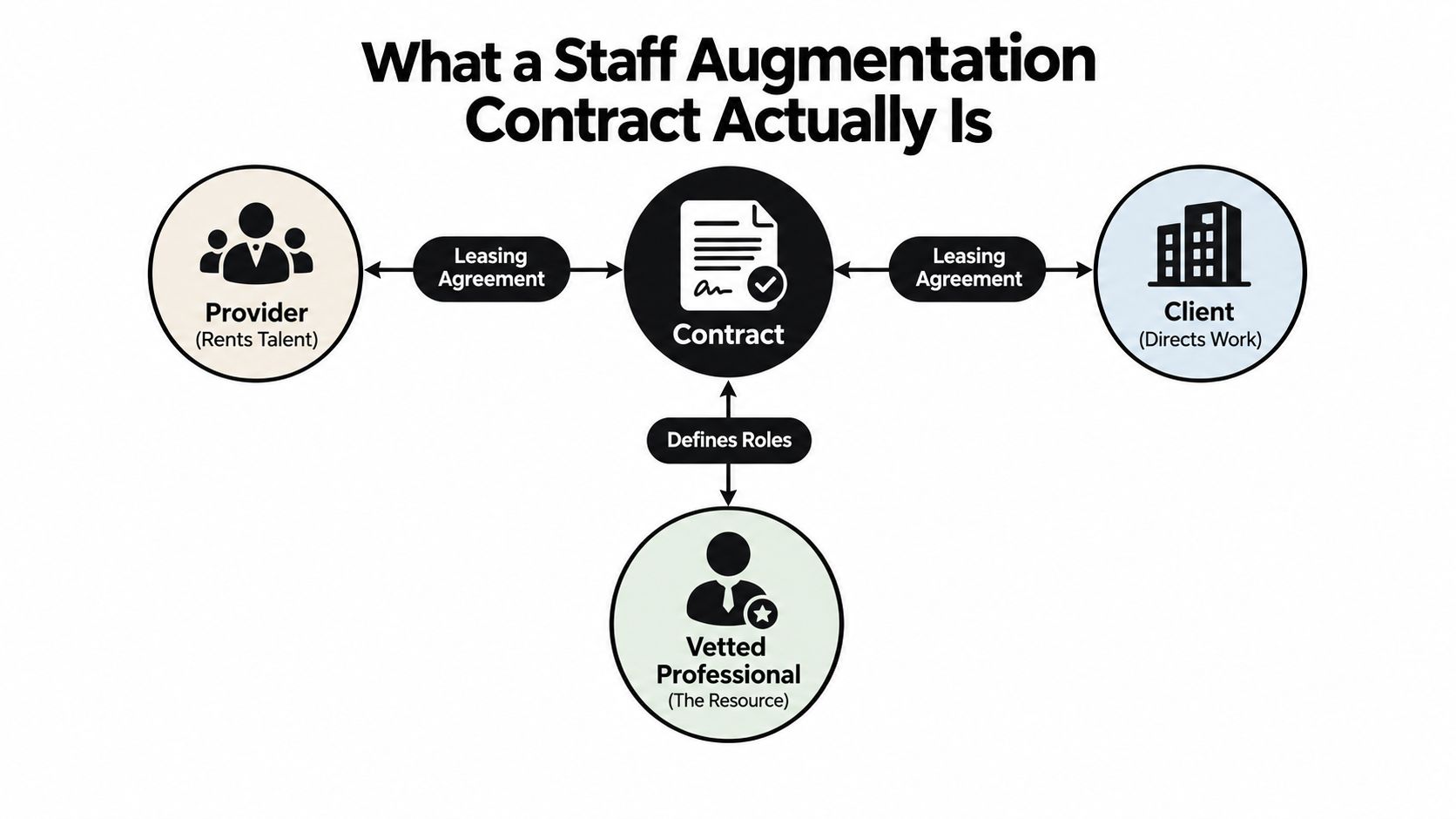
A staff augmentation contract functions like a leasing agreement for technical capacity. You access a vetted engineer, place that person within your delivery team, and direct the daily work. The provider remains the employer and handles payroll and employment obligations. The contract controls the consequences of that split, including liability, intellectual property, and the point at which operational control could create misclassified employment risk.
The relationship has three distinct parties:
The client sets priorities, assigns tickets, reviews pull requests, controls sprint participation, and makes product decisions.
The provider employs the specialist, manages payroll and employment duties, and supports replacement or compliance requirements.
The augmented professional performs technical work inside the client's systems and processes without becoming the client's employee by default.
The distinction from outsourcing matters. An outsourced vendor generally controls the delivery process and accepts accountability for an agreed outcome. Under staff augmentation, you own the work and manage the person's day-to-day contribution. What staff augmentation services involve provides a practical overview of that operating model.
At minimum, the agreement should identify the scope of services, duration, rates, supervision rights, employment relationship, confidentiality duties, IP ownership, and exit mechanics. It should also address deliverables, termination, and other commercial terms. For broader context on what is a service agreement, the same principle applies: the document must state each party's obligations rather than leave them to working habits.
U.S. federal law recognizes staff augmentation services involving personnel working in a government workspace to advise, support, or assist an agency's mission. The U.S. Code definition of staff augmentation services confirms that this is a defined arrangement, not an informal label.
Practical rule: If the contract does not clearly state who directs the work and who employs the person, do not sign until both points are fixed.
The clauses buyers skim often decide the hardest outcomes. A weak IP assignment can leave code ownership uncertain. A vague termination provision can keep an unsuitable resource in place. An absent employment warranty can increase misclassification exposure. Treat the contract as the operating boundary that protects delivery, ownership, and accountability.
How the Master Agreement and SOW Split Works
A staff augmentation contract is the control document for a three-party relationship. It determines who directs the engineer's work, who employs and pays that person, who owns the code, and where liability sits. Use two linked documents to keep those decisions clear.
The master services agreement, or MSA, sets the rules for the relationship. It normally covers rates or rate-setting mechanics, confidentiality, intellectual property, liability, indemnification, governing law, dispute resolution, compliance, and general termination. Negotiate this legal foundation once, then apply it to later placements.
The statement of work, or SOW, activates a specific engagement. It should identify the engineer or role, required skills, start date, expected duration, working arrangement, billing rate, reporting contacts, responsibilities, and acceptance or performance criteria. This separation lets you add capacity or change a role without reopening every general commercial term.
Clause Topic | Master Agreement (MSA) | Statement of Work (SOW) |
|---|---|---|
Relationship rules | Employment structure, supervision boundaries, confidentiality, IP, liability, indemnification | Role-specific application of those rules |
Commercial framework | Currency, invoicing method, rate-change process, payment terms | Engineer rate, approved hours, or engagement fee |
Legal terms | Governing law, dispute process, insurance, termination rights | Start date, duration, renewal, and engagement-specific exit details |
Delivery expectations | General cooperation and compliance duties | Skills, responsibilities, systems, deliverables, and acceptance criteria |
Staffing controls | General replacement and approval framework | Named resource, replacement trigger, and role-specific requirements |
The split reduces repeated negotiation. The MSA protects the legal framework, while the SOW supports faster staffing changes. Add clear hierarchy language. State which document controls if the SOW conflicts with the MSA, and prohibit a rushed SOW from weakening IP, confidentiality, liability, or employment-classification protections.
SOW errors create avoidable exposure. Teams omit a replacement obligation, describe the role with a vague title, fail to name the client's accountable manager, or insert IP language that contradicts the MSA. Apply contractor management best practices to keep the paperwork aligned with day-to-day governance.
Require the provider to identify the employing entity, confirm its responsibility for payroll and statutory obligations, and state who may direct daily work. Those details help separate augmentation from an arrangement that resembles direct employment.
A good SOW stays short enough for quick approval, yet precise enough for an engineering manager, procurement lead, and lawyer to read the engagement the same way.
Pricing Models and Key Legal Terms to Lock Down
Pricing is a risk-allocation decision. Choose the structure based on workload stability and the control your team will exercise. The contract must also define who carries liability, who owns the work, and when an augmentation arrangement starts to resemble misclassified employment.
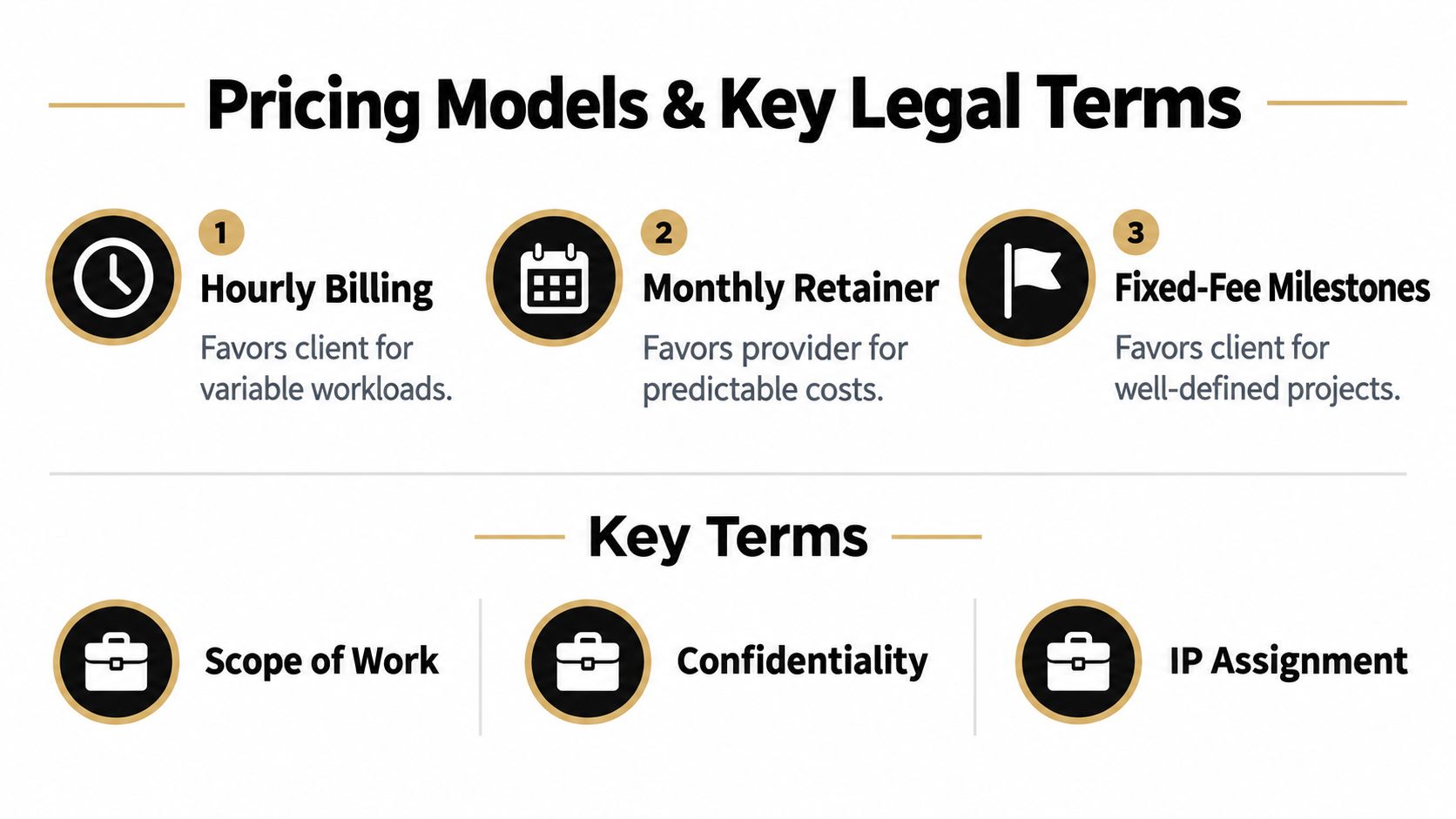
Hourly billing
Hourly, time-and-materials billing fits fluctuating workloads. You pay for approved time, adjust capacity as priorities change, and avoid a fixed commitment during quiet periods. The trade-off is invoice control. Require time records, approval deadlines, invoice detail, overtime authorization, and a process for disputing entries. The MakeAutomation billable hours guide can help finance and engineering teams apply consistent tracking rules.
Monthly retainers
A monthly rate per engineer gives the provider predictable revenue and gives your team a stable planning figure. Use it when the specialist will support recurring sprint work. Define availability, holidays, absences, substitutions, and partial-month charges. Without those terms, you may pay for capacity that is unavailable.
Fixed-fee milestones
Fixed-fee milestones suit stable requirements and objective acceptance criteria. They place more execution risk with the provider, while scope changes trigger renegotiation. Do not use this structure for an evolving backlog and still label it staff augmentation. Once the provider owns a defined outcome, the relationship begins to resemble project outsourcing.
Clauses that protect the client
Your legal team should require language that engineers, managers, procurement, and finance can apply without guesswork:
IP assignment: Assign code, documentation, inventions, architecture, and derivative work to the client upon creation, not only after final payment. Identify the provider's pre-existing IP and require written permission for reusable components.
Confidentiality: Bind the provider and every assigned engineer. Cover source code, credentials, customer information, product plans, and system documentation. State survival periods, access revocation duties, and data-return requirements.
Termination for convenience: Give either party a clear exit right with written notice. Keep that right separate from immediate termination for security, confidentiality, IP, or material contractual breaches.
Replacement: Define substitute qualifications, client approval, handoff duties, and the maximum replacement window. “Reasonable efforts” does not guarantee a replacement.
Employer warranty: Require the provider to confirm that it employs and pays the engineer, handles applicable payroll and employment obligations, and remains responsible for employer duties.
Require background screening where the role warrants it. Each assigned engineer should sign invention-assignment and confidentiality documents that carry the provider's obligations through to the individual. Specify insurance, audit cooperation, security controls, and indemnification for claims caused by the provider's failure to comply. Counsel should adapt the wording to the jurisdictions involved.
The contract should identify the employing entity and state who may direct daily work. Those details help preserve the intended staff augmentation structure instead of allowing client control to drift into an employment-like arrangement.
Finance also needs a workable process connecting rate cards, approvals, invoices, and staffing margins. Use this finance guidance for recruitment agencies to support that operating discipline.
Staff Augmentation Compared to Direct Hire and Managed Services
These models answer the same three questions: who controls the work, who carries employment risk, and who owns delivery. Select the model before negotiating the contract, because no clause can make an outcome-based managed service behave like an embedded engineer without changing the relationship.
Dimension | Staff Augmentation | Direct Hire | Managed Services |
|---|---|---|---|
Day-to-day control | Client directs the engineer | Client manages the employee | Provider manages its delivery team |
Employment relationship | Provider employs the specialist | Client employs the worker | Provider employs the delivery staff |
Delivery ownership | Client owns priorities and output | Client owns priorities and output | Provider owns agreed outcomes |
Capacity model | Flexible external capacity | Permanent headcount | Outsourced capability or project |
Best fit | Skill or capacity gaps inside an existing team | Long-term roadmap ownership | Defined services or deliverables |
Primary risk | Split authority and classification drift | Full employment liability and retention burden | Vendor dependency and outcome governance |
Staff augmentation sits in the middle. You get direct control over sprint priorities, architecture decisions, code review, and team rituals, while the provider handles payroll, benefits, and the employment relationship. That flexibility is valuable when your roadmap needs specialized capability but your permanent headcount plan isn't ready.
Direct hire is the right answer when the role owns a durable product area, internal platform, or leadership responsibility. You gain continuity and a direct employment relationship, but you also absorb recruiting risk, onboarding, benefits, compliance, performance management, and eventual termination obligations.
Managed services make more sense when you can define the outcome and don't need to direct each contributor. The provider supplies the team, management, process, and accountability. You measure results rather than assigning individual work. If your engineering manager will run the vendor's daily standups and approve every task, managed services is probably the wrong label.
For teams comparing delivery ownership in more detail, the managed engineering services overview provides a useful contrast. The contract should reflect the model you intend to operate, not the model that sounds easiest to procure.
Business Advantages and the Risks Most Buyers Underweight
A staff augmentation contract is a control document, not a purchasing form. It determines who carries employment liability, who owns the code, and whether day-to-day supervision turns a vendor relationship into misclassified employment. The model gives your team specialized capability without immediately expanding internal headcount, but only if the contract and operating practices match.
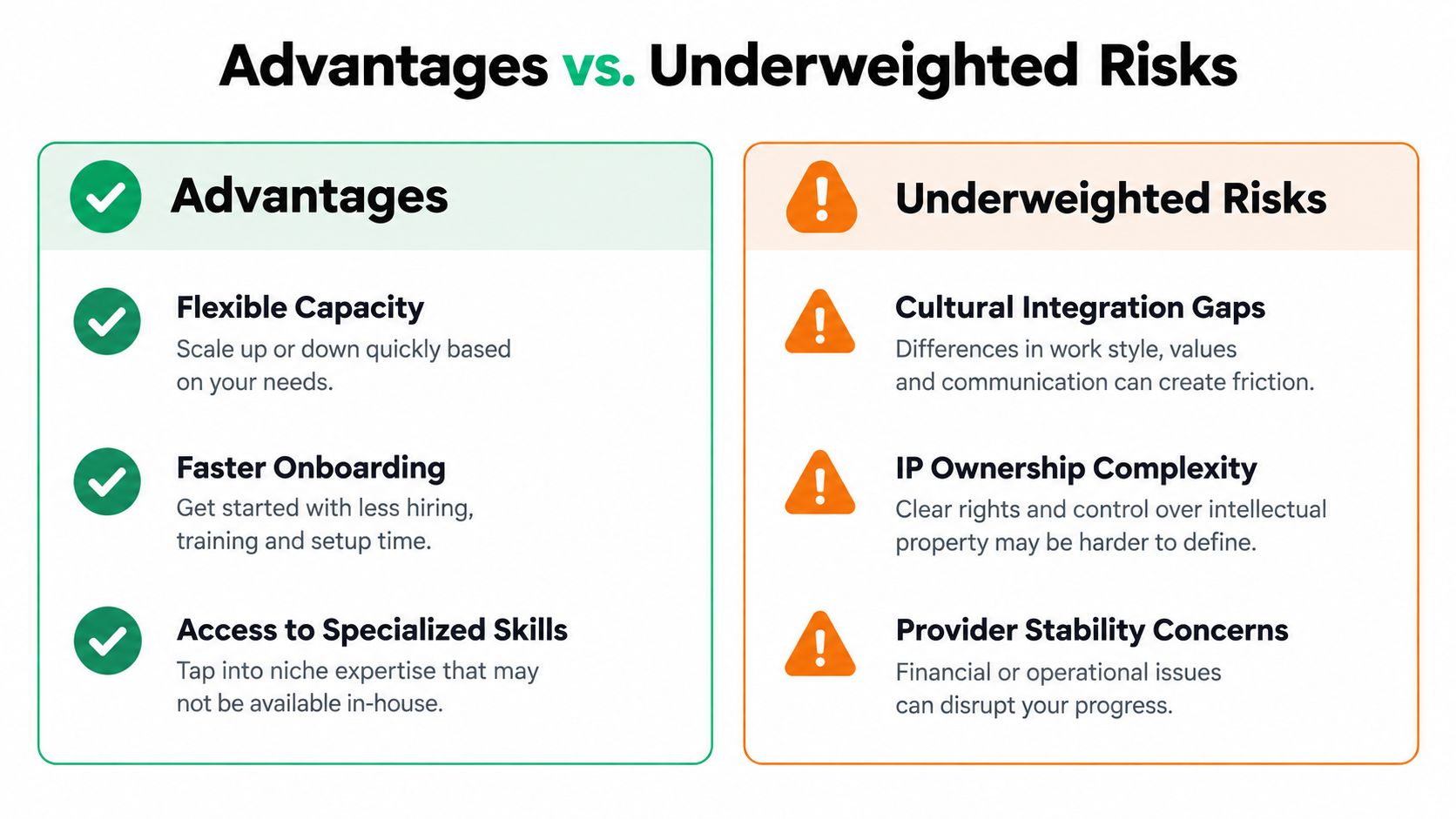
That flexibility helps when the roadmap needs cloud modernization, DevOps, platform work, data engineering, or AI engineering that the internal team cannot provide. You gain capacity quickly while the provider manages payroll, benefits, and the employment relationship. You still control priorities, architecture decisions, code review, and team rituals, so the agreement must define those boundaries precisely.
Do not treat the risks as administrative details. They appear through ordinary management behavior and weak handoff terms.
Misclassification: If your managers direct an augmented engineer like an employee, the working relationship can drift from the contract's intended structure. State the provider's employer responsibility, document the engagement purpose, preserve the vendor employment relationship, and review the arrangement across jurisdictions. Misclassification can expose your company to retroactive taxes, benefits, and penalties. The staff augmentation compliance guidance supports this review.
Knowledge leakage: A confidentiality sentence does not control repositories, credentials, exports, or post-engagement access. Require individual obligations, access revocation, return and deletion procedures, and continuing confidentiality.
Replacement gaps: If a key engineer leaves without a defined backfill duty, your roadmap absorbs the disruption. Specify qualification standards, client approval, handoff requirements, and a replacement timeline.
Cultural integration gaps: An embedded resource still needs onboarding, documented decisions, clear ownership, and regular feedback. The provider cannot take responsibility for how your team operates.
Provider stability concerns: Before granting production access, request evidence of insurance, financial health, payroll controls, and operational continuity.
Recent coverage points to stronger vetting and governance as employers seek specialized, AI-aware skills. FullScale's staff augmentation trends coverage reports that 43% of employers globally planned to increase staffing in Q4 2026, while 14% expected reductions. For CTOs, the conclusion is practical: augmenting an AI, cloud, or DevOps team requires performance governance, documentation, and knowledge transfer, not only a rate card.
Buyer Checklist and Best Practices for CTOs and Hiring Managers
Start with the provider, not the candidate profile. A polished résumé doesn't prove that the firm can employ, support, replace, and govern technical talent throughout the engagement.
Vet the provider before reviewing rates
Request verifiable client references for comparable technical work. Ask how the provider handles payroll, benefits, local compliance, security incidents, absences, performance disputes, and engineer replacement. Obtain current insurance certificates and evidence that the provider can continue paying its personnel without relying on a delayed client invoice.
Technical screening should involve engineers. Recruiter-only filtering often misses architecture judgment, operational maturity, debugging skill, and the ability to work inside an existing codebase. Use a technical conversation, a review of relevant work, and a structured client interview before approval.
Review the contract for control points
Prioritize the clauses that determine exposure:
IP assignment: Confirm ownership transfers upon creation and covers derivative work, documentation, and inventions.
NDA scope: Ensure obligations bind the provider and every assigned engineer, with survival after termination.
Exit rights: Require termination for convenience, immediate termination for cause, and a documented offboarding process.
Replacement SLA: Define the replacement window, qualification standard, client approval, and handoff duties.
Audit rights: Preserve the ability to verify compliance, access controls, insurance, and relevant employment documentation.
Govern the engagement without creating employment drift
Assign one accountable vendor contact and one internal delivery owner. Include augmented engineers in the technical workflow they need to perform the work, but keep the reporting and employment relationship distinct from your employees. Managers should assign deliverables and review output without casually adding internal benefits, changing employment terms, or treating the provider as invisible.
Document system access from day one. Require current architecture and runbook documentation, repository ownership, credential revocation, and code escrow or equivalent transfer procedures when the engagement ends. Review contractor status quarterly. If the person has become indistinguishable from a direct employee, escalate the issue to legal and human resources before the arrangement hardens.
Governance principle: Integrate the engineer into delivery, but don't blur the parties responsible for employment.
Putting It All Together With TekRecruiter
The contract is only as strong as the staffing process behind it. A provider can give you elegant IP language and still create delivery risk if its technical screening is superficial, its payroll controls are weak, or its replacement process depends on starting the search after the engineer leaves.
TekRecruiter uses an engineer-to-engineer recruiting model and supports staff augmentation, direct hire, on-demand talent, and managed services. For this topic, the relevant operating model is straightforward: external engineers extend the client team under client-side technical management, while the staffing firm remains responsible for the employment relationship and staffing administration.
The MSA and SOW structure gives CTOs a practical way to govern that relationship. The MSA should establish confidentiality, IP assignment, employer responsibility, liability, insurance, compliance, termination, and dispute terms. Each SOW should then identify the role, technical requirements, start date, rate, client manager, access needs, performance expectations, and replacement process. Ask for those documents before you approve a candidate, not after the engineer is already scheduled to start.
Buyer Checklist Item | TekRecruiter Delivery |
|---|---|
Verifiable technical vetting | Engineer-led technical conversations for engineering roles |
Specialized capability | Staffing across software, AI, DevOps, SRE, cloud, data, Salesforce, ERP, and cybersecurity engineering |
Client-side delivery control | Augmented engineers join the client team under client management |
Flexible capacity | Staff augmentation and on-demand access to a pre-vetted engineering bench |
Contract governance | MSA and SOW framework for separating relationship terms from engagement details |
Employment administration | Provider-side employment and staffing responsibilities defined in the agreement |
Exit protection | Contractual termination, knowledge transfer, access removal, and replacement terms |
Don't accept a vendor's claimed replacement guarantee, screening quality, or employer responsibility without reading the actual clause. Require the commitment in writing, define what “qualified” means, and make sure the SOW doesn't override the protections negotiated in the MSA.
Use the TekRecruiter staff augmentation service as a reference point when comparing providers, then ask for a sample SOW and rate card. The right contract should reduce ambiguity before the first engineer touches your repository.
TekRecruiter is a technology staffing, recruiting, and AI Engineer firm that helps companies deploy top-tier engineers anywhere. Visit TekRecruiter to discuss staff augmentation needs, review available engineering talent, and build an engagement with clear ownership, employment, and exit terms.
Comments