_edited.png)
IT Staff Augmentation Trends That Are Reshaping Teams
Your roadmap is locked. The release train is moving. Then sprint planning exposes the problem nobody in finance or recruiting feels the same way engineering does. You need an ML engineer who can integrate model output into production workflows, a platform engineer who can harden your Kubernetes setup, or a cloud specialist who can get a migration over the line. You need that person in the next sprint. Your hiring process will take months.
That's why IT staff augmentation trends matter right now. This isn't about chasing a buzzword. It's about closing the gap between how software teams ship and how companies still try to hire. Delivery runs in short cycles. Hiring doesn't.
The practical mismatch is clear. Software delivery cycles now run in two-to-four-week increments, while traditional hiring commonly takes 60 to 90 days. That's exactly why augmentation has shifted from ad hoc contracting to a planned capacity model for release phases, migrations, audits, and narrow expertise spikes, as described in this analysis of modern staff augmentation timing. If your team has felt the pressure from the engineering skills gap, you already know this isn't theoretical.
Table of Contents
Introduction Why IT Staff Augmentation Is Accelerating Now - The pressure is operational, not theoretical - Why leaders are treating augmentation differently
How IT Staff Augmentation Works Today - What stays with your internal team - What modern augmentation actually looks like - Where augmentation differs from managed services
Seven IT Staff Augmentation Trends Reshaping Engineering Teams - Demand is spreading across larger delivery models - The seven trends that matter - Where IT Staff Augmentation Demand Is Concentrated in 2026
Comparing Staff Augmentation Models and Vendor Approaches - Pure augmentation versus managed delivery - What I'd choose in real scenarios - The decision criteria that actually matter
Real World Applications and Cost Compliance Tooling in Action - Scenario one: AI integration sprint - Scenario two: cloud migration without stalling feature delivery - Scenario three: offshore talent in regulated environments
How to Choose Measure and Scale Your Augmentation Strategy - Start with the work, not the role - Screen for judgment, not just syntax - Measure what matters - Scale only after the first lane works
Next Steps to Deploy Top Engineering Talent with TekRecruiter
Introduction Why IT Staff Augmentation Is Accelerating Now
The old model was simple. Open a req, wait, interview, negotiate, onboard, then hope the timing still matches the work. That model breaks when your roadmap includes AI integration, cloud modernization, DevOps automation, security remediation, or data platform work that can't wait for a slow headcount cycle.
What changed is buyer behavior. Companies aren't using external technical talent only as a temporary fix anymore. The broader outsourcing market shows why. Recent forecasts place the global IT outsourcing market at USD 632.67 billion in 2026, growing to USD 815.24 billion by 2034 at a 3.22% CAGR, while another estimate puts it at USD 638.65 billion in 2026 and USD 752.08 billion by 2031 at a 3.32% CAGR. One 2026 outsourcing analysis also states that traditional staff augmentation now represents only 29% of outsourcing arrangements, which tells you the market has matured beyond simple contractor fill-ins toward more specialized delivery models, as detailed in this IT outsourcing market analysis.
The pressure is operational, not theoretical
Engineering leaders don't usually wake up wanting a staffing strategy discussion. They want to hit a release date, stabilize production, migrate infrastructure, or unblock a team that's waiting on one missing capability.
That's why the strongest IT staff augmentation trends all point in the same direction:
Capacity over headcount: Teams are adding external specialists for a defined workstream, not just backfilling seats.
Skills over titles: “Senior engineer” is too vague. “Platform engineer who can own CI/CD hardening and cloud rollout tasks this quarter” is useful.
Speed with control: Leaders want faster staffing without handing away architecture and product ownership.
Practical rule: If the work is urgent, specialized, and bounded, augmentation usually beats permanent hiring.
Why leaders are treating augmentation differently
The category is now big enough that multiple market trackers place it on different multi-billion-dollar paths. One 2026 industry summary notes estimates ranging from about USD 1.09 billion to USD 434.1 billion for the global IT staff augmentation market. A separate outlook projects the broader IT staff augmentation and managed services segment at USD 291.71 billion in 2025, USD 317.96 billion in 2026, and USD 707.05 billion by 2035 at 9.0% CAGR. A more conservative forecast places the pure service market at USD 1.15 billion in 2026, growing to USD 1.79 billion by 2035 at 5.1% growth. The spread itself matters because it shows how hard the category is to measure when some reports count only pure-play augmentation and others bundle managed services and outsourcing, as explained in this 2026 market outlook for IT staff augmentation.
My read is simple. You don't need perfect category math to make a staffing decision. You need to know whether the model solves the delivery problem in front of you. It does, when you use it deliberately.
How IT Staff Augmentation Works Today
Staff augmentation is the simplest model to explain and one of the easiest to misuse.
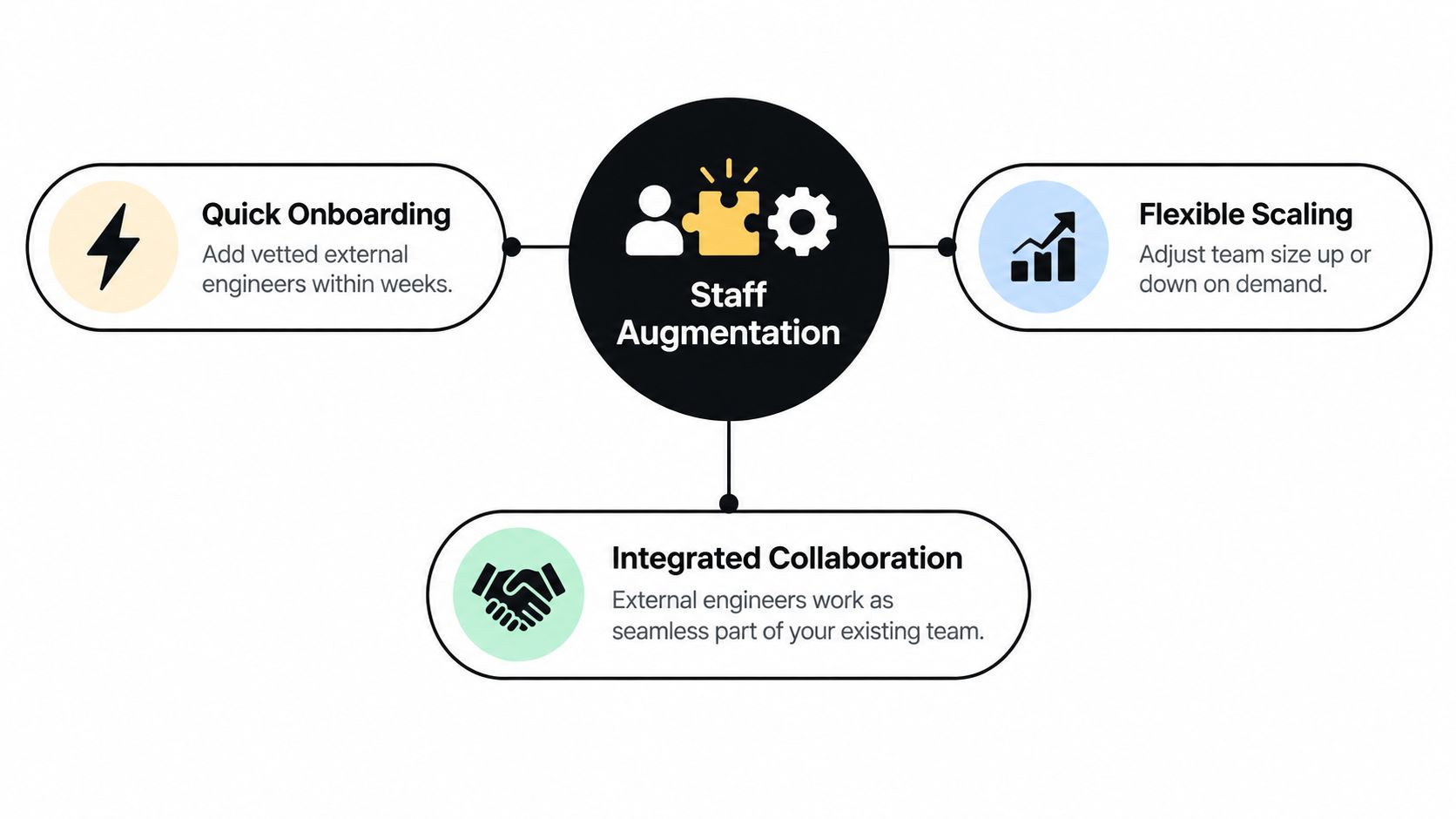
You bring in external engineers to work inside your team, in your tools, against your backlog, under your delivery leadership. You still own architecture, priorities, code review standards, release decisions, and the definition of done. The vendor supplies the people. You manage the work.
Think of augmentation like an extension cord for engineering capacity. It doesn't replace your power source. It lets you reach the work that your current team can't cover fast enough.
What stays with your internal team
A lot of failed engagements come from blurred ownership. If no one knows who makes the final call, quality drops and frustration rises.
Keep these functions internal:
Architecture ownership: Your staff should decide system boundaries, platform direction, and core trade-offs.
Product and business priority: External engineers shouldn't guess what matters most this sprint.
Final code and release accountability: The approving team must remain inside your org.
Security and policy decisions: Contractors can execute controls. They shouldn't define your risk posture.
For a more detailed walkthrough of how teams structure this in practice, this staff augmentation process guide is useful reading.
What modern augmentation actually looks like
The model has evolved. It's no longer just “we need two developers for a while.” Today's stronger engagements are narrower and more intentional.
Common examples:
Sprint support: You add a DevOps engineer for a release train that needs infrastructure automation and deployment cleanup.
Platform workstream coverage: You embed cloud engineers to handle a migration while your core team keeps product velocity moving.
Compliance milestone staffing: You bring in security or data specialists for an audit window or governance push.
The key is scope. Augmentation works best when the work is attached to a sprint goal, platform milestone, or defined execution lane. It works poorly when leaders use external talent as vague surplus capacity.
The client should own the roadmap. The augmented team should own execution inside clearly defined boundaries.
Where augmentation differs from managed services
Many buyers get sloppy. Augmentation and managed services are not interchangeable.
With pure augmentation, you direct the day-to-day work. With managed services, the vendor owns more of the delivery motion and often more operational accountability. Hybrid models sit in the middle.
Use augmentation when you need:
close integration with your team
fast specialist access
direct control over daily priorities
Use managed delivery when you need:
a vendor to absorb more coordination overhead
clearer operational ownership on stable work
less internal management lift
That distinction matters because a lot of the current market growth is happening in blended models, not in old-school hourly contracting.
Seven IT Staff Augmentation Trends Reshaping Engineering Teams
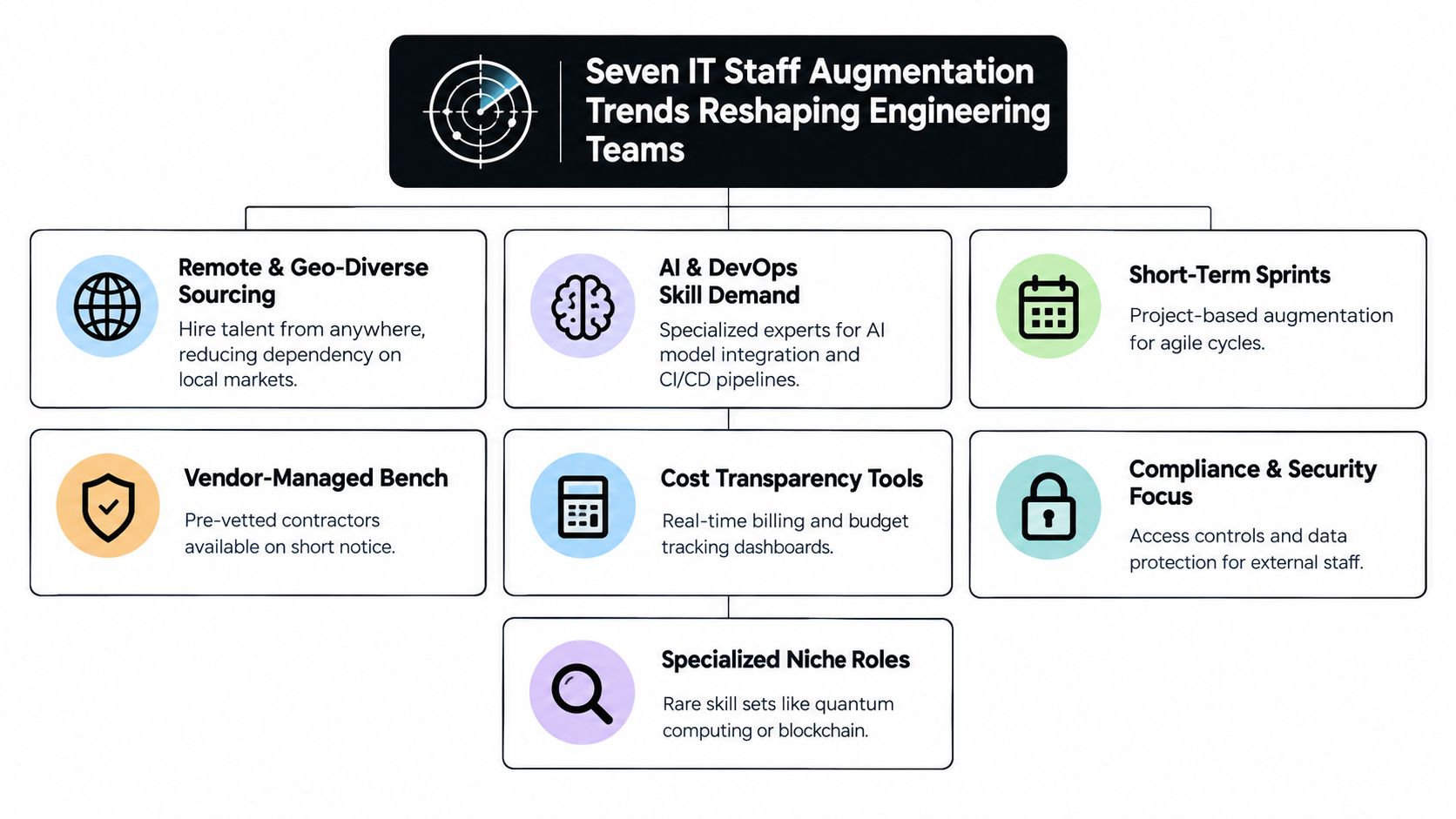
The best way to understand IT staff augmentation trends is to look at what they change in real delivery environments. Not on vendor slides. In sprint planning, incident response, cloud migrations, and AI implementation.
Demand is spreading across larger delivery models
One major benchmark sizes the global IT staff augmentation service market at USD 434.1 billion in 2026 and projects it to reach USD 1,243.4 billion by 2035, implying a 13.2% CAGR over the forecast period, according to this IT staff augmentation service market forecast. That doesn't describe a niche staffing tactic. It describes a scaling operating model.
The seven trends that matter
1. Remote and geo-diverse sourcing is now normal
Buyers are less tied to local markets because the work already happens in distributed tools like GitHub, Jira, Slack, Terraform, Kubernetes, AWS, Azure, Datadog, and Snowflake. That widens access to specialized engineers and reduces dependence on one hiring geography.
2. AI and DevOps skill demand is driving urgency
The highest-pressure roles are rarely generic software positions. They're AI implementation, cloud platform, DevOps, SRE, security, and data engineering roles tied to time-sensitive delivery work. These are the jobs leaders need before the next milestone, not after a quarter of recruiting.
3. Short-term sprint staffing is replacing vague contractor use
Teams increasingly use augmentation as planned sprint capacity. That's healthier than the old pattern of dropping in a contractor with fuzzy expectations. When the work is attached to a release phase or migration workstream, accountability improves.
4. Vendor-managed benches matter more than broad resumes
A vendor with a ready bench of pre-vetted specialists is more useful when demand spikes. This matters in volatile markets where projects recover faster than permanent requisition cycles.
In the UK, contract IT worker demand reached 51.4 in July 2026 on a 50-point growth threshold, its strongest reading in 35 months, while full-time technology workers were at 50.4, according to this July 2026 contractor demand update. That spread suggests firms are leaning on contingent technical talent first when demand rebounds.
5. Cloud-based delivery dominates the operating model
A 2026 market summary reports that cloud-based deployment represented more than 68% of the market in 2026, while offshore staff augmentation accounted for more than 52% of market revenue in the same year, based on this 2026 staff augmentation statistics summary. That aligns with how modern engineering work is delivered. Distributed teams working in cloud-native environments are no longer the exception.
6. Compliance and governance are moving earlier in the buying process
Leaders now ask harder questions about access controls, code ownership, environment isolation, and review accountability before external engineers ever touch production systems. That's not bureaucracy. It's basic survival if you operate in regulated environments or if AI-generated code enters the stack.
7. The AI bottleneck has shifted from writing code to reviewing it
This is the most overlooked trend. Most market commentary focuses on AI-assisted hiring, matching, and coding speed. The harder operational problem is governance. Recent coverage notes that the shortfall is increasingly in engineers who can review and take responsibility for AI-written code, not just produce code, and that AI/ML roles remain among the hardest to fill, as discussed in this analysis of staff augmentation trends in AI-era hiring.
If you're staffing AI work, don't hire for prompt fluency first. Hire for judgment, code review discipline, and production accountability.
Where IT Staff Augmentation Demand Is Concentrated in 2026
Trend Signal | What It Means for Buyers |
|---|---|
Contract demand is recovering faster than full-time demand | Keep a fast contractor onboarding path for specialized work |
Offshore delivery holds more than 52% of market revenue | Global sourcing remains central, especially for execution-heavy work |
Cloud-based delivery represents more than 68% of the market | Expect external engineers to work inside cloud-native toolchains |
AI and ML talent remains hard to fill | Screen for review and governance capability, not just coding output |
Traditional augmentation is only part of the outsourcing mix | Compare augmentation against hybrid and managed delivery, not against hiring alone |
Comparing Staff Augmentation Models and Vendor Approaches
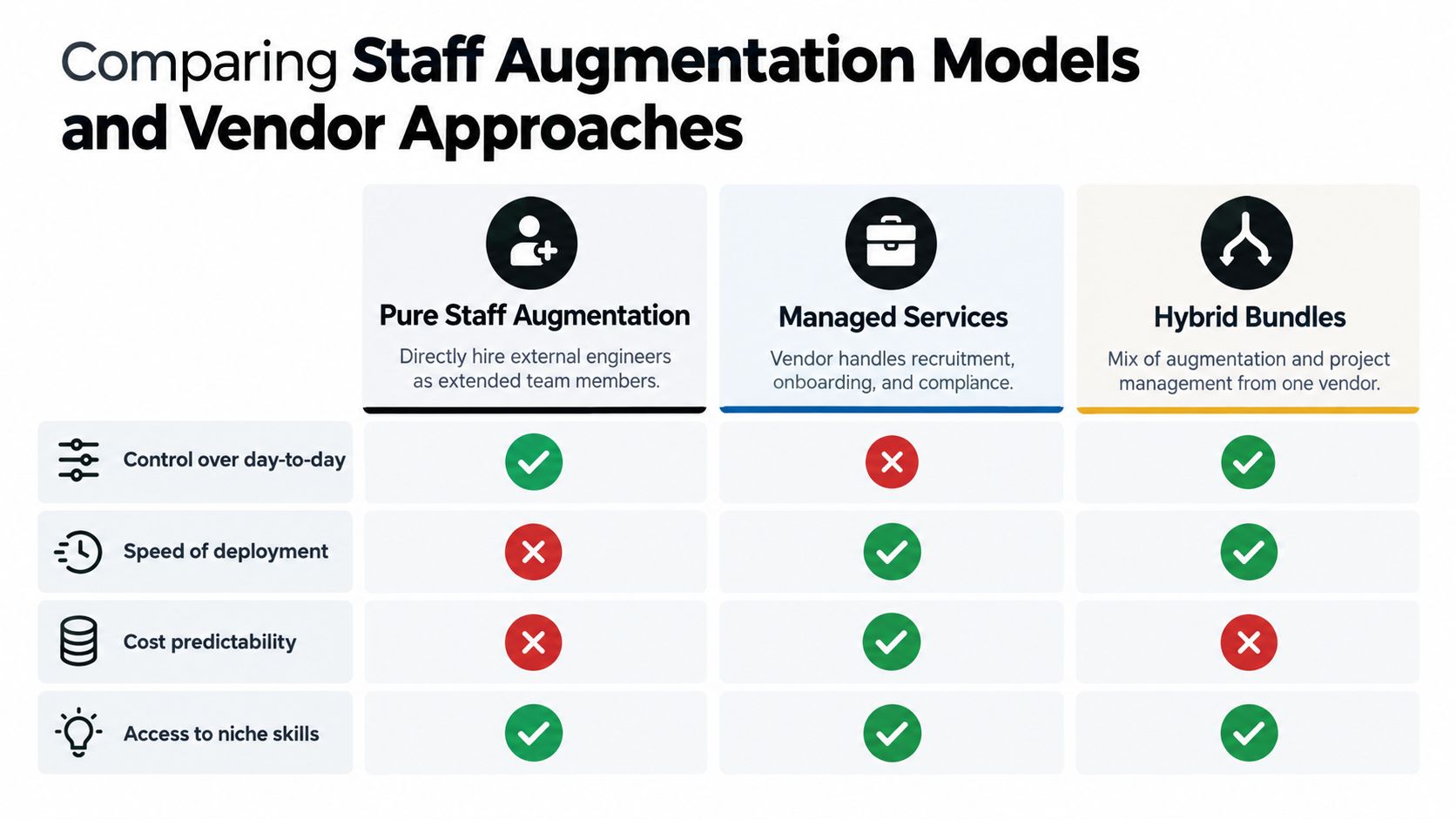
You don't need one staffing model. You need the right model for the kind of work in front of you.
Pure augmentation versus managed delivery
Pure staff augmentation gives you the most control. Your leads run the backlog, your architects define the patterns, and your engineering managers own execution quality. That's ideal when the external engineers must work inside your existing product or platform team.
Managed services are better when the work is stable enough for a vendor to take more responsibility. Think ongoing platform support, repeatable operations, or a defined service lane with less need for constant reprioritization.
Hybrid bundles work well when your situation is mixed. You may want external engineers embedded with your core team for migration execution while also asking the vendor to manage a narrower operational function.
For a practical side-by-side on where consulting overlaps and where it doesn't, this staff augmentation vs consulting comparison helps frame the trade-offs.
What I'd choose in real scenarios
Model | Best fit | Main advantage | Main risk |
|---|---|---|---|
Pure staff augmentation | Product squads, platform migrations, sprint execution | Direct control | Requires strong internal management |
Managed services | Stable operations, support lanes, routine delivery | Lower management overhead | Less day-to-day control |
Hybrid bundle | Programs with both execution and operational layers | Flexible accountability | Blurred ownership if poorly scoped |
On-demand bench | Fast specialist coverage for urgent gaps | Speed | Can become reactive if you don't define scope |
Direct hire support | Long-term core capability building | Durable knowledge retention | Slow compared with sprint needs |
The decision criteria that actually matter
Don't over-index on hourly rate or vendor brand positioning. Look at four things:
Speed to deployment: Can they place relevant engineers fast enough for the work window?
Control model: Do you want to run the work directly or hand more structure to a provider?
Skill specificity: Can they supply engineers who've done your kind of platform work before?
Replacement and continuity: What happens if a contractor rolls off midstream?
Good buyers don't ask, “Which model is best?” They ask, “Which model matches the accountability shape of this work?”
The biggest mistake I see is using pure augmentation for work nobody internally has time to lead, or buying managed services when the team still wants tight technical control. Pick the model that matches your management capacity, not just your budget.
Real World Applications and Cost Compliance Tooling in Action
Abstract staffing talk is easy. Actual delivery is where the model proves itself.

Scenario one: AI integration sprint
A product team wants to ship an AI-assisted feature into an existing application stack. The bottleneck isn't raw coding output. It's integration, review, testing, observability, and ownership of model-generated code.
The right augmented hire here is not “an AI person” in the abstract. It's an engineer who can review generated code, validate dependencies, spot unsafe patterns, and work inside existing CI/CD and application review practices.
Use a checklist like this:
Review ownership: Name the internal lead who signs off on AI-assisted code.
Repo discipline: Require the same pull request standards and branch protections as internal work.
Traceability: Track which components involved model-generated output and who approved them.
Scope limits: Keep external engineers on the integration lane, not vague product ownership.
Scenario two: cloud migration without stalling feature delivery
A platform team is moving core workloads to AWS or Azure while product squads still need to ship features. This is a classic augmentation use case because migration work is urgent, specialized, and finite.
Here the best setup is usually a workstream split. Internal platform leaders keep architecture and sequencing. Augmented cloud or DevOps engineers execute infrastructure tasks, automation, environment hardening, and migration runbooks.
One useful contract reference point is making sure role boundaries, deliverables, and IP terms are explicit up front. This staff augmentation contract guide is a practical starting place for that conversation.
Scenario three: offshore talent in regulated environments
Offshore staffing works well when you manage it properly. It fails when companies treat governance as paperwork after the fact.
The minimum operating checklist should include:
Access control design: Least-privilege permissions, separate identities, and clear environment boundaries.
Documentation standards: Runbooks, architecture notes, and handoff materials should be required deliverables.
Cost visibility: Track work by sprint outcomes and deliverables, not just hours consumed.
Replacement policy: Know how the vendor backfills talent and preserves continuity.
A lot of teams now use structured vendor platforms, engineer-led screening, and bench models to reduce startup friction. TekRecruiter is one example of a staffing and recruiting firm that supports staff augmentation, on-demand engineering access, direct hire, and managed services for software, AI, cloud, DevOps, data, and cybersecurity roles.
External engineers should never be “extra hands.” They should be mapped to a defined execution lane with clear approval paths.
How to Choose Measure and Scale Your Augmentation Strategy
If you treat augmentation like emergency staffing, you'll get emergency-staffing results. Use it like a delivery system instead.
Start with the work, not the role
Don't begin with a job title. Start with the constraint.
Ask:
What has to ship?
What capability is missing?
Is the need tied to a sprint, a migration phase, a compliance milestone, or a platform rollout?
Does this skill need to live in-house long term, or is it a time-bound spike?
If the work is narrow, urgent, and attached to a defined outcome, augmentation is usually the cleaner choice.
Screen for judgment, not just syntax
This matters most for AI, platform, and DevOps work. Plenty of candidates can talk about tools. Fewer can debug under pressure, review AI-generated code responsibly, and make safe trade-offs inside production systems.
Evaluate vendors on:
Engineer-led vetting: Deep technical conversations beat generic quizzes.
Scenario relevance: Ask how candidates handle migration risk, CI/CD failures, or unsafe generated code.
Communication quality: Strong engineers who can't operate inside your planning and review culture create drag.
Onboarding readiness: Fast access means nothing if security setup and environment access stall for days.
Measure what matters
Don't judge augmentation by activity. Judge it by productive integration.
Useful KPIs include:
KPI | Why it matters |
|---|---|
Time to productive contribution | Shows onboarding quality and role fit |
Sprint deliverable completion | Reveals whether the external engineer is helping the team ship |
Review quality | Critical for AI-assisted and infrastructure-heavy work |
Rework volume | Exposes poor fit, weak scoping, or sloppy oversight |
Retention through the workstream | Signals continuity and vendor stability |
Knowledge transfer quality | Determines whether value remains after the engagement ends |
Scale only after the first lane works
Start with one contained workstream. If that goes well, expand. If it doesn't, don't multiply the problem by adding more contractors.
A strong sequence looks like this:
Scope one execution lane
Assign one internal owner
Set onboarding rules before day one
Measure contribution by sprint
Expand only after the model proves itself
That discipline matters because staff augmentation is mainstream now. A labor benchmark cited in a 2026 market analysis states that over 14.6 million temporary and contract workers are engaged through staff augmentation in the US alone, and 54% of organizations already use staff augmentation models, according to this guide to IT staff augmentation services in the US. The model is common. Good execution still isn't.
Next Steps to Deploy Top Engineering Talent with TekRecruiter
The useful way to read IT staff augmentation trends is not as market commentary. It's as a decision framework. If your delivery cycle moves in weeks and your hiring cycle moves in months, permanent hiring alone won't cover every critical workstream. You need a second operating model.
Use augmentation when the work is specialized, urgent, and bounded. Use direct hire when the capability should compound inside the business for years. Use hybrid or managed approaches when you need broader delivery structure or less internal coordination load.
TekRecruiter fits this environment because the firm is built around engineers recruiting engineers, not generic resume filtering. That matters when you need people who can contribute in platform work, cloud modernization, DevOps, AI engineering, cybersecurity, or data systems without wasting cycles on weak screening. TekRecruiter also supports multiple delivery modes, including Direct Hire, Staff Augmentation, On-Demand, and Managed Services, which is the right model spread for teams that don't have one staffing problem, but several.
The core goal is simple. Match the staffing model to the shape of the work, then move fast enough that the roadmap doesn't slip while hiring catches up.
If your team needs to cover a sprint-bound skill gap, build AI capacity, or add engineers without slowing delivery, TekRecruiter gives you access to technology staffing, recruiting, and AI engineering support built for that exact problem. TekRecruiter is technology staffing and recruiting and AI Engineer firm that allows companies to deploy the top 1% of engineers anywhere.
Comments