_edited.png)
Technical Screening Interview: A Practical Guide for 2026
You're probably in the middle of this right now. One backend role opens, applications pile up, recruiters start scheduling calls, and before long somebody drops a folder of take-homes on your senior engineers. Nobody wants to review them. Nobody agrees on what “good” looks like. The hiring manager says the funnel is full, but the panel says the pipeline is weak.
That's the problem a technical screening interview is supposed to solve.
When it works, the screen protects engineering time and gives the team a clean read on whether a candidate deserves a deeper loop. When it fails, the rest of the process inherits bad signal. Strong people get rejected because the interviewer chased trivia. Weak people slip through because they memorized patterns. Then the onsite becomes expensive cleanup.
I've seen the same mistake from both sides. Teams often treat the screen like admin work. Candidates often treat it like a coding obstacle course. In practice, it's neither. A good technical screening interview is an engineer-to-engineer signal test. It should tell you whether this person can reason, debug, communicate, and learn in the environment you run.
Table of Contents
The Hiring Funnel Problem Behind Every Technical Screening Interview - Where the funnel breaks - The cost isn't only time
What a Technical Screening Interview Actually Is - What it is and what it isn't - What a good screen should predict
How a Technical Screen Works From Question to Score - What gets scored - Calibration matters more than clever questions
Question Types, Formats, and the AI Shift - Comparing the common formats - What AI changed
Common Pitfalls for Hiring Teams and Candidates - Where hiring teams go wrong - Where candidates go wrong
Run a Better Screen and Prepare for One - For hiring teams - For candidates
Why Engineer-to-Engineer Screening Changes the Signal - What changes in practice - The screen should act like calibration
The Hiring Funnel Problem Behind Every Technical Screening Interview
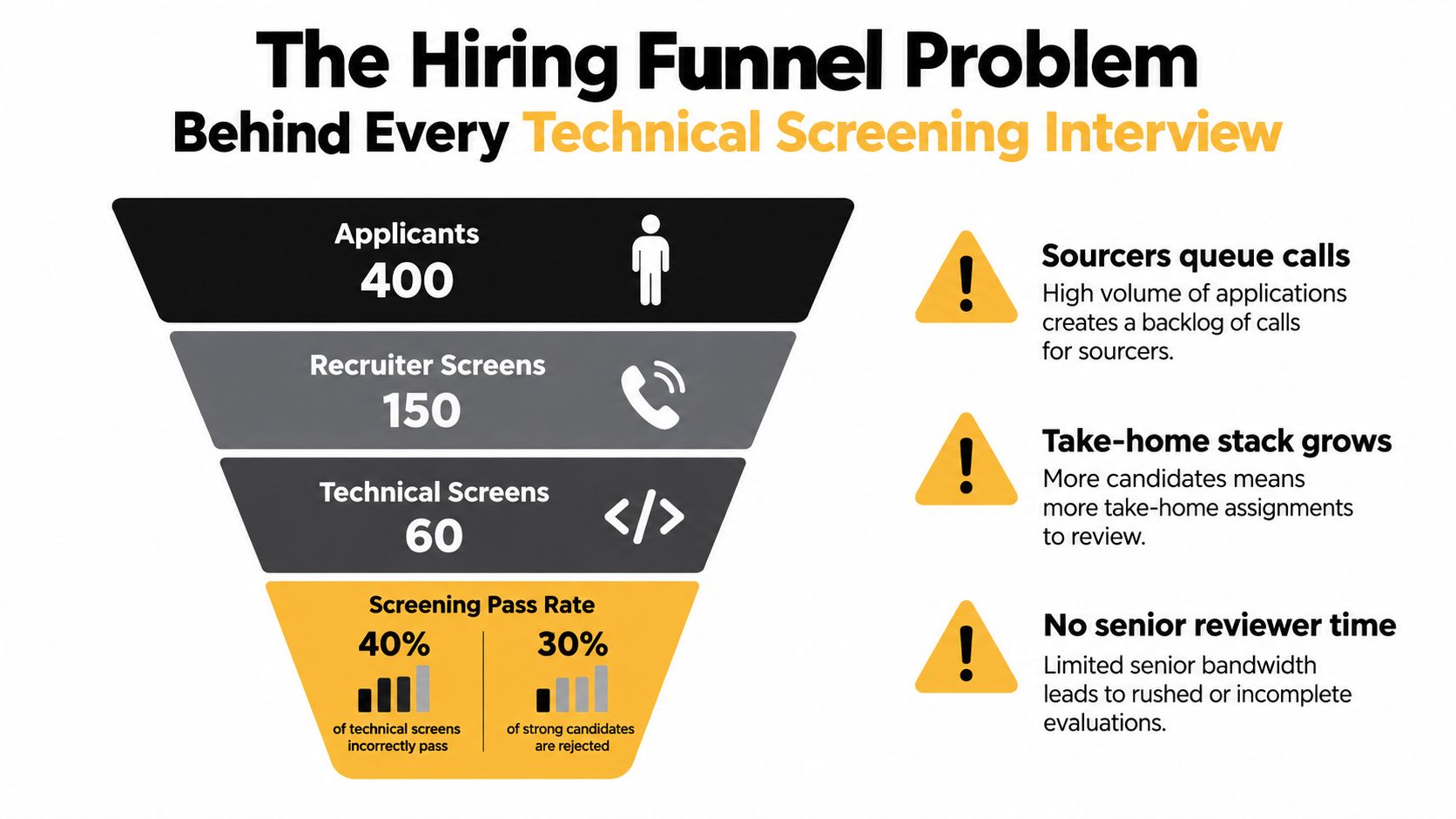
A lot of hiring pain starts before the first real technical conversation. You have one opening, far too many applicants, and no shared idea of what the screen is supposed to measure. The recruiter wants speed. The hiring manager wants confidence. The engineers want fewer false positives. Without structure, nobody gets what they want.
The scale problem is real. In 2026, technical roles reached only about 3.6% of applications to interview and 7.3% of interviewed candidates to offer, while employers averaged 17.6 interviewed candidates per technical hire and 23.3 interviewer-hours per technical hire in benchmarks summarized at OneHour Digital's technical interview statistics. The same summary reports that interviews per technical hire were up roughly 52% from about 11 to 17.6 since 2021. That's a lot of labor spent before anyone joins the team.
Where the funnel breaks
The problem isn't a shortage of applicants. It's that the screen isn't designed to separate useful signal from noise.
A sloppy screen creates three downstream failures:
Senior time gets wasted: Engineers end up in full loops with candidates who never had the fundamentals.
Candidates wait too long: Feedback slows down because nobody can convert vague notes into a decision.
The process feels transactional: Good candidates notice when the first technical conversation teaches them nothing about the role.
A lot of leaders frame this as a capacity problem. It's usually a signal-quality problem. If the screen can't distinguish a strong junior from a mid-level candidate who has rehearsed stock solutions, every later stage pays for that mistake.
Practical rule: The first technical screen should remove uncertainty, not create more of it.
The cost isn't only time
Time matters, but the bigger cost is calibration. Once a weak screening decision gets baked into the funnel, the hiring team starts debating the candidate instead of evaluating them. That's why a better process starts with a sharper screen, not a longer onsite.
Teams working through an engineering skills gap usually discover the same thing. The bottleneck isn't just candidate volume. It's the inability to identify real engineering judgment early enough to protect the rest of the process.
What a Technical Screening Interview Actually Is
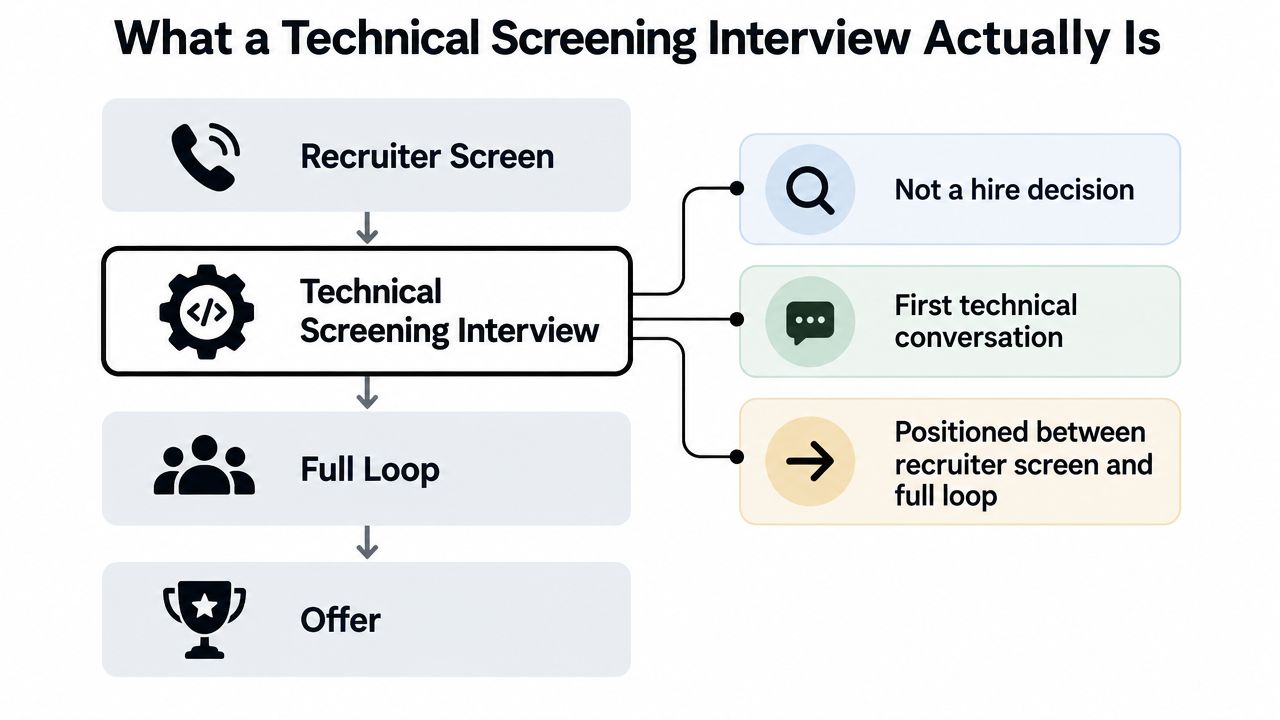
A technical screening interview is the first substantive technical conversation in the hiring process. It sits after the recruiter call and before the full interview loop. Its job isn't to make the final hire decision. Its job is to decide whether this candidate deserves deeper investment from the engineering team.
The simplest analogy is triage. The screen is the nurse, not the surgeon. It doesn't settle every question. It tells the team whether the candidate's profile, reasoning, and technical habits justify a more expensive evaluation.
Early in the process, it helps to anchor the role visually.
What it is and what it isn't
A recruiter screen usually covers logistics, motivation, compensation alignment, timeline, and broad background fit. A take-home can go deeper, but it's slower and often harder to compare across candidates. The onsite or full loop is broader still. It checks collaboration, design judgment, coding, communication, and role-specific depth across multiple interviewers.
The technical screen sits in the middle. It's narrow on purpose.
In most healthy processes, a working engineer runs it. That person asks job-relevant questions, probes for tradeoffs, and writes a pass or no-pass recommendation based on evidence from the conversation.
What a good screen should predict
A strong screen doesn't try to simulate the entire job in under an hour. It looks for a smaller set of predictive signals:
Can this person learn the stack?
Can they debug under pressure without freezing?
Can they explain technical choices clearly?
Can they work with another engineer without heavy prompting?
Public guidance from the U.S. Office of Personnel Management on structured interviews is useful here. It notes that higher-structure interviews produce higher validity, stronger rater reliability, stronger rater agreement, and less adverse impact. It also states that job-competency-based questions show strong content validity, criterion-related validity, and incremental validity over other selection measures.
That lines up with what experienced hiring teams already know. The best technical screening interview doesn't feel random. It feels repeatable.
How a Technical Screen Works From Question to Score
A screen works best when it runs like an instrument, not a performance. The candidate should know the problem. The interviewer should know what evidence they need. The score should come from observed behavior, not from how impressive the conversation felt.
A common coding round already follows a recognizable sequence. A breakdown published at The Interview Den coding interview roadmap describes a 2 to 5 minute warm-up and problem statement, a 5 to 10 minute approach discussion, a 15 to 25 minute live implementation segment, and a 5 to 10 minute testing and follow-up segment. That structure is useful because it forces the interviewer to observe more than just final code.
What gets scored
The best rubrics are short. Four or five competencies are enough if they match the role. Typical categories include problem decomposition, technical fundamentals, communication, debugging habits, and tradeoff reasoning.
Here's a practical version.
Sample Screen Scoring Rubric by Seniority | Junior Weight | Mid Weight | Senior Weight | Staff Weight |
|---|---|---|---|---|
Competency | ||||
Problem decomposition | High | High | Medium | Medium |
Technical fundamentals | High | High | High | Medium |
Communication | Medium | High | High | High |
Tradeoff reasoning | Low | Medium | High | High |
System judgment and influence | Low | Low | Medium | High |
This isn't about fake precision. It's about forcing interviewer discipline. Junior screens should lean harder on fundamentals and learning velocity. Staff screens should probe architectural judgment, scope control, and how the candidate influences other engineers.
A screen without a rubric usually turns into a confidence contest between interviewers after the call.
Calibration matters more than clever questions
Even a solid question set falls apart if one interviewer is strict and another passes anyone who seems pleasant. The write-up should happen right after the call while details are still fresh. Good notes point to evidence: where the candidate clarified assumptions, how they recovered from a bug, whether they spotted tradeoffs without prompting.
For teams refining the process, examples help. A list of insider IT interview questions can be useful, not as a script to copy, but as a reference point for the kinds of prompts that reveal how someone thinks under discussion.
Teams that need consistency at scale usually move toward a more structured interview process. That means fixed question order, anchored scoring, and periodic calibration sessions where interviewers compare notes on the same sample responses. Without that, the screen produces noise dressed up as judgment.
Question Types, Formats, and the AI Shift
Not every technical screening interview should look the same. A backend role, a DevOps hire, a machine learning engineer, and a staff platform candidate don't all produce signal in the same format. The mistake is assuming one interview type, usually live coding, should carry the whole process.
Comparing the common formats
Some formats are strong because they reveal thinking in real time. Others are useful because they reduce scheduling friction. Every option trades off depth, fairness, and vulnerability to AI-assisted output.
Question format comparison for technical screening interviews | Signal Strength | Scheduling Cost | AI Vulnerability | Best For |
|---|---|---|---|---|
Format | ||||
Live coding | High when discussion is strong | Medium | Medium | Problem solving, debugging, communication |
Take-home exercise | Medium to high if scoped well | High | High | Practical implementation, code quality |
Debugging walkthrough | High | Medium | Low to medium | Existing-code reasoning, diagnosis |
Junior system design prompt | Medium | Medium | Low | API thinking, component reasoning |
Senior architecture deep-dive | High | Medium | Low | Tradeoffs, scale judgment, leadership |
Async written response | Low to medium | Low | High | Early filtering when interviewer time is constrained |
Live coding still has a place, but only if the interviewer probes decisions. If the entire signal is whether the code compiles, you're testing memorization and composure more than engineering. Take-homes can show depth, but unmonitored tasks have become much harder to trust at face value.
What AI changed
The hiring market has already shifted toward AI-mediated workflows. A 2026 summary at Geekbye's interview statistics research reports that 67% of companies with more than 500 employees use AI-powered resume screening, 41% use AI to generate or customize interview questions, 28% use AI-assisted evaluation tools, and 19% have experimented with AI interviewers for initial screening rounds. The same source says candidate satisfaction with AI-only interviews is 34% lower than with human-conducted interviews.
That changes how teams should screen. Unmonitored coding tasks are easier to complete with generated help. What's harder to fake is sustained technical conversation: why a design was chosen, what would break under load, how a bug was isolated, what assumptions the candidate would revisit.
For candidates, broad prep still matters. A practical reference on system design and algorithm prep is useful because most screens now reward explanation, not just output.
For hiring teams, any role that touches applied AI should be assessed with role-specific prompts and explicit rules. A generic coding screen won't tell you much about model reasoning, evaluation tradeoffs, or production constraints. Teams building that capability often need a dedicated machine learning engineer assessment, not just a standard software interview recycled with new terminology.
Common Pitfalls for Hiring Teams and Candidates
The worst hiring misses usually don't come from one dramatic mistake. They come from quiet assumptions that nobody challenges. The team thinks the screen is working because candidates are getting filtered. The candidate thinks prep is working because they can solve rehearsed problems. Then both sides collide in an interview that measures the wrong things.
Where hiring teams go wrong
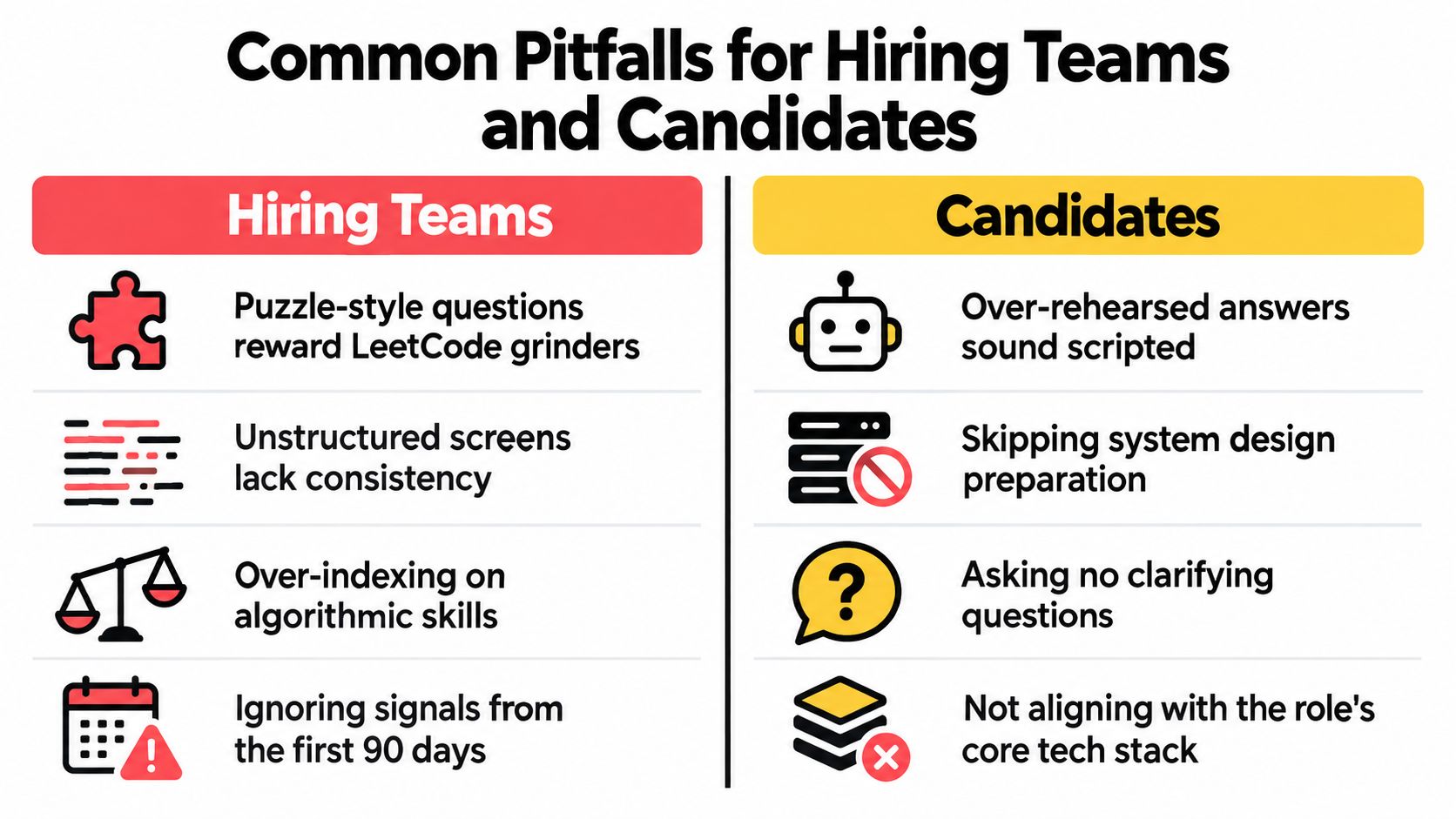
The most common team-side failure is over-indexing on puzzle-style questions. Those often reward candidates who've practiced a narrow genre of interview problem instead of people who can reason through production tradeoffs. Another failure is running unstructured screens, then asking interviewers to convert gut feel into a hiring decision.
A better pattern looks like this:
Replace isolated puzzles: Use tasks that resemble the job, such as debugging a service boundary, reasoning through data flow, or discussing a recent system choice.
Stop collecting vibes: Require written evidence tied to competencies.
Cut disconnected trivia: Language internals only matter when they affect the work.
Set AI rules up front: Candidates shouldn't have to guess whether outside assistance is allowed.
A candidate-reported study summarized at Prachub's pass-rates-by-round analysis found that technical screens progressed to the next stage 60.7% of the time, while onsite rounds produced offers only 25.1% of the time. The same dataset, drawn from 1,407 interview reports across 247 companies, found that senior-role processes increasingly include system design interviews, live coding with shared editors, take-home assignments, and technical presentations. The takeaway is simple. Different rounds test different things, and teams miss when they force one style of screening onto every role.
Where candidates go wrong
Candidates usually fail for the mirror-image reason. They prepare for the artifact, not the conversation.
Common misses include:
Grinding only coding patterns: Useful, but incomplete if the screen asks for tradeoffs or debugging.
Hiding uncertainty: Good interviewers trust candidates who name assumptions and risks.
Using AI on take-homes without understanding the code: Follow-up questions expose that quickly.
Asking no clarifying questions: That often reads as passivity, not confidence.
The candidate who says, “I'd make this tradeoff because the service needs predictable latency,” usually sounds stronger than the one who rushes to type.
The counter-practice is simple. Treat the screen like a working session. Say what you're optimizing for. Explain what you'd test. Name what you don't know yet.
Run a Better Screen and Prepare for One
A better technical screening interview comes from parallel discipline. Hiring teams need a repeatable process. Candidates need a prep plan that reflects how screens run now, not how they ran a few years ago.
For hiring teams
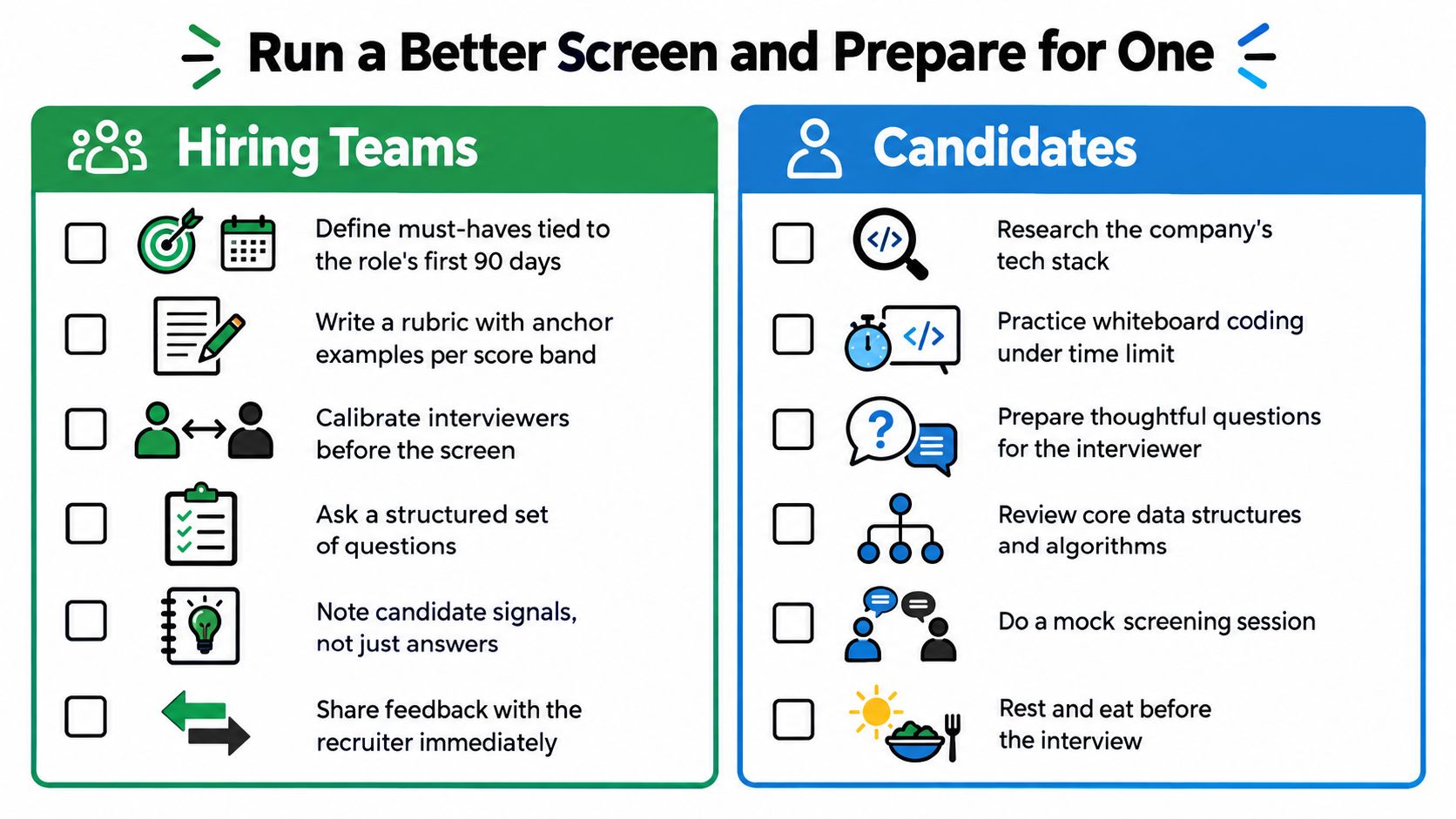
Start with the first ninety days of the role. If the person will own API performance, support incident response, or help migrate infrastructure, the screen should test for those abilities indirectly but clearly. Don't begin with a favorite question. Begin with the work.
A practical team playbook:
Define must-haves clearly Tie them to real expectations in the first months on the job.
Write anchored score bands Interviewers need examples of what weak, mixed, and strong evidence looks like.
Calibrate regularly Compare write-ups across interviewers and tighten where standards drift.
Set AI ground rules Spell out whether tools are allowed in take-homes, paired exercises, or written tasks.
Log the score quickly Notes get less reliable when they sit overnight.
Track conversion quality Watch screen-to-onsite movement and the quality of people who arrive there.
If your organization is shifting toward skills-based hiring, the screen becomes even more important. It's the moment where pedigree matters less and demonstrated reasoning matters more.
For candidates
Candidates need a narrower plan than most advice suggests. Don't prepare for every possible interview. Prepare for the role in front of you.
A useful short-cycle prep routine:
One week out: Audit the job description. Pull out the technical must-haves, then match each one to a project or problem you can discuss.
A few days out: Practice explaining tradeoffs aloud. Talk through a service, migration, outage, or design decision you worked on.
The day before: Prepare clarifying questions. Good candidates rarely jump straight into implementation.
After the interview: Debrief immediately. Write down what follow-up questions caught you off guard.
For broader preparation, practical job interview research tips can help candidates gather the right context before the conversation starts.
Working habit: If you can't explain why you chose a solution, the solution won't carry you very far in the screen.
One option for teams that want this process run by technical peers is TekRecruiter, which uses engineer-led technical conversations as part of hiring workflows rather than relying only on tests and quizzes.
Why Engineer-to-Engineer Screening Changes the Signal
Engineer-led screens work because the interviewer already speaks the language of the job. They know which tradeoffs matter, which shortcuts are acceptable, and which answers sound polished but collapse under follow-up. That raises signal density per minute.
There's also less translation loss. When the person asking the questions understands the stack and the constraints, they don't need to infer competence from surface confidence. They can probe directly into debugging habits, architecture choices, failure modes, and technical judgment.
What changes in practice
This model works best when the screener is calibrated and the session is focused. The point isn't to let every engineer improvise. The point is to combine domain fluency with structured evaluation.
A few practical differences show up quickly:
Feedback gets sharper: Notes tie back to actual engineering evidence.
Hiring managers move faster: They don't need to decode recruiter summaries into technical meaning.
Candidates engage more naturally: The interview feels closer to a working conversation than an audition.
There are constraints, of course. Senior engineers are expensive. Their time has to be protected. That's why short sessions, clean rubrics, and immediate write-ups matter so much.
The screen should act like calibration
A technical screening interview is not a miniature onsite. It's not a recruiter phone call with a coding question attached. It's a calibration exercise. The team is asking one disciplined question: based on this conversation, should we invest more engineering time?
That's why engineer-to-engineer screening tends to produce better outcomes than generic screening theater. It aligns the question, the evidence, and the evaluator. For companies hiring software, DevOps, cloud, and AI talent, that alignment is what keeps the funnel honest.
TekRecruiter is technology staffing and recruiting and AI Engineer firm that allows companies to deploy the top 1% of engineers anywhere. If you want a hiring process built around engineer-to-engineer signal instead of generic screens, visit TekRecruiter to see how the team supports technical hiring across software, DevOps, cloud, data, and AI roles.
Comments