_edited.png)
A CTOs Guide to Software Development Capacity Planning
Software development capacity planning is the art and science of matching your engineering team’s workload with their actual ability to deliver. It’s about looking ahead—predicting future needs so you have the right people with the right skills ready at the right time. Nail this, and you sidestep burnout while making sure projects get shipped efficiently.
Why Software Development Capacity Planning Matters

Too many engineering leaders I’ve worked with get stuck in a cycle of reactive hiring and "gut-feel" resource allocation. It’s a familiar story, and it almost always ends with the same problems: missed deadlines, spiraling costs, and worst of all, a burnt-out team. If you don't have a clear picture of what your team can realistically get done, you're flying blind with your product roadmap.
Done right, software development capacity planning turns engineering from an unpredictable cost center into a reliable value driver. This isn't about micromanagement. It's about creating clarity and predictability. Once you get this down, you can commit to business goals with confidence and innovate without constantly overloading your most valuable asset—your engineers.
Moving Beyond Simple Headcounts
True capacity planning is way more than just counting how many developers are on payroll. A team of ten engineers does not automatically mean you have 400 hours of pure coding time each week. Anyone who’s run a team knows the reality is far messier.
This is where a strategic process comes in. It forces you to account for all the hidden productivity drains that are so easy to ignore:
Administrative Overhead: All that time spent in sprint planning, retrospectives, and company-wide meetings adds up.
Unplanned Work: Critical bug fixes and urgent production support requests that blow up a perfectly planned sprint.
Professional Development: That crucial time for training and learning that makes your team stronger in the long run.
Paid Time Off: Vacations, sick days, and holidays have to be factored into any realistic timeline.
Forgetting these things creates a massive gap between what you think your capacity is and what your team actually produces.
By putting a number on these non-coding activities, leaders get an honest baseline of their team’s real production power. This data-driven foundation is the first step toward building a sustainable, high-performing engineering organization.
The Strategic Business Advantage
The ripple effects of solid capacity planning are felt far beyond the engineering department. When you can accurately forecast what your team can handle, you empower the entire organization. Product managers build roadmaps that are actually achievable. Sales teams set expectations with clients they can meet. And finance can budget for growth with real confidence.
This isn’t just a niche practice anymore; the market is reflecting its importance. The global capacity planning software market was recently valued at around USD 1.25 billion and is expected to grow, showing just how critical this is for managing modern teams and hitting client targets. For a broader look at resource management, there are some great guides on Application Capacity Planning.
Ultimately, this is about building an engineering function that’s both resilient and scalable—one that can adapt to business needs without torching the team or tanking product quality.
When your capacity planning shows a gap between your roadmap’s demands and your team's availability, it’s time to act. TekRecruiter provides the strategic staffing and AI engineering solutions to bridge that gap. We connect you with the top 1% of engineers, allowing you to deploy elite talent anywhere to execute your vision without compromise.
Establishing Your Baseline of True Capacity

Before you can even think about forecasting, you need a rock-solid grip on what your team can actually produce right now. Any effective software development capacity planning starts here, with an honest, data-driven look at your current state.
Forget simple headcount. The single biggest mistake I see engineering leaders make is assuming every developer is available for 40 hours of focused work each week. That’s a fantasy.
The reality is messy. A huge chunk of any engineer's time gets eaten up by essential, non-coding work. If you ignore this, your entire plan is built on a house of cards. The goal isn't to micromanage every minute, but to establish a realistic baseline that reflects how work really gets done.
Calculating True Developer Availability
First things first: you have to quantify the time your engineers spend away from their keyboards. This isn’t about blaming meetings—it’s about acknowledging their impact on your available hours.
A typical week is full of activities that are non-negotiable for collaboration, alignment, and team health. You have to subtract them from the standard workweek to get a real number.
Recurring Meetings: Daily stand-ups, sprint planning, retros, one-on-ones. They add up.
Company Overhead: All-hands meetings, departmental updates, and team-building events.
Unplanned Interruptions: The "fire drills"—urgent bug fixes, production support, and helping out a teammate who’s stuck.
Time Off: PTO, sick days, and public holidays all need to be factored in for a given period.
To make this tangible, let's break it down in a simple template.
Developer Availability Calculation Template
This is a straightforward way to get from a theoretical 40-hour week to a practical, usable number for your planning. The example below is pretty standard for a developer on an Agile team.
Factor | Calculation Example (Per Week) | Notes |
|---|---|---|
Total Hours | 40 Hours | The standard workweek. |
Recurring Meetings | - 5 Hours | Daily standups, sprint planning, retros, etc. |
Company Overhead | - 2 Hours | All-hands, department meetings, compliance training. |
Unplanned Interruptions | - 3 Hours | A conservative buffer for bug fixes and ad-hoc support. |
PTO/Sick/Holiday Average | - 2 Hours | Prorated average (e.g., 4 weeks vacation + holidays / 52 weeks). |
True Available Hours | 28 Hours | This is your baseline for planning. |
See the difference? We just went from 40 hours to 28 hours. That’s a massive 30% reduction in perceived capacity, and it’s much closer to reality.
By subtracting these predictable time drains, you shift from a theoretical 40-hour week to a much more realistic figure, often closer to 25-30 hours of actual project-focused time per developer. This number is your true availability—the cornerstone of accurate planning.
This approach transforms your capacity from a vague headcount into a specific number of engineering hours. As you get more comfortable with this, you'll want to dig deeper into mastering project management and resource allocation to refine your process even further.
From Availability to Actual Output
Knowing your team’s available hours is only half the battle. Now you have to measure what they actually produce with that time. This is where you connect hours to output and get a real feedback loop on productivity.
For teams running Agile, velocity is the go-to metric. It’s the average number of story points a team completes per sprint. Track it over a few sprints, and you’ll get a predictable rate of delivery that naturally accounts for the chaos of software development.
Another powerful metric is cycle time. This measures the clock time from when work starts on a task to when it’s delivered. Short cycle times mean your workflow is efficient. Long or erratic cycle times are a huge red flag, pointing to bottlenecks, tech debt, or process issues that are silently killing your capacity.
Aggregating Team and Departmental Capacity
Once you have a handle on individuals and teams, the final step is to roll it all up for a departmental view. This is what empowers strategic, leadership-level decisions.
Start by calculating the total available hours for each team. A team of five developers, each with a realistic capacity of 28 hours per week, gives you a total team capacity of 140 hours.
From there, you can aggregate the capacity across all teams in your department. This macro view lets you:
Confidently say "yes" or "no" to that big new initiative.
Pinpoint which teams are overloaded and burning out.
Build a data-backed case for new hires or bringing in outside help.
This bottom-up approach creates the data layer you need for all future forecasting. You’re no longer guessing; you’re planning with evidence.
When that baseline reveals a gap between what your team can do and what your roadmap demands, it’s time to find a partner. TekRecruiter connects innovative companies with the top 1% of global engineers. Whether it's staff augmentation, direct hires, or a full AI engineering solution, we provide the elite talent needed to turn capacity plans into reality.
Forecasting Future Demand with Confidence
Once you have a real baseline for your team's capacity, it’s time to look ahead. This is the part of the job that separates proactive engineering leaders from reactive managers who are always scrambling to catch up. It’s where software development capacity planning shifts from measuring what you can do to strategically deciding what you will do.
Forget about throwing darts at a board. Good forecasting is built on data-driven models that connect high-level business goals to the actual engineering effort required to hit them. The entire point is to build a defensible projection of what your teams will need to deliver on the product roadmap.
This means you have to translate abstract business initiatives into concrete resource needs. For instance, a goal like "enter the European market" isn't just a slide in a strategy deck—it’s a pile of engineering tasks. It might break down into 2,000 developer-hours for internationalization, 800 hours for GDPR compliance, and another 500 hours for new payment gateway integrations. That's the level of detail that makes a forecast something you can actually use.
Translating Business Goals into Engineering Needs
To create a forecast you can trust, you have to break down your product roadmap into chunks of work you can actually measure. This is how you connect the "what" (business goals) with the "how" (engineering resources).
The trick is to lean heavily on your historical data. If you have similar projects to look back on, your predictions will be far more educated.
Roadmap Initiatives: Start with the big-ticket items planned for the next two to four quarters.
Initial Sizing: Get in a room with product managers and tech leads to put high-level estimates on each initiative. T-shirt sizes (S, M, L, XL) work great at this stage.
Historical Data Conversion: Dig into your team's historical velocity or cycle time data to translate those t-shirt sizes into rough story points or developer-hour estimates.
Risk and Complexity Buffers: Always add a buffer for uncertainty. A project that involves a brand-new, unfamiliar technology needs a bigger buffer—think 20-30%—than something built with your core tech stack.
By following this process, you end up with a dynamic forecast, not a static list. It's a living model you can update as priorities inevitably shift or new information comes to light. For a deeper dive on the estimation process itself, check out our guide on software development cost estimation.
The Rise of AI and Machine Learning in Forecasting
One of the biggest shifts happening in capacity planning is the move toward predictive analytics powered by AI. Machine learning models can chew through enormous amounts of past project data—everything from Jira tickets to code commits—and spot hidden patterns and dependencies that a human would almost certainly miss.
Instead of just relying on manual estimates, these systems can predict the effort for new features with startling accuracy. They learn from every single project your team completes, helping to strip bias and "gut feelings" out of the planning process.
AI and machine learning have become a serious force in capacity planning, totally reshaping how organizations forecast their needs. By 2023, AI-driven features were becoming standard, allowing companies to finally shift from reactive to proactive resource management. This tech helps businesses forecast demand more accurately and respond faster to market changes—a critical advantage, especially when managing distributed teams. You can read more about these market trends on Data Insights Market.
Building a Dynamic and Adaptable Forecast
Your final forecast should never be a rigid, set-in-stone document. The real goal is to create a living model that helps you make smarter decisions when things change—and they always do.
Think about a real-world scenario: your company decides to fast-track a new feature to counter a competitor's move. With a dynamic forecast, you can immediately model the impact of that decision. You can see exactly which other projects would need to be delayed, pinpoint the specific skill sets required, and determine if you need to bring in outside help to hit the new deadline.
This ability to model different scenarios is what makes a forecast a truly strategic tool. It lets you answer the tough questions, like, "What happens if we hire two more backend engineers?" or "What's the real impact of delaying Project X by one quarter?"
When your forecast reveals a gap between your goals and your team's ability to deliver, you need a partner who can provide talent at speed. TekRecruiter specializes in connecting companies with the top 1% of engineers globally. Whether you need to augment your team for a critical project or find permanent hires with niche skills, we help you deploy elite talent anywhere to turn your strategic forecast into a delivered reality.
Bridging the Capacity Gap with Smart Staffing
You’ve done the analysis. You measured your team's real capacity, forecasted what’s coming down the pike, and the numbers don’t lie—you’ve got a gap. This is the moment in software development capacity planning where strategy hits the pavement. What you do next determines whether you nail your roadmap or start falling behind.
Your first instinct might be to push the current team harder, but that’s a short-term fix with long-term consequences. It's a surefire way to burn out your best people. Smart engineering leaders know they have a few different plays they can run. The trick isn't just filling a seat; it's about getting the right talent for the specific job, timeline, and team culture.
This all boils down to a few key questions: How urgent is the need? How long will the project last? What specific skills are we missing? And what’s the long-term hit to our budget and culture?
Evaluating Your Staffing Options
When that capacity gap shows up, the default reaction is often "let's open a new req." And for core, permanent needs, that's absolutely the right call. But it's not always the fastest or most efficient solution for every problem you'll face.
Let's break down the main strategies at your disposal:
Hiring Full-Time Employees (FTEs): This is your bread and butter for permanent, core-product roles. Bringing on a full-timer is a real investment in your company’s future. It’s how you build deep institutional knowledge and a team that’s connected to the mission. The downside? The hiring process is slow, often taking months to find and onboard the perfect person.
Staff Augmentation: Think of this as bringing in a specialist—a mercenary—to work as a seamless extension of your team. It’s incredibly powerful for short-term projects, covering for a parental leave, or tapping into niche skills (like a specific AI framework or a legacy language) you don't need forever.
Nearshoring/Outsourcing: This means partnering with an external agency or dedicated team, usually in a nearby time zone, to handle a whole project or function. It works wonders for well-defined, non-core work where you can hand off the specs and let them run with minimal daily check-ins.
Each of these has its time and place. The magic is in knowing which one to use when.
A Framework for Strategic Decisions
So, how do you pick? The secret is to match the solution to the problem. Don't throw a permanent solution at a temporary problem.
Let's walk through a real-world example. A B2B SaaS company has to build a one-off data migration tool to get clients off a legacy platform. It’s a critical project with a hard six-month deadline, and it requires expertise in an old database technology nobody on the team knows.
Hiring a full-time expert for this would be a waste; what would they do after the project is done? This is a textbook case for staff augmentation. You bring in a specialist who can dive in on day one, crush the project, and then roll off without any long-term overhead. For a deeper dive into this model, check out our guide on how staff augmentation can benefit your team.
The smartest engineering leaders build a flexible workforce model. They use a blend of full-time hires for core stability and augmented staff for specialized, temporary needs, creating an organization that can scale up or down with business demand.
This decision tree gives you a simple way to think about your forecasting approach based on the data you have on hand.
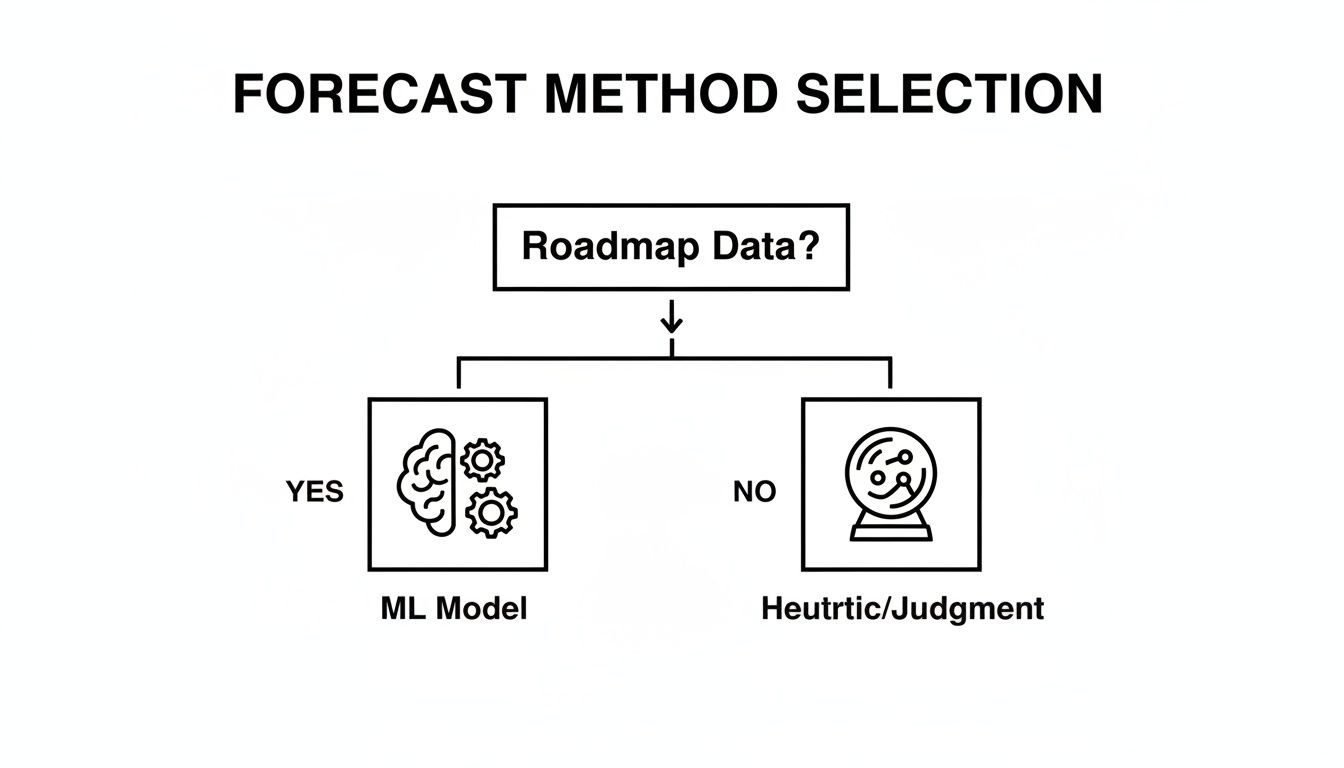
The image drives home a key point: with structured roadmap data, you can lean on more sophisticated, data-driven forecasting models. That leads directly to more reliable capacity plans.
The market for this kind of flexible talent is growing. When your internal teams are stretched thin, checking out the 12 Best IT Staff Augmentation Companies can give you the extra horsepower you need to bridge those gaps without missing a beat.
Ultimately, finding the right people—whether they're with you for a project or for the long haul—is how you close your capacity gap. At TekRecruiter, we specialize in connecting companies with the top 1% of global engineers. We provide the elite talent you need, from staff augmentation to direct hires, so you can execute your roadmap without delay.
Operationalizing Your Plan with Tools and Dashboards

A brilliant software development capacity planning strategy is just a document until you put it into action. The real value kicks in when that plan becomes a living, breathing part of your daily operations, giving you constant visibility to guide real-time decisions. This is where the right tools and dashboards stop being theoretical and start becoming your operational reality.
Without a centralized way to track your plan, it’s going to get stale, fast. The whole point is to create a single source of truth—a central nervous system for your engineering org that everyone from tech leads to the C-suite can understand at a glance.
Choosing the Right Tools for the Job
Look, spreadsheets are a fine place to start, but they rarely scale. As your team grows, they become a clunky, error-prone nightmare to maintain. To really get this working, you need tools built for the dynamic, messy reality of software development.
There are a few buckets of tools that get the job done:
Integrated Project Management Platforms: This is usually your first stop. Tools like Jira and Azure DevOps already hold the raw data on tasks, story points, and timelines. Many have add-ons or built-in features for basic workload management that can help you spot potential overloads.
Dedicated Capacity Planning Software: When you're ready to get serious, platforms like Saviom or Planview are built for this. They offer much deeper features for forecasting, scenario modeling, and skill-based resource allocation, giving you a level of insight you just can't get from a project board.
Engineering Management Platforms: Solutions like Jellyfish or LinearB plug right into your dev toolchain (Git, Jira, etc.) to give you a more nuanced picture of engineering work. They help you connect capacity directly to business goals by tracking metrics like cycle time and how resources are being spent on strategic initiatives.
The best tool really depends on your team's size and maturity. The key is to pick something that slots into your existing workflow, not something that forces your team to adopt a whole new, awkward process.
Building Your Single Source of Truth Dashboard
Your dashboard is the public face of your capacity plan. It needs to be clean, concise, and focused on the metrics that actually drive action. A cluttered dashboard is an ignored dashboard.
To create a powerful view, think about the most critical questions your stakeholders will have. A truly effective dashboard visualizes the balance between demand (what you need to build) and supply (your team's ability to build it).
A great capacity dashboard doesn't just show data; it tells a story. At a glance, it should reveal whether you're on track, where the risks are, and what decisions need to be made to keep the roadmap moving forward.
Key Metrics to Track and Visualize
To make your dashboard truly actionable, populate it with a handful of essential metrics. Ditch the vanity metrics and focus on what genuinely signals the health and performance of your engineering capacity.
Here are the non-negotiables:
Planned vs. Actual Capacity: This is the big one. It compares the available engineering hours you planned for a period against what was actually logged on project work. A consistent gap here means your baseline calculations are off.
Resource Utilization Rate: This shows the percentage of an engineer’s available time being used for productive work. If you see consistently high utilization (over 90%), that’s a red flag for burnout. Too low, and you've got inefficiencies or bottlenecks somewhere.
Forecast Accuracy: How close were your initial estimates to the final effort? Tracking this over time is how you get better, refining your forecasting models and making future plans far more reliable.
Capacity by Skill or Team: Don't just look at the total. Break down your capacity by key skill sets (e.g., backend, frontend, DevOps) or by specific product teams. This view immediately flags exactly where your most critical constraints are hiding.
When your dashboards start showing a persistent gap between demand and what your team can deliver, that's a crystal-clear signal to act. TekRecruiter is a technology staffing and AI engineering firm that helps innovative companies deploy the top 1% of engineers, anywhere. We help you bridge that capacity gap with elite talent, turning your strategic plans into delivered software.
Common Questions About Capacity Planning
Even with a perfect framework on paper, the real world always throws a few curveballs. When leaders start moving from theory to execution on capacity planning, the same practical questions pop up time and time again.
Let's cut through the noise and get straight to the answers you need to build and maintain a plan that actually works.
How Often Should We Update Our Capacity Plan?
This is a big one, and the short answer is: as often as your business rhythm demands. A static, annual plan is a fossil in today's software world. It's obsolete the moment you print it. You need a cadence that matches your team's actual tempo.
A good starting point for most Agile teams is a quarterly strategic review. This keeps your capacity plan aligned with the bigger picture and shifting business goals. On a more granular level, you should be making minor tweaks and adjustments during every single sprint planning session. That’s where you account for the real-time changes, sick days, and surprise tasks that inevitably show up.
What Is the Biggest Mistake Teams Make?
Hands down, the single biggest mistake is creating a plan based on a fantasy world where developers spend 40 hours a week on project work. Getting excited about the roadmap is great, but ignoring the reality of day-to-day operations is a recipe for failure.
This kind of optimistic planning is guaranteed to fall apart.
Always—and I mean always—start by calculating your team's true, available capacity. Before you even think about allocating time to new features, you have to subtract all the non-project work. This includes meetings, code reviews, administrative overhead, on-call rotations, and bug fixes. Injecting this dose of realism is the absolute foundation of a plan you can trust.
Remember, a capacity plan that ignores unplanned work and overhead isn't a plan—it's a wishlist. Ground your forecasts in the hard data of how your team actually spends their time.
How Do You Plan for Unpredictable R&D Work?
Innovation is messy. R&D projects are, by their very nature, unpredictable, which makes them a nightmare for traditional capacity models. The trick isn't to force a rigid estimate onto them, but to create a structured, protected space for exploration to happen.
A strategy I’ve seen work incredibly well is to time-box these efforts. Don't try to estimate the work; instead, allocate a fixed percentage of your team's total capacity to an "innovation bucket."
For example, you could dedicate 15-20% of your team's time to these projects. This gives your engineers the freedom to experiment and explore new ideas without derailing your core product commitments. It sets a predictable boundary around unpredictable work.
When your capacity plan reveals a gap between your goals and your team's current bandwidth, you need a solution that moves as fast as you do. TekRecruiter is a technology staffing and AI Engineer firm that allows innovative companies to deploy the top 1% of engineers anywhere. We bridge the gap so you can hit your strategic targets without delay.
Find the elite talent you need to scale at https://www.tekrecruiter.com.
Comments