A Guide to Talent Acquisition Consulting for Engineering Teams
Unlock the power of talent acquisition consulting to build elite engineering and AI teams. Learn proven strategies for hiring the top 1% of technical talent.
Talent acquisition consulting isn't just about hiring people. It’s a strategic partnership designed to build a sustainable, long-term engine for bringing elite talent through your doors. Think of it this way: traditional recruiting is about filling an immediate open role. This is about designing the entire system—from your employer brand to scalable hiring processes—and proactively mapping the talent market so you’re always ahead of the game.
What Is Talent Acquisition Consulting
Imagine you're trying to build a championship sports team. You wouldn't just hire random players to fill empty spots on the roster. You'd bring in a strategic scout, an architect, to design the entire system for finding, attracting, and signing the best athletes.
That’s the essence of talent acquisition consulting. It’s a move away from the transactional, reactive nature of simply filling a job opening. Instead, it's about building a robust, forward-thinking hiring function that plugs directly into your company’s biggest goals.

This strategic approach is no longer a "nice-to-have." It's becoming essential. By 2030, global talent shortages are projected to hit 85 million people. That could translate into an estimated $8.5 trillion in lost annual revenue for companies worldwide.
That massive gap is a clear signal: the old way of recruiting just doesn't cut it anymore. Organizations have to get smarter and more strategic.
To give you a clearer picture, let's break down how this strategic approach differs from the conventional recruiting model most of us are familiar with.
Talent Acquisition Consulting vs Traditional Recruiting
Aspect | Talent Acquisition Consulting | Traditional Recruiting |
|---|---|---|
Focus | Building a long-term, sustainable hiring "engine." | Filling a single, immediate job opening. |
Timeline | Proactive & ongoing. | Reactive & short-term. |
Scope | Holistic: employer branding, process design, market mapping, tech stack. | Transactional: sourcing, screening, and submitting candidates. |
Metrics | Quality of hire, time-to-productivity, retention rates, hiring velocity. | Time-to-fill, cost-per-hire. |
Relationship | Strategic partnership. | Vendor/service provider relationship. |
Goal | Create a competitive advantage through superior talent. | Close an open requisition. |
The table really highlights the fundamental mindset shift. One is about building an asset for the company, while the other is about completing a task. Both have their place, but only one drives sustained growth.
The Role of a Consultant
So, what does a talent acquisition consultant actually do? They act as an architect for your team. Their primary focus isn't just on placing a candidate, but on optimizing the entire system that attracts, evaluates, and keeps top performers.
This means their responsibilities are much broader than a typical recruiter's. They're often tasked with:
Strategic Workforce Planning: Looking at your current team structure to spot future skill gaps and building proactive hiring roadmaps to fill them before they become a problem.
Employer Branding: Crafting the compelling story about your company that attracts high-caliber candidates—especially the ones who aren't even looking for a new job.
Process Optimization: Bringing in the right tools and workflows, like applicant tracking systems, to make your hiring process more efficient and entirely data-driven.
Market Intelligence: Giving you the ground truth on compensation trends, what your competitors are doing, and where the best talent is hiding.
A consultant's real value is their ability to shift a company's mindset from reactive hiring (just filling empty seats) to proactive team building (acquiring strategic assets).
This shift is a game-changer, especially in hyper-competitive fields like AI and engineering, where having the right people is your biggest advantage. For deeper insights into different hiring models, you might find our guide on what staff augmentation is and how it can benefit your team useful. And to get a handle on the nuances of hiring without borders, you can dive into the specifics of remote talent acquisition.
Ultimately, when you partner with a firm that lives and breathes your industry, you get expertise that turns hiring from a chaotic scramble into a predictable, strategic weapon.
For CTOs and engineering leaders, a bad hire isn't just a line item gone wrong. It's a direct hit to your innovation pipeline, a morale killer, and a massive drag on your most critical projects.
This is where smart talent acquisition consulting stops being a back-office function and becomes your core competitive advantage. Especially when the stakes are as high as they are in software engineering and AI.
Let's be honest: the old "post and pray" method is completely broken for specialized roles. The best Machine Learning Engineers, DevOps gurus, and AI researchers aren't doom-scrolling job boards. They're heads-down, already employed, and solving hard problems. Getting to them requires a completely different playbook—one that's proactive, strategic, and built on a deep network.
The Real Cost of an Empty Chair
Every single day a key engineering role sits vacant, you're not saving money on salary; you're bleeding opportunity. That empty seat can push a product launch back by months, easily costing millions in lost revenue.
Think about the direct impact:
Delayed Projects: One missing Senior Engineer creates a bottleneck that grinds an entire sprint to a halt. Suddenly, feature releases are pushed, and you're breaking promises to customers.
Team Burnout: Your best people are forced to pick up the slack. This leads to exhaustion, shoddy code quality, and a revolving door of talent as your top engineers burn out.
Stalled Innovation: That ambitious R&D project you were banking on? It's on ice. Without the right expertise, you're standing still while more agile competitors eat your lunch.
A specialized consulting partner gets this. Their entire model is built around one thing: crushing the time-to-hire for these make-or-break roles. They keep your innovation engine fueled.
Stop Wasting Your Engineers' Time on Bad Interviews
Hiring in tech is tough because gauging real skill is an art. A generalist recruiter can barely tell the difference between a Data Engineer and a Data Scientist, let alone vet the nuances of a specific ML framework.
The result? Your hiring funnel gets clogged with unqualified candidates, forcing your senior engineers to waste precious hours screening resumes when they should be shipping code.
The true value of a specialist talent partner isn't just finding people—it's disqualifying the wrong ones before they ever get to you. They act as a technical filter, so only the most qualified, rigorously vetted engineers make it to your interview loop.
This expert-led vetting means every candidate you meet has the technical chops for the job. It not only raises the quality of your hires but also shows you respect your own team's time, making the whole process smarter and more effective.
Build Teams That Actually Stick Around
High turnover will cripple an engineering department. When you factor in recruiting fees, onboarding, and lost productivity, replacing a specialized engineer can cost as much as 150-200% of their annual salary. It’s a costly, demoralizing cycle.
Strategic talent acquisition breaks that cycle by zeroing in on long-term fit.
A real partner goes way beyond matching keywords on a resume. They focus on:
Cultural Alignment: Finding engineers who will actually thrive in your work environment, whether you're a scrappy startup or a structured enterprise.
Skill-Based Precision: Making sure a candidate's technical skills are a dead-on match for what the role needs today—and where it's going tomorrow.
Career Trajectory: Lining up the opportunity with the candidate's personal career goals, which is the secret to real engagement and loyalty.
When you nail the fit from day one, retention skyrockets. You're no longer just filling seats; you're building a stable, high-performing team that can solve complex problems together. Hiring becomes a sustainable investment, not a recurring expense.
At TekRecruiter, this is what we do. We build elite engineering and AI teams. Our deep industry network and relentless vetting process connect innovative companies with the top 1% of technical talent. We make sure every hire is a strategic asset.
If you're ready to stop filling seats and start building a real competitive advantage, let's talk. We can help you deploy the world-class engineers you need to win.
Choosing the Right Engagement Model
Picking a talent acquisition partner is only half the battle. How you work with them—the engagement model—is just as critical to getting the results you need. The right model has to sync up with your immediate business needs, your long-term roadmap, and, of course, your budget. It’s the framework that defines the relationship and makes sure you’re getting real value from your investment.
Don't treat this decision as an afterthought. It directly impacts the speed, scale, and permanence of your hiring strategy. By understanding the three core models—Staff Augmentation, Direct Hire, and Nearshore Team Building—you can make a smart choice that pushes your projects forward without creating friction.
This decision tree can help you figure out whether you need a strategic consultant or a traditional recruiter for the job at hand.
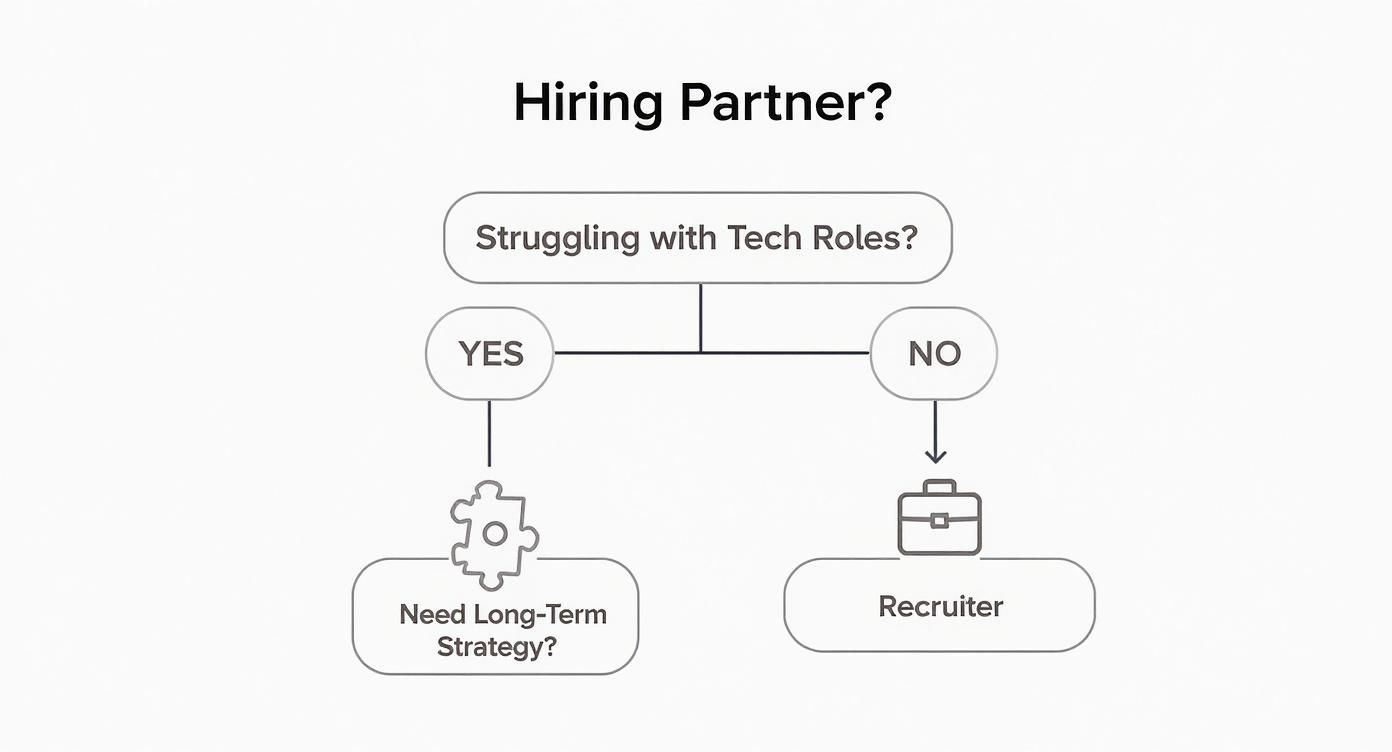
As the visual shows, it’s a pretty simple starting point: if you need a long-term strategy, you're looking for a consultant. If you just need to fill a seat, fast, a recruiter might be the right call.
Staff Augmentation For Project Firepower
Think of staff augmentation as bringing in a specialist—a highly skilled contractor—to plug directly into your existing team for a specific project or a set amount of time. This model is perfect when you’ve got a well-defined project with a clear finish line but you're short on internal bandwidth or a very specific skill set.
It’s the ideal solution for adding temporary firepower without the overhead and commitment of a full-time hire. You keep total control over the project and team management, while the consultant delivers the vetted talent you need to hit your deadlines.
Common use cases for staff augmentation include:
Hitting tight project deadlines when your current team is already maxed out.
Accessing specialized skills for a niche task, like rolling out a new cloud security protocol or building a specific AI algorithm.
Backfilling a critical role temporarily while you search for the right permanent employee.
By strategically augmenting your team, you can keep the momentum going on key initiatives without pulling your core team off their primary mission.
Direct Hire For Permanent Team Building
When your goal is to grow your core, permanent team, the direct hire model is the obvious choice. This is the classic approach where a talent acquisition consulting partner runs the entire search, vetting, and hiring process to find a long-term employee who is ready to grow with your company.
This isn’t just about filling a seat; it's a strategic investment in your organization’s future. The consultant does a deep dive to understand your company culture, technical stack, and long-term vision to find a candidate who is a perfect match on every level. This detailed approach is absolutely essential for senior-level or highly specialized engineering roles where a bad hire can be a massive, costly mistake.
For a more detailed breakdown of hiring models, check out our guide on staff augmentation versus outsourcing.
Nearshore Teams For Strategic Scaling
The nearshore team building model gives you a powerful hybrid approach, blending cost-efficiency with high-caliber talent. It involves building a dedicated team of engineers in a nearby country—often in a similar time zone—who operate as a seamless extension of your in-house team. This is a fantastic option for companies looking to scale their development capacity strategically without paying the premium for local talent.
This approach has exploded in popularity as remote work becomes the norm. In fact, 70% of the workforce is expected to work remotely at least five days a month by 2025. This trend has fueled a 107% growth in employer branding budgets over the last five years as companies fight for talent on a global scale. It’s no surprise, then, that the recruitment process outsourcing (RPO) market is projected to grow by 18.5% annually, proving there’s huge demand for expert partners who can build and manage these distributed teams.
To help you decide which model aligns best with your situation, here's a quick comparison.
Matching the Model to Your Needs
Criteria | Staff Augmentation | Direct Hire | Nearshore Teams |
|---|---|---|---|
Best For | Short-term projects, skill gaps | Core team growth, leadership roles | Long-term scaling, cost control |
Speed to Hire | Very Fast (days to weeks) | Slower (weeks to months) | Moderate (weeks to months) |
Cost Structure | Hourly/daily rate (operational expense) | One-time fee (capital expense) | Monthly retainer (operational expense) |
Management | You manage the individual directly | You manage the new employee | You manage the team lead/project |
Commitment | Low (project-based) | High (long-term employment) | High (ongoing partnership) |
Each approach is a tool designed for a specific job. Staff augmentation gives you speed and flexibility. Direct hire builds your foundation. Nearshore teams offer a scalable, long-term engine for growth.
Choosing the right one is a strategic decision that will directly shape your ability to deliver on your technology roadmap. At TekRecruiter, we specialize in all three. Whether you need to parachute in a top-tier AI engineer for a critical project or build out a dedicated nearshore team from scratch, we connect you with the top 1% of global talent to make it happen.
How to Select Your Ideal Consulting Partner
Picking the right talent acquisition partner is one of the most important calls a technology leader can make. This isn’t about hiring another vendor. It's about finding a strategic ally who will literally build the future of your engineering and AI teams.
The right partner doesn’t just forward resumes—they get your technical stack, see your needs before you do, and plug directly into your growth plan.
To make the right choice, you need a playbook. The mission is simple: find a firm that delivers elite talent, time and time again. That means you have to get past the sales pitch and drill down into the criteria that actually matter.
Evaluate Their Technical and Industry Expertise
First things first: domain knowledge. A generalist recruiter who can’t tell the difference between a Data Engineer and a Data Scientist is going to waste your time and burn out your best engineers with pointless interviews. You need a partner who speaks your language.
When you're vetting a potential firm, hit them with specific, pointed questions:
Role Nuances: "Walk me through the key skill differences between a Senior DevOps Engineer and an SRE."
Market Trends: "What are the going rates for Machine Learning Engineers with LLM experience in our key hiring regions right now?"
Sourcing Strategy: "Where are you finding passive candidates for niche roles like Quantum Computing researchers? Be specific."
Their answers will tell you everything. You’ll know immediately if they have real-world expertise or just a keyword-matching algorithm. A partner with deep industry connections knows where the top talent is hiding, what gets them excited, and how to bring them to your door.
Scrutinize Key Performance Indicators and Metrics
Data doesn't lie. A credible consulting firm won't hesitate to open up their books and show you their performance metrics. Don't let them get away with vague promises of "high-quality candidates." Ask for the hard numbers.
A top-tier talent acquisition firm uses metrics to prove their value to you, not just to track their own work. If they're cagey about sharing performance data, that's a massive red flag.
Focus on the KPIs that have a real impact on your business:
Time-to-Fill: What’s their average time to fill roles like the ones you have open? Every day a role sits empty, a project is delayed.
Submission-to-Interview Ratio: How many resumes do they have to send to land one interview? A low ratio means they’re doing their job and sending you only highly qualified people.
First-Year Turnover Rate: What percentage of their placements are gone within a year? This is the ultimate test of whether they find people who are a genuine, long-term fit.
These numbers give you a crystal-clear picture of their ability to deliver successful, lasting hires—not just warm bodies.
Review Case Studies and Pricing Models
You wouldn't hire an engineer without seeing their work, so why would you hire a recruiting partner without proof? Ask for case studies and references from companies that look like yours—similar size, industry, and technical challenges. A relevant case study proves they’ve already solved the problems you’re facing.
At the same time, you need to get a handle on their pricing. Different models—contingency, retainer, or a hybrid approach—work for different situations. Make sure their fee structure aligns with your budget and how often you plan to hire. A transparent partner will lay out all the costs upfront so there are no surprises later.
Finally, don’t forget to check their security and compliance practices. With data privacy laws getting stricter every day, your partner needs a rock-solid process for handling sensitive candidate and company information. This isn't just about ticking boxes; it's about protecting your brand and avoiding legal headaches.
Finding the right talent partner is a strategic hunt, not a quick buy. By digging into their technical depth, demanding data-driven proof, and checking their track record, you can find a firm that truly becomes an extension of your team.
At TekRecruiter, we specialize in connecting innovative companies with the top 1% of engineers. Our deep expertise in technology staffing and AI engineering means we understand your world. We’re ready to prove our value with transparent metrics and a track record of building elite teams. Contact us today to start deploying the world-class talent you need.
Weaving AI into Modern Talent Acquisition
The best hiring strategies today aren't just about human intuition or cold technology; they’re a powerful blend of both. Artificial intelligence isn't some far-off concept in recruiting anymore. It’s a real-world tool that top-tier talent acquisition consultants use to get a serious edge.
This partnership—where tech does the heavy lifting and humans handle the nuance—is completely changing how elite engineering and AI teams get built.
Think of AI as a force multiplier. It automates the most mind-numbing, repetitive parts of hiring. This frees up expert consultants to focus on what actually matters: building relationships, digging into cultural fit, and making sure every candidate has an incredible experience.
Uncovering Hidden Talent with AI Sourcing
Imagine the global talent market is a massive, unexplored ocean. Old-school sourcing is like fishing with a small net in a bay you already know—you tend to catch the same fish. AI-powered sourcing, on the other hand, is like having advanced sonar that maps the entire ocean floor, finding talent nobody else can see.
These smart platforms can:
Analyze Millions of Data Points: They scan professional networks, open-source code repositories, and academic papers to find engineers with the exact skills you need.
Spot Passive Candidates: AI can pick up on subtle digital clues that suggest a top performer might be open to a new role, even if they aren't actively looking.
Build Diverse Pipelines: By focusing purely on skills and experience, AI helps strip unconscious bias from the very first step, creating a more inclusive pool of candidates.
This data-first approach means consultants can look way beyond the usual suspects and connect with a broader, more qualified, and more diverse group of professionals.
Building a Smarter, Fairer Hiring Process
AI’s impact doesn't stop at finding people. It's also making the evaluation process faster, more consistent, and frankly, more equitable for everyone. Intelligent platforms can analyze interviews and assessments to pinpoint key skills while actively reducing the human bias we all carry.
To get a handle on their biggest hiring challenges, 84% of talent acquisition teams are now using advanced analytics to understand their hiring funnels. But here’s the catch: a staggering 87% are still stuck using clunky spreadsheet exports. That’s a huge gap.
Consulting firms are closing that gap by bringing in AI platforms that can analyze and even transcribe interviews to assess a candidate's fit objectively. This gives hiring managers feedback they can actually use.
The point of AI in recruiting isn't to replace human judgment—it's to sharpen it. Technology gives us the unbiased data, so consultants can make smarter, more informed decisions about a candidate's true potential.
With the right tools, the hiring process becomes a well-oiled machine. If you're looking to explore what's out there, our guide on the 15 best recruiting automation software solutions is a great place to start. Marrying smart tech with human oversight ensures every hiring decision is backed by both hard data and expert intuition.
By building AI into our workflow, we deliver a service that’s not just faster but far more precise. At TekRecruiter, we pair these advanced technologies with our deep industry knowledge to connect innovative companies with the top 1% of engineers. If you’re ready to build a world-class team with a smarter, AI-powered approach, let's talk.
Build Your Elite Engineering Team with TekRecruiter
Trying to hire elite engineering and AI talent feels like an uphill battle, but it’s not one you have to fight alone. TekRecruiter isn't just another staffing firm—we're a strategic partner dedicated to building the backbone of your company's future. As a premier technology staffing and AI Engineer firm, we specialize in placing the top 1% of engineers with innovative companies just like yours.
We blend the sharp foresight of talent acquisition consulting with AI-driven recruiting to give you a real competitive edge. Our entire approach is built to dismantle the roadblocks that slow growth and kill innovation. To truly build teams that last, it's worth exploring powerful hiring and recruiting strategies that attract the best candidates in a crowded market.
Building a world-class engineering team is not about filling seats—it's about making strategic investments in the people who will define your company's future. An expert partner ensures every hire is an asset, not just a headcount.
Let us help you scale your teams with world-class talent and bring your most ambitious vision to life. We give you access to elite engineers at a surprisingly cost-effective rate—a topic we dive into in our article on finding cheaper and talented software engineers.
Ready to build your dream team? Connect with us today and let’s secure the talent you need to win.
Got Questions? We've Got Answers.
Jumping into talent acquisition consulting can bring up a few questions, especially when you're building out specialized engineering and AI teams. Let's tackle some of the most common things CTOs and HR leaders ask when they're thinking about a strategic partnership.
What’s the Real Difference Between Talent Consulting and a Staffing Agency?
It’s the difference between a transaction and a partnership.
A standard staffing agency is purely transactional. Their one and only goal is to fill an open seat as fast as possible. It’s a reactive approach, designed to fix an immediate, short-term problem. Think of it as putting a bandage on a recurring issue.
Talent acquisition consulting, on the other hand, is about building a long-term, sustainable hiring engine. We’re not just filling one role; we’re improving your employer brand, proactively building talent pipelines for future needs, and making sure your team is always ready for what’s next. It's a strategic investment in your company's growth.
Is This Really Cost-Effective for a Startup?
Absolutely. In fact, for a startup, it's often more cost-effective. The real cost of hiring isn’t just a recruiter’s fee. It’s the crippling loss of productivity from a key role sitting empty for months. It’s the massive expense of a bad hire, which can set you back up to 200% of that person's annual salary.
Good consulting reduces your time-to-hire, dramatically improves candidate quality, and boosts retention. That all adds up to a strong ROI. Plus, most modern firms offer flexible models that can be shaped to fit a startup’s budget and immediate priorities.
How Long Until We Actually See Results?
You’ll see results in stages. Filling a critical role can happen surprisingly fast, but the bigger strategic wins—like a stronger employer brand and a truly efficient hiring process—are built over time.
You can typically expect to see a noticeable improvement in your candidate pipeline and the quality of people you're talking to within the first couple of months. The more foundational process changes usually solidify over a 6 to 12-month period, creating a lasting impact on how you attract and keep the best people in your industry.
Ready to stop reacting and start building a strategic talent engine? As a premier technology staffing and AI Engineer firm, TekRecruiter allows innovative companies to deploy the top 1% of engineers anywhere. Let our expert talent acquisition consulting build the world-class AI and engineering teams you need to win. Start building your future today.