Top 10 Microservices Architecture Best Practices for 2026
Discover the top 10 microservices architecture best practices for building scalable and resilient systems. Learn DDD, CI/CD, service mesh, and more.


Microservices promise unprecedented agility, scalability, and resilience, but they also introduce significant architectural and operational complexity. Transitioning from a monolithic application is not merely a technical refactor; it's a fundamental paradigm shift that impacts design, deployment, data management, and even organizational culture. Without a solid foundation of proven strategies, engineering teams often inadvertently build a distributed monolith—a system burdened with all the operational overhead of microservices but none of the promised benefits. This outcome is a costly and avoidable failure pattern.
This guide cuts through the theoretical noise to provide a prioritized roundup of the ten most critical microservices architecture best practices for modern engineering organizations. We will move beyond high-level concepts and dive deep into actionable patterns and concrete implementation advice. You will learn not just what to do, but how and why.
We'll cover essential topics including strategic decomposition with Domain-Driven Design (DDD), robust API contract management, implementing a database-per-service pattern, and leveraging service mesh technology for complex communication. Furthermore, we'll explore CI/CD automation, advanced observability with distributed tracing, and critical resilience patterns like circuit breakers. Mastering these principles is about more than just avoiding common pitfalls; it’s about unlocking the full potential of your distributed systems. To truly build a world-class architecture, it's essential to understand broader principles of good software architecture, beyond just microservices. You can learn more about general software architecture best practices for scalable startups. By applying these targeted strategies, you will build applications that are not just functional but genuinely scalable, maintainable, and future-proof.
1. Service Decomposition and Domain-Driven Design (DDD)
The foundation of any successful microservices architecture is getting the service boundaries right. Poor decomposition leads to a "distributed monolith," where services are tightly coupled, negating the benefits of independent deployment and scalability. Service decomposition is the practice of breaking down large applications into smaller, autonomous services organized around specific business capabilities rather than technical layers. This is where Domain-Driven Design (DDD), a concept popularized by Eric Evans, provides an essential strategic framework.
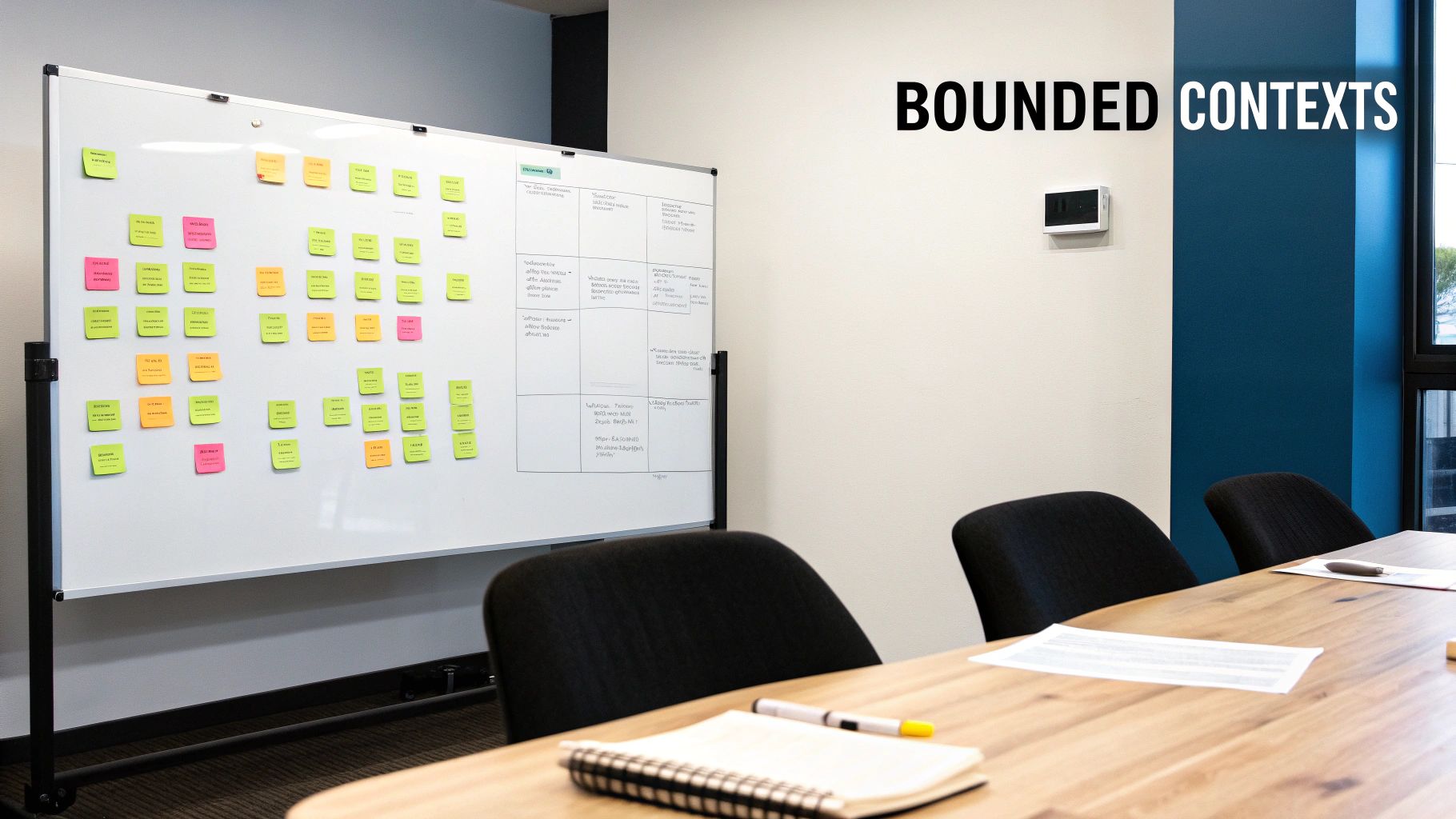
DDD aligns technical architecture directly with the business domain. It uses core concepts like Bounded Contexts to define clear boundaries where a specific domain model is applicable. Inside each context, a Ubiquitous Language (a shared vocabulary between developers and business stakeholders) eliminates ambiguity. This ensures each microservice has a single, well-defined responsibility, mirroring real-world business functions like "Payments," "User Profiles," or "Inventory Management." For organizations transitioning from older systems, applying these principles is a key part of the journey. You can explore various approaches in our detailed guide on legacy system modernization strategies.
How to Implement DDD for Service Decomposition
Conduct Domain Workshops: Run collaborative sessions like EventStorming with domain experts, product managers, and engineers to visually map out business processes and identify natural seams that define your bounded contexts.
Define a Ubiquitous Language: Create and maintain a shared glossary of terms for each bounded context. This glossary should be used in code, documentation, and team conversations to prevent misunderstandings.
Start Small: Avoid over-decomposing at the beginning. Identify 3-5 core business domains and build services around them first. You can always break them down further later as the domain becomes better understood.
Key Insight: The goal is not to create the smallest services possible, but to create services that are cohesive, loosely coupled, and aligned with a specific business capability. This strategic approach is a cornerstone of effective microservices architecture best practices.
Finding engineers with deep expertise in both DDD and your specific business domain can be a significant challenge. To accelerate your projects, TekRecruiter connects you with the top 1% of engineers who can implement these complex architectural patterns effectively, ensuring your microservices initiative succeeds from the start.
2. API-First Design and Contract-Based Development
Once services are decomposed, their communication becomes the lifeblood of the architecture. An API-First design philosophy treats every service's interface as a first-class product, defining and agreeing upon its contract before any code is written. This approach decouples teams, allowing frontend, mobile, and other backend services to develop in parallel against a stable, predictable contract. It shifts the focus from implementation details to consumer needs, ensuring APIs are consistent, usable, and well-documented from day one.

This contract, often defined using specifications like OpenAPI for REST or Protocol Buffers for gRPC, becomes the single source of truth for all service interactions. It enables powerful automation, from generating client SDKs and server stubs to running contract tests in the CI/CD pipeline. Companies like Stripe exemplify this by providing comprehensive, developer-centric API documentation that accelerates third-party integration. For a deeper look into the specifics of API design, our guide on API development best practices for modern software offers additional valuable insights.
How to Implement API-First Design
Standardize on a Specification: Choose a specification like OpenAPI 3.0+ and make it the standard for defining all synchronous APIs. Use tools like AsyncAPI for event-driven services.
Implement Contract Testing: Use tools like Pact or Spring Cloud Contract to verify that services adhere to their defined contracts. These tests should be a mandatory part of your CI pipeline to catch breaking changes early. For an in-depth exploration of how to effectively design, secure, and scale your APIs, refer to this guide on APIs for Microservices.
Leverage Mock Servers: Generate mock servers from your API contracts using tools like Prism or Mockoon. This allows consumer teams to build and test their applications without waiting for the actual service to be fully implemented.
Key Insight: Treating APIs as products forces a consumer-centric mindset, leading to better-designed, more stable, and more easily adopted services. This is a critical discipline for scaling microservices architecture best practices across multiple teams.
Successfully implementing a robust API governance strategy requires engineers who think like product owners. TekRecruiter specializes in sourcing elite talent with a proven track record in API-first design, helping you build a dependable and scalable microservices ecosystem.
3. Database per Service Pattern with Event Sourcing
A common pitfall in microservices is creating hidden dependencies through a shared database. This leads to tight coupling, where changes to the data schema for one service can break others, destroying the autonomy microservices promise. The Database per Service pattern solves this by giving each microservice exclusive ownership of its own data store. This ensures loose coupling and allows each service team to choose the database technology best suited for its specific needs, whether it's SQL, NoSQL, or a graph database.

This pattern is often powerfully combined with Event Sourcing, an approach popularized by Greg Young. Instead of storing the current state of data, Event Sourcing stores the full sequence of state-changing events as an immutable log. This not only provides a complete audit trail but also serves as a natural mechanism for publishing state changes to other services. For instance, in an e-commerce platform, an event can be published for inventory and shipping services to consume, achieving data consistency through an event-driven, eventually consistent model. This approach is a core part of many modern microservices architecture best practices.
How to Implement This Pattern
Choose the Right Event Store: Start with a general-purpose database like PostgreSQL or MongoDB for your event log. As your needs mature, you can migrate to specialized solutions like EventStoreDB for higher performance and features.
Use the Saga Pattern: For operations that span multiple services (e.g., placing an order that requires payment and inventory updates), implement the Saga pattern to manage distributed transactions and handle failures gracefully.
Implement Snapshotting: To avoid replaying a long history of events every time you need to reconstruct an entity's state, create periodic snapshots of the current state. This significantly improves read performance for long-lived entities.
Plan for Schema Evolution: Events are immutable, so you must have a clear strategy for versioning event schemas. Plan for backward and forward compatibility to ensure older events can still be processed as the system evolves.
Key Insight: Combining the Database per Service pattern with Event Sourcing creates a highly decoupled, scalable, and auditable system. It shifts the focus from managing shared state to communicating state changes, which is fundamental to building a resilient microservices architecture.
Implementing advanced patterns like Event Sourcing and CQRS requires specialized engineering talent. TekRecruiter provides access to the top 1% of engineers with proven expertise in building complex, event-driven distributed systems, helping you build a robust and future-proof architecture.
4. Service Mesh Implementation (Istio, Linkerd, Consul)
As a microservices architecture grows, managing network communication, security, and observability becomes increasingly complex. A service mesh is a dedicated infrastructure layer that handles service-to-service communication through lightweight network proxies, known as sidecars, deployed alongside each service instance. This layer abstracts away complex networking logic from your application code, allowing developers to focus on business logic while the mesh handles critical cross-cutting concerns.
Pioneered by companies like Lyft with their Envoy proxy, and now offered through powerful platforms like Istio, Linkerd, and Consul, a service mesh provides capabilities like intelligent traffic management, mutual TLS (mTLS) for security, and detailed telemetry out of the box. This provides a uniform way to secure, connect, and monitor services. For example, Istio allows for sophisticated traffic shaping, enabling canary deployments and A/B testing without any changes to the microservices themselves. This level of control is a hallmark of mature microservices architecture best practices.
How to Implement a Service Mesh
Start Simple: For teams new to the concept, begin with a simpler, performance-focused mesh like Linkerd. Its "just works" approach to features like mTLS and observability provides immediate value without the steep learning curve of more feature-rich options like Istio.
Focus on One Capability First: Instead of enabling all features at once, start with a single high-impact area. For example, implement traffic management to perform a canary release. Once the team is comfortable, introduce security features like mTLS policies.
Monitor the Control and Data Planes: A service mesh introduces new components to manage. Closely monitor the resource consumption (CPU, memory) of the sidecar proxies and the health of the control plane to prevent performance bottlenecks.
Key Insight: A service mesh decouples operational networking concerns from application code, empowering platform teams to enforce consistent security, routing, and observability policies across the entire architecture without burdening development teams.
Implementing and managing a service mesh requires specialized skills in Kubernetes, networking, and security. TekRecruiter can connect you with the top 1% of platform and DevOps engineers who possess the deep expertise needed to design, deploy, and operate a service mesh, ensuring your microservices communication is reliable, secure, and observable.
5. Containerization, Orchestration and CI/CD
To truly capitalize on the agility promised by microservices, each service must be packaged and deployed in a consistent, automated, and scalable manner. This is where the powerful trio of containerization, orchestration, and Continuous Integration/Continuous Deployment (CI/CD) becomes indispensable. Containerization, popularized by Docker, packages a microservice and all its dependencies into a single, immutable artifact. This container runs identically on any infrastructure, from a developer's laptop to production servers, eliminating the classic "it works on my machine" problem.
Orchestration platforms like Kubernetes, originally developed by Google, then manage these containers at scale. They automate complex tasks like deployment, scaling, load balancing, and self-healing, providing the robust operational foundation required for a distributed system. A strong CI/CD pipeline automates the entire release process from code commit to production deployment, enabling teams to release changes frequently and safely. For companies aiming for cloud-native excellence, mastering these tools is non-negotiable; our guide on Kubernetes consulting services details how expert guidance can streamline this process.
How to Implement a Modern Deployment Platform
Standardize on a Container Platform: Use Docker for containerization and a managed Kubernetes service (like GKE, EKS, or AKS) to reduce operational overhead. This provides a consistent runtime environment for all microservices.
Implement GitOps: Store all infrastructure and application configuration, including Kubernetes manifests and CI/CD pipeline definitions, in version control (Git). Use tools like ArgoCD or Flux to automatically sync the state of your cluster with the repository.
Build Fast, Secure Pipelines: Design CI/CD pipelines that provide feedback in under 15 minutes. Integrate automated security scans (SAST, DAST, dependency checks) and use feature flags to separate code deployment from feature release, enabling safer rollouts.
Key Insight: Containerization provides consistency, orchestration provides scalability and resilience, and CI/CD provides speed and safety. Together, they form the operational backbone of high-performing microservices architecture best practices, turning independent services into a manageable, automated system.
Building and maintaining this sophisticated platform requires specialized talent. TekRecruiter connects you with the top 1% of DevOps and platform engineers who possess deep expertise in Kubernetes, Docker, and CI/CD automation, ensuring your infrastructure can support rapid and reliable innovation.
6. Distributed Tracing and Observability (OpenTelemetry, Jaeger, Datadog)
In a monolithic application, debugging is relatively straightforward. In a distributed microservices architecture, a single user request can trigger a complex chain reaction across dozens of services. Without proper visibility, pinpointing the source of a failure or a performance bottleneck becomes nearly impossible. This is where comprehensive observability, built on the pillars of traces, metrics, and logs, becomes non-negotiable. Distributed tracing provides the narrative, stitching together the journey of a request as it traverses the entire system.
Observability is more than just monitoring; it’s about being able to ask arbitrary questions about your system's state without needing to ship new code. Tools and standards like OpenTelemetry provide a vendor-agnostic way to instrument your services, ensuring that telemetry data (traces, metrics, logs) is collected consistently. This data is then sent to backends like Jaeger or commercial platforms like Datadog for analysis. For example, when Uber’s ride-matching system experiences latency, distributed tracing allows engineers to instantly identify which specific microservice is the culprit, drastically reducing mean time to resolution (MTTR).
How to Implement Distributed Tracing and Observability
Standardize on OpenTelemetry: Adopt OpenTelemetry early in the development lifecycle, not as an afterthought. Its standardized APIs and SDKs prevent vendor lock-in and create a unified instrumentation strategy across all services.
Implement Context Propagation: Ensure that trace context (using headers like the W3C Trace Context standard) is propagated across all service calls, including synchronous APIs, message queues, and asynchronous event streams. This is crucial for creating complete, end-to-end traces.
Combine Traces, Metrics, and Logs: Correlate all three observability pillars. For instance, link traces to specific log entries using a . This allows an engineer to jump from a slow trace span directly to the relevant logs for deep-dive analysis, which is a key tenet of microservices architecture best practices.
Key Insight: Observability is not just a tool for incident response; it's a critical capability for understanding system behavior, optimizing performance, and making informed decisions. Treat it as a first-class feature of your architecture, not a bolt-on accessory.
Building a truly observable system requires specialized skills in Site Reliability Engineering (SRE) and distributed systems. TekRecruiter connects you with elite engineers who have hands-on experience implementing observability platforms at scale, empowering your team to maintain and debug your microservices with confidence.
7. Asynchronous Communication and Event-Driven Architecture
To achieve true decoupling and resilience in a microservices architecture, you must move beyond synchronous, request-response communication patterns. Asynchronous communication, often realized through an Event-Driven Architecture (EDA), allows services to interact without being directly dependent on each other's immediate availability. Instead of making a direct API call and waiting for a response, a service publishes an "event" to a message broker when a significant state change occurs. Other services can then subscribe to these events and react accordingly, on their own time.
This pattern drastically reduces inter-service dependencies. For example, if a "Payment" service is temporarily down, an "Order" service can still publish an event. The Payment service simply processes the event from the message queue once it comes back online, ensuring no data is lost and the user experience is not blocked. This approach is fundamental to building scalable and fault-tolerant systems, as demonstrated by companies like LinkedIn with Apache Kafka and Uber for handling massive streams of trip data.
How to Implement Asynchronous Communication
Choose the Right Broker: Start with a tool like RabbitMQ for simpler, reliable messaging needs. For high-throughput, real-time data streaming and log aggregation, Apache Kafka is the industry standard.
Ensure Idempotency: Design your event consumers to be idempotent, meaning they can safely process the same message multiple times without unintended side effects. This is critical for handling network retries or message redeliveries.
Implement Robust Error Handling: Use Dead Letter Queues (DLQs) to capture and isolate messages that consumers repeatedly fail to process. This prevents a single bad message from blocking the entire queue and allows for later analysis and reprocessing.
Manage Event Schemas: Employ a schema registry, such as Confluent Schema Registry, to enforce a contract for your event structures. This prevents breaking changes and ensures producers and consumers can evolve independently without causing data parsing errors.
Key Insight: Adopting an event-driven approach shifts the architectural focus from direct commands to reacting to business events. This model is one of the most powerful microservices architecture best practices for building systems that are not only scalable and resilient but also more adaptable to future business requirements.
Implementing a robust event-driven architecture requires specialized engineering talent familiar with distributed systems, message brokers, and complex failure modes. TekRecruiter sources the top 1% of engineers who possess deep expertise in Kafka, RabbitMQ, and cloud-native messaging services, empowering your team to build a truly resilient and scalable platform.
8. Resilience Patterns: Circuit Breakers, Retries, and Timeouts
In a distributed environment, failures are not exceptions; they are an inevitability. A core tenet of microservices architecture best practices is to build systems that anticipate and gracefully handle failures. Resilience patterns are a set of strategies designed to prevent a failure in one service from cascading and causing a total system outage. These patterns, popularized by Michael Nygard in his book Release It!, are essential for maintaining service availability and reliability.
The three most critical patterns are Circuit Breakers, Retries, and Timeouts. A circuit breaker acts like an electrical one: after a certain number of failures, it "trips" and stops sending requests to a struggling service, giving it time to recover. Retries are used for transient, short-lived errors, like a brief network glitch. Timeouts prevent a single slow request from consuming resources indefinitely while waiting for a response that may never come. Together, these mechanisms create a fault-tolerant system that can degrade gracefully rather than collapsing entirely.
How to Implement Resilience Patterns
Leverage Mature Libraries: Instead of building these complex patterns from scratch, use well-tested libraries like Resilience4j (Java), Polly (.NET), or Go-Resilience (Go). These libraries provide robust implementations of circuit breakers, retries with exponential backoff, and more.
Configure Intelligent Retries: Implement retries with exponential backoff and jitter. This means the delay between retries increases exponentially, and a small random amount of time (jitter) is added to prevent waves of synchronized retries from overwhelming a recovering service (the "thundering herd" problem).
Set Meaningful Timeouts: Base timeout values on your Service Level Objectives (SLOs) and observed performance metrics (e.g., 99th percentile latency), not arbitrary guesses. A timeout should be just long enough to allow for a successful response under normal load.
Key Insight: Resilience isn't about preventing all failures, but about containing their impact. An effective resilience strategy ensures that your application remains functional for users, even when parts of the system are down, by providing fallbacks or degraded functionality.
Implementing these distributed systems patterns requires engineers who think in terms of failure modes and fault tolerance. TekRecruiter specializes in connecting you with the top 1% of engineers who have deep, practical experience building resilient, production-grade microservices, ensuring your architecture can withstand real-world challenges.
9. Configuration Management and Secrets Management
In a microservices architecture, services must run across multiple environments like development, staging, and production. Hardcoding environment-specific settings into your application code is a direct path to operational chaos and security breaches. Effective configuration management decouples application logic from its environment, allowing the same container image to be promoted across pipelines without changes. This practice manages settings like database connection strings, API endpoints, and feature flags externally.
Closely related, secrets management is a non-negotiable security discipline for handling sensitive data such as API keys, passwords, and TLS certificates. Storing secrets in version control or embedding them in container images creates massive security vulnerabilities. A robust secrets management system provides a secure storage vault, enforces strict access control policies, and offers a full audit trail for all access attempts. This separation of concerns is fundamental to building secure, scalable, and manageable microservices architecture best practices.
How to Implement Configuration and Secrets Management
Externalize All Configurations: Use environment variables, configuration files mounted as volumes, or a centralized configuration service. In Kubernetes, ConfigMaps are the native way to inject non-sensitive configuration data into your pods.
Leverage a Dedicated Secrets Vault: Never store secrets directly in code, configuration files, or unencrypted Kubernetes Secrets. Use a dedicated tool like HashiCorp Vault, AWS Secrets Manager, or Azure Key Vault, which provide encryption at rest, fine-grained access control (RBAC), and secret rotation capabilities.
Automate Secret Rotation: Implement policies to automatically rotate credentials with short Time-To-Live (TTL) values. This minimizes the window of opportunity for attackers if a secret is ever compromised.
Audit Everything: Ensure your secrets management tool logs every access request. Regularly review these audit logs to detect and respond to anomalous behavior quickly.
Key Insight: Treat configuration and secrets as first-class citizens of your architecture, not as an afterthought. A unified and secure strategy for managing them is critical for achieving operational efficiency and preventing catastrophic security incidents.
Implementing a secure, end-to-end secrets management lifecycle requires specialized expertise in both security and DevOps. To ensure your systems are built on a foundation of security, TekRecruiter connects you with the top 1% of engineers who are experts in implementing tools like Vault and cloud-native secrets managers, protecting your critical assets from day one.
10. Team Structure and Conway's Law Alignment
One of the most overlooked yet critical aspects of microservices is organizational structure. Conway's Law famously states that an organization will design systems that mirror its communication structure. If your organization is siloed into traditional frontend, backend, and database teams, you are likely to build a "distributed monolith" where services remain tightly coupled along those technical layers, undermining the goal of autonomy. Aligning your team structure with your service architecture is a non-negotiable step for success.
The best practice is to form small, cross-functional teams that own one or more microservices end-to-end. This model, exemplified by Amazon’s "two-pizza teams," gives each team full autonomy and responsibility over their service's lifecycle, from development and deployment to operations and maintenance. Each team acts as a mini-startup, empowered to make local decisions quickly without navigating complex cross-departmental approvals. This structure fosters a strong sense of ownership and accountability, which is essential for building resilient systems. For a deeper dive into team dynamics, explore our guide on how to build high-performing teams in tech.
How to Align Teams with Microservices
Organize Around Business Capabilities: Structure teams around the same business domains or bounded contexts used for service decomposition (e.g., "Team Checkout," "Team Search"). Avoid organizing by technical function.
Establish Clear Service Ownership: Every service must have a designated owning team responsible for its health, performance, and on-call rotation. This eliminates ambiguity during incidents and ensures accountability.
Create a Platform Team: To avoid duplicating effort, establish a central platform engineering team that provides shared infrastructure, CI/CD pipelines, and observability tools as a self-service product for the service teams.
Key Insight: Treat your team structure as a direct enabler of your architecture. By consciously designing your organization to match your service boundaries, you create the social and technical conditions for true service independence and scalability.
This shift requires engineers with a "you build it, you run it" mindset and diverse skill sets. Finding professionals who can operate effectively in these autonomous, cross-functional teams is a challenge. TekRecruiter specializes in sourcing the top 1% of engineers who possess both the technical depth and the collaborative mindset needed to thrive in a modern microservices environment.
Microservices Architecture: 10 Best Practices Comparison
Approach | Implementation Complexity 🔄 | Resource Requirements ⚡ | Expected Outcomes 📊 | Ideal Use Cases 💡 | Key Advantages ⭐ |
|---|---|---|---|---|---|
Service Decomposition and Domain-Driven Design (DDD) | High — extensive domain analysis and careful boundary design | Moderate–High — cross-functional teams, DDD expertise, time for workshops | Modular, business-aligned services; independent deployability and clearer ownership | Large, complex business domains needing clear boundaries | ⭐ Parallel development; scalable business capabilities; improved domain clarity |
API-First Design and Contract-Based Development | Moderate — up-front API design and governance required | Low–Moderate — design tools, contract testing, documentation effort | Fewer integration issues; parallel frontend/backend development | Public APIs, multi-client platforms, teams working in parallel | ⭐ Clear contracts; easier testing and onboarding; stable integrations |
Database per Service Pattern with Event Sourcing | Very High — event stores, replay, eventual consistency challenges | High — storage for event logs, specialized tooling, experienced engineers | Strong data autonomy, auditability, replayable state, temporal queries | Audit-critical systems, financials, systems needing event history | ⭐ True data ownership; built-in audit trails; supports CQRS |
Service Mesh Implementation (Istio, Linkerd, Consul) | High — sidecars, network policies, and mesh configuration | High — CPU/memory overhead, mesh controllers, platform expertise | Centralized traffic control, security (mTLS), enhanced observability | Large Kubernetes clusters with many services needing policy and routing | ⭐ Decouples networking from code; consistent security; advanced traffic mgmt |
Containerization, Orchestration and CI/CD | Moderate–High — pipeline and cluster complexity, Kubernetes learning curve | High — cluster infra, registries, CI/CD systems, DevOps expertise | Consistent deploys, faster release cycles, autoscaling and resilience | Any microservices deployment aiming for frequent, reliable releases | ⭐ Environment consistency; automation; rapid, safe deployments |
Distributed Tracing and Observability (OpenTelemetry, Jaeger) | Moderate — instrumentation, sampling, and trace correlation | Moderate–High — collectors, storage, dashboards, SRE skills | Faster diagnosis, reduced MTTR, visibility into performance and dependencies | Production systems with many services needing SLOs and debugging | ⭐ Unified visibility across traces/metrics/logs; improved troubleshooting |
Asynchronous Communication and Event-Driven Architecture | High — broker management, idempotency, ordering and consistency models | Moderate–High — message brokers, schema registries, monitoring | Loose coupling, resilience, scalable event processing and extensibility | High-throughput streaming, decoupled integrations, complex workflows | ⭐ Decoupling and resilience; easy to add new consumers; scalable patterns |
Resilience Patterns: Circuit Breakers, Retries, Timeouts | Low–Moderate — coding and tuning of patterns and thresholds | Low — libraries and monitoring; minimal infra | Reduced cascading failures, graceful degradation, improved availability | Systems interacting with unreliable dependencies or external APIs | ⭐ Protects system stability; reduces load on failing services; simple to add |
Configuration Management and Secrets Management | Low–Moderate — tooling and policy setup, secret rotation design | Moderate — vaults or cloud secret stores, access controls, audits | Secure, environment-agnostic deployments; easier rollouts and compliance | Multi-environment deployments and regulated systems needing secret control | ⭐ Prevents credential leakage; enables dynamic config and feature rollout |
Team Structure and Conway's Law Alignment | High (organizational) — requires restructuring and cultural change | Moderate — training, platform teams, alignment processes | Faster delivery, clearer ownership, architecture mirrors org communication | Organizations scaling microservices and seeking autonomous teams | ⭐ Improves autonomy and ownership; reduces coordination overhead |
Build Your A-Team for a World-Class Architecture
Embarking on a microservices journey is more than a technical refactoring; it's a fundamental paradigm shift in how you build, deploy, and manage software. We have traversed a comprehensive landscape of microservices architecture best practices, from the strategic decomposition of services using Domain-Driven Design (DDD) to the tactical implementation of resilience patterns like circuit breakers and retries. The path to a truly scalable, resilient, and agile system is paved with intentional design choices and disciplined execution.
Mastering this architecture means moving beyond siloed functions and embracing a holistic view. It requires a deep commitment to API-first design, ensuring your services communicate through well-defined, stable contracts. It demands a sophisticated data strategy, often leveraging the Database per Service pattern and event-driven communication to maintain autonomy without sacrificing consistency. Furthermore, it necessitates a robust operational foundation built on container orchestration, mature CI/CD pipelines, and a comprehensive observability stack that can make sense of a complex, distributed environment.
The Human Element: Your Architecture's Critical Dependency
Ultimately, the success of your microservices adoption hinges not on any single technology or pattern, but on the people who bring it to life. As we discussed with Conway's Law, your organizational structure and communication pathways directly shape your system's architecture. A distributed system requires distributed ownership and teams that can operate with autonomy and high alignment.
This is the most crucial takeaway: technology follows talent. You cannot build a world-class, decoupled architecture with a team that lacks the specialized skills to manage its complexity. The most meticulously planned system will falter without the right expertise in place.
Consider the roles essential to executing these microservices architecture best practices:
Domain Experts who can effectively model business boundaries.
Platform Engineers proficient in Kubernetes, service mesh, and CI/CD automation.
Site Reliability Engineers (SREs) who can build and manage a sophisticated observability and resilience strategy.
Software Engineers with a deep understanding of distributed systems principles, asynchronous communication, and API design.
Building this "A-Team" is often the most significant challenge organizations face. The talent required is scarce, highly sought-after, and critical to avoiding the dreaded "distributed monolith" anti-pattern. Your ability to attract, hire, and retain these individuals will directly correlate with the success and ROI of your microservices initiative. This is not just a technical challenge; it is a strategic talent imperative.
From Blueprint to Reality: Your Next Steps
The journey from a monolithic past to a microservices future is a marathon, not a sprint. The principles outlined in this guide provide the map, but your team provides the engine. As you move forward, focus on incremental adoption, continuous learning, and fostering a culture of ownership and collaboration. Start small, prove value, and build momentum.
Remember that adopting these practices is not about checking boxes; it's about fundamentally improving your organization's ability to deliver value to customers quickly and reliably. A well-executed microservices architecture is a powerful competitive advantage, enabling innovation at a scale that monolithic systems simply cannot match. The investment in both technology and talent is substantial, but the rewards are transformative.
Executing a world-class microservices strategy requires world-class talent. TekRecruiter is a technology staffing, recruiting, and AI engineering firm that allows innovative companies to deploy the top 1% of engineers anywhere. Let us help you build the high-performing team required to master these microservices architecture best practices by visiting TekRecruiter today.