A Modern Playbook for Managing Distributed Teams
Master managing distributed teams with proven strategies. Learn to hire, onboard, and lead high-performing remote engineering teams from anywhere in the world.
Effectively managing a distributed team is a whole different ballgame. You can't just replicate what you did in the office. It's a strategic shift away from office-centric habits to a model built on intentional communication, the right tooling, and a foundation of trust.
This isn't about watching green dots on Slack. It's about creating a system where autonomy thrives and outcomes are what matter—not butts in seats.
Embracing the New Reality of Engineering Leadership
Let's be clear: remote and distributed work isn't a trend anymore. It's a permanent part of the tech landscape. What started as a necessity has quickly become a massive strategic advantage for companies that want to hire the best engineers, no matter where they live. The data shows it, and the talent demands it.
The growth has been staggering. Projections show that remote work will make up 48% of the global workforce by 2025, which is nearly double the pre-pandemic numbers. In the U.S. alone, we're looking at a projected 36.2 million remote workers—that's a 417% increase. The tech industry is at the forefront, with 67% of tech employees working mostly from home as of 2023. You can dig into more of these stats in a detailed report from Yomly.
The Foundational Pillars of Success
To win in this environment, you have to move beyond just managing tasks. You need to build a rock-solid operational framework. This is what separates the struggling remote teams from the high-performing ones. The whole strategy boils down to three pillars that are completely interconnected.
This simple diagram breaks it down.
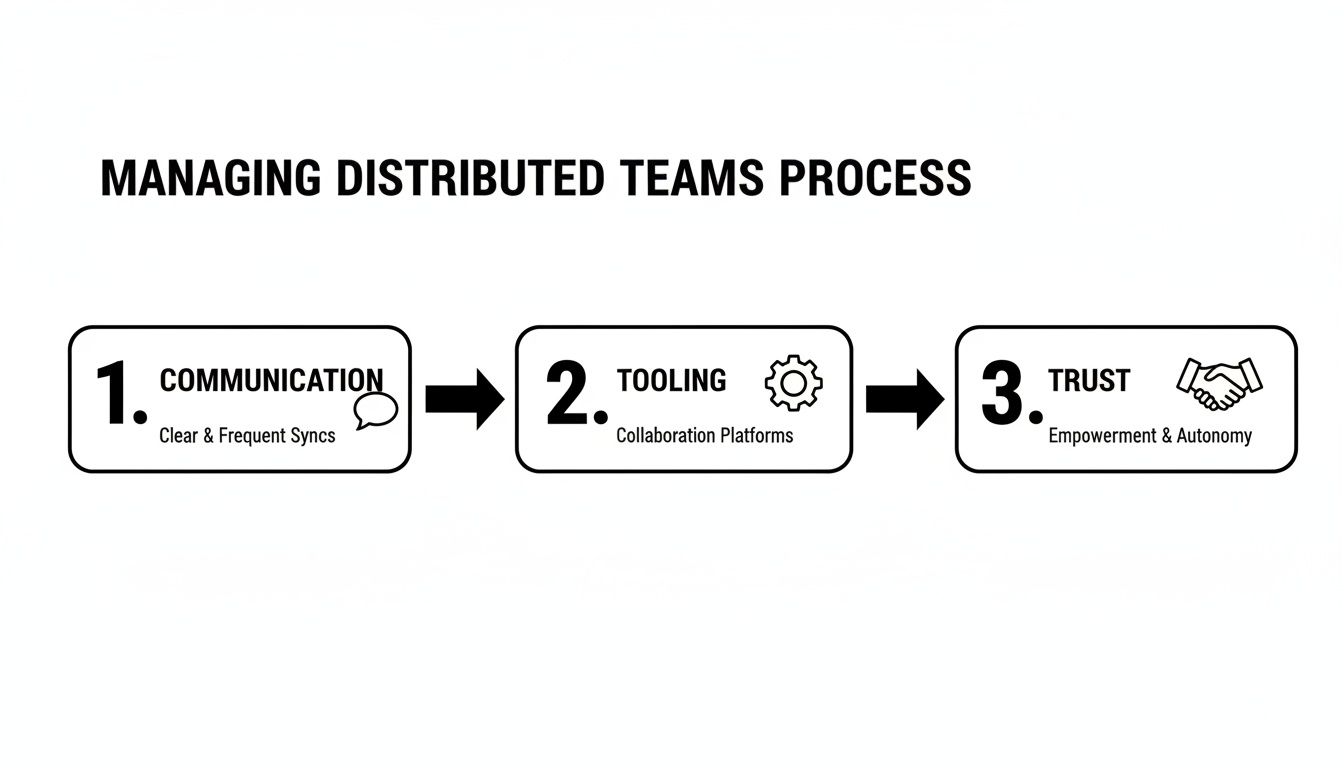
It’s a cycle. Clear communication lets you get the most out of your tools, and using those tools effectively helps build and reinforce trust across the entire team. It all feeds into itself.
Getting this right isn't an accident; it requires a deliberate, thoughtful approach. You're trying to create an environment where engineers feel connected, empowered, and totally aligned with the company’s goals, regardless of their time zone.
"The biggest mistake leaders make is trying to replicate an in-office environment remotely. True success comes from embracing a new mindset focused on trust, autonomy, and asynchronous communication, where performance is measured by results, not hours online."
To summarize these core ideas, here's a quick look at the pillars that hold up a successful distributed team.
Core Pillars of Distributed Team Management
Pillar | Key Focus Area | Desired Outcome |
|---|---|---|
Communication | Establishing clear, multi-channel communication protocols (async & sync). | Everyone has the information they need to work autonomously without constant meetings. |
Tooling | Implementing a tech stack that supports collaboration, automation, and security. | Friction is removed from daily workflows, allowing engineers to focus on high-impact work. |
Trust | Building a culture of psychological safety, ownership, and outcome-based performance. | Engineers feel empowered to make decisions, take risks, and do their best work without micromanagement. |
Mastering these elements is non-negotiable for any organization that wants to thrive. This isn’t just about managing people; it's about engineering a system where elite talent can truly shine.
Ready to build your own high-performing distributed team without the operational overhead? TekRecruiter specializes in sourcing, vetting, and deploying the top 1% of engineers from global talent hubs. We handle the complexities so you can focus on innovation. Let's build your elite engineering team today.
How to Source and Hire Elite Global Talent
Your team’s success lives and dies by the quality of your engineers, regardless of where they log in from. When you decide to look beyond your local city, you’re not just expanding your search radius—you’re tapping into a global reservoir of skill. But this isn't about just posting a job and hoping for the best. It’s about architecting a hiring machine built to attract and land the world's best.

I’ve seen a massive shift towards nearshore talent hubs in Latin America. The advantage here is simple but powerful: significant time-zone alignment. It kills the friction that comes with managing a team spread across a 12-hour divide and makes synchronous collaboration feel almost effortless. Plus, the cultural overlap often makes for a much smoother integration into the team.
Crafting Job Descriptions That Actually Attract Top Talent
For a distributed team, your job description is your most important filter. It has to do more than just list a bunch of technologies. It needs to sell the remote work reality and be brutally honest about the traits someone needs to thrive without constant oversight.
Get rid of the boring, standard bullet points. Instead of "proficient in Python," frame it around the impact they'll have. Something like, "You will build and own the core APIs that power our real-time data processing, impacting millions of users daily." See the difference?
You also need to be explicit about the soft skills that are totally non-negotiable for remote work:
Proactive Communication: Make it clear you expect frequent, concise updates, both written and verbal. No ghosting allowed.
Document-First Mentality: Call out that your team lives in tools like Confluence to make asynchronous work possible. If they hate writing, they won’t fit.
Autonomy and Ownership: Emphasize that you’re looking for someone who can take a high-level goal and just run with it.
This level of detail doesn't just attract the right people; it actively repels those who would crumble in your remote culture.
Vetting for Remote Readiness, Not Just Tech Skills
The interview process has to change. Technical chops are table stakes, but they don't tell you if someone can actually function on a remote team. Your coding challenges and system design sessions are still important, but they’re only half the story. You have to simulate the remote environment to see how they really operate.
A candidate's ability to solve a complex algorithm is important, but their ability to clearly explain their solution in a written document or a pre-recorded video is what truly predicts their success on a distributed team.
Give them a take-home assignment that requires both coding and a short written explanation or a Loom video walkthrough. This is a direct test of their ability to communicate complex ideas asynchronously—a skill every single remote engineer must have. In the live interviews, dig into their past experiences with behavioral questions about remote collaboration, resolving conflict across time zones, and managing their own schedule.
If you want to go deeper on structuring this process, check out our complete guide on how to hire remote developers and build your dream team.
Using a Specialized Partner to Accelerate Your Search
Let's be real: sourcing, vetting, and hiring elite global talent is a full-time job. Navigating international markets, verifying credentials, and assessing for remote readiness can absolutely crush your internal teams. This is where a specialized recruiting partner becomes your secret weapon.
Working with a firm that already has a pre-vetted network of top-tier engineers can shrink your hiring timeline from months to weeks. These partners do the heavy lifting—the initial screening, technical assessments, and cultural fit analysis. They hand you a shortlist of candidates who are not only technically brilliant but are proven performers in a distributed world.
This frees up your engineering leaders to focus their time where it matters most: the final, critical interview stages.
Don't let the headache of global hiring slow you down. TekRecruiter specializes in placing the top 1% of engineers from global talent hubs directly onto your team. We handle the sourcing and vetting so you can get back to building. Let us find the world-class talent you need to win.
Building Your Digital Headquarters and Communication Stack
When your team is distributed, your tech stack isn't just a collection of apps—it's your office. It's the hallway, the conference room, and the whiteboard, all rolled into one digital space. Getting this right means building a "digital headquarters" that makes work flow smoothly, no matter where your engineers are.
This isn't just a nice-to-have anymore. The modern workforce demands this level of flexibility; in fact, hybrid work is now the go-to model for 83% of employees around the globe. Companies are catching on, with over 80% investing in better collaboration tools and security to keep up.
But simply having Slack for chat and Zoom for calls is table stakes. A truly effective digital HQ is an integrated system designed for clarity and focus.
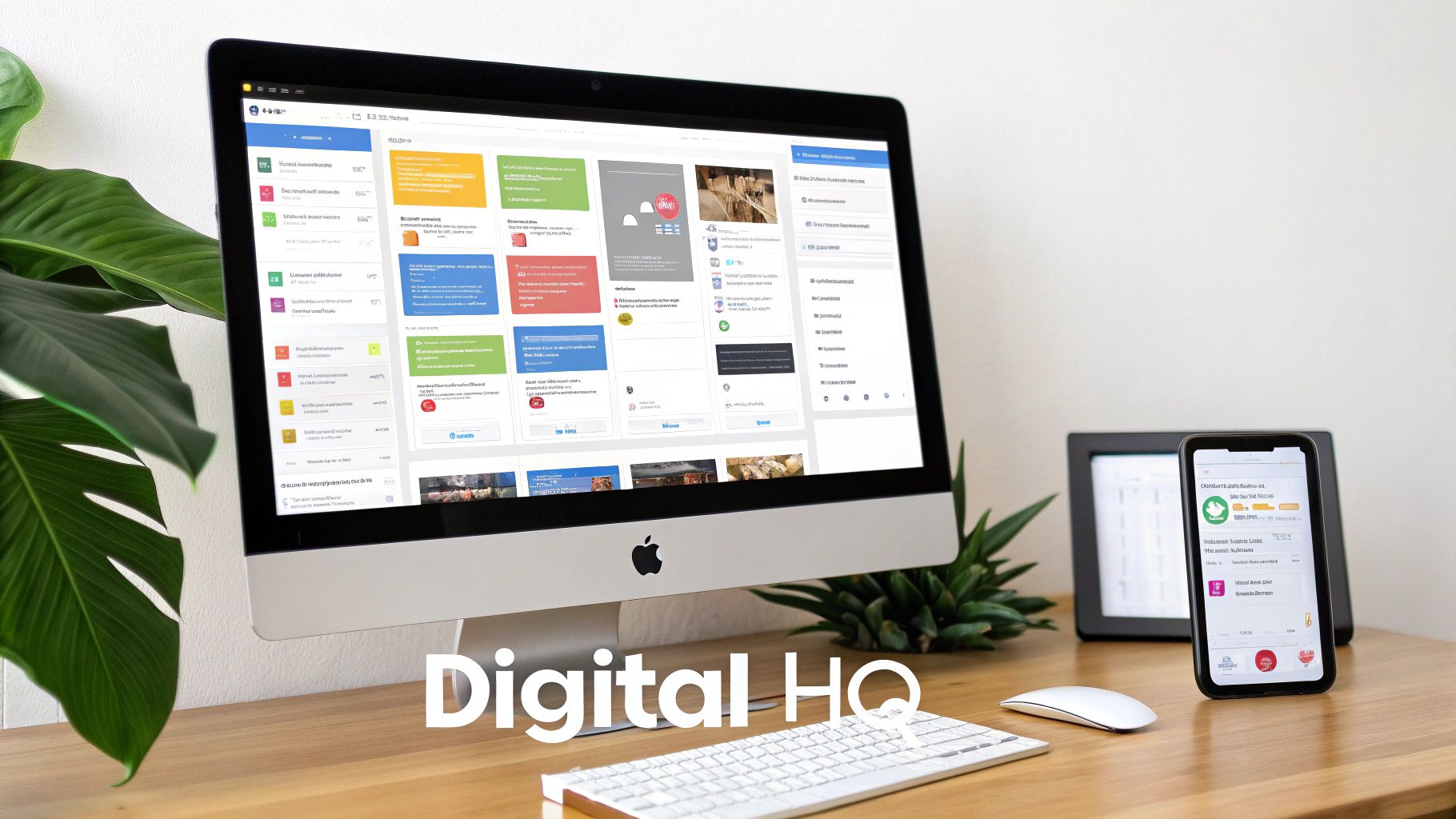
The key is creating an organized environment that prevents information from getting trapped in silos and makes asynchronous communication the default, not the exception.
Adopt an Asynchronous-First Mindset
Here's the single biggest mistake I see leaders make: they try to shoehorn old, in-office habits into a remote setup. This just leads to endless calendar Tetris, meeting fatigue, and a fast track to burnout.
The answer is to flip the script and adopt an asynchronous-first mindset. Real-time meetings should be a last resort, not the default. This philosophy protects your team's deep work time and respects their individual schedules and time zones.
It all comes down to defaulting to written communication and rock-solid documentation.
Ditch the daily stand-up meeting. Instead, create a dedicated Slack channel where engineers post concise, written updates when they start their day.
Move design reviews out of live meetings. A designer can record a quick Loom video walking through their mockups. The team can then leave precise, time-stamped feedback whenever it suits them.
Make decisions in writing. Document proposals, discussions, and final decisions in a shared space like Confluence or Notion. This creates a permanent, searchable record of why a decision was made.
This shift doesn't just make work more efficient; it empowers your team to contribute thoughtfully on their own time, leading to better outcomes and a healthier work-life balance.
Core Components of Your Tech Stack
A strong digital headquarters stands on three pillars: communication, project management, and a single source of truth for knowledge. You have to be intentional about choosing tools that champion async collaboration.
"Your tech stack should be a force multiplier for autonomy. The right tools don't just facilitate communication; they create a single source of truth that empowers engineers to find answers and make decisions independently."
When you're designing this digital HQ, the tools you pick are critical. For instance, digging into the best knowledge base software is a non-negotiable step to ensure everyone can find what they need, when they need it. A well-oiled knowledge base is your first line of defense against repetitive questions and a massive accelerator for new hires.
For a deeper look at how the right tools can transform your team's productivity, check out our guide on how to leverage technology to boost your remote work teams.
To get started, here’s a look at the essential tool categories and some of the heavy hitters in each space.
Essential Tools for Distributed Engineering Teams
Choosing the right combination of tools is only half the battle. The real magic happens when you establish crystal-clear guidelines for how and when to use each one, creating a predictable and efficient communication flow for the entire team.
Tool Category | Primary Function | Example Platforms |
|---|---|---|
Instant Communication | Real-time chat for quick questions and team bonding. | Slack, Microsoft Teams |
Project Management | Tracking tasks, managing sprints, and visualizing progress. | Jira, Asana, Trello |
Knowledge Hub | Centralized documentation, meeting notes, and project specs. | Confluence, Notion, Guru |
Video & Async Comms | Virtual meetings and recorded walkthroughs or updates. | Zoom, Google Meet, Loom |
Feeling overwhelmed by the challenge of building a high-performing distributed team? TekRecruiter specializes in deploying the top 1% of engineers anywhere in the world. We handle the complexities of sourcing and vetting, allowing you to focus on innovation.
Navigating Global Security and Compliance Challenges
When you build a distributed team, your security perimeter is no longer the four walls of your office. It's now a sprawling network of home offices, personal devices, and varied jurisdictions, each with its own set of rules. This creates a minefield of security threats and compliance headaches that can bring your growth to a screeching halt if you're not prepared.
Let’s be clear: security is no longer just an IT problem. It's a fundamental business function. Getting this right means building a proactive strategy that covers everything from international data privacy laws to the security on an engineer’s personal laptop. A single breach can be devastating, both financially and to your reputation. You simply can't afford to get this wrong.
Building a Foundation of Zero Trust
The old castle-and-moat security model is dead. In a world where your team is everywhere, you have to operate on the assumption that no user or device is automatically trustworthy, regardless of whether they’re on a “company” network or not. This is the heart of a Zero Trust architecture.
Instead of giving blanket access, Zero Trust forces strict verification for every single request. It's about implementing multi-factor authentication (MFA) everywhere, enforcing the principle of least privilege—where people only get access to what they absolutely need—and constantly monitoring for anything that looks out of place. This approach drastically shrinks your risk, even if an employee's credentials get compromised.
Security for a distributed team isn't a one-and-done setup. It’s about building layers of defense that protect your assets, no matter where your people are logging in from.
Managing Endpoint Security for a Remote Workforce
Every laptop, every phone, every device your team uses is a potential door for an attacker. For any distributed team, a rock-solid endpoint security policy isn't just nice to have; it's non-negotiable.
Your strategy needs to cover a few key bases:
Device Management: Use Mobile Device Management (MDM) solutions to enforce baseline security standards on any device touching company data. Think mandatory disk encryption, strong passwords, and automatic screen locks.
Software Patching: This is basic but critical. Make sure every device has automated patching turned on for operating systems and apps to close the door on known vulnerabilities.
Endpoint Detection and Response (EDR): You can't protect what you can't see. EDR tools give you the real-time visibility you need to detect, investigate, and shut down threats on individual devices.
Protecting your digital infrastructure is everything. A complete guide to security audits in network security can give you a solid framework for assessing and hardening your defenses against today's threats.
Untangling the Web of Global Compliance
Hiring globally means you're suddenly playing by a whole new set of rules—a patchwork of international and local regulations. Laws like Europe's GDPR or California's CCPA come with massive fines and strict rules on how you handle personal data.
And it’s not just data privacy. You're also dealing with a tangle of international labor laws, tax obligations, and intellectual property rights in every country you operate in. The administrative lift can feel overwhelming.
This isn't just an anecdotal problem. Recent data shows that 63% of global companies say compliance is their single biggest challenge in managing distributed teams. It's no wonder that 87% of companies are actively trying to find better ways to handle it, with 51% currently searching for new platforms to get their global operations in order.
Documenting your security policies and running regular training is a good start, but it's not enough. You need robust monitoring to protect company assets and ensure your global growth is built on a foundation that's both secure and compliant. For more on this, check out a modern guide to recruitment cyber security, which offers some great context on protecting your talent pipeline from the start.
Struggling to keep up? TekRecruiter doesn't just help you find the top 1% of global engineers. We recruit people who take security and process seriously. Let us help you build a world-class team on a foundation you can trust.
Fostering a High-Performing Remote Culture
How do you build a cohesive, motivated culture when your team is spread across continents? I can tell you it isn't through virtual happy hours or other forced-fun initiatives. A truly high-performing remote culture is built intentionally, brick by brick, on a foundation of psychological safety, genuine belonging, and a relentless focus on outcomes.

Let's be clear: this is a leadership challenge, not an HR checklist. It demands a fundamental shift from managing by presence to leading with trust. The goal is to create an environment where top engineers are empowered to do their best work, period—no matter their location.
Creating Psychological Safety and Connection
In an office, trust can build organically. In a remote setting, it has to be earned through consistent, deliberate actions. The bedrock of any successful distributed team is psychological safety—the shared belief that you won't be punished or humiliated for making a mistake or speaking your mind. Without it, innovation dies on the vine and collaboration grinds to a halt.
As a leader, you have to model vulnerability. Openly admit your own mistakes. Create forums for honest feedback where there are zero repercussions. This is how you build a culture where engineers feel safe enough to experiment, ask for help, and challenge the status quo.
Beyond safety, you need to cultivate real human connection. Those spontaneous "water cooler" moments are gone, so you have to architect new opportunities for social interaction, both structured and unstructured.
Virtual Team Building That Actually Works: Ditch the awkward Zoom happy hours where everyone stares at each other. Instead, try activities that demand collaboration, like virtual escape rooms or collaborative online games (Jackbox Games is a classic). Even a simple "show and tell" of personal passion projects works wonders. The key is active participation, not passive observation.
Structured Mentorship Programs: Pair senior engineers with junior team members across different locations. This isn't just about skill development; it builds strong interpersonal bonds that bridge geographical and cultural divides.
Informal Social Channels: Dedicate Slack channels for non-work chatter. Think , , or . These digital spaces give team members a place to connect on a human level, sharing parts of their lives beyond code commits and project deadlines.
Driving Performance with Trust and Autonomy
When you have a culture of trust, you naturally get more autonomy. Stop measuring productivity by hours logged or green status indicators. Free your engineers to focus on what actually matters: delivering results. This is where outcome-based performance management becomes your most powerful tool.
Frameworks like Objectives and Key Results (OKRs) are tailor-made for this. They shift the entire conversation from "what are you doing?" to "what are we achieving?"
When you standardize goal tracking and make progress visible to everyone, you build a system of accountability without resorting to micromanagement. Research shows that teams with clear, trackable goals are 20% more effective simply because everyone understands how their individual work plugs into the bigger picture.
Redefining Performance Management for Remote Teams
Fair performance reviews in a distributed environment require a completely new playbook. Proximity bias—that unconscious tendency to favor employees who are physically closer—is a very real threat. To fight it, your review process has to be data-driven and rooted in tangible outcomes.
Focus on Impact, Not Presence: Evaluate engineers on the quality of their code, their contributions to team goals, and their impact on the product. Metrics like pull request cycle times, bug resolution rates, and the successful delivery of features are far more telling than hours spent at a keyboard.
Gather 360-Degree Feedback: Get input from peers, project managers, and other cross-functional collaborators. This paints a holistic picture of an employee's performance that isn't skewed by a single manager's limited perception.
Use Regular, Asynchronous Check-ins: Scrap sporadic formal reviews. Instead, use frequent, lightweight check-ins. A manager can send a quick async video message each week to recognize great work and offer support—a simple action that studies show can double a team's sense of connection and clarity.
Ultimately, building a high-performing remote culture is about creating an ecosystem of trust, clarity, and empowerment. It’s a system where every engineer, no matter where they are, feels connected, valued, and equipped to succeed.
Building this kind of culture while simultaneously sourcing elite global talent can stretch any leader thin. TekRecruiter specializes in deploying the top 1% of engineers anywhere in the world, allowing you to focus on fostering a world-class culture while we handle the complexities of building your team.
Ready to Build Your Elite Engineering Team?
Look, managing a distributed team is tough. Building one from scratch? Even tougher. It’s way more than just finding a few developers online. You need a real strategy for sourcing, security, and building a culture that actually works—something most companies just don't have the bandwidth for.
This is where having a dedicated partner changes the entire game.
At TekRecruiter, we find and place the top 1% of engineers from anywhere on the globe. We take the hiring headaches off your plate so your leaders can get back to what they do best: driving innovation.
Flexible Solutions for How You Actually Work
Every company is different. You might need staff augmentation to hit a tight deadline, direct hires for permanent core roles, or an outside AI engineering company to own a whole build. We get it. We recruit the engineers, and when the work belongs with an outside team, we find and vet the best one for it. See how MSP & Outsourcing Search works.
Our model is built for that flexibility. With nearshore staffing in Latin America, we give you access to world-class talent in your time zone.
Don't let the friction of global hiring and management slow you down. The right partner isn't a cost—it's an accelerator. You get elite talent, faster, and build the high-performing distributed team that will actually move the needle.
Our founder, Ron Smith, is a former software engineer who holds AWS, Salesforce and Google Cloud certifications, so we have the technical depth to evaluate the engineers who build custom AI and cloud systems.
Want to see how we deliver this kind of value? We break it down in our post on securing talented software engineers at a competitive cost.
Stop letting the complexities of building a distributed team hold you back. Let us find the elite engineers who will bring your vision to life. We’ll handle the sourcing and the vetting. You just focus on building the future.
Got Questions About Managing Distributed Teams? Let's Get Them Answered.
Even with a solid game plan, you're going to hit some specific hurdles. It’s just the nature of leading teams spread across the globe.
Let’s tackle a few of the most common questions I hear from engineering and HR leaders. These are the real-world sticking points, with practical answers to help you lead with confidence.
What’s the Single Biggest Mistake I Can Make?
Trying to clone your office culture and force it into a remote setting. I’ve seen it happen time and time again, and it’s a recipe for disaster.
This mistake leads directly to micromanagement, calendars choked with pointless meetings, and leaders obsessing over green status dots instead of actual results. It’s a fast track to burnout and kills team morale.
You have to fundamentally shift your thinking. Success in a distributed model is built on trust, autonomy, and asynchronous communication. You measure performance on tangible outcomes, not on who was logged in the longest.
The goal isn’t surveillance; it's empowerment. Give your engineers clear objectives and the freedom to execute, and they’ll blow you away with what they deliver.
How Do You Actually Build a Culture Across Different Time Zones?
You can't just hope a great culture will magically appear. Without a physical office to act as a social hub, you have to be deliberate and intentional about building connection. The key is creating a consistent, inclusive experience for every single person, no matter where they clock in.
Here are a few things that work:
Nail Down Your Values: Don't just write them on a wall (or a webpage). Define the core principles that guide every decision and action, and then live them out loud.
Engineer Connection: You have to schedule time for people to connect. This means both structured, work-related collaboration and informal things like virtual coffee chats or online team games. Make it a priority.
Level the Playing Field: Recognition, promotions, and cool projects can't feel like they only go to people in certain time zones. Every team member needs an equal shot at growth and visibility.
It's a balancing act. You want to celebrate the unique cultural backgrounds on your team while constantly reinforcing the shared mission that ties you all together. That’s how you build real belonging.
What Are the Absolute Must-Have Tools for a New Distributed Team?
Okay, let's get past the obvious. You need a messaging app like Slack or Microsoft Teams, and you need a video tool like Zoom or Google Meet. That's table stakes.
The real game-changers for a new distributed team are the tools that create a "single source of truth." This foundation comes down to two critical categories.
First, a centralized project management platform is non-negotiable. Something like Jira or Asana gives everyone visibility into who’s doing what and keeps the work moving. Second, you absolutely need a robust documentation hub—think Confluence or Notion.
These tools are the bedrock of effective asynchronous work. They cut down on meetings, kill dependency issues, and empower your engineers to find the answers they need without having to wait for someone else to come online.
Juggling these challenges while trying to source elite global talent can stretch any leader thin. TekRecruiter is a technology staffing and recruiting firm that allows innovative companies to deploy the top 1% of engineers anywhere. We handle the complexities of finding and vetting talent, so you can focus on building a world-class culture and shipping incredible products. Find your next elite engineer today.
 Ron SmithPresident & Lead RecruiterTekRecruiter