_edited.png)
Accepting the Offer Letter: A Practical Guide for 2026
Mira had just finished a six-week interview loop for a senior backend engineering role. The hiring manager called with good news, the recruiter said the team was thrilled, and Mira replied that she was excited too. Then the PDF arrived. Three days later, it was still open on her laptop, untouched.
That pause is normal. Accepting the offer letter isn't a rubber stamp after a verbal yes. It's the point where enthusiasm becomes a written commitment, and where vague promises need to become clear terms. A verbal intent, a written offer, a signed acceptance, and a first day are four separate events with different practical and legal weight.
The risk doesn't disappear when you say yes. It can expand between signature and start date through changed terms, delayed onboarding, missing contingencies, or an employer decision that never appeared in the original conversation. This guide shows you how to read the letter, use the response window, negotiate before acceptance, document the agreement, and protect yourself after signing.
Table of Contents
Reading the Offer Letter Like a Pro - Start with the role and money - Then inspect the legal and conditional terms - Use a pre-sign checklist
Email and Phone Scripts That Actually Work - Acknowledge receipt - Request time or make a counter - Confirm acceptance
After You Sign, Before You Start - Build protection into the waiting period
From Signed Letter to First Day With Confidence - Build a practical first-month map
The Decision You Thought You Already Made
Mira's recruiter had already heard the answer she wanted. “I'm thrilled,” Mira said on the phone. She meant it. The role matched her backend experience, the manager understood distributed systems, and the product had technical problems worth solving.
But the letter introduced friction. The title was slightly different from the one discussed. The remote arrangement appeared in an email, not the offer. The equity language pointed to a separate plan document, and the start date left little room for her notice period. None of those details automatically killed the offer. Together, they made signing without questions irresponsible.
Senior recruiter rule: excitement is a reason to move quickly, not a reason to stop reading.
The four milestones matter:
Verbal intent: You tell the employer you want the job. This communicates enthusiasm, but it may not identify the final terms.
Written offer: The employer states the role, compensation, conditions, and deadline. This is the document you can inspect and compare.
Signed acceptance: You communicate clear agreement to the stated terms. Contract enforceability generally depends on a definite offer, clear acceptance, agreement on essential terms, and consensus about each party's rights and duties. A counteroffer isn't the same as accepting the original offer, as explained in this employment offer contract guidance.
Start date: You begin work. This is operationally important, but it doesn't erase problems created earlier.
Candidates often resign after a verbal promise, then discover the written letter contains a different location, a conditional start date, or compensation that was described too casually. Keep your resignation decision tied to a written offer whose important terms you understand.
Your review should answer five questions. What exactly am I accepting? What remains conditional? What can I negotiate? When must I respond? What could still go wrong after I sign? If your current job is already pushing you toward a change, this guide to reasons to leave a job can help separate a considered move from an emotional reaction.
Reading the Offer Letter Like a Pro
Read the letter in the order an employment dispute or difficult onboarding conversation would expose it, not in the order your excitement wants to read it. Mark every promise that matters, then check whether it appears in the letter, an attached plan, a benefits document, or nowhere at all.
Start with the role and money
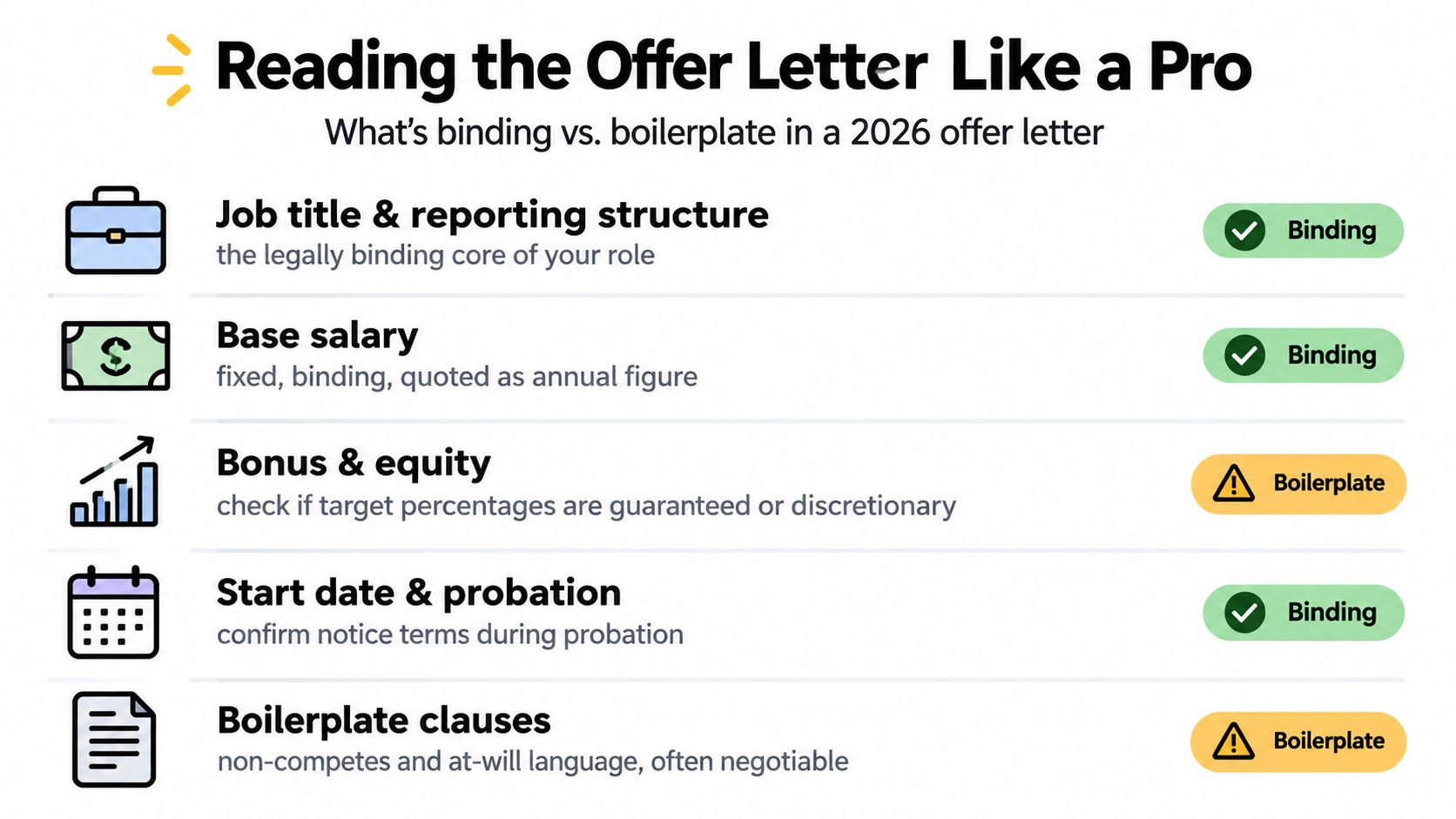
Job title and reporting line should match the role you accepted. Look for the exact title, department, manager, employment type, location, and work arrangement. Ask, “Is this the role and reporting structure we discussed, and will those terms appear in the final agreement?”
Base salary should appear as a fixed annual or hourly amount. Confirm pay frequency and currency where relevant. Ask whether the figure is guaranteed base compensation or includes a temporary adjustment.
Bonus language matters more than the target amount. Find “target,” “discretionary,” eligibility requirements, payment timing, and whether you must remain employed on the payment date. A target bonus isn't automatically guaranteed.
Equity rarely lives entirely in the offer letter. Read the grant size, vesting schedule, cliff, refresh policy, exercise terms, and the separate equity plan. Pay special attention to how the plan defines cause, what happens on termination, and whether acceleration applies during a sale or another qualifying event.
Then inspect the legal and conditional terms
Benefits summaries can be useful, but they may say “subject to plan terms.” Ask for the actual benefits summary and confirm when coverage begins. At-will language usually explains the employment relationship rather than promising stability, so don't spend negotiation capital trying to remove standard wording.
Restrictive covenants deserve closer attention. Read the scope of any non-solicit or non-compete, the choice-of-law state, the geographic and time limits, and whether the language affects customers, employees, or future work. Check IP assignment, arbitration, post-employment cooperation, confidentiality, and any repayment obligation if you leave within twelve months.
References, background checks, work authorization, relocation, and other conditions should be explicit. If the offer depends on them, ask what happens if a condition is delayed or fails.
Use a pre-sign checklist
Before signing, verify:
Role: Title, manager, team, location, remote status, and responsibilities.
Compensation: Base, bonus mechanics, equity documents, vesting, and eligibility.
Timing: Start date, response deadline, notice period, and probation terms.
Conditions: Background checks, references, authorization, relocation, and other contingencies.
Execution: Correct legal entity, signature blocks, attachments, and required return method.
Circle unclear language and ask for written answers. Your employer value proposition matters, but a persuasive employer value proposition framework can't replace precise terms in the agreement.
Timing Your Acceptance Without Burning the Offer
Timing is everything, but poor timing makes you look either careless or unavailable. A written offer commonly includes an expiration date, and some templates state that the offer is withdrawn if the signed copy isn't returned by that deadline, as shown in this offer letter template guidance.
Don't rush inside a day unless the terms are already clear and the deadline is immediate. Don't disappear for a week while the employer waits. A practical workflow is to acknowledge receipt within one business day, review for two or three days, ask focused questions by day three, and return a signed letter or decline by day five.
Window | Candidate Risk | Employer Risk | Recommended Action |
|---|---|---|---|
Same day | Signing terms you haven't understood | Creates little time for clarification | Acknowledge receipt, don't sign automatically |
Two to three days | Missing a short deadline if you stay silent | Candidate may interpret silence as disinterest | Review carefully and send consolidated questions |
Four to five days | Extension may become harder near expiration | Team may need to manage headcount uncertainty | Decide, negotiate once, then accept or decline |
Beyond the stated deadline | Offer may lapse | Employer may move to another finalist | Request written confirmation before relying on the offer |
Use a direct extension request:
Thank you for sending the offer. I'm excited about the role and want to review the terms carefully. Could I confirm my decision by [date]? I'll use the time to resolve a few questions about the written terms and start date.
The employer's deadline isn't always artificial. Headcount approval can change, a requisition can close, or another finalist can remain available. If the deadline is genuinely tight, ask which terms are fixed, request the missing attachments immediately, and get any extension in writing. If the pressure feels manufactured, stay calm and ask for the reason and the exact consequence of missing the date.
Acceptance becomes effective at different times depending on how you communicate it. The contract acceptance timing explanation distinguishes mailed acceptance under the mailbox rule from instantaneous methods such as email, phone, or text, where receipt generally matters. Because jurisdiction and wording can change the result, keep the signed letter, your email, and delivery confirmation.
What to Negotiate Before You Say Yes
Negotiate before acceptance, not after you've announced that the deal is done. One clean round of back-and-forth is normal. Negotiating every minor detail makes you look unfocused, while accepting everything without a question leaves value and clarity on the table.
Pick two meaningful asks. For most engineers, the order is straightforward:
Base salary: Usually the strongest compensation lever because it affects future raises and market positioning. Anchor to a specific number and explain the value you bring.
Signing bonus: Often easier to adjust than base pay, especially when salary bands are rigid. It can bridge a gap without permanently changing the compensation structure.
Equity: Ask about grant size, vesting cliffs, refreshers, exercise terms, and acceleration. Senior candidates should understand what the equity is intended to represent, not just the headline quantity.
Title: Cheap for the company to change and meaningful for your future search. Make sure it reflects the scope you'll own.
Remote or hybrid terms: Get the location, schedule, travel expectations, and approval process in writing. A verbal "flexible" promise is weak protection.
PTO and relocation: Worth asking when they affect your transition, move, or existing commitments.
Don't burn relationship capital over standard benefits or boilerplate at-will language. Legal restrictions may deserve review by an attorney, but demanding that every standard clause disappear usually creates friction without improving the practical offer.
A strong counter sounds like this:
I'm excited about the role and believe the scope matches my experience building and operating backend systems. If you can move the base to [specific figure], I'm prepared to accept the offer and align on the remaining details.
Give the employer room to respond. If salary cannot move, ask whether a signing bonus, title adjustment, equity clarification, or start-date change can address the underlying issue. Candidates who want a deeper framework for confidently negotiate salary offer can use that resource to prepare their wording and rationale.
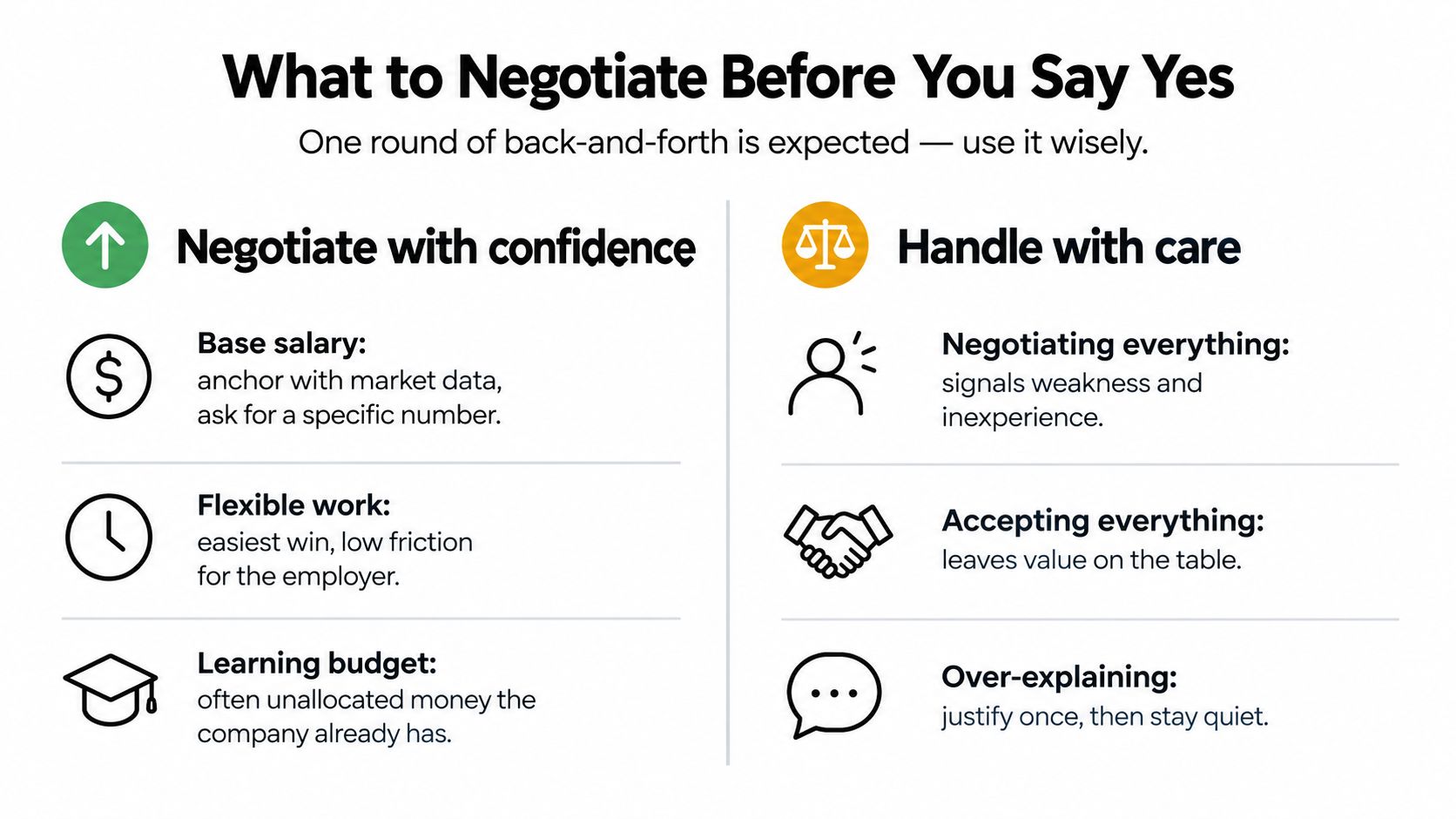
The rule is simple. Choose your two real asks, support them briefly, negotiate once, then close. Your future manager is about to need your judgment, not a long performance of bargaining.
Email and Phone Scripts That Actually Work
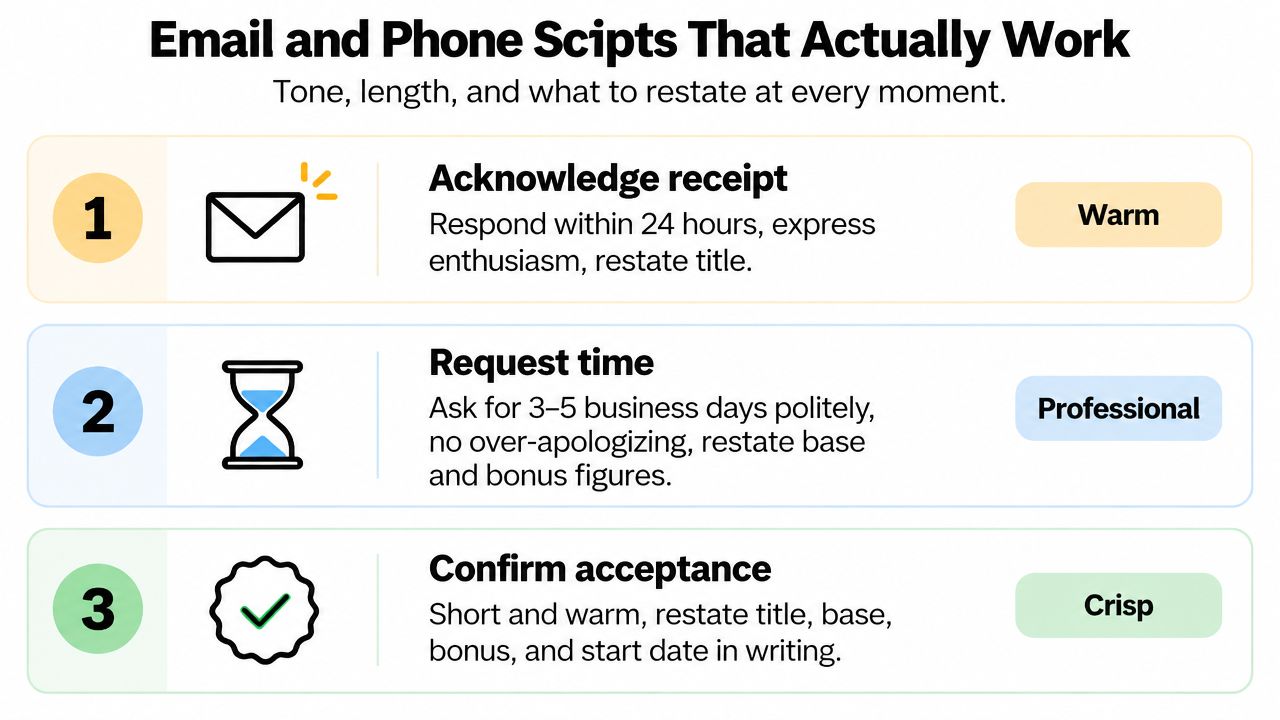
Your acceptance email should be warm enough to build the relationship and precise enough to serve as a record. Keep it short. Restate the role, employer, base, bonus terms, start date, work arrangement, manager, and any agreed conditions.
Acknowledge receipt
Send this even when you need time:
Subject: Offer for Senior Backend EngineerHi [Name], Thank you for sending the offer for the Senior Backend Engineer role. I'm excited about the opportunity and appreciate the team's time throughout the process. I've received the letter and will review the terms carefully. Could we speak about the start date and equity documents before I confirm?Best, [Name]
A clear subject helps the recruiter route the message. If you're polishing subject lines, this guide to email subject line capitalization offers useful conventions without turning the email into marketing copy.
Request time or make a counter
Hi [Name], Thank you again for the offer. I'm very interested in joining [Company] as [Title]. I'd like two to three business days to review the written terms and discuss one compensation question. Based on the role scope and my experience, would you consider a base salary of [specific figure]? If we can align on that point, I'll be ready to make a final decision by [date].Best, [Name]
Don't write a legal brief. State the request, give a short reason, and stop talking. The employer can respond without decoding your message.
Confirm acceptance
Hi [Name], I'm pleased to accept the offer for [Title] at [Company]. I confirm the base salary of [amount], the applicable bonus terms, the [equity description or attached plan], the [remote or hybrid arrangement], and the start date of [date], reporting to [Manager]. My acceptance remains subject to the contingencies stated in the written offer. Please confirm receipt and let me know the next onboarding steps.Best, [Name]
If you accept verbally before the letter arrives, say:
I'm excited to move forward based on the terms we discussed. Please send the written offer so I can review and confirm the final details in writing.
That keeps enthusiasm intact without treating an incomplete conversation as the final agreement. For additional workplace communication context, see this raise request email guide.
On the phone, open with: “Hi [Recruiter], I'm calling to confirm you received my signed acceptance and to make sure we agree on the start date and next steps.” If HR goes quiet, follow up by phone within a few days, then send a written recap. If someone demands a signature within a day, ask for the deadline, the missing documents, and whether signing confirms only acceptance or also a separate employment agreement.
After You Sign, Before You Start
The post-acceptance period is a risk window. Acceptance rates can look healthy while the process still fails after signature, because the employer may delay a start date, revisit headcount, or leave a condition unresolved. A 2026 survey cited by Indeed found that 18% of candidates said an employer withdrew a job offer after extending it in Q1 2026. Treat that as a reason for safeguards, not as a reason to panic. Indeed's acceptance-letter guidance also highlights the gap between accepting and beginning work.
The wider benchmark picture is uneven. Ashby reported offer acceptance rates of 77% in 2021, 76% in 2022, and 81% in 2023 in its dataset, with 2023 the highest average there, while another 2026 industry summary reported 82% in 2026. Those figures show why acceptance is useful, but they don't prove that your individual start date is secure.
Build protection into the waiting period
Ask the recruiter to confirm, in writing:
Contingencies: Whether references, background verification, work authorization, or other checks remain open, and what happens if processing is delayed.
Start date: Whether the date is firm, conditional, or subject to a project or headcount approval.
Onboarding contact: Who owns communication if the portal, equipment, or paperwork stalls.
Status cadence: When you'll receive the next update and who to contact if it doesn't arrive.
Maintain a private financial plan that can absorb a delayed start. The right amount depends on your own expenses, but having coverage for one to two months of expenses is a sensible target when the gap would create real hardship. Don't announce this concern to the employer as a threat. Use it to make calm decisions.
Risk | Likelihood | Impact | Safeguard |
|---|---|---|---|
Background or reference delay | Possible | Start date may move | Submit documents promptly and ask who owns the check |
Headcount or hiring freeze | Possible | Offer or start can be delayed | Confirm approval status and keep correspondence |
Remote-location mismatch | Possible | You may be unable to work as planned | Get work location and authorization in writing |
Counteroffer from current employer | Common enough to plan for | Decision becomes emotionally noisy | Compare the original reasons for leaving with the counteroffer |
HR silence after signing | Possible | Anxiety and poor coordination | Follow up by phone, then recap by email |
A counteroffer usually addresses the symptom, not the reason you started looking. More money can be useful, but it doesn't automatically fix weak management, limited scope, poor technical direction, or a stalled career path. If you accept one, be honest about why the original move mattered and whether the employer can actually change it.
During week one after signing, complete the paperwork, confirm day-one logistics, close competing processes professionally, and stop interviewing elsewhere unless the new employer materially changes the agreement. Protect your attention and your reputation at the same time. For a clear explanation of the background verification process, use a reliable checklist rather than guessing what the employer still needs.
From Signed Letter to First Day With Confidence
A signed letter becomes useful only when the details survive contact with onboarding. Save the offer, attachments, negotiation emails, acceptance message, and recruiter confirmations in one dedicated folder. If the start date changes or a condition remains unresolved, you shouldn't have to reconstruct the agreement from memory.
Before day one, confirm the start date, reporting line, work location, equipment, access process, and first meeting. Return paperwork before the onboarding portal closes, and keep copies of anything you submit. Prepare references and background-check documents before someone asks for them at the last minute.
Build a practical first-month map
You don't need a polished 30-60-90 plan before you start. You do need questions:
First 30 days: What systems, people, and decisions must you understand?
Next 60 days: Which delivery or reliability problems should you help solve?
By 90 days: What evidence will show your manager that you're operating at the expected level?
Ask your manager for an early conversation about priorities, decision rights, technical context, and how success will be evaluated. For an engineering role, ask which services, repositories, incidents, design documents, and stakeholders deserve attention first. Preparation should reduce uncertainty, not encourage you to pretend you already know the company.
Mute competing recruiter outreach and decline active processes cleanly. Keep a private record of the offer correspondence until you're established, because a written trail helps if an employer changes a start date or reopens a term. If you need updated professional materials during the transition, these AI headshot career tips can help you present yourself consistently without making your profile the center of the move.
TekRecruiter is a technology staffing and recruiting and AI Engineer firm that allows forward-thinking companies to deploy the top 1% of engineers anywhere. Its recruiters use technical conversations to match engineers with roles, and candidates can use a recruiting partner to clarify offer terms, references, notice periods, and onboarding expectations before signing.
If you're accepting an offer and want a clearer path from written terms to a productive first day, TekRecruiter connects innovative companies with engineering, product, and go-to-market talent while helping candidates navigate the practical details that can derail a move. Visit the site to explore technology recruiting and AI engineering opportunities built around the work you actually want to do.
Comments