_edited.png)
Cloud Systems Engineering: The 2026 Hiring Guide
94% of enterprises use cloud services in some form, making cloud systems engineering the discipline that connects mainstream adoption with operational resilience. The work is not just moving servers to a provider. It is designing systems that remain secure, observable, recoverable, and economically controlled when demand, dependencies, and failure conditions change.
Cloud teams now face a sharper trade-off than a technology checklist suggests. Feature velocity matters, but every deployment can expand the blast radius of a bad configuration, a dependency failure, or an untested recovery path. Hiring compounds the problem because many candidates can describe cloud architecture, while fewer can reason clearly about what happens when a distributed system is degraded in production.
Table of Contents
The Evolution of Cloud Systems Engineering - From infrastructure access to systems control
Core Competencies and Technical Stack - Architecture and networking - Security and observability - Infrastructure as code
Defining Team Structures and Overlaps - Match the role to the failure mode
The Resilience Gap in Cloud Engineering - Velocity versus blast radius
Scaling Efficiency Through Predictive Automation - Capacity planning as a control loop - What to measure before automating
The Evolution of Cloud Systems Engineering
Cloud systems engineering has a long technical lineage. The conceptual precursors of cloud computing are commonly traced to the 1950s and 1960s, when mainframe time-sharing allowed multiple users to share a central computer. That model established two ideas that still shape modern platforms, shared resources and economies of scale. The system mattered more than any one user's machine.
A later milestone arrived in 2006, when Amazon launched Amazon Web Services with Simple Storage Service, S3, and Elastic Compute Cloud, EC2. Those services made on-demand infrastructure broadly accessible over the internet and accelerated the move from hardware-centric operations to software-defined systems engineering. The history is useful because it explains why today's practitioners work primarily with distributed systems, virtualization, automation, and control planes rather than single-machine administration. The enterprise cloud computing overview provides additional context for that shift.
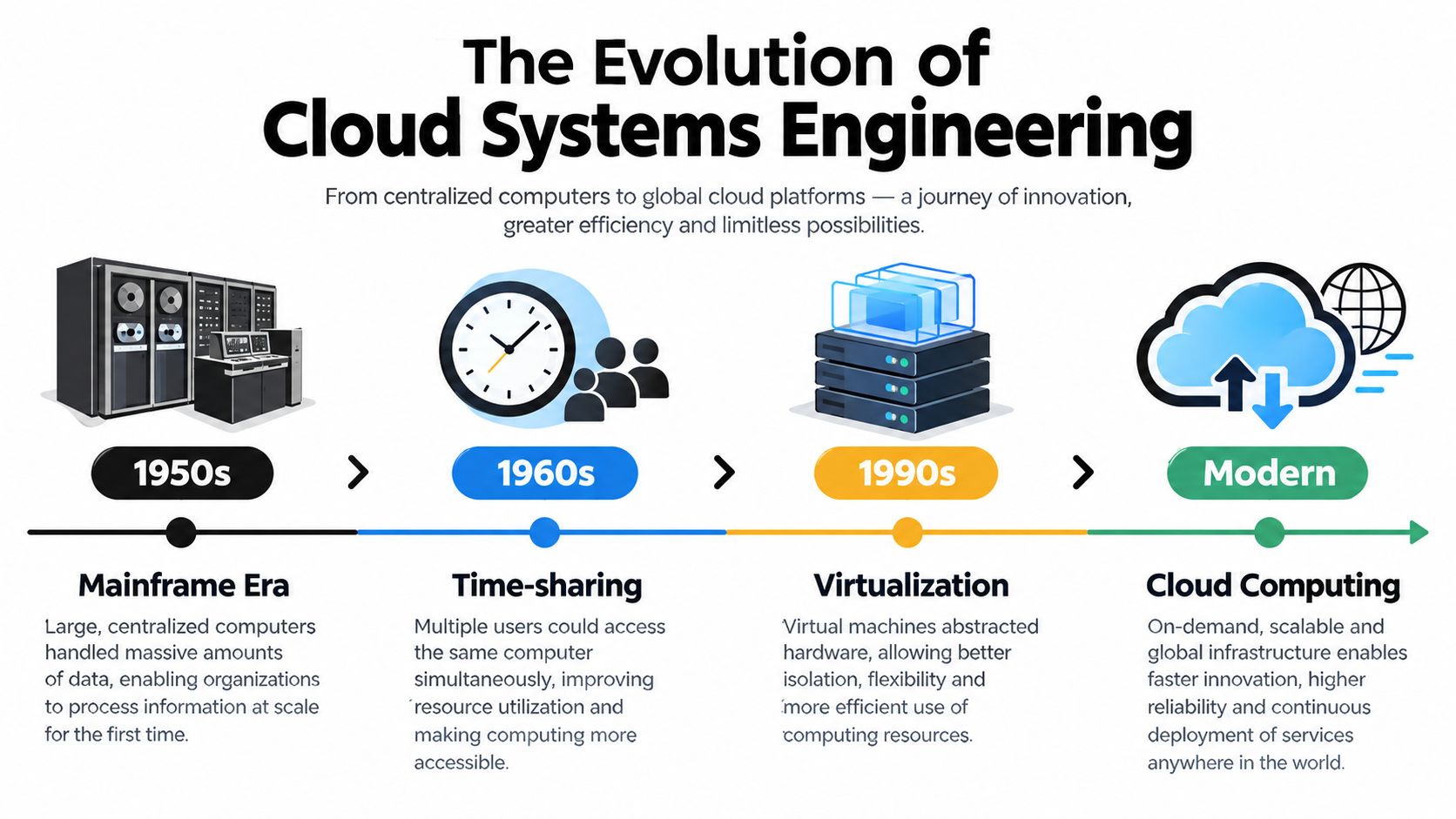
From infrastructure access to systems control
The commercial scale of cloud reinforces the change. One 2026 market snapshot estimated the cloud computing market at $912.77 billion in 2025, up from $156.4 billion in 2020. Independent industry summaries also report that 94% of enterprises use cloud services in some form, while companies run roughly 50% of their workloads in public clouds, up from 39% in 2022. These figures are documented in CloudZero's cloud computing statistics.
The important engineering conclusion isn't that every workload belongs in a public cloud. It is that cloud operating assumptions now influence enterprise infrastructure decisions at a global scale. Teams need engineers who can choose between managed services and self-managed components, model dependency risk, automate repeatable changes, and keep cost and failure behavior visible.
Practical rule: Treat the cloud as a programmable distributed environment, not as a remote data center with a different billing model.
That distinction affects hiring. A server administrator who can provision a machine may not be prepared to design safe regional failover, isolate tenants, or debug queue buildup across asynchronous services. Cloud systems engineering emerged because the failure modes and operating surfaces became larger than the individual host.
Core Competencies and Technical Stack
A competent cloud systems engineer connects five technical pillars rather than mastering them in isolation. Architecture defines the system's boundaries, networking controls how components communicate, security limits what each component can do, observability reveals behavior, and infrastructure-as-code makes the intended state repeatable. The cloud-native architecture guide is a useful companion when evaluating those design choices.
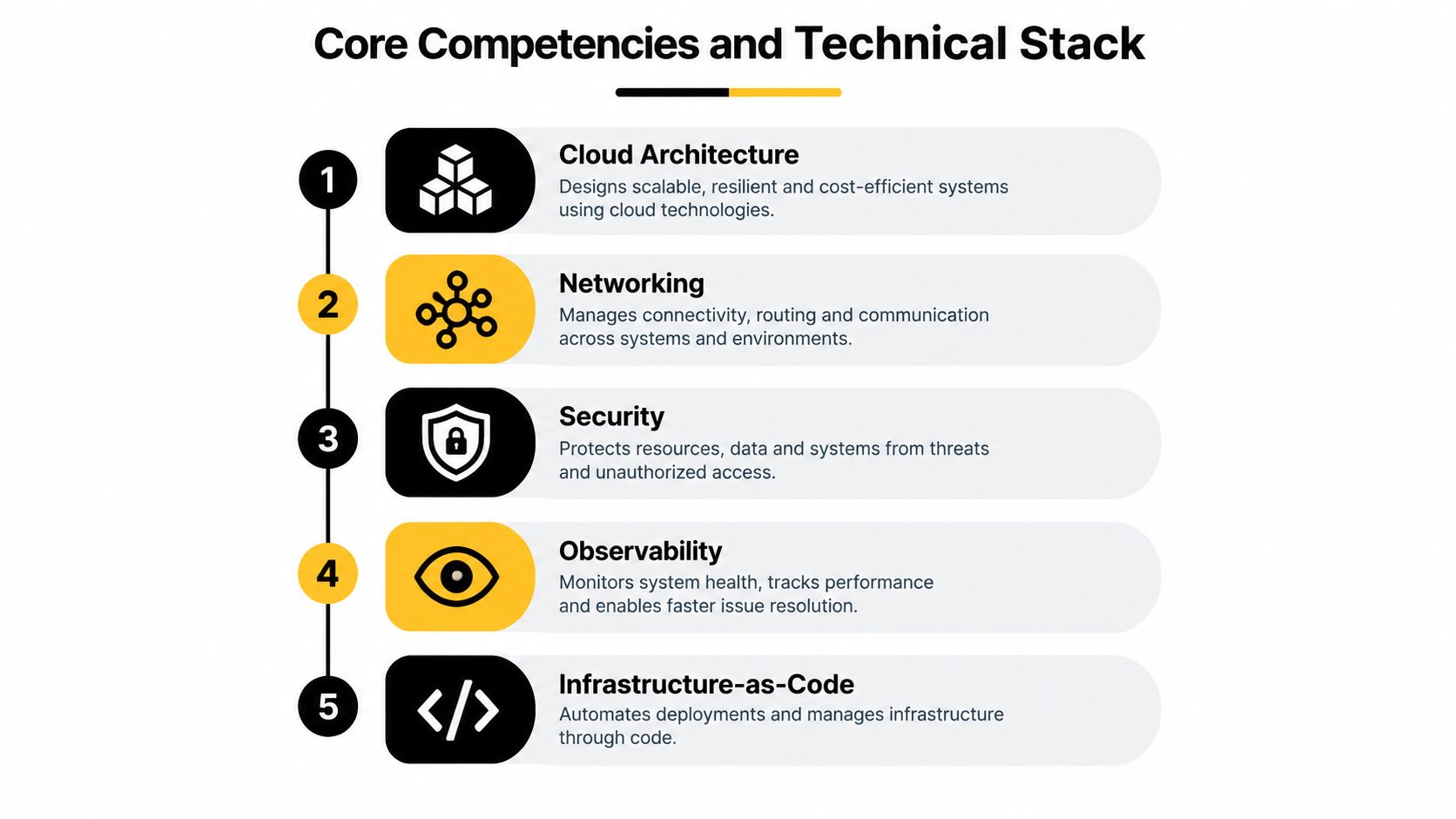
Architecture and networking
Cloud architecture starts with workload behavior, not a preferred service catalog. Engineers should identify state, throughput, latency sensitivity, recovery requirements, and dependency boundaries before selecting containers, functions, virtual machines, queues, or databases. A design that scales compute while leaving a single shared database or synchronous downstream call unconstrained hasn't solved the system's capacity problem.
Networking turns those boundaries into enforceable paths. Strong candidates can explain routing, private connectivity, service discovery, load balancing, egress control, and failure behavior when a dependency becomes slow rather than completely unavailable. They should also understand that a network timeout is a systems event, not merely a configuration inconvenience.
Security and observability
Security belongs in the architecture and delivery process. Under the shared responsibility model, the provider secures the underlying cloud infrastructure, while the customer secures configurations, identities, data, and workloads above the provider-managed layer. For IaaS, that means the provider covers physical infrastructure, networking, and virtualization, while the customer manages the operating system, applications, identities, data, logical network settings, and security monitoring, as explained in PwC's shared responsibility guidance.
Observability closes the feedback loop. Logs explain events, metrics expose trends, and traces connect user-visible latency to service dependencies. Good engineers use that evidence to revise limits, retry policies, partitioning, and deployment strategies. Dashboards that don't change decisions are decoration.
Infrastructure as code
Infrastructure-as-code tools such as Terraform, OpenTofu, CloudFormation, and Pulumi encode environments as reviewable artifacts. The value isn't only faster provisioning. Versioned declarations support repeatability, policy checks, drift detection, and safer rollback. Security controls become more reliable when engineers can test and apply them consistently instead of reproducing them manually under deadline pressure.
Defining Team Structures and Overlaps
Organizations often use DevOps, SRE, and Platform Engineering as interchangeable job labels. That creates hiring confusion because the roles overlap in tooling but differ in ownership. DevOps describes a collaboration model that brings development and operations closer together. SRE applies software engineering methods to operational reliability. Platform Engineering builds internal products that make the reliable path easier for application teams to use.
The right structure depends on the constraint blocking delivery. If developers and operations teams work through slow handoffs, the organization may need DevOps practices and shared ownership. If production incidents, toil, and unclear service objectives dominate, an SRE capability may be more appropriate. If every product team independently builds pipelines, identity integrations, deployment controls, and service templates, a platform team can create a paved road.
Role | Primary Focus | Key Deliverable |
|---|---|---|
DevOps Engineer | Collaboration, delivery flow, and automation | Integrated build, test, release, and operational workflows |
Site Reliability Engineer | Reliability, service objectives, and operational toil | Measurable reliability practices, automation, and incident response |
Platform Engineer | Internal developer experience and reusable infrastructure | A supported internal platform with self-service capabilities |
Match the role to the failure mode
A small team may not need three separate departments. One engineer can contribute to delivery automation, reliability, and platform design, but the organization should still define the responsibilities explicitly. Otherwise, urgent feature work consumes the same person who is expected to maintain deployment safety and incident readiness.
A platform team also shouldn't become a ticket desk for infrastructure requests. Its product is the developer interface, documentation, templates, guardrails, and feedback loops that let application teams ship without bypassing policy. SRE shouldn't become a renamed operations queue either. Reliability work needs engineering investment, service ownership, and authority to push back on unsafe changes.
The comparison in Platform Engineering vs. DevOps can help leaders separate organizational intent from fashionable titles. During interviews, ask candidates which responsibilities they've owned, which trade-offs they made, and how they measured whether the team became safer or merely faster.
The Resilience Gap in Cloud Engineering
Managed services remove infrastructure tasks. They don't remove failure modes.
A provider may operate the physical infrastructure, networking, and virtualization layer, but customers still control identities, workload behavior, data protection, logical network settings, and much of the monitoring surface. A permissive identity policy, unsafe deployment, exhausted connection pool, or poorly bounded retry loop can take down an application even when the managed service itself is healthy.
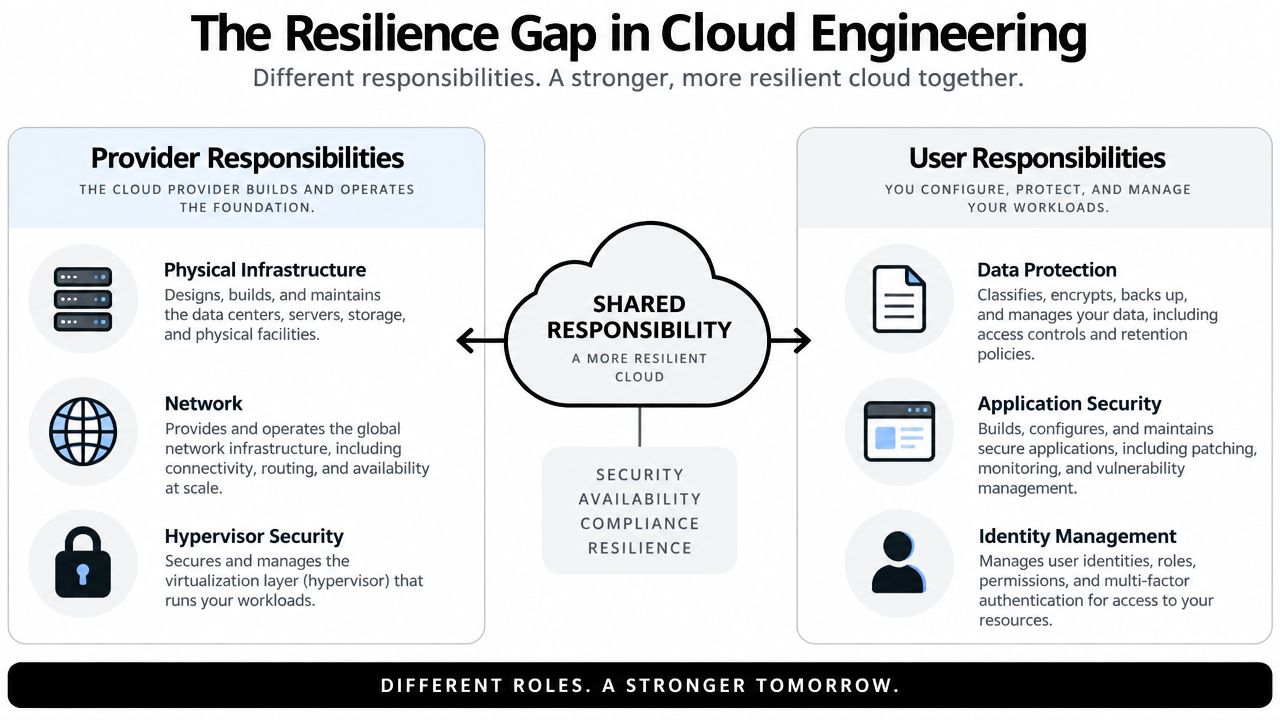
Velocity versus blast radius
The resilience gap appears when teams optimize for feature throughput while leaving failure containment implicit. A release can be technically successful and still be operationally dangerous if it reaches every tenant at once, changes a shared configuration without validation, or depends on a single region without a tested recovery path.
Recent coverage of cloud DevOps trends notes that major outages have returned reliability, multi-region design, and operational readiness to the center of engineering discussions. It also highlights a recurring mismatch, teams standardize developer workflows and governance while content and practice often stop at architecture diagrams instead of addressing blast-radius reduction, graceful degradation, and incident recovery at scale, as discussed in InfoQ's cloud and DevOps trends coverage.
Operational test: Ask what the system does when a dependency is slow, credentials are misconfigured, a region is unavailable, or a deployment partially succeeds. The answer reveals more than a diagram.
Resilient design uses boundaries deliberately. Incremental rollouts, independent failure domains, circuit breakers, queue isolation, cached responses, read-only modes, and clear recovery procedures can keep a local defect from becoming a broad outage. These mechanisms cost engineering time and introduce complexity, so they should be tied to business impact rather than added as ritual.
A candidate who only discusses scaling under normal load is missing the central systems question. The reliability engineering primer is relevant because reliability is a design and operating discipline, not a monitoring dashboard.
A short visual explanation can reinforce how provider and customer responsibilities divide in practice:
Scaling Efficiency Through Predictive Automation
Reactive autoscaling is useful, but it responds to evidence that demand has already changed. During a sharp burst, new capacity may take time to provision, initialize, warm, and receive traffic. That delay can create queue buildup and tail latency even when the scaling policy eventually reaches the correct target.
A trace-based performance study found that workload-agnostic autoscalers can perform as well as workload-specific autoscalers for bursty workloads. It also found that the Plan autoscaler produced an order of magnitude more task delay in some cases. The engineering lesson is broader than choosing a particular controller. Allocation policy and controller behavior materially affect tail latency under load swings, as shown in the trace-based autoscaling study.
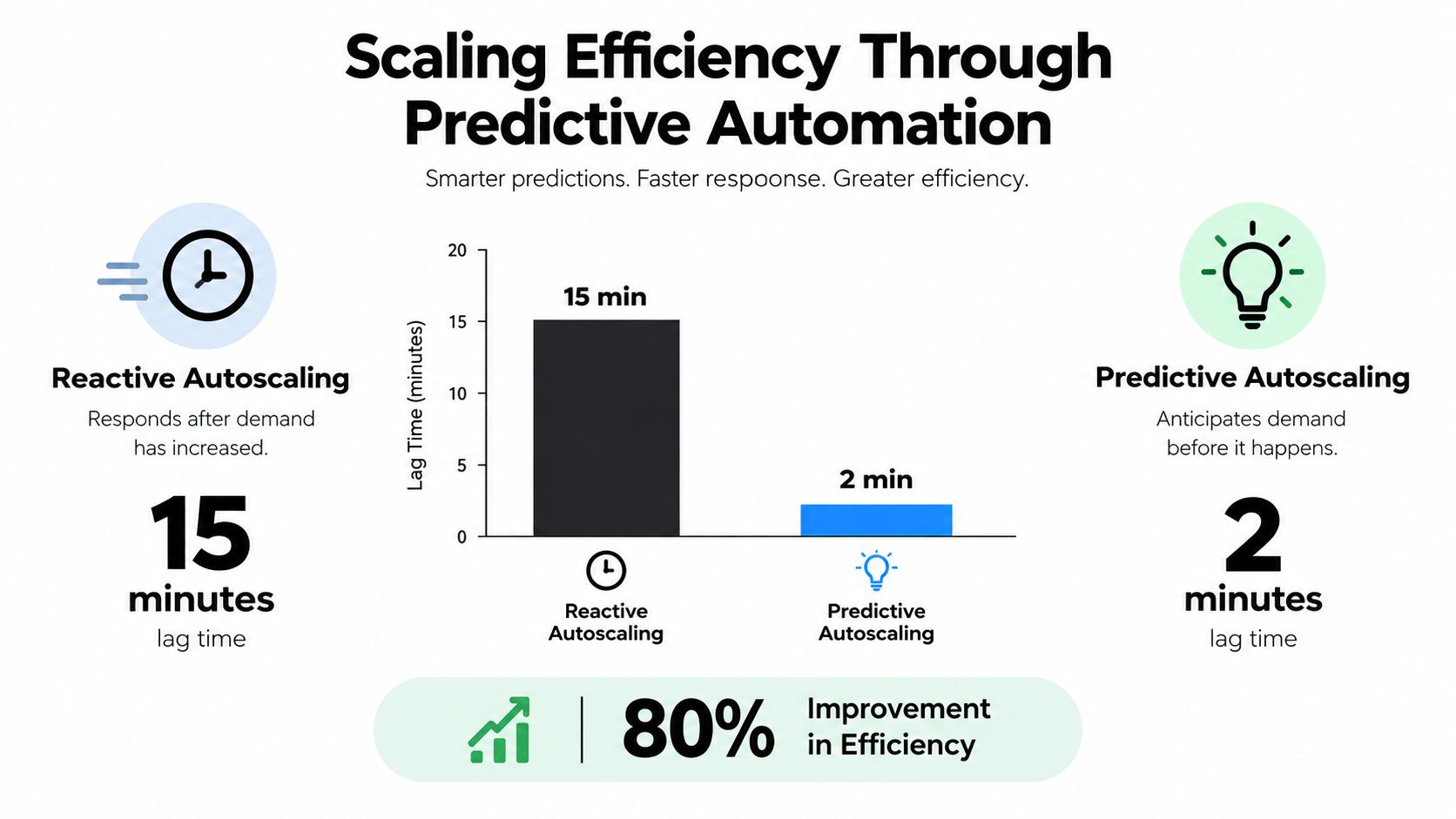
Capacity planning as a control loop
Predictive autoscaling adds a feed-forward signal. Instead of waiting for CPU, queue depth, or request rate to cross a threshold, the system uses observed patterns and forecasts to place capacity ahead of expected demand. That forecast still needs guardrails because predictions can be wrong. A solid design combines forecasts with reactive protection, bounded provisioning, admission control, and explicit rollback behavior.
One experimental study reported compute-hours dropping from 1,260 to 980, P95 latency falling from 141 ms to 118 ms, SLA compliance rising from 97.4% to 99.1%, and average utilization increasing from 58% to 76%, according to the predictive autoscaling experiment. Those results illustrate the value of combining capacity planning with observability-driven control loops, while still requiring careful validation because experimental behavior doesn't automatically transfer to every workload.
What to measure before automating
Start with the signals that explain user impact:
Demand shape: Record request volume, queue depth, concurrency, and workload mix rather than relying on one infrastructure metric.
Provisioning delay: Measure how long capacity takes to become useful, including startup, cache warming, readiness checks, and traffic registration.
Tail behavior: Track P95 latency and error behavior so average latency doesn't conceal overloaded users.
Economic control: Compare capacity decisions with compute consumption and utilization, then add limits that prevent a forecast from creating uncontrolled spend.
Predictive automation works when engineers treat it as a control system. It fails when teams deploy a forecast without validating its inputs, fallback path, or interaction with retries and downstream limits.
Hiring Strategy for Elite Cloud Talent
The hiring gap isn't usually a lack of cloud vocabulary. It is the difference between describing a service and reasoning about a production system under stress. Keyword screening can identify Terraform, Kubernetes, AWS, Azure, or GCP on a résumé, but it won't reliably reveal whether a candidate understands dependency failure, unsafe retries, identity boundaries, or recovery trade-offs.
Use an engineering-to-engineer process with progressively harder evidence:
Start with a system narrative. Ask the candidate to explain a distributed system they operated, including its dependencies and the failure that changed its design.
Probe trade-offs. Give them a scaling or deployment scenario and ask what they would protect first, what they would measure, and what they would deliberately leave out.
Test failure reasoning. Explore partial outages, stale data, regional disruption, credential errors, and rollback limits.
Verify implementation depth. Review infrastructure code, incident artifacts, runbooks, or a practical design exercise. Look for clarity and safe defaults, not tool-name density.
The strongest interviewers also improve the candidate experience. Clear role positioning, technical content, and focused communication support the broader recruitment marketing tips hiring teams use to attract serious specialists. Marketing can't compensate for a weak technical process, but a vague job description can hide a strong opportunity from the people most qualified to evaluate it.
Deploying Top-Tier Engineering Teams
Cloud systems engineering is difficult to staff because the role sits across architecture, operations, security, and software delivery. Leaders need people who can build an internal platform without turning it into a bottleneck, reduce blast radius without freezing releases, and use observability to make capacity and reliability decisions. Those capabilities rarely appear through résumé keywords alone.
TekRecruiter is one staffing and recruiting option for organizations hiring across cloud and systems engineering, DevOps, SRE, platform, AI, data, cybersecurity, product, and go-to-market functions. Its model uses engineer-to-engineer technical conversations rather than relying only on keyword matching. That approach is relevant when a hiring team needs to distinguish someone who has operated production systems from someone who has only completed cloud coursework or assembled a service demo.
The delivery model can fit different staffing conditions. Direct hire supports permanent team building, staff augmentation adds capacity for a defined initiative, on-demand access supports urgent needs, and nearshore recruiting can align English-speaking technical talent with a team's time zone. The right choice depends on whether the constraint is a missing long-term owner, a temporary modernization workload, or a need to accelerate delivery while the internal team remains accountable for architecture.
A practical hiring brief should name the system problem, failure boundaries, expected ownership, and evidence required in the interview. It should also state whether the engineer will design platform capabilities, operate reliability controls, or improve application delivery. Precision at the start reduces mismatched interviews and makes the eventual team structure easier to manage.
TekRecruiter helps innovative companies deploy the top 1% of engineers anywhere through technology staffing, recruiting, and AI Engineer services. Visit TekRecruiter to discuss cloud systems engineering hiring, direct placement, staff augmentation, nearshore support, or an engineering team built around your resilience goals.
Comments