_edited.png)
How to Hire Remote Developers and Find Top Talent
Hiring remote developers really boils down to a few key stages: getting crystal clear on the role you need to fill, knowing where to find top talent globally, running a tight and effective vetting process, and finally, setting up solid legal and onboarding frameworks. When you nail these steps, hiring stops being a headache and becomes a genuine strategic advantage. You're not just plugging a gap; you're finding a long-term contributor who can help push your business forward.
Why Hiring Remote Developers Is a Strategic Move
The conversation around hiring remote developers has changed. It’s no longer just a trend or a cost-cutting tactic—it’s now a core part of building a resilient, competitive business. For a long time, companies saw remote work as a nice-to-have, but now it's a fundamental piece of workforce planning for any forward-thinking organization.
This shift isn't just about opportunity; it’s driven by necessity. The local tech talent market is incredibly fierce. If you're looking for specialized skills in fields like AI, cybersecurity, or cloud engineering, you'll quickly find that the local pool just can't keep up with demand.
Expanding Your Access to Talent
Think about it: when you restrict your search to a 30-mile radius around your office, you're fighting for the same handful of experts as every other company in your city. It’s a zero-sum game.
By opening your search to the world, you suddenly have access to a massive, diverse pool of candidates. This isn't just about getting more applications—it's about finding that one perfect person with the precise niche skills your project demands, whether they live in another city or on another continent.
This global approach is a direct answer to the widening skills gap. Projections show that over 90% of organizations worldwide expect IT skill shortages by 2026. If companies stick to localized hiring, this could cost them a staggering $5.5 trillion. Going remote is one of the most effective ways to get ahead of this risk. You can find more data-backed insights on remote hiring trends to see how other companies are adapting.
By thinking globally, you transform a talent scarcity problem into a talent abundance opportunity. Your ideal candidate is out there—remote work just makes it possible to find them.
Gaining a Competitive Advantage
Beyond just filling roles, building a remote team delivers real, tangible benefits that fuel growth and innovation. The advantages go way beyond saving a bit on office rent or tapping into lower salary markets.
Let's look at the key advantages you unlock when you hire remote developers.
Key Advantages of Hiring Remote Developers
This table offers a quick look at the strategic drivers behind building a remote team and the direct benefits they bring to your business.
Strategic Driver | Key Benefit for Your Business |
|---|---|
Accelerated Timelines | With developers in different time zones, a "follow-the-sun" model keeps work moving 24/7, dramatically shortening development cycles. |
Increased Innovation | A global team brings diverse perspectives and problem-solving approaches, leading to more creative and resilient solutions. |
Improved Retention | Offering remote work flexibility is a massive perk that boosts autonomy and work-life balance, making your best people want to stay. |
A well-structured remote team allows you to:
Accelerate Product Development: With a "follow-the-sun" workflow, progress doesn't stop when your local team logs off. Hand-offs between time zones can keep projects moving around the clock.
Increase Team Diversity: Bringing together people from different backgrounds and cultures isn't just a social good; it leads to better products. Different viewpoints challenge assumptions and uncover blind spots.
Improve Employee Retention: The flexibility and autonomy of remote work are incredibly powerful retention tools. When developers have control over their environment, they're happier, more productive, and far more likely to stick around for the long haul.
Defining the Role and Crafting the Job Description
Before you even think about posting a job opening, the most critical work happens internally. I've seen too many teams jump the gun, and the result is always the same: a flood of unqualified applicants and a hiring process that drags on for months. Getting absolute clarity on what you actually need is your single greatest asset.
This first step is less about writing and more about a bit of honest introspection. You need to sit down with your engineering leads and do a frank skills-gap analysis. Where are projects stalling out? What are the real technical bottlenecks holding you back? The answers to those questions will point you directly to the tangible needs a new hire must fill.
This isn't about chasing some mythical "rockstar" developer. It's about finding the right piece for your specific engineering puzzle.
Distinguishing Must-Haves from Nice-to-Haves
Once you’ve nailed down the core problem, it’s time to separate the deal-breakers from the "would-be-great-ifs." This distinction is absolutely crucial for writing a job description that attracts the right people without scaring off perfectly capable candidates who might just be missing one peripheral skill.
Think of it like this: a "must-have" is a skill that, if the candidate doesn't have it, they simply cannot do the job. A "nice-to-have," on the other hand, is a bonus that might shorten their ramp-up time or bring some extra value down the line.
Must-Have: For a senior backend role, this is something like "5+ years of production experience with Python and Django." It's non-negotiable for the project at hand.
Nice-to-Have: "Experience with GraphQL or a frontend framework like React." This is valuable, for sure, but it’s something a smart engineer can learn on the job.
Being too rigid with your list of must-haves will shrink your talent pool for no good reason. An Upwork study found that 73% of all departments will have remote workers by 2028. The talent is out there, but you have to be realistic about your core needs to find them.
Defining Success in the First 90 Days
With remote roles, early momentum is everything. A new developer can't just absorb context by osmosis or by sitting next to a teammate at lunch. You have to spell out what success looks like in their first three months with concrete, measurable outcomes.
This simple framework gives both you and your new hire a clear path to follow. It turns the fuzzy goal of "getting up to speed" into a set of tangible milestones.
For instance, a solid 90-day plan could look like this:
First 30 Days: Get the local development environment fully configured, complete the onboarding module, and ship a small, supervised bug fix to production.
First 60 Days: Take full ownership of a small feature, actively contribute to code reviews, and show a solid grasp of the primary codebase.
First 90 Days: Independently drive the development of a minor project or epic, requiring minimal day-to-day supervision.
Setting these clear, early benchmarks is one of the most effective ways to ensure a remote developer integrates successfully. It cuts through the ambiguity and gives everyone a shared definition of what it means to be a productive member of the team.
Articulating Your Culture for a Remote World
Finally, your job description has to do more than just list tech skills. It needs to sell your company culture in a way that actually connects with the kind of autonomous, self-motivated people who thrive in remote settings. Vague platitudes like "fast-paced environment" are meaningless.
Get specific about how your team actually works when you're not in the same room.
Do you favor deep work and asynchronous communication over back-to-back Zoom calls? Say that.
Is your team documentation-first? Make that a selling point.
What does work-life balance really look like? Mention your stance on flexible hours or asynchronous stand-ups.
Top remote talent isn't just looking for another paycheck; they're looking for an environment where they can do their best work without the friction of a traditional office. Your job description is your first, and arguably best, chance to prove that your company is that place.
Sourcing and Engaging Top Remote Engineering Talent
Let's be honest: finding great remote developers isn’t about posting a job and hoping for the best. The real talent, the kind of engineers who can truly move the needle, are usually heads-down, deep in their work. They aren't scrolling through job boards. To hire the best, you have to meet them where they are.
That means shifting your focus from traditional job sites to the communities where engineers live and breathe code. General-purpose platforms cast too wide a net, pulling in a lot of noise. Niche communities, on the other hand, give you a direct line to specialized, high-caliber professionals who are genuinely passionate about their craft.
Before you even start reaching out, it pays to refine your approach. This quick flowchart lays out the groundwork.
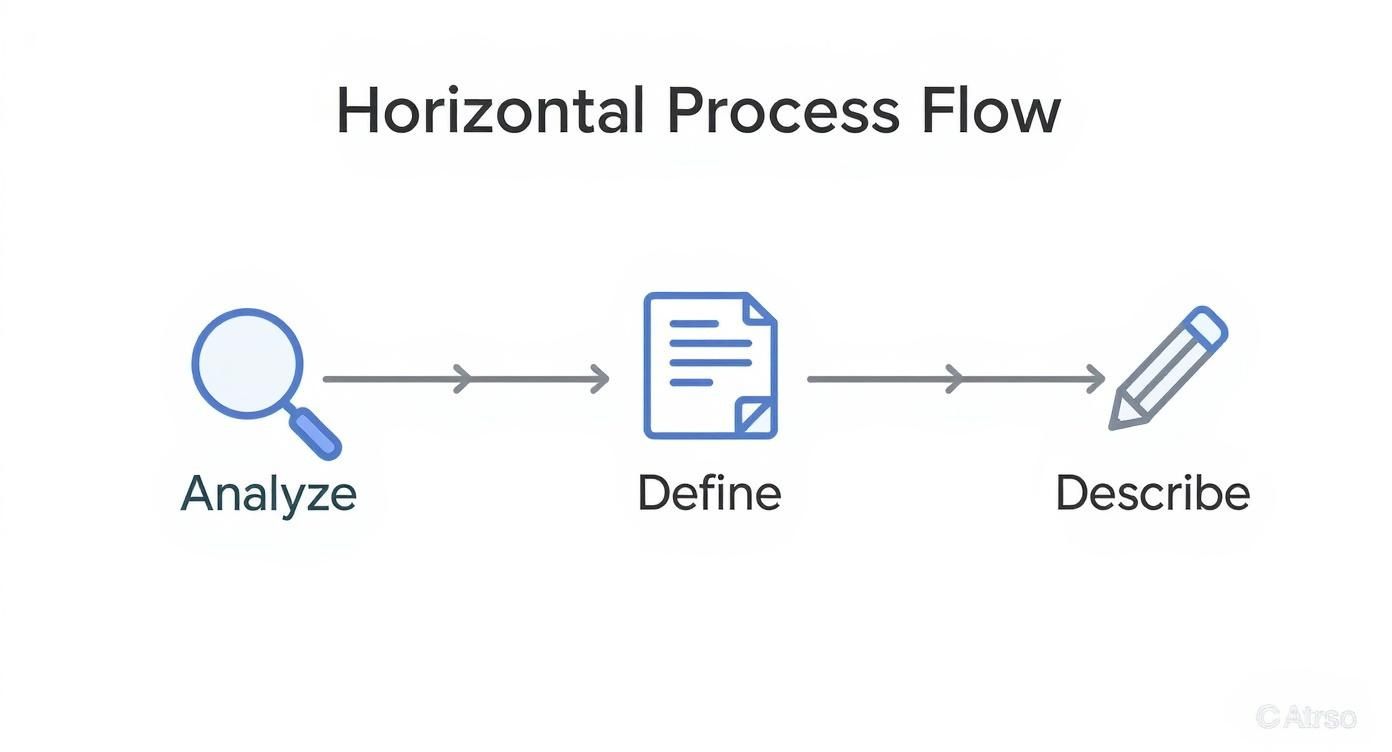
As you can see, the real work begins with analyzing your needs and defining the role—this foundation is what makes a successful search possible.
Uncovering Talent in Niche Developer Communities
The most skilled remote developers often put their work and expertise on public display. These platforms aren't just for Q&A; they're living, breathing portfolios for millions of engineers.
GitHub: Don't just look at repositories. Dig into the pull requests, issue discussions, and project contributions. An engineer who writes thoughtful code reviews or helps solve a tricky bug for a stranger is demonstrating the exact collaborative and problem-solving skills you need for remote work.
Stack Overflow: Users with high reputation scores who consistently provide clear, well-reasoned answers are often true subject matter experts. Their activity is proof of deep technical knowledge and an ability to communicate complex ideas well—a priceless remote skill.
Specialized Platforms: Don’t sleep on the smaller, highly-focused communities. A Discord server for a popular JavaScript framework or a Slack community for DevOps engineers can be an absolute goldmine for finding exactly the right person.
When you do reach out, your message has to be personal. Reference a specific open-source contribution or a particularly sharp answer they gave. Trust me, generic, templated messages go straight to the trash.
The goal isn't just to fill a role; it's to start a relationship. Your initial outreach should show you've done your homework and genuinely value their expertise, making them far more likely to engage.
This proactive approach is how smart companies are finding better talent all over the world. In fact, research shows that 68% of companies find superior talent by hiring remotely, with access to specialized skills being the biggest driver. And these hires often stick around longer. You can dig into more data about the benefits of hiring remote employees on SecondTalent.
Choosing the Right Engagement Model
Once you've found the right person, you need a plan for bringing them on board. The way you engage a remote developer will hinge on your project's scope, your budget, and how integrated you need them to be. The three main models each serve a different strategic purpose.
Comparing Remote Hiring Models
Choosing an engagement model can feel overwhelming, but it really comes down to your specific needs. This table breaks down the most common options to help you decide which is the right fit for your business, budget, and long-term goals.
Model | Best For | Control Level | Cost Structure | Time to Hire |
|---|---|---|---|---|
Direct Hire | Long-term core team members, roles requiring deep institutional knowledge, and building company culture. | High | Full-time salary, benefits, and overhead. | High (4-8 weeks+) |
Staff Augmentation | Filling specific skill gaps for a project, scaling a team quickly without long-term commitment. | Medium | Hourly or monthly rate; no benefits overhead. | Low (1-3 weeks) |
Agency Partnership | Outsourcing an entire project or function when you lack in-house expertise or management bandwidth. | Low | Project-based fee or retainer. | Very Low (days) |
Each model has its place. The key is aligning the model with your immediate and future plans for the role and the project.
Direct Hire: The Traditional Path
Direct hiring is what most people think of: bringing someone on as a full-time, permanent employee. This model is perfect for core roles where you need deep institutional knowledge, long-term commitment, and a strong cultural fit. Think senior leaders, key architects, or anyone who will fundamentally shape your product's future.
Of course, this is also the most time-consuming route. It carries the highest overhead due to salary, benefits, and the legal complexities of compliance, especially when hiring across borders.
Staff Augmentation for Flexibility
Staff augmentation is about bringing in a developer on a contract basis to work alongside your existing team. It's a fantastic solution when you have a specific, time-bound project or need a niche skill set that your current team is missing.
It’s fast, flexible, and lets you avoid the long-term financial commitment of a direct hire. The developer integrates directly into your team and works under your management, giving you full control without the HR burden.
Agency Partnerships for Managed Outcomes
Partnering with a development agency means outsourcing an entire project or function. This approach is best when you don't have the internal expertise to manage a technical project or you need a complete, ready-made team to deliver a product from start to finish.
You provide the high-level requirements, and the agency handles everything else—project management, execution, and final delivery. While this model offers the least hands-on control, it can be the absolute fastest way to get a project across the finish line if you're comfortable entrusting the outcome to a third-party expert.
Mastering the Remote Interview and Vetting Process
When you’re hiring remote developers, the interview process is a whole different ballgame. You can’t just walk by someone's desk to see how they're doing or gauge their vibe in a conference room. Your vetting process has to be deliberately built to find the traits that truly matter for remote success: autonomy, crystal-clear communication, and a proactive mindset.
Simply throwing your old interview questions onto a Zoom call won’t cut it. You need a multi-stage process that systematically tests for technical chops, collaborative spirit, and whether they'll actually fit in with your team, all from a distance.
The Multi-Stage Remote Interview Framework
A solid, structured process is your best defense against hiring mistakes. It creates a level playing field and gives you a complete picture of each candidate. Instead of one marathon interview, break it down into focused stages, each with a specific goal. This not only respects the candidate’s time but also gives your team much richer data to make a decision.
Here’s a flow that works really well in practice:
The Initial Screen (30 minutes): This is a quick chat, usually with a recruiter or the hiring manager. The main goal here is to check the basics—do they have the core qualifications? Are their salary expectations in the right ballpark? You're also getting a first impression of their communication style and how genuinely interested they are.
Technical Deep Dive (60-90 minutes): Time for one of your senior engineers to take the lead. This isn't a quiz; it's a conversation. They'll dig into the candidate's past projects, the reasoning behind their architectural choices, and how they approach solving tricky technical problems.
The Take-Home Challenge (Asynchronous): This is where the rubber meets the road. You get to see their actual coding skills in an environment that mimics real work. More on this in a second.
Live Coding or System Design (60 minutes): This session is all about watching them think. It’s less about getting to the perfect answer and more about seeing how they collaborate and break down a complex problem under a bit of pressure.
Cultural Alignment Call (45-60 minutes): The final piece of the puzzle. Have them meet with a few folks outside the engineering team. This is crucial for seeing how they’ll mesh with the wider company culture and values.
Following a consistent structure like this helps strip out unconscious bias and ensures you’re measuring every single candidate against the same yardstick. It's an absolute must when you hire remote developers.
Designing an Effective Take-Home Challenge
A well-designed take-home challenge is probably the most powerful tool you have for remote hiring. It puts developers in their natural element, letting them use their own tools and workflow to solve a realistic problem on their own schedule.
But be careful—a bad test can be worse than no test at all. Get it wrong, and you’ll just frustrate great candidates and learn nothing useful.
Here’s how to get it right:
Keep it relevant. The task should feel like something your team would actually work on. A great approach is to have them build a small, self-contained feature for a simplified version of your product.
Respect their time. Be upfront about how long it should take—ideally no more than 3-4 hours. Anything more starts to feel like free labor, and the best engineers will simply walk away.
Write a crystal-clear brief. Don't make them guess. Give them a clear problem statement, define what success looks like, and provide any starter code or API docs they'll need.
Look beyond the code. The code itself is only part of the evaluation. Pay close attention to their documentation, the clarity of their commit messages, and whether they wrote tests. These are the hallmarks of a true professional.
The best take-home challenges don't just test coding ability; they test craftsmanship. How a candidate documents their work and explains their decisions often reveals more than the code itself.
Uncovering Remote-Ready Traits with Behavioral Questions
Technical skill gets a candidate in the door, but soft skills determine if they'll thrive. Things like self-discipline and asynchronous communication skills are what separate a good remote developer from a great one, and you can’t see them on a resume. You have to actively dig for them.
So, move beyond tired old questions like, "Tell me about a time you faced a challenge." You need to get specific.
Questions That Reveal Remote Readiness:
Trait to Assess | Sample Behavioral Question | What You're Listening For |
|---|---|---|
Autonomy | "Describe a project where you had minimal supervision. How did you structure your work and keep stakeholders informed without being asked?" | You want to hear about self-management, proactive updates, and a sense of ownership that doesn't require constant hand-holding. |
Asynchronous Communication | "Tell me about a complex technical issue you had to explain to a non-technical person entirely through written communication (e.g., Slack, email, documentation)." | Are they able to write clearly and concisely? Do they anticipate questions? This shows they can convey complex ideas without needing a live conversation. |
Problem-Solving | "Walk me through a time you were completely stuck on a bug. What steps did you take to unblock yourself before asking for help?" | Look for a systematic debugging process. Do they check logs and documentation first? You want someone resourceful who knows when it's the right time to escalate. |
These kinds of questions force candidates to pull from actual experience, giving you real evidence of how they operate. A developer who can clearly articulate these stories is far more likely to succeed in a distributed team where self-direction isn't just a bonus—it's a requirement. Here at TekRecruiter, we find these discussions are absolutely pivotal in identifying that top 1% of engineers who are built for remote work.
Navigating Global Compensation and Legal Compliance
So, you’ve found a fantastic developer. They nailed the technical interviews, their past work is solid, and they seem like a great fit for the team. Now comes the tricky part: figuring out the compensation and legal side of hiring someone in another country. It can feel like wading into a swamp of regulations, but getting this right from the start is crucial for building a lasting, stable relationship with your new hire.
The first big question you need to tackle is how you'll structure their pay. There’s no one-size-fits-all answer here. The best path forward really depends on your company's philosophy on fairness, your budget, and how committed you are to global pay equity.
Local Market Rates Versus a Global Standard
One of the most heated debates in remote work is whether to base pay on someone’s location or to set a single salary band for each role, no matter where they live.
Paying Local Market Rates: This is the most common approach. You adjust salaries based on the developer’s local cost of living and market data. A senior engineer in San Francisco is going to have a very different salary expectation than an equally talented one in Lisbon or Buenos Aires. The main upside here is cost savings, letting you tap into incredible talent pools without blowing up your payroll.
A Single Global Standard: Some companies, like GitLab, have pioneered this model. They offer the same pay for the same role, period. It’s a powerful way to foster a sense of fairness and equity, tying compensation directly to skill and impact, not geography. The obvious downside is that it can get expensive fast if you hire a lot of people in high-cost-of-living areas.
A lot of companies land somewhere in the middle. They create regional salary bands that group together countries with similar economies, striking a balance between managing costs and paying people equitably.
Your compensation strategy says a lot about your company culture. Whether you lean toward market-based efficiency or global pay equity, the most important thing is to be transparent about your approach right from the first conversation with a candidate.
Understanding International Labor Laws and Contracts
Once you’ve got a compensation plan, you have to sort out the legal framework. Hiring someone abroad isn't as simple as sending over your standard US employment contract. Every country has its own unique labor laws, tax rules, and mandatory benefits you have to follow.
Cutting corners here can lead to some serious headaches, including big fines and legal battles over misclassifying an employee as a contractor. For example, things we might consider perks in the U.S., like guaranteed paid time off or a 13th-month bonus, are legally required in many countries across Europe and Latin America.
You need to make sure your employment contracts are fully compliant with local laws, covering essentials like:
Probationary periods
Termination clauses and required notice
Intellectual property (IP) ownership
Confidentiality and data protection rules
It's also worth noting how much salary benchmarks can differ. In the U.S., you might see developer rates from $45 to $150+ per hour. In contrast, you can often find developers of the same caliber in Latin America for 60–70% less. I saw this firsthand with a U.S. fintech startup that brought on a few key developers from India; they slashed their development costs by 55% and shipped new features 25% faster in just one quarter. For more raw data, you can see a breakdown of global developer hiring rates on Inexture.com.
Simplifying Compliance with an Employer of Record
For most companies, especially smaller ones, trying to become an expert in the labor laws of every country where you hire is just not realistic. That’s where an Employer of Record (EOR) comes in. Think of an EOR as a partner that acts as the legal employer for your team members in their home country.
An EOR takes all the administrative and legal chaos off your plate. They handle:
Compliant Payroll: Making sure taxes and social security are withheld and paid correctly.
Statutory Benefits: Managing all the mandatory benefits, like health insurance, pensions, and paid leave.
Local Contracts: Drafting employment agreements that are 100% compliant with local regulations.
Risk Mitigation: They take on the legal liability of employment, so your company is protected.
Working with an EOR like Deel, Remote, or Papaya Global means you can hire talent almost anywhere, quickly and legally, without the massive headache of setting up a local entity. It turns a huge legal hurdle into a straightforward process. Here at TekRecruiter, we walk our clients through these options all the time to make sure their global hiring strategy is both effective and buttoned-up.
Onboarding and Retaining Your Remote Development Team

Getting a signed contract isn't the finish line when you hire a remote developer—it's the starting gun for the next, equally critical race. I've seen it time and again: a thoughtful, structured onboarding process is the single biggest factor that turns a promising hire into a high-impact, long-term team member. If you get this part wrong, you're setting yourself up for that dreaded quick turnover.
This is even more vital for remote engineers. They can't just absorb your company's culture through osmosis or lean over a cubicle to ask a quick question. You have to be intentional about everything, from the moment they get their welcome email to their first major code commit. The whole point is to stamp out ambiguity and build a real connection from day one.
The Remote Engineer's 30-60-90 Day Plan
The best tool I've found for this is a solid 30-60-90 day plan. It’s a roadmap that transforms the fuzzy goal of "getting up to speed" into concrete, achievable milestones. This framework helps your new developer feel productive and supported right out of the gate, instead of lost and overwhelmed.
First 30 Days: Integration and Learning
The first month is all about getting them plugged in. The goal isn't massive feature delivery; it's about making them feel comfortable, connected, and equipped to do their job.
Week 1: This week should be 100% focused on setup and human connection. Get all their hardware and software access sorted out. Schedule one-on-ones with every single person on the team. And absolutely assign them an onboarding buddy—a go-to person for all the "silly" questions they might be hesitant to ask in a public channel.
Weeks 2-4: Time for their first "win." Give them a small, low-risk bug to fix or a minor enhancement to build. The idea is to let them touch the entire development lifecycle, from pulling down the repo to seeing their change go live. It builds confidence like nothing else.
An effective remote onboarding process makes a new hire feel like part of the team before they've even written a line of code. The initial focus should always be on people and process, not just output.
First 60 Days: Contribution and Collaboration
By month two, the training wheels start to come off. Your developer should be shifting from learning mode into contributing mode, taking on more complex tasks and becoming a more active voice on the team.
Take Ownership: Hand them their first real feature or a small project to own from start to finish. Make sure a senior developer is available for guidance, but let the new hire drive.
Join the Rituals: Push them to actively participate in code reviews (both giving and receiving), jump into technical discussions, and contribute their thoughts during sprint planning. Their perspective needs to become part of the team's regular rhythm.
First 90 Days: Autonomy and Impact
At the three-month mark, you should see a high degree of autonomy. A successfully onboarded developer now understands the "why" behind their work and can push tasks forward with minimal hand-holding. If they're a fully integrated, productive member of the team by now, you've nailed it.
Strategies for Long-Term Retention
Onboarding is just the beginning; retention is the long game. In a market this competitive, you can't afford to get complacent. Keeping your best remote talent engaged requires a deliberate strategy built on growth, trust, and clear communication.
The secret is creating an environment where developers feel they are building a career, not just closing tickets. It's about investing in their professional development and showing them a clear path forward. Here are a few battle-tested strategies we at TekRecruiter always recommend to our partners:
Map Out Career Paths: Don't make it a mystery. Document what it takes to get from a junior to a senior role, and what comes after. Regular, transparent talks about their career goals show you're actually invested in them.
Build a Documentation-First Culture: For a remote team, great documentation is everything. It's the silent mentor that empowers developers to solve problems on their own and cuts down on needless meetings.
Provide Real Mentorship: Pair your junior or mid-level developers with senior engineers. This does more than just speed up skill development—it builds the strong personal bonds that are the glue of a cohesive remote culture.
Recognize and Reward Impact: Make a habit of celebrating wins, and do it publicly. Whether it’s a successful launch or just a really clever fix for a nasty bug, feeling valued is one of the most powerful motivators there is.
Your Questions About Hiring Remote Developers, Answered
When you start building a global team, you're bound to run into some common questions. Every founder and hiring manager I talk to seems to hit the same handful of concerns when they first start hiring remote developers. Let's clear those up so you can move forward confidently.
It might feel like a whole new world, but the fundamentals of great hiring haven't changed. You still need clarity, good communication, and a strong culture—you just have to build them in a different way.
What Are the Biggest Mistakes People Make?
I see the same missteps time and time again. The first, and maybe the most damaging, is writing a vague job description. If you don't know exactly who you need, you'll attract a lot of people you don't. Another huge one is failing to specifically test for asynchronous communication skills. If a developer can't explain a complex problem clearly in writing, they're going to be a bottleneck for your whole team.
Other common mistakes include trying to shoehorn an in-office interview process into a remote setting—it just doesn't work. But the biggest oversight? Skipping a structured remote onboarding. You can’t just ship a laptop and expect a new hire to thrive. They end up feeling isolated and useless, and it's a completely avoidable problem.
How Do You Actually Build a Team Culture When No One's in the Same Room?
Building a great remote culture is all about being deliberate. It won't happen on its own. It all starts with strong documentation and transparent communication, which for most teams lives in tools like Slack and your project management boards.
Intentionality is the bedrock of a thriving remote culture. You must actively create the connection points that happen organically in an office.
To make that connection happen, you need to put in the work. Here’s what’s effective:
Schedule casual video calls with no agenda. Just a virtual coffee or water cooler chat.
Pair new hires with a "buddy" so they have a dedicated person for all the "stupid" questions.
Shout out wins in a public channel. Make sure everyone's hard work gets seen and celebrated.
Fly everyone in for an in-person meetup once or twice a year if you can swing it. The bonding from a few days together pays dividends for months.
What Are the Absolute Must-Have Tools for a Remote Team?
You don't need a hundred different apps, but you do need a solid, reliable tech stack. A well-run remote team's toolkit usually boils down to three essential categories that form the backbone of their daily operations.
Communication: You need a place for real-time chat, and that's usually Slack or Microsoft Teams. For face-to-face meetings, you'll want something solid like Zoom or Google Meet.
Project Management: Work has to be visible to everyone. Tools like Jira, Asana, or Trello are perfect for tracking tickets, running sprints, and just generally seeing who's doing what.
Code Collaboration: This one is non-negotiable. Your single source of truth for code will be a version control system like GitHub or GitLab. It’s where all the magic of code reviews, collaboration, and deployment pipelines happens.
At TekRecruiter, we live and breathe this stuff. We specialize in helping companies sidestep the pitfalls and build truly elite remote engineering teams. Whether you need top-tier staff augmentation or a full-service AI engineering solution, we connect you with the top 1% of global talent to get your projects across the finish line. Learn more about how we can build your ideal team.
Comments