_edited.png)
Managed Services Platform Guide for Engineering Leaders
When does a managed services platform remove operational complexity, and when does it put another vendor between your engineers and the systems they need to control?
That question matters more than market size, feature count, or a polished dashboard. A platform can centralize monitoring, patching, security, backups, automation, and reporting, yet still create lock-in, unclear ownership, and expensive switching costs. The right choice depends on your workload complexity, security maturity, automation readiness, and the operating model you want to build.
Table of Contents
What Is a Managed Services Platform - From reactive support to operational ownership
Common Use Cases and Applications - Match the platform to the pain
Selection Criteria for Engineering Leaders - Evaluate the operating model - Put the contract under engineering review
Implementation Challenges and Mitigation - Where deployments become difficult
What Is a Managed Services Platform
A managed services platform combines technology, processes, and specialist expertise to operate part of an organization's IT environment on an ongoing basis. The provider may manage cloud infrastructure, servers, networks, endpoint systems, security controls, backups, incident response, and operational reporting. The platform is the coordination layer. It connects telemetry, workflows, automation, people, and service commitments.
That's different from buying a monitoring tool or hiring a contractor for a defined project. A tool produces data, while a managed service provider takes responsibility for acting on that data. A contractor adds capacity for a period, while a managed services arrangement establishes continuing operational ownership, usually governed by defined service levels and escalation paths.
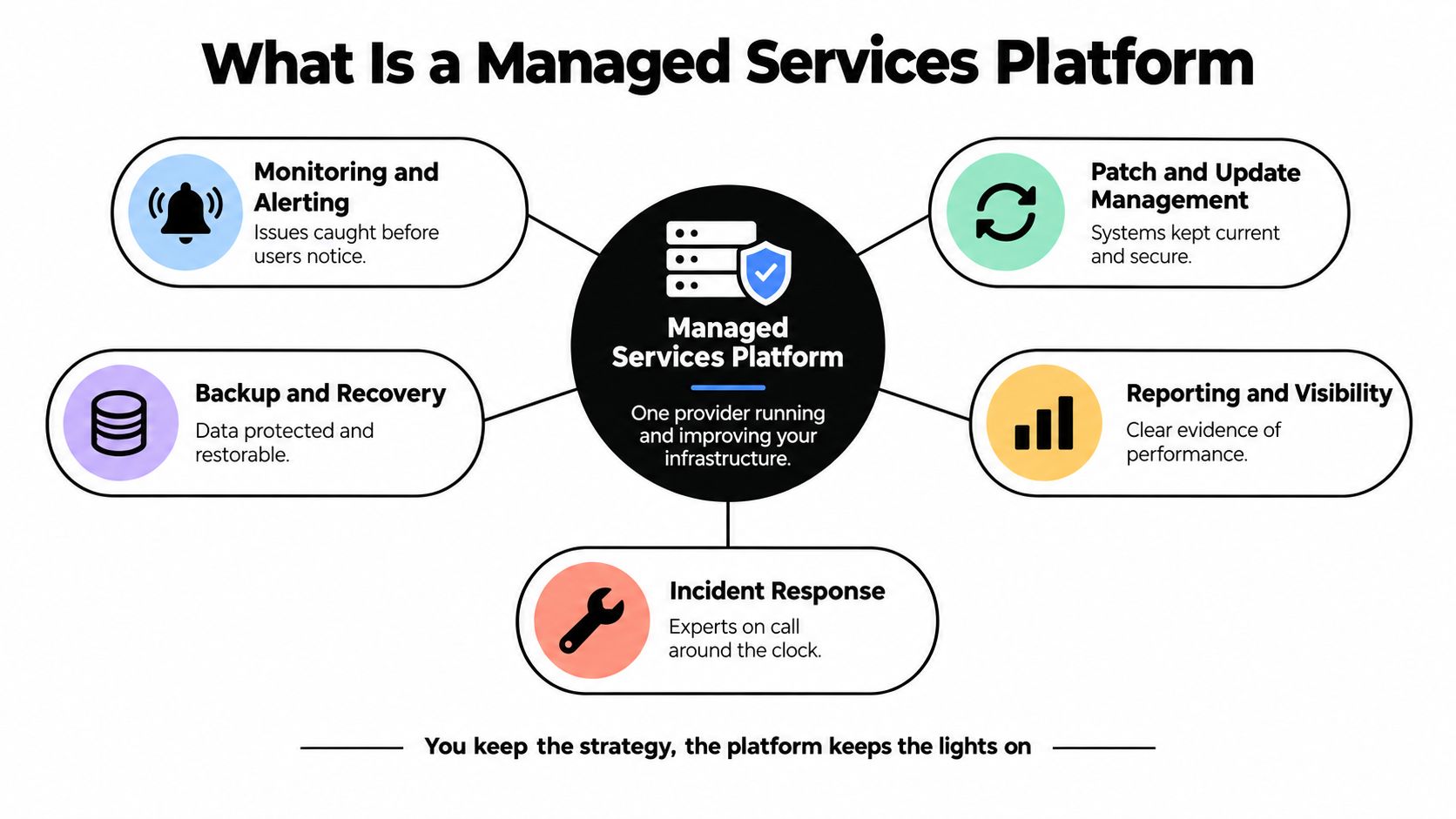
From reactive support to operational ownership
Traditional IT support often begins with a ticket. Someone reports an outage, a failed backup, or a slow application, and a technician investigates. Modern managed services aim to detect conditions earlier, apply standard remediation, and improve the environment continuously rather than waiting for users to notice a problem. This shift is why proactive IT management is central to the model, and proactive IT management from CloudOrbis offers useful context on how providers structure that work.
The commercial category has expanded well beyond niche support. One 2026 industry estimate valued the global managed services market at USD 430.56 billion and projected USD 704.20 billion by 2031, implying a 10.34% CAGR from 2026 to 2031. Another forecast placed the market at USD 460.59 billion in 2026 and USD 705.22 billion by 2031, with an 8.9% CAGR. The variation between estimates is a reminder to compare definitions, but both point to a globally scaled operating layer, as documented by Mordor Intelligence's managed services market analysis.
Cloud operations illustrate the transition particularly well. A 2026 study valued the global cloud managed services market at USD 134.44 billion in 2024 and projected it to reach USD 305.16 billion by 2030, a 14.7% CAGR from 2025 to 2030, according to Grand View Research's cloud managed services analysis. The platform model works when it turns fragmented operational activity into a repeatable service, without taking strategic decisions away from the engineering organization.
Core Features and Architecture
A useful managed services platform has four connected layers. Telemetry collects metrics, logs, traces, configuration data, and security signals. Decisioning correlates events, identifies priority, and routes incidents. Automation executes approved actions such as restarting a service, applying a patch, opening a change record, or triggering a rollback. Human operations handle exceptions, risk decisions, architecture changes, and communication.
The architecture should resemble a control loop, not a collection of dashboards. A signal enters the system, the platform determines whether it represents a real service condition, an automated playbook handles known cases, and an engineer takes over when the situation falls outside defined boundaries.

The components that matter
Monitoring alone doesn't reduce operational burden. The provider needs actionable thresholds, service maps, ownership metadata, and a disciplined incident workflow. If every alert creates a ticket, your platform will amplify noise. If alerts lack runbooks, the provider will still depend on manual diagnosis.
Look for these capabilities:
Unified observability: Metrics, logs, traces, infrastructure events, and application health should be connected to the services your business operates.
Incident orchestration: The system should group related alerts, assign ownership, record decisions, and support escalation without forcing engineers to copy information between tools.
Automation with controls: Playbooks need approvals, audit trails, rollback paths, and clear limits. “Fully automated” isn't a quality standard by itself.
Configuration and asset intelligence: The provider must know which systems exist, how they depend on each other, and which changes could create risk.
Reporting that supports decisions: Reports should show recurring failure modes, capacity pressure, security exposure, SLA performance, and unresolved ownership gaps.
Cloud-managed architectures can use software-defined networking, network functions virtualization, open APIs, and multivendor orchestration to centralize delivery. In a five-year analysis, one such architecture showed roughly 78% lower operating expense, 70% lower capital expenditure, and 76% lower total cost of ownership versus the existing operating model. The analysis attributed savings mainly to eliminating truck rolls, reducing onsite maintenance and installation, and minimizing onsite software support, as described in Cisco's managed architecture business case.
Your platform engineering model still matters. Teams comparing ownership boundaries should distinguish platform engineering vs DevOps, particularly where internal developers need self-service while an external provider manages the underlying operating layer.
Managed Services vs Staff Augmentation vs MSPs
These models solve different problems, even though vendors often use the terms loosely. Staff augmentation supplies people. A traditional MSP commonly manages recurring maintenance or infrastructure services. A managed services platform combines operational technology, processes, and provider accountability around defined outcomes.
Factor | Managed Services Platform | Staff Augmentation | Traditional MSP |
|---|---|---|---|
Control | Shared control based on agreed service boundaries | Customer retains direct day-to-day control | Provider controls assigned maintenance functions |
Cost structure | Recurring service cost tied to scope, capability, and service levels | Labor cost tied to assigned personnel and duration | Recurring fee for defined support or infrastructure services |
Deployment speed | Requires discovery, integration, runbooks, and governance | Often fast if suitable talent is available | Fast for standardized services, slower for unusual environments |
Quality assurance | Platform telemetry, workflows, automation, and SLA reporting | Depends on individual skills and internal management | Depends on provider processes and technician coverage |
Strategic alignment | Strong when outcomes and architecture boundaries are explicit | Strong for projects requiring internal direction | Strong for stable, repeatable operational needs |
Best fit | Ongoing operational ownership across complex environments | Short-term capacity, specialist gaps, or project surges | Routine maintenance, support, and infrastructure administration |
The main mistake is choosing based on speed alone. A staff augmentation engagement can start quickly, but your managers still own prioritization, quality, documentation, and delivery risk. A traditional MSP can absorb routine work, but may struggle with a fast-changing platform architecture. A managed services platform can provide broader operational coverage, but it needs better integration and governance at the beginning.
For a more detailed comparison of workforce models, staff augmentation vs other models from nexus IT group is a useful reference. The decision should begin with the responsibility you want to transfer, not the product category a salesperson presents.
Choose staff augmentation when your team knows what to build and needs more hands. Choose a traditional MSP when the environment is stable and the service boundary is easy to document. Choose a managed services platform when you need continuous operation, cross-tool coordination, standardized response, and measurable ownership.
Common Use Cases and Applications
The strongest use cases start with a repeated operational problem. If engineers spend their time sorting alerts, applying routine patches, checking backups, or producing compliance evidence, a platform can turn those tasks into managed workflows. It won't fix unclear architecture or weak ownership, but it can make disciplined operations repeatable.

Match the platform to the pain
Cloud infrastructure: The provider manages provisioning standards, operating-system updates, network controls, backup policies, and capacity review while your engineers retain application ownership.
DevOps and release operations: The platform can connect deployment events to observability, enforce change workflows, and provide rollback support when a release affects service health.
Monitoring and incident response: Correlation, routing, runbooks, and escalation reduce the time engineers spend interpreting disconnected signals.
Security operations: Vulnerability remediation, identity monitoring, endpoint controls, and security event triage can be managed through one operating process.
Compliance reporting: Evidence collection becomes a recurring workflow instead of a last-minute document exercise, provided the platform records actions and approvals reliably.
Start with one service boundary. Define the systems included, the signals that matter, the actions the provider may automate, and the conditions that require your team's approval. Then measure whether the arrangement reduces interruptions without hiding important operational information. Guidance on the business case is available in managed services advantages, but the practical test is always the same: does the platform improve the work your engineers perform?
A managed services platform also fits cloud migration programs when the organization needs operational continuity during change. The provider can standardize monitoring and recovery across legacy systems and cloud workloads, but migration decisions, data classification, and application modernization still require internal technical leadership.
Operational automation needs a human fallback. Before enabling automatic remediation, document the trigger, expected state, permitted action, rollback method, and owner who reviews the result.
The platform delivers value when it removes repetitive coordination, not when it merely relocates it. If your engineers still reconcile tickets, dashboards, alerts, and provider updates manually, you've purchased an integration project rather than an operating model.
Selection Criteria for Engineering Leaders
Selection should begin with a workload inventory, not a vendor demo. List the environments, critical services, compliance obligations, current tools, recurring incidents, and decisions your internal engineers must retain. Then score each provider against those realities rather than accepting a generic maturity label.
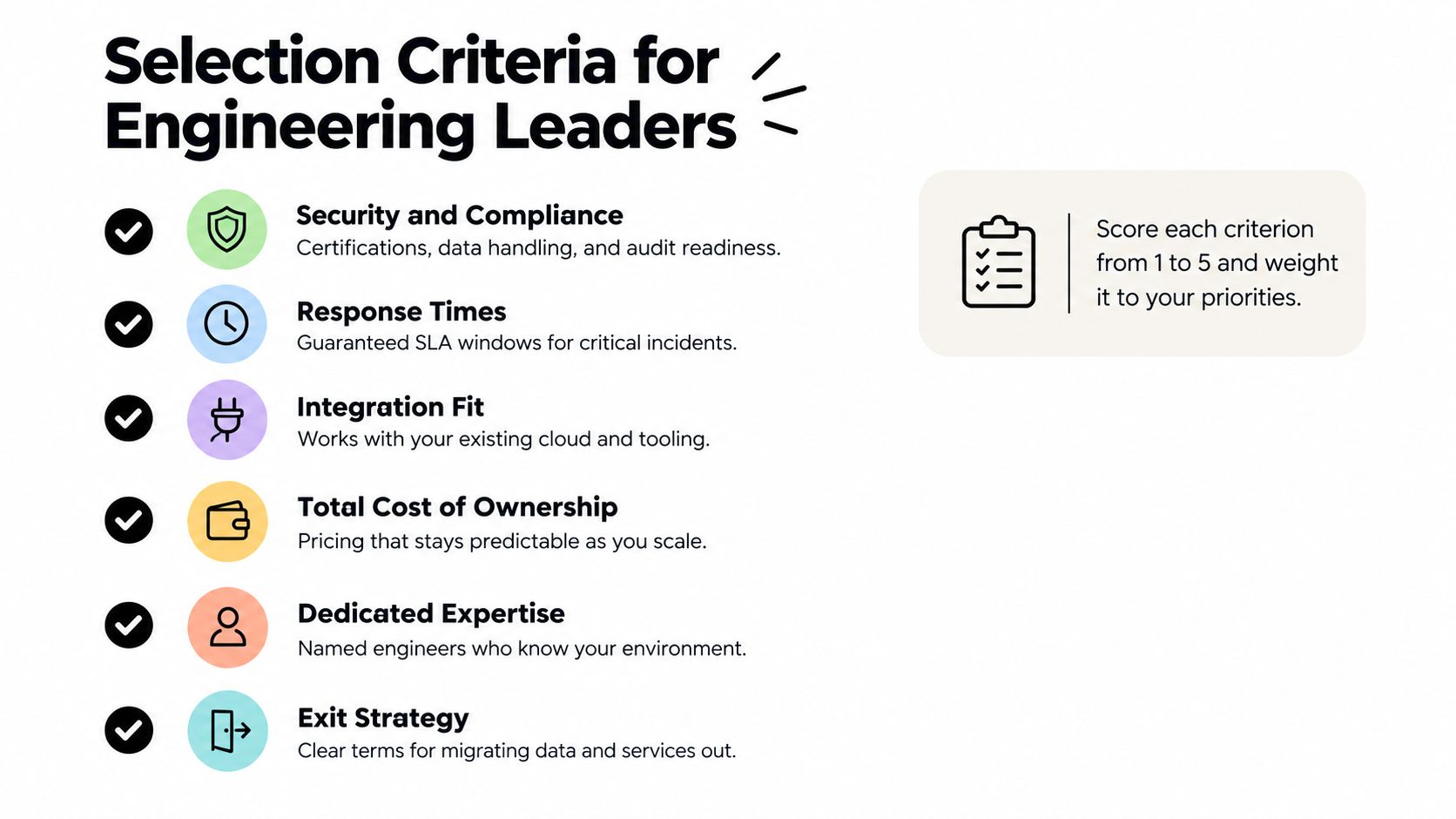
Evaluate the operating model
Technical depth comes first. Ask the provider to explain how it handles your actual stack, including identity, networking, data services, Kubernetes, CI/CD, legacy systems, and security tooling. A broad integration catalog doesn't prove operational competence.
Integration fit determines whether the platform consolidates work or adds another console. Require a walkthrough using your ticketing, cloud, observability, identity, and change-management systems. Confirm that data can move through documented APIs and that your team can export configurations, incidents, reports, and runbooks.
Security and compliance must cover access controls, data handling, audit evidence, privileged operations, subcontractors, and incident notification. Do not accept certifications as a substitute for understanding who can change production and how those changes are recorded.
Commercial clarity matters because platform costs often extend beyond the headline subscription. Review implementation, integrations, onboarding, data retention, support tiers, professional services, usage-based charges, and exit assistance. A practical external perspective is available in this We Fix PC Laptop IT guide.
Score each provider against technical fit, security, integration, operating discipline, economics, and reversibility. The vendor selection criteria framework can support that process, but your weighting should reflect business risk. A platform that scores well on automation but poorly on exit terms may be the wrong choice for a core production environment.
Put the contract under engineering review
A managed IT services SLA should identify covered systems, delivered services, response expectations, liability protection, payment structure, and performance standards, as explained in ConnectWise's SLA guidance. Broader SLA guidance also recommends documenting measurement methods, responsibilities, reporting, escalation, and remedies when targets are missed, according to CIO's outsourcing SLA overview.
Your agreement should also define change approval, data ownership, access termination, documentation standards, transition support, and the evidence used to verify performance. If those clauses aren't clear, the dashboard won't protect you.
Implementation Challenges and Mitigation
More automation doesn't automatically produce simpler operations. A poorly configured platform can create duplicate alerts, conflicting ownership, brittle playbooks, and a new queue that engineers must monitor. The first implementation question should be which work will disappear, not how many features the provider can activate.
Where deployments become difficult
Tool integration is a common failure point. Every connector introduces data mapping, permissions, failure modes, and maintenance responsibility. Start with the systems that influence incident decisions, then add integrations only when they remove a real handoff.
Knowledge transfer also receives too little attention. Providers need architecture diagrams, dependency maps, runbooks, maintenance windows, known failure patterns, and access procedures. Your team needs a clear record of what the provider changed and why.
Internal resistance is rational when engineers fear loss of control or blame. Define retained responsibilities, invite senior engineers into runbook design, and make escalation a shared process. The provider should take repetitive operational work, not become an opaque authority over production.
Vendor dependency requires its own controls:
Require portability: Keep data export, API access, configuration ownership, and runbook rights in the contract.
Separate standards from implementation: Store service definitions, policies, and recovery procedures in formats your team can maintain outside the vendor platform.
Test the exit path: A theoretical transition plan isn't enough. Validate how you would recover records, credentials, configurations, and operational knowledge.
Review concentration risk: Identify which people, tools, integrations, and decisions would stop working if the provider disappeared.
Disaster recovery exposes weak boundaries quickly. Your disaster recovery planning guidance should align with the managed services contract, including recovery ownership, testing, evidence, and communication.
A platform is adding complexity when nobody can explain its escalation path, automation permissions, data model, or replacement plan. Pause expansion until those basics are visible.
Next Steps for Your Organization
A managed services platform is a fit when your organization has recurring operational work, a clear service boundary, and enough process maturity to measure outcomes. It's a poor fit when the environment is changing so quickly that nobody can define ownership, or when your internal team needs granular control over every infrastructure decision.
Run a short assessment before speaking with providers:
Map the workload: Identify the services, environments, dependencies, and recurring operational tasks that consume engineering time.
Classify the work: Separate strategic architecture, product delivery, routine maintenance, incident response, security operations, and compliance evidence.
Set ownership boundaries: Write down what the provider may observe, change, automate, approve, and escalate.
Define success qualitatively: Look for fewer repetitive interruptions, clearer accountability, faster diagnosis, stronger recovery discipline, and better evidence of service health.
Score reversibility: Confirm that your organization can retrieve its data, documentation, configurations, and operational knowledge.
Pilot narrowly: Select a service with meaningful operational friction but manageable risk. Expand only after reviewing the quality of alerts, escalations, documentation, and reporting.
Cost deserves disciplined analysis. Modern managed services can reduce total operating cost by 15% to 45%, and more than 90% of surveyed organizations said the model met or exceeded expectations for cost savings and efficiency, according to KPMG's Global Managed Services Outlook 2026. Those findings support investigation, not a guaranteed business case. Your model should include internal oversight, transition effort, integration work, retained expertise, contract risk, and the cost of changing providers.
The labor model deserves equal attention. Automation can reduce manual monitoring and ticket triage while increasing the need for platform engineers, security specialists, reliability expertise, service owners, and people who can govern automated decisions. Don't remove internal capability before you understand which knowledge must remain inside the organization.
For some companies, the right answer is a managed provider. For others, it's an internal platform team supported by targeted staff augmentation. A third group needs a hybrid model, with external operational coverage around stable services and internal ownership of architecture, product-facing reliability, security decisions, and engineering standards.
TekRecruiter fits the talent side of that decision. It provides technology staffing and recruiting, including AI engineering, DevOps, SRE, cloud, systems, platform, data, and cybersecurity talent, along with staff augmentation and other delivery options. Its engineers-recruiting-engineers model is designed to help forward-thinking companies deploy highly capable engineers where managed services still require internal technical ownership.
TekRecruiter helps forward-thinking companies deploy the top 1% of engineers anywhere through technology staffing, recruiting, and AI Engineer services. If your managed services strategy needs platform, DevOps, cloud, cybersecurity, or AI talent, visit TekRecruiter to discuss the operating model and engineering capability your organization needs.
Comments