_edited.png)
Build Winning Nearshore Software Development Teams
Feeling the squeeze of the tech talent gap? Nearshore software development teams are more than just a buzzword—they're a powerful way to extend your organization with elite engineers from countries right next door. Think of it as your strategic edge: access to world-class talent in your time zone, which keeps agile collaboration seamless and project timelines tight.
So, What Exactly Is A Nearshore Software Development Team?
Imagine you're building a championship sports team. You wouldn't just scout players in your hometown, right? You'd look for top athletes in neighboring regions. These players get your competitive mindset, can train with the core team in real-time, and bring diverse skills that fill critical gaps on your roster.
That’s the core idea behind building a nearshore software development team.
It’s about partnering with tech professionals in countries that are geographically close and share similar time zones—usually within a one to three-hour difference. For a U.S.-based company, that almost always means tapping into the incredible talent hubs in Latin American countries like Mexico, Colombia, or Costa Rica.
The Core Components of Nearshoring
The real goal here is to augment your in-house team without the frustrating communication delays or cultural friction that can come with traditional outsourcing. Nearshoring blends the best of both worlds: you get the cost-effectiveness of a global talent pool combined with the collaborative firepower of a local team.
Here's what makes it work:
Time Zone Alignment: Overlapping work hours mean real-time communication is actually real-time. Daily stand-ups, quick problem-solving sessions, and impromptu pair programming are all on the table, which is an absolute game-changer for any agile workflow.
Cultural Affinity: When you share cultural norms and business practices, you spend less time navigating misunderstandings and more time building a genuinely cohesive, unified team.
Geographic Proximity: Being closer means occasional in-person meetings for a big strategy session or team-building event are actually feasible and affordable. A quick flight is a lot easier to manage than a multi-day international trek.
This infographic breaks down the key differences between the main software development models at a glance.
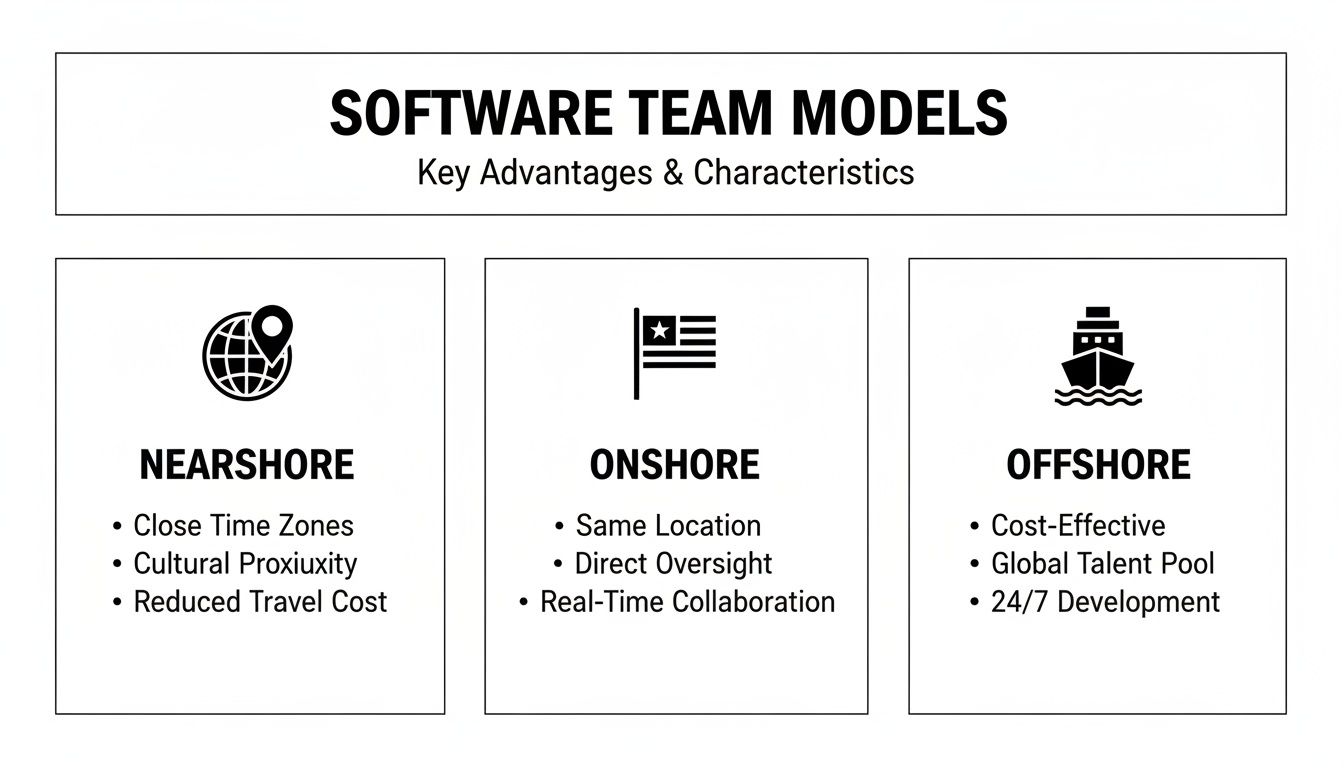
As you can see, nearshoring hits that sweet spot, balancing the proximity of onshore teams with the global talent access of offshore models. If you want to go a bit deeper, you can learn more about how nearshore outsourcing works and its practical applications. It's this strategic balance that’s making it such a go-to choice for tech leaders focused on both performance and efficiency.
Ready to build your championship engineering team without being held back by geography? TekRecruiter connects innovative companies with the top 1% of nearshore software development and AI engineering talent, all managed under a proven, U.S.-based delivery model to guarantee seamless integration and exceptional results.
The Real Payoff: Why Tech Leaders Choose Nearshore Teams
Let's move past the dictionary definition. The real power of a nearshore software development team shows up in the tangible business outcomes it delivers. For CTOs and VPs of Engineering, this isn't just about outsourcing tasks; it's a strategic play to lock in cost savings, tap into world-class talent, and gain serious operational agility.
These aren't just separate benefits—they work together to build a powerful competitive edge.

So, how does this translate into real-world wins for leaders trying to innovate faster and smarter? Let's break it down.
Slash Costs Without Sacrificing Quality
The most immediate win from nearshoring is a sharp drop in operational costs, but without the quality trade-offs you might fear. We're not just talking about lower salaries here. We're talking about optimizing the total cost of hiring.
When you factor in recruitment overhead, pricey benefits packages, and office space for domestic engineers, the savings become impossible to ignore. A nearshore model can deliver 20-40% cost savings over a comparable domestic team. That’s real budget you can plow back into product development, marketing, or other growth drivers.
Think about it: that kind of financial flexibility lets you scale your team and crush your roadmap goals without seeing your burn rate explode.
The numbers don't lie. Nearshore teams in Latin America and Eastern Europe are completely changing the cost equation for U.S. and European companies. Monthly developer rates often fall between $4,000–$7,000. Compare that to onshore costs that can easily top $180,000 annually for a single developer. For a more detailed look, this 2026 software development rates report from CloudEmployee.io is worth a read.
Access Elite Talent You Can't Find at Home
Let's be honest—the domestic tech talent market is a battlefield. Finding senior engineers with in-demand skills is slow, difficult, and brutally expensive. Nearshoring smashes those geographical walls, giving you direct access to deep, specialized talent pools across Latin America and Eastern Europe.
Nearshoring has evolved from a cost-saving tactic into a core talent acquisition strategy. It’s a direct pipeline to senior engineers with the critical, niche expertise that’s either unavailable or unaffordable in your local market.
These regions are not backwaters; they're buzzing tech hubs with world-class universities and a heavy focus on STEM education. This means you can find seasoned professionals ready to tackle your biggest challenges:
Artificial Intelligence and Machine Learning: Find experts who live and breathe sophisticated AI models.
Cloud Architecture: Bring in certified AWS, Azure, and GCP pros to build resilient, scalable infrastructure.
DevOps and CI/CD: Hire specialists to build and fine-tune the automated pipelines that accelerate delivery.
This direct line to specialized skills lets you build a more capable team, faster than you ever could by sticking to local hiring. For a deeper dive, check out our guide on the top 10 nearshore outsourcing benefits for tech leaders.
Get Agile with Real-Time Collaboration
This might be the most underrated advantage of all: the immense power of real-time collaboration. Unlike offshore models that are constantly fighting massive time zone gaps, nearshore teams operate on a very similar workday. For agile development, that’s a complete game-changer.
When your entire team is in sync, communication just flows. Problems get solved in hours, not days. You eliminate the painful delays, crossed wires, and endless rework that kill momentum in so many offshore projects. The impact on your KPIs is direct and measurable.
Faster Sprint Velocity: Daily stand-ups are seamless. Feedback loops are instant. Your team actually hits its sprint goals, consistently.
Higher-Quality Code: Real-time pair programming and code reviews mean bugs get squashed early, not after they've caused chaos.
A Stronger, Cohesive Team: Overlapping hours build a genuine "one team" culture, boosting morale and slashing attrition.
This operational sync allows nearshore software development teams to operate as a true extension of your in-house crew, driving projects forward with the speed and precision your business demands.
Ready to build an elite engineering team that delivers these strategic advantages? TekRecruiter is your partner in deploying the top 1% of nearshore software and AI engineers. We bridge the gap, allowing you to scale with world-class talent, managed under a proven U.S.-based delivery model that guarantees success.
How to Select the Right Nearshore Development Partner
Picking a partner is the most important decision you'll make when you decide to go nearshore. Get it right, and the firm becomes a genuine extension of your team, pushing your roadmap forward and sparking innovation. Get it wrong, and you’re looking at friction, delays, and risk that completely undermine why you went this route in the first place.
This isn't just about finding the lowest bidder. It’s about finding a strategic ally who gets your technical standards, your culture, and your business goals. You have to look past the slick sales decks and dig into their actual capabilities. A solid vetting process is the only way to make a confident decision that sets you up for success.
Vetting Technical Excellence and Security Posture
First thing's first: you need to validate their technical chops and how seriously they take security. Vague claims about "expertise" won't cut it. You need to see the receipts—verified credentials and a security-first mindset that’s baked into everything they do.
Demand proof that they know your tech stack inside and out. Look for engineers with current, verifiable certifications from the platforms that matter.
Cloud Platforms: Do they have certified pros in AWS, Azure, or GCP? This is table stakes for understanding modern, scalable infrastructure.
Enterprise Systems: If your business runs on something like Salesforce, they better have certified developers and architects on their team.
Specialized Skills: Ask them about their hands-on experience with AI, data engineering, or any other niche skills your projects depend on.
Just as critical is their security framework. This partner will have access to your IP and sensitive data, so their security protocols are non-negotiable.
A partner’s approach to security is a direct reflection of their professionalism and respect for your business. Look for firms that don't just talk about security but can prove their compliance with recognized industry standards.
A few key things to check for are SOC 2 compliance, which proves they have serious controls for managing customer data. Also, ask how they’ve implemented a zero-trust architecture. It's a modern security model that assumes no user or device can be trusted by default, and that proactive stance is exactly what you need to protect your assets.
Assessing Talent Acquisition and Project Management
At the end of the day, a nearshore partner is a talent provider. That means you need to get under the hood of their recruitment process to see if they can consistently find and keep the kind of top-tier engineers you need. How do they find, vet, and develop the top 1% of talent?
Building an effective nearshore team starts with having the right strategies for finding and onboarding the best people. For a deeper dive into talent acquisition, you can find some great expert tips for hiring remote software developers. A mature partner will have a multi-stage screening process that goes beyond just technical skills to evaluate communication, problem-solving, and cultural alignment.
But talent is only half the battle. Their project management methodology is what turns that expertise into actual results. Dig into their approach to agile development, their communication protocols, and their governance models. Do they have a clear track record of delivering projects at a similar scale and complexity to yours?
Choosing the Right Engagement Model
Finally, you have to pick an engagement model that works for your team and your project goals. This decision determines the level of control, responsibility, and integration you'll have. The two most common models are staff augmentation and fully managed teams.
This table breaks down the main differences to help you decide which path is right for you.
Factor | Staff Augmentation | Fully Managed Teams |
|---|---|---|
Control | You manage the team and project direction directly. | The partner manages the team and project deliverables. |
Responsibility | Your internal leaders are responsible for outcomes. | The partner is accountable for meeting project goals. |
Best For | Filling specific skill gaps on an existing team. | Outsourcing an entire project or product from start to finish. |
Integration | Engineers integrate directly into your existing squads. | The team operates as a self-contained unit. |
For a more in-depth look at these options, check out our comprehensive guide to nearshore software development services. Making the right choice here is key to making sure the partnership is set up to support your operational style from day one.
Ready to find a partner who meets these exacting standards? TekRecruiter specializes in deploying the top 1% of certified engineers from premier nearshore locations. We provide the technical expertise, rigorous security, and flexible engagement models to build the elite team your vision demands.
Integrating Your Nearshore Team for Peak Performance
Picking the right nearshore partner is a huge first step. But the real make-or-break moment? Integration. You’re not just hiring developers; you’re building an extension of your engineering department. Getting that “one team” culture right from day one is the only way to make it work.
This is more than just adding names to a Slack channel. It's about deliberately tearing down the invisible "us vs. them" wall that can poison distributed teams. The goal is a single, cohesive unit where every single person—no matter their zip code—is completely invested in the mission.

Building Robust Communication Channels
Solid communication is the lifeblood of any nearshore team. Without it, you’ll burn time and money on misaligned priorities and duplicated work, no matter how talented your engineers are. The trick is to build a communication framework that feels immediate, clear, and constant.
Start by mirroring the communication hubs you use in-house. This is non-negotiable for making information flow freely.
Dedicated Slack Channels: Create channels for every project, team, or critical topic. It keeps conversations organized and ensures everyone sees the same information in real-time. No more private DMs or email chains.
Mandatory Daily Video Stand-ups: Seeing faces builds connection and helps you read the room. These daily check-ins are essential for keeping an agile rhythm and building real camaraderie.
Shared Documentation Hub: Use a tool like Confluence or Notion as the single source of truth. All project specs, tech docs, and process guides live here.
A structured approach like this kills information silos before they start. It makes every engineer feel like a first-class citizen, not a satellite.
Establishing Technical and Governance Alignment
Great communication is one thing, but peak performance demands total alignment on your tech stack and how you govern projects. Your nearshore team needs the right keys to the kingdom and a clear rulebook to contribute effectively from sprint one.
Set up a shared development environment with a solid CI/CD pipeline. This is your quality control engine, automating builds and tests to ensure all code—whether written in your HQ or by a nearshore partner—meets the exact same standard. Getting this right is absolutely critical for successfully managing remote teams.
The most successful integrations treat nearshore engineers as true colleagues, not just contractors. This means giving them the same access to tools, the same context on business goals, and the same opportunities to contribute to technical decisions.
This technical harmony has to be backed by a clear governance model. Define roles and responsibilities with precision so there's zero ambiguity about who owns what. This is where dedicated, US-based project management acts as the critical bridge, smoothing out cultural nuances and driving delivery against business goals. To see this in action, check out our practical guide to nearshore agile software development.
The market is already voting with its feet. Nearshore software development is the go-to strategy for 49% of U.S. companies outsourcing to Mexico and Canada. Why? Because the talent shortage in specialized fields like cloud-native development and AI is real.
Ultimately, integrating a nearshore team comes down to building a foundation of trust and shared purpose. When you create a truly unified environment, you unlock what you were after in the first place: the full power of global talent.
This is what TekRecruiter does. We don’t just find engineers; we build integrated, high-performance teams. Our U.S.-based project management and proven onboarding process ensure your nearshore talent operates as a seamless extension of your organization, helping you deploy the top 1% of global engineers to crush your roadmap.
Measuring the Success and ROI of Your Nearshore Team
So, how do you actually prove your nearshore team is worth the investment? The initial cost savings are easy to point to, but the real value runs much deeper. To make a rock-solid case to your CFO and other stakeholders, you need more than just expense reports. You need hard data that shows improvements in productivity, quality, and speed.
This means shifting the conversation from "How much are we saving?" to "How much more value are we creating?" It's about tracking the right key performance indicators (KPIs) that prove your nearshore partners are helping you crush your technology roadmap.

Key Metrics Beyond Cost Savings
To get the full picture, you need to track metrics that show real engineering efficiency and product quality. These are the KPIs that resonate with both the finance department and your fellow tech leaders because they tie directly back to business goals.
Here’s where to start:
Agile Velocity and Cycle Time: Are you getting more done each sprint? That’s velocity. How long does it take an idea to go from a ticket to production? That’s cycle time. When these numbers start improving, you have clear proof that your development process is getting leaner and more productive.
Bug Density and Rework: Keep an eye on the number of bugs per feature or even per line of code. A downward trend here is a huge win. It means higher-quality code is being shipped the first time, and your team is spending less time fixing mistakes and more time building what’s next.
Time-to-Market: This is a big one. How fast can you deliver new features to your customers? Shrinking this timeline is a massive competitive advantage, proving your team can react quickly to what the market wants.
The Financial Impact of Stability
One of the most overlooked financial wins of a great nearshore team is a lower attrition rate. We all know how expensive it is to lose a good engineer on our domestic teams. It’s not just the recruiter fees; it’s the lost productivity, the institutional knowledge that walks out the door, and the time it takes to get someone new up to speed.
Retaining experienced engineers is a critical component of long-term ROI. A stable nearshore team preserves invaluable institutional knowledge, reduces onboarding overhead, and ensures project momentum isn't constantly disrupted by departures.
Do the math on what it costs to replace a single senior engineer—recruitment, training, ramp-up time—and you’ll quickly see how much you save. A stable, long-term nearshore partnership directly strengthens your bottom line by cutting down these disruptive, recurring costs.
Building Your Business Case with Data
The move to nearshoring isn't just a trend; it's a massive market shift. The global outsourcing market is valued at $618.38 billion, and the nearshore piece is growing at an impressive 13.95% CAGR. For tech leaders like us, that translates to 20–40% cost efficiency over onshore teams. But the real story is in the collaboration that minimal time zone differences unlock. You can dig deeper into these numbers in this comprehensive software outsourcing report.
When you combine those hard financial savings with clear, data-backed improvements in your productivity and quality metrics, you have an undeniable business case. A simple dashboard visualizing these KPIs will show everyone the strategic value and positive ROI your nearshore software development teams are delivering.
Ready to build an elite nearshore team that delivers measurable ROI? TekRecruiter connects innovative companies with the top 1% of global engineers. Our U.S.-based project management ensures seamless integration and a clear focus on hitting the KPIs that matter to your business.
Time to Build Your Elite Engineering Team with TekRecruiter
You've got the roadmap. You see how nearshore software development isn't just a trend—it's a strategic weapon. We're talking serious cost savings, access to world-class engineers, and collaboration that actually feels collaborative.
The only thing left is to act. While you’re reading this, your competitors are already using this model to scale faster and more efficiently. Waiting isn't an option anymore.
At TekRecruiter, we're not just another vendor on a long list. We're the strategic partner that helps you execute. We connect the most ambitious companies with the absolute top 1% of engineering talent, eliminating the friction and risk that holds most businesses back.
A Direct Pipeline to World-Class Talent
We build elite AI and software development teams by going straight to the source: the premier talent hubs in Latin America and Europe. This isn't about finding any developer. It’s about finding the right one—someone with deep technical skill who fits your culture and is ready to make an impact from day one.
Our talent pool is stacked with certified experts in the technologies that actually drive a business forward:
Cloud Platforms: AWS, Azure, and GCP architects who know how to build infrastructure that scales without breaking the bank.
Enterprise Systems: Certified Salesforce developers who can bend the platform to your will, not the other way around.
AI and Machine Learning: Specialists who can design and deploy the complex models that turn raw data into a real competitive advantage.
Proven Delivery, Managed in the US
Finding great talent is only half the battle. Execution is everything.
That's why our entire delivery model is managed by a seasoned, US-based project management team. This isn't just a nice-to-have; it's the critical layer that ensures there are no communication breakdowns or misaligned expectations. It’s how we guarantee your onshore leaders and nearshore teams operate as a single, seamless unit.
TekRecruiter bridges the gap between your vision and its execution. We deliver the talent, the framework, and the US-based oversight you need to accelerate your roadmap with total confidence.
Our engineers are ready to jump in, integrate with your existing teams, adopt your agile processes, and start delivering value immediately. We handle the headaches of global sourcing, vetting, and compliance. You get to focus on what you do best: building the future.
Stop letting the local talent crunch dictate your pace of innovation. The world’s best engineers are ready to build with you.
It's time to stop searching and start building.
Connect with TekRecruiter today and let's deploy the elite engineering team that will bring your vision to life.
Common Questions, Answered
If you're considering a nearshore team, you've probably got questions. Good. Making a strategic move like this demands clarity. Here are the straight answers to the questions we hear most often from CTOs and engineering leaders.
"Isn't Nearshoring Just Cheaper Offshoring?"
Not even close. That’s probably the biggest myth out there.
Thinking of nearshoring as just a cost-cutting play misses the entire point. The real strategic win is real-time collaboration. Your nearshore team isn’t working while you sleep; they’re in your Slack channels, daily stand-ups, and code reviews right alongside your local engineers. This kills the communication lag that plagues offshore models and builds a genuine "one team" dynamic.
Then there's the talent argument. The idea that you're sacrificing quality for cost is outdated. Tech hubs across Latin America are turning out world-class engineers specializing in AI, cloud infrastructure, and data science. You're not just saving money; you're accessing an elite talent pool without the bidding wars of Silicon Valley.
"How Do I Protect My Code and Intellectual Property?"
This is non-negotiable, and any partner worth their salt will treat it that way. Don’t just take their word for it; demand to see their security framework.
A serious partner will be able to prove their security posture with things like:
SOC 2 Compliance: This isn't just a badge; it's proof they have audited, rigorous controls for handling client data.
A Zero-Trust Mindset: Their architecture should assume nothing is safe, verifying every single access request, every time.
Secure Dev Practices: Ask them about their CI/CD security, how they scan code, and how often they run security audits. It tells you if security is a checklist item or part of their DNA.
And, of course, the contract must be ironclad. It should state, without ambiguity, that every line of code and all intellectual property created by the team is 100% yours.
"How Fast Can We Actually Get a Team Up and Running?"
Much faster than you think. Onboarding a full nearshore software development team typically takes just two to four weeks.
A mature partner has this down to a science. They handle the sourcing, the vetting, the HR headaches, and the payroll complexities. Your job is to define the mission; their job is to deliver the talent ready to execute on it.
This isn't about just filling seats. It's about rapidly integrating skilled engineers so they're pushing code and contributing to your roadmap from day one. It lets you scale your capacity and hit deadlines without getting bogged down by the six-month recruiting cycles common in the US.
Ready to stop searching for talent and start building the future? TekRecruiter is a technology staffing and recruiting and AI Engineer firm that allows innovative companies to deploy the top 1% of engineers anywhere. We bridge the gap between your vision and its execution, providing elite nearshore teams managed under a proven US-based delivery model. Connect with us to build your elite engineering team today.
Comments