_edited.png)
Unlocking Growth with AI Development Services
When someone talks about AI development services, they’re not just talking about writing a few lines of code. Think of it as the complete, end-to-end process of building, deploying, and managing an AI system that actually works in the real world. It’s everything from the initial whiteboard sketch to the ongoing maintenance needed to keep the system sharp and effective.
What Are AI Development Services
Let's use an analogy. Imagine you decide you want to compete in a Formula 1 race. You wouldn't just buy a powerful engine and expect to end up on the podium. To win, you need a world-class team—specialists who design the chassis, obsess over aerodynamics, analyze terabytes of race data, and map out a brilliant track strategy.
AI development services are that entire 'race team' for your business.
This shifts the whole conversation from a simple coding project to a strategic partnership. For a CTO or VP of Engineering, this isn't about buying a piece of software; it's about building a custom solution that delivers measurable business results. It’s a structured journey from A to Z, ensuring the final product is powerful, reliable, and perfectly synced with your company’s goals. If you want to see how different firms position their offerings, you can check out a typical AI company's site, like Parakeet AI's homepage.
This whole process generally follows a five-step lifecycle, from initial idea to continuous improvement.
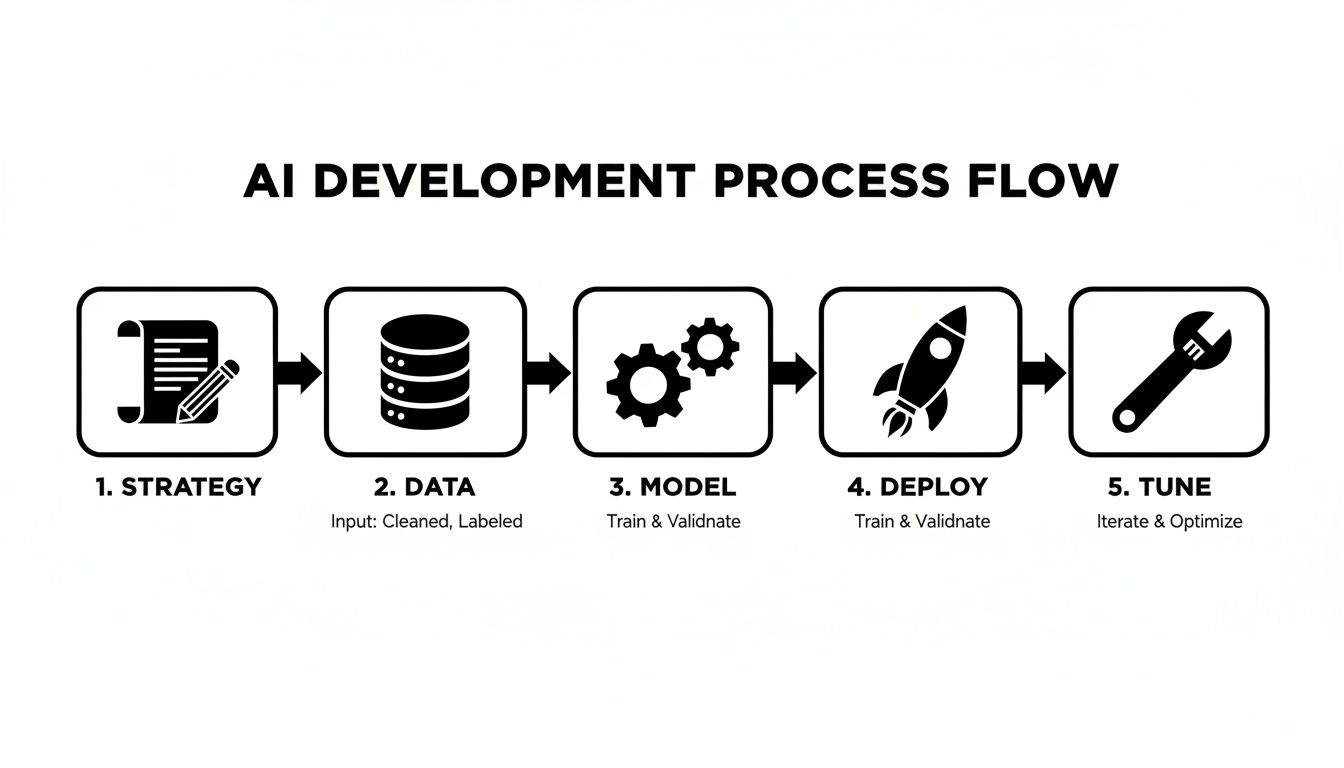
As you can see, it's not a one-and-done deal. Great AI is cyclical, with each stage feeding into the next to keep the system performing at its peak.
Core Components of the AI Lifecycle
The path from a business problem to a fully operational AI solution has several make-or-break phases. If you cut corners on any one of them, it’s like sending a race car out with a loose bolt—the entire thing can fall apart.
Strategic Planning: This is where it all begins. You're not just building AI for the sake of it. You're identifying a specific business problem, defining what success looks like in hard numbers, and making sure an AI solution is even the right tool for the job.
Data Readiness and Preparation: Data is the high-octane fuel for any AI model. This stage is all about gathering, cleaning, and structuring massive datasets. If you feed the model garbage, you'll get garbage out. Quality is non-negotiable.
Model Creation and Training: Now the fun begins. Data scientists and ML engineers get to work building and training the actual model. They select the right algorithms and frameworks to tackle the problem you defined back in the strategy phase. You can get a deeper look at how this fits into the big picture in our guide on what is AI automation and how does it work.
Deployment and Integration: A perfectly trained model sitting on a server is useless. This step is about getting it out into the wild and plugging it into your existing systems and workflows so it can start doing its job.
Continuous Performance Tuning: The work doesn’t stop at launch. The model's performance has to be constantly monitored. As new data comes in and business needs evolve, the model needs to be retuned and refined to stay effective.
Ultimately, these services provide a structured framework to transform raw, complex data into a real competitive advantage.
At TekRecruiter, we connect you with the elite engineering talent required for every single stage of this lifecycle. Whether you need to bring on a top-tier AI strategist to augment your team or deploy a fully managed crew for an end-to-end build, we find you the top 1% of engineers who can turn your vision into reality.
What Are AI Development Services, Really?
To get a handle on AI development services, you need to think beyond just writing code. A real AI partner brings a full suite of interconnected capabilities to the table. These aren't just items on a project plan; they're the essential gears that work together to turn a tough business challenge into a smart, automated solution.
Let’s break down the four foundational pillars that define a true AI development partnership.

Custom AI Engineering
This is the core of the operation. It's where experts build AI models from scratch, tailored specifically to your business. Off-the-shelf software will only get you so far before you hit a wall. Custom engineering means designing, building, and training models on your data to solve your problems, fitting perfectly into your workflows.
Think about a logistics company trying to predict shipping delays. They need a custom model that can analyze their own fleet data, unique weather patterns on their routes, and specific regional traffic. No generic tool can do that. This is how specialized engineering creates a real competitive edge.
AI Data Preparation and Enrichment
If AI is the engine, then data is the fuel. And just like an engine, it sputters and dies on bad fuel. Without clean, high-quality, structured data, even the most brilliant algorithm is useless. Data preparation is the painstaking work of cleaning, labeling, and transforming raw information into something a machine can actually learn from.
It's a well-known secret in the industry that data scientists can spend up to 80% of their time just getting the data ready. That number alone shows you how critical this step is for the success of any AI project.
Making sure your models are trained on the right stuff is non-negotiable. Using the best data enrichment tools and methods is a core part of the process, ensuring every insight is built on a rock-solid foundation. Frankly, this stage is often what separates a successful AI initiative from a failed one.
To help visualize how these services fit together, here’s a quick breakdown of what a top-tier partner offers and why it matters to your bottom line.
Key AI Development Service Offerings
Service Offering | Core Focus | Primary Business Impact |
|---|---|---|
Custom AI Engineering | Building bespoke AI/ML models from scratch for specific business problems. | Creates a unique competitive advantage that off-the-shelf solutions can't replicate. |
Data Preparation | Cleaning, labeling, and structuring raw data to make it usable for AI training. | Ensures model accuracy and reliability by providing high-quality "fuel" for algorithms. |
Managed Intelligence | Ongoing monitoring, maintenance, and retraining of deployed AI models. | Protects the initial investment by preventing performance decay and ensuring long-term value. |
Systems Integration | Embedding AI models into existing cloud infrastructure (AWS, Azure, GCP) and workflows. | Makes AI insights actionable by connecting them directly to business operations and applications. |
Each of these offerings represents a critical phase in the journey from an idea to a fully operational, value-driving AI system.
Managed Intelligence and Optimization
Getting an AI model live isn't the finish line—it's the starting pistol. Managed intelligence is all about the ongoing care and feeding required to keep your AI solutions running at their best. Models can "drift" over time as real-world data changes, causing their accuracy to plummet if left unchecked.
This service is all about staying proactive and includes:
Performance Monitoring: Keeping a close eye on model accuracy and other key metrics.
Model Retraining: Regularly updating the model with fresh data to keep it sharp and relevant.
System Maintenance: Making sure the underlying infrastructure is secure, stable, and running smoothly.
Without this, the money you invested in building the AI can evaporate quickly. You can get a better sense of this by checking out our guide on finding the right machine learning consulting firms.
AI Systems Integration
An AI model sitting on a server is worthless. It only provides value when it’s woven into the fabric of your business. AI systems integration is the technical work of embedding these new capabilities into your existing cloud setup—whether that’s AWS, Azure, or GCP—and hooking them into your DevOps pipelines and other enterprise software.
This is what makes the AI’s outputs actionable, getting the right information to the right system or person at precisely the right moment. The demand for this is exploding; the global AI software market hit US$122 billion in 2024 and is on track to reach a staggering US$467 billion by 2030. That growth isn’t just about building models; it’s about making them work inside real companies.
Delivering on these core services requires elite talent. At TekRecruiter, we connect you with the top 1% of engineers who live and breathe every aspect of AI development. Whether you need a team for a custom build or a specialist to integrate AI into your cloud environment, we provide the people who can actually get it done.
Assembling Your Elite AI Team
Behind every powerful AI solution isn't just a brilliant algorithm—it's a high-stakes assembly of human experts. Getting an AI initiative off the ground, let alone to the finish line, depends entirely on putting the right people with the right skills in the right seats. It’s not just about who you need, but how you bring them on board.
Think of it like putting together a special operations unit. Each member has a distinct, critical role, and the mission’s success hinges on their seamless collaboration. Choosing the wrong person or the wrong engagement strategy can jeopardize the entire operation before it even gets started.
For HR leaders and technical executives, this is a massive challenge. The talent pool for top-tier AI professionals is notoriously thin and fiercely competitive. Deciding whether to hire permanently, augment your existing team, or outsource the entire project is a major strategic call.
The Key Roles in Your AI Operations Unit
An effective AI team is never just a room full of coders. It's a multidisciplinary unit where strategy, data, and engineering collide. Let’s break down the three core roles you absolutely have to fill.
The Mission Commander (AI Strategist): This is your visionary. The AI Strategist lives and breathes the business landscape, identifying high-value opportunities where AI can make a real, measurable impact. They define the mission's objectives, chart the course, and ensure the final product actually solves the business problem it's supposed to.
The Intelligence Analyst (Data Scientist): Data is the fuel for any AI engine, and the Data Scientist is the one who refines it. They are masters of statistics, modeling, and analysis. Their job is to clean and prep massive datasets, hunt for hidden patterns, and build the first prototypes of the AI models.
The Field Operative (Machine Learning Engineer): This is your builder. The ML Engineer takes the models prototyped by data scientists and forges them into robust, production-ready software. They are the experts in coding, system architecture, and deployment, making sure the AI can operate reliably and at scale inside your existing tech stack.
These roles are distinct, but they’re also deeply interconnected. A brilliant strategy is useless without clean data, and a perfect model is worthless if you can’t get it out the door.
Three Proven Engagement Models for Sourcing Talent
Once you know the roles you need, the next question is how to get them. There are three primary models for building your team, each suited for different business needs, timelines, and levels of in-house expertise.
The right model isn't just about filling a seat; it's a strategic choice that impacts your project's speed, control, and long-term success. Your decision should be guided by your internal capabilities and project goals.
Here’s how they stack up:
1. Staff Augmentation This is your go-to when you have a solid in-house team but need to plug a specific skill gap or add firepower for a critical project. For instance, if your team is great at data engineering but lacks a specialist in natural language processing (NLP), staff augmentation lets you bring in that specific expertise on a flexible basis without a long-term commitment.
2. Direct Hire When AI is core to your long-term business strategy, you need to build a permanent, in-house capability. A direct hire is about finding a full-time employee who will grow with your company, build institutional knowledge, and drive your AI initiatives for years to come. This is the best choice for locking down core leadership roles like a Head of AI.
3. Managed AI Services If you lack the internal resources or expertise to run an AI project from start to finish, this model is your solution. You partner with a specialized firm that takes complete ownership of the project—from strategy and development to deployment and maintenance. It's an end-to-end solution for companies that want the results of a world-class AI team without building one from scratch.
Figuring out the best way to structure your team can be complex. For a deeper dive, check out our guide on how to hire remote developers and build your dream team.
Whether you need to augment your team with a world-class ML Engineer, secure a permanent AI Strategist, or deploy a fully managed nearshore team, TekRecruiter provides access to the top 1% of engineers anywhere. We connect you with the precise expertise you need to ensure your mission succeeds.
Choosing the Right AI Engagement Model
So, how do you actually bring top-tier AI talent into your company? This is a bigger decision than you might think. Do you cherry-pick a few specialists to plug gaps in your current team, or do you hand over the keys to an entire project to a dedicated partner?
There's no single right answer. It all comes down to your business goals, how fast you need to move, and the resources you already have in-house.

Getting this choice right can mean the difference between launching on time and blowing your budget. Get it wrong, and you're looking at delays, cost overruns, and a whole lot of frustration.
When to Augment Your Team
Staff augmentation is your best move when you've already got a solid team but need a specific, high-level skill to push a project over the finish line. Think of it like a film crew hiring a world-class stunt coordinator for a complex action sequence. The core team is already there; you're just bringing in a specialist for a critical part of the job.
This model is a perfect fit if you're facing scenarios like these:
You need to scale, fast. Your startup just landed a huge client and needs to double its engineering team yesterday. Augmentation gets you elite talent immediately, skipping the months-long traditional hiring cycle.
You have a specific skill gap. Your data engineers are brilliant, but none of them have touched computer vision. Bringing in a contract expert keeps your project moving without pulling your team off what they do best.
You must maintain control. The project's vision and day-to-day management need to stay firmly in your hands. Augmented staff slot directly into your existing workflows, reporting structure, and culture.
This approach gives you maximum control and flexibility, which is ideal for dynamic projects where the goalposts might shift.
When to Outsource the Entire Project
On the other hand, a fully managed or outsourced project makes sense when you need to build something new from the ground up without disrupting your daily operations. This is like hiring a general contractor to build your new office while your company keeps running business as usual.
Outsourcing is the clear winner when:
You have zero internal AI expertise. An established manufacturing company wants to build a predictive maintenance system but doesn't have a single data scientist on staff. Outsourcing the project to an AI development services provider gets the job done without the pain of building a new department from scratch.
Your scope, timeline, and budget are locked. The project has crystal-clear goals and a firm deadline. A managed services partner can take complete ownership and deliver the final product on time and on budget.
This "turnkey" approach lets your team stay focused on their core work while a dedicated partner handles the entire AI lifecycle.
Comparing AI Engagement Models: Staff Augmentation vs. Outsourcing
Not sure which path is right for you? This table breaks it down by what matters most: control, speed, scope, and cost. Use it to map your project needs to the right model.
Factor | Staff Augmentation | Fully Outsourced Project |
|---|---|---|
Project Control | High. You manage the talent directly. | Low. The partner manages the project. |
Integration | Deep. Integrates into your existing team. | Separate. Operates as an external unit. |
Speed to Start | Very Fast. Talent can be onboarded in days. | Slower. Requires detailed scoping and contracts. |
Cost Structure | Variable. Based on hourly or daily rates. | Fixed. Often based on project milestones. |
Management Overhead | High. Requires internal project management. | Low. The partner handles all management. |
Best For | Filling skill gaps & scaling existing teams. | Well-defined projects with no internal expertise. |
Ultimately, the best choice aligns your talent strategy with your business goals. For a deeper dive into these models, check out our strategic guide comparing staff augmentation and managed services.
The Nearshore Advantage
There's a third way that's becoming a game-changer, especially for startups and nimble HR leaders: nearshore delivery. It blends the cost savings of global talent with the real-time collaboration you need for agile projects.
TekRecruiter’s model—staffing elite, time-zone-aligned engineers with U.S. oversight—is projected to deliver 16% cost efficiencies for AI services spending by 2026. This isn't just about trimming the budget; it's a talent strategy that lets you scale overnight with world-class engineers. You can read more about these AI spending projections on marketsandmarkets.com.
Choosing the right model comes down to aligning your people with your goals. The secret is finding a partner flexible enough to adapt with you, whether you need one elite engineer or a fully managed AI team.
No matter your approach, TekRecruiter connects you to the top 1% of global AI talent. We provide the people and the expertise to help you build your future, on your terms.
Getting Pricing, Security, and Compliance Right
Choosing an AI development partner is about more than just their tech stack or portfolio. You’re vetting their business practices just as much as their engineering talent. If you get the contract, security, and compliance wrong from the start, you’re building your entire project on a shaky foundation. These are the elements that protect your investment, your data, and your IP.
First up is understanding how a potential partner handles pricing. This isn't just a line item on an invoice; the right model has to match your project's scope, your risk tolerance, and how clearly you can define the outcome. A bad contract fit leads to blown budgets and mismatched expectations every single time.
AI Pricing Models Aren't One-Size-Fits-All
AI projects are messy and unpredictable by nature, and the pricing models reflect that. You'll generally run into three common structures, and each one is a tool for a specific job.
Fixed-Price Contracts: This is your go-to when you have a crystal-clear scope and predictable deliverables. You lock in a single price upfront, which is great for budgeting. The downside? There’s zero flexibility if your requirements pivot mid-project.
Time-and-Materials (T&M): Perfect for complex, exploratory projects where the finish line isn't fully defined. You pay for the hours and resources used, giving you maximum agility. But you have to manage it closely to keep costs from spiraling.
Value-Based Contracts: Here, the partner’s payment is tied directly to the business results they deliver—think revenue gains or massive cost savings. This model creates perfect alignment, but it can be a beast to structure and measure properly.
The key is matching the contract to the project. A quick proof-of-concept? Fixed-price makes sense. A long-term R&D initiative? T&M is probably your best bet.
Your Data Is Your Gold—Guard It Fiercely
In the world of AI, your data is everything. Protecting it isn't just a good idea; it's a fundamental requirement. Any partner worth their salt has to show a rock-solid commitment to security and full compliance with data privacy laws. This isn’t a checkbox exercise—it’s a core competency that shields your business from massive risk.
When you're vetting a partner, put their security posture under a microscope. You need straight answers on how they manage sensitive information and protect your intellectual property.
A partner’s approach to security tells you everything about their professionalism. If you get vague answers or they can’t show you documented protocols, those are giant red flags. Walk away.
Drill down on these key areas:
Data Privacy and Protection: How do they secure data both in transit and at rest? They need to have clear encryption standards and strict access control policies.
Regulatory Adherence: Make sure they are compliant with the regulations that matter to your business, whether that’s GDPR in Europe, CCPA in California, or something else.
Intellectual Property (IP): Your contract needs to spell it out in no uncertain terms: you own the final AI model and all the IP created during the project. Period.
Doing this homework saves you from legal headaches and ensures your competitive edge stays yours. The AI services market is exploding, projected to grow from USD 173.56 billion in 2025 to a staggering USD 976.23 billion by 2035 in the U.S. alone. As the stakes get higher, so does the need for elite-level security. You can find more details on this market growth from Grand View Research.
Navigating all this requires a partner who isn't just a coder, but a trusted advisor. At TekRecruiter, we connect you with the top 1% of engineers who build with security baked in from day one. Whether it’s through our specialized AI engineering services or by finding you the perfect talent to bring in-house, we make sure your innovation is built on a foundation of trust.
Your AI Future is Built by People, Not Just Code
Let's be honest. Building a truly game-changing AI solution isn't just about getting your hands on the latest tech—it's about finding the right people to wield it. Every successful AI project comes down to the talent behind the keyboard, and that's exactly where we come in. At TekRecruiter, we connect companies like yours with the top 1% of engineers on the planet, closing the gap between a brilliant idea and a market-ready product.
We've designed our specialized ai development services and tech staffing to be flexible and impactful. We get that no two projects are the same, which is why we offer a range of engagement models built around your specific goals.

Elite Talent, Delivered Your Way
Need to add a world-class machine learning specialist to your team? We can do that. Want a fully managed nearshore team to own a project from concept to launch? We've got you covered. Our talent pools across Latin America and Europe give you a serious strategic edge, blending cost-efficiency with the kind of real-time collaboration that modern agile projects require. You get elite skills without the headaches and communication gaps of old-school outsourcing.
Better yet, all our projects are supported by U.S.-based project management. This ensures a completely seamless and accountable experience from day one. It's the best of both worlds: world-class global talent, managed locally.
Cloud Expertise You Can Actually Trust
Modern AI and the cloud are inseparable. A powerful model that can't be deployed or scaled within your infrastructure is just a science experiment—it delivers zero business value. This is why our expertise goes way beyond just model development.
A partnership should do more than just deliver code; it should deliver confidence. Confidence in the team, the process, and the security of your most valuable assets—your data and your intellectual property.
We are certified experts with the world’s leading cloud platforms, making sure your AI solutions are not just smart, but flawlessly executed. Our core competencies are rooted in:
This deep platform knowledge means we build solutions that are scalable, secure, and perfectly woven into your existing tech stack. We handle the cloud complexity so you can stay focused on the business outcomes.
If you’re ready to stop chasing talent and start building an elite engineering team to accelerate your AI initiatives, the path forward begins with the right people. Partner with TekRecruiter and let's turn your vision into a real competitive advantage.
Ready to assemble your top-tier AI team? Connect with us today to discover how the top 1% of engineering talent can transform your business.
Frequently Asked Questions About AI Development
When you start digging into AI development, a few practical questions always come up. Forget the hype for a second—what does this actually look like on the ground? Business leaders and CTOs need to know about timelines, returns, and what the core concepts really mean before making any big moves. Here are the straight answers to the questions we hear most often.
How Long Does a Typical AI Project Take?
This is the classic "it depends" question, but I can give you some real-world benchmarks. The timeline is almost entirely dictated by how complex your goal is and, more importantly, how clean your data is. A project can be a quick sprint or a year-plus marathon.
Let's break it down into the typical phases you'll encounter:
Proof-of-Concept (PoC): Are we even sure this idea will work? A PoC is a low-risk way to find out. We're talking about a small-scale test to prove the core concept is technically sound. Expect this to take about 2 to 4 months to get from an idea to a rough prototype.
Minimum Viable Product (MVP): This is where it gets real. An MVP is the first version of your AI solution that actual users can interact with. It has just the core features needed to solve a primary problem and gather feedback. Getting an MVP out the door usually takes 6 to 9 months.
Full-Scale Enterprise Deployment: This is the big one—a polished, robust solution fully wired into your existing systems. It's built for scale, security, and reliability. These projects often push past the 12-month mark, easily. That timeline includes all the heavy lifting: deep integration, exhaustive testing, and fine-tuning post-launch.
Honestly, the biggest wildcard is always the data. If your data is a mess, you can bet that will add serious time to the front end of any project.
How Do I Measure the ROI of an AI Project?
If you’re only looking at a simple cost-versus-profit calculation for AI, you're missing half the story. The real return on an AI investment is a mix of hard numbers you can track and strategic advantages that are harder to pin down but just as valuable.
The true value of AI isn't just in the one thing it fixes. It's the ripple effect—how it elevates performance across the entire business and opens up competitive angles you didn't have before.
To get a complete picture of your ROI, you need to track both sides of the coin:
Quantitative Metrics: These are the numbers you can put on a dashboard. Think direct cost savings from automating manual tasks, a jump in revenue from smarter lead scoring, or measurable efficiency gains in your supply chain. These are the easy wins to report.
Qualitative Metrics: These are just as crucial, but they don't fit neatly into a spreadsheet. We're talking about higher customer satisfaction scores, faster and more confident decision-making from your leadership team, and the massive competitive edge you get from being first to market with an AI-driven solution.
What Is the Difference Between AI and Machine Learning?
It's easy to get lost in the jargon, but the relationship between Artificial Intelligence (AI), Machine Learning (ML), and Deep Learning (DL) is pretty simple. Just think of them as Russian nesting dolls.
Artificial Intelligence (AI): This is the biggest, outermost doll. AI is the whole grand idea of building machines that can think, reason, and learn like humans. It covers everything from playing chess to understanding spoken language.
Machine Learning (ML): This is the next doll inside. ML is a way to achieve AI. Instead of writing explicit, step-by-step rules, you feed a system a ton of data and let it figure out the patterns on its own to make predictions or decisions.
Deep Learning (DL): This is the smallest doll at the very center. DL is a supercharged, more advanced subset of Machine Learning. It uses complex structures called neural networks, with many layers, to solve incredibly tricky problems like recognizing objects in photos or translating languages in real-time.
Each layer enables the next, allowing us to build increasingly smart and powerful systems.
Your AI initiatives deserve more than just a provider; they need a strategic partner. TekRecruiter is the technology staffing and recruiting and AI Engineer firm that allows innovative companies to deploy the top 1% of engineers anywhere. We provide the elite talent and managed services needed to turn your vision into a reality.
Ready to build your AI future with a world-class team? Connect with TekRecruiter today.
Comments