_edited.png)
Your Guide to Nearshore Software Development Services
Ever thought about building a team not on the other side of the world, but more like in a neighboring city? That’s the real idea behind nearshore software development services. It’s a model that partners you with expert tech teams in nearby countries, sidestepping the headaches of wildly different time zones and cultures.
What you get is a powerful blend: the cost-efficiency of outsourcing paired with the tight-knit collaboration you’d expect from an in-house team.
The Strategic Power of Nearshore Development

For technology leaders, nearshoring isn't just a line item on a budget. It's a strategic play to build resilient, high-performing engineering teams.
Forget the old offshore models that create painful communication delays. Nearshoring is all about real-time collaboration. Imagine your team in New York working in perfect sync with developers in Colombia, or your London office brainstorming with engineers in Poland without missing a beat.
This proximity—geographically and culturally—gets rid of the frustrating lag times and crossed wires that can completely derail a project. Instead of waiting overnight for an answer to a simple question, your teams can jump on a call and solve it in minutes. That synchronized workflow is what fuels real agility.
If you want to get into the nitty-gritty, you can learn more about what nearshore outsourcing is and how it works in our deep-dive guide.
Why Nearshoring is Gaining Momentum
The market is catching on, and fast. The nearshore software development services space is exploding, projected to hit a $15 billion valuation in 2025 and growing at a solid 12% compound annual growth rate (CAGR) through 2033.
This isn't just a trend. It’s a massive shift in how businesses think about building teams. They're ditching far-flung partners to eliminate time zone chaos and actually get work done together, in real time. You can find more data on this surge at Archive Market Research.
This move is all about tangible benefits that hit the bottom line and improve the final product. Here’s what’s driving it:
Real Collaboration: When work hours overlap, your teams can actually work together. They can hop on a video call, review code, and make decisions without the back-and-forth delays.
Cultural Fit: Shared cultural norms and business ethics mean less friction. It just makes for a more cohesive and effective team environment.
Access to Top Talent: Nearshore hubs in Latin America and Eastern Europe are packed with seriously skilled engineers who specialize in AI, cloud computing, and other critical fields.
Genuine Agility: The ability to communicate and iterate instantly lets teams adapt on the fly. Project requirements change, and a nearshore team can pivot right along with you, speeding up development cycles.
By making nearshoring a core part of your talent strategy, you're not just outsourcing. You're building a powerful extension of your team that delivers both efficiency and excellence.
Ready to build a world-class engineering team without geographical barriers? TekRecruiter is a technology staffing, recruiting, and AI Engineer firm that allows innovative companies to deploy the top 1% of engineers anywhere.
Comparing Onshore, Nearshore, and Offshore Models

Choosing a software development partner is a huge strategic decision. This choice impacts everything from your budget and timelines to how your teams actually work together day-to-day. You’re not just hiring coders; you're building an extension of your company, and where you build it matters.
Think of it like opening a new office. Do you build it right next door (onshore), in a neighboring city (nearshore), or on the other side of the world (offshore)? Each option has its own unique mix of costs, communication styles, and logistical realities.
The Onshore Model: Local Talent at a Premium Price
Onshore development means you're hiring developers or partnering with an agency right in your own country. The biggest win here is proximity. There are zero time zone headaches, no cultural disconnects, and communication is as simple as it gets.
This model is a great fit for projects that need constant face-to-face collaboration or involve sensitive data that can't leave the country. But that convenience comes with a hefty price tag—you're paying top-dollar domestic rates for that talent.
The Offshore Model: Global Reach with Logistical Hurdles
Offshore is the polar opposite. You source your talent from far-flung countries, like a US company working with teams in India or the Philippines. The main motivation? A dramatic drop in costs, with hourly rates that are often a fraction of what you'd pay at home.
Those savings are tempting, but they come with real challenges. A 10-12 hour time difference can absolutely kill real-time collaboration. Simple questions turn into 24-hour delays. On top of that, major cultural and language gaps can create misunderstandings that quietly derail project quality and timelines.
The Nearshore Model: A Strategic Balance
This is where nearshore software development services hit the sweet spot. The model involves partnering with teams in nearby countries—for instance, a US company working with engineers in Latin America. It’s all about finding a strategic balance, getting the best of both worlds.
Nearshoring gives you access to a much more cost-effective talent pool without giving up real-time collaboration. With a tiny time zone difference (usually just 0-3 hours), your teams can actually work together during the day. This closeness also means much greater cultural alignment, making it far easier to integrate your nearshore partners and make them feel like part of the core team.
For a deeper dive, check out this definitive tech guide comparing nearshore vs. offshore models.
Nearshore isn't just a compromise; it's a strategic optimization. It allows businesses to tap into global talent and achieve significant cost efficiencies while preserving the collaborative agility that is essential for modern software development.
To make it even clearer, let's break down how these models stack up against the factors that really matter to your business.
Outsourcing Models At A Glance
This table gives you a side-by-side look at the Onshore, Nearshore, and Offshore models based on the criteria that will drive your decision. It’s a quick way to see the trade-offs and find the right fit for your needs.
Factor | Onshore Development | Nearshore Development | Offshore Development |
|---|---|---|---|
Cost | Highest | Moderate (significant savings over onshore) | Lowest |
Time Zone Overlap | Perfect (same time zone) | High (0-3 hour difference) | Low (8-12+ hour difference) |
Collaboration | Seamless and in-person | High-quality, real-time remote collaboration | Challenging, often asynchronous |
Cultural Alignment | Identical | High similarity and alignment | Low, potential for significant differences |
Talent Access | Limited to the domestic market | Broad access to regional talent hubs | Vast global access |
Travel & Oversight | Easy and inexpensive | Moderately easy and affordable | Difficult and expensive |
Ultimately, the right choice always comes back to your specific project needs, your budget, and the level of collaboration your teams require to succeed.
The Real Wins: Why Nearshoring is More Than Just a Line Item
Let's be blunt: choosing a nearshore software development partner isn't just about shuffling your org chart. It's a strategic play that, when done right, feels less like outsourcing and more like discovering a hidden wing of your own office. It’s about building a partnership that plugs directly into your workflow, driving both speed and genuine innovation.
The benefits here go way beyond pinching pennies. They weave through your entire development process, from the first brainstorm to the final deploy, creating a leaner, smarter, and more cohesive operation.
The Business Case That Your CFO Will Love
The first thing everyone notices is the cost savings. But the real story is how nearshoring turbocharges your ROI by letting you use your resources more intelligently and building a better, more integrated team.
Cost is the hook, and for good reason. Nearshore developers often charge a staggering 46% less per hour than their U.S.-based counterparts, without any drop in quality. You're getting top-tier talent, just without the Bay Area price tag. This model also dodges the instability of some offshore zones by focusing on politically and economically stable hubs like Mexico and Colombia.
The results speak for themselves. Companies are reporting 20-50% faster delivery and 40% drops in cost. (You can dig into the numbers in this report on nearshore development statistics). This isn't just about saving money; it's about reallocating that budget to where it really counts—like core product innovation, aggressive marketing, or scaling another part of the business. You're not just spending less; you're investing smarter.
Another massive win is how much easier it is to collaborate. The cultural alignment and minimal time zone friction mean your nearshore team feels like your team, not a disconnected vendor on the other side of the world. Adopting proven best practices for managing remote teams makes this integration even smoother.
Nearshoring shifts outsourcing from a cost-cutting tactic to a strategic growth engine. It creates a blended, high-performance team that’s completely aligned on hitting your business goals.
This tight integration delivers a few key outcomes:
Serious ROI: You’re combining lower operational costs with higher productivity. The math is simple, and the return on investment is undeniable.
Elastic Scalability: Need to ramp up for a big launch or scale back after a release? You can adjust your development firepower on the fly, without the HR headaches and overhead of hiring full-time staff.
Lower Churn: The best nearshore partners are experts at talent retention. This gives you stable, long-term teams that build a deep, invaluable understanding of your product and your business.
The Tech Advantages That Your CTO Craves
From a technical standpoint, nearshoring is all about gaining the agility and specialized skills you need to build better software, faster. The magic ingredient? Synchronized work schedules.
When your team in Chicago and your engineers in Costa Rica are working the same hours, problems get solved in real-time. A technical blocker that might take 24 hours to resolve with an offshore team can be fixed over a quick video call. Debugging code, hashing out a new feature, or whiteboarding an architecture becomes instantaneous.
This real-time workflow is the lifeblood of modern Agile and DevOps cultures, where constant communication is non-negotiable. The ability to collaborate instantly doesn't just speed things up—it fundamentally changes how you build.
Beyond that, nearshoring throws open the doors to a massive, highly skilled talent pool. Tech hubs across Latin America and Eastern Europe are churning out world-class engineers who live and breathe the most in-demand technologies.
Access to Niche Expertise:
Artificial Intelligence & Machine Learning: Need to build smarter applications? Tap into a deep well of data scientists and AI engineers ready to tackle complex problems.
Cloud Computing: Find certified AWS, Azure, and Google Cloud experts who can architect, manage, and optimize your cloud infrastructure from day one.
Cybersecurity: Bring on specialists who can build security and compliance into your applications from the ground up, not as an afterthought.
At the end of the day, these technical advantages mean you can innovate faster. You can turn brilliant ideas into market-ready products with more speed, more precision, and fewer roadblocks.
Ready to put these advantages to work for your team? TekRecruiter is a premier technology staffing and recruiting firm that connects innovative companies with the top 1% of engineers, wherever they are. Let us find you the elite nearshore talent you need to accelerate your growth.
Choosing the Right Engagement Model
Your success with nearshore software development services really comes down to picking the right partnership structure. Think of it like building a house. Do you just need an expert electrician to wire a new room, or do you need a dedicated crew to manage the whole construction? Maybe you just need a contractor to handle one part of the job from start to finish. Each one requires a totally different kind of engagement.
Nearshore partnerships aren't a one-size-fits-all deal. How you structure the collaboration directly impacts your project's speed, cost, and final outcome. Getting the model right from the start ensures your nearshore team clicks into place and delivers exactly what your business needs.
Staff Augmentation: The Scalpel Approach
The Staff Augmentation model is your precision tool. It’s built to fill a very specific skill gap on your existing in-house team. You aren't handing off an entire project; you’re embedding one or more specialized engineers directly into your current squads.
This is the perfect move when your team is 90% of the way there but needs a specific expert—say, a senior AI engineer or a cloud security specialist—to close a critical gap. The nearshore developer becomes a seamless extension of your local crew, reporting to your managers and working within your established processes.
For a deeper look at how this stacks up against other strategies, check out our detailed comparison of staff augmentation vs. outsourcing.
Managed Teams: Your Dedicated Product Crew
A Managed Team is a much more complete solution. With this model, you partner with a nearshore company to build a self-sufficient, dedicated team that takes total ownership of a product or a major piece of a project.
This team, while technically external, works exclusively for you. The beauty is that your nearshore partner handles all the HR and admin headaches—recruiting, onboarding, retention—while you stay focused on directing the team's product vision and roadmap. It’s an ideal setup for long-term projects or for launching a new product line without pulling your core developers off their mission-critical work.
This approach gives you the focus of an in-house team combined with the scalability and operational efficiency of an outsourced partner. You get a dedicated unit laser-focused on your success, managed for peak performance.
The infographic below really nails the core advantages that make nearshore models so effective, especially when you look at cost, risk, and return on investment.
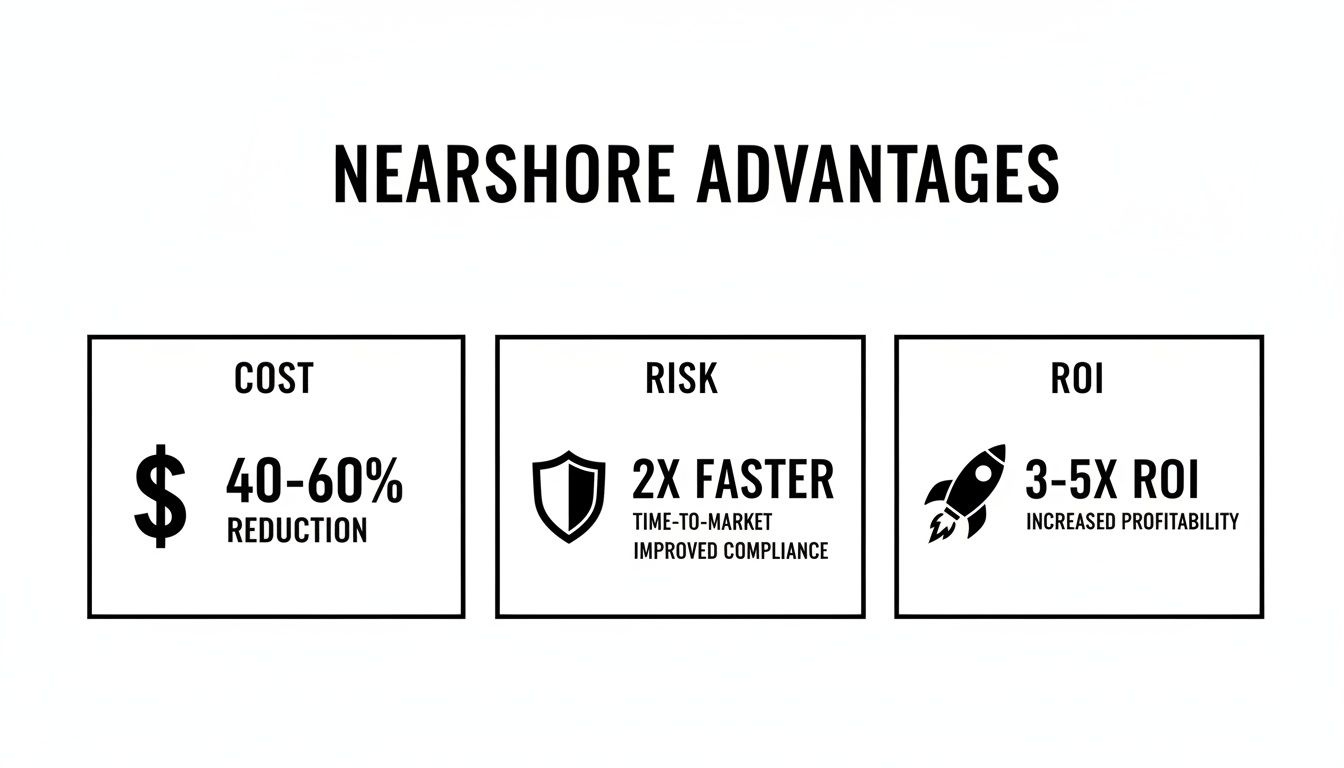
This visual breaks down how nearshoring strategically balances lower costs with reduced operational risk to deliver a much stronger ROI.
Project-Based Work: The Turnkey Solution
The Project-Based model is the most hands-off of the three. You define the project scope, lay out the requirements, and list the deliverables, and your nearshore partner runs with it. They manage the entire development lifecycle—planning, execution, testing, and deployment—all for a fixed price.
This is your best bet for well-defined, shorter-term projects with clear start and end dates. If you need a specific mobile app, a website redesign, or a particular software module built without tying up your internal team in day-to-day management, this model delivers predictable results on a set budget. The key, of course, is to have your requirements locked down from the get-go to avoid scope creep.
Choosing the right engagement model is the first real step toward building a powerful nearshore team. At TekRecruiter, we specialize in helping you deploy the top 1% of engineers anywhere, plugging the perfect talent into the model that makes the most sense for you. Let's find the elite engineers to drive your vision forward.
How To Choose Your Nearshore Development Partner

Picking a partner for nearshore software development services is a lot more than a line item in your procurement process. You're not just buying a service; you're bringing a team into the fold that will live and breathe your product's journey. A glossy portfolio and a sharp price tag are just table stakes.
The real work is digging past the sales pitch. You need to find a partner whose technical skills, operational maturity, and cultural DNA genuinely sync with yours. Get it wrong, and you’re looking at missed deadlines, mounting technical debt, and a whole lot of frustration. But when you get it right, that partnership becomes a massive force multiplier for your business.
Assessing Deep Technical Expertise
Anyone can talk a good game about technology. Execution is what matters. You have to verify a team's technical depth with practical, hands-on assessments. Standard interview questions just don't cut it when your product's performance hangs in the balance.
Here’s how to put their skills to the test:
Live Coding Challenges: Ditch the theoretical questions. Give them a real problem from your world and watch them code a solution live. This tells you everything about their problem-solving instincts, coding style, and how they handle pressure.
Code Review Scenarios: Hand them a piece of code—bonus points if it has some subtle bugs or architectural flaws—and ask for a review. Their feedback will reveal their eye for detail, grasp of best practices, and ability to communicate complex ideas clearly.
Architectural Whiteboarding: Ask their senior engineers to sketch out a system architecture for a new feature. This is a powerful way to gauge their big-picture thinking, understanding of scalability, and knowledge of modern design patterns.
Evaluating Processes And Compliance
Brilliant engineers can be completely hamstrung by chaotic processes. Your partner needs a mature operational framework that guarantees quality, security, and predictability. This is what separates professional-grade agencies from cobbled-together teams.
A partner's project management methodology and security posture are not just formalities—they are the foundation upon which successful, scalable, and secure software is built.
Look for hard evidence that they take structured development and security seriously:
Project Management Methodologies: Do they really run Agile or Scrum, or are they just throwing the words around? Ask for concrete examples of their sprint planning, daily stand-ups, and retrospectives. How do they actually handle scope creep and shifting priorities?
Security and Compliance: In a world of constant digital threats, security is absolutely non-negotiable. Check their certifications. Are they SOC 2 or ISO 27001 compliant? Make them walk you through their data handling policies and how they manage regulations relevant to your industry, like GDPR or HIPAA. For a detailed guide on building your remote team, this proven playbook for hiring remote developers is a great resource.
Uncovering Talent Strategy
At the end of the day, a partner is only as good as its people. High turnover can absolutely cripple your project's momentum, forcing you to waste time re-onboarding new faces. That's why you have to dig into their talent acquisition and retention strategy. To go deeper on this, check out our article on nearshore staffing for CTOs and HR leaders.
The stability of your nearshore team hinges on their ability to attract and keep top-tier talent. Don’t be afraid to ask some pointed questions:
"What is your average employee retention rate?"
"How do you support the professional development of your engineers?"
"Can we speak with some of your long-term developers?"
Finding the right partner is the single most critical step you'll take. TekRecruiter is a technology staffing and recruiting firm that helps innovative companies deploy the top 1% of engineers, anywhere in the world. We connect you with elite, pre-vetted nearshore talent so you can build with confidence.
Frequently Asked Questions
When you're looking into nearshore software development, a few practical questions always come up. How do you handle security? What’s it like to get a new team up and running? Let’s cut through the noise and get straight to the answers you need.
How Is My Intellectual Property Protected?
This is non-negotiable. Protecting your IP isn't an afterthought; it’s baked into the process from day one with any partner worth their salt. You own what you pay for, period.
Here’s how it's secured:
Ironclad NDAs: The first step is always a comprehensive Non-Disclosure Agreement. This isn't just with the firm; it covers every single developer who touches your project.
Secure Infrastructure: Think encrypted data storage, tightly controlled network access, and strict permissions. Your digital assets should never be exposed.
Clear Contractual Ownership: Your Master Services Agreement (MSA) needs to be crystal clear: all work product and IP created belong exclusively to you. There should be no ambiguity.
What Does the Onboarding Process Actually Look Like?
A good onboarding process isn't about throwing people into the deep end. It’s a structured ramp-up designed to get your new team members contributing meaningful work, fast.
It usually breaks down into three phases:
Technical Onboarding: This is where the team gets access to your codebase, development environments, and critical tools. They’ll get a rundown of the existing architecture and your coding standards so they can hit the ground running.
Cultural and Process Integration: Your new developers get introduced to how your team works. This means getting them into your Jira or Trello boards, adding them to your Slack or Teams channels, and including them in daily stand-ups and sprint planning.
The First Project: They’ll typically start with a smaller, well-defined task. This isn't busy work—it's a strategic first step that lets them learn the workflow and build momentum before diving into the bigger, more complex challenges.
How Are Cultural Differences Managed?
Let's be honest, one of the biggest draws of nearshore software development services is that cultural friction is already minimal. You’re often working with people who share similar business ethics and communication styles.
Still, you don’t just hope for the best; you actively build a single, unified team culture.
The point isn't to erase cultural differences. It's to build a shared team culture founded on respect, clear communication, and a laser focus on the same goal.
Here’s how you make it work:
Set Clear Communication Rules: Document everything. What’s the expected response time on Slack? How should feedback be delivered? When everyone knows the rules of engagement, things just run smoother.
Encourage Real Connection: Don't let the relationship be purely transactional. Virtual coffee chats, team-building activities, or even just non-work-related channels help build the personal trust that’s crucial for high-performing teams.
Unify Around Shared Goals: When everyone is aligned on the product vision and celebrating wins together, geography becomes irrelevant. You’re not an "in-house team" and a "nearshore team"—you're just the team.
Finding the right engineers is the most critical step in building a powerful nearshore team. TekRecruiter is a technology staffing and recruiting and AI Engineer firm that allows innovative companies to deploy the top 1% of engineers anywhere. Let us connect you with the pre-vetted, elite talent you need to accelerate your roadmap. Build your world-class team with us by visiting https://www.tekrecruiter.com.
Comments