_edited.png)
What Is Penetration Testing and How It Protects You
You've got a scan report on your desk, the dashboard is green enough to feel reassuring, and yet your team still can't answer the one question that matters, “Can an attacker string these weaknesses together and get somewhere serious?” That gap is where penetration testing earns its keep. It's not a prettier vulnerability scan, it's a controlled attempt to prove what an attacker could really do, and whether your organization can stop it.
A lot of leaders treat security testing like a checklist. Find the flaw, mark it fixed, move on. Real attackers don't work that way. They look for combinations, weak assumptions, and paths through systems that looked harmless in isolation, which is why simulated attacks matter before you even define the term.
Table of Contents
Why Simulated Attacks Matter Before You Define Them - Why the breach story matters more than the scan result
What Penetration Testing Really Means - Controlled break-in, not reckless hacking
Black Box White Box and Grey Box Testing Explained - Choosing your penetration testing model
How Penetration Testing Works From Planning to Reporting - The workflow leaders should expect
Penetration Testing vs Vulnerability Assessment Tools and Metrics That Matter - What to measure and why
When to Test Compliance Drivers and the Shift to Continuous Validation - When leaders should schedule tests
How to Source Top Pentesters and Put Results to Work With TekRecruiter - What top pentesters should prove in interview
Why Simulated Attacks Matter Before You Define Them
A clean vulnerability scan can still leave an organization exposed. The reason is simple: isolated findings do not show how an attacker might connect weak points into a working path. A penetration test is built to test that path under realistic constraints, the way a locksmith checks whether a door, latch, and frame all fail together.
The business value is evidence. A scanner may confirm that a weakness exists, but it rarely shows whether someone can chain a low-severity information disclosure with an overly permissive IAM role and then move laterally into production data. That is the difference CTOs need to see when they ask what is penetration testing. They are not buying a list of issues, they are buying proof of whether controls hold when an intruder behaves like an intruder.
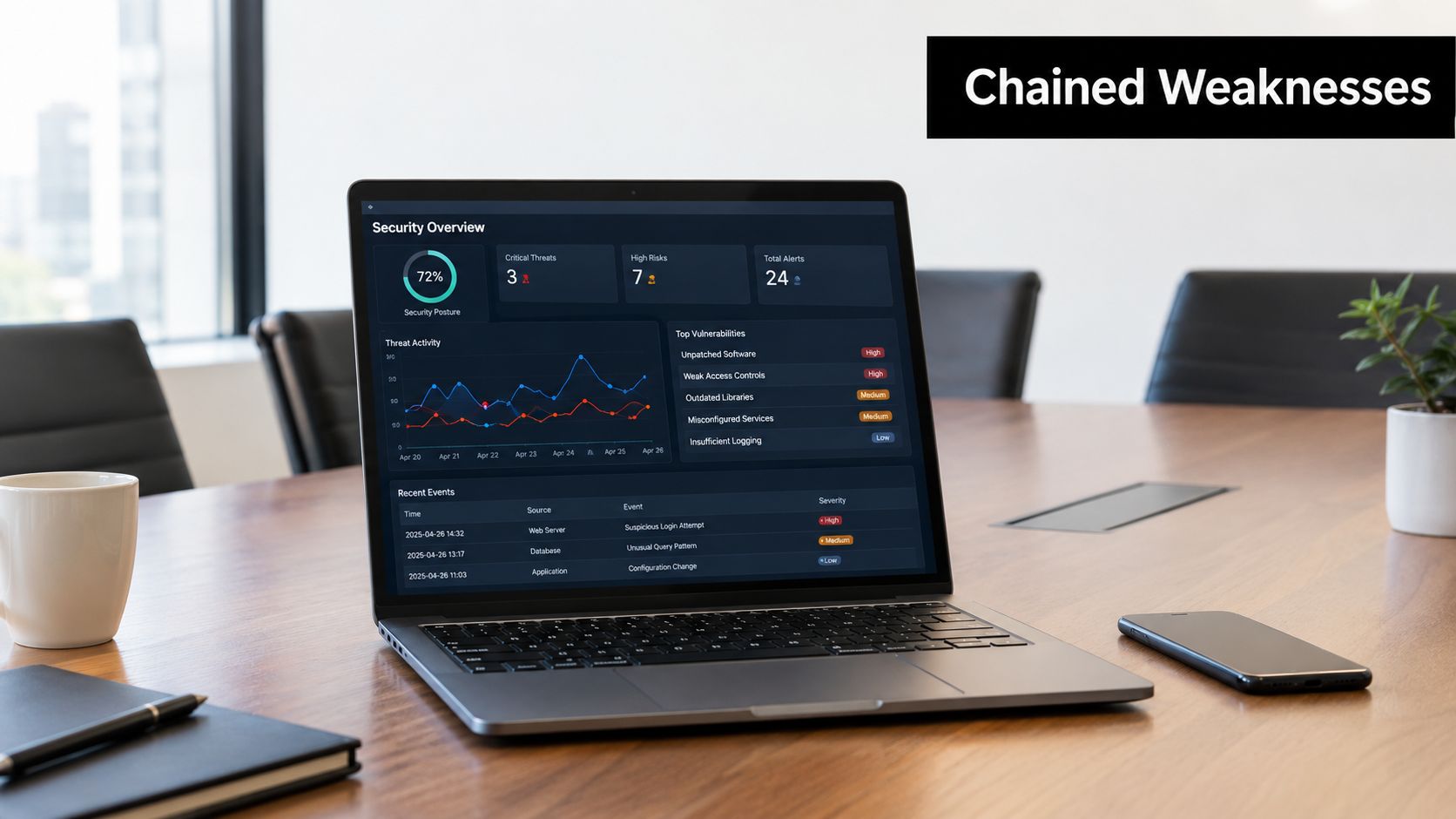
Why the breach story matters more than the scan result
A vulnerability report can look tidy while real risk remains unchanged. That is why simulated attacks matter. They answer the harder question, what happens when someone combines the overlooked pieces, tests the controls, and pushes toward a business asset instead of stopping at the first alert.
Practical rule: If your security review stops at detection, you still do not know whether an attacker can turn those issues into access.
That changes how leaders hire, too. A strong pentester is not just someone who finds flaws, but someone who can explain attack paths, show which assumptions failed, and separate noise from remediation priorities. Good methodology matters because it tells you whether a finding is a one-off bug or a repeatable route into the environment.
If you already use vulnerability assessment as part of your program, pentesting asks a different question. It checks whether the weaknesses are exploitable in context, whether the controls break under pressure, and what should be fixed first.
What Penetration Testing Really Means
A release is approaching, and the security team has found several weaknesses. The CTO now faces a practical decision: which issues can be exploited, which controls would stop an attack, and which pentester can produce evidence the engineering team can act on?
Penetration testing answers those questions through controlled simulated attacks. Evaluators mimic real-world attackers and, within agreed constraints, try to circumvent or defeat security features in an application, system, or network, according to NIST's glossary on penetration testing. Effective tests may chain weaknesses across systems, gaining access that no individual flaw would provide. The purpose is therefore to validate exploitability and attack paths, not enumerate CVEs.
A vulnerability scan may enumerate CVEs and open ports without validating exploitability. A penetration test follows the evidence, tests whether access can be gained, and examines how far that access reaches.
Controlled break-in, not reckless hacking
The “controlled” part matters as much as the “break-in” part. The tester works inside an agreed scope, with limits on time, targets, techniques, and business impact. Those constraints protect operations while making the result relevant to the risk leaders need to understand.
A pentest only has value when the test conditions resemble the risk you care about.
The deliverable should show whether an attack path worked, what the tester could reach, which assumptions failed, and what defensive change would interrupt the path. That evidence gives engineering leaders a remediation order and gives hiring managers a way to assess testing quality. Strong pentesters explain their reasoning, distinguish a reproducible route from an isolated observation, and connect technical findings to affected assets.
A what a vulnerability assessment actually covers overview provides useful context for separating assessment from exploitation. The distinction matters because organizations can otherwise purchase a list of findings when they need proof that a weakness leads to access.
The core takeaway is simple. Penetration testing is proof under constraints. It turns “this may be weak” into evidence about whether the weakness can become access, what stopped the tester, and what the organization should fix first.
Black Box White Box and Grey Box Testing Explained
A security leader choosing a pentest model is also choosing what evidence the team will receive. The tester's starting knowledge affects realism, coverage, cost, and the kinds of blind spots the engagement can expose. It should therefore match both the risk question and the remediation decision that follows.
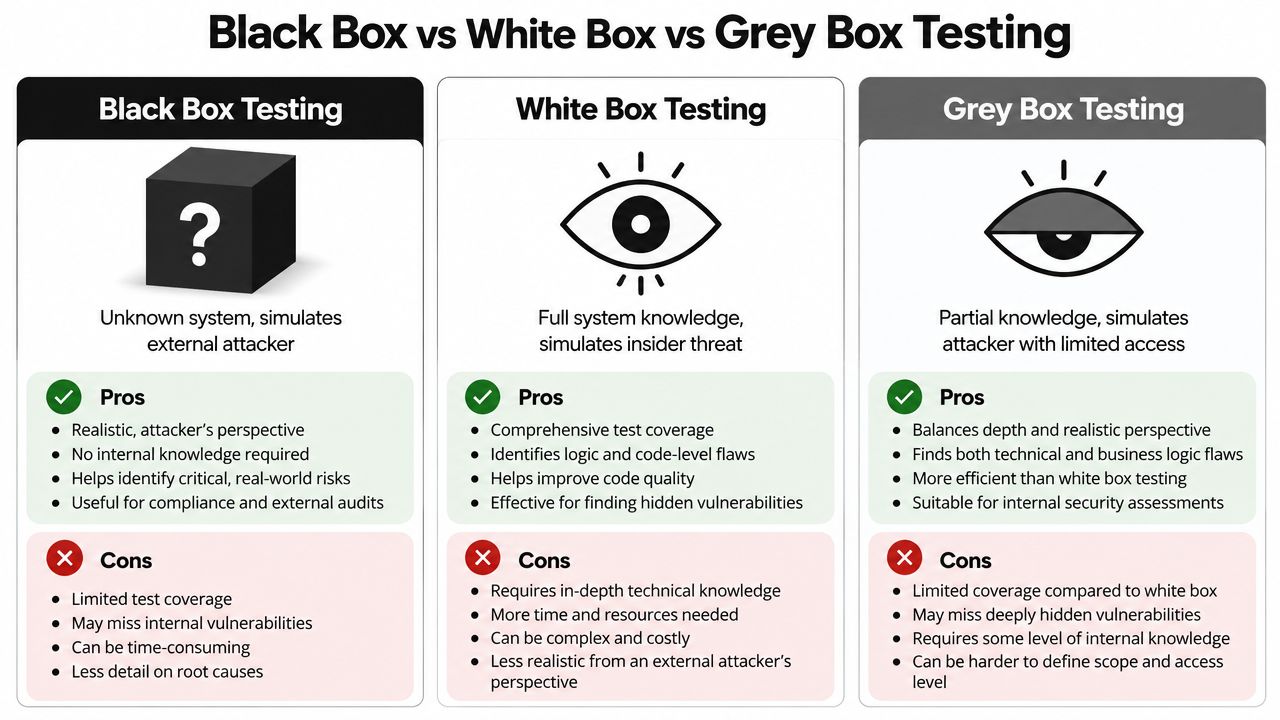
Choosing your penetration testing model
Testing Model | Attacker Knowledge | Best For |
|---|---|---|
Black box | Little or no prior knowledge | External exposure, realism, and testing what a stranger can find |
White box | Full knowledge of systems and code | Deep review, complex applications, and finding issues hidden in architecture or logic |
Grey box | Partial knowledge | A balanced test of realistic access plus deeper validation |
Black box testing resembles an outside attack. The tester begins with public signals, login surfaces, and exposed services, showing what a stranger could discover. That realism helps assess external exposure, but limited context can leave deeper application logic unexplored.
White box testing gives the tester broad visibility into architecture, source code, and credentials. It supports close examination of logic paths, hidden assumptions, and internal trust boundaries. The trade-off is reduced similarity to an outsider's starting position, although the findings may give developers clearer remediation steps.
Grey box testing starts with partial knowledge or access. It can represent an adversary who obtains limited credentials or information, then tests whether that foothold can expand. For mature teams, this often balances realistic attack conditions with meaningful validation of internal controls.
The model also affects how you evaluate a pentester. Strong candidates can explain why a method fits the threat, what its blind spots are, and how they would turn evidence into a remediation order. Method choice is part of the hiring signal, not merely a procurement detail.
Decision rule: Choose the model that matches the risk you're trying to understand, not the model that sounds toughest in a procurement meeting.
For a staffing and delivery perspective, security testing guidance on white-box and black-box approaches offers a concise comparison. Align the model with the question the engagement must answer.
How Penetration Testing Works From Planning to Reporting
NIST SP 800-115 frames penetration testing as a four-phase process, planning, discovery, attack, and reporting. In that model, planning sets the rules and objectives, discovery gathers information and analyzes vulnerabilities, attack attempts exploitation to confirm weaknesses, and reporting documents findings and remediation guidance. A PTES-based view goes further and treats pentesting as a seven-phase methodology, which the OWASP Web Security Testing Guide describes as a fixed sequence rather than a single activity. You can see that structure in the OWASP penetration testing methodology reference.
The workflow leaders should expect
The first phase is planning. Scope, authorization, timing, and success criteria are defined. If that part is sloppy, the rest of the engagement can become noisy, risky, or useless.
Then comes discovery, where the tester gathers information and narrows the attack surface. After that, the attack phase tries to prove whether those weaknesses can be used in practice. Reporting closes the loop with evidence, impact, and the recommended fix.
PTES breaks that into more detail, including pre-engagement, intelligence gathering, vulnerability assessment, exploitation, post-exploitation, reporting, and retesting. That extra granularity helps teams understand that pentesting is a sequence of decisions, not an ad hoc hack.
A strong deliverable is a remediation-focused technical report that records what was tested, how it was tested, what was discovered, what was exploited, what an attacker could achieve, and how to fix it. The useful part is not just the narrative, it's the evidence behind each finding and the retesting path that follows.
Reporting standard: If the report doesn't make it easy for engineers to fix the issue and prove the fix worked, the test hasn't finished its job.
Teams that connect testing to delivery often fold that workflow into DevSecOps integration, because value shows up when findings move into engineering work, not when they sit in a PDF.
Penetration Testing vs Vulnerability Assessment Tools and Metrics That Matter
A vulnerability assessment and a penetration test are related, but they're not the same job. One is about finding and classifying weaknesses. The other is about proving whether those weaknesses can be exploited in a realistic path to impact. A scanner can be enough when you need inventory, broad coverage, or a quick check after a change. A pentest is the better fit when you need to know whether a flaw can become a real incident.
The difference also changes the tools you choose. Vulnerability assessments lean on scanners, configuration checks, and asset discovery. Penetration tests may use the same discovery tools, then add manual exploitation, chained attack paths, and post-exploitation validation.
For a practical industry perspective, security testing insights from Technovation LLC provide a helpful comparison between the two approaches.
What to measure and why
Metrics matter, but only if they map to the actual job.
Findings count, useful for tracking volume, but not enough by itself.
Exploitability evidence, which shows whether a weakness is theoretical or practical.
Attack path depth, which helps teams understand how far a tester got through chained weaknesses.
Remediation status, because closed findings matter more than discovered findings.
A good pentest report should also include evidence for each finding, prioritized remediation, and retesting guidance. That aligns with expert reporting guidance that focuses on what was tested, what was exploited, and how to fix it.
Don't let the team celebrate discovery alone. Discovery without closure is just a cleaner backlog.
The wrong metric makes teams optimize for quantity. The right metric tells you whether engineering fixed the thing, whether the fix held, and whether the same path still exists after the next release.
When to Test Compliance Drivers and the Shift to Continuous Validation
A release can pass its checklist and still expose a new attack path. That is why testing cadence should follow meaningful change, not an annual date on the compliance calendar. The 2025 Cobalt report describes a shift toward continuous validation, while remediation remains slow: a median 37 days to resolve serious pentest findings, only 48% of vulnerabilities remediated overall, and 81% of organizations believing their security posture is strong, as reported in State of Pentesting 2025.
These figures point to a management decision. A pentest is valuable when leaders can fund the fix, assign ownership, and verify that the attack path no longer works. Test frequency should therefore reflect how quickly the application, infrastructure, and identity model change.
AI adds another reason to revisit the schedule. In 2025, 98% of organizations were incorporating generative AI into products, but only 66% were regularly security testing those AI products, according to Cobalt's 2025 pentesting takeaways. DORA, NIS2, and PCI DSS v4.0 are also tightening expectations. The practical meaning of what is penetration testing now includes AI behavior, cloud configuration, identity controls, and legacy applications.
When leaders should schedule tests
Schedule testing after major application changes, identity redesigns, cloud migrations, or the release of a new AI feature. Compliance deadlines remain useful triggers, but they should confirm an existing validation plan rather than create one.
Teams aligning testing cadence with audit readiness often evaluate top SOC 2 software for 2026 alongside their continuous validation roadmap. Risk management guidance for cybersecurity programs can help connect test results with business priorities, ownership, and remediation decisions.
A mature program treats each test as a feedback loop: test, prioritize, fix, retest, and check for recurrence. That sequence helps leaders judge pentesters by the quality of evidence and remediation guidance they provide, not by finding volume alone.
How to Source Top Pentesters and Put Results to Work With TekRecruiter
Hiring for pentesting is not the same as hiring for generic security work. You want people who can reason under constraints, explain risk clearly, and show how they'd prove impact without creating unnecessary disruption. The strongest signal is usually not a résumé keyword list, it's how the candidate talks through attack paths, reporting discipline, and remediation priorities.
When you're sourcing externally, look for evidence of authorization discipline, report quality, and practical communication with engineers. When you're staffing internally, you need people who can work across security, platform, and application teams without turning every finding into a turf war. For a broader market view, cybersecurity staffing with GENTY recruitment shows how specialist sourcing is often framed around role fit and compliance pressure.
What top pentesters should prove in interview
Scope discipline, they should explain how they avoid testing outside permission boundaries.
Technical depth, they should discuss how they validate findings, not just identify them.
Reporting clarity, they should turn technical evidence into remediation language that engineers can use.
Retest mindset, they should treat closure as part of the job, not an afterthought.
A strong candidate should also understand why authorization matters. A legally meaningful penetration test requires explicit approval, written scope, defined permission boundaries, permitted techniques, testing windows, and escalation contacts. Without that, testing can drift into unauthorized access territory.
TekRecruiter is a technology staffing and recruiting firm that sources engineering talent, including cybersecurity engineers, through engineer-to-engineer evaluation. If you need pentesters or adjacent security talent, that model can help you staff the work without forcing your team to sort through weak signals.
If you need help staffing penetration testing, remediation, or the security engineering roles that sit around them, TekRecruiter can help you find the right people and move faster. Visit TekRecruiter to connect the hiring side of this work to the security outcomes your team needs.
Comments