_edited.png)
Writing a Position Description That Attracts Top Engineers
You've posted a Senior Software Engineer role, shared it across the usual channels, and now the applications are arriving. The problem is that most candidates have the wrong experience, while the engineers you want can't tell what they'd own, what success looks like, or whether the compensation matches the scope. Your team spends hours screening people who were never a fit.
That outcome usually starts before sourcing. Writing a position description is a conversion problem, not a clerical exercise. The document must attract capable engineers, help the right people self-select, and give interviewers enough detail to test the capabilities that matter. It also needs to remain clear, inclusive, and defensible after the candidate applies.
Table of Contents
Lay the Foundation With Purpose Scope and Structure - Define why the position exists - Map permanent work into broad areas - Record controls and keep the document current
Turn Responsibilities Into Measurable Outcomes and Interview Signals - Write the outcome before the method - Add an early success horizon
Define Must Have Versus Nice to Have Skills Without Degree Filters - Use capability language
Optimize Length Salary Bands and Compliance for More Applicants - Treat transparency as design
Why Most Position Descriptions Fail Engineering Hires
A weak engineering description usually contains familiar phrases: “work in a fast-paced environment,” “collaborate cross-functionally,” and “build scalable solutions.” None of those statements tells a senior engineer what system they'll change, which decisions they'll own, or what trade-offs they'll face.
The hiring manager then gets a predictable result. Applicants may have impressive résumés, but they're optimized for keywords rather than the actual problem. Recruiters schedule screens without enough context, interviewers improvise questions, and strong candidates leave because the role feels generic.
A useful position description does three jobs at once:
Sells the problem: Explain why the work matters and what makes it technically difficult.
Defines the boundary: State what the engineer owns, what another team owns, and where decisions go.
Signals success: Describe the outcomes the person should drive, not just the activities they'll perform.
Practical rule: If a qualified engineer can't explain the role's hardest problem after reading the opening paragraph, the description isn't ready.
The distinction matters because a job requisition authorizes hiring, while the external position description persuades a candidate to engage. Keep the approval details and candidate-facing story connected, but don't confuse their purposes. TekRecruiter's explanation of what a job requisition is provides useful context for separating internal authorization from candidate communication.
Senior engineers also inspect language for warning signs. An inflated list of every framework the company has ever used suggests the team hasn't decided what the role requires. A degree requirement with no connection to the work suggests screening convenience rather than engineering judgment. A long list of responsibilities with no priorities suggests the new hire will inherit every unresolved problem.
The target isn't maximum applicant volume. It's qualified attention from engineers who understand the problem and want to own it.
Lay the Foundation With Purpose Scope and Structure
Start before writing bullets. A disciplined sequence forces the hiring team to agree on the role before marketing it.
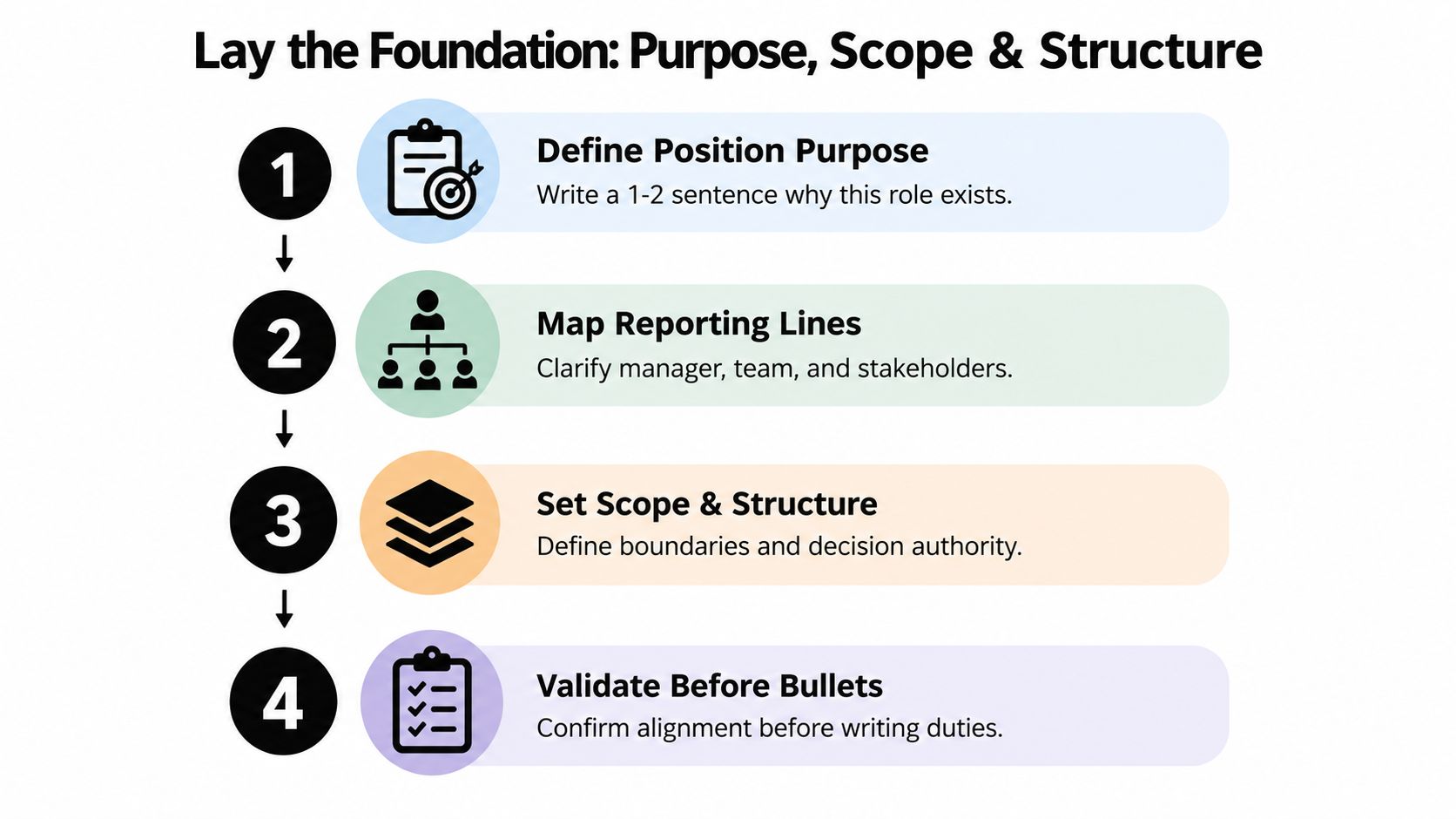
Define why the position exists
Write a short purpose statement that answers three questions: What business or technical problem exists? Why does this position need to exist now? What will be different when the person succeeds?
“Build and maintain software” is a task description. “Own the reliability work that allows the payments platform to support expanding transaction volume without slowing product delivery” gives the candidate a reason to care and a starting point for evaluation.
Then identify the reporting line. Name the manager, the immediate team, and the stakeholders who influence the work. Engineers want to know whether they'll report to an engineering manager, product leader, or technical executive, and whether architecture decisions are local or shared.
Map permanent work into broad areas
List the duties assigned to the position on a continuing basis. Separate them from temporary projects, emergency coverage, and tasks the team hopes someone might eventually handle. Use observable work units such as “design service interfaces,” “review production changes,” or “analyze model performance,” rather than traits such as “be strategic” or “show ownership.”
Group related duties into broad responsibility areas. Public-sector guidance recommends a fixed sequence of purpose, permanently assigned duties, responsibility groups, time allocation, qualifications, working conditions, supervision, and special requirements before HR review. A university position-description writing guide also recommends plain language, duty-focused writing, and roughly 10 or fewer broad responsibility statements to keep the document usable and auditable.
Estimate the proportion of work devoted to each area. The estimate doesn't need false precision. It should show whether the role is primarily feature development, platform reliability, technical leadership, customer work, or operational response.
For a broader planning model, a best content brief example 2026 can help your team clarify audience, intent, structure, and desired action before drafting. The same discipline applies to a position description. Decide what the reader must understand before adding detail.
Record controls and keep the document current
Document decision authority, supervision, working conditions, travel or location expectations, and special requirements. The U.S. Office of Personnel Management defines a position description through its major duties, responsibilities, and supervisory relationships, and says a narrative description normally includes an introduction, major duties and responsibilities, and controls over the position in its position-description guidance.
That record matters beyond publishing. The U.S. Equal Employment Opportunity Commission treats a written description prepared before advertising or interviewing as evidence of essential functions under the ADA. Review the document when the role changes, not only when the company reopens hiring. A stale description creates confusion for candidates and weakens internal alignment.
For a concrete technical example, compare the structure with TekRecruiter's production engineering job description guide. The title and technology will vary, but the underlying questions remain stable: why the role exists, what it controls, and what work belongs to it.
Turn Responsibilities Into Measurable Outcomes and Interview Signals
Responsibilities describe activity. Outcomes describe the change the engineer must create. Top candidates respond to the second because it lets them judge the problem, the level of ownership, and the quality of the engineering environment.
Take “improve platform performance.” It's too broad to guide hiring. A stronger version might say, “Identify the highest-impact latency constraints in the customer-facing API, establish a measurement baseline, and lead improvements with product and infrastructure partners.” That statement still leaves room for discovery, but it tells the candidate what evidence the team expects.
Write the outcome before the method
For each responsibility, define the result first. Then add constraints, collaborators, and the evidence that will show progress.
Software engineering: Replace “build backend services” with an outcome involving service boundaries, reliability, maintainability, or delivery flow.
AI engineering: Replace “develop machine-learning models” with an outcome involving evaluation quality, production integration, monitoring, or responsible deployment.
DevOps and SRE: Replace “manage infrastructure” with an outcome involving deployment safety, observability, incident learning, or platform usability.
Data engineering: Replace “create pipelines” with an outcome involving trusted data products, lineage, freshness, or access for downstream teams.
Don't promise a fixed result the engineer can't control. If product priorities, data quality, or legacy architecture constrain the work, say so. Credibility beats an impressive but unrealistic promise.
Add an early success horizon
Describe what good progress looks like during the early phase of the role, then describe the longer-term direction. The point isn't to create a rigid performance contract. It's to show how the manager will judge progress.
A useful pattern is:
Understand: Map the current system, users, risks, and constraints.
Improve: Deliver a meaningful change that proves judgment and execution.
Scale: Establish practices, architecture, or automation that compounds the team's effectiveness.
Each outcome should have an interview signal. If the description says the engineer will improve service reliability, ask candidates to explain how they'd establish a baseline, choose leading indicators, and balance reliability work against feature delivery. If the role includes model deployment, discuss evaluation design, failure modes, data drift, and rollback decisions.
The signal should be observable in conversation or work review. It shouldn't require a trivia quiz about a preferred tool.
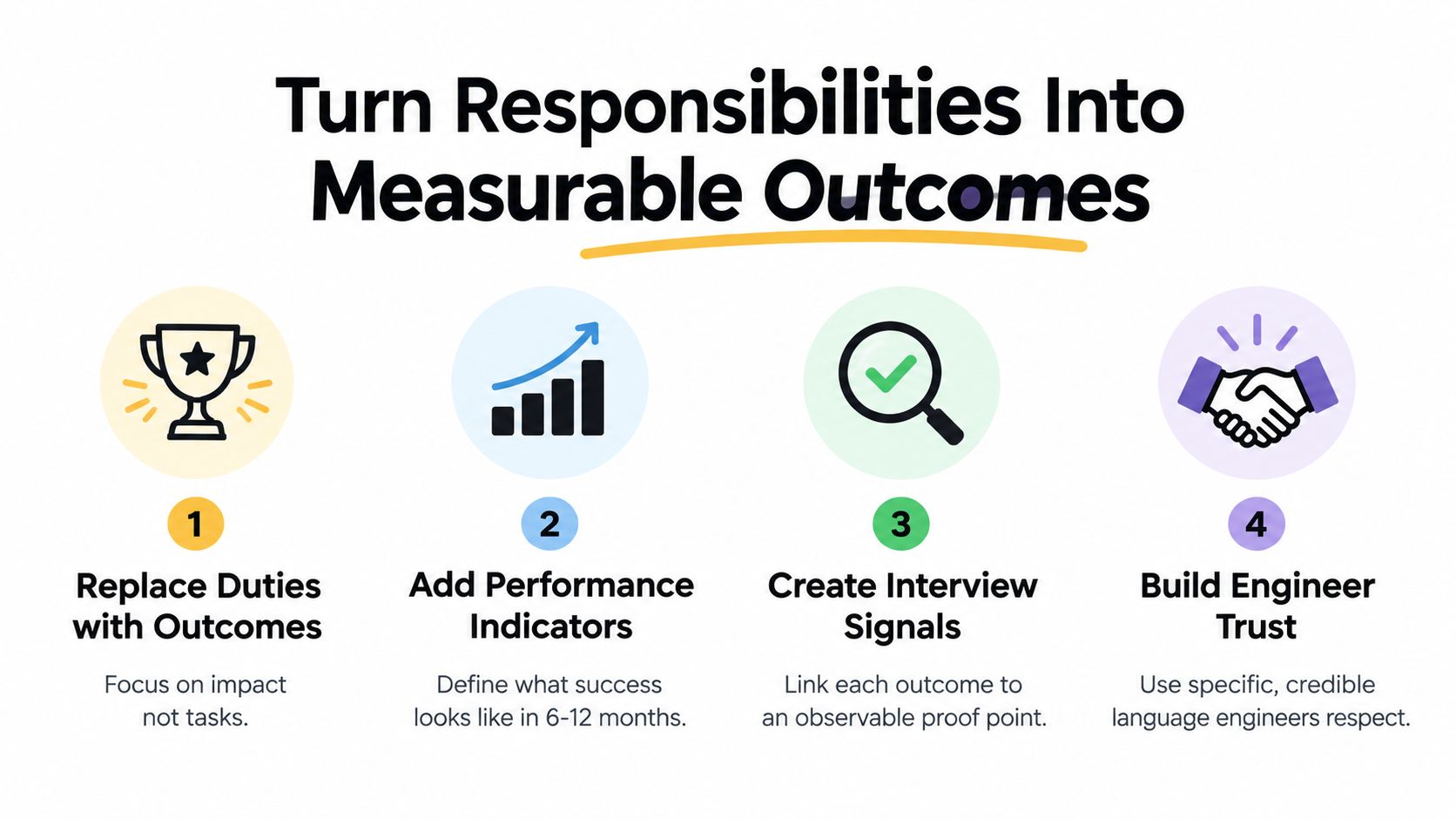
An interview process becomes more consistent when every major outcome maps to a question, a technical discussion, or a work sample. Candidates can assess the role, while interviewers use the same rubric instead of chasing whichever technology appears on a résumé. Teams tracking quality-of-hire metrics can also connect the original outcomes to later performance reviews.
Use the following video as another prompt for discussing how responsibilities, outcomes, and evaluation should connect.
The strongest descriptions make the interview feel like a continuation of the job, not a separate obstacle course. When candidates recognize the problems they'll discuss in the work itself, both sides get a better signal.
Define Must Have Versus Nice to Have Skills Without Degree Filters
The most important distinction in a technical description is capability versus familiarity. A must-have skill is necessary to perform an essential function. A nice-to-have skill may reduce ramp time, but its absence shouldn't automatically eliminate a capable engineer.
That distinction supports skills-first hiring. A 2024 Indeed analysis found that 52% of U.S. job postings had no formal education requirement, compared with 48% in 2019. The share requiring at least a four-year degree fell from 20.4% to 17.8%, and college-degree mentions declined in 87% of occupational groups analyzed, according to the published analysis. The same report notes that 64% of U.S. adults don't hold a bachelor's degree, so degree-first wording can exclude relevant talent before anyone evaluates their engineering ability.
Use capability language
Write “can design and operate distributed services with clear failure handling” instead of “has a computer science degree.” Write “can explain model evaluation choices and production trade-offs” instead of requiring a narrow academic background. If a certification, license, or specific education level is necessary, state why it connects to the work.
Essential functions need the same discipline. The EEOC says employers should consider whether the position exists to perform the function, how many other employees can share it, and the expertise required. ADA-focused guidance also points to whether everyone in the role performs the duty, whether previous employees performed it, whether removing it would alter the position, and whether failing to perform it would have significant consequences. Document the time spent on each function where relevant, as recommended in this ADA job-description guidance.
Use a simple interview framework:
Requirement | Must Have or Nice to Have | How to Verify in Interview |
|---|---|---|
Design reliable services | Must Have | Discuss a system the candidate designed, including failure modes and trade-offs |
Operate production systems | Must Have | Explore incident response, observability, and follow-up improvements |
Experience with your exact cloud provider | Nice to Have | Ask how the candidate would transfer comparable platform knowledge |
Experience in your industry | Nice to Have | Test domain learning through a realistic scenario |
Specific degree | Usually unnecessary unless job-related | Verify the underlying technical capability through evidence and discussion |
Avoid replacing degree filters with arbitrary years-of-experience filters. Years can provide context, but they don't prove judgment, depth, or ownership. Set the bar through artifacts, decisions, and technical reasoning.
For a deeper explanation of this approach, TekRecruiter's guide to what skills-based hiring means offers a relevant reference. The hiring team still needs standards. The improvement comes from measuring the standards directly.
Optimize Length Salary Bands and Compliance for More Applicants
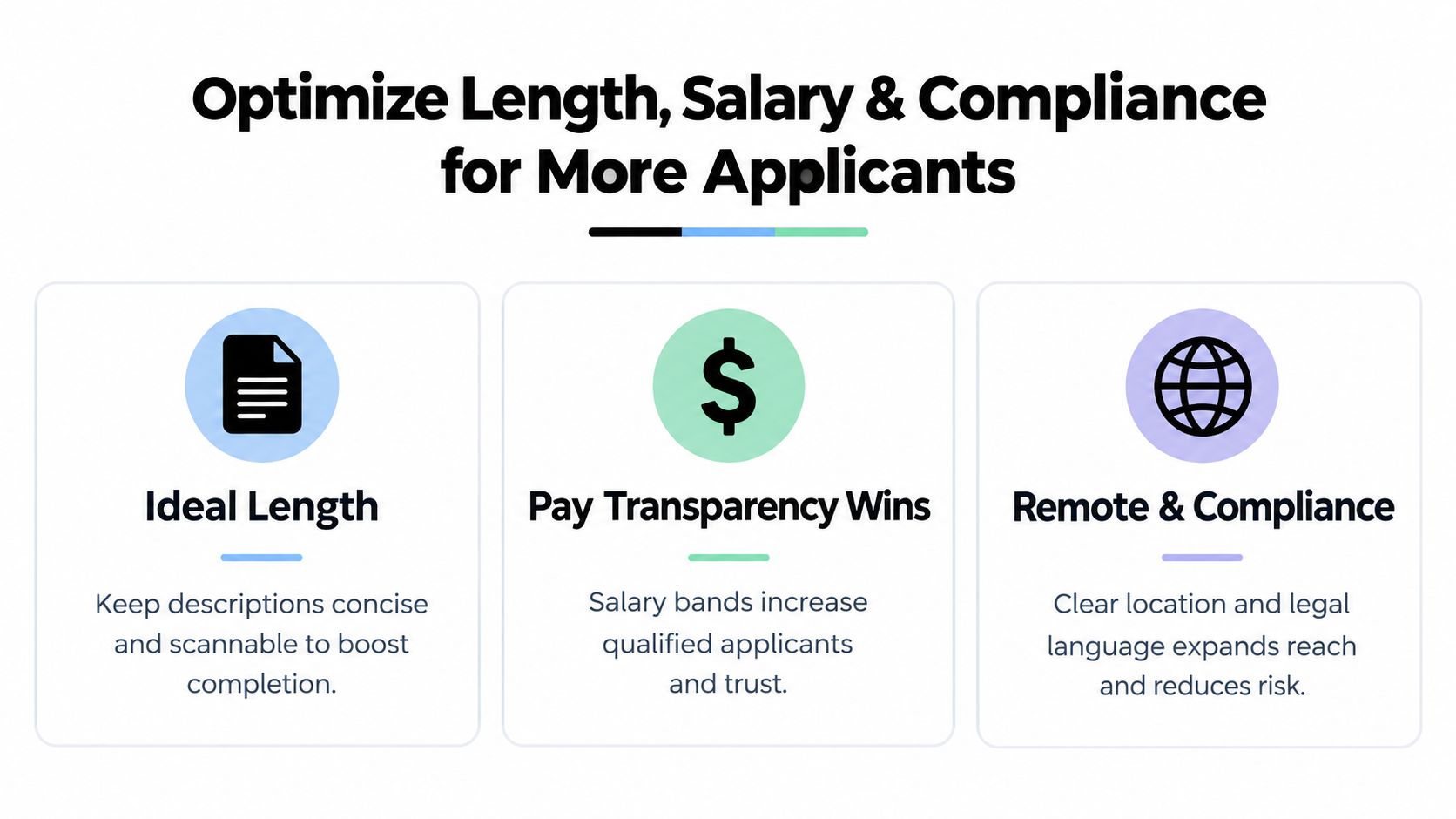
A position description can be accurate and still fail because candidates won't finish reading it. Appcast reported in 2023 that descriptions between 201 and 400 words produced apply rates of about 8% to 8.5%, while descriptions under 200 words produced roughly 4.5%. Descriptions above 401 words saw declining apply rates, and those above 701 words reliably fell below 5%, according to the reported job-description data.
LinkedIn talent research found that posts between 1 and 300 words generated 8.4% more applications per view than average, also cited in that source. The practical conclusion is straightforward. Put the role, location, compensation, outcomes, and must-have skills where a candidate can scan them quickly. Move company history and secondary context lower.
Treat transparency as design
Pay information is now part of the candidate experience and, in several markets, part of the legal requirement. New York State requires employers with 4 or more employees to disclose compensation ranges in job advertisements. Minnesota requires employers with 30 or more employees to include a starting salary range plus a general benefits description. Jersey City requires employers with 5 or more employees to include both a pay range and benefits information in every job posting, as summarized in this pay-transparency overview.
Don't hide the range at the bottom. Place compensation near the role summary and explain what affects placement within the range, such as scope, skills, location, or level. List the benefits that materially affect a candidate's decision without turning the description into a policy manual.
Remote and hybrid language belongs beside compensation because location can affect pay, tax, employment setup, and compliance. State whether the role is onsite, remote, or hybrid. For distributed hiring, identify required time-zone overlap, travel expectations, and any geographic limits your counsel has approved. Don't promise “work from anywhere” if the company can't employ someone in every jurisdiction.
The description should be concise, but never at the expense of information candidates need to make an informed decision. Delete slogans before deleting scope, pay, location, or working conditions.
Final Checklist and How TekRecruiter Helps You Hire Faster
Before publishing, read the description as both a candidate and an interviewer. If either audience has to guess, revise it.
Title accuracy: Use the title qualified engineers recognize and search for.
Purpose clarity: Explain why the position exists and what problem it addresses.
Scope boundaries: Name ownership, reporting lines, stakeholders, and decision authority.
Outcome language: Describe meaningful results, not an inventory of tasks.
Skills hierarchy: Separate must-have capabilities from useful background.
Interview signals: Connect each major outcome to an observable technical discussion.
Essential functions: Document fundamental duties and the reasoning behind their essentiality.
Location and pay: State work arrangement, compensation range, benefits, and relevant jurisdiction language.
Readability: Remove inflated requirements, vague culture language, and unnecessary company history.
Review process: Ask the hiring manager, an engineer who does comparable work, and HR or legal reviewers to confirm accuracy.

A strong document improves the handoff between recruiting and engineering, but it doesn't replace technical vetting. TekRecruiter is a technology staffing and recruiting and AI Engineer firm that uses engineer-to-engineer conversations across software engineering, AI engineering, DevOps, SRE, cloud, data, Salesforce, ERP, and cybersecurity roles. Its delivery options include direct hire, staff augmentation, on-demand access to a bench of 30,000+ pre-vetted engineers, and managed services.
That model fits teams that need technical judgment before the interview loop begins. Candidates discuss architecture, production constraints, and real engineering decisions instead of completing generic tests that may not reflect the role.
Use TekRecruiter when your position description needs to become a qualified hiring pipeline, not just a polished document. Their direct-hire, staff-augmentation, on-demand, and managed-services teams can help you reach and evaluate top engineers anywhere, including AI and other specialized technical roles.
Comments