_edited.png)
Kubernetes Consulting Services for Seamless Cloud Native Adoption
Kubernetes consulting is all about bringing in specialized expertise to help you design, build, and run complex container platforms.The right guidance helps companies ship products faster, get a handle on cloud spending, and sidestep the common traps that come with going cloud native.
Why Top Engineering Teams Rely on Kubernetes Consulting

Adopting Kubernetes is like bolting a jet engine onto your engineering organization. It gives you incredible power for speed and scale, but it’s definitely not a simple plug-and-play upgrade. Without specialized mechanics—engineers who truly understand its complex inner workings—you’re risking turbulence, operational drag, and maybe even a catastrophic failure.
This is exactly why sharp CTOs and VPs of Engineering turn to Kubernetes consulting.
These services go way beyond just getting the platform running. They dig into core business problems. The goal isn’t just to “use Kubernetes,” but to turn it into a strategic asset that actually delivers measurable value. And the market is exploding because of it.
The global Kubernetes Solutions market hit USD 2,056.45 million and is expected to reach USD 7,574.09 million by 2032. That's a compound annual growth rate of 17.7%. You can dig into more market insights on Congruence Market Insights.
This kind of growth points to a hard truth: running Kubernetes well at scale demands a deep bench of specialized talent that most companies just don't have in-house.
Closing the Critical Talent Gap
One of the biggest drivers for seeking outside help is the relentless shortage of qualified Kubernetes experts. Finding, hiring, and keeping engineers with proven cloud native experience is a massive headache. For many, addressing the IT skills gap and the outsourcing imperative becomes the only practical way to get access to that specialized knowledge quickly.
A consulting partner gives you that access instantly. They help your team:
Move Faster: Instead of losing months trying to build skills from scratch, you can start executing on your roadmap right away.
Dodge Expensive Mistakes: Good consultants have seen it all. They know how to avoid the common configuration blunders that open up security holes and send your cloud bill through the roof.
Level Up Your Own People: The best engagements involve collaboration and knowledge sharing, which builds your internal team's skills for the long haul.
Navigating Complexity for Business Value
It's not just about the talent gap; Kubernetes itself is brutally complex. Getting it right means having a deep understanding of networking, storage, security policies, and observability. A misstep in any one of these areas can wipe out the platform's benefits, leaving you with an unstable, insecure, and overpriced system.
This is where the real value of a good kubernetes consulting service shines. They're your strategic guide, helping you build a platform that’s resilient, secure, and cost-effective—one that’s built to serve your business goals.
To help clarify how these services translate to real-world impact, let's break down the core problems they solve.
Core Problems Solved by Kubernetes Consulting
Consulting Service | Business Problem It Solves | Strategic Outcome |
|---|---|---|
Assessment & Strategy | "We don't know where to start or if Kubernetes is even right for us." | A clear roadmap, validated business case, and alignment between tech and business goals. |
Architecture & Design | "We need a platform that scales securely and won't break the bank." | A resilient, multi-cloud or hybrid architecture built for security, compliance, and cost. |
Migration & Modernization | "Our old monolith is slowing us down, and we need to move to microservices without downtime." | A smooth, phased migration that accelerates release cycles and reduces operational overhead. |
Platform Engineering | "Our developers are bogged down with infrastructure tasks instead of writing code." | An internal developer platform (IDP) that boosts developer productivity and enforces standards. |
SRE & Operations | "Our system is unstable, and we're constantly fighting fires." | Improved reliability, automated incident response, and a proactive approach to operations. |
Ultimately, expert guidance ensures your investment in this powerful technology delivers a clear and undeniable return.
A Look Inside Kubernetes Consulting Offerings
So, what do Kubernetes consultants actually do? Beyond the big-picture strategy, a real partnership with a Kubernetes consulting service gives you a concrete roadmap. It’s a series of tangible services designed to take you from that initial spark of an idea to a fully operational, high-performance platform. These aren’t just one-off technical tasks; they are structured engagements built to solve specific business problems at every stage of your cloud-native journey.
That journey, surprisingly, often starts not with building, but with understanding. Think of it as a pre-flight check before launching a complex mission. You absolutely need to know your current capabilities, potential risks, and the exact destination before you take off.
Foundational Assessment and Strategic Planning
Before you can even think about building a resilient Kubernetes platform, you need a solid blueprint. This is the foundational phase where consultants dig into your existing infrastructure, applications, and team skills to figure out if you're even ready for a cloud-native shift. It’s all about answering the big question: "Where are we now, and where do we really need to go?"
This stage usually involves:
Readiness Assessment: A deep dive into your current tech stack, operational processes, and team expertise to pinpoint strengths and, more importantly, critical gaps.
Application Portfolio Analysis: A thorough review of your applications to decide which ones are easy wins for containerization and which ones will need a much heavier lift to modernize.
Strategic Roadmap Development: Creating a practical, phased plan that lays out clear milestones, what resources you'll need, and what business outcomes to expect.
Getting this planning phase right prevents incredibly costly missteps down the road. It ensures your Kubernetes initiative is tied to business objectives from day one, instead of turning into a cool-but-useless science project with no clear ROI. The demand for this kind of expert guidance has exploded as more companies realize just how complex this transition is.
In fact, Kubernetes consulting has become an essential part of the market, identified as a critical offering for any organization moving to Kubernetes-based environments. As more businesses turn to Kubernetes to streamline their operations and scale up, the need for specialized consulting has surged right along with it.
Architecture Design and Implementation
Once the strategy is locked in, it's time to start building the platform. This is where expert architects design a Kubernetes environment that is secure, scalable, and doesn’t break the bank. It's not about spinning up a default cluster and calling it a day; it’s about engineering a production-grade system that’s built specifically for your workloads and compliance needs.
For many organizations, a key part of this is getting help with specialized projects like Heroku to Kubernetes migration services to evolve their infrastructure. This hands-on phase is all about the nitty-gritty: setting up networking, storage, CI/CD pipelines, and observability tools to create a single, resilient ecosystem.
Advanced Platform Engineering and SRE
With a solid foundation in place, the focus shifts to optimization and operational excellence. The advanced consulting offerings are all about making the platform not just functional, but a true force multiplier for your engineering teams. This is where you start to see the real business value of Kubernetes come to life.
A well-architected platform empowers developers to ship code faster and more reliably. The goal is to create an "internal developer platform" (IDP) that abstracts away the underlying complexity, allowing engineers to focus on building features, not wrestling with infrastructure.
This top-tier of services includes:
Platform Engineering: Building "paved roads" for developers with standardized tools, automated workflows, and self-service capabilities. This is a massive productivity booster and enforces best practices across the entire organization.
Site Reliability Engineering (SRE) and Operations: Bringing in SRE principles to guarantee uptime and performance. This means setting up sophisticated monitoring, defining clear Service Level Objectives (SLOs), and automating incident response to make sure the platform is always there for your customers. For a closer look at this model, you might find our guide on considering DevOps as a Service solutions interesting.
Security Hardening and Compliance: Proactively locking down the platform by implementing strict access controls, network policies, and container security scanning. Consultants help you navigate tough compliance standards like SOC 2, HIPAA, or PCI DSS, making sure your environment is audit-ready and protected from threats.
From the first assessment to ongoing optimization, Kubernetes consulting offerings give you a structured path to success. Each service builds on the last, creating a stable, secure, and developer-friendly platform that drives real business results.
Choosing the Right Engagement Model for Your Needs
Finding a top-tier Kubernetes consultant is a great first step, but how you structure the partnership is what really sets you up for success. The right engagement model is the difference between a quick transactional fix and a strategic partnership that delivers real, lasting value. It's about aligning the consultant's expertise with your specific business goals, your timeline, and the team you already have in place.
Get this wrong, and you’re staring down the barrel of misaligned expectations, scope creep, and a budget that balloons out of control. Let's break down the common models so you can make a smart call for your engineering team and your bottom line.
Staff Augmentation: Bridging Skill Gaps
Think of staff augmentation as bringing in a specialist surgeon for a tricky procedure. You have a capable team, but you need a specific, high-level skill set that you just don't have in-house. This model is perfect when you need to embed one or more Kubernetes experts directly into your existing team to fill a knowledge gap or add some serious horsepower to a critical project.
The biggest win here is direct control and seamless integration. The augmented engineers report to your managers and work shoulder-to-shoulder with your full-time employees, adopting your company's culture and workflows. This is ideal for projects where deep institutional knowledge is non-negotiable. If you're weighing your options, you can learn more by exploring our guide on staff augmentation versus outsourcing and which model fits you.
The catch? The responsibility for project management and the final outcome still rests entirely on your shoulders. You're hiring for skills, not a guaranteed result.
This decision tree gives you a simple way to think about where to start—from assessing your current environment to building and securing your new platform.
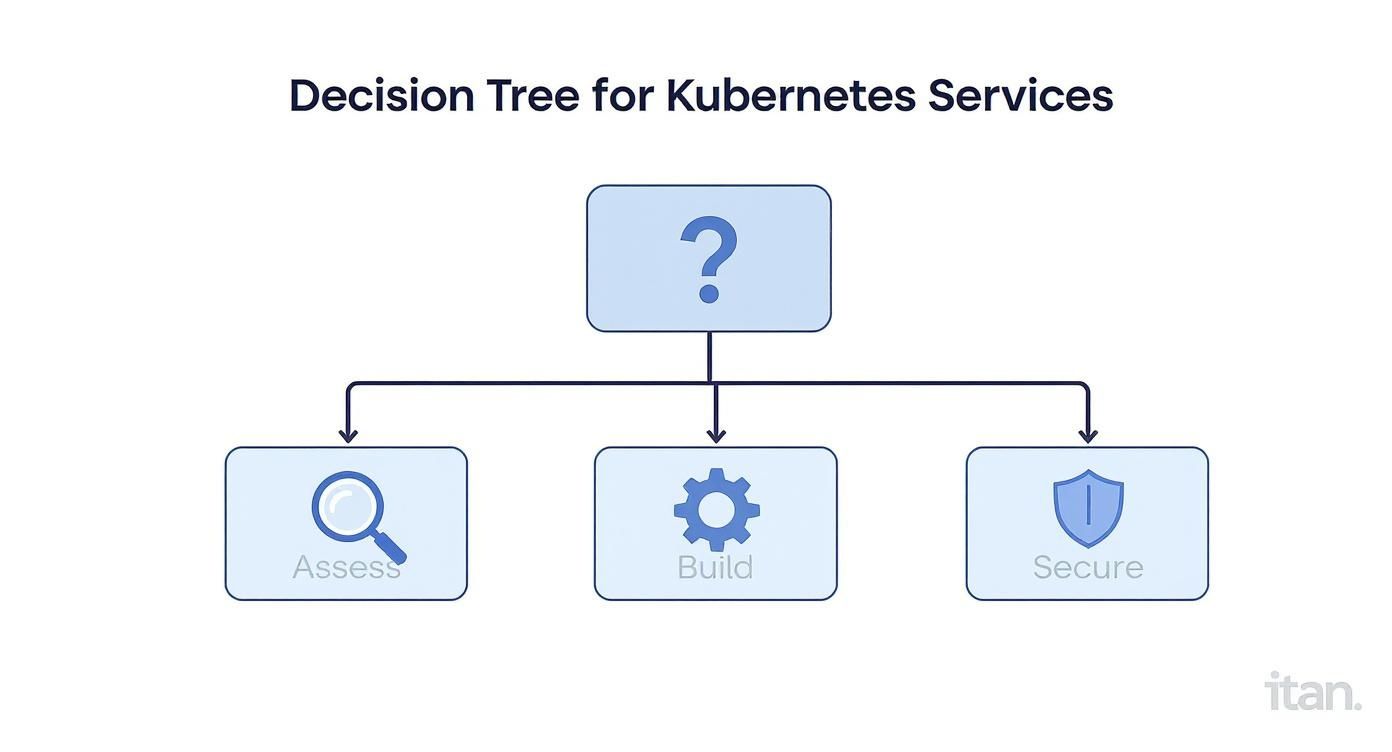
As the diagram shows, a thorough assessment is almost always the right first move before you commit to a full-scale build. It defines the scope and ensures everyone is aiming at the same target.
Project-Based Engagements: For Defined Outcomes
A project-based engagement is a totally different ballgame. Here, you're hiring a firm to deliver a specific, well-defined outcome for a fixed price. It’s like hiring a general contractor to build a house: you agree on the blueprint, timeline, and cost, and they handle everything from the foundation to the final coat of paint.
This model is your best bet for discrete projects with crystal-clear deliverables, such as:
A complete cloud migration from a legacy system to a new Kubernetes cluster.
The design and rollout of a secure, production-ready internal developer platform.
A comprehensive security audit and hardening of your existing environment.
The main advantage is predictability. You lock in the scope, timeline, and budget, which shifts most of the execution risk over to the consulting partner. The trade-off is flexibility. If your requirements change halfway through, you'll likely need a change order to adjust the scope, which can add time and cost.
Managed Services: For Long-Term Stability
Finally, a managed service model is a long-term partnership where you hand over the ongoing operation, maintenance, and optimization of your Kubernetes platform. This is like hiring a property management company for a large apartment building—they handle all the upkeep, security, and tenant issues so you don't have to.
This model is for organizations that want to focus their internal engineering talent on core product innovation, not on the day-to-day toil of managing complex infrastructure.
A managed service provider shoulders the 24/7 operational burden, taking care of everything from security patching and incident response to performance tuning and cost optimization. It provides incredible peace of mind and ensures your platform stays stable, secure, and efficient. It's the most hands-off approach, but it also requires a high degree of trust in your chosen partner.
Picking the right partnership structure isn't just an administrative task; it's a strategic decision that directly impacts the return you get on your Kubernetes investment. Each model has its place, and understanding the nuances will help you choose the one that fits your situation perfectly.
Comparing Kubernetes Engagement Models
To make the choice clearer, here’s a side-by-side comparison of the primary engagement models. Use this table to weigh the pros and cons against your organization's immediate needs and long-term strategy.
Engagement Model | Best For | Pros | Cons |
|---|---|---|---|
Staff Augmentation | Filling specific skill gaps and adding capacity to existing teams. | Direct control, deep integration with your team and culture, quick onboarding. | You retain full responsibility for project management and outcomes. |
Project-Based | Discrete projects with clearly defined scopes, timelines, and deliverables. | Predictable costs and timelines, risk is transferred to the vendor, outcome-focused. | Less flexible to scope changes, requires significant upfront planning. |
Managed Services | Offloading the long-term operational burden of platform management. | Frees up your internal team, provides 24/7 expert support, predictable operational costs. | Less direct control, requires a high level of trust in your partner. |
Ultimately, the "best" model depends entirely on your context. Are you looking for a specific skill set to help your team over a hurdle, a dedicated partner to deliver a finished product, or an operator to manage the whole thing for you? Answering that question is the first step toward a successful engagement.
Your Practical Checklist for Selecting a Kubernetes Partner

Choosing the right Kubernetes partner is more art than science, but you can’t just wing it. With so many firms claiming to offer Kubernetes consulting services, you need a way to cut through the noise and find the real experts—not just the ones riding a trend.
This isn’t a small decision. Enterprise Kubernetes adoption is through the roof, with some CNCF reports showing it as high as 96%. And with 91% of those organizations having over 1,000 employees, the demand for serious, professional guidance on large-scale projects is obvious. You can dig into more of this data by exploring Kubernetes adoption statistics from Tigera.
This checklist isn't about surface-level questions. It’s a practical guide to help you vet potential partners and make a call with confidence.
First, Vet Their Technical Chops
You have to validate their technical depth. Don’t just take their marketing slicks at face value; you need objective proof that they live and breathe the cloud native ecosystem. A truly skilled partner will have credentials that are easy to find and verify.
Here's what to look for:
CNCF Certifications: Are their engineers actually certified? Look for credentials like Certified Kubernetes Administrator (CKA), Certified Kubernetes Application Developer (CKAD), or the Certified Kubernetes Security Specialist (CKS). These aren't just fancy badges; they prove a baseline of standardized, verifiable knowledge.
Cloud Provider Partnerships: Do they have advanced partner status with AWS, GCP, or Azure? This tells you they understand the underlying cloud infrastructure inside and out, which is absolutely critical for building a platform that won't fall over.
Open-Source Contributions: Have they actually contributed back to Kubernetes or other CNCF projects? This is a huge signal. It shows they aren't just using the tech—they’re helping to build and shape it.
These credentials show that the team has put in the real work to master their craft.
Next, Scrutinize Their Real-World Experience
Certifications are a great starting point, but they don't tell the whole story. You need a partner who has been in the trenches and successfully solved the same kinds of problems you’re facing right now. This is where you dig into their track record.
Ask for specific, relevant case studies. Don't let them get away with generic success stories. You want to see examples that mirror your industry, your scale, and your exact technical goals. Look for hard, measurable outcomes—things like reduced cloud spend, better developer productivity, or a faster deployment cadence.
Don’t be shy about asking for client references. Any consulting firm that's confident in their work will be more than happy to connect you with past clients who can talk about their communication style, their process, and whether they delivered on their promises.
This is how you confirm their theoretical knowledge actually translates into practical results that matter to the business.
Finally, Assess Cultural Fit and Knowledge Transfer
Technical skill is only half the battle. The best partnerships are built on solid communication and a collaborative spirit. Remember, you're not just hiring a vendor to throw work over the wall—you’re embedding a team of experts into your organization.
Pay close attention to their communication style during your initial conversations. Do they actually listen to your concerns, or are they just pushing a pre-packaged, one-size-fits-all solution? A good partner acts as a guide, working with your team to find the right path forward.
More importantly, a key outcome of any consulting project should be leveling up your own team.
Knowledge Transfer Plan: Ask them directly how they plan to transfer knowledge to your engineers. Do they offer paired programming? What about documentation and training sessions? Get specific.
Empowerment Focus: The end goal is to make your team self-sufficient. A great partner should be trying to work themselves out of a job, leaving your team stronger and more capable than they found them.
Choosing a firm with the right experience and a collaborative mindset is the only way to ensure the partnership is smooth and the value sticks around long after the contract ends. Our guide on how to find elite DevOps consulting firms has even more insights on how to handle this vetting process.
How to Measure the ROI of Your Consulting Investment

Bringing in a Kubernetes consulting service is a major investment. It’s not just about solving a tech problem; it's a strategic move. To make sure it pays off, you have to prove its value with hard numbers, not just a gut feeling that things are "better."
A great engagement produces results you can actually measure—results that make sense to both your engineering leads and the C-suite. The trick is to define what success looks like before a single line of code is touched. You need a clear way to track progress and calculate the Return on Investment (ROI), turning technical wins into business outcomes your CFO will care about.
Identifying Key Performance Indicators That Matter
Don't get bogged down tracking every metric under the sun. Zero in on the Key Performance Indicators (KPIs) that directly tie back to efficiency, stability, and cost. These KPIs are the foundation of your business case, painting a clear before-and-after picture of the consultant's impact.
The metrics that really move the needle tend to fall into three buckets:
Speed and Agility Metrics: How fast can your team ship value? Kubernetes is supposed to speed everything up, so this is a huge one.
Stability and Reliability Metrics: Is the platform more resilient? Less downtime directly impacts revenue and customer trust. Simple as that.
Cost and Efficiency Metrics: Are you running a leaner operation? This is often the easiest win to translate into a dollar figure for your ROI calculation.
By hitting all three, you build a balanced scorecard that shows the full value of bringing in an expert.
The strongest business cases are built on a blend of speed, stability, and savings. Proving improvements in just one area is good, but demonstrating gains across the board is how you get enthusiastic buy-in for future investments.
Translating Technical Wins into Business Value
So, let's connect those buckets to specific, measurable KPIs. We need to go from abstract ideas to concrete numbers you can drop into a report.
Deployment Frequency: How often are you pushing new code to production? A top-tier consultant should help you increase this number dramatically. It’s a direct proxy for developer productivity.
Mean Time to Recovery (MTTR): When something breaks, how fast can you fix it? Slashing your MTTR from hours to minutes is a powerful sign of a more resilient platform and smarter operations.
Total Cost of Ownership (TCO): This is the bottom line. A good consultant will help you optimize cloud spend, kill off redundant tools, and cut down on operational overhead. Tracking TCO reveals the raw financial gain from your investment.
Don’t forget the cost of talent. Hiring specialized engineers is a huge expense. To see how much, check out our guide on decoding the Senior DevOps Engineer salary in 2024. It provides real-world context for weighing the cost of a consultant against a full-time hire.
Once you have these metrics, calculating your ROI is straightforward. You can quantify the value of shipping code faster, the money saved from reduced downtime, and the hard savings from a lower TCO. This data-driven approach turns a technical discussion into a clear-cut business case. It proves your investment wasn't just another line item—it was a strategic play that generated real, measurable value for the entire company.
Got Questions About Kubernetes Consulting? We Have Answers.
Even with a solid plan, it’s natural to have questions before you bring in an expert. Smart leaders want to know exactly what they’re getting into. We’ve pulled together the most common questions we hear from CTOs and VPs of Engineering to give you the straight answers you need.
No fluff here—just direct, practical information to clear up any doubts about cost, timing, and security.
How Much Is This Going to Cost?
Let’s get this out of the way: there’s no single price tag for Kubernetes consulting. The final cost comes down to how you decide to partner up. The complexity of your project, the specific skills you need, and how long you need them for are the big three factors that shape the price.
You’ll typically see a few different pricing models:
Hourly Rates: This is common for staff augmentation, where you’re essentially paying for an expert’s dedicated time.
Fixed Prices: Perfect for project-based work. The scope is clear, the outcome is defined, and the price is locked in.
Monthly Retainers: The go-to for managed services. You get ongoing operational support for a predictable monthly cost.
Bottom line: always ask for a detailed proposal. It should break down every single cost so there are no surprises. You need to know exactly where your money is going.
When Is the Right Time to Hire a Consultant?
Timing is everything. Jump the gun, and you might waste money. Wait too long, and you could be paying a fortune to fix mistakes that were easily avoidable. The best time to call in an expert is usually when you hit a specific trigger—a major business goal or a persistent pain point.
Proactively engaging a consultant before a major initiative is almost always cheaper than hiring one to clean up a mess. They help you build it right the first time, saving you from a mountain of technical debt and glaring security holes.
It’s probably time to make the call when you’re:
Planning a big cloud migration and can’t afford any downtime.
Struggling with platform instability, and your team is stuck in a cycle of firefighting and burnout.
Needing to ship features faster, but your infrastructure is a constant bottleneck.
Facing a major skills gap on your team that’s holding you back from adopting modern practices.
What Security Risks Can a Consultant Actually Mitigate?
Kubernetes security is notoriously tricky. A single misconfiguration can throw the doors wide open for attackers. A good consultant doesn’t just run a checklist; they focus on hardening your entire environment by closing the critical security gaps that overworked internal teams often miss.
They’ll help you implement a real defense-in-depth strategy. It’s about building multiple layers of protection around your workloads, data, and infrastructure to defend against threats from both inside and out.
A security-focused engagement will zero in on:
Ironclad Access Control: Implementing proper Role-Based Access Control (RBAC) to enforce the principle of least privilege. No one gets access they don’t absolutely need.
Smart Network Segmentation: Using strict network policies to control traffic between pods, which limits the blast radius if a breach does happen.
Supply Chain Security: Locking down your CI/CD pipeline. This means container scanning and image signing to stop vulnerabilities before they ever get close to production.
Hardening Configurations: Methodically hunting down and eliminating insecure default settings—the low-hanging fruit that attackers love to exploit.
By focusing on these key areas, consultants help you build a platform that’s not just powerful, but resilient and secure by design.
Navigating the complexities of Kubernetes requires elite talent. At TekRecruiter, a leading technology staffing, recruiting, and AI Engineer firm, we specialize in helping innovative companies deploy the top 1% of engineers anywhere. Whether you need a strategic consultant or want to build a world-class team, we provide the expertise to turn your vision into reality. Learn how TekRecruiter can help you deploy the world's best engineers.
hi88 giúp tôi quan sát cách giao diện hỗ trợ ghi nhớ vị trí nội dung sau nhiều lần chuyển đổi. Tôi thường kiểm tra một khu vực trước, sau đó rời sang nhóm khác rồi quay lại để xem khả năng định hướng có thay đổi không. Trong quá trình sử dụng, tôi đánh giá Bắn cá, Nổ hũ và Thể thao như những điểm kiểm tra khác nhau trên trang. Mỗi nhóm được nhận diện riêng giúp tôi hình dung đường quay lại mà không cần dò toàn bộ danh mục. Khi chuyển sang Xổ số, cấu trúc tương tự tiếp tục hỗ trợ việc xác định vị trí. Nhờ cách tổ chức này, tôi dễ duy trì thói…
Sunwin khiến tôi quan tâm đến khả năng giữ mạch trải nghiệm khi người dùng khám phá nhiều thể loại liên tiếp. Tôi thường chuyển từ bắn cá sang nổ hũ, rồi quay lại game bài và Live Casino để theo dõi cách nội dung được duy trì. Điều tôi quan sát là vị trí đang sử dụng có dễ nhận biết và quá trình quay lại có giữ được sự liền mạch hay không. Khi người dùng luôn hiểu mình đang ở đâu, việc khám phá nhiều nhóm nội dung sẽ ít tạo cảm giác mất phương hướng. Tôi cũng xem xét cách thông tin được trình bày sau mỗi lần chuyển đổi để đánh giá mức độ nhất quán…
sunwin is an online platform where payment handling becomes important because deposits and withdrawals connect directly with normal account use. I usually check the available payment method, linked account information, transaction amount, and current processing status before returning to the entertainment sections. If the system clearly shows whether a request is pending, completed, or needs verification, I do not have to guess what is happening. I also prefer previous transaction records to remain easy to review. For me, the payment experience works better when each step is visible, account information is clearly separated, and users can understand the current status without moving through several pages or contacting support just to learn what happened to a request.
cm888 làm tôi để ý đến khả năng tương thích khi người dùng truy cập các khu game trên nhiều thiết bị khác nhau. Tôi thường kiểm tra bắn cá, nổ hũ, game bài và casino trên điện thoại rồi so sánh với phiên bản máy tính. Điều tôi quan sát là cách bố trí menu, danh mục và chức năng chính có được duy trì theo cùng một logic hay không. Khi thiết kế có sự đồng bộ, người dùng có thể chuyển đổi thiết bị mà không gặp nhiều khó khăn. Sự ổn định trong cách hiển thị giúp trải nghiệm trở nên linh hoạt hơn
Khi mình muốn tìm một bộ phim có thể xem trọn trong một buổi, https://phimhayok.vip/ giúp mình tập trung trực tiếp vào khu vực phim lẻ thay vì phải duyệt chung với các series dài tập. Mình thử xem một số phim hành động, tâm lý và hài để đánh giá cách nội dung được phân loại. Thông tin về thể loại, quốc gia, năm phát hành và mô tả phim giúp mình sàng lọc lựa chọn trước khi mở video. Khi muốn đổi sang tác phẩm khác, mình quay lại danh sách và tiếp tục duyệt mà không phải bắt đầu từ trang đầu. Sau vài lần sử dụng, cách tổ chức này trở nên khá dễ nhớ. Việc tách…