_edited.png)
Managed Services Meaning: A Clear Guide for Leaders
Your production system is down, alerts are piling up, and the internal team is already committed to the next release. A support vendor promises to “take care of IT,” but the proposal says little about who owns the result, how quickly incidents receive attention, or what happens when the provider misses its targets.
That confusion is the core problem behind the search for managed services meaning. Managed services aren't just outsourced labor. They're an operating agreement in which a third party takes continuing responsibility for a defined function, usually under a subscription or service-level agreement, with agreed processes, accountability, and reporting.
Table of Contents
Managed Services Meaning in Plain Language - The contract is the product
Managed Services vs Staff Augmentation and Direct Hire - Staff augmentation extends your team - Direct hire builds institutional capability
How Managed Services Actually Operate - SLAs turn expectations into operating rules - The daily loop matters more than the brochure
Why the Managed Services Market Is Growing - Complexity creates recurring demand
Managed Services Meaning in Plain Language
Many leaders treat every external technology arrangement as the same thing. A contractor, a recruitment firm, a break-fix help desk, and a managed service provider can all appear on the same purchasing list, but they transfer very different responsibilities.
In plain English, managed services means paying a provider to continuously operate, monitor, maintain, and improve a defined business or IT function. The relationship usually runs through a recurring commercial model or an SLA, rather than a one-time invoice after something breaks. This is the distinction described in Red Hat's explanation of managed IT services, which frames the model around proactive responsibility for defined technology functions.
The practical shift is from reaction to ownership:
Define the service. Specify what the provider owns, such as cloud operations, endpoint management, security monitoring, or an engineering outcome.
Set measurable expectations. Document response times, resolution targets, availability, escalation rules, reporting, and exclusions.
Run continuously. The provider monitors the environment, performs maintenance, handles incidents, and identifies recurring causes.
Review outcomes. Both sides use service reports and operational reviews to assess performance and adjust priorities.
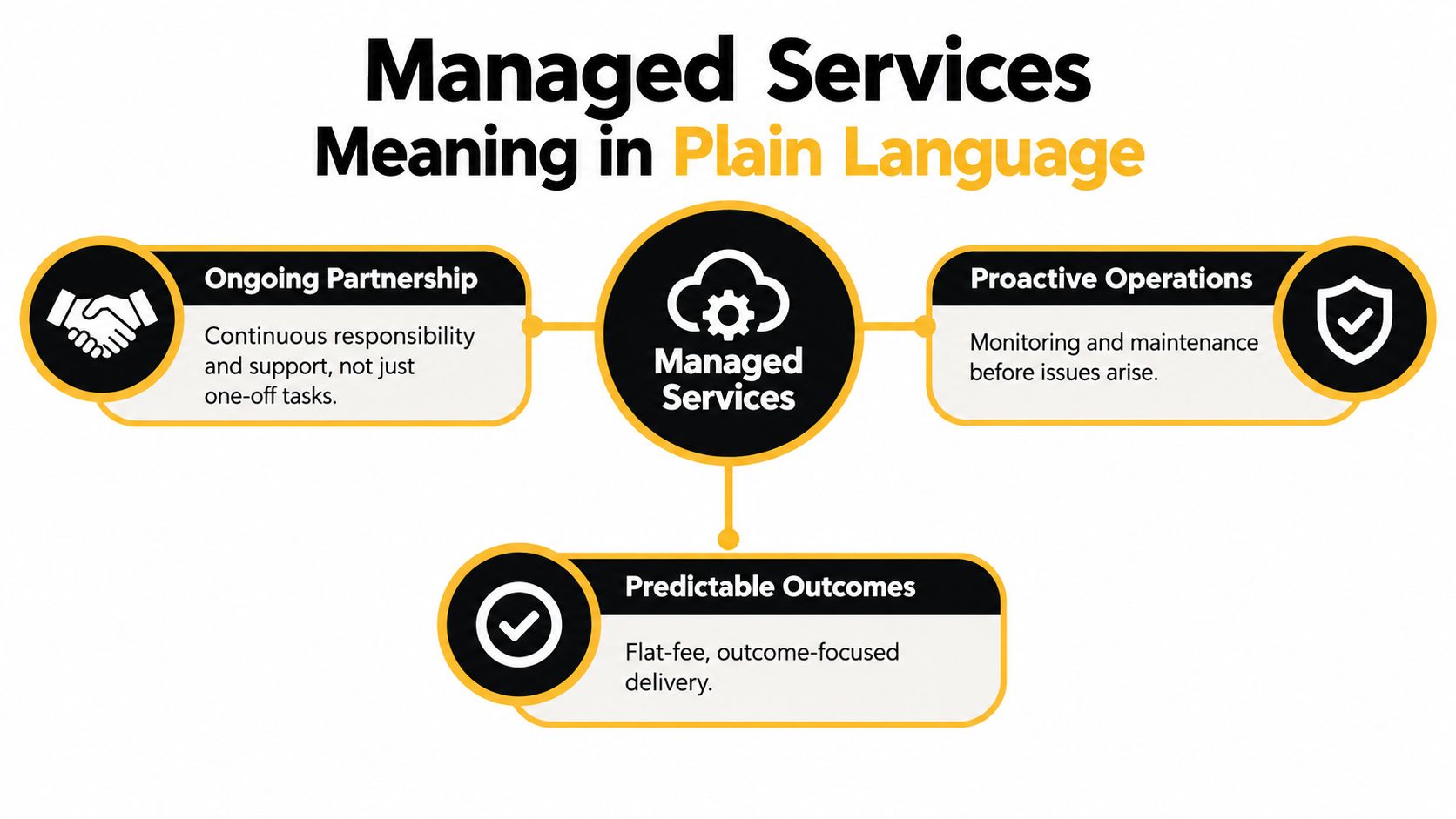
The contract is the product
A genuine managed service makes accountability visible. If a provider only supplies people and your managers decide their daily work, you're closer to staff augmentation. If the provider responds only after failure, you're buying break-fix support. Managed services move responsibility toward the provider while your organization retains governance, business priorities, and approval rights.
That doesn't mean every risk disappears. A weak scope creates disputes, vague service levels make performance difficult to challenge, and poor access controls can create security exposure. Review practical services from a managed provider with those contract questions in mind, then compare the model with managed services examples relevant to your environment.
Practical rule: If the contract doesn't define the service, the provider's responsibility, and the evidence used to measure delivery, you haven't bought accountability. You've bought hope.
Managed Services vs Staff Augmentation and Direct Hire
External help doesn't tell you which engagement model you've chosen. Ownership does.
Managed services transfer responsibility for a defined outcome. Staff augmentation adds people to your existing team, while direct hire adds permanent employees to your organization. Each model can work well, but they solve different problems.
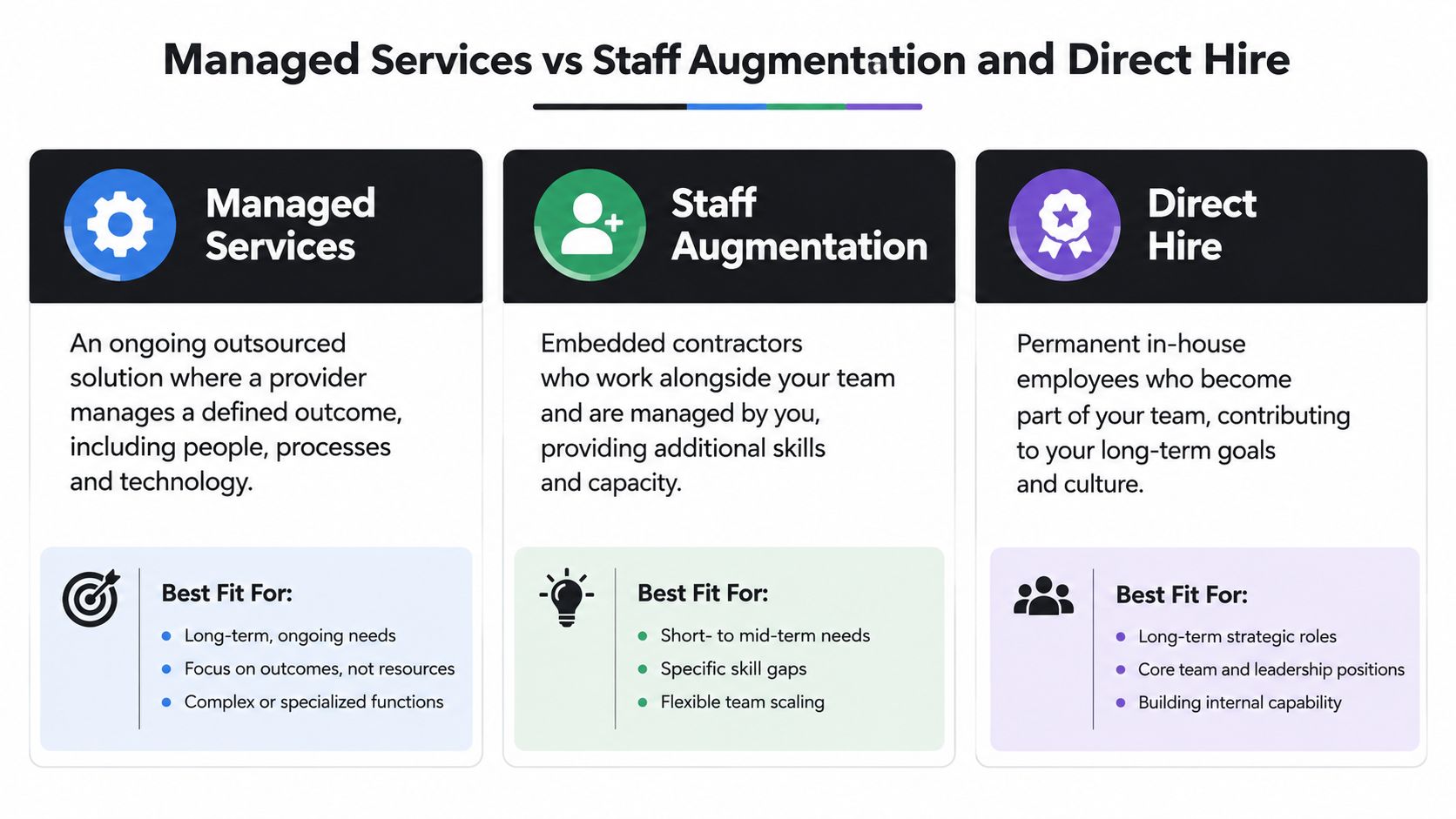
Model | Who manages the work | What you buy | Best fit |
|---|---|---|---|
Managed services | Provider manages delivery and service operations | A defined service or outcome | A recurring capability that needs predictable performance |
Staff augmentation | Your managers manage the individuals | Additional capacity or skills | A temporary gap, project surge, or specialist need |
Direct hire | Your organization manages the employee | A permanent role and long-term capability | A core function you want to own internally |
Staff augmentation extends your team
With staff augmentation, a contractor may join your sprint ceremonies, use your tools, and follow your engineering manager's priorities. You control the backlog and acceptance decisions. The staffing partner helps you access capacity, but it generally doesn't own uptime, incident response, or the success of the complete service.
That flexibility is useful when requirements are changing or the team already has strong operational leadership. It can fail when leaders expect contractors to independently own a system without giving them authority, context, or a clear internal decision-maker. A practical overview of this model appears in what staff augmentation services involve.
Direct hire builds institutional capability
Direct hire makes sense when a capability is strategically important and likely to remain inside the business. Permanent engineers accumulate architectural context, product knowledge, and relationships that are difficult to transfer through a rotating external workforce. The trade-off is slower capacity changes and full responsibility for recruiting, management, retention, tooling, and professional development.
Choose managed services when service reliability and operational accountability matter more than controlling every individual task. Choose staff augmentation when your internal team can manage delivery but needs more hands. Choose direct hire when the capability itself is a long-term competitive asset.
How Managed Services Actually Operate
The operational machinery sits behind the sales language. A provider may describe “24/7 support” or “end-to-end ownership,” but those phrases only become meaningful when translated into workflows, service levels, and evidence.
SLAs turn expectations into operating rules
An SLA should identify the events that start the clock, the severity classifications, the expected response, the expected restoration or resolution, and the escalation path. Managed service operations commonly log incident timestamps and compare them with contractual targets. Availability commitments can include 99.9% uptime, a benchmark discussed in this incident management guide for MSPs.
That number alone isn't enough. Ask whether maintenance windows are excluded, how partial outages are measured, and whether the provider reports service availability by component. A provider that can't show the calculation can't give you a dependable uptime commitment.
The daily loop matters more than the brochure
A mature service usually follows a repeatable loop:
Observe: Collect alerts, logs, health signals, and user reports.
Triage: Classify severity, assign ownership, and suppress duplicate noise.
Act: Restore service, apply an approved change, or escalate to a specialist.
Learn: Document the cause, update runbooks, and track recurring incidents.
Report: Review trends, missed targets, risks, and improvement actions.
Subscription delivery supports this continuous relationship, but it doesn't guarantee quality. The contract should define governance meetings, report contents, change approval, access management, business continuity, and exit assistance. Leaders evaluating modern processes of operations for 2026 should focus on how the provider will operate inside their actual environment, not on an abstract maturity label.
A managed team can also be part of the model. In that arrangement, an external engineering group may own a defined product, platform, or delivery stream while working against agreed outcomes. The distinction from staff augmentation remains the same: the provider manages the team and accepts responsibility for the committed scope. See managed engineering services for a related delivery model.
Why the Managed Services Market Is Growing
The market is growing because organizations are buying operational capacity and accountability, not merely access to outside workers. Managed services generally replace fragmented break-fix transactions with recurring, proactive delivery. A 2023 to 2024 KPMG outlook summarized in the managed services reference found that 62% of respondents viewed managed services as clearly distinct from traditional outsourcing, particularly because they operate as recurring, as-a-service processes.
The commercial scale reinforces that this isn't a niche purchasing tactic. The same reference reports a global managed services market of $311 billion in 2023, with annual growth of 12.6%. Those figures should be treated as market context, not as proof that every provider delivers value. Growth can reflect genuine demand, but buyers still need to test scope, controls, and performance evidence.
Complexity creates recurring demand
Cloud estates change constantly. Security monitoring requires persistent attention. SaaS portfolios, data platforms, compliance workflows, and distributed employees create operational work that doesn't end when a project ships. KPMG's state of the managed services market in 2025 describes expansion across cyber, SaaS, digital innovation, ESG, and mixed delivery models, while emphasizing a shift beyond simple cost reduction.
That shift explains why the strongest managed service proposals discuss risk, resilience, customer success, automation, and improvement plans. Cloud buyers should also understand their own cloud cost optimization levers before outsourcing financial governance. A provider can't optimize what the client hasn't agreed to measure.
When Managed Services Make Sense for Your Organization
A growing software company has a small platform team, an expanding cloud footprint, and customers who expect reliable access. The team can build product features, but every incident interrupts roadmap work. A managed cloud or SRE service may fit because the company needs a repeatable operating capability, defined escalation, and continuous attention more than it needs another individual contributor.
A different company is modernizing a legacy application. Its requirements are uncertain, architecture decisions are still forming, and product leaders expect frequent changes. Staff augmentation may work better because internal leaders need direct control over priorities and design decisions. A managed outcome contract can become restrictive if nobody can define the boundaries of delivery.
Use these questions before choosing:
Is the work recurring? Repeated operational responsibility is a stronger fit than a one-time migration.
Can you define the boundary? If you can't describe what the provider owns, pricing and accountability will remain unclear.
Do you need control or relief? Staff augmentation preserves day-to-day control. Managed services reduce the internal operating burden.
Is the capability strategic? Direct hire may be wiser when internal knowledge and long-term ownership matter most.
Can you govern the supplier? Someone inside the organization must own the relationship, approve changes, review reports, and challenge weak performance.
Managed services make sense when the organization has a stable need, meaningful operational complexity, and a willingness to manage through outcomes. They make less sense when leaders are using the label to avoid making product decisions, clarify ownership, or hire for a capability they should retain.
Building Technical Teams with TekRecruiter
Managed services and technical hiring aren't competing ideas. A company can outsource a defined operational function while building an internal team for architecture, product direction, security ownership, or customer-facing innovation. The important decision is where permanent judgment should live and which repeatable work an external provider can operate effectively.
TekRecruiter is a technology staffing and recruiting and AI Engineer firm that allows ambitious companies to deploy the top 1% of engineers anywhere. Its engineers recruiting engineers approach uses technical conversations to evaluate software engineering, AI engineering, DevOps, cloud, data, cybersecurity, product, and go-to-market talent. That signal is useful when a leader needs to distinguish someone who has operated a production system from someone whose résumé only lists the relevant tools.

The firm also describes an AI-native recruiting operation for sourcing, screening, matching, and delivering talent. Its managed services business model can sit alongside direct hire or staff augmentation when a company needs both accountable delivery and carefully selected internal capability.
A strong hiring decision still depends on the role. Hire directly for enduring ownership, augment when capacity is temporary, and consider managed delivery when the outcome and operating boundary can be specified clearly.
The following video provides another way to consider how managed services can support technical delivery decisions.
TekRecruiter helps companies access technology staffing, recruiting, and AI engineering talent for direct hire, staff augmentation, and managed delivery needs. Visit TekRecruiter to discuss the technical capability, team structure, and accountability model your organization needs next.
Comments